
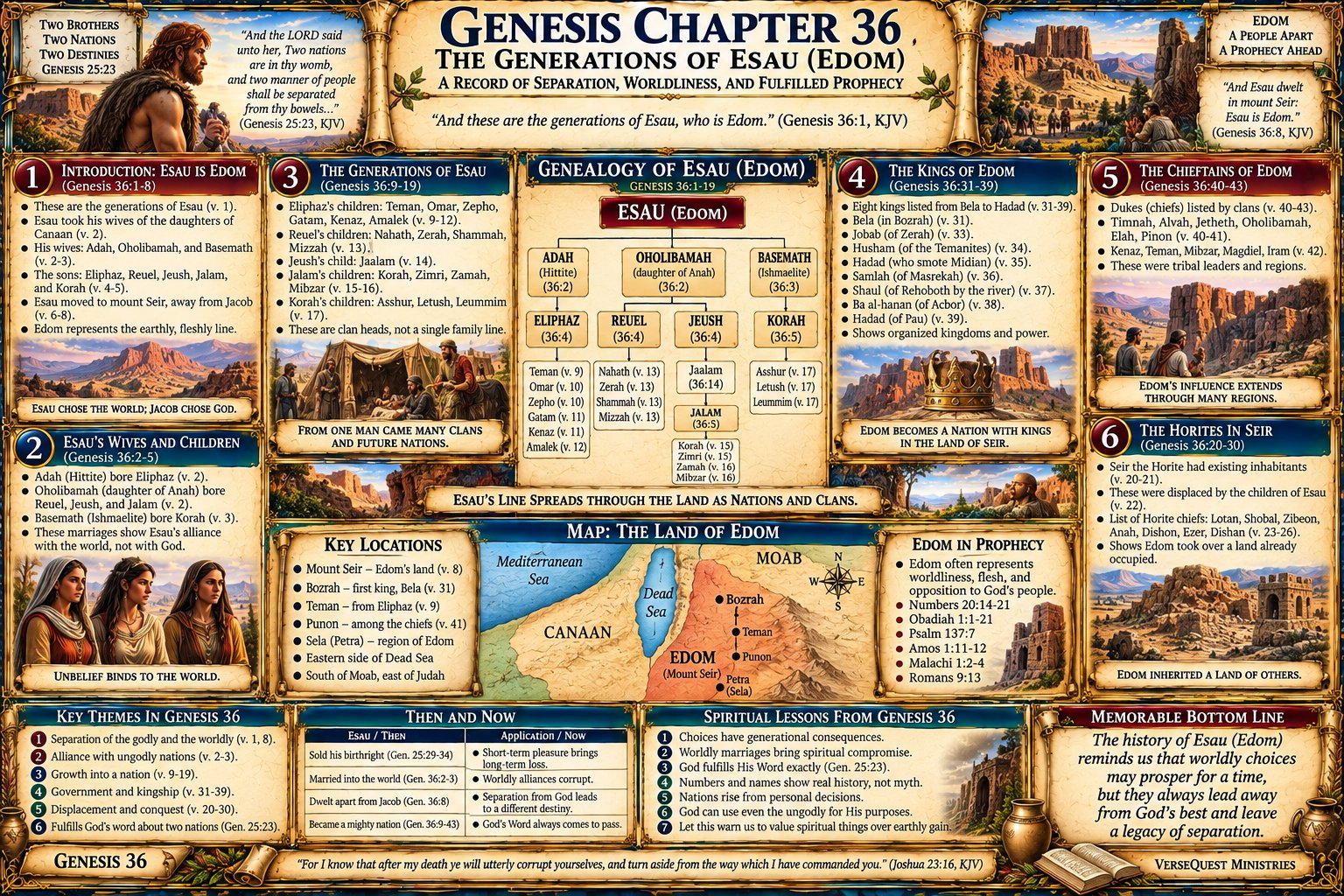
Genesis 36 – The Generations of Esau and Edom: Mount Seir, Chiefs, Kings, Horites, and the Nation Descended from Esau (KJV Bible Study Chart)
Explore Genesis 36 with this detailed KJV Bible study chart tracing Esau’s descendants and the rise of the nation of Edom in Mount Seir. Follow the family lines of Adah, Bashemath, and Aholibamah through Eliphaz, Reuel, Amalek, and the chiefs of Edom, while distinguishing Esau’s genealogy from the earlier Horite inhabitants of Seir. The chart also examines the kings who ruled Edom before Israel had a king and provides essential background for later biblical passages concerning Edom in Numbers, Deuteronomy, Obadiah, Ezekiel, Malachi, and Romans. Genesis 36 demonstrates that God’s word concerning two nations was fulfilled while the covenant line remained distinct through Jacob. Ideal for Bible study, homeschool, Sunday school, prophecy studies, Old Testament surveys, genealogy work, and historical Bible teaching.
$4.99
Description
Genesis 36: The Generations of Esau, Who Is Edom is a detailed KJV Bible study chart tracing the descendants of Esau, the development of Edom in Mount Seir, the chiefs and kings that arose from his family, and the distinction between Esau’s descendants and the earlier Horite inhabitants of the region. Though Genesis 36 is heavily genealogical, it is essential for understanding later biblical history and prophecy involving Edom.
The chapter repeatedly emphasizes the identification “Esau is Edom.” Esau takes his wives and household, leaves the land where Jacob dwells, and settles in Mount Seir because their possessions are too great for them to remain together. The separation of the brothers fulfills the earlier word given before their birth that “two nations are in thy womb.”
Esau’s principal family lines must be kept carefully distinguished. Adah, daughter of Elon the Hittite, bears Eliphaz. His sons include Teman, Omar, Zepho, Gatam, and Kenaz, while Timna, Eliphaz’s concubine, bears Amalek. Bashemath, daughter of Ishmael and sister of Nebajoth, bears Reuel, whose sons are Nahath, Zerah, Shammah, and Mizzah. Aholibamah, daughter of Anah, bears Jeush, Jaalam, and Korah.
These descendants develop into clans and chiefs, called “dukes” in the King James Bible. Genesis 36 therefore records not merely one household but the growth of Esau’s descendants into an organized people occupying Mount Seir.
The chapter also records the inhabitants of Seir the Horite. These families are distinct from Esau’s immediate genealogy, though Edom later possesses the territory. Deuteronomy 2 explains that the children of Esau displaced the Horites and occupied their land, helping connect Genesis 36 with later historical details.
Genesis 36:31–39 lists kings who reigned in Edom “before there reigned any king over the children of Israel.” This demonstrates that Edom developed a recognized political structure before Israel established its monarchy. The chapter then closes with additional Edomite chiefs according to their habitations.
Edom becomes highly significant throughout Scripture. Later passages record conflict between Edom and Israel, prophetic judgments against Edom, and the historical consequences of the two brother nations taking separate paths. Yet Genesis 36 itself should be allowed to stand first as literal genealogy and history.
The chapter demonstrates that God’s word concerning Esau was fulfilled. Esau becomes a nation, possesses territory, develops chiefs and kings, and grows into Edom. At the same time, the covenant line remains distinct through Jacob. Genesis 36 therefore preserves the historical record necessary for understanding both the relationship and the later conflict between Israel and Edom.
Genesis 36, Esau, Edom, Esau is Edom, Mount Seir, generations of Esau, Adah, Bashemath, Aholibamah, Eliphaz, Reuel, Teman, Amalek, Edomite dukes, Edomite chiefs, kings of Edom, Horites, Seir the Horite, two nations, Jacob and Esau, Edom and Israel, genealogy, fulfilled prophecy, separation of nations, biblical history
Genesis 36 interrupts the Jacob narrative to preserve the complete record of Esau’s development into Edom. The repeated statement “Esau is Edom” is essential because later Scripture frequently speaks of Edom without repeating the connection to Isaac’s elder son. The chapter therefore supplies the genealogical foundation needed for later historical and prophetic passages.
Esau removes his household from Jacob and settles permanently in Mount Seir. Genesis explains that their possessions are too great for them to dwell together. This separation develops the earlier prophecy of Genesis 25:23: two sons become two peoples and ultimately two nations.
The wives and sons must be kept carefully arranged. Adah bears Eliphaz. Eliphaz fathers Teman, Omar, Zepho, Gatam, and Kenaz, while Timna his concubine bears Amalek. Bashemath bears Reuel, whose sons are Nahath, Zerah, Shammah, and Mizzah. Aholibamah bears Jeush, Jaalam, and Korah. These family lines become chiefs within Edom.
The King James Bible uses the title “duke” for these clan leaders. The term describes tribal or regional chiefs rather than modern European nobility. Genesis 36 traces the movement from Esau’s immediate household into numerous organized clans occupying the territory of Edom.
Verses 20–30 introduce a separate genealogy: Seir the Horite and the Horite families who inhabited the land. These names should not be inserted into Esau’s direct genealogy. Deuteronomy 2:12 and 22 later explains that the descendants of Esau displaced the Horites and succeeded them in the land.
Genesis 36:31 makes an important historical observation: “these are the kings that reigned in the land of Edom, before there reigned any king over the children of Israel.” Eight kings are then named. The record shows that Edom possessed organized kingship before Israel’s monarchy was established centuries later.
The chapter concludes by listing additional Edomite chiefs according to their names, families, places, and habitations. Genesis therefore records real geography, clans, rulers, and national development rather than symbolic mythology.
Later Scripture gives Edom major prophetic significance. Numbers, Obadiah, Isaiah, Jeremiah, Ezekiel, Amos, and Malachi all address Edom at various points. Those later judgments should be interpreted from their own contexts rather than automatically reading every prophetic detail back into Genesis 36.
Genesis 36 also maintains an important dispensational distinction. Esau receives descendants, territory, leaders, and national strength, but the Abrahamic covenant line advances through Jacob. Material prosperity and political power are not the same as covenant inheritance.
The chapter ultimately demonstrates God’s accuracy in history. Esau becomes Edom exactly as Scripture records, while Jacob becomes Israel. The two brothers produce distinct nations whose later relationships can only be understood correctly when Genesis 36 is read carefully.
Genesis 36 is useful for teaching the importance of biblical genealogies, the accuracy of God’s promises concerning nations, the distinction between Esau’s descendants and Jacob’s covenant line, and the historical foundation behind later prophecies concerning Edom. It also demonstrates that material growth, political organization, and national strength do not by themselves establish covenant position. The chapter is valuable for personal Bible study, Sunday school, homeschool instruction, Bible institutes, Old Testament surveys, prophecy studies, genealogy work, historical geography, Romans 9 studies, and teaching on Israel, Edom, Amalek, and the consequences of generational choices.
King James Bible, Strong’s Concordance, Thompson Chain-Reference Bible, Treasury of Scripture Knowledge, Nave’s Topical Bible, Genesis 25–36 study notes, Jacob and Esau comparison charts, Edom genealogy charts, maps of Mount Seir and Edom, Deuteronomy 2 studies, 1 Chronicles 1 genealogies, Obadiah commentary studies, Ezekiel 35 studies, Malachi 1 studies, Romans 9 studies, Amalek Scripture studies, Israel and Edom prophecy charts, VerseQuest Genesis charts
Related products
-
Hath God Said
-
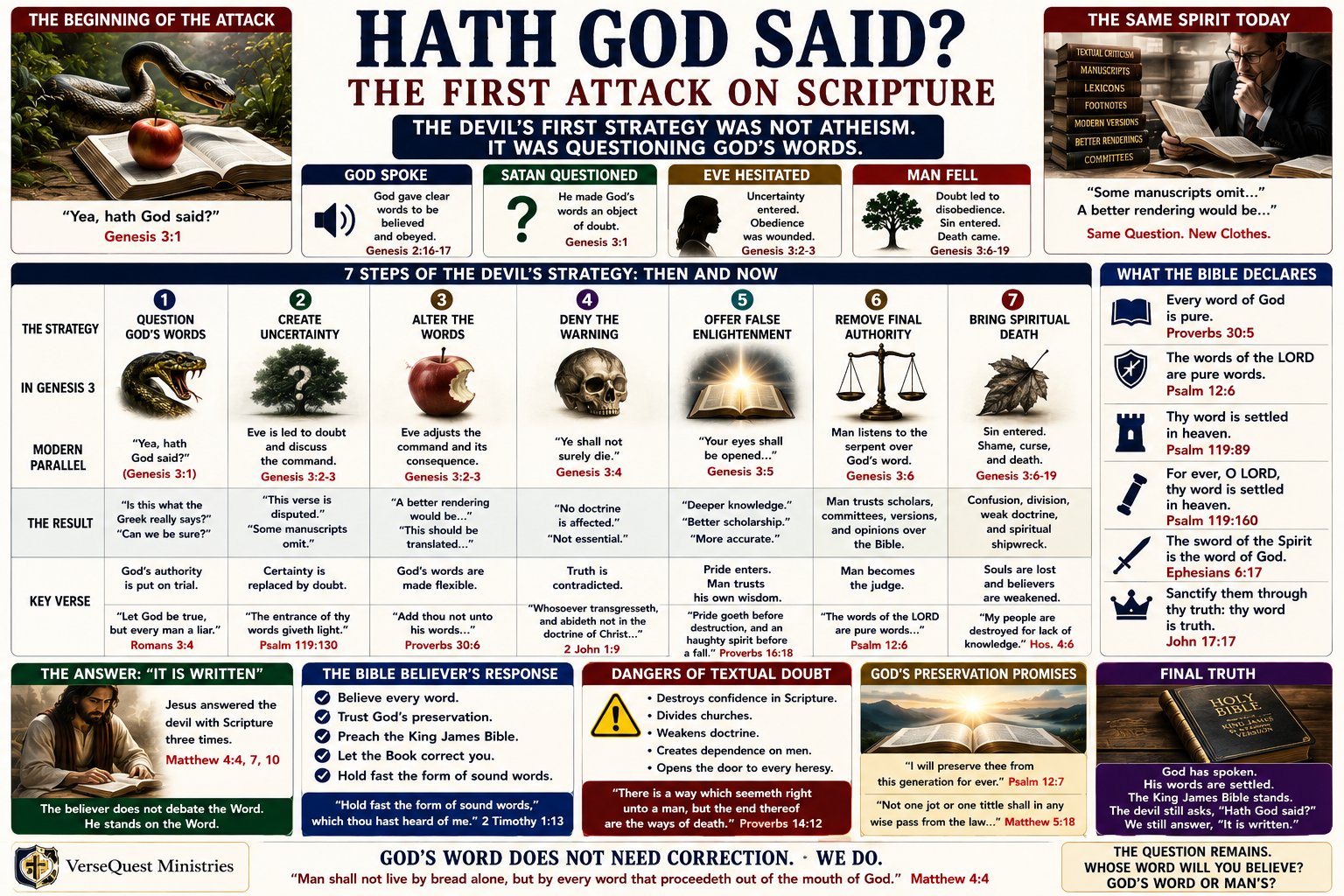
- Hath God Said? Bible Study Chart – The First Attack on Scripture, Textual Doubt, and KJV Preservation
- Trace Satan’s first attack on Scripture with this detailed KJV Bible study chart covering Genesis 3:1, textual doubt, altered words, false enlightenment, Bible preservation, and final authority.
- $3.99
- Add to cart
-
-
Biblical Humility
-
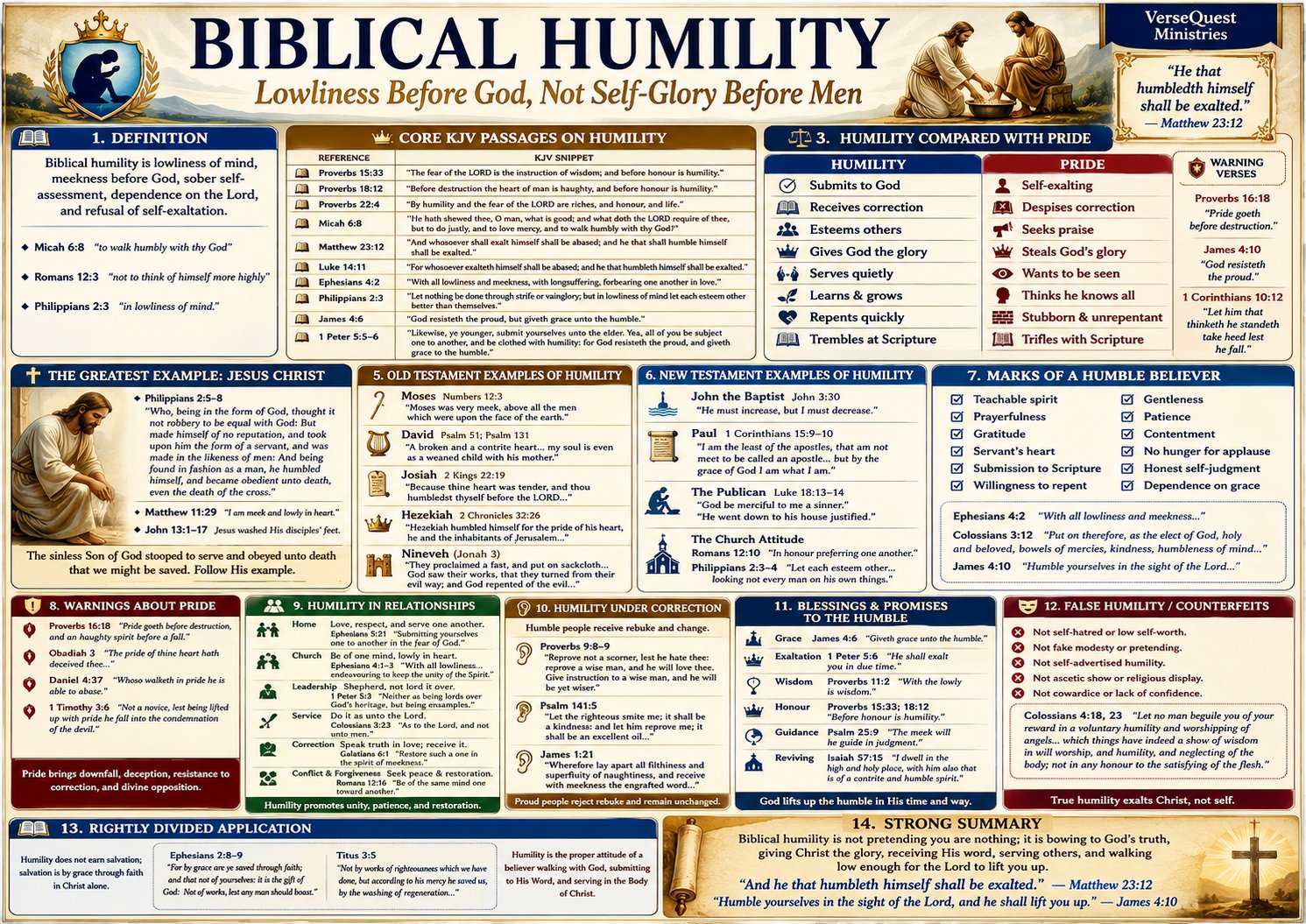
- Biblical Humility Bible Study Chart – Lowliness Before God, Not Self-Glory Before Men (KJV)
- Study biblical humility with this detailed KJV chart comparing humility and pride, Christ’s example, receiving correction, servant leadership, grace, and practical Christian living.
- $3.99
- Add to cart
-
-
Law vs Grace
-
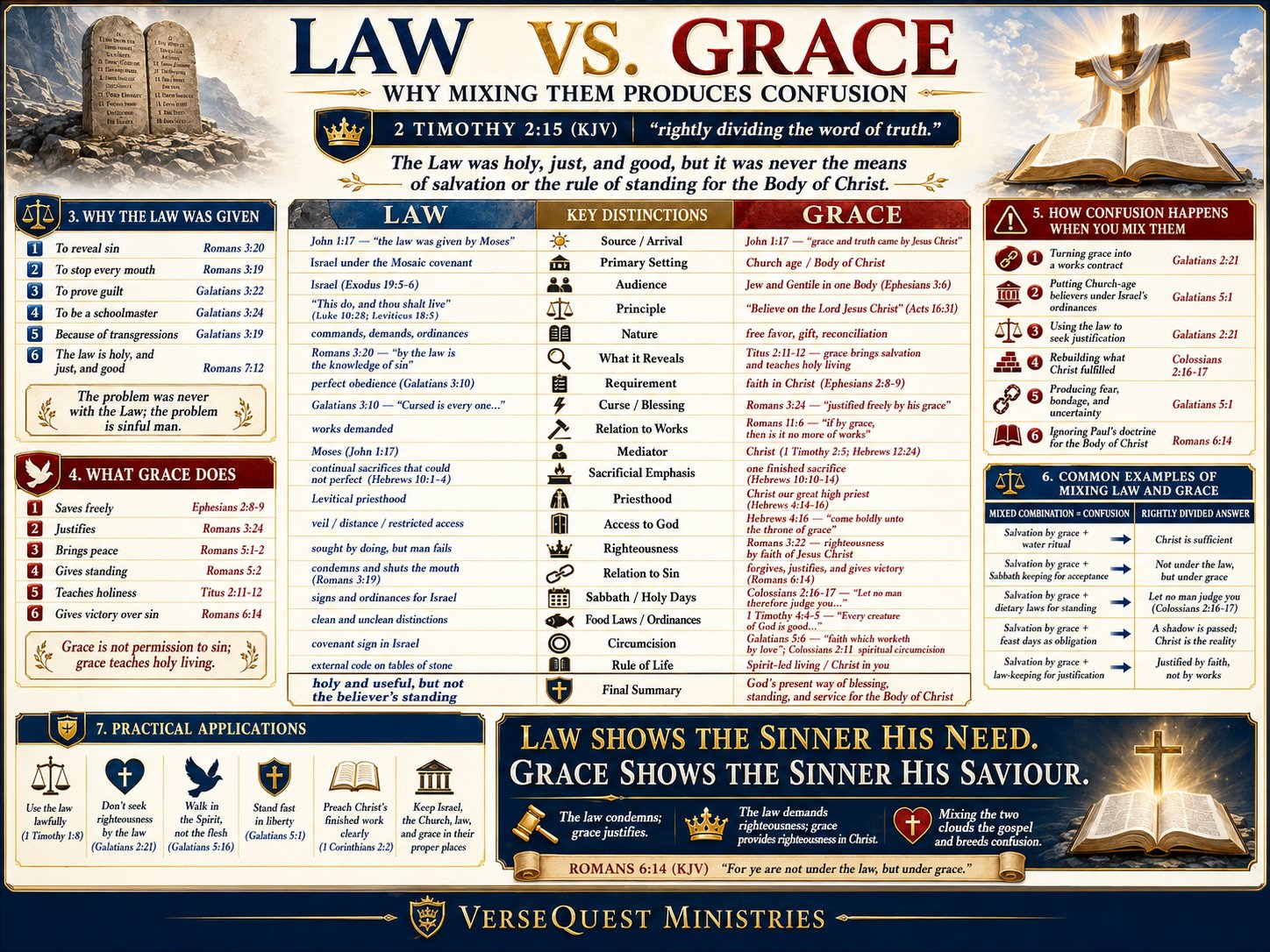
- Law vs. Grace Bible Study Chart – Why Mixing Them Produces Confusion (KJV)
- Compare law and grace with this detailed KJV Bible study chart explaining salvation, justification, holiness, Israel’s Mosaic covenant, Christian liberty, and the danger of mixing law with the gospel.
- $3.99
- Add to cart
-
-
Bitterness
-
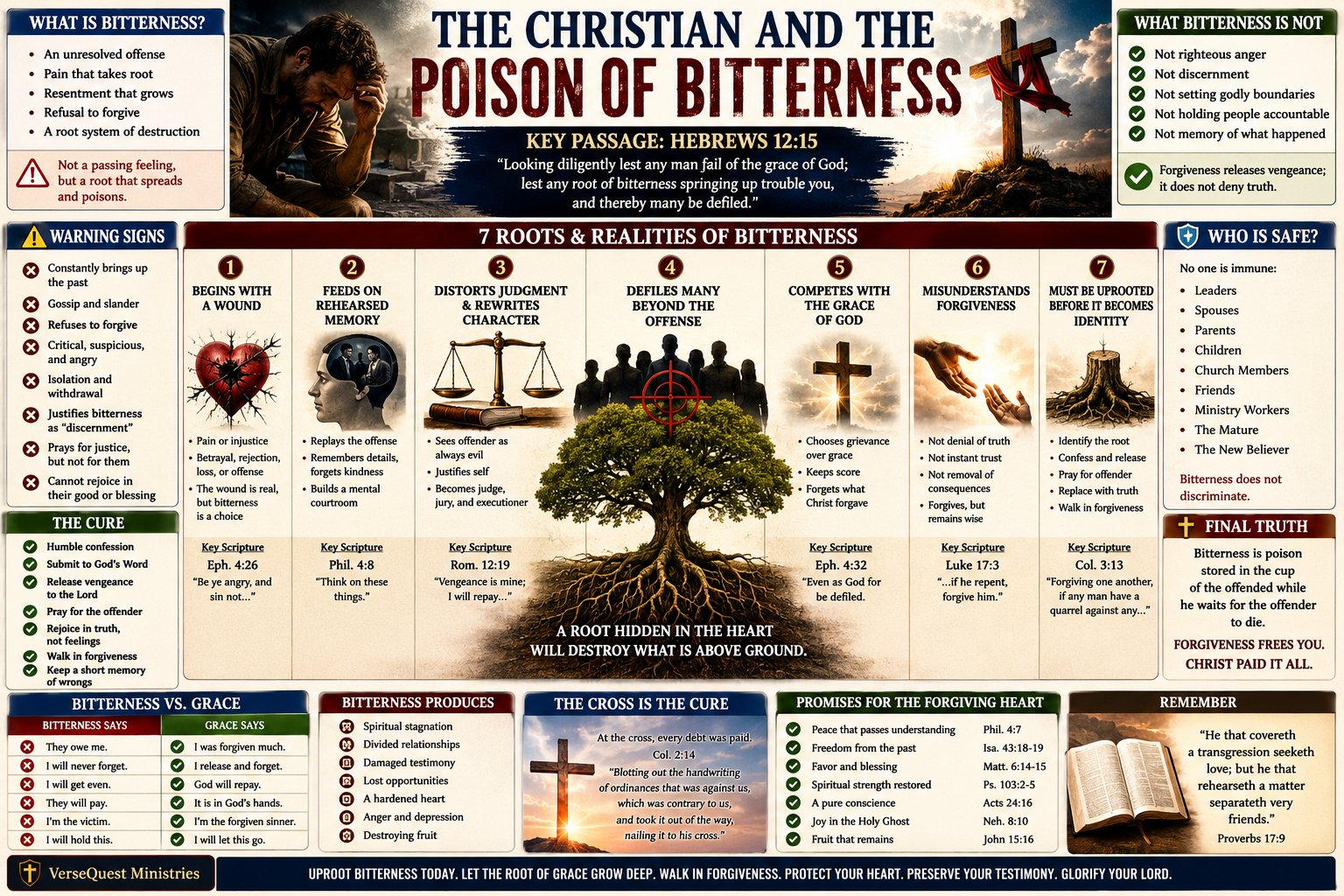
- The Christian and the Poison of Bitterness Bible Study Chart – Forgiveness, Grace, and Healing the Heart (KJV)
- Expose and uproot bitterness with this detailed KJV Bible study chart covering unresolved offenses, warning signs, forgiveness, grace, wise boundaries, the cross, and healing for the Christian heart.
- $3.99
- Add to cart
-
-
Bible Study Chart
-
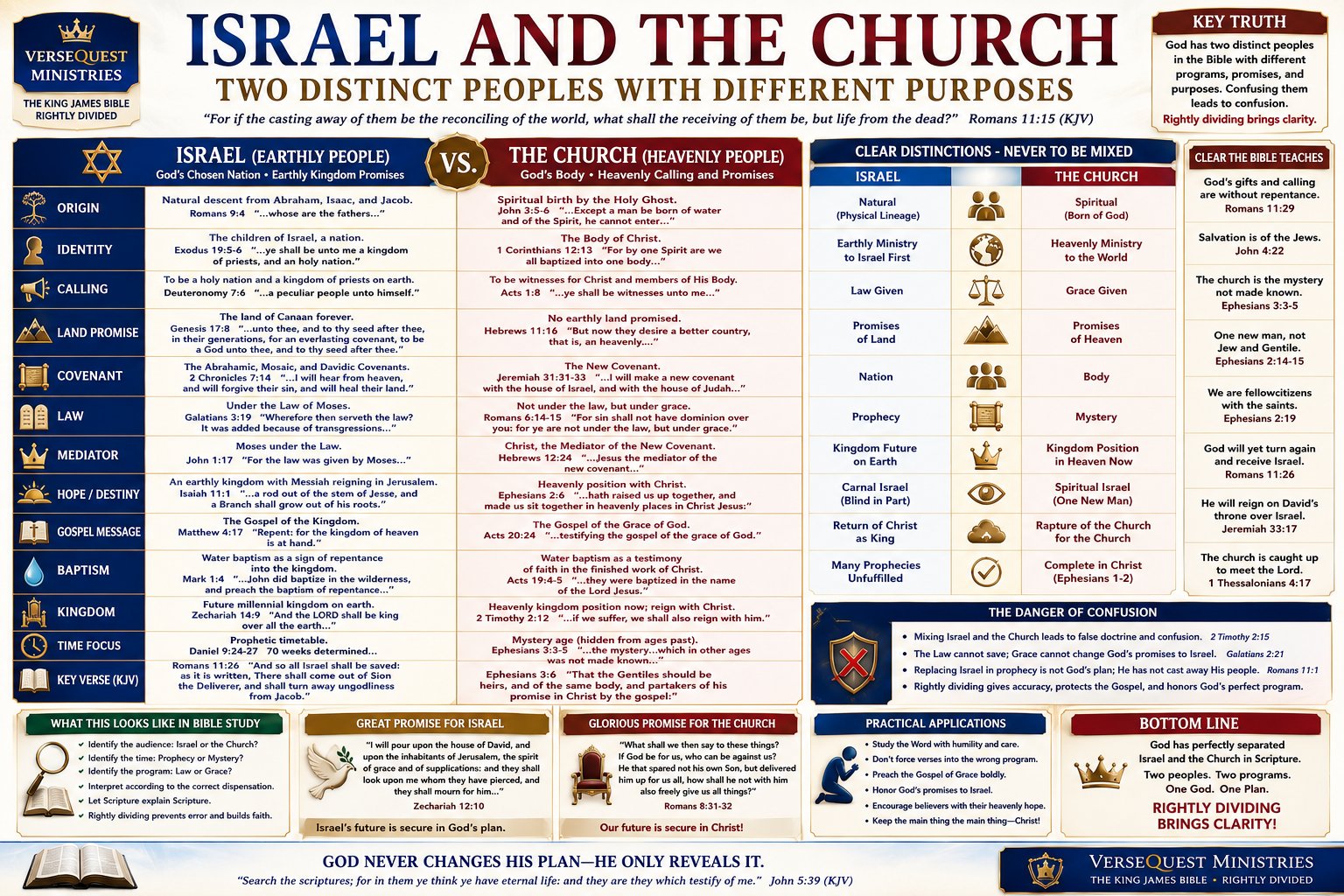
- Israel and the Church Bible Study Chart – Two Distinct Peoples with Different Purposes (KJV)
- Compare Israel and the Church with this detailed KJV Bible study chart covering their distinct origins, identities, covenants, callings, promises, gospel programs, and future destinies.
- $3.99
- Add to cart
-