
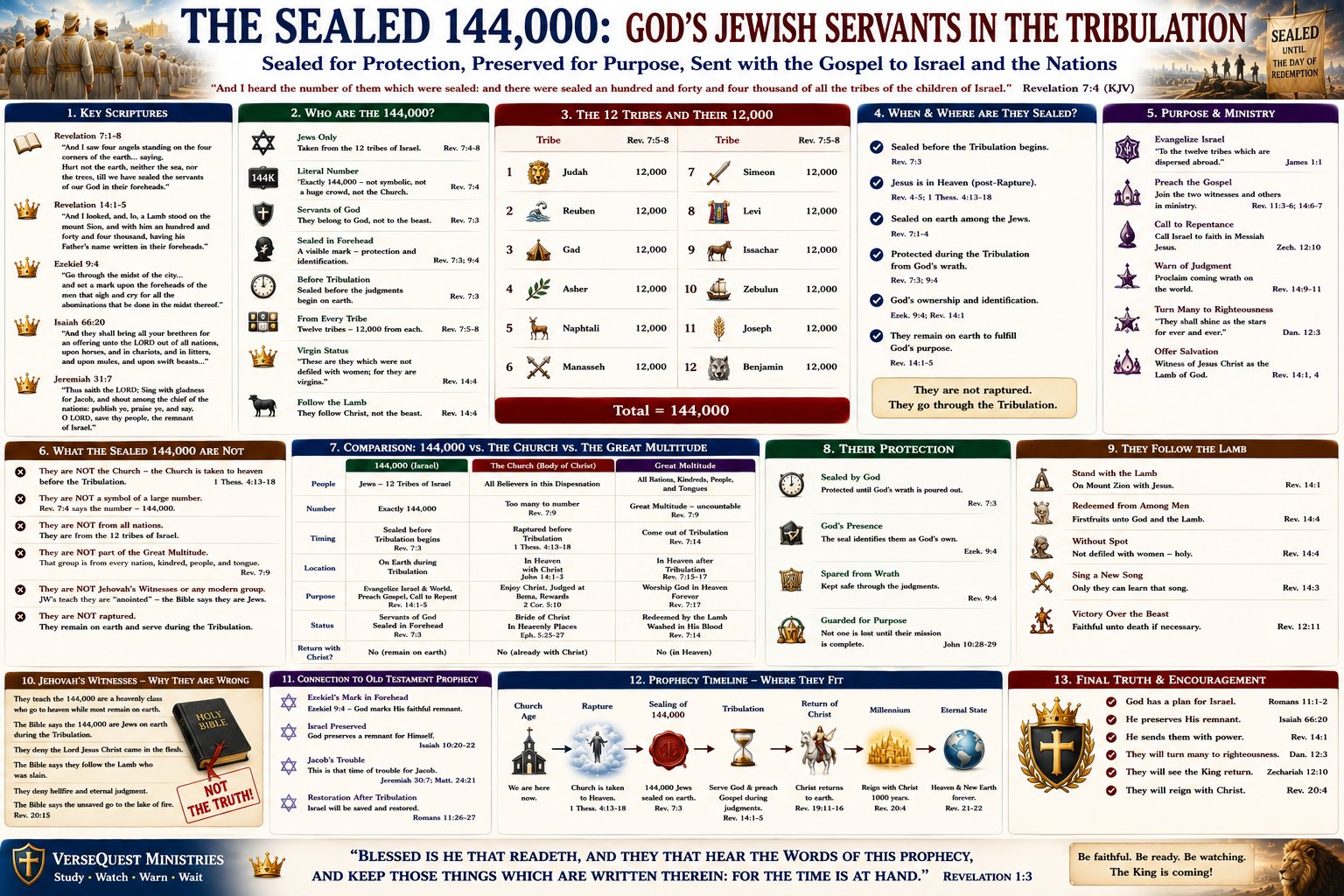
The Sealed 144,000 – God’s Jewish Servants from the Twelve Tribes of Israel in the Tribulation (KJV Bible Study Chart)
Understand Revelation’s sealed 144,000 with this detailed KJV chart covering their literal Israelite identity, the twelve tribes and 12,000 from each, God’s seal, their distinction from the Church and great multitude, Tribulation setting, connection with Israel’s remnant, loyalty to the Lamb, and future prophetic purpose.
$4.99
Description
The Sealed 144,000: God’s Jewish Servants in the Tribulation is a comprehensive, rightly divided KJV Bible study chart examining one of the most misunderstood groups in the book of Revelation. Drawing primarily from Revelation 7:1–8 and Revelation 14:1–5, the chart identifies the 144,000 as a literal company of Israelites—12,000 sealed from each of twelve named tribes—set apart as servants of God during the future Tribulation. It distinguishes them from the Church, the great multitude of Revelation 7, Jehovah’s Witnesses, and every modern religious organization that attempts to appropriate their identity.
Revelation 7 leaves remarkably little room for confusion concerning who these people are. John writes, “And I heard the number of them which were sealed: and there were sealed an hundred and forty and four thousand of all the tribes of the children of Israel.” The passage then names the tribes and gives 12,000 from each. The text does not say they are spiritual Israel, a symbolic representation of the Church, or 144,000 exceptionally spiritual Christians. They are explicitly connected with “the children of Israel.”
The number itself is presented with precision. Revelation does not merely describe a large crowd or an indefinite body of saints. John hears the number—144,000—and then the Holy Spirit divides that number into twelve companies of 12,000. Judah, Reuben, Gad, Asher, Naphtali, Manasseh, Simeon, Levi, Issachar, Zebulun, Joseph, and Benjamin are named. The deliberate enumeration makes the literal Israelite identity central to the passage.
The list is also doctrinally interesting because it is not identical to every other tribal listing in Scripture. Dan is absent by name, Ephraim is not named directly, Joseph appears, Levi is included, and Manasseh is listed separately. The Bible contains several tribal lists arranged differently according to purpose. Rather than rewriting Revelation 7 to match another list, the student should accept the tribes exactly as the Holy Spirit gave them in this prophetic setting.
These 144,000 are servants of God. Before additional judgment proceeds, Revelation 7:3 commands, “Hurt not the earth, neither the sea, nor the trees, till we have sealed the servants of our God in their foreheads.” Their first defining relationship is therefore not to Antichrist, a denomination, or a political movement. They belong to God and are marked accordingly.
Their seal represents divine ownership, identification, protection, and purpose. The beast later marks his worshippers in Revelation 13, producing a striking contrast between two kingdoms. God marks His servants, while Antichrist marks those belonging to his rebellious system. One mark identifies allegiance to the true God; the other identifies allegiance to the beast.
The location of the seal in the forehead recalls other biblical scenes in which God identifies those belonging to Him before judgment. Ezekiel 9 describes a mark placed upon the foreheads of those grieving over abominations in Jerusalem before destruction proceeds. Revelation develops that concept within the far greater judgments of the Day of the Lord.
The 144,000 therefore demonstrate that divine wrath is never uncontrolled chaos. God knows exactly who belongs to Him. While the earth moves toward extraordinary judgment, the Lord can identify, preserve, direct, and use His servants according to His purpose.
Revelation 14 gives additional information about this company. John sees the Lamb standing on Mount Sion with “an hundred forty and four thousand,” having the Father’s name written in their foreheads. The group identified and sealed in Revelation 7 appears again associated directly with Jesus Christ.
They sing a new song which no other group can learn in the same manner. This identifies them as a unique prophetic company with a distinct experience and testimony. They are not simply one more name for every redeemed person in Scripture.
Revelation 14 also describes them as “redeemed from the earth” and “redeemed from among men, being the firstfruits unto God and to the Lamb.” Their position as firstfruits connects them with a larger work of God during the Tribulation and with Israel’s approaching national restoration.
The passage describes them as not being defiled with women and calls them virgins. Whatever modern interpreters attempt to do with the wording, the King James Bible states their condition plainly. Their separation is part of their distinctive prophetic identity and consecration.
Most importantly, “These are they which follow the Lamb whithersoever he goeth.” Their loyalty belongs to Jesus Christ in an age when the world is being pressured to follow the beast. While Antichrist gathers worshippers, God preserves a company that follows the true Lamb.
This produces one of Revelation’s greatest contrasts. The beast possesses followers bearing his mark. The Lamb possesses servants bearing the Father’s name. The beast’s followers worship an imitation king headed toward destruction. The 144,000 follow the true King whose Kingdom cannot be overthrown.
The chart rightly emphasizes that the 144,000 are Jews rather than the Church. The Body of Christ consists of saved Jews and Gentiles made one in Christ during the present mystery dispensation. Ephesians 3 and First Corinthians 12 explain this one-Body truth. Revelation 7, however, deliberately returns to tribal distinctions and names Israelites according to their ancestral tribes.
That is precisely what should be expected when God resumes His prophetic dealings with Israel. The Church does not need to be turned into the twelve tribes, because the Bible already has twelve tribes. Israel does not need to be absorbed into the Church, because Romans 11 guarantees that God retains a future purpose for Jacob.
The distinction protects both programmes. The Church possesses its heavenly calling and blessed hope in Christ. Israel retains its national promises, prophetic future, remnant, Kingdom expectations, and restoration beneath Messiah.
Romans 11:25–27 teaches that Israel’s present blindness is partial and temporary. The nation remains beloved for the fathers’ sakes, and the gifts and calling of God are without repentance. Revelation’s return to tribes, Jerusalem, Temple imagery, sealed Israelites, and national conflict agrees perfectly with that promise.
The chart also distinguishes the 144,000 from the great multitude appearing later in Revelation 7. The 144,000 are numbered precisely; the great multitude cannot be numbered. The 144,000 are identified from tribes of Israel; the great multitude comes from “all nations, and kindreds, and people, and tongues.”
The 144,000 are sealed servants within the Tribulation setting. The great multitude is seen before God’s throne and is identified as coming out of great Tribulation. Blending the groups destroys the very distinctions the Holy Spirit carefully placed in the chapter.
The two companies demonstrate the breadth of God’s work during the future prophetic period. Israel occupies the centre of the covenant and Kingdom programme, yet God’s salvation and testimony also reach beyond Israel to people from the nations.
The chart further distinguishes the 144,000 from Jehovah’s Witnesses and similar groups. No modern organization has the right to seize Revelation’s number while discarding Revelation’s description. The text does not say 144,000 Watchtower adherents, denominational elites, specially anointed Christians, or inhabitants of heaven chosen by a modern religious society.
The Bible says they are “of all the tribes of the children of Israel.” A religious system cannot take the number literally while spiritualizing away the people from whom the number is drawn.
The Watchtower interpretation encounters additional problems because Revelation 14 describes the 144,000 following the Lamb, while historic Jehovah’s Witness theology denies the full biblical deity of Jesus Christ. The same passage they claim for themselves places the 144,000 in intimate identification with the Lamb whom Revelation worships and exalts.
The 144,000 also stand within a prophetic programme involving Israel rather than the organizational history of a nineteenth- or twentieth-century religious movement. Their biblical setting is Daniel’s seventieth week, the judgments of Revelation, the rise of Antichrist, Israel’s trouble, and the approach of Messiah’s visible Kingdom.
The chart connects the 144,000 with the Old Testament principle of a preserved remnant. God repeatedly preserves faithful Israelites during periods of national unbelief and judgment. Elijah learned that thousands remained who had not bowed to Baal. Isaiah spoke extensively of a remnant. Ezekiel pictured God marking His faithful ones amid Jerusalem’s corruption.
Jacob’s trouble does not mean Jacob’s annihilation. Jeremiah 30 calls the future crisis a time of unprecedented trouble yet promises that Israel will be saved out of it. Zechariah likewise presents severe national refinement followed by recognition of the pierced Messiah.
Isaiah 60 anticipates Israel’s future glory and the nations responding to God’s work among His people. Jeremiah 31 celebrates God’s continuing covenant faithfulness to Israel. These passages help establish the prophetic soil from which Revelation’s 144,000 emerge.
Their sealing demonstrates protection, but protection must be defined biblically. God’s seal identifies them as His own and preserves them for His purpose amid judgment. It does not mean that every servant of God in Revelation escapes persecution or bodily suffering. Revelation is filled with faithful witnesses who are killed yet ultimately victorious.
The 144,000 are protected because God has work for them to accomplish. Divine preservation is tied to divine purpose. Satan, the beast, armies, plagues, and world turmoil cannot prematurely cancel what God has ordained.
Their later appearance with the Lamb demonstrates that God’s seal is effective. The group counted in Revelation 7 is not presented as having disappeared into the beast’s system. They remain associated with the Lamb and bear the Father’s name.
The chart connects their purpose with witness and ministry during the Tribulation. Revelation explicitly calls them servants of God, and their consecrated status strongly supports a special role within God’s Tribulation testimony. Within a dispensational interpretation, they are commonly understood as Jewish witnesses whom God uses as the prophetic programme turns again toward Israel and the nations.
That witnessing role fits the wider Tribulation setting. Revelation contains prophetic witnesses, the everlasting gospel, angelic proclamations, calls to fear God, warnings against the beast, Tribulation saints, martyrs, Israel’s remnant, and multitudes ultimately standing before God.
The safest doctrinal wording is that Revelation explicitly identifies the 144,000 as sealed servants of God, while their description as a worldwide corps of 144,000 evangelists is an interpretive conclusion rather than a sentence the passage states directly. Their service certainly belongs to God; the exact details of every individual activity should not be supplied where Scripture remains silent.
Their ministry fits the prophetic call toward Israel’s repentance. Zechariah foretells Israel eventually looking upon the One whom they pierced. The Tribulation strips away false confidence, exposes Antichrist’s counterfeit covenant, and prepares a surviving remnant to recognize Jesus Christ as Messiah.
Their testimony also stands against the beast’s false gospel. Antichrist tells the world to follow man. The 144,000 follow the Lamb. The false prophet points toward the beast’s image. God’s servants bear the Father’s name. The beast promises temporary security; Christ offers the Kingdom and eternal righteousness.
They warn of judgment because Revelation is not merely a book of private devotional comfort. The seals, trumpets, vials, Babylonian judgment, beast worship, and Armageddon demonstrate that God will judge persistent rebellion.
Yet judgment is accompanied by testimony. Even during the darkest period in human history, God is not left without witnesses. The world cannot plead that heaven remained entirely silent while Antichrist ruled.
The chart’s comparison between the 144,000, the Church, and the great multitude is especially useful. The 144,000 are literal Israelites from twelve tribes. The Church is the Body of Christ formed during the present mystery dispensation from believing Jews and Gentiles made one. The great multitude consists of people from every nation, kindred, people, and tongue connected with the Great Tribulation.
The numbers differ. The 144,000 are exactly counted. The Church is never restricted to such a number. The great multitude is explicitly beyond human numbering.
Their timing differs as well. The Church’s catching away belongs before Tribulation wrath within the pre-Tribulation framework. The 144,000 belong to the Tribulation programme and are sealed within Revelation’s judgment narrative. The great multitude is identified as having come out of great Tribulation.
Their locations and purposes differ. The Church is caught up to Christ and possesses its heavenly calling. The 144,000 are associated with Israel’s prophetic programme and later stand with the Lamb. The great multitude appears before the throne praising God after coming out of great Tribulation.
Right division does not create artificial differences. It respects the differences already written into the passages.
The prophetic timeline begins with the present Church Age, during which the gospel of grace is proclaimed and the Body of Christ is formed. The Church’s blessed hope is the catching away described in First Thessalonians 4 and First Corinthians 15.
After the Church’s removal, God’s prophetic programme concerning Israel moves again to centre stage. Daniel’s seventieth week unfolds, Israel experiences Jacob’s trouble, and Revelation presents the sealed Israelite servants in connection with the coming judgments.
The 144,000 remain associated with God’s purpose through the Tribulation rather than becoming worshippers of the beast. They stand as testimony that the Dragon cannot erase Israel, Antichrist cannot cancel God’s covenants, and divine wrath does not mean divine forgetfulness.
Jesus Christ ultimately returns in glory. Revelation 19 reveals the King of kings descending from heaven, defeating the beast and false prophet, judging His enemies, and taking visible authority over the earth.
The Millennium follows, fulfilling the earthly Kingdom promises concerning Messiah, Israel, Jerusalem, and the nations. The same prophetic programme that includes Jacob’s trouble ends with Jacob’s Messiah reigning.
The chart therefore reinforces a major dispensational truth: God still has a plan for Israel. Revelation does not dissolve Jewish identity precisely when prophecy becomes most intensely concerned with Jerusalem, the tribes, the Temple, the remnant, and Messiah’s Kingdom.
Replacement theology has difficulty with passages such as Revelation 7 because the Holy Spirit returns to unmistakably Israelite language. The simplest reading is also the strongest: when God says tribes of the children of Israel and then names the tribes, He means Israel.
The chart also emphasizes the faithfulness of God. Israel’s long history of unbelief does not render His Word void. Human failure cannot make an unconditional divine promise evaporate.
Romans 11 asks whether God has cast away His people and answers, “God forbid.” Revelation 7 demonstrates that this answer remains true in the final prophetic crisis.
God knows the tribes even when modern genealogists do not. The inability of contemporary human beings to identify every individual Israelite tribe does not hinder omniscience. The God who scattered Israel knows exactly whom He is sealing.
The sealed servants also demonstrate that God can preserve people amid wrath without confusing them with the Church. Noah was preserved through his judgment setting. Lot was removed before destruction. Israel was distinguished in Egypt. Revelation shows God marking His servants according to the demands of His future programme.
This distinction helps prevent a common prophetic error: assuming that because God preserves anyone during the Tribulation, the Church must therefore remain there. Revelation itself supplies multiple groups and different dealings.
The 144,000 follow the Lamb rather than the beast. That truth supplies the practical heart of the chart. Every age eventually comes down to allegiance. Who owns you? Whose words govern you? Which kingdom receives your loyalty?
For the present believer, the answer is not to pretend to be one of the 144,000. It is to belong to Jesus Christ, believe the gospel of grace, study His Word, rightly divide prophecy, and remain faithful in the calling God has actually given the Church.
The present Body of Christ should not steal Israel’s prophetic identity in an attempt to make Revelation personally relevant. Scripture becomes more useful, not less useful, when it is interpreted correctly. The Church learns from God’s faithfulness to Israel without becoming Israel.
The 144,000 also reveal the certainty of Christ’s triumph. The beast may possess temporary political authority, the false prophet may deceive the world, and the Dragon may persecute God’s people, but Revelation 14 does not show the 144,000 bowing before 666. It shows them with the Lamb.
That is the final picture worth remembering. Antichrist has his marked multitude, but Jesus Christ has His sealed servants. The beast has a number, but the Lamb has a name. Satan controls temporarily, but God preserves according to eternal purpose.
The final truth and encouragement are therefore clear: God has a plan for Israel, He preserves His remnant, He raises servants during the darkest prophetic hour, He brings Israel toward righteousness, and He will send Jesus Christ back as the promised King.
The world may enter Tribulation, but prophecy does not end with Tribulation. The Dragon rages, the beast rises, Babylon falls, Christ returns, Israel sees her King, and the Kingdom belongs to Jesus Christ.
This resource is ideal for personal Bible study, Revelation 7 teaching, Revelation 14 studies, 144,000 instruction, Israel-and-Church distinctions, Tribulation prophecy, Jehovah’s Witness apologetics, remnant theology, Daniel’s seventieth-week studies, pre-Tribulation Rapture teaching, Kingdom prophecy, prophecy conferences, Sunday school, homeschool Bible curriculum, Christian schools, Bible institutes, pastoral training, and sermon preparation.
The sealed 144,000, Revelation 7, Revelation 14, 144000 Israelites, twelve tribes of Israel, 12000 from each tribe, Jewish servants of God, seal of God, Father’s name in their foreheads, Israel in the Tribulation, Israel’s remnant, Jacob’s trouble, firstfruits unto God, follow the Lamb, Mount Sion, great multitude versus 144000, Church versus Israel, Jehovah’s Witnesses refuted, Tribulation servants, preservation during wrath, future restoration of Israel
Revelation 7 identifies the 144,000 as 144,000 from the tribes of the children of Israel. The passage gives an exact number and then divides that number into twelve groups of 12,000. The simplest and strongest interpretation is therefore that these are literal Israelites rather than a symbolic description of the Church, a generic company of Christians, or a modern religious organization.
The tribal list contains Judah, Reuben, Gad, Asher, Naphtali, Manasseh, Simeon, Levi, Issachar, Zebulun, Joseph, and Benjamin. Dan is not named, and Ephraim does not appear under his own name. Students should preserve Revelation’s list rather than altering it to match another tribal arrangement elsewhere in Scripture, because biblical tribal lists vary according to purpose.
The 144,000 are explicitly called “the servants of our God” and are sealed in their foreheads. Their seal signifies divine ownership, identification, preservation, and purpose. Revelation later contrasts God’s seal with the beast’s mark, presenting two rival kingdoms and two unmistakable allegiances.
Revelation 14 shows the same numbered company with the Lamb upon Mount Sion and the Father’s name in their foreheads. They sing a unique song, are described as virgins, are redeemed from among men, are called firstfruits unto God and the Lamb, and “follow the Lamb whithersoever he goeth.” Their loyalty to Christ stands in direct contrast with the world’s allegiance to the beast.
The 144,000 must be distinguished from the Church. The Church is the one Body formed during the present mystery dispensation from saved Jews and Gentiles. Revelation 7 returns deliberately to named Israelite tribes within the future prophetic programme. Right division allows the Church to remain the Church and Israel to remain Israel.
They must also be distinguished from the great multitude of Revelation 7. The 144,000 are exactly numbered and drawn from Israel; the great multitude cannot be numbered and comes from all nations, kindreds, peoples, and tongues. The great multitude is seen before the throne after coming out of great Tribulation, while the 144,000 form a distinct sealed company.
The 144,000 are not Jehovah’s Witnesses or a special modern religious class. Revelation defines them by Israelite tribal identity rather than denominational membership. Any interpretation that insists the number 144,000 is literal while spiritualizing away the twelve tribes is inconsistent with the passage itself.
God’s preservation of the 144,000 fits the Old Testament doctrine of an Israelite remnant. Elijah’s seven thousand, Isaiah’s remnant prophecies, Ezekiel’s marked faithful, Jeremiah’s promises to Jacob, and Zechariah’s future refining of Israel establish the wider prophetic pattern. Judgment does not mean God has forgotten His covenant promises.
The seal protects and preserves the 144,000 for God’s appointed purpose. Revelation explicitly calls them servants; their broader identification as a corps of 144,000 evangelists is a common dispensational inference rather than a direct statement of the text. Their ministry should therefore be described firmly as divine service and witness while avoiding details Scripture itself does not specify.
Their existence demonstrates that God has not replaced Israel with the Church. Romans 11 rejects the idea that God has permanently cast away His people and promises a future national work after Israel’s present partial blindness. Revelation’s sealed tribes agree naturally with that future restoration.
Within a pre-Tribulation framework, the Church is caught away before the Day-of-the-Lord wrath, while the 144,000 belong to Israel’s subsequent Tribulation programme. The Church’s hope is the Rapture; the sealed Israelites serve within the prophetic period leading toward Israel’s deliverance and Christ’s visible return.
The ultimate lesson is God’s faithfulness. Satan may rage against Israel, Antichrist may rule temporarily, and the world may worship the beast, but God knows His servants and preserves His prophetic purpose. Revelation 14 ultimately shows the 144,000 not defeated by the beast but standing with the Lamb.
144,000 Bible studies, Revelation 7 teaching, Revelation 14 instruction, twelve-tribes studies, Israel-and-Church distinctions, Jewish-remnant teaching, Tribulation prophecy, Jehovah’s Witness apologetics, seal-of-God studies, Daniel’s seventieth-week instruction, Jacob’s-trouble lessons, pre-Tribulation Rapture studies, Revelation timelines, future-Israel teaching, Kingdom prophecy, Sunday school lessons, homeschool Bible curriculum, Christian school teaching, Bible institute classes, prophecy conferences, pastoral training, sermon preparation
King James Bible, Strong’s Concordance, Thompson Chain-Reference Bible, Treasury of Scripture Knowledge, Nave’s Topical Bible, Revelation 7 study notes, Revelation 14 commentary materials, twelve-tribes comparison charts, Israel’s-remnant Scripture studies, Romans 9–11 outlines, Daniel 9 seventy-weeks charts, Jacob’s-trouble resources, Church-versus-Israel comparison charts, Jehovah’s Witness apologetics resources, Tribulation timelines, sealed-servants studies, pre-Tribulation Rapture charts, millennial Kingdom materials, VerseQuest Revelation and prophecy charts
Related products
-
Bible Overview Series
-
- The New Jerusalem Made Plain — 621-Page PDF Study
- The New Jerusalem Made Plain is a massive 621-page KJV/rightly divided PDF study on the literal holy city revealed in Revelation 21–22. This 100-essay book makes the New Jerusalem plain…
- $34.99
- Add to cart
-
-
Heaven
-
- The Doctrine of Heaven Made Plain — 599-Page KJV Bible Study PDF
- A massive 599-page KJV, rightly divided study on heaven, covering the present heaven, resurrection body, Rapture, Millennium, New Jerusalem, eternal state, hard questions, funeral lies, and cult errors.
- $34.99
- Add to cart
-
-
Names of Christ
-
- The Names and Titles of Jesus Christ Made Plain
- A complete 100-essay KJV Bible study on the names and titles of the Lord Jesus Christ, showing His deity, humanity, blood atonement, resurrection, priesthood, headship over the Church, shepherd care,…
- $29.99
- Add to cart
-
-
Premium Studies
-
-25%
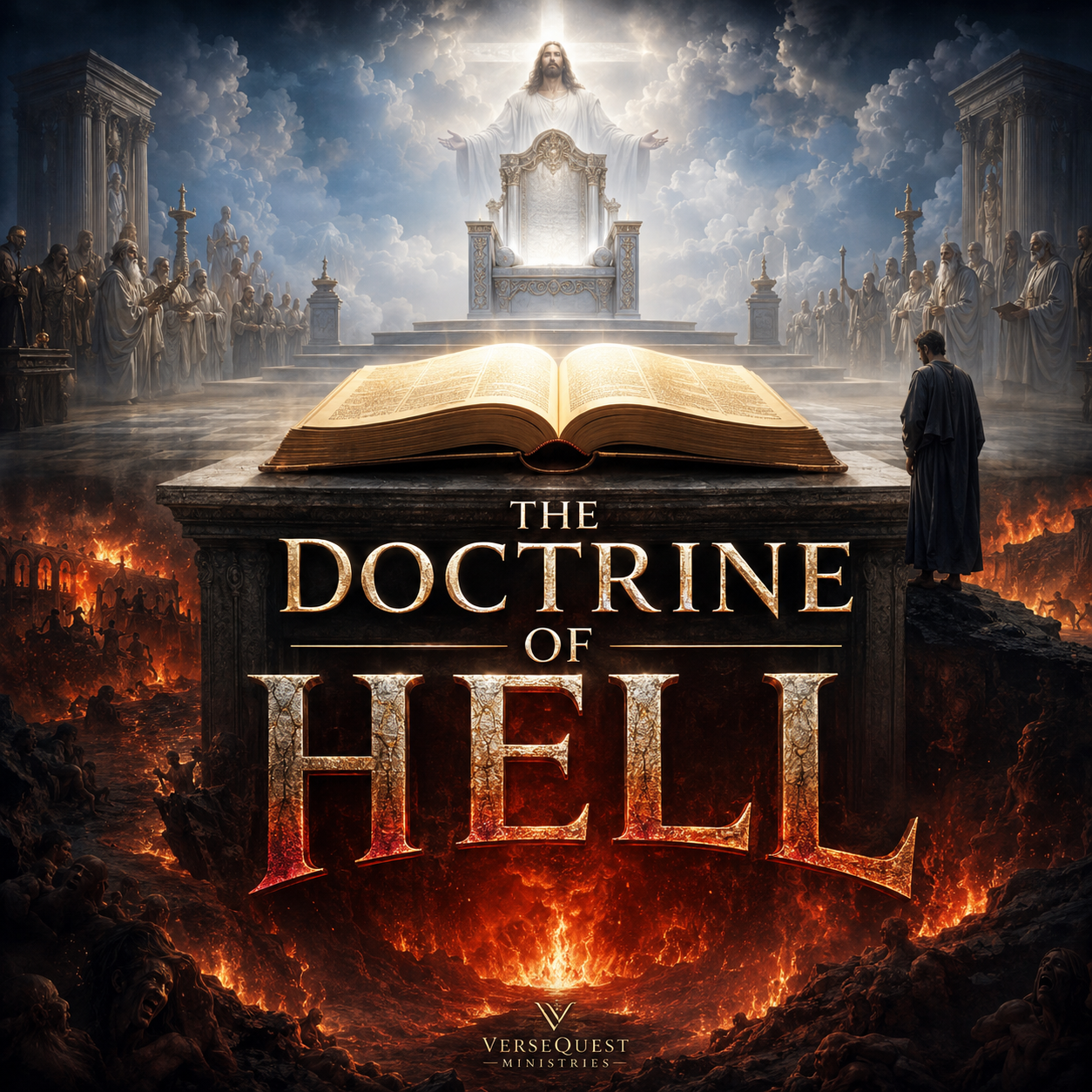
- The Doctrine of Hell — Premium Essay Series PDF
- A 383-page premium VerseQuest PDF study book containing 54 KJV essays on hell, fire, darkness, judgment, the lake of fire, the second death, and Jesus Christ as the only escape.
- Original price was: $39.99.$29.99Current price is: $29.99.
- Add to cart
-
-25%
-
VerseQuest Premium Library
-
-67%
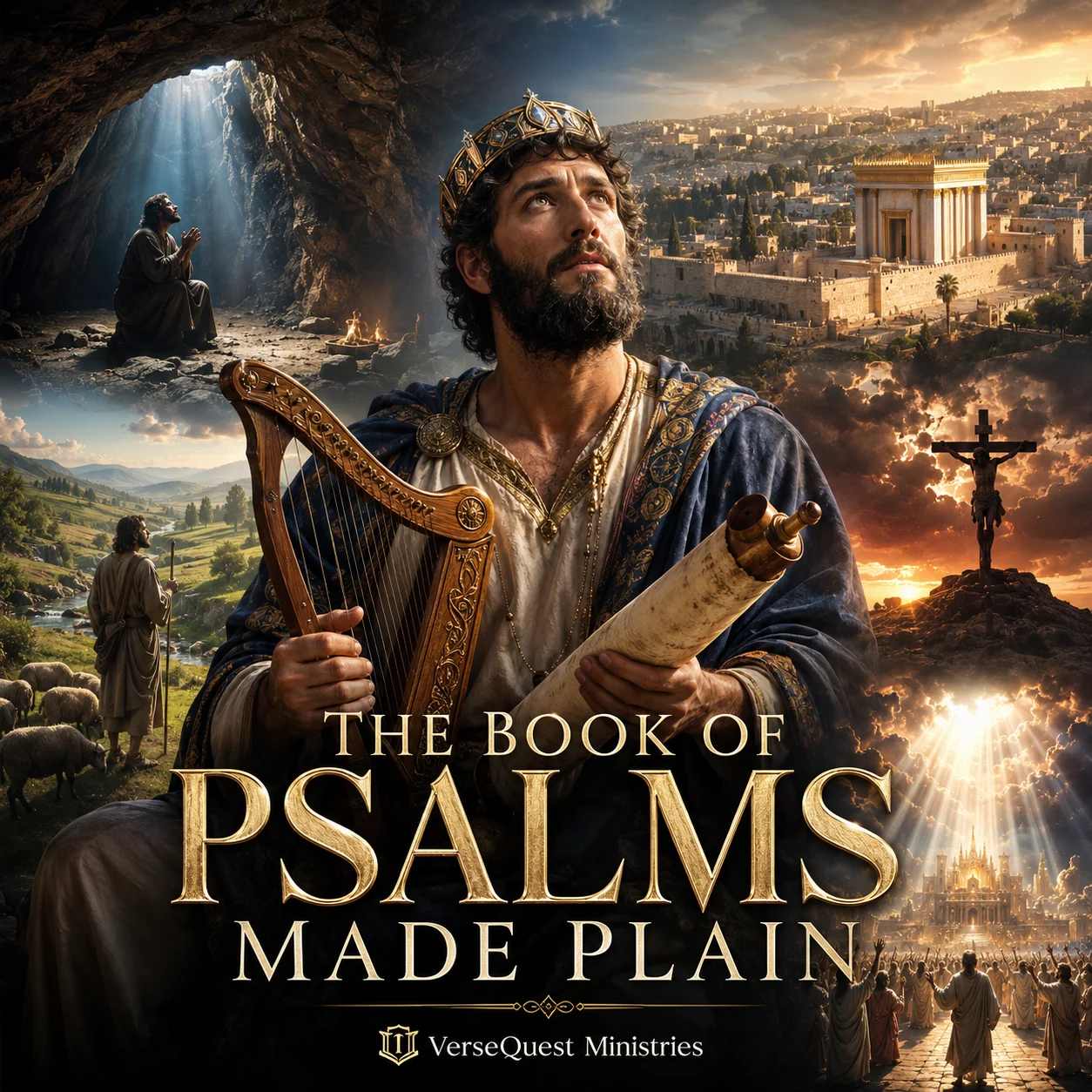
- The Book of Psalms Made Plain – 383-Page KJV Psalm Study
- The Book of Psalms Made Plain is a 383-page premium KJV Bible study featuring 54 detailed essays through the major themes, doctrines, prophecies, prayers, laments, and praises of the Psalms.…
- Original price was: $29.99.$9.99Current price is: $9.99.
- Add to cart
-
-67%