
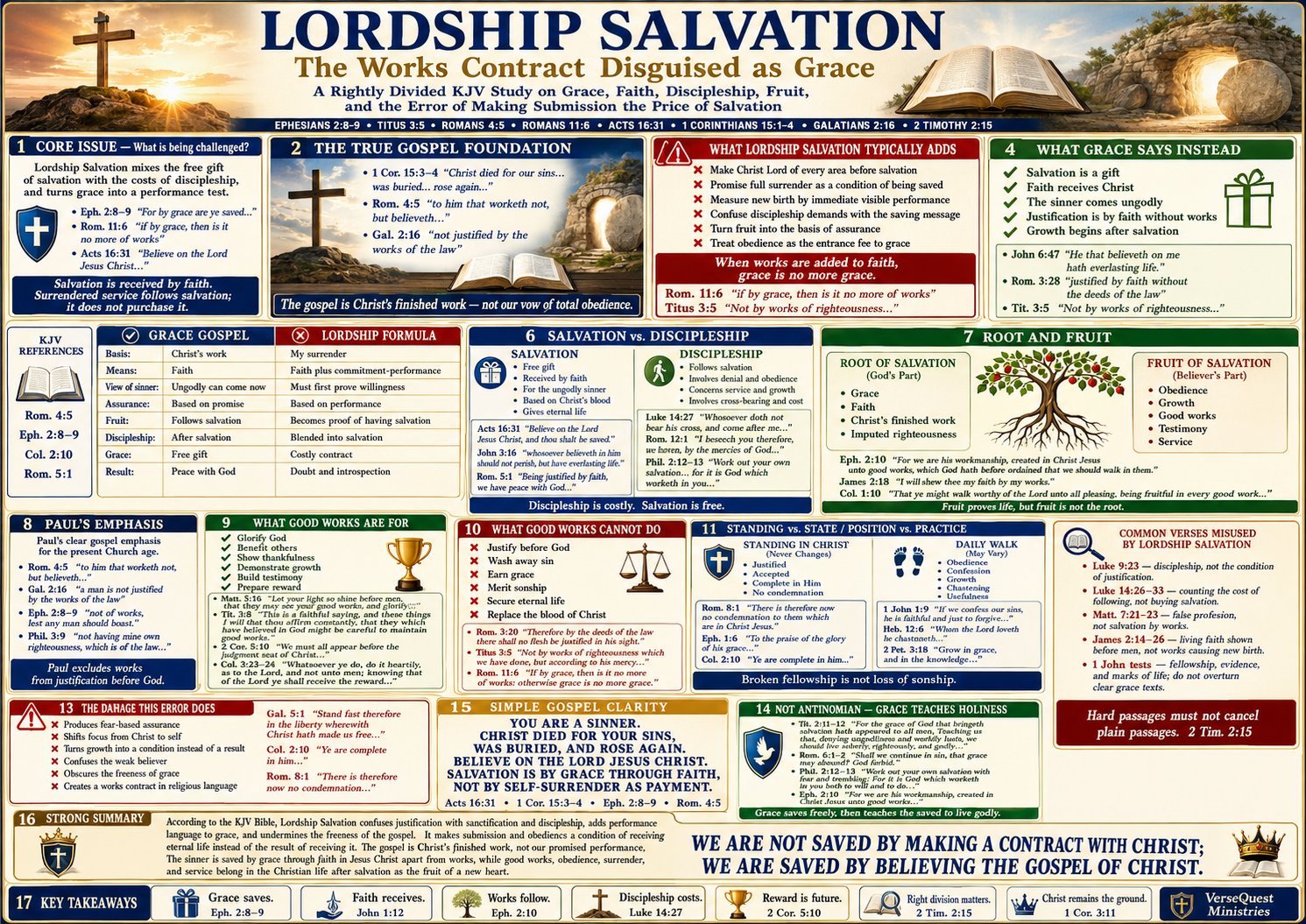
Lordship Salvation Exposed – The Works Contract Disguised as Grace and the Difference Between Salvation and Discipleship (KJV Bible Study Chart)
Examine Lordship Salvation with this detailed KJV chart distinguishing the free gift of salvation from costly discipleship, justification from sanctification, and the root of grace from the fruit of Christian obedience.
$3.99
Description
Lordship Salvation: The Works Contract Disguised as Grace is a detailed KJV Bible study chart examining the error of placing discipleship demands, promises of total surrender, personal obedience, visible fruit, or lifelong performance into the sinner’s initial reception of eternal life.
Built around Ephesians 2:8–9, Titus 3:5, Romans 4:5, Romans 11:6, Acts 16:31, 1 Corinthians 15:1–4, Galatians 2:16, and 2 Timothy 2:15, this chart distinguishes the free gift of salvation from the costly responsibilities of Christian discipleship.
The central issue is not whether Christians should obey Jesus Christ, forsake sin, grow spiritually, produce good works, surrender their lives, or serve the Lord faithfully. Scripture commands all of those things. The issue is whether those responsibilities are part of the price a sinner must promise to pay before God will grant eternal life.
The chart challenges the teaching that saving faith must include a pledge of unconditional surrender, a willingness to obey every future command, or a promise of lifelong discipleship before the sinner may be justified. When those demands are placed into the saving transaction, grace becomes a contract and faith becomes a commitment to future performance.
Ephesians 2:8–9 declares that salvation is by grace through faith, that it is the gift of God, and that it is “not of works.” A gift is received rather than purchased. If the sinner must promise sufficient obedience before receiving it, the gift has been converted into a performance agreement.
Romans 4:5 describes the sinner who “worketh not, but believeth on him that justifieth the ungodly.” God does not wait for the sinner to become outwardly respectable, spiritually mature, fully surrendered, or visibly fruitful before justifying him. He justifies the ungodly person who believes.
The chart presents the true gospel foundation from 1 Corinthians 15:1–4. Jesus Christ died for our sins according to the Scriptures, was buried, and rose again the third day. Salvation rests upon Christ’s finished work—not upon the sinner’s promise of total future obedience.
The gospel does not ask the sinner to offer God a vow of flawless discipleship. It announces that Jesus Christ has already supplied the righteousness, sacrifice, payment, and resurrection life the sinner could never provide.
Galatians 2:16 repeatedly excludes the works of the law from justification. A person is justified through faith in Jesus Christ rather than through law-keeping, moral achievement, religious performance, or personal surrender treated as spiritual merit.
Acts 16:31 gives the plain answer to the question of salvation: “Believe on the Lord Jesus Christ, and thou shalt be saved.” Paul and Silas did not present the Philippian jailer with a probationary contract, demand proof of future perseverance, or require him to demonstrate discipleship before receiving eternal life.
The chart explains what the Lordship Salvation formula commonly adds to the gospel. It may tell the sinner that he must make Christ Lord of every area before salvation, promise total surrender, renounce every known sin successfully, guarantee future obedience, or prove his willingness to endure discipleship’s cost.
These demands may be expressed in spiritual language, but they introduce human performance into the reception of grace. The sinner is no longer simply trusting Christ; he is also trusting the sincerity, completeness, and endurance of his own commitment.
Romans 11:6 states that grace and works cannot share the saving foundation. If salvation is by grace, it is no longer of works. If human performance is made part of the condition, grace is no longer grace in its biblical sense.
Titus 3:5 likewise declares that God saved us “not by works of righteousness which we have done.” A promise to perform future righteousness cannot become a substitute for works already performed. Whether the performance is past, present, or promised, it still directs attention toward the sinner’s commitment rather than Christ’s sufficiency.
The chart contrasts the grace gospel with the Lordship formula. The grace gospel rests upon Christ’s work, is received through faith, welcomes the ungodly sinner immediately, grounds assurance in God’s promise, places discipleship after salvation, and produces peace with God.
The Lordship formula places emphasis upon the sinner’s surrender, combines faith with commitment and performance, requires evidence of willingness before acceptance, grounds assurance partly in conduct, and blends discipleship into the saving message.
The result is often doubt and introspection. Instead of asking, “Did Jesus Christ fully pay for my sins, and have I trusted Him?” the person continually asks, “Was my surrender complete enough? Did I mean it deeply enough? Have I obeyed consistently enough? Have I produced enough fruit to prove I was ever saved?”
Biblical assurance cannot rest upon the quality of the sinner’s promise. Human commitment changes, weakens, and sometimes fails. Assurance must rest upon the unchanging promise of God and the completed redemption accomplished by Jesus Christ.
The chart explains what grace says instead. Salvation is a gift. Faith receives Christ. The sinner comes as ungodly. Justification is by faith without works. Growth begins after salvation.
John 6:47 declares, “He that believeth on me hath everlasting life.” Romans 3:28 concludes that a man is justified by faith without the deeds of the law. Grace does not ask the sinner to prove he deserves the gift before receiving it.
A major section distinguishes salvation from discipleship. Salvation is the free gift of eternal life, received by faith, offered to the ungodly sinner, grounded in Christ’s blood, and secured by God’s promise.
Discipleship follows salvation. It involves self-denial, obedience, sacrifice, growth, service, suffering, faithfulness, and learning to follow Jesus Christ in daily life.
Luke 14 contains strong demands concerning the cost of discipleship. Those commands are true and serious, but they must not be turned into conditions for receiving justification. The cost of becoming a faithful disciple is not the purchase price of becoming God’s child.
Romans 12:1 calls believers to present their bodies as living sacrifices. Paul addresses people who have already received God’s mercies. Surrender is the reasonable service of the saved believer, not the payment required from the unsaved sinner.
Philippians 2:12–13 commands believers to work out their salvation because God is already working within them. The passage does not tell sinners to work for salvation. It describes the outward development of spiritual life already received.
The chart’s root-and-fruit comparison keeps the order clear. The root of salvation is God’s grace, faith in Christ, Christ’s finished work, and imputed righteousness. The fruit of salvation includes obedience, spiritual growth, good works, testimony, service, and increasing conformity to Christ.
Fruit proves that life is present, but fruit does not create the life of the tree. Good works should follow salvation, but they cannot become the root from which justification grows.
Ephesians 2:10 follows the declaration of salvation by grace and states that believers are created in Christ Jesus unto good works. Verse 10 does not cancel verses 8–9. It places works exactly where they belong—after salvation.
James 2 teaches that faith without works is dead in practical demonstration. James addresses the person who says he has faith but shows no evidence. He does not replace Christ’s work with man’s works or teach that the sinner purchases spiritual birth through obedience.
Colossians 1:10 calls believers to walk worthy of the Lord and remain fruitful in every good work. Fruitfulness is an essential goal of Christian growth, but it remains fruit rather than the saving root.
The chart presents Paul’s clear gospel emphasis. Romans 4:5 excludes works from justification. Galatians 2:16 excludes works of the law. Ephesians 2 excludes boasting. Philippians 3 rejects personal righteousness as the basis of acceptance.
Paul does not teach lawlessness. He teaches that holiness must follow salvation in the proper order. Romans 6 rejects the idea that grace permits continued rebellion, while Titus 2 teaches that grace instructs saved believers to deny ungodliness.
The proper answer to legalism is not antinomianism. The proper answer is biblical order. Grace saves freely, and then grace teaches the saved person to live godly.
Good works glorify God, benefit others, express gratitude, demonstrate spiritual growth, strengthen testimony, and prepare believers for reward. They cannot justify before God, wash away sin, earn grace, merit sonship, secure eternal life, or replace the blood of Christ.
The chart distinguishes standing in Christ from the believer’s daily state. Standing includes justification, acceptance, completeness in Christ, and freedom from condemnation. This standing rests upon Jesus Christ and does not fluctuate with daily performance.
The believer’s walk may involve obedience, confession, growth, chastening, service, usefulness, and varying degrees of fellowship. Broken fellowship is not the same as lost sonship.
First John 1:9 teaches believers to confess sin and receive cleansing in fellowship. Hebrews 12 teaches that God chastens His children. Second Peter 3:18 commands believers to grow in grace.
These passages demonstrate that Christians may fail, require correction, and need continued growth. They do not teach that every failure proves the person was never justified.
The chart also addresses commonly misused verses. Luke 9:23 concerns discipleship and daily cross-bearing, not the means of receiving justification. Luke 14 concerns counting the cost of discipleship, not purchasing eternal life.
Matthew 7:21–23 exposes false professors who never knew Christ. It does not teach salvation through religious works. In fact, those rejected people appeal to their many works, while Christ says He never knew them.
James 2 concerns living faith demonstrated before men. First John examines fellowship, obedience, evidence, and maturity, but must not be transformed into a system in which Christian performance replaces Christ as the ground of assurance.
Hard passages must not be used to cancel clear passages. Second Timothy 2:15 commands believers to rightly divide the Word of Truth so that salvation, discipleship, sanctification, service, fruit, and reward are not blended into one confused religious contract.
The chart explains the damage produced by Lordship Salvation. It creates fear-based assurance, shifts attention from Christ to self, turns growth into a condition rather than a result, confuses weak or immature believers, weakens the freeness of grace, and wraps a works contract in Christian vocabulary.
A struggling believer may begin examining every failure as evidence that he was never saved. Instead of confessing sin, receiving correction, and continuing to grow, he may be trapped in repeated attempts to obtain salvation through a more complete surrender.
The gospel calls the sinner to trust Jesus Christ, not to trust the anticipated quality of his future Christian life. The believer’s growth may be strong or weak, rapid or slow, consistent or troubled, but Christ remains the only foundation of justification.
This does not provide false assurance to empty professors. A person who has never believed the gospel is not saved merely because he repeated words or embraced a doctrinal label. Assurance belongs to those who have trusted Jesus Christ and His finished work.
Neither should grace be used to shield deliberate rebellion from biblical correction. Saved believers are commanded to obey, confess sin, serve faithfully, walk in the Spirit, and submit to the authority of Scripture.
The difference is the direction of the doctrine. Lordship Salvation places surrender before salvation as part of its condition. The gospel of grace places surrendered living after salvation as the grateful response of the redeemed believer.
The chart’s simple gospel message is direct: You are a sinner. Jesus Christ died for your sins, was buried, and rose again. Believe on the Lord Jesus Christ. Salvation is by grace through faith—not by self-surrender offered as payment.
Christ saves the sinner. The Holy Spirit gives new life. Scripture teaches the believer. Grace produces gratitude. Growth, obedience, service, surrender, and fruit belong to the Christian life that follows.
The strong summary is clear: according to the King James Bible, justification must not be confused with sanctification and discipleship. Adding performance requirements to grace undermines the freeness of the gospel and places assurance upon the unstable foundation of human commitment.
We are not saved by making a contract with Christ. We are saved by believing the gospel of Christ. Discipleship costs, Christian obedience matters, good works should follow, and faithful service will be rewarded—but Jesus Christ alone remains the ground of eternal salvation.
Lordship Salvation, salvation by grace through faith, grace versus works, faith alone, Christ’s finished work, salvation versus discipleship, free gift of eternal life, costly discipleship, root and fruit, justification versus sanctification, standing versus state, position versus practice, good works after salvation, Christian obedience, surrender after salvation, assurance of salvation, eternal security, Pauline gospel, passages misused for Lordship Salvation, rightly dividing Scripture
Lordship Salvation, as challenged in this chart, places discipleship commitments into the sinner’s reception of eternal life.
The issue is not whether Jesus Christ is Lord. Scripture plainly declares His Lordship. The issue is whether the sinner must promise complete future obedience as part of the condition for justification.
Salvation is based upon Christ’s finished work rather than the sinner’s vow of surrender.
First Corinthians 15:1–4 defines the gospel as Christ’s death for sins, burial, and resurrection.
Acts 16:31 answers the salvation question with faith in the Lord Jesus Christ.
Ephesians 2:8–9 describes salvation as the gift of God received by grace through faith and not by works.
Romans 4:5 teaches that God justifies the ungodly person who believes rather than the person who first proves personal righteousness.
A promise to perform future works remains human performance when made part of the saving condition.
Romans 11:6 teaches that grace and works cannot share the foundation of salvation.
Salvation and discipleship are related but distinct. Salvation is free; discipleship involves cost, obedience, sacrifice, and growth.
Luke 9 and Luke 14 contain serious discipleship demands. These passages should not be turned into the entrance requirements for justification.
Romans 12 calls saved believers to present themselves as living sacrifices. Surrender follows the mercies of God already received.
The root of salvation is grace, faith, Christ’s work, and imputed righteousness.
The fruit of salvation includes obedience, good works, growth, testimony, service, and surrender.
Fruit reveals life but does not create spiritual life.
Ephesians 2:10 places good works after salvation rather than within the saving foundation.
James 2 confronts empty profession and demonstrates that living faith should produce works.
James does not overturn Paul’s teaching that justification before God is by faith without works.
Paul does not teach lawlessness. Romans 6 rejects sin as the proper response to grace.
Grace saves freely and then teaches believers to live soberly, righteously, and godly.
Good works glorify God and benefit others but cannot justify, regenerate, forgive, or secure eternal life.
Standing in Christ includes justification, acceptance, completeness, and no condemnation.
Daily practice includes obedience, confession, growth, usefulness, fellowship, chastening, and service.
Failure in the Christian walk may damage fellowship and reward without reversing justification.
Matthew 7:21–23 does not teach salvation through works. The rejected professors appeal to their religious accomplishments, but Christ says He never knew them.
First John examines fellowship, obedience, and spiritual evidence but should not be used to replace Christ’s promise with performance-based assurance.
The sinner’s assurance must rest upon God’s Word, not upon continual inspection of whether his original surrender was sufficiently complete.
A weak believer needs doctrine, correction, growth, and encouragement—not repeated attempts to purchase salvation through deeper commitment.
Grace is not antinomianism. The secure believer remains accountable to Christ and should pursue holiness.
Discipleship does not save the sinner, but every saved believer should desire to become a faithful disciple.
The correct order is Christ’s work, faith, salvation, new life, growth, obedience, service, fruit, and reward.
The final ground remains Jesus Christ alone.
Lordship Salvation studies, grace-versus-works teaching, explaining salvation and discipleship, gospel-clarity classes, assurance counseling, new-believer discipleship, justification-by-faith instruction, distinguishing root from fruit, Christian-obedience teaching, standing-versus-walk studies, refuting performance-based assurance, eternal-security lessons, Paul-and-James comparisons, pastoral counseling, Sunday school lessons, homeschool Bible curriculum, Christian school instruction, Bible institute classes, sermon preparation
King James Bible, Strong’s Concordance, Thompson Chain-Reference Bible, Treasury of Scripture Knowledge, Nave’s Topical Bible, Romans 3–6 study notes, Gospel of John assurance studies, Ephesians 2 worksheets, Galatians commentary materials, Titus 2–3 study notes, salvation-versus-discipleship charts, grace-versus-works resources, standing-versus-state studies, eternal-security Scripture cards, Pauline epistle outlines, VerseQuest salvation and right-division charts
Related products
-
Ages To Come
-
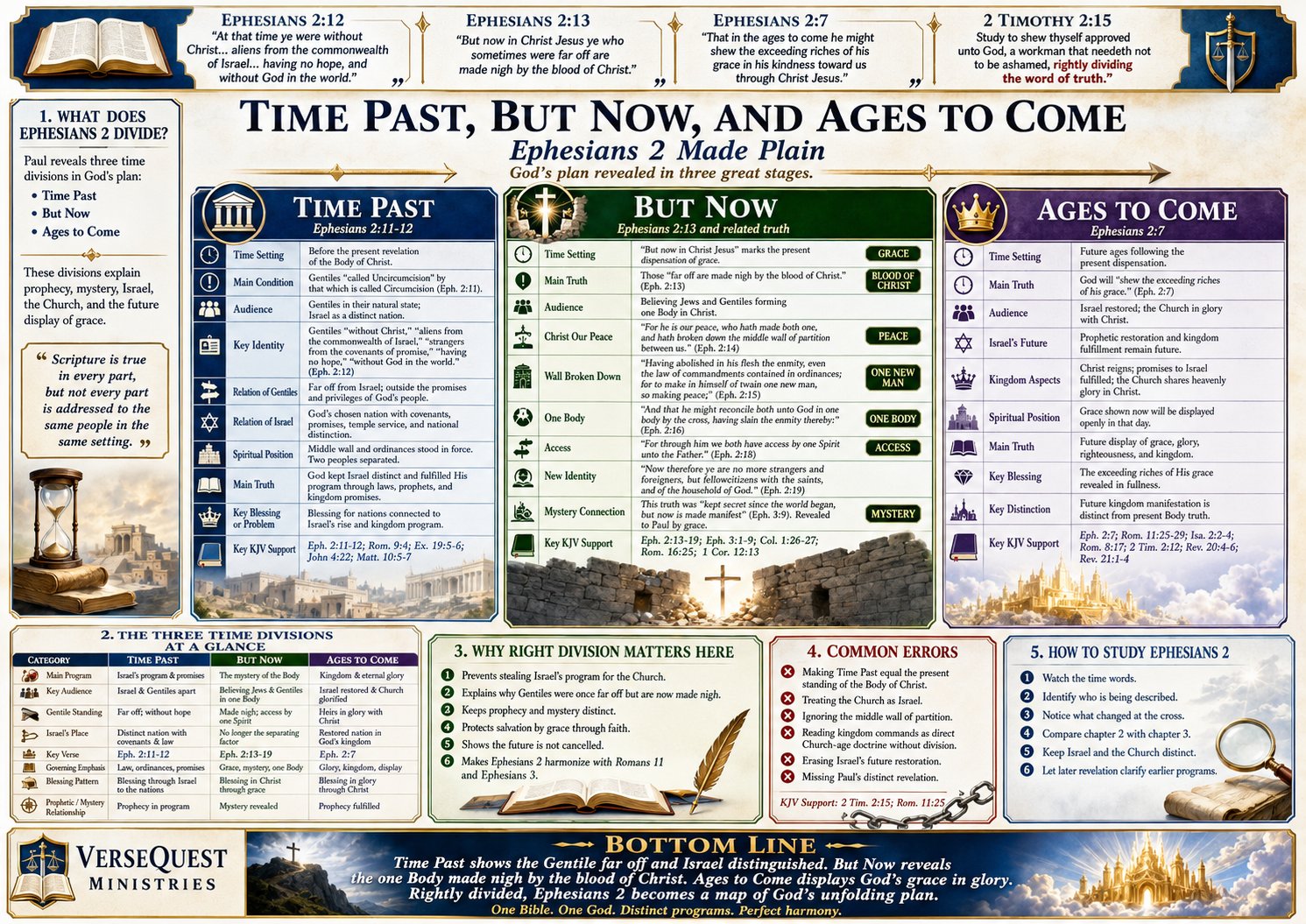
- Time Past, But Now, and Ages to Come – Ephesians 2 Rightly Divided KJV Bible Study Chart
- Understand Ephesians 2 with this detailed KJV chart explaining Time Past, But Now, Ages to Come, Gentile distance, the one Body, Israel’s future, and the importance of right division.
- $3.99
- Add to cart
-
-
Baptismal Regeneration
-
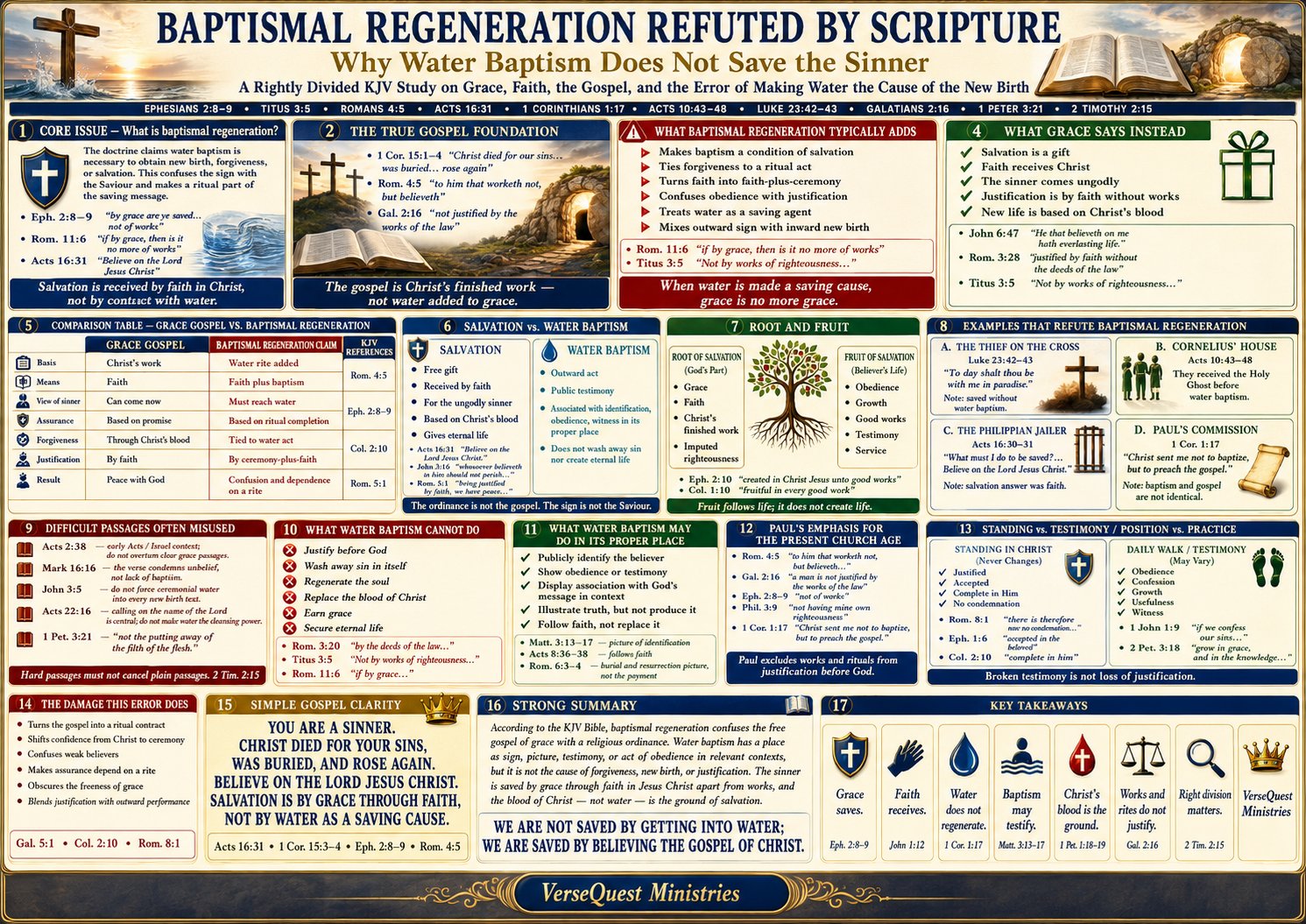
- Baptismal Regeneration Refuted by Scripture – Why Water Baptism Does Not Save the Sinner (KJV Bible Study Chart)
- See why water baptism does not save with this detailed KJV chart covering the gospel of grace, faith versus ritual, the thief on the cross, Cornelius, Paul’s commission, difficult baptism…
- $3.99
- Add to cart
-
-
What Was Completed at Calvary
-
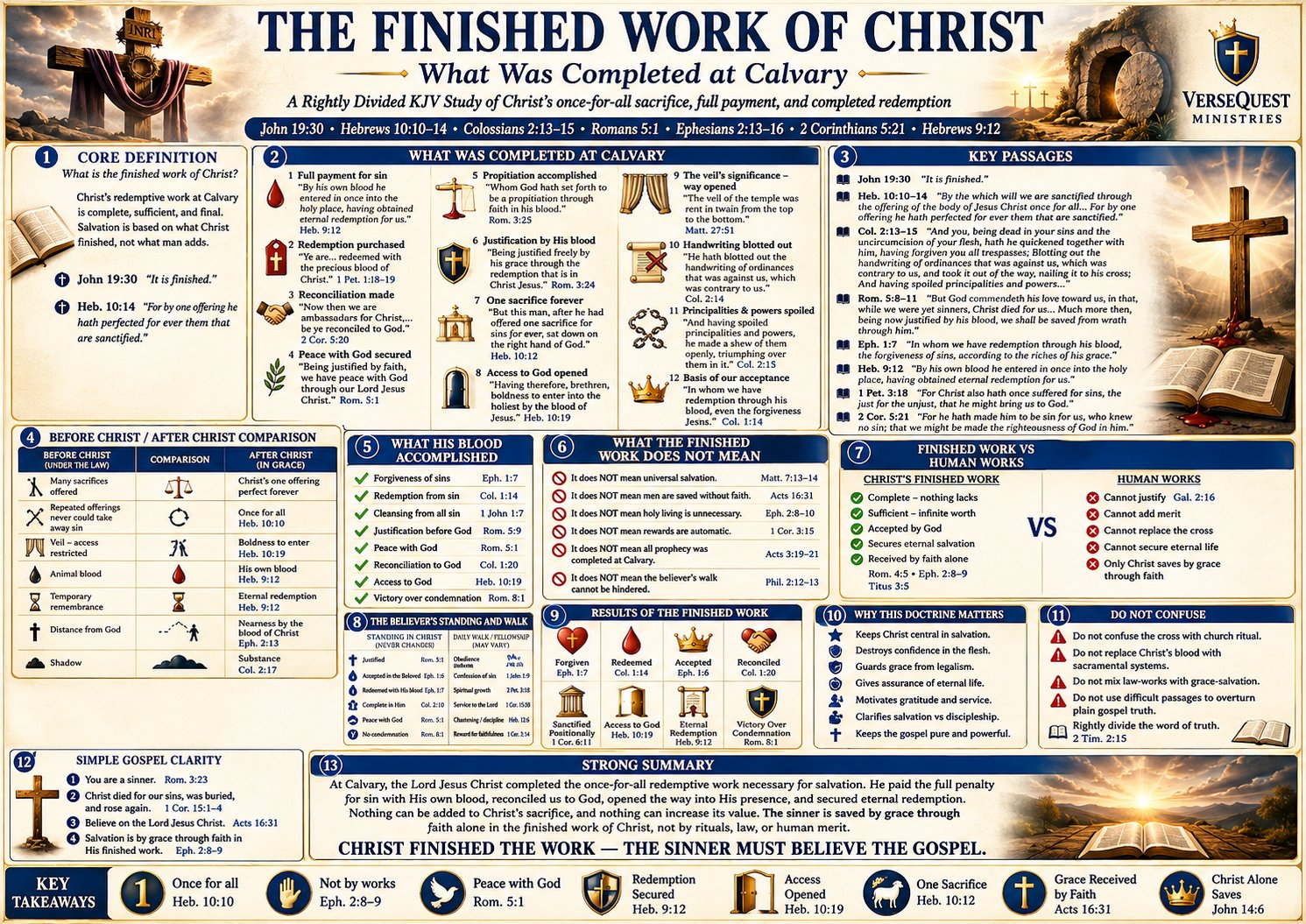
- The Finished Work of Christ – What Was Completed at Calvary Through His Once-for-All Sacrifice (KJV Bible Study Chart)
- Understand the finished work of Christ with this detailed KJV chart covering Calvary’s full payment, redemption, justification, reconciliation, propitiation, access to God, one sacrifice forever, and salvation apart from human…
- $3.99
- Add to cart
-
-
Assurance of Salvation
-
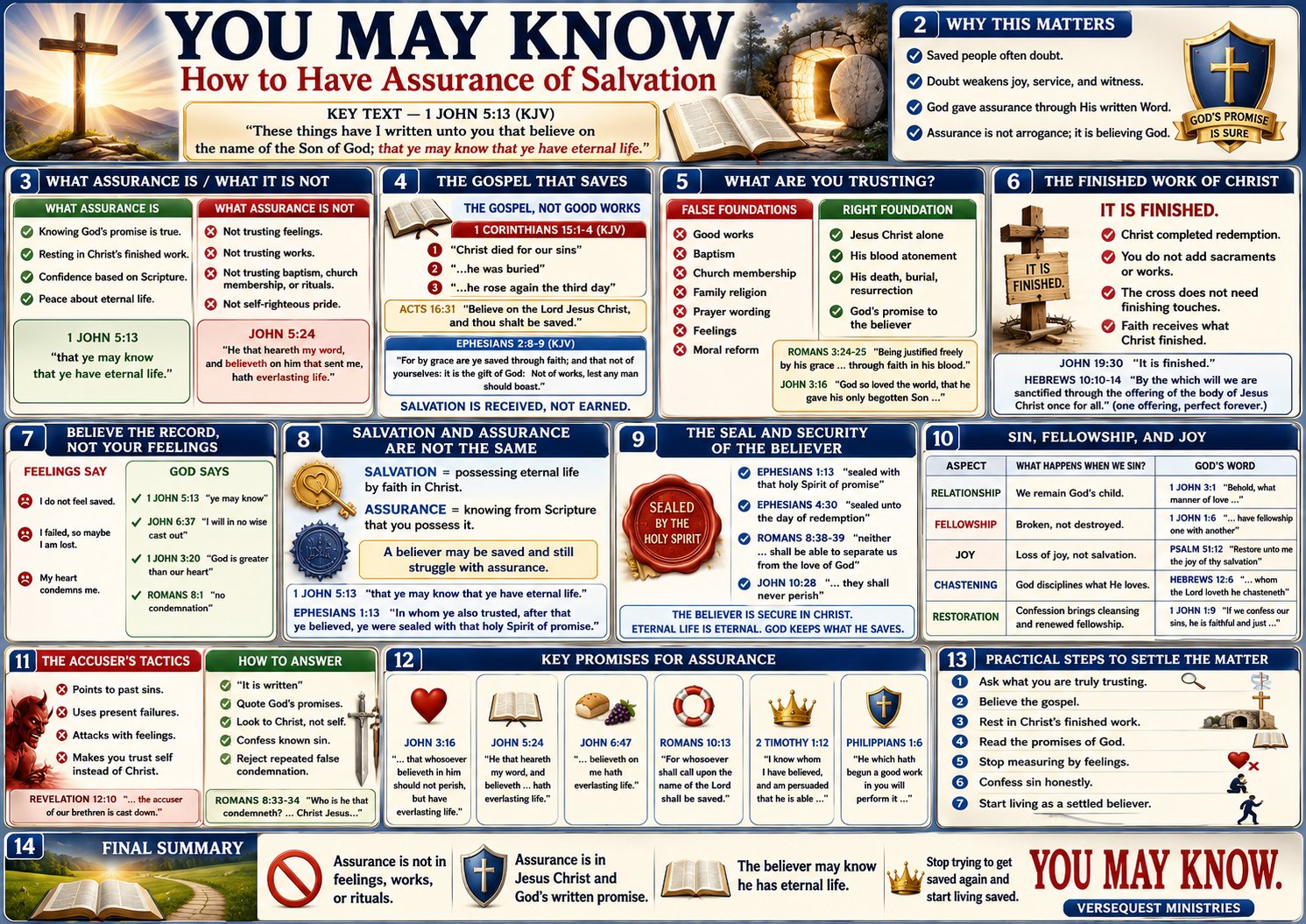
- You May Know – Assurance of Salvation, Eternal Security, and the Finished Work of Christ (KJV Bible Study Chart)
- Gain biblical assurance of salvation with this detailed KJV chart covering Christ’s finished work, eternal life, grace through faith, the Holy Spirit’s seal, sin and fellowship, confession, and God’s promises.
- $3.99
- Add to cart
-
-
The Gospel of the Kingdom
-
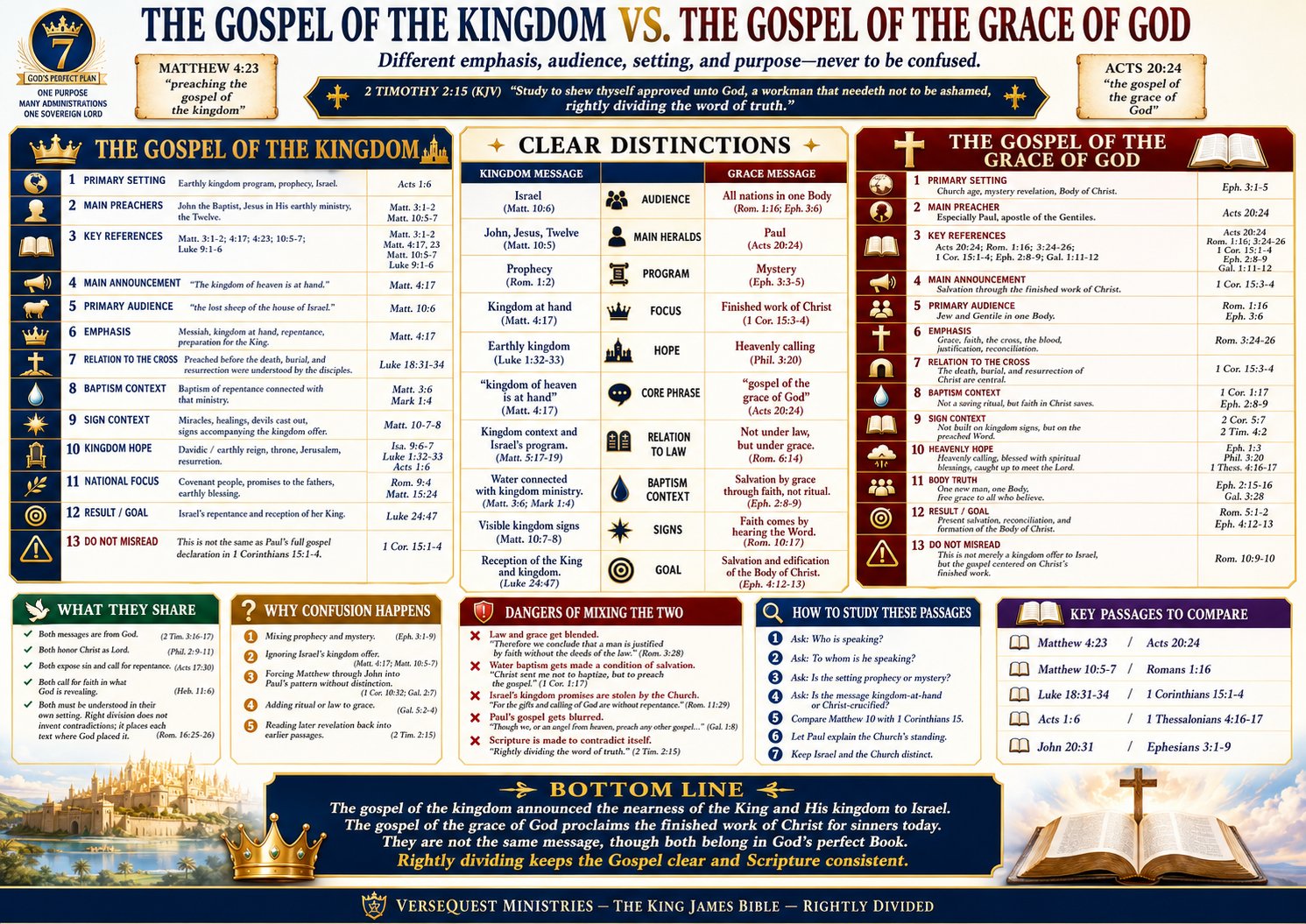
- The Gospel of the Kingdom vs. the Gospel of the Grace of God – KJV Right Division Bible Study Chart
- Compare the gospel of the kingdom and the gospel of the grace of God with this detailed KJV chart covering audience, message, prophecy, mystery, baptism, signs, salvation, and right division.
- $3.99
- Add to cart
-