
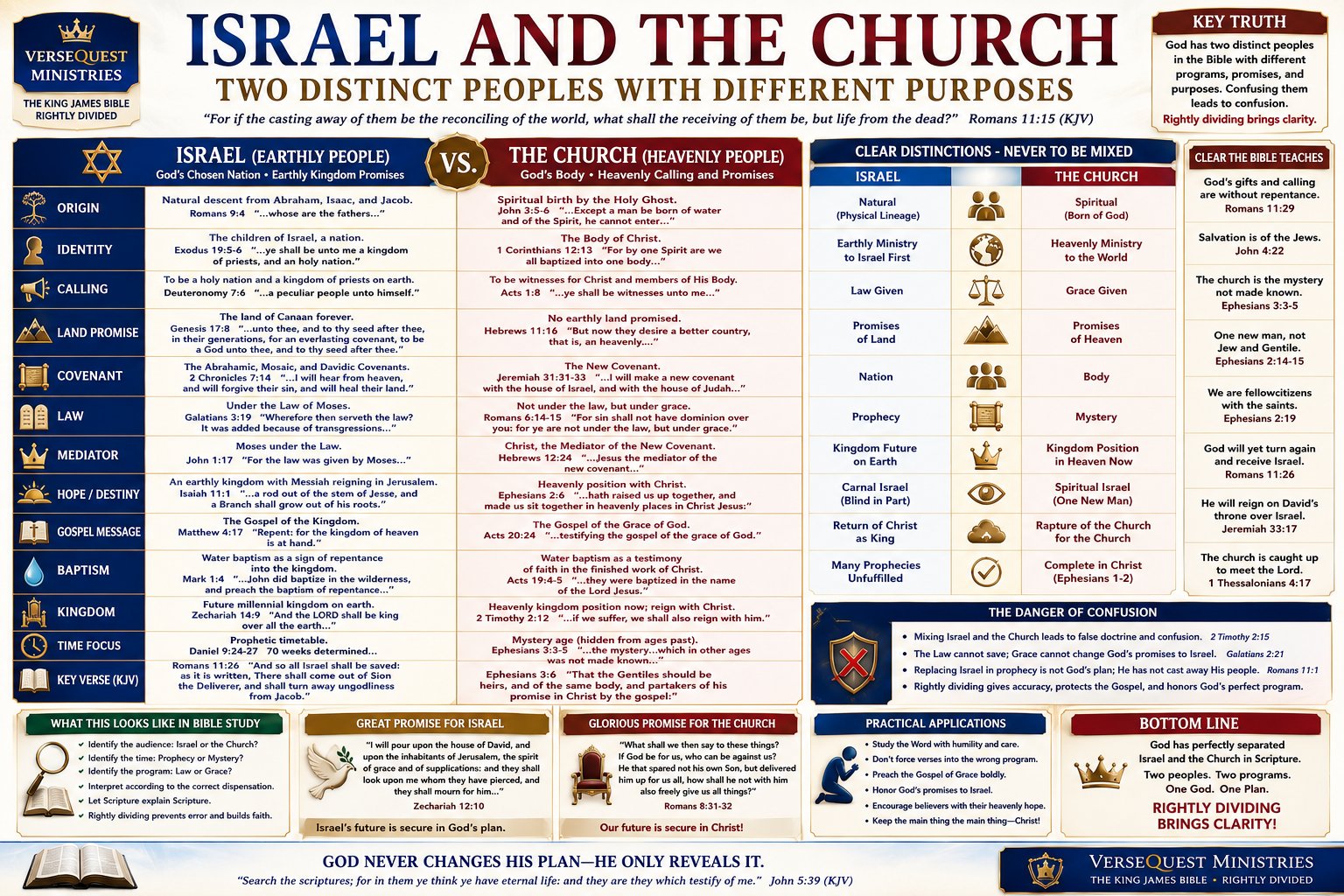
Israel and the Church Bible Study Chart – Two Distinct Peoples with Different Purposes (KJV)
Compare Israel and the Church with this detailed KJV Bible study chart covering their distinct origins, identities, covenants, callings, promises, gospel programs, and future destinies.
$3.99
Description
Israel and the Church: Two Distinct Peoples with Different Purposes is a detailed KJV Bible study chart explaining one of the most important distinctions in rightly divided Bible study. It compares Israel, God’s chosen earthly nation, with the Church, the Body of Christ possessing a heavenly calling, and shows why these two programs must not be merged, exchanged, or confused.
God has one sovereign plan and one eternal purpose, but Scripture reveals different peoples, callings, promises, covenants, ministries, and destinies within that plan. Israel and the Church both belong to the unfolding revelation of God, yet they do not possess the same origin, identity, commission, inheritance, time focus, or prophetic purpose.
Israel’s national origin is traced through the physical descendants of Abraham, Isaac, and Jacob. God separated Israel from the nations, gave the people a land, established covenants with them, placed them under the law of Moses, and promised an earthly kingdom ruled by the Messiah. These promises are literal, national, territorial, and prophetic.
The Church has a different origin. The Body of Christ is formed through spiritual birth and the baptism of believers by the Holy Spirit into one body. Its members are saved Jews and Gentiles who are reconciled to God through the finished work of Jesus Christ and made spiritually one in Him.
A major comparison examines the identity of each people. Israel is repeatedly described as a nation and kingdom of priests connected with earthly covenant promises. The Church is called the Body of Christ, a new man in whom believing Jews and Gentiles possess equal spiritual standing through grace.
The chart distinguishes their callings. Israel was called to be a holy nation, a peculiar people, and a testimony to the nations from its promised land. The Church is called to bear witness to Jesus Christ, preach the gospel of grace, and manifest the truth of the mystery revealed through the apostle Paul.
The land promise belongs specifically to Israel. God promised the land of Canaan to Abraham and his seed as an everlasting possession. The Church is never given a national territory on earth. Its members are blessed with spiritual blessings in heavenly places and look for a better, heavenly country.
The covenant section explains that Israel is connected with the Abrahamic, Mosaic, Davidic, and New Covenants. The New Covenant was expressly promised to the house of Israel and the house of Judah. The Church benefits from the blood of Christ and His redemptive work without becoming Israel or cancelling Israel’s future national fulfillment.
Israel was placed under the law of Moses, while the Church is not under the law but under grace. This distinction does not make the law sinful or unimportant. The law is holy and profitable when used lawfully, but it must not be imposed upon the Body of Christ as the means of justification, sanctification, or covenant identity.
The chart also compares the mediators and governing revelations associated with each program. Moses is connected with the giving of the law, while Jesus Christ is the mediator of the New Covenant and Head of the Church. Christ is central to both programs, but His relationship to Israel’s kingdom promises must not be confused with His present heavenly Headship over the Body.
Israel’s prophetic hope concerns restoration, national salvation, the return of the Messiah, the possession of the promised land, and the earthly reign of Christ from Jerusalem. The Church’s hope concerns its heavenly position in Christ, the catching away of the saints, resurrection and glorification, and reigning with Christ.
The gospel-message comparison distinguishes the gospel of the kingdom, proclaimed in connection with Israel’s Messiah and approaching kingdom, from the gospel of the grace of God entrusted especially to Paul. The death, burial, and resurrection of Christ stand at the center of the saving message preached during the present dispensation.
The chart also distinguishes water baptism connected with Israel’s repentance and kingdom preparation from the believer’s present identification with Christ through the work of the Holy Spirit. These subjects must be studied in their contexts rather than blended into one undivided system.
The contrast between prophecy and mystery is essential. Israel’s future was spoken by the prophets since the world began, while the truth concerning the one Body was hidden in God and later revealed through Paul. The mystery does not erase prophecy; it introduces previously unrevealed truth for the present Church Age.
The chart presents numerous distinctions that should never be mixed: natural lineage and spiritual birth, earthly ministry and heavenly ministry, law and grace, land promises and heavenly promises, nation and Body, prophecy and mystery, earthly kingdom and heavenly position, the Second Coming and the Rapture, and unfulfilled national prophecy versus complete spiritual standing in Christ.
A section titled The Danger of Confusion explains the consequences of failing to maintain these distinctions. Mixing Israel and the Church produces false doctrine, places believers under legal bondage, steals Israel’s promises, weakens assurance, and forces passages into programs for which they were never intended.
Replacement theology is directly rejected. The Church has not cancelled Israel, inherited Israel’s national identity, or permanently taken possession of every promise made to Abraham, Isaac, Jacob, and David. Romans 11 teaches that God’s gifts and calling are without repentance and that He will yet turn again to Israel.
The chart also protects the Church’s distinct blessings. The Body of Christ should not be forced under Israel’s law, earthly kingdom commission, tribulation program, or national covenant obligations. Believers should understand their complete position in Christ and their heavenly hope.
Practical Bible-study applications encourage the reader to identify the audience, time, program, covenant, and dispensation of every passage. Scripture should be allowed to explain Scripture without forcing verses addressed to Israel into Church doctrine or using Church truth to cancel Israel’s future.
The bottom line is clear: God has perfectly distinguished Israel and the Church in His Word. They are two peoples within one sovereign plan, possessing different programs and purposes that ultimately bring glory to the same Lord Jesus Christ. Rightly dividing these truths produces clarity, protects the gospel, honours God’s promises, and allows the Bible to speak without manufactured contradiction.
This chart is ideal for personal Bible study, dispensational teaching, pastoral training, Sunday school, homeschool Bible curriculum, Bible institutes, prophecy classes, Israel studies, Pauline doctrine, sermon preparation, and believers who want a clear visual explanation of the distinction between Israel and the Body of Christ.
Israel and the Church, two distinct peoples, earthly and heavenly programs, right division, Abrahamic Covenant, Mosaic Covenant, Davidic Covenant, New Covenant, land promise, Body of Christ, law and grace, prophecy and mystery, kingdom gospel, gospel of grace, Israel’s restoration, heavenly citizenship, Rapture of the Church, Second Coming of Christ, replacement theology, dispensational Bible study
Israel begins with God’s covenant dealings through Abraham, Isaac, and Jacob. The nation possesses a physical lineage, a literal land promise, national covenants, and a future earthly kingdom under the Messiah.
The Church is the Body of Christ. It is formed through spiritual birth and the Holy Spirit’s work of placing believers into one body. It includes saved Jews and Gentiles without making Gentiles into physical Israel.
First Corinthians 10:32 recognizes Jews, Gentiles, and the Church of God as meaningful biblical distinctions. A careful Bible student should not erase categories that the Holy Spirit preserves.
Israel’s land promise is literal. God promised Canaan to Abraham and his descendants. The Church possesses heavenly blessings in Christ but receives no national land grant that replaces Israel’s inheritance.
The law was given to Israel through Moses. The Church is not under the Mosaic law as its covenant rule but under grace. Mixing the two produces legalism and weakens the believer’s understanding of Christ’s finished work.
The New Covenant was promised to Israel and Judah. The Church receives salvation through Christ’s blood and enjoys spiritual blessings secured by His sacrifice, but this does not cancel the covenant’s future national fulfillment for Israel.
Prophecy concerns truths spoken by the prophets from the beginning. The mystery concerning the one Body was hidden in God and later revealed through Paul. Mystery truth supplements the biblical revelation without erasing prophecy.
The gospel of the kingdom announced Israel’s approaching Messiah and kingdom. The gospel of the grace of God proclaims Christ’s death, burial, and resurrection as the completed basis of salvation in the present age.
The Rapture and the Second Coming should not be merged. At the Rapture, Christ gathers the Church to Himself. At the Second Coming, He returns visibly as King, judges His enemies, restores Israel, and establishes His earthly reign.
Israel’s present blindness is partial and temporary. Romans 11 teaches that God has not cast away His people permanently and that His gifts and calling are without repentance.
The Church should not steal Israel’s earthly promises, and Israel’s prophetic tribulation program should not be imposed upon the Church. Maintaining both distinctions protects each program from confusion.
Rightly dividing Israel and the Church is not dividing God’s purpose. It is honouring the distinctions through which His one sovereign plan is revealed and fulfilled.
Israel and Church comparison studies, dispensational Bible teaching, right-division classes, prophecy instruction, Pauline doctrine, law and grace studies, covenant studies, Rapture and Second Coming comparisons, refuting replacement theology, pastoral training, Sunday school lessons, homeschool Bible curriculum, Christian school instruction, Bible institute classes, sermon preparation, new-believer discipleship, personal Bible study, biblical interpretation training
King James Bible, Strong’s Concordance, Thompson Chain-Reference Bible, Treasury of Scripture Knowledge, Nave’s Topical Bible, dispensational timeline charts, Israel and Church comparison notes, Abrahamic Covenant studies, Romans 9–11 study resources, Pauline epistle outlines, prophecy charts, law and grace comparison studies, Rapture and Second Coming charts, VerseQuest right-division and doctrine charts
Related products
-
The Rapture
-
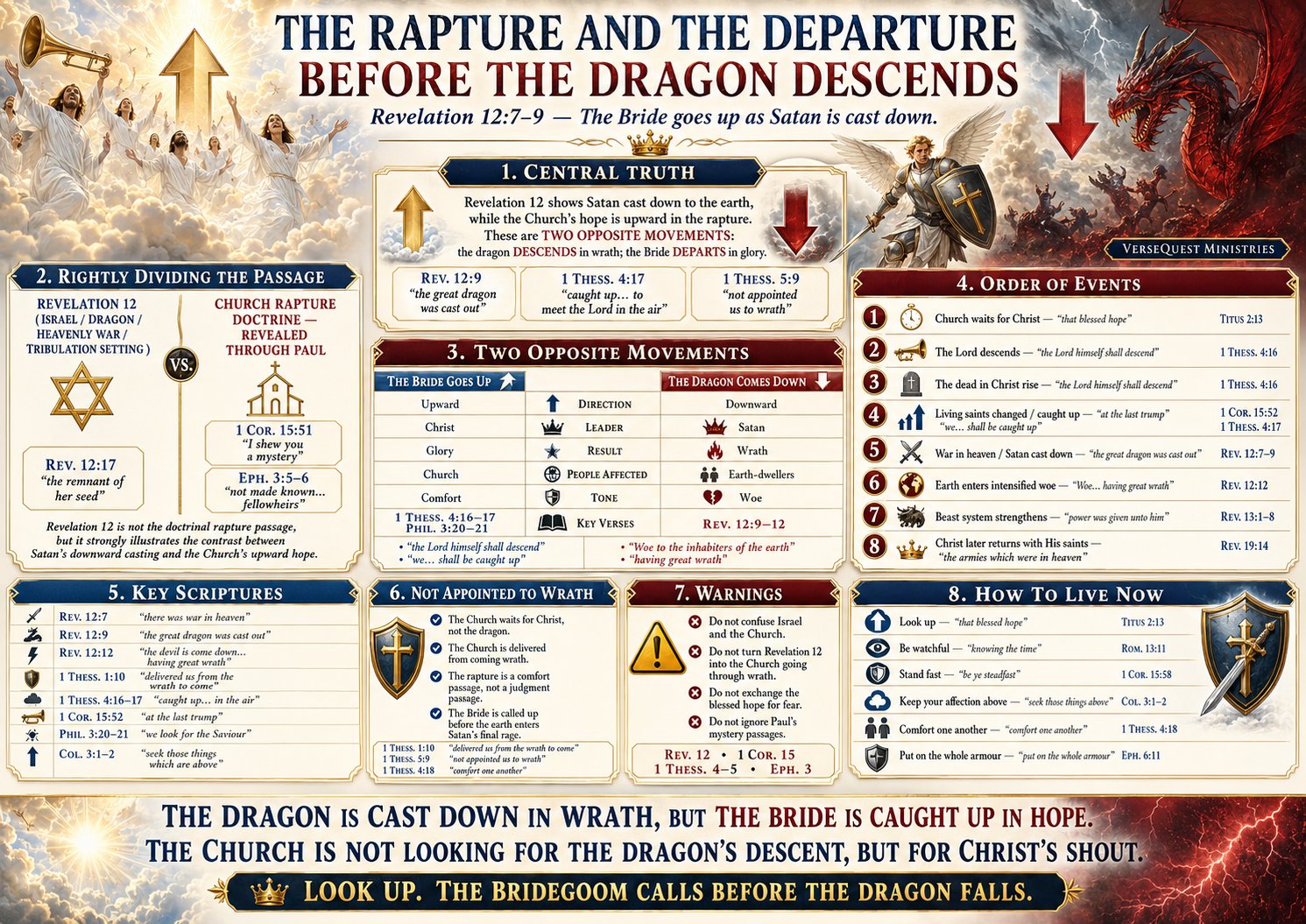
- The Rapture and the Departure Before the Dragon Descends – Printable Bible Study Chart
- Printable KJV Bible study chart on The Rapture and the Departure Before the Dragon Descends, showing the Bride caught up before Satan is cast down in wrath. This premium VerseQuest…
- $4.99
- Add to cart
-
-
Paul and the Twelve
-
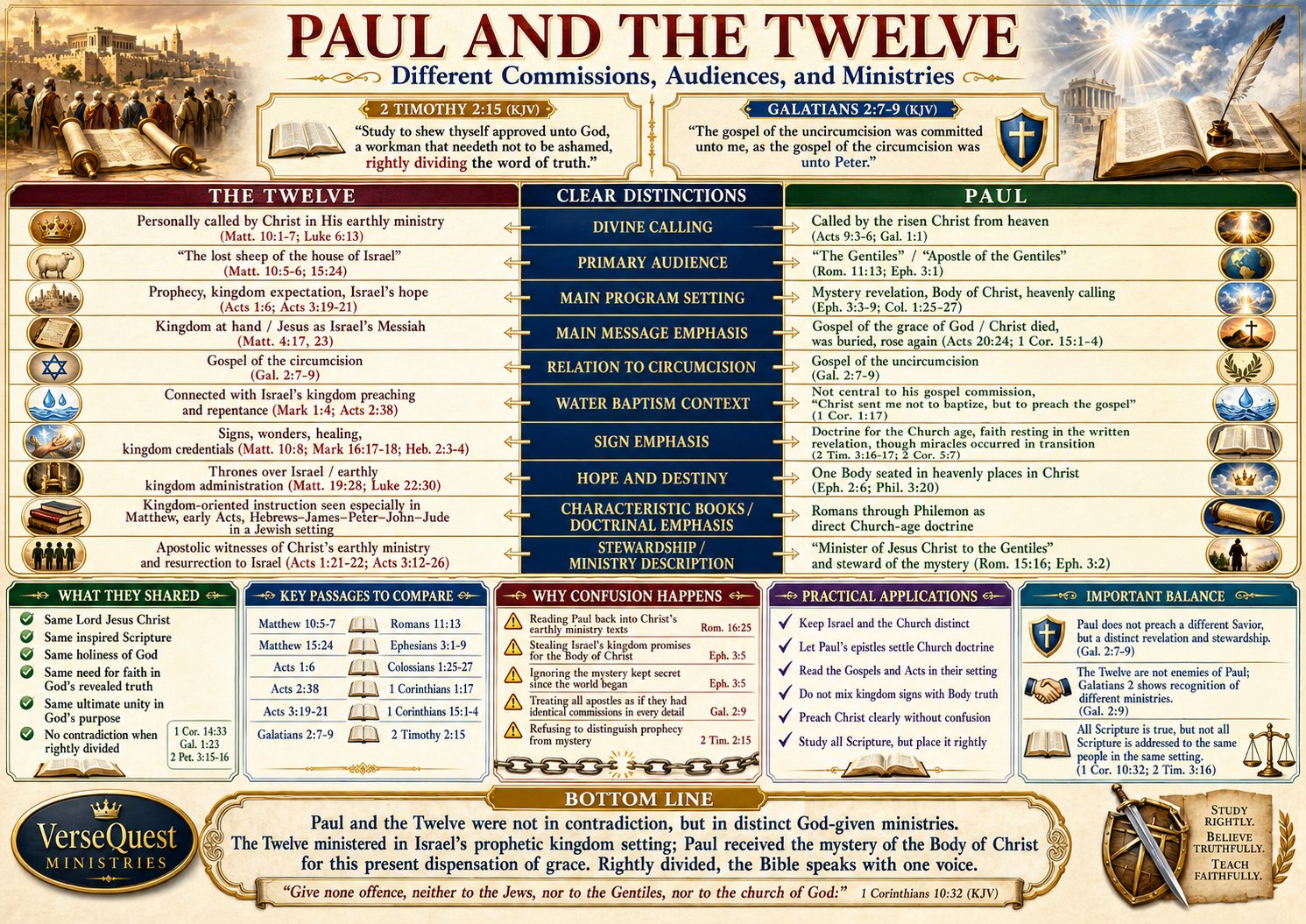
- Paul and the Twelve Bible Study Chart – Different Commissions, Audiences, and Ministries (KJV)
- Compare Paul and the Twelve with this detailed KJV Bible study chart covering their distinct callings, audiences, Kingdom and mystery settings, gospel stewardships, baptism contexts, signs, and future hopes.
- $3.99
- Add to cart
-
-
Doctrine
-
-50%
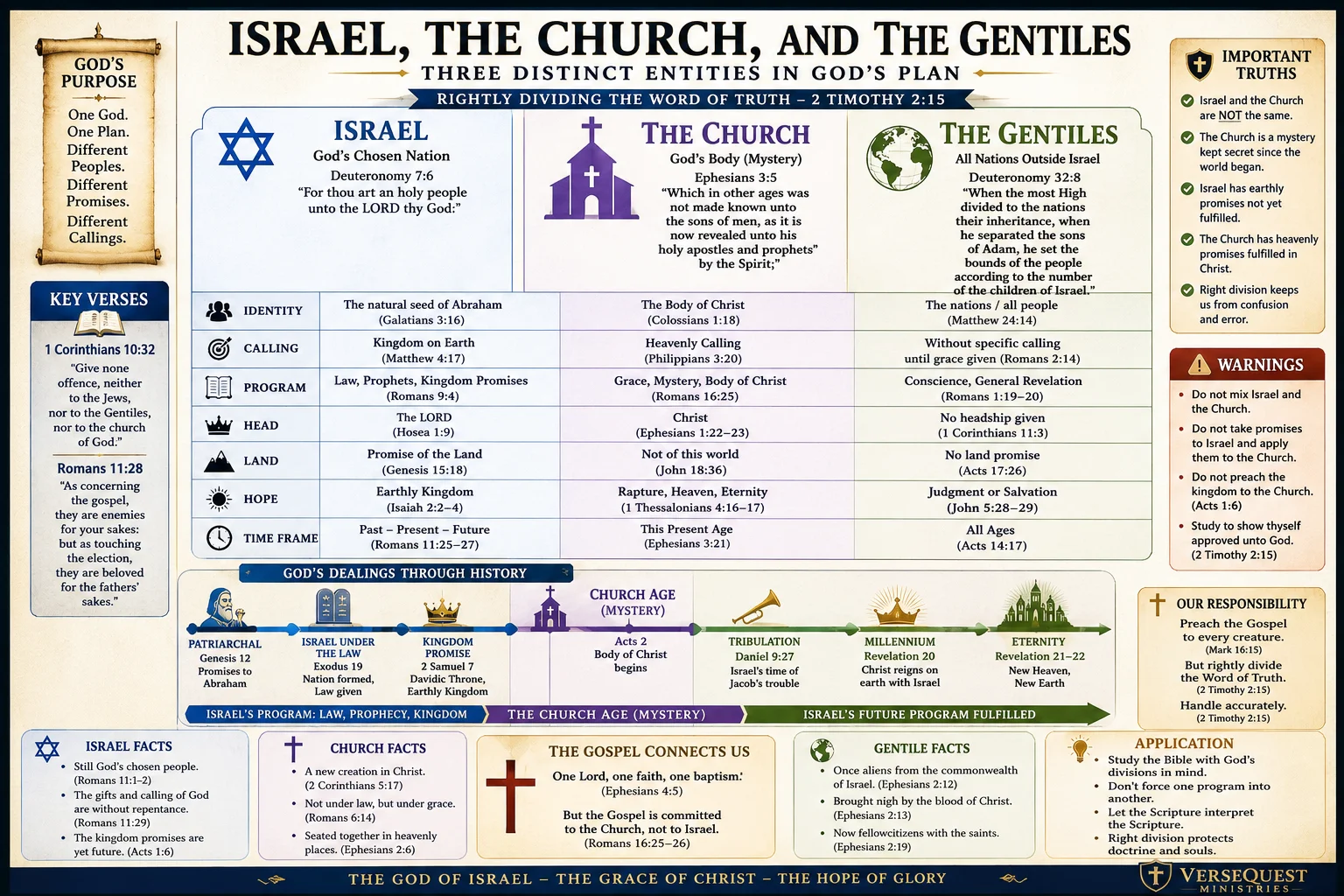
- Israel, the Church, and the Gentiles Chart — KJV Rightly Divided
- Premium printable KJV Bible study chart comparing Israel, the Church, and the Gentiles as three distinct entities in God’s plan. Rightly divided, visually organized, and designed for teaching and personal…
- Original price was: $10.00.$4.99Current price is: $4.99.
- Add to cart
-
-50%
-
Law vs Grace
-
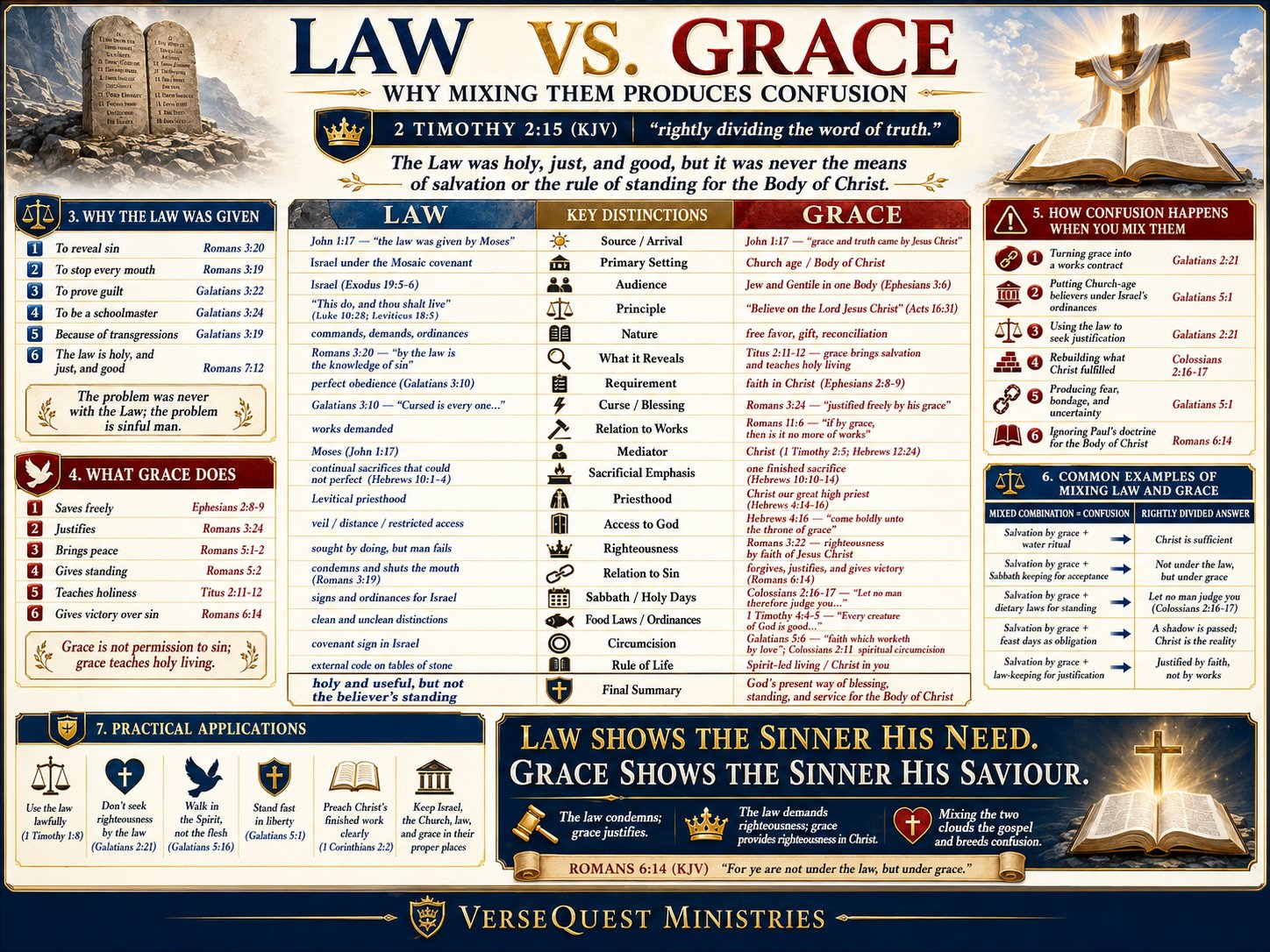
- Law vs. Grace Bible Study Chart – Why Mixing Them Produces Confusion (KJV)
- Compare law and grace with this detailed KJV Bible study chart explaining salvation, justification, holiness, Israel’s Mosaic covenant, Christian liberty, and the danger of mixing law with the gospel.
- $3.99
- Add to cart
-
-
Not Under Law But Grace
-
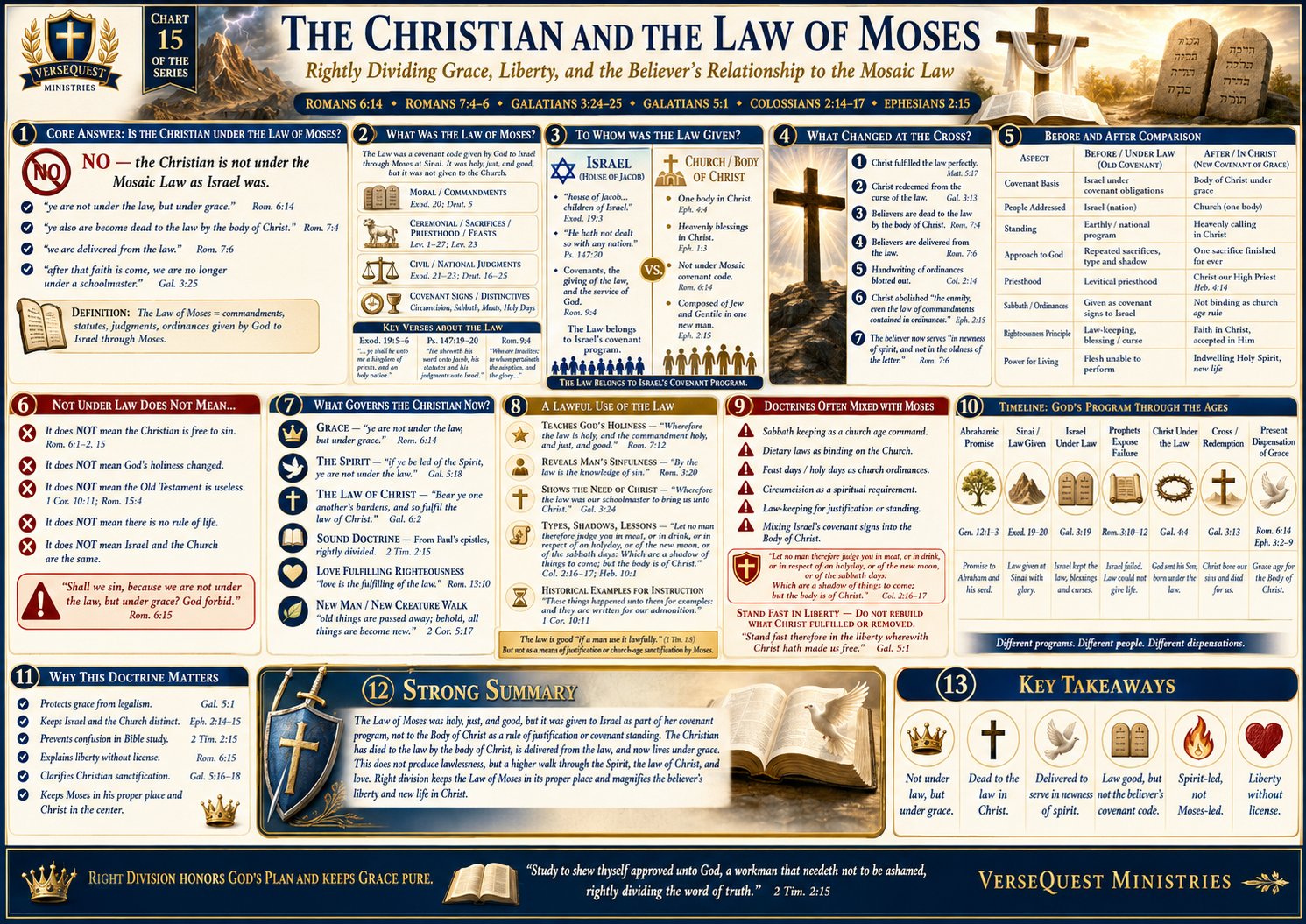
- The Christian and the Law of Moses – Grace, Liberty, and the Believer’s Relationship to the Mosaic Law (KJV Bible Study Chart)
- Understand the Christian’s relationship to the law of Moses with this detailed KJV chart covering Israel’s covenant, grace, liberty, the cross, the law of Christ, and Spirit-led living.
- $3.99
- Add to cart
-