
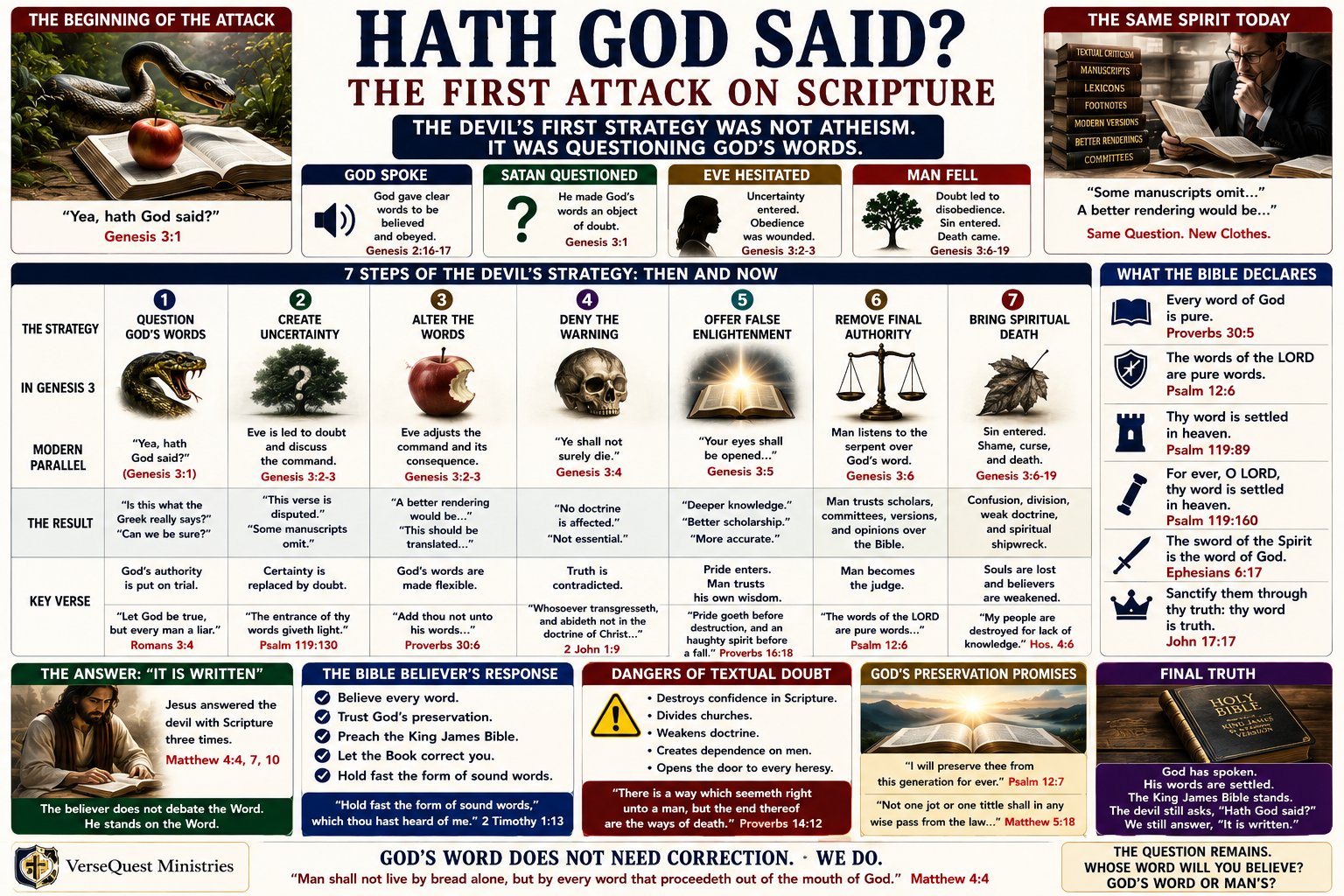
Hath God Said? Bible Study Chart – The First Attack on Scripture, Textual Doubt, and KJV Preservation
Trace Satan’s first attack on Scripture with this detailed KJV Bible study chart covering Genesis 3:1, textual doubt, altered words, false enlightenment, Bible preservation, and final authority.
$3.99
Description
Hath God Said? The First Attack on Scripture is a detailed KJV Bible study chart tracing Satan’s original strategy in Genesis 3 and showing how the same pattern of questioning, altering, denying, and overruling God’s words continues through modern textual doubt.
The devil’s first recorded strategy was not atheism. He did not begin by denying that God existed. He began with the question, “Yea, hath God said?” The attack focused upon the certainty, authority, wording, and meaning of divine revelation. Once Eve began discussing God’s command with the serpent rather than standing upon it, uncertainty entered and obedience weakened.
The chart presents the progression of the fall in four clear stages. God spoke definite words that were to be believed and obeyed. Satan turned those words into an object of suspicion. Eve hesitated, altered the command, and entertained uncertainty. Man then disobeyed, bringing sin, shame, judgment, and death into the human race.
A central section traces seven steps in the devil’s strategy, both in Genesis 3 and in its modern parallels. The first step is to question God’s words. The second is to create uncertainty about what the text actually says. The third is to alter or soften the wording. The fourth is to deny the warning attached to disobedience. The fifth is to promise superior enlightenment. The sixth is to remove the Bible as the final authority. The seventh is to produce spiritual confusion and death.
The modern language may sound more scholarly, but the underlying question remains the same. Expressions such as “some manuscripts omit,” “this verse is disputed,” “a better rendering would be,” or “the Greek really says” may train readers to distrust the Bible they hold and transfer authority to scholars, committees, lexicons, manuscripts, and modern translations.
The chart does not condemn honest study, historical information, language tools, or responsible scholarship. It addresses the danger of placing those tools above the written Word. A concordance may help a believer study Scripture, but it must not become a throne from which Scripture is corrected. A manuscript may provide historical evidence, but it must not replace God’s preserved Book as the believer’s final authority.
The seven-step comparison demonstrates how textual doubt progresses. First, God’s authority is placed on trial. Then certainty is replaced by doubt. God’s words are treated as flexible, warnings are softened, human wisdom is exalted, man becomes the judge of Scripture, and believers are left with weakened doctrine and divided confidence.
A special section gathers clear declarations from the King James Bible. Every word of God is pure. The words of the LORD are pure words. God’s Word is settled in heaven. His Word is true from the beginning. The Word of God is the sword of the Spirit, and believers are sanctified through the truth.
The chart also presents the biblical response: “It is written.” When Jesus Christ was tempted, He did not negotiate with Satan, search for a more probable reading, or place the Scripture on trial. Three times He answered the tempter with the written Word. The believer’s safety is found in standing upon Scripture rather than debating whether God spoke clearly.
The dangers of textual doubt include destroyed confidence in Scripture, weakened doctrine, dependence upon human authorities, division among believers, and an open door to further error. Once every passage becomes subject to revision, no doctrine remains entirely safe from the editor’s pencil.
God’s preservation promises provide the answer. The LORD promised to preserve His words. Christ declared that not one jot or tittle would pass from the law until all was fulfilled. The believer can therefore trust that the God who inspired Scripture is also capable of preserving it for succeeding generations.
The chart’s final challenge is direct: Whose word will you believe—God’s Word or man’s? God has spoken, His words are settled, and the King James Bible stands as the believer’s final authority. God’s Word does not need correction. The reader does.
This resource is ideal for personal Bible study, KJV Bible classes, Scripture-preservation studies, Bible-version discussions, pastoral training, Sunday school, homeschool instruction, Christian schools, Bible institutes, apologetics, sermon preparation, and teaching on final biblical authority.
Hath God said, Genesis 3 deception, first attack on Scripture, questioning God’s words, textual doubt, biblical preservation, final authority, King James Bible, altering Scripture, denying God’s warning, false enlightenment, manuscript uncertainty, modern Bible versions, textual criticism, trust in Scripture, it is written, preserved words, doctrinal certainty, spiritual deception, Bible authority
Satan’s first attack was directed at the words of God. The serpent did not begin by arguing that there was no God. He began by turning a clear command into a question: “Yea, hath God said?”
Questioning created the environment for alteration. Eve added to God’s wording by saying, “neither shall ye touch it,” and weakened the certainty of judgment by saying, “lest ye die.” Once the words became flexible, obedience became negotiable.
The serpent then denied God’s warning directly: “Ye shall not surely die.” Doubt rarely remains neutral. It prepares the heart to reject what God has plainly spoken.
False enlightenment followed contradiction. Satan promised that disobedience would open their eyes and make them as gods. Error often presents itself as intellectual advancement, hidden knowledge, superior insight, or freedom from restrictive authority.
The same spiritual pattern appears whenever the Bible is treated as uncertain until scholars approve it. The terminology may be academic, but the practical effect is to place God’s words on trial.
Scholarship is valuable when it serves Scripture. It becomes dangerous when it judges Scripture, replaces Scripture, or teaches the believer that no final text can be confidently possessed.
A Bible that must continually be corrected cannot function as the final court of appeal. The authority eventually belongs to whoever decides which words should remain, which should be removed, and which reading is supposedly better.
Jesus answered temptation with “It is written.” He treated the written Word as sufficient, authoritative, understandable, and final. The believer should follow the same pattern.
God’s preservation is not dependent upon man’s perfection. The same God who inspired His words is able to keep them through history and place them in the hands of ordinary believers.
Textual doubt weakens preaching because the preacher cannot confidently declare, “Thus saith the Lord,” while continually questioning whether the Lord actually said it.
The Bible should correct the believer. When the believer is trained to correct the Bible, the proper relationship between man and revelation has been reversed.
The final issue is faith. Either God has preserved His words as He promised, or the believer remains dependent upon changing human opinions. Biblical confidence receives the Book, believes every word, and stands upon what is written.
KJV Bible teaching, Scripture-preservation classes, Genesis 3 studies, Bible-version discussions, apologetics, pastoral training, doctrinal instruction, new-believer discipleship, Sunday school lessons, homeschool Bible curriculum, Christian school teaching, Bible institute classes, sermon preparation, church leadership training, personal Bible study, defence of final authority, textual-criticism studies, spiritual discernment
King James Bible, Strong’s Concordance, Thompson Chain-Reference Bible, Treasury of Scripture Knowledge, Nave’s Topical Bible, Scripture-preservation study notes, Genesis 3 cross-reference materials, Bible-version comparison worksheets, personal doctrinal notebook, studies on Psalm 12, studies on Psalm 119, studies on 2 Timothy 3, studies on Revelation 22, VerseQuest KJV and doctrine charts
Related products
-
Bitterness
-
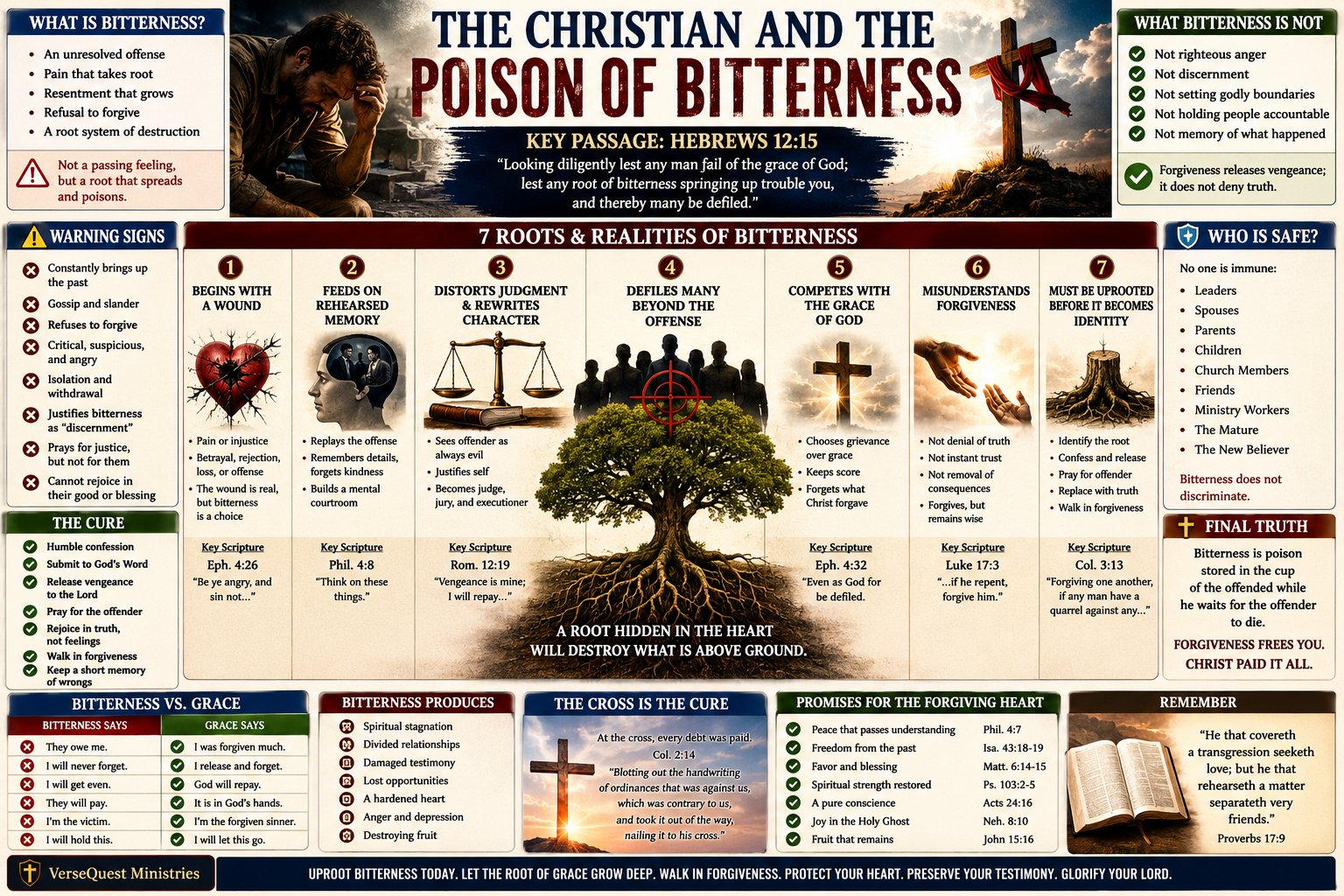
- The Christian and the Poison of Bitterness Bible Study Chart – Forgiveness, Grace, and Healing the Heart (KJV)
- Expose and uproot bitterness with this detailed KJV Bible study chart covering unresolved offenses, warning signs, forgiveness, grace, wise boundaries, the cross, and healing for the Christian heart.
- $3.99
- Add to cart
-
-
Spiritual Growth
-
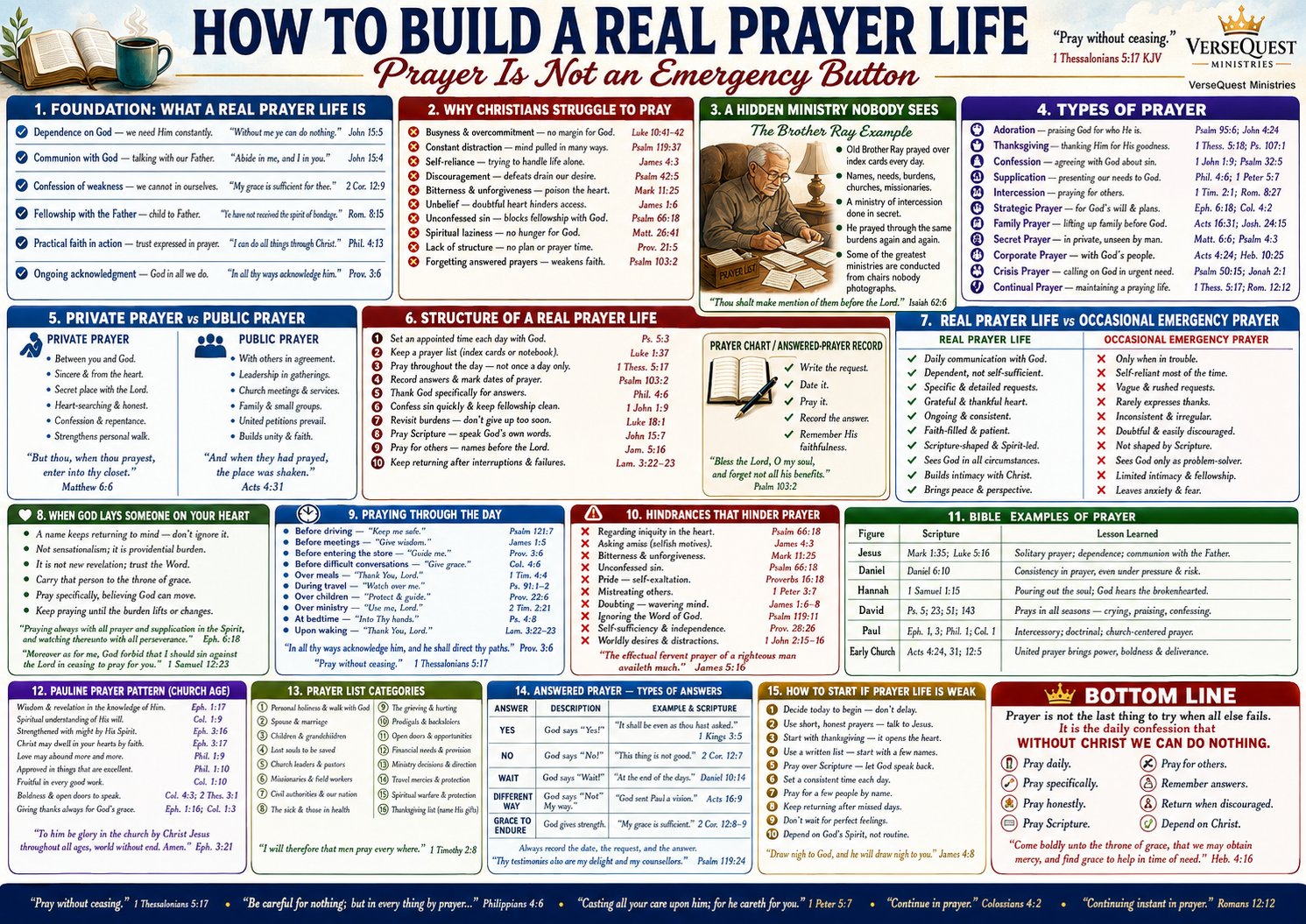
- How to Build a Real Prayer Life – Biblical Prayer Guide and KJV Bible Study Chart
- Build a consistent, biblical prayer life with this detailed KJV Bible study chart. Explore the foundations of prayer, types of prayer, common hindrances, answered prayer, Bible examples, and practical ways…
- $3.99
- Add to cart
-
-
Heavenly Program
-
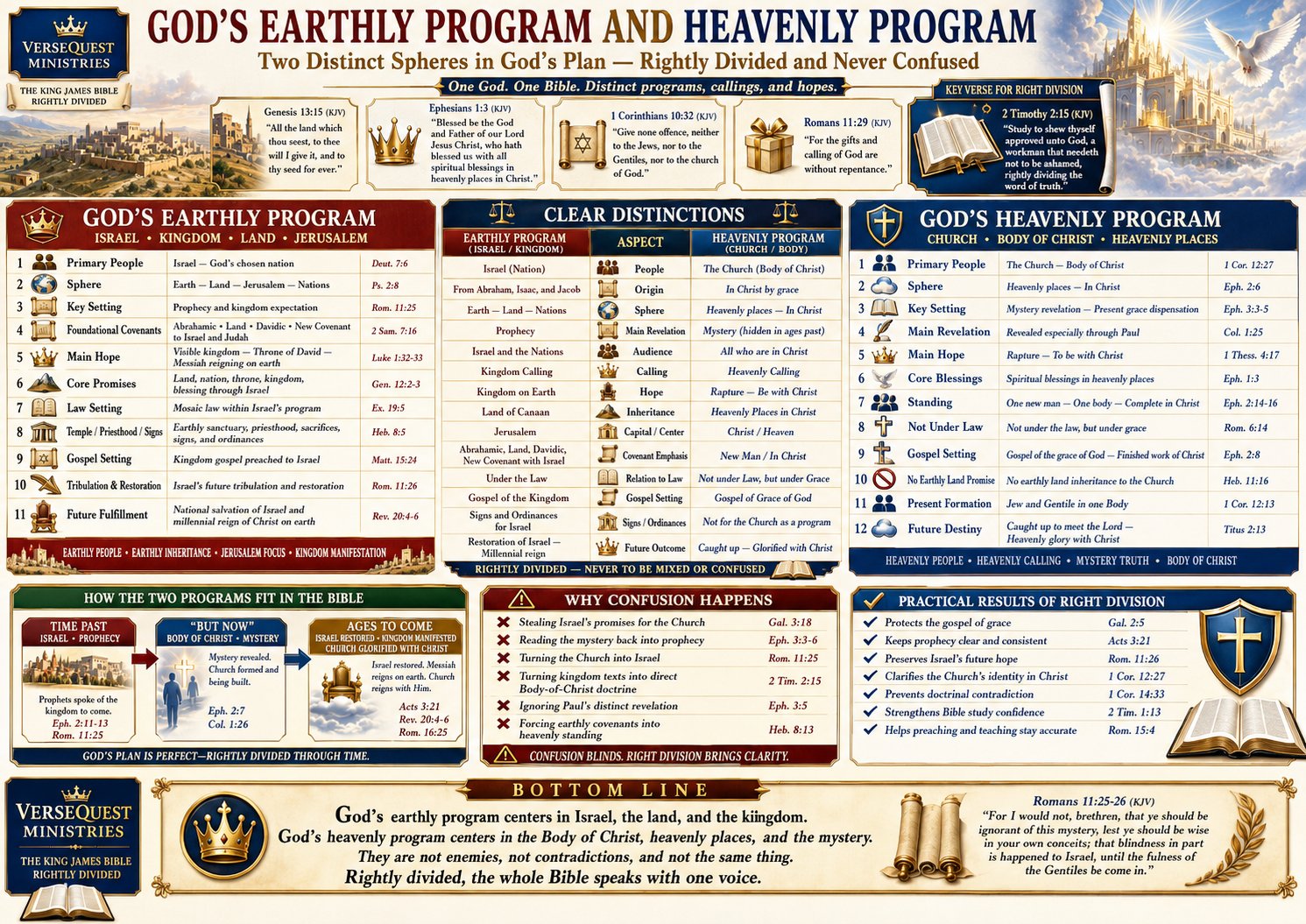
- Israel and the Church: Earthly and Heavenly Callings – KJV Bible Study Chart
- Printable digital KJV Bible study chart comparing Israel’s earthly promises and kingdom hope with the Church’s heavenly calling in Christ. Covers prophecy and mystery, biblical covenants, law and grace, the…
- $3.99
- Add to cart
-
-
Cain and Abel
-
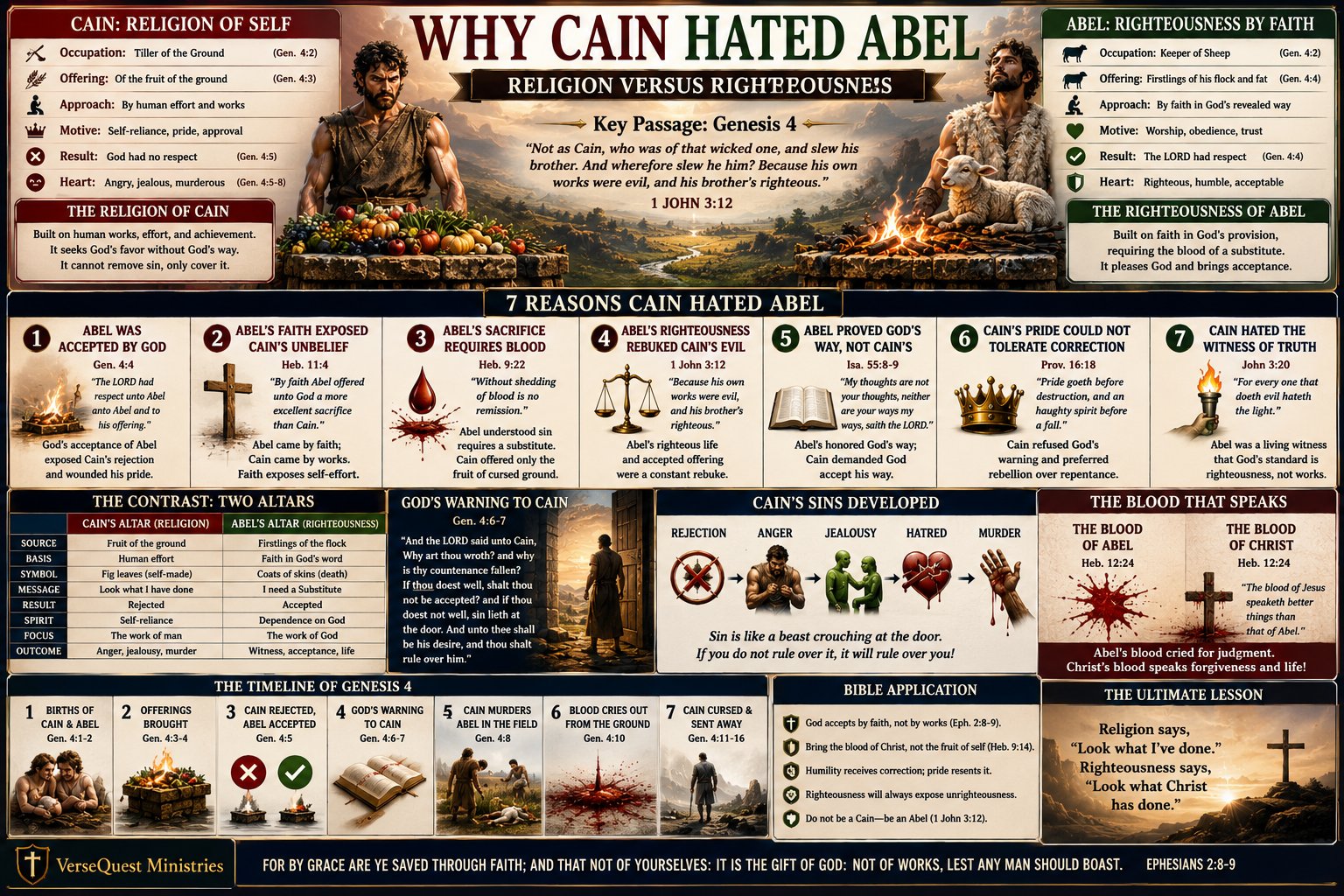
- Why Cain Hated Abel Bible Study Chart – Religion Versus Righteousness, Faith, Works, and Blood Sacrifice (KJV)
- Discover why Cain hated Abel with this detailed KJV Bible study chart comparing religion and righteousness, human works and faith, rejected worship, blood sacrifice, pride, jealousy, and salvation through Christ.
- $3.99
- Add to cart
-
-
Spritual Dryness
-
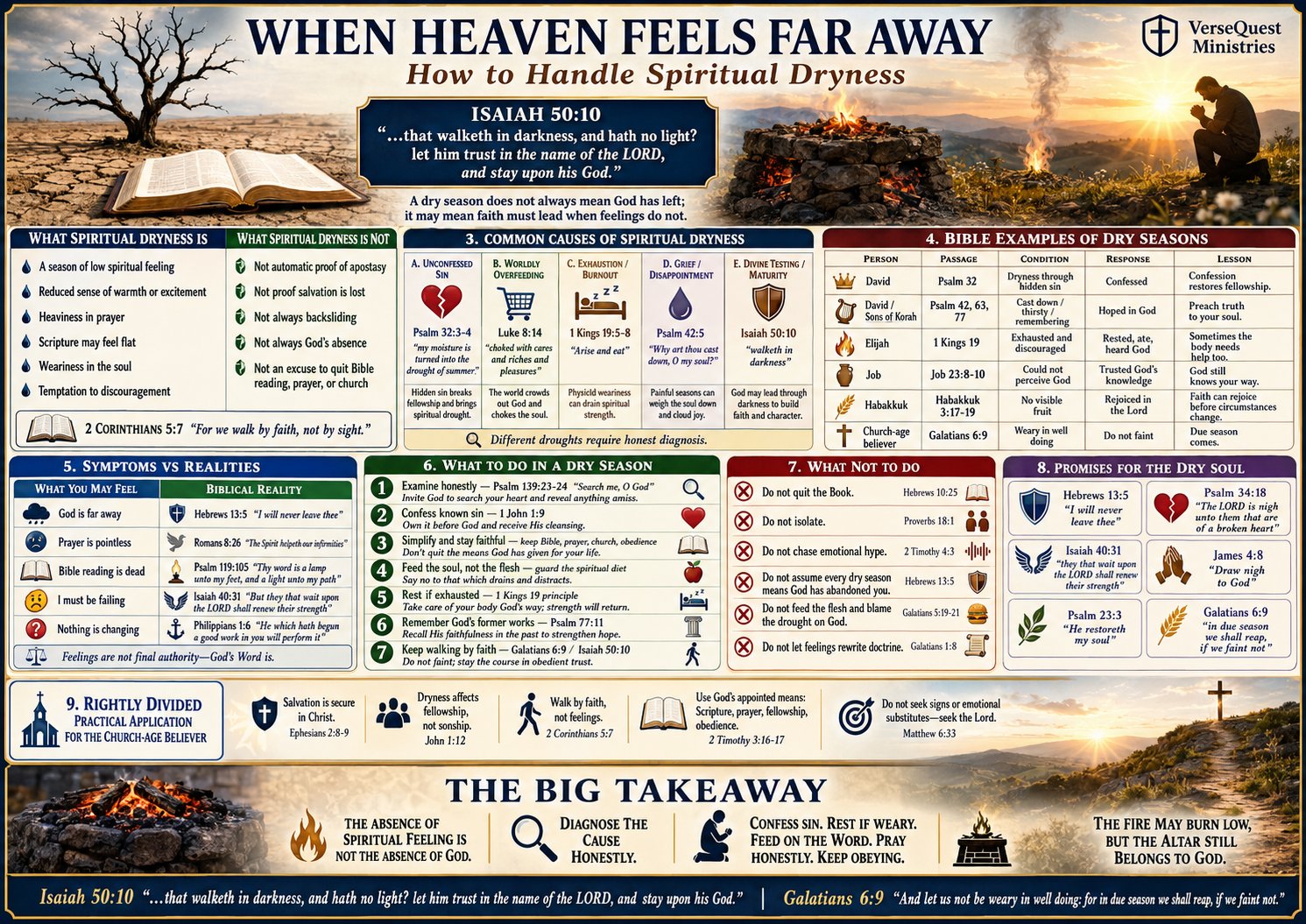
- When Heaven Feels Far Away – How to Handle Spiritual Dryness and Walk by Faith (KJV Bible Study Chart)
- Walk through spiritual dryness with this detailed KJV Bible study chart covering its causes, biblical examples, warning signs, promises, faithful habits, and the difference between feelings and truth.
- $3.99
- Add to cart
-