
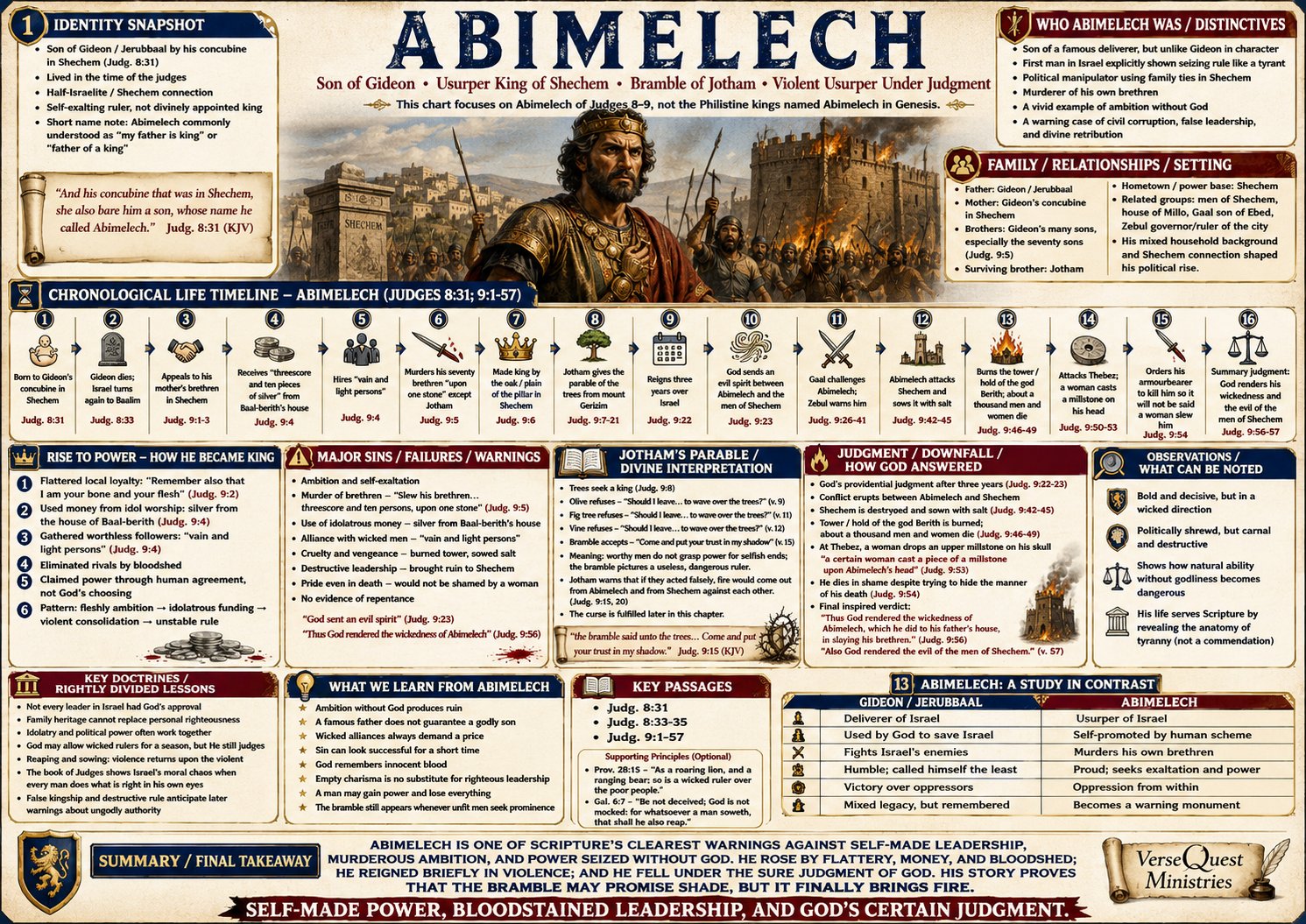
Abimelech – Son of Gideon, Usurper King of Shechem, the Bramble of Jotham, and a Warning Against Self-Made Power (KJV Bible Study Chart)
Study Abimelech, the murderous son of Gideon, with this detailed KJV chart covering his rise through Shechem, the slaughter of his brothers, Jotham’s bramble parable, three-year reign, destruction of Shechem, and final judgment.
$3.99
Description
Abimelech: Son of Gideon, Usurper King of Shechem, Bramble of Jotham, and Violent Ruler Under Judgment is a detailed KJV Bible-character chart examining one of the darkest political figures in the book of Judges. His story in Judges 8:31 and Judges 9:1–57 reveals what happens when personal ambition, family influence, idolatrous money, popular approval, murder, and unchecked power combine beneath a leader who was never appointed by God.
This chart concerns the Abimelech who was the son of Gideon, also called Jerubbaal, through Gideon’s concubine in Shechem. It does not concern the Philistine rulers named Abimelech in Genesis. Gideon had delivered Israel from Midian, but Abimelech inherited his father’s famous name without possessing his father’s humble beginning, dependence upon God, or role as Israel’s deliverer.
Abimelech was connected to two worlds. Through Gideon, he belonged to the household of a celebrated judge of Israel. Through his mother, he possessed close family and political connections in Shechem. Instead of using that heritage for service, he turned it into an instrument of manipulation and personal advancement.
After Gideon died, Israel returned to Baal worship and made Baal-berith their god. The people forgot the LORD who had delivered them and showed no lasting kindness to Gideon’s household. That spiritual collapse created the environment in which Abimelech’s ambition could flourish.
The chart traces his rise to power step by step. Abimelech went to his mother’s relatives in Shechem and appealed to local loyalty. He asked whether it was better for Gideon’s seventy sons to rule over them or for one man—one of their own flesh and bone—to possess authority.
His argument was not based upon divine calling, righteous character, proven service, or concern for Israel. It was built upon family loyalty, political convenience, and fear of rival leadership. He offered the men of Shechem a ruler who belonged to them rather than a servant chosen by God.
The men of Shechem gave Abimelech seventy pieces of silver from the house of Baal-berith. His political campaign was financed by money taken from an idolatrous temple. Scripture therefore links his rise directly with false worship, corrupt funding, and a city willing to purchase its preferred ruler.
Abimelech used that silver to hire “vain and light persons” who followed him. His government was founded not upon wisdom, law, justice, or covenant faithfulness but upon hired men willing to advance violent ambition.
The chart emphasizes that corrupt rulers often attract corrupt helpers. Abimelech needed followers who would not question murder, challenge injustice, or restrain his appetite for power. Empty men became useful servants of an empty throne.
Abimelech then went to his father’s house at Ophrah and murdered his seventy brethren upon one stone. Only Jotham, Gideon’s youngest son, escaped because he hid himself.
The killing was not a battlefield accident or an uncontrolled moment of anger. It was calculated political extermination. Abimelech removed every brother he regarded as a potential rival and built his crown upon the blood of his own family.
The men of Shechem rewarded this massacre by making Abimelech king beside the plain or pillar associated with Shechem. Human agreement placed a crown upon his head, but popular approval could not transform usurpation into divine calling.
Abimelech was self-made in the worst sense. He did not wait for God, receive a prophetic commission, deliver Israel from an oppressor, or demonstrate the qualities expected of a judge. He created his own opportunity, financed it through idolatry, eliminated opposition through murder, and seized authority through local politics.
Jotham responded from Mount Gerizim with one of the Bible’s earliest and most memorable political parables. In his parable, the trees sought a king to reign over them.
The olive tree refused because accepting the proposed rule would require leaving the fatness by which God and man were honoured. The fig tree refused to abandon its sweetness and good fruit. The vine refused to leave the wine that cheered God and man.
Each fruitful tree recognized that genuine usefulness was more valuable than grasping for domination. The trees already producing something beneficial did not need a crown to prove their worth.
Finally, the trees approached the bramble. Unlike the fruitful trees, the bramble readily accepted the offer. It invited the trees to trust in its shadow and threatened that fire would come out from the bramble and consume the cedars of Lebanon.
The picture is intentionally absurd and dangerous. A bramble provides little protection, produces no nourishing fruit, and easily catches fire. Its promise of shelter is empty, while its threat of destruction is real.
Jotham’s interpretation was direct. If the men of Shechem had acted sincerely and honourably toward Gideon’s household, they might rejoice in Abimelech. If not, fire would proceed from Abimelech and consume Shechem, while fire from Shechem would consume Abimelech.
The parable exposed Abimelech as a useless ruler whose ambition would eventually ignite the people who elevated him. The bramble might promise shade, but it would finally produce fire.
The chart follows Abimelech’s three-year reign. His power appeared established for a time, and the bloodshed upon which his throne rested seemed to have succeeded. Yet delayed judgment is not cancelled judgment.
Judges 9 states that God sent an evil spirit between Abimelech and the men of Shechem. Their alliance began to collapse through distrust, treachery, conflict, and division.
This divine action did not make God the author of Abimelech’s wickedness. It means God judicially permitted and directed hostility within an already corrupt alliance so that the murder of Gideon’s sons would be avenged.
The men who had helped Abimelech gain power eventually turned against him. The partnership formed through self-interest possessed no covenant loyalty, moral foundation, or spiritual unity capable of preserving it.
Gaal the son of Ebed arrived in Shechem and challenged Abimelech’s authority. He appealed to the city’s pride and questioned why Shechem should serve Gideon’s son.
Zebul, the ruler of the city and Abimelech’s supporter, secretly informed Abimelech of the rebellion. Abimelech arranged an ambush, attacked Gaal’s forces, and restored temporary control.
The conflict demonstrates the instability of power built through manipulation. Abimelech had used local loyalty to rise, and another ambitious man attempted to use the same local loyalty against him.
Abimelech then turned with savage vengeance upon Shechem. He captured the city, killed its inhabitants, destroyed it, and sowed it with salt.
The city that had financed his rise and crowned him became the object of his wrath. Those who selected a violent ruler for their advantage discovered that violence does not remain permanently under the control of its sponsors.
The people of the tower or hold of Shechem fled into the stronghold of the house of the god Berith. Abimelech gathered wood, placed it against the hold, and burned approximately one thousand men and women alive.
The house of the false god that had supplied silver for Abimelech’s rise could not protect its worshippers from the ruler it had helped create. Idolatry financed the bramble, and the bramble finally burned the idolaters.
Jotham’s warning was being fulfilled exactly. Fire went out from Abimelech and devoured the men of Shechem.
Abimelech next attacked Thebez and captured the city, but the inhabitants fled into a strong tower. As he approached the tower intending to burn it as he had burned the hold at Shechem, a woman cast a piece of a millstone upon his head and broke his skull.
The self-made king who had slaughtered seventy brothers upon one stone was struck down by a stone dropped from above. His violent rise and humiliating end display the moral government and providential judgment of God.
Even while dying, Abimelech remained controlled by pride. He called his armourbearer and ordered him to kill him so that people would not say a woman had slain him.
He was more concerned about the wording of his obituary than the wickedness of his life. His final act did not reveal repentance, confession, humility, or fear of God. It revealed a proud man attempting to manage his reputation after divine judgment had already crushed his throne.
His armourbearer thrust him through, and Abimelech died. When the men of Israel saw that their leader was dead, they departed every man to his own place.
His kingdom possessed no enduring covenant, righteous succession, national healing, or godly legacy. It disintegrated with the death of the man around whom it had been built.
Scripture gives the inspired explanation of his downfall: “Thus God rendered the wickedness of Abimelech, which he did unto his father, in slaying his seventy brethren.” God also rendered the evil of the men of Shechem upon their own heads, and the curse of Jotham came upon them.
The chart identifies Abimelech’s major sins and failures: ambition, self-exaltation, fratricide, idolatrous funding, alliance with wicked men, cruelty, vengeance, destructive leadership, pride, and refusal to repent.
His story demonstrates that wickedness may look successful for a season. He obtained money, followers, a crown, military power, and three years of rule. Yet temporary success is not evidence of divine approval.
A throne gained by sin becomes a witness against the person sitting upon it. Abimelech possessed authority without legitimacy, followers without fellowship, power without righteousness, and a crown without God.
The chart compares Abimelech with Gideon. Gideon was raised by God to deliver Israel from foreign oppression. Abimelech promoted himself and brought oppression from within.
Gideon initially described himself as the least in his father’s house. Abimelech demanded recognition because of his family relationship. Gideon fought Israel’s enemies; Abimelech murdered his own brothers.
Gideon’s victory delivered the nation. Abimelech’s ambition divided a city, destroyed families, and filled the land with blood. Gideon’s legacy was mixed because of later failures, but Abimelech became a warning monument to tyranny.
The comparison also teaches that a famous father cannot guarantee a godly son. Spiritual inheritance is not transferred automatically through bloodline, reputation, position, or family history.
Abimelech lived during the period of the judges, when “every man did that which was right in his own eyes.” His reign reveals what happens when personal autonomy reaches the level of government: a ruler defines right by his desires and uses power to remove anyone standing in his way.
He was not a king in the later Davidic covenant line, nor was his reign the righteous monarchy God would establish through David. He was a local usurper elevated by Shechem during a period of national disorder.
Right division keeps Abimelech within his proper historical setting. His story concerns Israel during the judges, not a direct government program for the Body of Christ. Nevertheless, the moral and spiritual lessons remain profitable.
The New Testament does not command Christians to establish Abimelech’s political system, reproduce Israel’s judges, or build an earthly kingdom through force. It does instruct believers to recognize pride, covetousness, cruelty, corrupt leadership, and the principle that a person reaps what he sows.
Abimelech’s life reveals the anatomy of tyranny. It often begins with flattery, grievance, family or tribal loyalty, convenient religion, money from corrupt sources, hired enforcers, elimination of rivals, and a claim that one strong ruler will solve the people’s problems.
The people of Shechem were not innocent victims throughout the entire account. They helped finance Abimelech, supported the murder of his brothers, crowned him, and expected to benefit from his rule. God judged both the tyrant and the community that empowered him.
False leadership frequently tells supporters that the violence will remain directed only at their enemies. Shechem learned that the sword used to establish a ruler can later be turned against those who placed it in his hand.
The chart also exposes the danger of charisma without character. Abimelech appears bold, decisive, politically shrewd, and militarily aggressive. Those qualities become destructive when separated from holiness, humility, justice, and submission to God.
Natural ability is not godliness. A person may organize followers, deliver persuasive speeches, defeat rivals, and seize opportunities while remaining entirely unfit for spiritual leadership.
Leadership must be measured by God’s Word rather than mere results. Crowds, money, expansion, influence, and the removal of opposition cannot prove that God appointed the leader.
Jotham’s bramble parable remains permanently relevant. Worthy people do not need to abandon fruitful service merely to grasp personal dominion. Empty ambition often seeks prominence because it has little lasting fruit to offer.
The bramble promises shade it cannot provide and threatens fire it can easily spread. Tyrants frequently exaggerate their ability to protect while demonstrating a remarkable ability to destroy.
The chart’s practical lessons are forceful. Ambition without submission to God produces ruin. Wicked alliances eventually demand a price. Sin may appear successful briefly, but God remembers innocent blood.
Leadership obtained through manipulation cannot produce righteous stability. Idolatry and political power often cooperate. Reaping and sowing remain real, and violence returns upon those who employ it.
The believer should never mistake self-promotion for divine calling. Godly service is proved through faithfulness, humility, doctrine, sacrifice, and concern for others—not through the destruction of everyone perceived as competition.
Churches and ministries should beware of leaders who use family connections, financial influence, flattery, fear, division, and hired loyalty to create personal kingdoms. The Lord’s work does not need a bramble on a throne.
The final message is unmistakable: Abimelech rose through flattery, money, murder, and bloodshed. He ruled briefly through fear and violence. He destroyed the city that crowned him and died beneath the judgment of God.
His story proves that self-made power may promise shade, but it ultimately produces fire. Bloodstained leadership cannot escape the Judge who sees every hidden scheme, remembers every victim, and renders to every man according to his deeds.
This resource is ideal for personal Bible study, Judges chapter studies, Bible-character instruction, leadership training, political and civil-government lessons, warnings against tyranny, pastoral accountability, youth ministry, Sunday school, homeschool Bible curriculum, Christian schools, Bible institutes, sermon preparation, and studies of Jotham’s bramble parable.
Abimelech son of Gideon, Abimelech in Judges, Judges 9, usurper king of Shechem, Jotham’s bramble parable, Gideon and Abimelech, murder of Gideon’s sons, seventy pieces of silver, house of Baal-berith, corrupt political funding, vain and light persons, self-made leadership, ambition without God, tyranny, Shechem destroyed, tower of Shechem, woman with the millstone, divine retribution, reaping and sowing, judgment upon wicked rulers
This chart concerns Abimelech, the son of Gideon in Judges 8–9, not the Philistine rulers bearing the same name in Genesis.
Abimelech was born to Gideon’s concubine in Shechem. His mixed household background and local family connections became important in his political rise.
Gideon was also called Jerubbaal because he had thrown down Baal’s altar. Ironically, Abimelech later financed his kingdom with silver from Baal-berith’s house.
After Gideon died, Israel returned openly to Baal worship. National apostasy prepared the ground for corrupt leadership.
Abimelech appealed to his mother’s relatives and emphasized that he was their bone and flesh. His campaign was built upon local identity rather than divine qualification.
The men of Shechem gave him seventy pieces of silver from the temple of Baal-berith. False worship and political ambition became financial partners.
Abimelech hired vain and light persons. Leaders seeking wicked ends usually surround themselves with people willing to ignore truth and conscience.
He murdered Gideon’s seventy sons upon one stone. The repeated number connects the bloodshed directly with the silver used to finance his rise.
Jotham escaped and became the only surviving brother able to testify against Abimelech’s crime.
The men of Shechem made Abimelech king. Popular approval gave him power but could not provide divine legitimacy.
Abimelech did not deliver Israel from an external enemy. He created internal oppression through self-promotion, murder, and fear.
Jotham’s parable contrasted fruitful trees with the bramble. The olive, fig, and vine valued their God-given usefulness above political exaltation.
The bramble possessed little fruit or protective shade, yet readily sought rule over the trees. It pictured a worthless but ambitious ruler.
The bramble’s invitation to trust its shadow was deceptive. Those who seek protection under corrupt power may discover that it provides no genuine safety.
The bramble’s threat of fire predicted mutual destruction between Abimelech and Shechem.
Abimelech reigned for three years. The delay before judgment demonstrates that temporary success does not equal divine approval.
God sent an evil spirit between Abimelech and the men of Shechem. Their wicked alliance was divided as part of God’s providential judgment.
The men who helped elevate Abimelech later turned against him. Partnerships founded upon selfish advantage possess no lasting loyalty.
Gaal challenged Abimelech by appealing to Shechemite pride. The same local politics that helped Abimelech rise were turned against him.
Zebul informed Abimelech and helped suppress Gaal’s rebellion. Intrigue, betrayal, and ambush defined Abimelech’s government.
Abimelech destroyed Shechem and sowed the city with salt. The ruler chosen to protect local interests destroyed the people who crowned him.
Approximately one thousand men and women died when Abimelech burned the hold of the house of Berith.
The temple connected with the beginning of his political rise became the location of his supporters’ destruction.
At Thebez, a woman dropped part of a millstone upon Abimelech’s head. His death came through an unexpected and humiliating instrument.
Abimelech ordered his armourbearer to kill him because he feared being remembered as a man slain by a woman.
His concern for reputation continued after any opportunity for repentance had nearly disappeared. Pride governed both his reign and his death.
Judges 9 explicitly states that God rendered Abimelech’s wickedness upon him and brought Jotham’s curse upon Shechem.
The story demonstrates divine retribution. The blood Abimelech shed and the fire he used returned upon his own house and reputation.
Gideon’s history did not guarantee Abimelech’s character. A godly or famous parent cannot transfer righteousness automatically to a child.
Abimelech’s natural courage and political skill became destructive because they were separated from submission to God.
The period of the judges repeatedly demonstrates the danger of everyone doing what is right in his own eyes. Abimelech extended personal autonomy into tyrannical government.
He should not be confused with the later kings of Judah or Israel established within the formal monarchy. His was a local, violent usurpation centred in Shechem.
The Body of Christ is not instructed to reproduce Israel’s judges or create an earthly theocratic kingdom. The account remains profitable for doctrine, warning, leadership, and moral instruction.
The central lesson is that power seized without God may flourish briefly, but it cannot escape divine judgment.
Abimelech Bible-character studies, Judges 9 instruction, Jotham’s bramble parable, warning against political tyranny, leadership-accountability training, recognizing self-appointed leaders, dangers of corrupt religious funding, consequences of unchecked ambition, family legacy and personal character, manipulation and local loyalty, church leadership discernment, abuse of authority, divine judgment studies, teaching sowing and reaping, Sunday school lessons, homeschool Bible curriculum, Christian school teaching, Bible institute classes, pastoral training, sermon preparation
King James Bible, Strong’s Concordance, Thompson Chain-Reference Bible, Treasury of Scripture Knowledge, Nave’s Topical Bible, Bible atlas of ancient Shechem, Judges 8–9 study notes, Gideon and Abimelech comparison materials, Old Testament leadership studies, Jotham’s bramble parable worksheets, biblical-government resources, studies on tyranny and righteous authority, pastoral-accountability guides, Galatians 6 sowing-and-reaping studies, charts of Israel’s judges, VerseQuest Bible-character and leadership charts
Related products
-
Bible Overview Series
-

- The New Jerusalem Made Plain — 621-Page PDF Study
- The New Jerusalem Made Plain is a massive 621-page KJV/rightly divided PDF study on the literal holy city revealed in Revelation 21–22. This 100-essay book makes the New Jerusalem plain…
- $34.99
- Add to cart
-
-
Study Books (PDF)
-
-25%

- The Mysteries of God Revealed for the Church Age – Premium Essay Series PDF
- A premium 404-page VerseQuest Ministries digital PDF study book featuring 54 detailed KJV-only essays on the mysteries of God revealed for the Church Age. This rightly divided study covers the…
- Original price was: $39.99.$29.99Current price is: $29.99.
- Add to cart
-
-25%
-
The Rapture
-
-67%
- Caught Up Before the Wrath – 66-Essay KJV Rapture Study
- Caught Up Before the Wrath is a 430-page premium KJV Bible study defending the pre-tribulation Rapture of the Church from a rightly divided, dispensational perspective. This 66-essay VerseQuest Ministries book…
- Original price was: $29.99.$9.99Current price is: $9.99.
- Add to cart
-
-67%
-
Heaven
-
- The Doctrine of Heaven Made Plain — 599-Page KJV Bible Study PDF
- A massive 599-page KJV, rightly divided study on heaven, covering the present heaven, resurrection body, Rapture, Millennium, New Jerusalem, eternal state, hard questions, funeral lies, and cult errors.
- $34.99
- Add to cart
-
-
Angels
-
-67%
- The Doctrine of Angels Made Plain – 620-Page KJV Bible Study PDF
- The Doctrine of Angels Made Plain is a 620-page KJV Bible study that traces angels from Genesis to Revelation. This premium VerseQuest PDF explains holy angels, Christ’s supremacy over angels,…
- Original price was: $29.99.$9.99Current price is: $9.99.
- Add to cart
-
-67%