
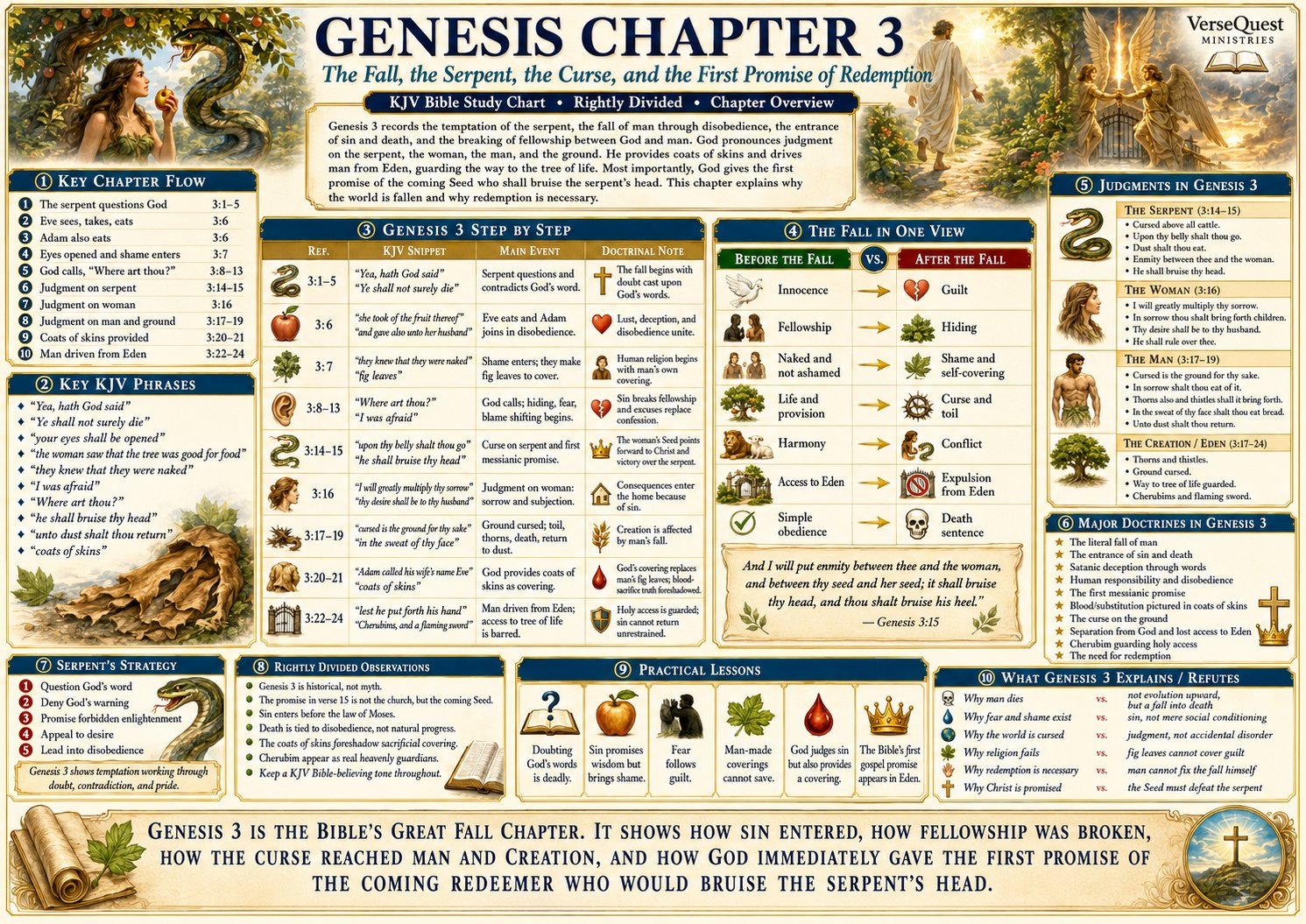
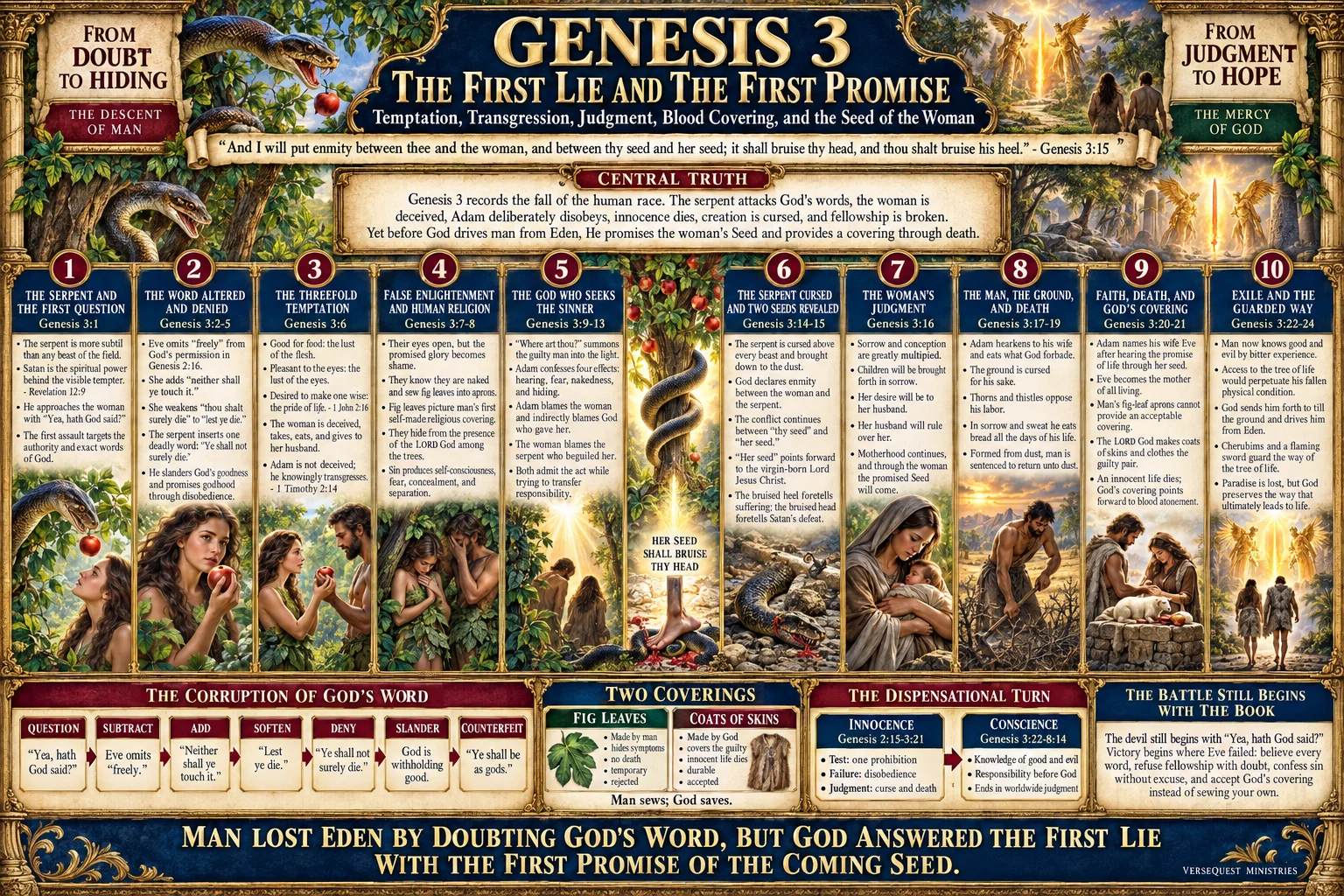
Genesis 3 – The First Lie and the First Promise: The Fall, the Serpent, the Two Seeds, God’s Judgment, and the Coming Seed of the Woman (KJV Bible Study Chart)
Explore Genesis 3 with this detailed KJV chart covering the serpent’s first lie, the corruption of God’s Word, the threefold temptation, Adam and Eve’s Fall, fig-leaf religion, God’s judgments, Genesis 3:15 and the two seeds, the Seed of the woman, coats of skins, death, conscience, and mankind’s exile from Eden.
$4.99
Description
Genesis 3: The First Lie and the First Promise is a comprehensive KJV Bible study chart tracing the fall of the human race from Satan’s first recorded attack upon God’s Word to God’s first great promise of ultimate victory through the Seed of the woman. It follows the chapter through the serpent’s deception, Eve’s alteration of God’s command, Adam’s deliberate transgression, the threefold temptation, the false enlightenment produced by sin, mankind’s attempt at self-covering, God’s confrontation of the sinners, the judgments pronounced upon the serpent, woman, man, and ground, the conflict between the serpent’s seed and the woman’s Seed, God’s provision of coats of skins, and Adam and Eve’s expulsion from Eden.
Built around Genesis 3:1–24, this chart presents the Fall not merely as an ancient moral failure but as the foundational catastrophe affecting mankind, creation, marriage, labour, death, human conscience, spiritual warfare, and the entire biblical story of redemption. Genesis 3 explains why the world described as “very good” at the close of Genesis 1 becomes a world of shame, fear, pain, thorns, death, separation, murder, judgment, and eventual worldwide destruction.
The chapter begins not with an open attack against God but with a question about His words. “Yea, hath God said?” Satan’s first recorded strategy is not to deny God’s existence but to challenge the accuracy, authority, clarity, and goodness of what God has spoken. The battleground of Genesis 3 is therefore the Word of God before it becomes the fruit of the tree.
The serpent is introduced as “more subtil than any beast of the field which the LORD God had made.” Behind the visible serpent stands the spiritual adversary later identified in Revelation as “that old serpent, called the Devil, and Satan.” The physical scene in Eden therefore contains a larger invisible conflict involving Satan’s rebellion against God and his attack upon the earthly creature made in God’s image.
Satan approaches the woman and begins with a question designed to create uncertainty. He does not initially shout, threaten, or display overt wickedness. He invites conversation about whether God really said what He said. Doubt becomes the doorway through which contradiction enters.
The chart emphasizes the progressive corruption of God’s Word in the temptation. God had told Adam that he could “freely eat” of the trees of the garden except for one. In Eve’s response, the generous word “freely” disappears. The goodness of God becomes less visible as attention shifts toward the prohibition.
Eve then adds the statement “neither shall ye touch it,” something not included in the recorded command of Genesis 2:16–17. Human additions to divine revelation are dangerous because once God’s Word is supplemented, altered, or softened, the original command becomes increasingly difficult to defend accurately.
She also weakens the certainty of the penalty from God’s “thou shalt surely die” to “lest ye die.” What God stated with certainty is now expressed as possibility. The authority of the sentence has been softened before Satan directly denies it.
The serpent then moves from questioning to contradiction: “Ye shall not surely die.” The first great lie opposes the exact words of God. Satan tells mankind that sin will not produce the consequence God announced.
This pattern repeats throughout Scripture. God speaks plainly, man modifies what He said, and Satan offers a contradictory promise. False religion and unbelief continually depend upon persuading sinners that God does not really mean the warnings He gave.
The serpent further slanders the character of God by implying that the divine prohibition exists because God is withholding something desirable. “God doth know” that eating the fruit will open their eyes and make them “as gods, knowing good and evil.” The Creator’s protective boundary is recast as selfish restriction.
The temptation therefore attacks both God’s Word and God’s character. Once the sinner doubts what God said, he becomes susceptible to the accusation that God is not good.
The serpent’s counterfeit promise is extraordinary: disobedience will supposedly produce enlightenment, knowledge, elevation, and godlike status. Satan presents rebellion not as a fall downward but as advancement upward.
Sin still advertises itself this way. The forbidden thing is presented as freedom. Submission to God is called bondage. Rebellion is called enlightenment. Pride is called self-discovery. What God calls death is marketed as life.
Genesis 3:6 reveals the familiar threefold pattern of temptation. The tree is “good for food,” “pleasant to the eyes,” and “a tree to be desired to make one wise.” These correspond closely with the later New Testament description of “the lust of the flesh, and the lust of the eyes, and the pride of life” in First John 2:16.
The lust of the flesh sees what satisfies bodily appetite. The lust of the eyes desires what appears attractive. The pride of life reaches for self-exaltation, independence, status, and forbidden knowledge.
Eve is deceived and takes the fruit. First Timothy 2:14 later states that “Adam was not deceived, but the woman being deceived was in the transgression.” Adam’s participation is therefore particularly serious because he sins knowingly.
The woman takes, eats, and gives to her husband with her, and he eats. The rebellion moves rapidly from conversation to desire, from desire to action, and from individual action to shared transgression.
The chart’s movement from doubt to hiding captures the immediate consequence. Their eyes are opened, but Satan’s promised enlightenment proves to be false enlightenment. They do gain knowledge, but not the glory they expected.
The first thing they discover is shame.
Genesis 3:7 states, “And the eyes of them both were opened, and they knew that they were naked.” Innocence disappears, self-consciousness enters, and the man and woman who were previously naked and unashamed now attempt to cover themselves.
Their first response to sin is religion manufactured by human hands. They sew fig leaves together and make aprons.
This becomes a powerful biblical picture of self-righteousness. The guilty sinner knows something is wrong and attempts to repair his condition through his own work.
The leaves represent human effort attempting to deal with spiritual guilt without confronting the underlying rebellion. The problem is not simply exposed skin. The problem is disobedience before God.
Man covers symptoms. God deals with guilt.
The sinner then moves from self-covering to hiding. Adam and Eve hear the voice of the LORD God walking in the garden and hide among the trees.
Before sin, God’s presence was the centre of human fellowship. After sin, the same presence produces fear. The problem has not changed in God; it has changed in man.
Genesis 3:9 records one of Scripture’s great divine questions: “Where art thou?” God does not ask because omniscience has lost track of Adam. The question summons the sinner out of hiding and forces him to confront his condition.
Adam’s answer reveals the effects of the Fall: fear, nakedness, shame, and concealment. He says he heard God’s voice, was afraid because he was naked, and hid himself.
Sin has produced alienation before physical death occurs. Adam remains biologically alive but spiritually separated from the fellowship he possessed before transgression.
God’s questions continue: “Who told thee that thou wast naked?” and “Hast thou eaten of the tree, whereof I commanded thee that thou shouldest not eat?”
The issue returns immediately to the Word Adam violated. God does not allow the sinner to redefine the problem as anxiety, low self-esteem, lack of education, poor social conditions, or unfortunate circumstances. Adam disobeyed a direct command.
Adam confesses the act while attempting to redistribute responsibility. “The woman whom thou gavest to be with me, she gave me of the tree, and I did eat.” His statement places the woman between himself and his own decision and subtly points back toward God who gave her.
Blame enters human relationships immediately after sin.
The woman responds similarly: “The serpent beguiled me, and I did eat.” She acknowledges eating but transfers attention toward the deceiver.
Both ultimately admit the act, but both demonstrate the fallen tendency to explain sin by emphasizing someone else.
Genesis 3 therefore exposes one of mankind’s oldest defensive mechanisms: confession without full personal responsibility.
The chapter then turns to judgment, beginning with the serpent. God curses the serpent above cattle and beasts of the field and declares that it will go upon its belly and eat dust.
More importantly, God announces a continuing conflict: “And I will put enmity between thee and the woman, and between thy seed and her seed.”
This is one of the most consequential verses in Scripture. The conflict of Genesis does not end when Adam and Eve leave the garden. It becomes a continuing warfare involving two seeds.
Within the interpretive framework of this chart, Genesis 3:15 presents a literal conflict between the serpent’s seed and the woman’s Seed rather than merely an abstract metaphor for good and evil. The chart traces that seed conflict through later Scripture while recognizing Jesus Christ as the ultimate victorious Seed of the woman.
The phrase “her seed” is itself striking because biblical genealogy ordinarily associates seed with the male line. The promise therefore contains something extraordinary from the beginning.
The ultimate fulfillment appears in Jesus Christ, born of a woman and conceived apart from an ordinary human father. Galatians 4:4 says that God sent forth His Son, “made of a woman,” while the Gospel accounts present the virgin conception.
The promised Seed receives a wound: “thou shalt bruise his heel.” Christ suffers at Calvary. The cross looks temporarily like the serpent’s victory because the Messiah is rejected, wounded, and put to death.
Yet the same verse announces the serpent’s ultimate defeat: “it shall bruise thy head.” The wound to the heel is suffering; the wound to the head is decisive conquest.
Calvary therefore fulfills both aspects in principle. Satan bruises the promised Seed, but Christ’s death and resurrection destroy the adversary’s claim and guarantee his final defeat.
Hebrews 2:14 states that through death Jesus Christ destroys “him that had the power of death, that is, the devil.” First John 3:8 says the Son of God was manifested that He might destroy the works of the devil.
The entire Bible develops from this first promise. Genesis 3:15 begins a line that moves through Abraham, Isaac, Jacob, Judah, David, the virgin conception, the cross, resurrection, Second Coming, and the final destruction of Satan.
The chart therefore appropriately calls Genesis 3 the chapter of the first lie and the first promise. Satan speaks his first great lie, but God answers it before the chapter ends with the promise of the coming Seed.
Judgment then turns toward the woman. Genesis 3:16 announces multiplied sorrow and conception, pain associated with childbearing, altered marital dynamics, and the husband’s rule.
The blessing of fruitfulness remains, but it now operates inside a fallen world. Motherhood continues, yet it carries sorrow.
This judgment does not eliminate the woman’s dignity or role in God’s redemptive purpose. Indeed, the promised Seed comes through the woman. Judgment and hope stand side by side.
The consequences of sin also enter marriage. The union created in Genesis 2 as harmonious one-flesh companionship now experiences the tensions generated by fallen desire, selfishness, domination, and blame.
Marriage itself is not cursed away. The institution remains, but fallen human nature damages the fellowship it was designed to contain.
God next addresses Adam. The judgment begins by identifying his failure to heed God above the competing voice placed before him. “Because thou hast hearkened unto the voice of thy wife, and hast eaten of the tree.”
The issue is not that listening to one’s wife is inherently wrong. The issue is that Adam accepted another voice when it contradicted the direct Word of God.
The ground is cursed for Adam’s sake. The earth that previously produced abundance beneath effortless divine order now brings forth thorns and thistles.
Work existed before sin, but painful toil does not. Genesis 2 gave Adam labour without the curse; Genesis 3 adds sorrow, resistance, sweat, frustration, and death.
Adam will eat bread “in the sweat of thy face.” Human civilization now develops under conditions of scarcity and mortality.
The judgment ends where Adam’s physical body began: “for dust thou art, and unto dust shalt thou return.” The man formed from dust will return to dust because of sin.
Romans 5 later explains the theological significance: “by one man sin entered into the world, and death by sin.” Adam’s transgression becomes the entrance point through which sin and death affect the human race.
The Fall is therefore not merely Adam’s private moral failure. It becomes a racial catastrophe requiring a second Man and last Adam.
First Corinthians 15 contrasts Adam and Christ. “The first man Adam was made a living soul; the last Adam was made a quickening spirit.” The first Adam introduces death into human experience; Jesus Christ becomes the source of resurrection life.
Genesis 3:20 then contains an extraordinary act of faith. Adam calls his wife’s name Eve, “because she was the mother of all living.”
This occurs after God has pronounced death but after God has also promised the woman’s Seed.
Adam names her in light of life rather than merely death. Humanity will continue. The promised Seed can come.
The chart therefore places faith alongside judgment. God’s sentence is real, but so is His promise.
Genesis 3:21 records that “Unto Adam also and to his wife did the LORD God make coats of skins, and clothed them.” Their fig-leaf coverings are replaced by a covering God provides.
The contrast is powerful. Man sews leaves; God supplies skins. Man attempts to conceal his condition through temporary human effort; God provides the covering.
Because coats of skins require the death of an animal, the passage naturally suggests innocent life given in connection with the sinner’s covering. The verse itself does not explicitly record a formal sacrifice or identify the blood as an atonement offering, so that connection is best described as typological.
Later Scripture makes the doctrine of blood atonement explicit. Leviticus declares that “it is the blood that maketh an atonement for the soul.” Hebrews states, “without shedding of blood is no remission.” Ultimately, redemption is accomplished through the precious blood of Jesus Christ.
The coats of skins therefore become a powerful early picture of a truth that unfolds progressively throughout Scripture: guilty man cannot adequately cover himself, and God’s provision involves death.
The chart’s Two Coverings panel captures this contrast. Fig leaves are made by man, hide symptoms, involve no death, and represent temporary self-covering. Coats of skins are made by God, cover the guilty pair, involve death, and point forward typologically toward substitution and blood atonement.
The difference is not fashion. It is theology.
Human religion continually attempts to reproduce fig leaves through works, ceremonies, morality, philosophy, education, ritual, tradition, and self-improvement. The sinner wants a covering he can sew himself.
The gospel strips away that confidence. Righteousness comes through Jesus Christ rather than the sinner’s own works.
Genesis 3 then closes with exile from Eden. God declares that man now possesses knowledge of good and evil and prevents access to the tree of life lest he eat and live forever in his fallen condition.
Expulsion is therefore both judgment and mercy. God does not permit fallen mankind to perpetuate its corrupt condition eternally through access to the tree.
Adam is sent from the garden to till the ground from which he was taken. The place of fellowship becomes inaccessible because of sin.
Cherubims and a flaming sword are placed east of Eden “to keep the way of the tree of life.” Paradise is lost, and the pathway back cannot be crossed through human strength.
The closing picture is sobering: mankind outside, the garden guarded, the tree inaccessible, and death now governing Adam’s race.
Yet Genesis 3 does not close without hope because the promise of verse 15 remains active outside the gate.
The Seed will come.
The chart’s title movement “From Doubt to Hiding” summarizes sin’s downward progression. Satan questions God’s Word, the sinner entertains doubt, the command is altered, desire develops, the transgression occurs, shame appears, human covering is attempted, fear follows, and finally the sinner hides.
Sin promises enlargement and produces shrinking.
It promises liberation and produces fear.
It promises knowledge and produces shame.
It promises godhood and produces dust.
The counterpart movement “From Judgment to Hope” reveals the character of God. He judges sin truthfully but simultaneously announces redemption.
The same chapter containing “thou shalt surely die” contains “her seed… shall bruise thy head.”
God’s holiness does not eliminate His mercy, and His mercy never requires Him to pretend sin is harmless.
The chart also identifies the dispensational turn produced by the Fall. Within the traditional dispensational framework, Adam and Eve move from the age of Innocence into the age of Conscience.
Under Innocence, Adam lives beneath a single prohibition in an unfallen environment. Revelation is direct, responsibility is plain, and the consequence is death.
Once Adam knows good and evil experientially, humanity lives with an awakened conscience and direct responsibility before God outside Eden. The period traditionally designated Conscience continues until the Flood judgment in Genesis 6–8.
The label Conscience does not mean people during later dispensations lack conscience, just as the age of Grace does not mean God showed no grace previously. Dispensational titles identify a predominant feature of a particular stewardship rather than the exclusive existence of that principle.
The Fall therefore changes the administration under which mankind lives while never removing human responsibility toward revelation.
Genesis 3 also becomes a foundational chapter for understanding the doctrine of original sin. Adam’s disobedience affects not only himself but the race descending from him.
Romans 5 repeatedly contrasts the offence of one man with the obedience of one Man. Through Adam comes condemnation and death; through Jesus Christ comes justification and life.
The two-Adams doctrine cannot be understood correctly without Genesis 3.
The chapter also explains human shame. Shame is not originally part of God’s good creation. Genesis 2 ends with nakedness without shame; Genesis 3 introduces shame immediately after sin.
It explains fear. Adam’s first recorded fear comes after disobedience.
It explains broken fellowship. Man hides from the God whose presence should have been his delight.
It explains blame. Adam blames the woman and indirectly God; Eve blames the serpent.
It explains pain. Sorrow enters childbearing and labour.
It explains ecological frustration. The ground produces thorns and thistles.
It explains death. Man returns to dust.
It explains spiritual conflict. Enmity between the serpent’s seed and the woman’s Seed becomes an organizing principle of biblical history.
And it introduces redemptive hope. The Seed of the woman will crush the serpent’s head.
The chart’s section The Battle Still Begins with the Book gives Genesis 3 immediate practical force. Satan still begins with “Yea, hath God said?”
The details change, but the strategy remains remarkably stable. The adversary attacks confidence in God’s exact words before offering an alternative.
He may question whether God preserved His words, whether a verse means what it plainly says, whether doctrine matters, whether moral boundaries remain valid, or whether human scholarship must repair divine revelation.
Once Scripture becomes uncertain, every other doctrine becomes negotiable.
The appropriate response is therefore to know God’s Word accurately. Eve’s altered quotation demonstrates why vague familiarity with Scripture is not enough.
The believer should refuse fellowship with doubt when doubt begins by accusing God’s Word falsely. Honest questions may lead toward truth; satanic questioning seeks permission to abandon truth already revealed.
The believer should recognize that sin always advertises benefits while hiding consequences. Satan mentioned opened eyes and godlike knowledge but omitted fear, shame, pain, thorns, exile, and death.
Every temptation contains edited advertising.
The believer should also refuse self-covering. Fig leaves cannot restore fellowship with God. Religious activity cannot erase guilt.
The answer is God’s provision rather than man’s invention.
Confession also matters. Adam and Eve demonstrate how naturally sinners transfer blame. Repentance requires agreeing with God concerning our own transgression rather than constructing explanations around someone else’s failure.
Genesis 3 finally teaches that divine judgment does not nullify divine promise. God does not abandon His redemptive plan when mankind falls.
Before Adam and Eve even leave Eden, God has already announced the coming Victor.
The rest of the Bible is the unfolding answer to Genesis 3.
Why does Christ come? Genesis 3.
Why must He be born of a woman? Genesis 3.
Why does Satan oppose the promised line? Genesis 3.
Why must there be blood atonement? Genesis 3 begins the picture.
Why does mankind die? Genesis 3.
Why will Satan finally be crushed? Genesis 3.
Why is paradise ultimately restored in Revelation? Because what was lost through Adam is recovered under the victory of Jesus Christ.
Revelation closes the circle Genesis opens. The tree of life appears again. The curse is removed. God dwells with His people. Death disappears. The serpent is permanently defeated.
The Bible begins with paradise lost through the first Adam and ends with eternal victory through Jesus Christ.
The chart’s final declaration summarizes the chapter powerfully: Man lost Eden by doubting God’s Word, but God answered the first lie with the first promise of the coming Seed.
This resource is ideal for personal Bible study, Genesis chapter studies, Fall-of-man teaching, serpent studies, Satan and temptation studies, Genesis 3:15 studies, seed-of-the-woman teaching, serpent-seed studies, original-sin instruction, Adam-versus-Christ studies, blood-atonement typology, dispensational studies, biblical marriage instruction, creation studies, Christian apologetics, homeschool Bible curriculum, Sunday school, Christian schools, Bible institutes, pastoral training, and sermon preparation.
Genesis 3, fall of man, first lie in the Bible, first promise in the Bible, serpent in Eden, Satan and the serpent, Yea hath God said, corruption of God’s Word, threefold temptation, lust of the flesh, lust of the eyes, pride of life, fig leaves, coats of skins, Genesis 3:15, seed of the woman, serpent seed, two seeds, original sin, curse upon the ground, sorrow in childbirth, death through Adam, Adam and Christ, blood covering, expulsion from Eden, tree of life, cherubim and flaming sword
Genesis 3 records the entrance of human sin into the Adamic race and establishes foundational doctrines concerning temptation, Satan, the authority of God’s Word, shame, fear, guilt, death, judgment, conscience, spiritual warfare, substitutionary covering, and redemption. The chapter begins with the serpent questioning God’s words and ends with fallen mankind driven from Eden, yet God places His promise of victory at the very centre of the judgment.
Satan’s first recorded attack begins with “Yea, hath God said?” His method progresses from questioning the Word to altering it, softening its warning, denying its penalty, slandering God’s motives, and offering a counterfeit promise of enlightenment. Eve omits the generosity of “freely,” adds “neither shall ye touch it,” and weakens “thou shalt surely die” to “lest ye die” before the serpent directly says “Ye shall not surely die.”
Genesis 3:6 displays the threefold temptation later summarized in First John 2:16. The tree appeals as good for food, pleasant to the eyes, and desirable to make one wise, corresponding naturally with the lust of the flesh, lust of the eyes, and pride of life. Eve is deceived, while First Timothy 2:14 states that Adam is not deceived but knowingly transgresses.
The promised enlightenment becomes shame. Adam and Eve know they are naked, sew fig leaves, fear God’s presence, and hide. Their self-made covering becomes an early picture of man attempting to remedy guilt through his own works. God later replaces their fig leaves with coats of skins.
God seeks Adam with the question “Where art thou?” not because He lacks knowledge but because the sinner must be brought into the light. Adam’s response reveals fear, shame, hiding, and blame. He points toward the woman God gave him, while the woman points toward the serpent. Sin therefore damages fellowship with God and with one another.
Genesis 3:15 explicitly speaks of enmity between the serpent and woman and between “thy seed” and “her seed.” Within the interpretive framework of this chart, these are treated as two real opposing seeds whose conflict develops through later Scripture. The ultimate victorious Seed of the woman is Jesus Christ, who is wounded in suffering yet defeats the serpent decisively.
The unique expression “her seed” points prophetically toward the coming of Jesus Christ through a woman. The later virgin conception supplies the fullest messianic fulfillment, while Hebrews, Romans, Colossians, and First John develop Christ’s victory over Satan and his works.
The woman’s judgment includes multiplied sorrow associated with conception and childbearing and changed marital dynamics within the fallen condition. Motherhood nevertheless continues, allowing the promised Seed to enter human history.
Adam’s judgment includes a cursed ground, thorns and thistles, painful labour, sweat, and eventual return to dust. Work itself predates sin, but frustration and sorrow in labour result from the curse. Romans 5 later identifies Adam’s transgression as the entrance point through which sin and death affect mankind.
Adam naming his wife Eve demonstrates hope in the continuation of life after God’s promise. Genesis 3:21 then records God making coats of skins and clothing the guilty pair. Animal skins necessarily imply death, but the verse does not explicitly describe a formal animal sacrifice. The relationship to substitution and blood atonement is therefore best understood as typology illuminated by later Scripture.
The contrast between fig leaves and coats of skins is doctrinally significant. Man attempts to cover himself; God supplies the covering. Later revelation makes clear that sinful works cannot justify mankind and that final redemption comes through the blood and righteousness of Jesus Christ.
God expels Adam and Eve from Eden and stations cherubims with a flaming sword to guard the way to the tree of life. Exile is judgment, yet preventing fallen mankind from eating of the tree and perpetuating its corrupted physical condition also displays divine mercy.
Within a traditional dispensational framework, Genesis 3 marks the transition from the dispensation of Innocence to the dispensation of Conscience. The term Conscience is a theological label describing the predominant stewardship after mankind acquires experiential knowledge of good and evil; it is not a term Genesis itself gives to the era.
Genesis 3 explains the Bible’s entire redemptive movement. The first Adam brings sin and death, while Jesus Christ comes as the last Adam and promised Seed to bring righteousness, resurrection, and final victory. Paradise is lost in Genesis, but Revelation ultimately restores access to the tree of life after Satan, death, and the curse are permanently removed.
Genesis 3 Bible studies, Fall-of-man studies, temptation teaching, Satan and serpent studies, corruption-of-Scripture lessons, Genesis 3:15 teaching, seed-of-the-woman studies, serpent-seed studies, original-sin instruction, Adam-versus-Christ lessons, blood-atonement typology, fig-leaf religion studies, dispensational Innocence-to-Conscience teaching, biblical marriage studies, spiritual-warfare classes, Christian apologetics, homeschool Bible curriculum, Sunday school lessons, Christian school teaching, Bible institute classes, pastoral training, sermon preparation
King James Bible, Strong’s Concordance, Thompson Chain-Reference Bible, Treasury of Scripture Knowledge, Nave’s Topical Bible, Genesis 2–4 study notes, Genesis 3:15 Scripture chains, temptation comparison charts, Adam-and-Christ studies from Romans 5 and First Corinthians 15, blood-atonement studies, Leviticus 17 resources, Hebrews sacrifice studies, Satan and serpent Scripture chains, seed-of-the-woman prophecy studies, dispensational charts on Innocence and Conscience, Revelation 12 and 20 studies, VerseQuest Genesis and creation charts
Related products
-
The Rapture
-
-67%
- Caught Up Before the Wrath – 66-Essay KJV Rapture Study
- Caught Up Before the Wrath is a 430-page premium KJV Bible study defending the pre-tribulation Rapture of the Church from a rightly divided, dispensational perspective. This 66-essay VerseQuest Ministries book…
- Original price was: $29.99.$9.99Current price is: $9.99.
- Add to cart
-
-67%
-
Premium Studies
-
-25%
- The Doctrine of Hell — Premium Essay Series PDF
- A 383-page premium VerseQuest PDF study book containing 54 KJV essays on hell, fire, darkness, judgment, the lake of fire, the second death, and Jesus Christ as the only escape.
- Original price was: $39.99.$29.99Current price is: $29.99.
- Add to cart
-
-25%
-
Prophecy Studies
-

- The Resurrection of Jesus Christ Made Plain – 501-Page KJV Bible Study
- A massive 501-page VerseQuest Ministries PDF Bible study defending and explaining the bodily resurrection of Jesus Christ from a KJV, rightly divided perspective. This 80-essay study covers the empty tomb,…
- $34.99
- Add to cart
-
-
Angels
-
-67%
- The Doctrine of Angels Made Plain – 620-Page KJV Bible Study PDF
- The Doctrine of Angels Made Plain is a 620-page KJV Bible study that traces angels from Genesis to Revelation. This premium VerseQuest PDF explains holy angels, Christ’s supremacy over angels,…
- Original price was: $29.99.$9.99Current price is: $9.99.
- Add to cart
-
-67%
-
Bible Prophecy Charts
-
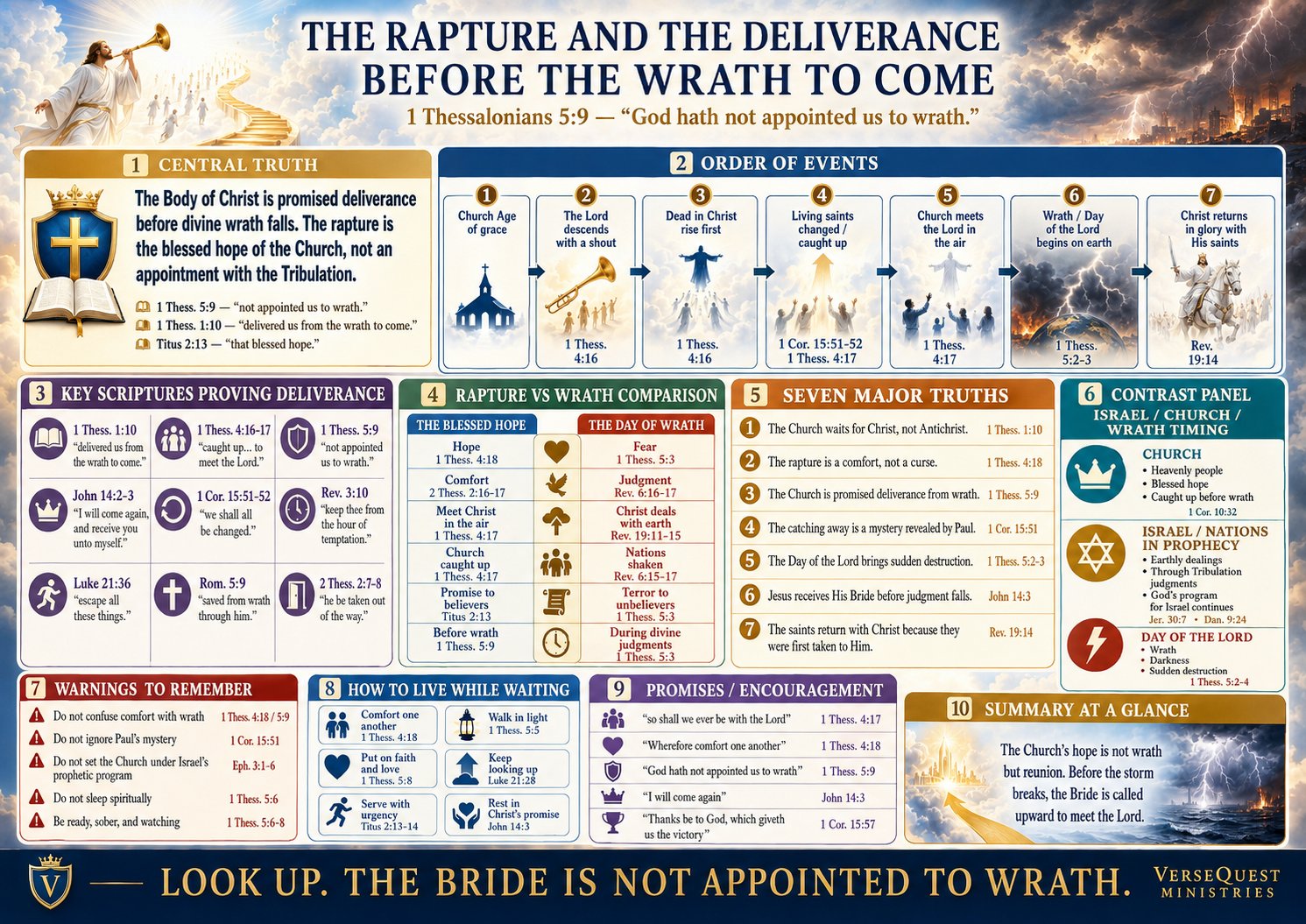
- The Rapture and the Deliverance Before the Wrath to Come – Printable Bible Study Chart
- Printable KJV Bible study chart on The Rapture and the Deliverance Before the Wrath to Come, showing from 1 Thessalonians 5:9 that the Church is not appointed to wrath. This…
- $4.99
- Add to cart
-