
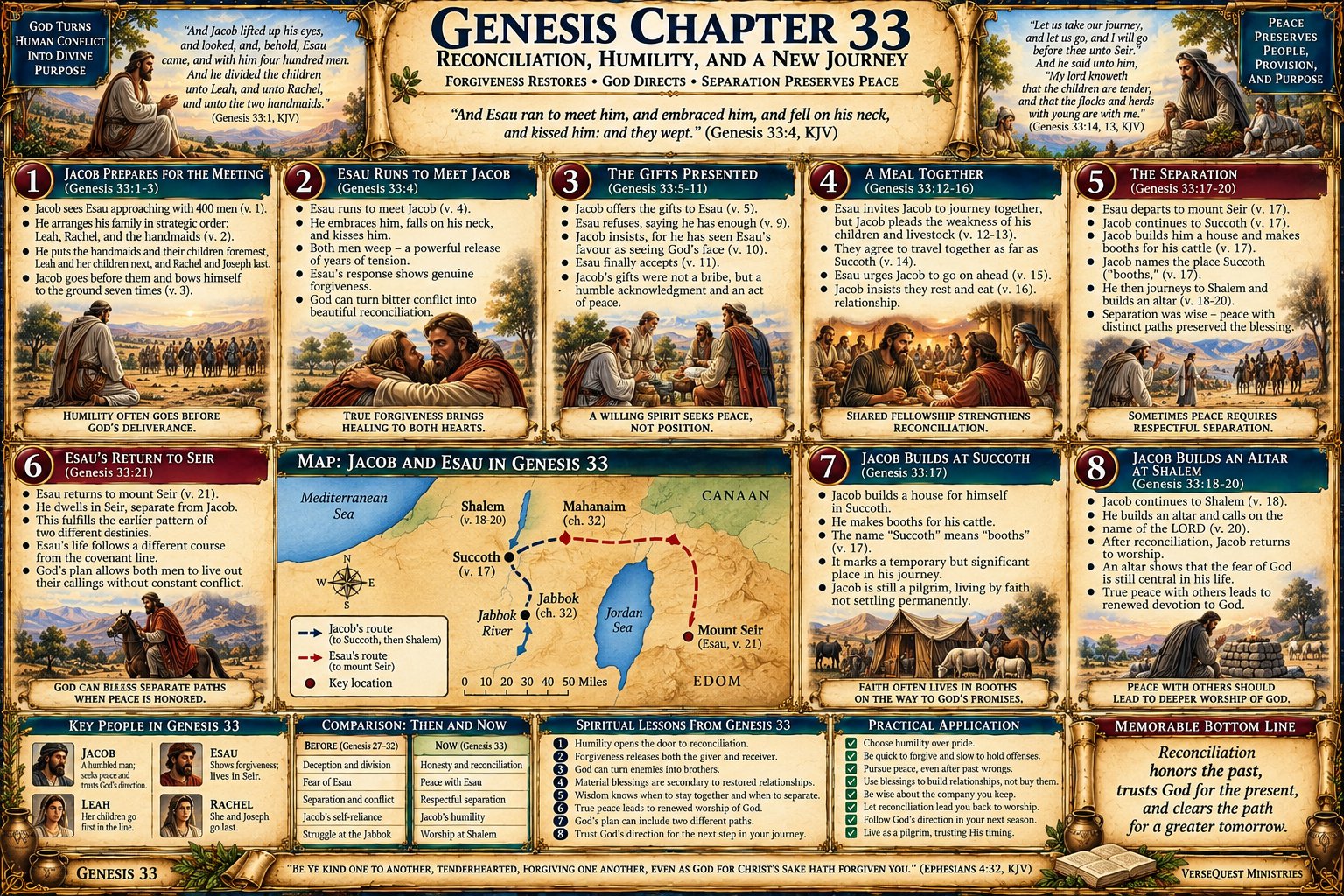
Genesis 33 – Jacob and Esau Reconciled: Humility, Gifts, Separation, Succoth, Shechem, and the Altar of El-elohe-Israel (KJV Bible Study Chart)
Explore Genesis 33 with this detailed KJV Bible study chart tracing Jacob’s long-feared meeting with Esau, his sevenfold bow, the brothers’ emotional embrace, and the remarkable reconciliation that replaces expected violence. Follow Jacob as he presents his family and gifts, Esau offers to journey with him, and the brothers peacefully continue on separate paths. The chart also traces Jacob to Succoth and then Shalem near Shechem, where he purchases land and builds an altar called El-elohe-Israel, connecting his worship with the new name received at Peniel. Genesis 33 offers powerful lessons on humility, reconciliation, peacemaking, family conflict, respectful separation, and returning to worship after fear. Ideal for Bible study, Sunday school, homeschool, sermon preparation, discipleship, and family or reconciliation studies.
$4.99
Description
Genesis 33: Reconciliation, Humility, and a New Journey is a detailed KJV Bible study chart tracing Jacob’s long-awaited meeting with Esau, the unexpected reconciliation between the estranged brothers, Jacob’s gifts, their peaceful separation, and Jacob’s continued journey into Canaan. After years of fear and the transforming encounter at Peniel, Jacob must finally face the brother from whom he fled.
Jacob sees Esau approaching with four hundred men and arranges his family in groups, placing the handmaids and their children first, Leah and her children next, and Rachel and Joseph last. Jacob himself goes before them and bows to the ground seven times as he approaches Esau. The man who once obtained blessing through deception now approaches with humility rather than manipulation.
Esau’s response overturns Jacob’s fears. Instead of attacking, “Esau ran to meet him, and embraced him, and fell on his neck, and kissed him: and they wept.” Years of estrangement end not with violence but with reconciliation. Scripture does not use the word forgiveness directly in the scene, but Esau’s embrace, tears, and peaceful conduct plainly demonstrate restored relations between the brothers.
Jacob presents his family and explains that the children are those “which God hath graciously given thy servant.” He also presses Esau to accept the livestock he has sent ahead. Esau initially refuses, saying, “I have enough,” but Jacob urges him until he accepts. Jacob speaks of seeing Esau’s face “as though I had seen the face of God,” because Esau has received him favorably.
Esau then offers to accompany Jacob on the journey. Jacob declines, explaining that the children are tender and the flocks and herds must be moved carefully. Esau also offers to leave some of his people with Jacob, but Jacob again declines. The brothers therefore reconcile without forcing permanent proximity.
Esau returns toward Seir while Jacob travels to Succoth, where he builds a house and makes booths for his cattle. He later comes to Shalem, near Shechem, purchases a parcel of land, and erects an altar.
Jacob calls the altar El-elohe-Israel, meaning in substance God, the God of Israel. This is especially significant after the new name given in Genesis 32. The chapter that begins with fear of Esau ends with worship of God.
Genesis 33 therefore presents reconciliation without erasing distinction. Peace is restored, but Jacob and Esau continue on separate paths. Humility replaces fear, God turns anticipated conflict into peace, and Jacob advances further into the land promised to his fathers.
Genesis 33, Jacob and Esau, reconciliation, humility, forgiveness, restored relationship, four hundred men, Jacob bows seven times, Esau embraces Jacob, brothers weep, gifts to Esau, peaceful separation, Mount Seir, Succoth, Shalem, Shechem, altar, El-elohe-Israel, God of Israel, family reconciliation, peacemaking, divine providence, Jacob’s journey, covenant land
Genesis 33 records the meeting Jacob has feared since learning that Esau was approaching with four hundred men. After wrestling at Peniel in Genesis 32, Jacob must now walk into the situation he cannot avoid. He arranges his family in groups but places himself ahead of them. Jacob bows seven times as he approaches Esau, demonstrating remarkable humility before the brother he had wronged years earlier.
The great surprise comes in Genesis 33:4: “Esau ran to meet him, and embraced him, and fell on his neck, and kissed him: and they wept.” Jacob expected danger, but the meeting produces tears and reconciliation. Scripture does not explicitly say that Esau verbally forgave Jacob, yet his actions unmistakably show that the former murderous hostility of Genesis 27 is no longer governing the encounter.
Esau asks about Jacob’s family. Jacob answers that they are “the children which God hath graciously given thy servant.” The language reflects a changed perspective. Jacob recognizes his household as God’s gracious provision rather than merely the product of his own plans.
Esau also asks about the large groups of livestock Jacob sent ahead. Jacob explains that the gifts were intended to find grace in Esau’s sight. Esau initially refuses because he already has enough, but Jacob urges him to receive them. Jacob’s gifts can be understood as part of his sincere effort to repair the relationship, though the text does not require us to treat them as formal legal restitution.
Jacob tells Esau that seeing his favorable face has been “as though I had seen the face of God.” Coming immediately after Peniel, this wording is striking. Jacob has encountered God and survived; now he encounters the brother he feared and discovers mercy rather than vengeance.
Genesis 33:12–16 does not record a meal. Esau offers to travel with Jacob, but Jacob explains that the children and livestock cannot move quickly. Esau then offers to leave some of his men, which Jacob also declines. Esau returns toward Seir in verse 16 while Jacob moves to Succoth. Peace therefore does not require the two households to become one household.
At Succoth Jacob builds a house and booths for his cattle. He later reaches Shalem near Shechem, purchases a parcel of land, and pitches his tent there. The chapter ends with an altar called El-elohe-Israel. Jacob’s new name, Israel, now appears in his worship.
Genesis 33 therefore moves from anticipated violence to peaceful separation and worship. Reconciliation does not erase history, but it prevents history from controlling the future. Jacob and Esau take different paths without renewed hatred, while Jacob continues deeper into the land of promise under the hand of God.
Genesis 33 is useful for teaching humility before reconciliation, the value of taking responsible steps toward peace, the danger of allowing fear to define another person before the meeting occurs, and the wisdom of recognizing that restored relationships do not always require identical paths afterward. It also provides practical instruction on family conflict, restitution, generosity, respectful boundaries, and returning to worship after a season of tension. The chapter is valuable for personal Bible study, Sunday school, homeschool instruction, Bible institutes, sermon preparation, marriage and family studies, conflict-resolution teaching, discipleship, peacemaking studies, and lessons on humility, forgiveness, restoration, and trusting God with difficult encounters.
King James Bible, Strong’s Concordance, Thompson Chain-Reference Bible, Treasury of Scripture Knowledge, Nave’s Topical Bible, Genesis 27–36 study notes, Jacob and Esau comparison charts, Jacob life timeline, patriarchal maps of Peniel Succoth Shechem and Seir, biblical reconciliation studies, forgiveness Scripture chains, Romans 12 studies, Ephesians 4 studies, Hebrews 12 Esau studies, Abrahamic covenant charts, El-elohe-Israel word studies, VerseQuest Genesis charts