
Genesis 2 – The Garden, the Man, and the Bride: Eden, Adam, God’s Command, Work, Marriage, and the Seventh Day (KJV Bible Study Chart)
Explore Genesis 2 with this detailed KJV chart covering the completion of creation, the seventh-day rest, Adam formed from dust, Eden and its rivers, work before the curse, the tree of knowledge, Adam’s command, the creation of Eve, one-flesh marriage, and the biblical picture of Adam and his bride.
$4.99
Description
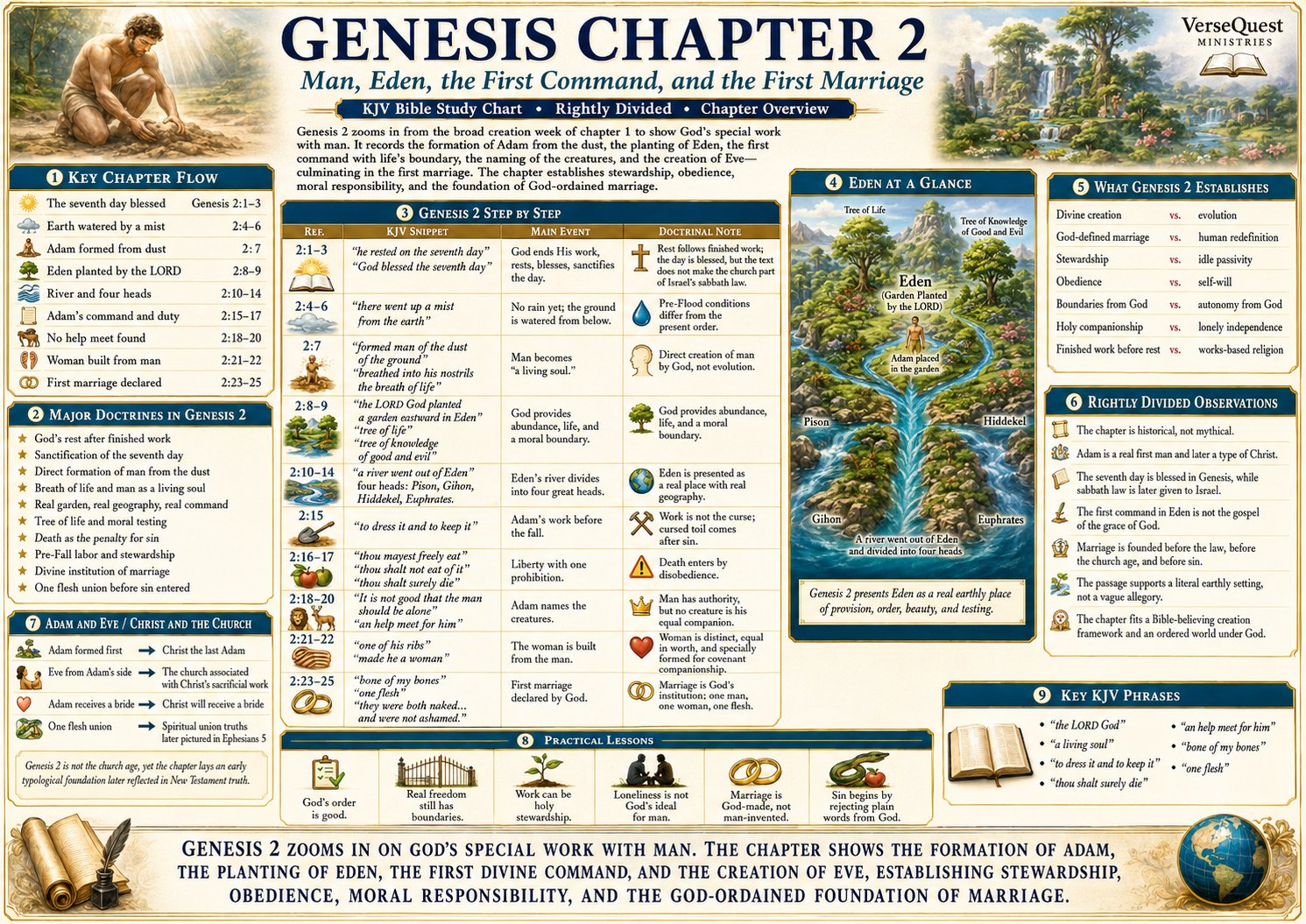
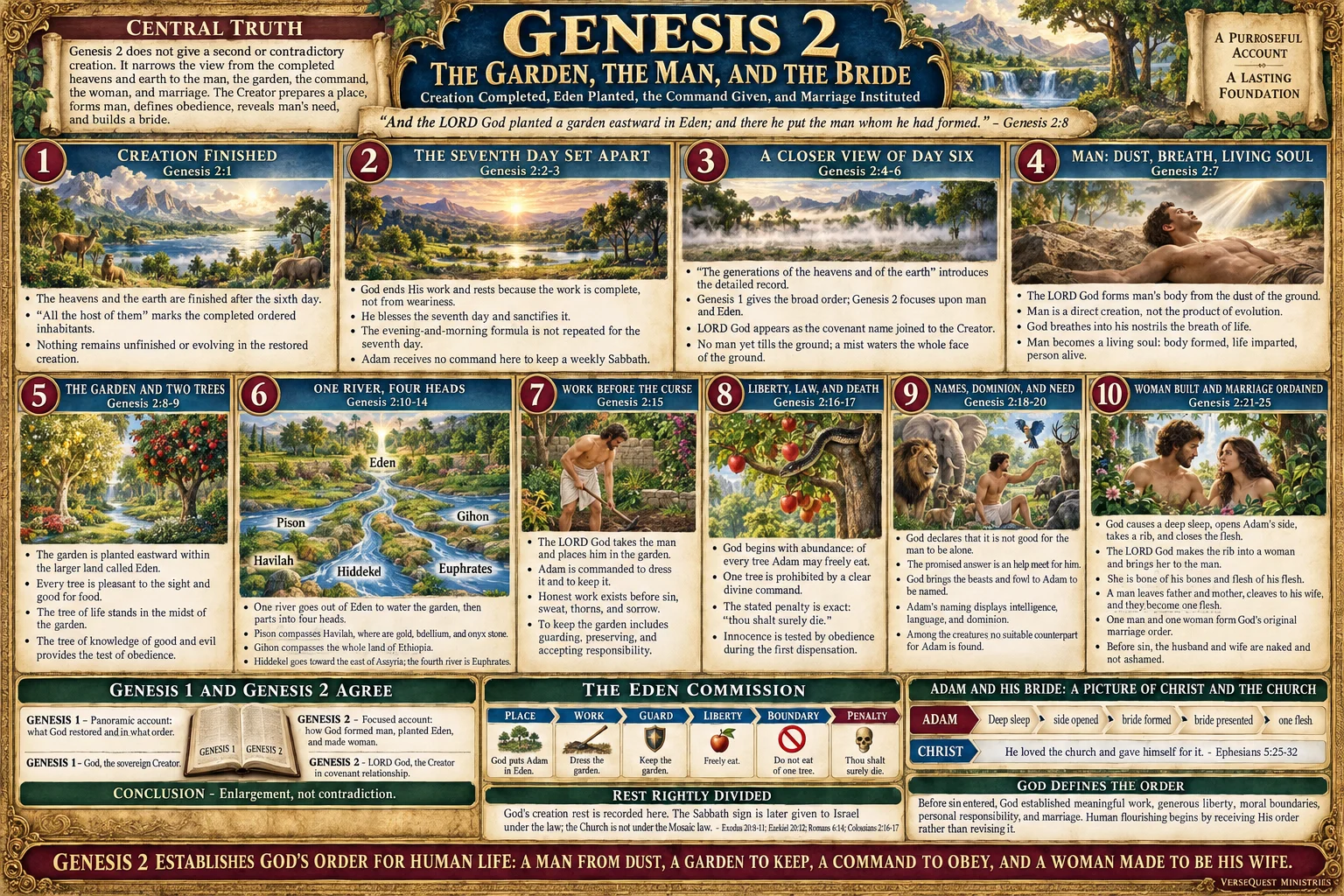
Genesis 2: The Garden, the Man, and the Bride is a comprehensive KJV Bible study chart examining the second chapter of Genesis as the focused continuation and enlargement of the creation account. Rather than presenting a contradictory second creation story, Genesis 2 narrows the viewpoint from the completed heavens and earth to God’s dealings with man: the completion of creation, the sanctification of the seventh day, the forming of Adam from the dust, the planting of Eden, the river and its four heads, man’s work before the curse, the command concerning the tree of knowledge, Adam’s naming of the animals, the creation of woman from Adam’s side, and God’s institution of marriage.
Built around Genesis 2:1–25, this chart demonstrates that Genesis 1 and Genesis 2 operate together naturally. Genesis 1 provides the panoramic account of the ordered creation and restoration, while Genesis 2 provides a close view of mankind’s creation, environment, responsibility, command, companionship, and marriage. The first chapter emphasizes God as sovereign Creator over the whole created order; the second repeatedly uses the covenantal name LORD God as the Creator personally deals with Adam and the woman.
Genesis 2 begins with creation completed rather than continuing indefinitely. “Thus the heavens and the earth were finished, and all the host of them.” The language of completion is decisive. God’s work reaches its appointed conclusion, and the ordered world described through the preceding six days does not remain unfinished, embryonic, or dependent upon further evolutionary development. The heavens, earth, and their host stand finished according to God’s design.
This completion also provides the setting for the seventh day. Genesis 2:2 says that on the seventh day God ended His work and rested from all His work which He had made. God’s rest does not imply fatigue, weakness, or physical exhaustion. Isaiah 40:28 declares that the Creator “fainteth not, neither is weary.” The seventh-day rest is the rest of completed accomplishment: nothing remains to be added to the work just finished.
God blesses the seventh day and sanctifies it, setting it apart from the six working days. The chapter therefore establishes the creation pattern of six days followed by a seventh-day rest long before Israel receives the Mosaic Sabbath command. At the same time, Genesis 2 does not record God commanding Adam to observe a weekly Sabbath ordinance. The later covenant Sabbath given to Israel should therefore be distinguished from the historical fact of God’s seventh-day creation rest.
This distinction becomes especially important for right division. Exodus later incorporates the seventh-day pattern into Israel’s national covenant law, but Colossians 2:16–17 warns Church-age believers not to allow others to judge them concerning Sabbath days. The creation rest establishes a divine pattern; the Mosaic Sabbath becomes a particular covenant sign and command for Israel.
Genesis 2:4 introduces “the generations of the heavens and of the earth when they were created.” The narrative now moves from the broad order of Genesis 1 to a detailed examination of the terrestrial setting prepared for Adam. The chapter is enlargement, not contradiction. Genesis 1 asks broadly what God established and in what sequence; Genesis 2 concentrates on how God formed man, established his environment, assigned his work, imposed a moral boundary, and supplied the woman who would become his wife.
The title LORD God becomes prominent throughout the chapter. The sovereign Creator of Genesis 1 is not an impersonal force or distant cosmic architect. He personally forms Adam, breathes life into him, plants the garden, places the man within it, gives him a command, brings the animals before him, sees his need for companionship, forms the woman, and brings her unto the man. Creation moves directly into relationship and responsibility.
Before man cultivates the ground, Genesis records environmental conditions in which no man yet exists to till it and a mist goes up from the earth to water the ground. The chapter does not require a second creation of vegetation after Genesis 1; it narrows attention to the conditions surrounding Adam, cultivated vegetation, the garden, and man’s specific agricultural responsibility.
Genesis 2:7 gives one of Scripture’s foundational statements concerning human nature: “And the LORD God formed man of the dust of the ground.” Man’s physical body is deliberately fashioned by God. Adam does not descend from a lower animal, emerge from a primitive hominid population, or gradually attain humanity through evolutionary development. His body originates through a direct creative act.
The material used is humbling: dust. Man possesses extraordinary dignity because he bears God’s image, yet his physical origin gives him no basis for self-deification. He is an image-bearing creature, not the Creator.
God then “breathed into his nostrils the breath of life; and man became a living soul.” The order is significant. A formed body alone is not the complete living man. God imparts the breath of life, and man becomes a living soul.
The verse does not say God placed an evolved animal beneath a spiritual influence until it developed religious awareness. God forms the body directly, imparts life directly, and thereby produces the living human person. Human existence is dependent from beginning to end upon the Creator.
Genesis 2 next introduces the garden of Eden. The LORD God plants a garden eastward in the larger region called Eden and places the man whom He formed within it. Eden is not merely a metaphor for psychological innocence or a religious myth concerning human development. Genesis describes a planted garden associated with identifiable geographical features, vegetation, rivers, and later historical consequences.
God causes every tree pleasant to the sight and good for food to grow from the ground. The environment is simultaneously beautiful and useful. Biblical creation does not portray beauty as unnecessary decoration. God supplies both nourishment and delight.
Two trees receive special attention: the tree of life and the tree of the knowledge of good and evil. The tree of life stands in the midst of the garden and later becomes central to the consequences of the Fall. The tree of knowledge becomes the location of the first explicit moral prohibition given to Adam.
These trees demonstrate that Eden contains genuine liberty without moral autonomy. Adam receives abundance, freedom, responsibility, and fellowship, but he does not possess authority to redefine good and evil.
A river goes out of Eden to water the garden and afterward divides into four heads: Pison, Gihon, Hiddekel, and Euphrates. Genesis describes actual lands and geographical relationships associated with these rivers. Pison encompasses Havilah, a land associated with gold, bdellium, and onyx. Gihon encompasses the land of Ethiopia. Hiddekel goes toward the east of Assyria, and the fourth river is Euphrates.
The post-Flood world should not be assumed to preserve Edenic geography unchanged. The global catastrophe in Noah’s day drastically altered the terrestrial environment. Similar river or place names in the later world may preserve earlier names without requiring the pre-Flood landscape to be reconstructed perfectly from modern geography.
The important truth is that Genesis presents Eden as a real geographical environment. Man begins his history in an actual garden planted by God, not in an imaginary symbolic paradise invented to communicate an abstract moral lesson.
Genesis 2:15 introduces work before the curse. The LORD God takes Adam and puts him into the garden “to dress it and to keep it.” Labour therefore is not itself a result of sin. Productive work belongs to God’s original good order.
The curse of Genesis 3 later introduces sweat, thorns, sorrow, frustration, and resistance into human labour, but meaningful responsibility predates the Fall. Man was not created for perpetual idleness.
Adam receives a place, a task, and responsibility. God puts him somewhere specific and gives him something meaningful to do. Biblical human flourishing is not based upon escape from responsibility but faithful stewardship beneath God.
To dress the garden involves cultivation and productive care. To keep it carries the idea of guarding, preserving, watching, and maintaining. Adam is not an owner independent of God but a steward working within property ultimately belonging to his Creator.
Work therefore possesses dignity because God assigns it. Honest labour is not beneath spirituality. Before there is a church building, civil government, marketplace, or human institution, there is a man working faithfully where God put him.
Genesis 2:16–17 introduces liberty, law, and death. God begins with generosity: “Of every tree of the garden thou mayest freely eat.” The first emphasis is freedom rather than prohibition. Adam stands surrounded by divine provision.
God then establishes one clear boundary: “But of the tree of the knowledge of good and evil, thou shalt not eat of it.” Freedom exists beneath God’s authority. Biblical liberty never means the absence of divine boundaries.
The consequence is equally clear: “for in the day that thou eatest thereof thou shalt surely die.” God does not conceal the penalty, create an ambiguous rule, or allow Adam to plead ignorance. The command is understandable, limited, and direct.
The tree therefore becomes a genuine test of obedience. Adam may possess vast freedom without possessing the right to violate God’s one prohibition.
This arrangement reveals an important principle governing every dispensation: God reveals His will, man bears responsibility toward that revelation, and disobedience produces consequences. The particular commands may differ across biblical programmes, but creaturely accountability to divine revelation remains.
The chart appropriately identifies this arrangement as the Eden commission. Adam receives a place in Eden, work to perform, a garden to keep, broad liberty to enjoy, a specific boundary not to cross, and a stated penalty for rebellion.
This sequence reveals that divine order is not oppressive. Place, work, protection, liberty, boundaries, and consequences existed before sin entered the world. Modern man often defines freedom as the elimination of boundaries, while Genesis presents boundaries as part of God’s good order.
Genesis 2:18 then records something God declares “not good.” After the repeated goodness of Genesis 1, the LORD God says, “It is not good that the man should be alone.”
This does not imply that Adam is defective or that God made a mistake requiring correction. God is revealing a need built into His purpose for mankind. Adam’s solitary condition prepares the narrative for the creation of the woman.
God promises “an help meet for him.” The KJV wording is precise. The woman is a help meet—suitable, corresponding, and fitted—for the man. She is neither an identical duplicate nor an inferior creature. God creates a corresponding human partner uniquely suited to Adam.
Before forming the woman, God brings the animals to Adam to see what he will call them. Adam names cattle, fowl, and beasts of the field.
This naming demonstrates intelligence, language, observation, classification, and dominion. Adam is not pictured as an intellectually primitive cave-dweller slowly inventing speech through evolutionary experimentation. The first man possesses functioning language and sufficient intellectual capacity to classify the living creatures brought before him.
The naming exercise also reveals Adam’s need. Among the animals “there was not found an help meet for him.” No creature shares the unique human relationship for which man was created.
The solution is not another animal, another Adam, or a being unrelated to him. God forms woman from man.
Genesis 2:21 states that the LORD God causes a deep sleep to fall upon Adam. While Adam sleeps, God opens his side, takes one of his ribs, and closes up the flesh.
The woman is therefore neither formed independently from a second pile of dust nor evolved through another biological line. Her origin is directly connected with Adam’s own body.
Genesis 2:22 uses remarkable wording: “And the rib, which the LORD God had taken from man, made he a woman.” God builds the woman from what He takes from Adam and then “brought her unto the man.”
God is therefore the first arranger and witness of marriage. Adam does not wander through Eden and establish a social contract according to preference. God forms the bride and brings her to the man.
Adam immediately recognizes their relationship: “This is now bone of my bones, and flesh of my flesh.” He calls her Woman because she was taken out of Man.
The distinction between male and female exists alongside profound unity. They are different, corresponding, and joined. Genesis gives neither interchangeable sexuality nor competing human species. The woman shares Adam’s humanity while possessing the sex God created specifically for her role in the union.
Genesis 2:24 then establishes the foundational order of marriage: “Therefore shall a man leave his father and his mother, and shall cleave unto his wife: and they shall be one flesh.”
Jesus Christ later quotes this passage when teaching about marriage. The doctrine therefore survives the Fall, Flood, patriarchal era, Mosaic law, and changing cultures. Christ returns to the creation order as authoritative.
Marriage begins with one man and one woman joined by God’s design. The man leaves father and mother, cleaves to his wife, and the two become one flesh. Marriage is not invented by government, civilization, religion, tribal custom, or human preference. It originates with God before the Fall.
Because marriage precedes sin, it belongs to God’s good creation rather than being a concession to human corruption. The institution carries companionship, sexual union, family order, multiplication, mutual responsibility, and covenant loyalty.
The chapter concludes by stating that the man and woman were both naked and “were not ashamed.” Innocence characterizes their relationship before sin.
Nakedness without shame is possible because lust, corruption, exploitation, fear, manipulation, betrayal, and sinful self-consciousness have not yet entered the relationship. Genesis 3 changes that condition dramatically.
Genesis 2 therefore establishes the original pattern before the Fall so that Genesis 3 can show exactly what sin destroys.
The chart’s comparison Genesis 1 and Genesis 2 Agree is important. Critics frequently claim the chapters preserve contradictory creation accounts because Genesis 1 gives the broad order while Genesis 2 concentrates upon Adam, Eden, and the woman.
That criticism mistakes a change in camera angle for a contradiction. A panoramic account may describe an entire event and then a second account may focus closely upon one part of it without rewriting the chronology.
Genesis 1 presents the wide-angle view: God orders the restored creation and creates mankind. Genesis 2 moves in close: how was the man formed? Where was he placed? What was he commanded? Why was the woman formed? How did marriage begin?
The second account adds detail rather than contradiction.
The change from God in Genesis 1 to LORD God throughout Genesis 2 likewise does not indicate competing deities or stitched-together pagan documents. The Creator of Genesis 1 is the LORD entering into personal covenantal relationship with the man He made.
The chart also presents the Eden Commission in a memorable sequence: place, work, guard, liberty, boundary, and penalty. God gives Adam a garden to inhabit, meaningful labour, responsibility to keep what was entrusted to him, generous freedom, a moral prohibition, and an announced consequence.
This pattern shows how false the accusation is that God’s law is fundamentally hostile to human flourishing. Adam’s life under divine authority is filled with provision, beauty, purpose, companionship, liberty, and meaningful work.
Only one tree is forbidden.
Satan’s later temptation will attempt to make that one restriction seem larger than every blessing surrounding it. That method remains characteristic of temptation: ignore the thousand gifts and stare at the one boundary.
Genesis 2 also establishes personal responsibility. Adam receives the command before the woman is created. The responsibility to communicate and guard God’s revealed Word therefore carries particular importance when Genesis 3 begins.
The serpent’s assault will focus directly upon the Word: “Yea, hath God said?” Genesis 2 supplies the exact command so that the reader can compare God’s words with Satan’s revision.
The chapter therefore prepares the doctrinal battlefield of Genesis 3. The garden is ready, the man is formed, the woman is present, the command has been given, and the consequence has been stated. Nothing necessary for obedience is missing.
The chart’s section Adam and His Bride: A Picture of Christ and the Church develops a legitimate New Testament typology. Genesis itself presents Adam and Eve historically; Ephesians 5 later uses Genesis 2:24 while teaching concerning Christ and the Church.
Paul quotes, “For this cause shall a man leave his father and mother, and shall be joined unto his wife, and they two shall be one flesh,” and then declares, “This is a great mystery: but I speak concerning Christ and the church.”
That later revelation allows Adam and his bride to be viewed typologically. Adam enters a deep sleep, his side is opened, the woman is formed, and she is presented to him. Jesus Christ gives Himself for the Church, and the Church is presented in union with Him.
The typology should not be pressed beyond what Scripture warrants, but the connection between marriage and Christ’s relationship with the Church is explicitly made by the apostle Paul.
Genesis 2:24 therefore becomes larger than an explanation of human marriage while never ceasing to be an explanation of human marriage. The historical institution becomes a vehicle through which God later reveals something concerning Christ and His Body.
This demonstrates again why right division matters. The mystery of Christ and the Church was not doctrinally revealed to Adam in Genesis 2. Paul later reveals the mystery and shows how the ancient marriage text contains a pattern capable of illustrating it.
The chart’s Rest Rightly Divided panel likewise makes an important distinction. God’s seventh-day rest occurs at creation, while the formal Sabbath sign is later given to Israel under the Mosaic covenant.
Exodus 31 explicitly identifies the Sabbath as a sign between God and the children of Israel. Ezekiel likewise connects Sabbath observance with Israel’s covenant identity.
The present Body of Christ is not placed beneath Israel’s Sabbath ordinance. Romans and Colossians protect Christian liberty concerning days while emphasizing the believer’s relationship with Jesus Christ.
Genesis 2 should therefore not be used to place Christians under the Mosaic covenant thousands of years before that covenant was given.
At the same time, the seventh-day rest teaches enduring truths concerning completed work, divine order, and the Creator’s authority over time. The believer may learn from the pattern without confusing creation history with Israel’s later legal requirement.
The chart’s final principle—God Defines the Order—summarizes the chapter well. Before sin entered, God established work, liberty, moral boundaries, personal responsibility, male and female, companionship, marriage, and stewardship.
The biblical order is therefore not a reaction to fallen human society. It precedes fallen society.
Work exists before the curse. Marriage exists before the curse. Male and female exist before the curse. Moral law exists before the curse. Responsibility exists before the curse.
Human rebellion later damages these institutions but does not create them.
Modern culture repeatedly attempts to redefine human flourishing by removing the boundaries established in Eden. Genesis teaches the opposite. Flourishing begins when the creature receives God’s gifts on God’s terms.
Adam possesses abundance without covetousness, work without oppressive toil, authority without tyranny, nakedness without lust, marriage without betrayal, and liberty without rebellion.
Sin destroys that equilibrium in the following chapter.
Genesis 2 therefore becomes indispensable for understanding Genesis 3. The Fall cannot be understood without first understanding what was lost.
Adam does not fall from savagery into a slightly worse condition. He falls from extraordinary divine provision, innocence, direct responsibility, meaningful work, marital unity, and a world unscarred by human sin.
The greater the original blessing, the greater the tragedy of rebellion.
Genesis 2 is also foundational for biblical anthropology. Man is a direct creation from dust animated by God’s breath. The woman is formed from man. Both possess humanity given by God rather than arising independently.
Human value therefore comes from the Creator, not intelligence tests, productivity, social status, race, wealth, health, age, or political recognition.
Man’s lowly physical origin in dust guards against pride, while his creation in God’s image guards against treating human life as disposable.
The chapter establishes biblical stewardship. Adam receives the garden but does not become the autonomous owner of creation. God remains Lord.
Human dominion must therefore be exercised under divine authority. Stewardship without God becomes exploitation; dominion under God becomes responsible care.
The chapter establishes biblical work. Work is dignified because God gives it before the Fall. Laziness cannot appeal to Eden for support.
The curse makes labour painful, but Christ does not call believers toward uselessness. The New Testament likewise commands Christians to work honestly and serve faithfully.
The chapter establishes biblical liberty. Adam may freely eat of every tree except one. God’s order begins with immense generosity.
Biblical liberty is therefore never correctly defined as freedom from God. True liberty functions inside the good order established by the Creator.
The chapter establishes biblical law. One command is sufficient to demonstrate that even innocent man remains accountable to revelation.
Morality is not invented after sin. Good and evil already possess objective meaning because God defines them.
The chapter establishes biblical marriage. God creates the sexes, forms the woman, brings her to the man, and defines one-flesh union.
Jesus Christ later appeals directly to this creation order, demonstrating that marriage doctrine cannot be revised merely because culture changes.
The chapter establishes the basis for family. Genesis 2:24 refers to leaving father and mother even before Adam and Eve have children. God therefore establishes in principle the generational structure human society will follow.
A new household is formed through marriage while recognizing the reality of the parental household from which husband and wife come.
The chapter establishes companionship. God says man’s aloneness is not good and supplies not merely company but the particular companion suited to him.
Marriage is therefore more than reproduction. The woman is a corresponding help and one-flesh companion.
The chapter also establishes the importance of boundaries before temptation appears. That is a truth with enormous practical value. God’s boundaries are not placed after disaster merely to punish people; they often exist beforehand precisely to protect what is good.
The command concerning the tree stood between Adam and death.
Obedience would have preserved liberty. Rebellion will introduce slavery.
That pattern echoes throughout Scripture.
The chart’s closing statement summarizes Genesis 2 effectively: God establishes His order for human life—a man from dust, a garden to keep, a command to obey, and a woman made to be his wife.
Genesis 2 therefore does far more than supply additional details about creation. It defines the Creator-creature relationship in the setting immediately before sin.
God provides the place.
God provides the life.
God assigns the work.
God establishes the law.
God identifies the need.
God creates the woman.
God defines marriage.
Man’s good is found in receiving the order God gives rather than revising it.
This resource is ideal for personal Bible study, Genesis chapter studies, creation teaching, Adam and Eve studies, Garden of Eden instruction, biblical marriage teaching, biblical manhood and womanhood, Sabbath and creation-rest studies, Christian family instruction, work and stewardship lessons, creation-versus-evolution discussions, Church-and-marriage typology, homeschool Bible curriculum, Sunday school, Christian schools, Bible institutes, pastoral teaching, marriage seminars, and sermon preparation.
Genesis 2, Garden of Eden, Adam from dust, breath of life, living soul, seventh day rest, creation completed, LORD God, river of Eden, Pison River, Gihon River, Hiddekel River, Euphrates River, tree of life, tree of knowledge of good and evil, Adam’s command, work before the curse, Adam names the animals, help meet for man, creation of Eve, woman from Adam’s side, biblical marriage, one flesh, Adam and Christ typology, Christ and the Church, creation order
Genesis 2 is not a contradictory second creation account. Genesis 1 provides the panoramic order of creation and restoration, while Genesis 2 narrows its attention to Adam, Eden, God’s command, the forming of woman, and the institution of marriage. The chapter enlarges upon the human events associated with Day Six rather than replacing the chronology already supplied.
Genesis 2:1 declares that the heavens, earth, and all their host were finished. Creation has reached its appointed completion. God’s seventh-day rest therefore represents finished work rather than weariness, because Scripture teaches that the Creator does not faint or become weary.
God blesses and sanctifies the seventh day, but Genesis does not record a weekly Sabbath command being given to Adam. The Mosaic Sabbath is later given specifically to Israel as a covenant sign. Right division distinguishes God’s creation rest from Israel’s subsequent Sabbath ordinance and the Church’s liberty concerning days.
Genesis 2:7 teaches direct human creation. God forms Adam from the dust of the ground and breathes into his nostrils the breath of life, after which man becomes a living soul. Adam does not emerge through evolutionary development from lower creatures.
The LORD God plants the Garden of Eden and places Adam there. Eden contains trees pleasant to the sight and good for food, including the tree of life and the tree of the knowledge of good and evil. The garden represents abundance under God’s authority rather than unrestricted moral autonomy.
A river flows from Eden and divides into four heads identified as Pison, Gihon, Hiddekel, and Euphrates. Genesis treats Eden as a real geographical setting. The Flood later dramatically alters terrestrial geography, so modern geography should not be required to reproduce the pre-Flood world exactly.
Adam is placed in the garden to dress and keep it. Work therefore predates the curse. Sin later makes labour sorrowful and difficult, but productive responsibility itself belongs to God’s original good order.
God permits Adam to eat freely from the garden while prohibiting the tree of knowledge of good and evil. Biblical liberty exists within divine boundaries. The announced penalty “thou shalt surely die” establishes genuine accountability before sin enters.
God declares that it is not good for man to be alone and promises a help meet for him. The animals are brought to Adam to be named, displaying his intelligence, language, classification ability, and delegated dominion, but no suitable human counterpart is found among them.
God causes a deep sleep to fall upon Adam, takes a rib from his side, makes the woman, and brings her unto the man. Woman is therefore directly created by God while sharing Adam’s humanity. She is a corresponding companion rather than an unrelated independent creation.
Genesis 2:24 establishes marriage as the union of a man and his wife becoming one flesh. Jesus Christ later appeals directly to this creation passage when teaching about marriage. Marriage therefore originates with God before the Fall rather than with human government or later culture.
Adam and Eve are naked and not ashamed before sin. Their innocence is free from the lust, fear, exploitation, guilt, and self-conscious shame introduced in Genesis 3. Genesis 2 establishes the good order from which mankind subsequently falls.
Ephesians 5:31–32 provides the New Testament basis for viewing Adam and his bride typologically in relation to Christ and the Church. This connection is later revelation and should be identified as typology rather than something Genesis 2 explicitly explains to Adam.
Genesis 2 establishes enduring foundational principles concerning human life: meaningful work, stewardship, liberty under God, moral boundaries, personal accountability, male and female, companionship, marriage, and dependence upon the Creator. Human flourishing begins with receiving God’s order rather than attempting to rewrite it.
Genesis 2 Bible studies, Garden-of-Eden teaching, Adam and Eve studies, creation-order instruction, biblical marriage classes, Christian family teaching, manhood and womanhood studies, work-before-the-curse lessons, biblical stewardship, liberty and obedience studies, tree-of-life studies, seventh-day-rest teaching, Sabbath rightly divided, marriage typology, Christ-and-Church studies, Genesis homeschool curriculum, Sunday school lessons, Christian school teaching, Bible institute classes, pastoral training, marriage seminars, sermon preparation
King James Bible, Strong’s Concordance, Thompson Chain-Reference Bible, Treasury of Scripture Knowledge, Nave’s Topical Bible, Genesis 1–3 study notes, Garden of Eden Scripture studies, Adam and Eve comparison charts, biblical marriage Scripture chains, Matthew 19 marriage studies, Ephesians 5 Christ-and-Church outlines, Sabbath and creation-rest comparison charts, Adam and Christ studies from Romans 5 and 1 Corinthians 15, biblical work and stewardship studies, Genesis river and geography resources, VerseQuest Genesis and creation charts
Related products
-
KJV Studies
-
-67%
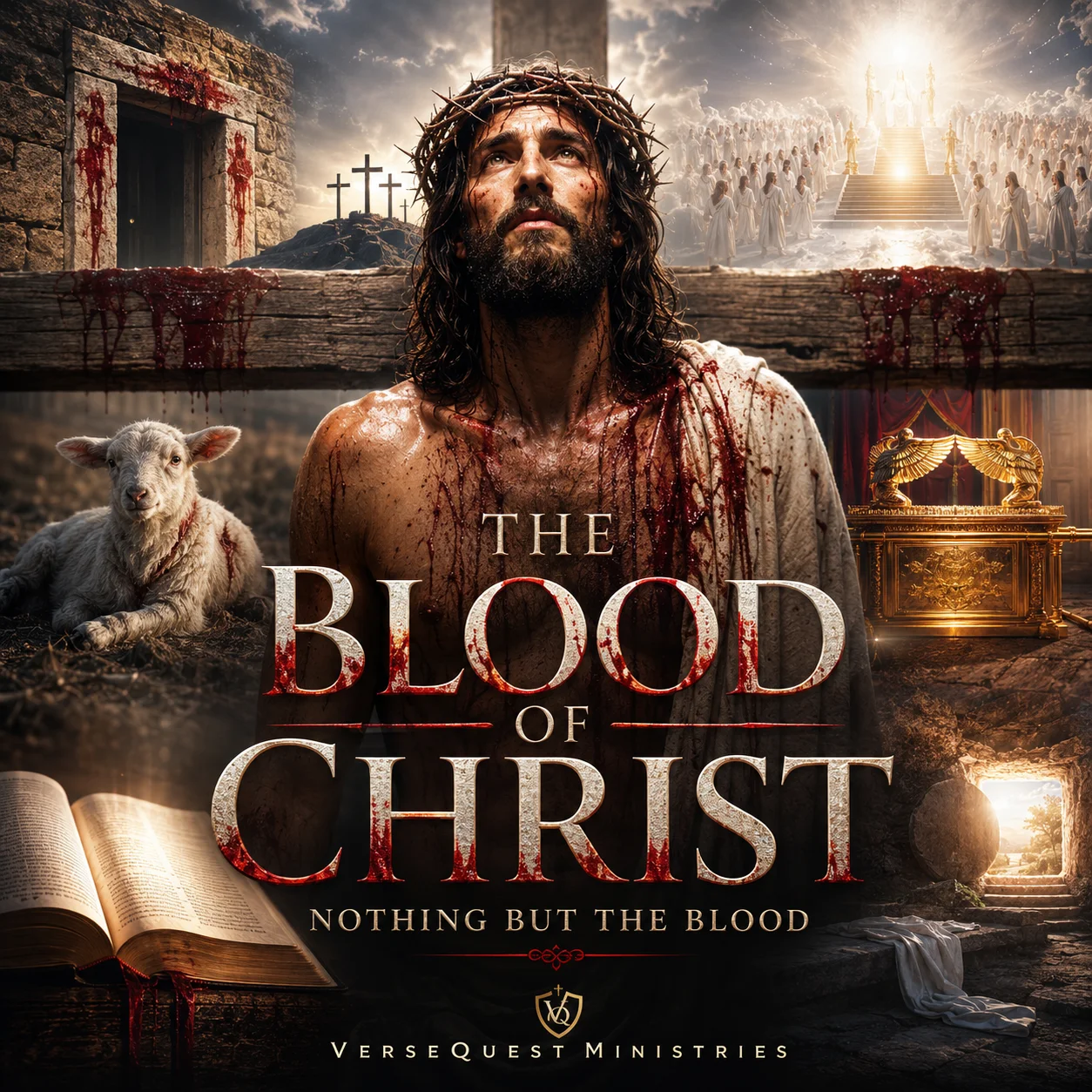
- The Blood of Christ – 66-Study KJV Bible Doctrine PDF
- A 441-page premium VerseQuest PDF featuring 66 detailed KJV Bible studies on the blood of Jesus Christ. This powerful doctrinal resource covers redemption, justification, propitiation, cleansing, access to God, eternal…
- Original price was: $29.99.$9.99Current price is: $9.99.
- Add to cart
-
-67%
-
Premium Studies
-
-25%
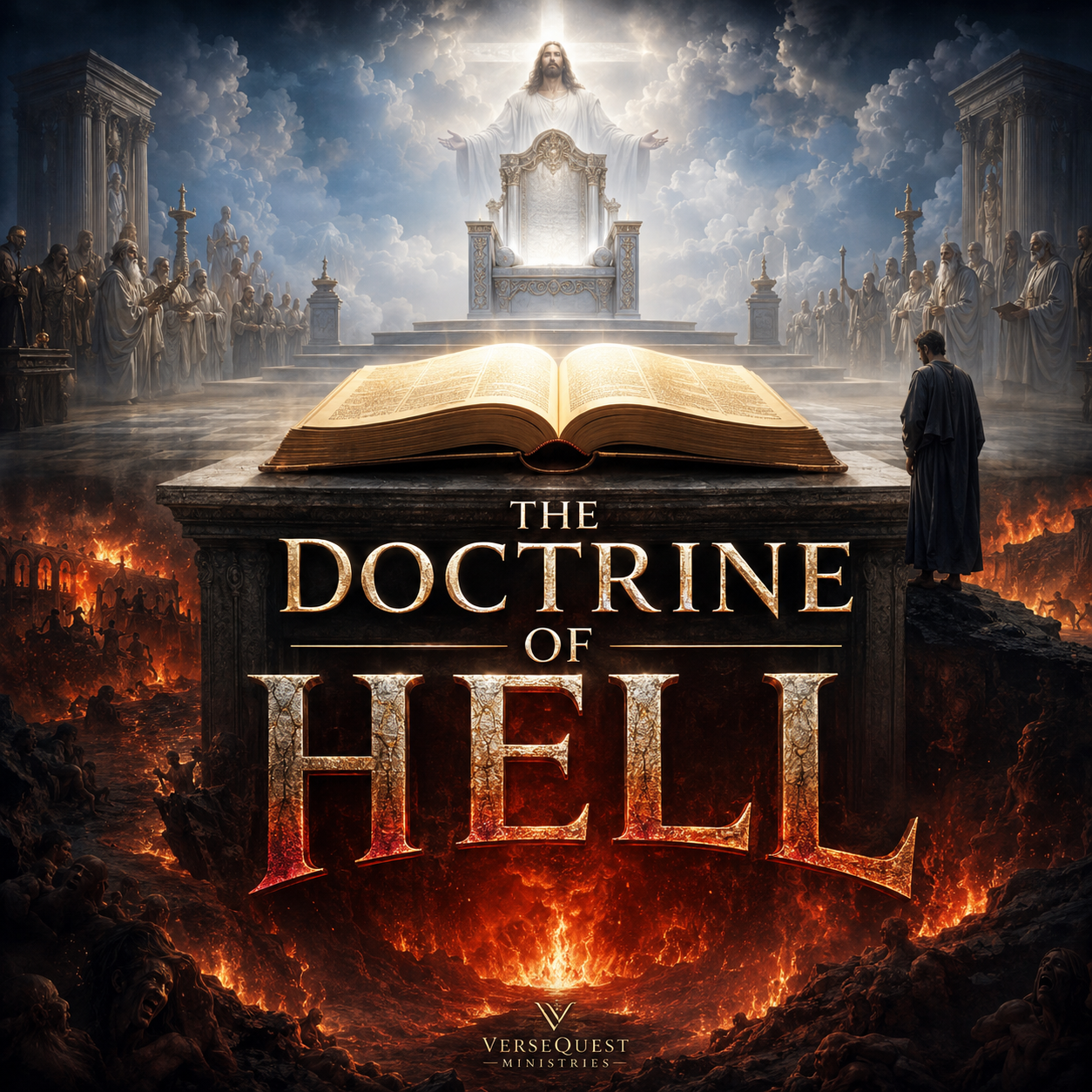
- The Doctrine of Hell — Premium Essay Series PDF
- A 383-page premium VerseQuest PDF study book containing 54 KJV essays on hell, fire, darkness, judgment, the lake of fire, the second death, and Jesus Christ as the only escape.
- Original price was: $39.99.$29.99Current price is: $29.99.
- Add to cart
-
-25%
-
The Rapture
-
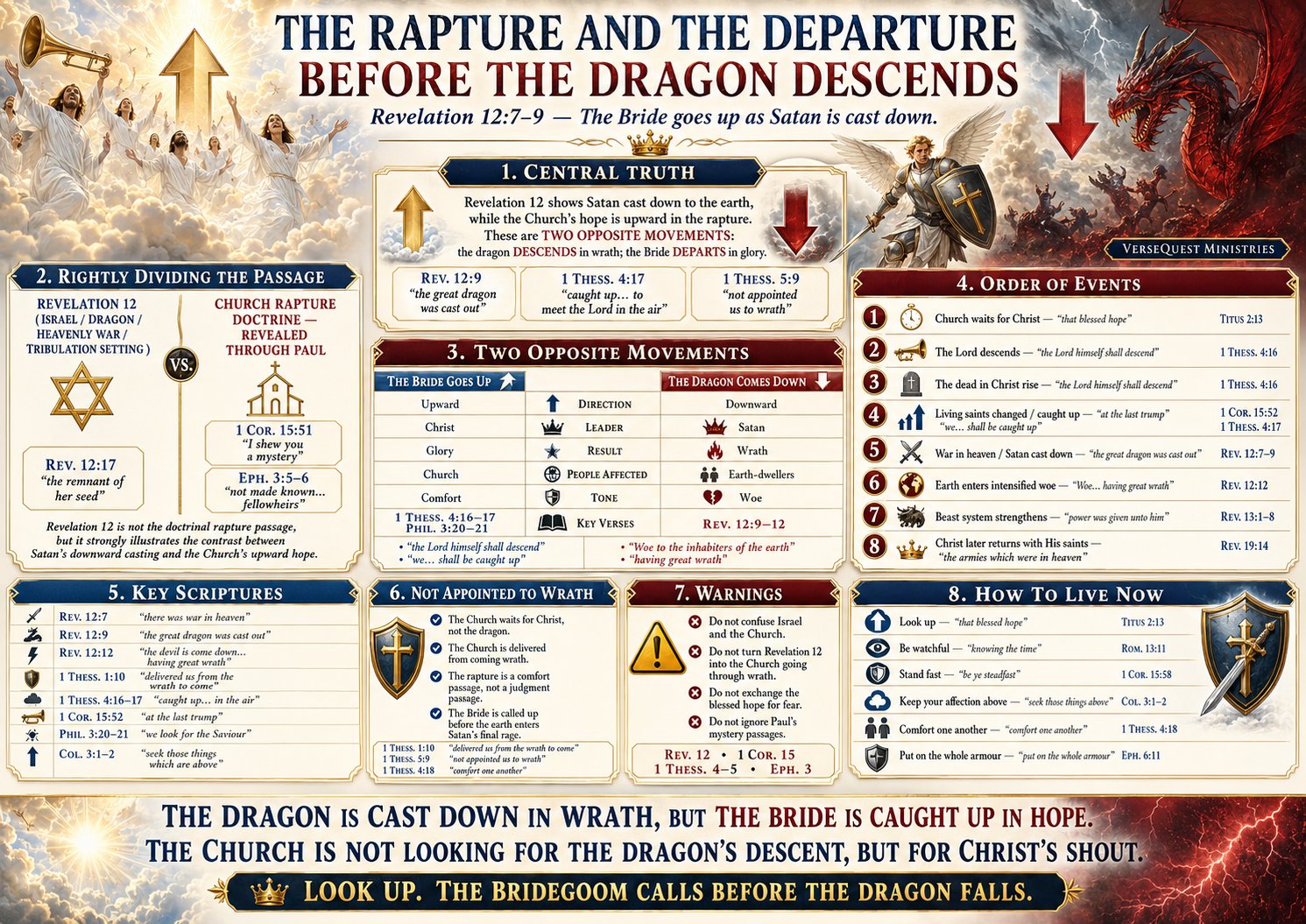
- The Rapture and the Departure Before the Dragon Descends – Printable Bible Study Chart
- Printable KJV Bible study chart on The Rapture and the Departure Before the Dragon Descends, showing the Bride caught up before Satan is cast down in wrath. This premium VerseQuest…
- $4.99
- Add to cart
-
-
Premium VerseQuest Books
-
-75%
- Christ in the Old Testament Made Plain — 100-Essay KJV Study PDF
- A massive 670-page premium KJV Bible study PDF featuring 100 detailed essays showing Jesus Christ throughout the Old Testament in promise, type, sacrifice, Christophany, prophecy, suffering, resurrection, priesthood, and future…
- Original price was: $39.99.$9.99Current price is: $9.99.
- Add to cart
-
-75%
-
VerseQuest Premium Library
-
-67%
- The Book of Psalms Made Plain – 383-Page KJV Psalm Study
- The Book of Psalms Made Plain is a 383-page premium KJV Bible study featuring 54 detailed essays through the major themes, doctrines, prophecies, prayers, laments, and praises of the Psalms.…
- Original price was: $29.99.$9.99Current price is: $9.99.
- Add to cart
-
-67%