
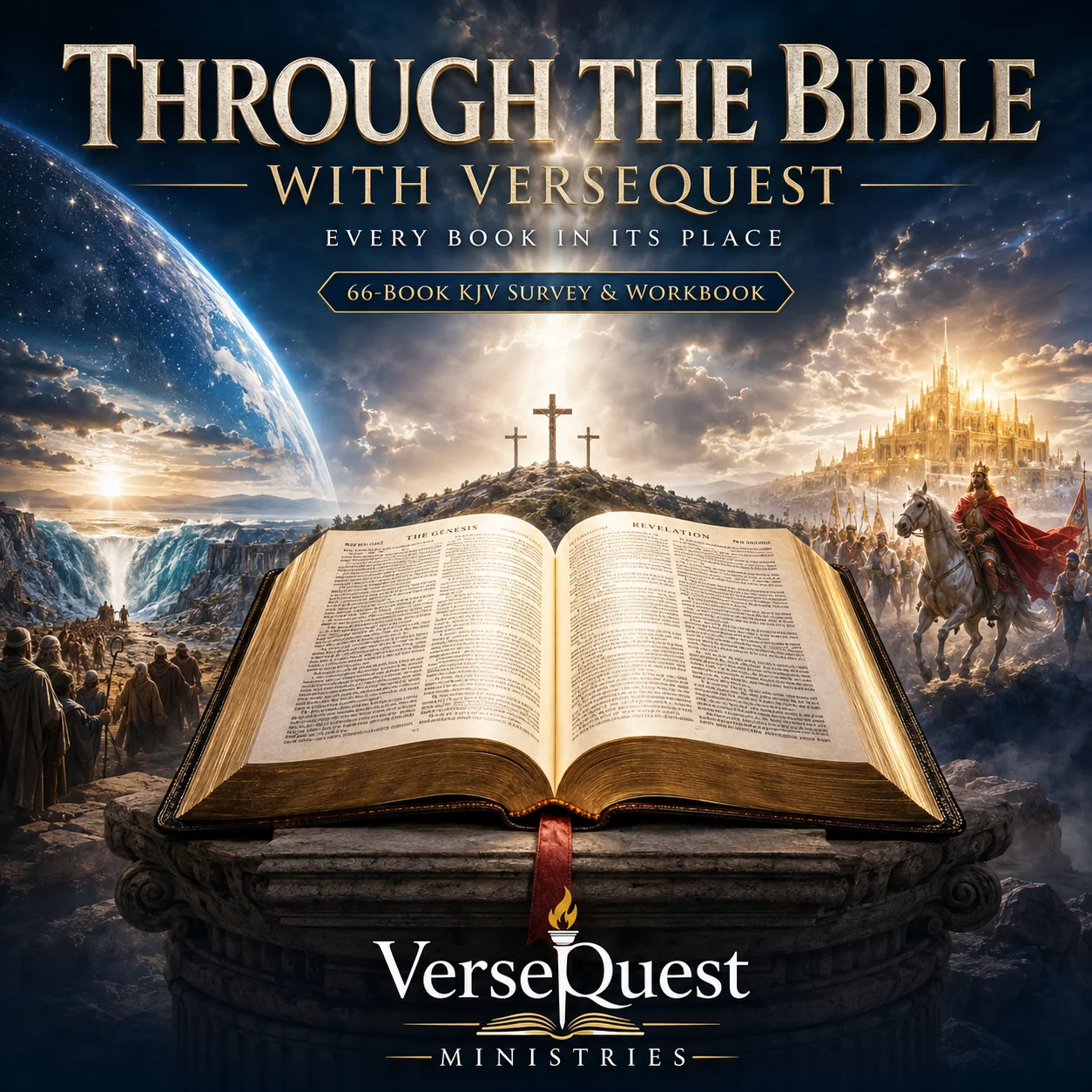
Through the Bible with VerseQuest: Every Book in Its Place — A 66-Book KJV Survey and Rightly Divided Workbook
Through the Bible with VerseQuest is a complete 228-page, 66-book King James Bible curriculum that places every Bible book within its proper historical, doctrinal, dispensational, and prophetic setting. It includes detailed book overviews, selected KJV reading assignments, 66 student worksheets, complete parent-and-teacher answer keys, teaching notes, grading guidance, a 36-week homeschool plan, a 66-week group-study option, glossary, further-study plan, and certificate of completion.
Written from a strong KJV Bible-believing and rightly divided perspective, this printable PDF helps students distinguish Israel from the Church, law from grace, prophecy from mystery, and the Rapture from the Second Advent. It is designed for grades 6–12, homeschool families, new believers, adult Bible students, churches, teachers, and serious readers who want to see every book in its proper place.
$34.99
Description
Through the Bible with VerseQuest is a complete 228-page Bible curriculum designed to help students understand where every book belongs in the history, doctrine, and prophecy of Scripture. Rather than treating the Bible as a collection of disconnected stories or inspirational quotations, this course follows all 66 books in canonical order and places each one within the Bible’s unfolding movement from creation and ruin to covenants, Israel, law, Messiah, the Church, prophecy, judgment, the coming kingdom, and the new creation.
Every Bible book receives a dedicated overview presenting its author, approximate date, chapter count, historical setting, key idea, major movement, book map, principal people, important places, major events, doctrinal spine, connection to Christ, key KJV verse, and one central truth to remember. Each overview also contains a specific rightly divided explanation showing the book’s audience, dispensational setting, and doctrinal placement, along with a warning about a common misreading of the book.
The 66 student worksheets move beyond general reflection questions. Students observe the structure and purpose of each book, compare related Scriptures, identify audiences and covenants, examine doctrine, explain dispensational distinctions, copy a key verse directly from the King James Bible, and state how the truth should affect belief or conduct. Selected reading assignments are provided for longer books, while shorter books may be read in their entirety.
A complete parent-and-teacher guide follows the student curriculum. Each of the 66 books receives suggested answers for all 12 workbook questions, a direct-reading summary, a right-division checkpoint, an important correction to emphasize, a teaching aim, and a consistent 25-point grading guide. These materials allow a parent, pastor, teacher, or ministry leader to guide the course without having to construct a separate answer key.
The curriculum begins with an introduction to biblical authority and right division, instructions for students and teachers, a seven-dispensation framework, and a complete 36-week homeschool schedule. The schedule covers two books per week for 33 weeks, followed by Old Testament review, New Testament review, and a final examination or presentation. A slower 66-week church or adult-study format is also explained for groups that wish to study one Bible book each week.
The course is unapologetically King James Bible-centered, Bible-believing, dispensational, and rightly divided. It distinguishes Israel from the Body of Christ, law from grace, prophecy from mystery, the gospel of the kingdom from Paul’s gospel, the Rapture from the Second Advent, and the future Tribulation from the Church’s present calling. Salvation today is presented as the free gift of God by grace through faith in the death, burial, and resurrection of Jesus Christ, apart from works.
Literal biblical history and prophecy are treated as realities rather than embarrassed metaphors. The curriculum addresses the gap between Genesis 1:1 and 1:2, six literal days of restoration and creative work, the fixed enclosed earth, the firmament and waters above, the lights within the firmament, the worldwide Flood, angelic sons of God, giants, Babel, Israel’s literal covenants and land, Christ’s bodily resurrection, the pre-Tribulation Rapture, Daniel’s seventieth week, the visible Second Advent, the literal thousand-year kingdom, final judgment, and the new heaven and new earth.
The concluding material provides a lifelong-study plan, recommended doctrinal tracks, ministry applications, a 30-term glossary, and a printable certificate of completion. The course is identified as Foundations Level and is appropriate for grades 6–12, homeschool families, family study, new believers, adult Bible students, churches, Sunday schools, discipleship groups, prison ministries, and serious students who want to see the whole Bible in its proper order.
This purchase provides one printable, downloadable PDF under a personal and household license. The customer receives five download attempts with no expiration and should save a backup copy after downloading. The purchaser may print copies for personal use and members of the immediate household and may use the material for personal teaching preparation. The PDF may not be shared, emailed, resold, publicly uploaded, or reproduced for an entire church, classroom, ministry, recovery program, prison program, or organization without appropriate permission or group licensing.
The authority of the King James Bible: The preserved words of God remain the course’s governing authority, while outlines, charts, workbooks, and teachers remain servants of the text. Every book in its proper place: Each Bible book is located within the larger movement of biblical history, doctrine, prophecy, and progressive revelation. Right division: Every passage must be studied according to its speaker, audience, time, covenant, dispensation, doctrinal purpose, and promised result. The seven dispensations: Innocence, Conscience, Human Government, Promise, Law, Grace, and Kingdom provide the course’s basic stewardship framework. Israel and the Body of Christ: Israel’s covenants, land, kingdom, tribes, Jerusalem, and prophetic future are distinguished from the heavenly calling of the Body revealed through Paul. Law and grace: The Mosaic law was given to Israel and must not be imposed upon the justified believer as the Church’s covenant. The gospel for today: Salvation is received by grace through faith in Christ’s death, burial, and resurrection, apart from human works or religious merit. Pauline revelation: Romans through Philemon provide the governing doctrine of the Body of Christ, including justification, identification, sealing, Christian liberty, ministry, the Judgment Seat, and the Rapture. Prophecy and mystery: Israel’s prophesied earthly kingdom is distinguished from the previously hidden mystery of the one Body and its heavenly calling. Creation and biblical cosmology: The course treats Genesis literally, including the gap, the firmament, waters above, the fixed enclosed earth, and the appointed lights within the firmament. The unseen realm: Angels, stars, sons of God, fallen beings, giants, spiritual conflict, and prophetic heavenly warfare are treated as real biblical subjects. Covenants and promises: The Abrahamic, Mosaic, Davidic, and new covenants are examined according to their stated parties and promised fulfillments. Christ throughout Scripture: Each book is connected to Jesus Christ through direct prophecy, doctrine, office, event, or legitimate biblical type without forcing every detail into allegory. The pre-Tribulation Rapture: The catching away of the Body is distinguished from Christ’s visible return to earth after the Tribulation. Daniel’s seventieth week: The future Tribulation resumes Israel’s prophetic program and includes Antichrist, persecution, divine judgments, witnesses, and the 144,000. The Second Advent and kingdom: Jesus Christ returns visibly, judges His enemies, restores Israel, and reigns literally for one thousand years. Final judgment and eternity: The course follows Scripture through the Great White Throne, lake of fire, new heaven, new earth, and New Jerusalem. Audience before application: Students learn that all Scripture is profitable, but not every command, promise, warning, or covenant is addressed directly to the same people. Doctrinal clarity before personal reflection: Observation, comparison, and proper placement come before personal application. Teaching mastery: Students are trained to explain each book’s purpose, audience, structure, major doctrine, dispensational setting, and relation to Christ.
Central argument: The Bible becomes clearer when every book, command, covenant, gospel, promise, warning, and prophetic event is placed with its proper audience and within its proper dispensation. Right division does not deny any part of Scripture; it preserves the meaning of every part.
Major observations:
- The Bible’s 66 books form one coherent revelation while retaining distinct historical settings, audiences, covenants, and doctrinal purposes.
- Genesis supplies the foundation for creation, sin, death, sacrifice, judgment, covenant, Israel, and the promised Seed.
- The Law belongs historically and covenantally to Israel, although every part remains profitable for learning.
- Israel’s historical books demonstrate the nation’s life in the land, kingdom, division, captivity, and partial restoration.
- The books of poetry and wisdom address worship, suffering, practical conduct, love, mortality, and life under God’s rule.
- The prophets announce real judgment, national restoration, Messiah, the Day of the LORD, Israel’s kingdom, and the future reign of Christ.
- The Gospels record the earthly ministry of Israel’s promised Messiah and the kingdom offer in its Jewish setting.
- Acts is a transitional book and must not be treated as though every event establishes permanent Church-Age doctrine.
- Paul’s epistles reveal the gospel, doctrine, position, walk, ministry, and hope of the Body of Christ.
- The Hebrew and General Epistles retain their named audiences and contribute important doctrine without erasing Pauline distinctions.
- Revelation completes the Bible through Tribulation, Advent, kingdom, judgment, and new creation.
Important distinctions:
- Israel is not the Church, and the Church does not cancel Israel.
- The gospel of the kingdom is not identical to Paul’s gospel of the grace of God.
- The Mosaic covenant is not the covenant governing the Body of Christ.
- Water baptism must not be confused with the Spirit’s work of placing a believer into Christ.
- The Rapture is not the visible Second Advent.
- The Church Age is not the promised millennial kingdom.
- The 144,000 are not a symbolic name for the Church.
- The new covenant is explicitly promised to Israel and Judah.
- Spiritual application does not authorize the reader to steal another audience’s covenant promises.
- A genuine type of Christ must arise from biblical patterns rather than imagination.
Doctrinal conclusions:
- The King James Bible is received as the preserved written authority for English-speaking students.
- The sinner today is justified by faith in Jesus Christ apart from works.
- Every saved member of the Body is sealed by the Holy Spirit and awaits the catching away of the Church.
- Israel retains a literal national and prophetic future.
- Daniel’s seventieth week remains future.
- Jesus Christ will return bodily and visibly to reign on earth.
- The millennial kingdom lasts a literal thousand years.
- Satan, fallen angels, Antichrist, divine judgments, resurrection, the lake of fire, and New Jerusalem are realities rather than metaphors for human experience.
Memorable teaching points:
- Every verse is true, but every verse is not addressed to the same person.
- Application must follow interpretation.
- A promise keeps the name and address God placed upon it.
- Acts records transition; Paul supplies settled Church doctrine.
- Christ should be found where Scripture reveals Him, not where imagination forces Him.
- Right division protects the gospel without discarding the rest of the Bible.
- The Bible does not end with mankind improving the world; it ends with the King returning, judging, reigning, and making all things new.
Subjects for further study:
- How do the covenants develop from Genesis through the prophets?
- Which doctrines were mysteries revealed particularly through Paul?
- How does Acts move from Jerusalem and the twelve toward Paul’s Gentile ministry?
- Which Old Testament prophecies await literal fulfillment?
- How do the Gospels differ in emphasis while presenting the same Jesus Christ?
- What passages distinguish the Rapture from the Second Advent?
- How do Genesis, Job, Psalms, the prophets, Jude, and Revelation describe the firmament and the unseen realm?
- How should a Bible student distinguish doctrinal instruction from historical description and spiritual application?
Personal Bible study: A reader may complete the course independently by reading the assigned KJV passages, studying each overview, answering the worksheet questions, and checking responses against the teacher guide. The curriculum supplies a structured path for readers who have studied isolated passages but have never understood the Bible as a whole.
Homeschool instruction: The 36-week schedule provides a complete school-year Bible course. Families may divide each week into Bible reading, overview study, written work, answer review, and oral recap. The 25-point grading guide allows parents to evaluate progress consistently, while the completion certificate provides a formal ending to the course.
Family Bible study: Parents may use the overview pages to introduce each book, discuss the worksheet questions together, assign memory work, and ask children to teach the lesson back in their own words. The material is substantial enough for older students and accessible enough to guide family discussion.
Sunday school and adult Bible classes: The curriculum may be taught as a 66-week course covering one book each week. The overview can guide the lesson, the worksheet can provide preparation or homework, and the parent-and-teacher guide can function as the instructor’s doctrinal outline.
Small groups and discipleship: Leaders may use the course to help new believers establish a whole-Bible framework before moving into more detailed doctrinal or verse-by-verse study. Questions concerning audience, covenant, dispensational location, and common misreadings encourage meaningful discussion.
Sermon and lesson preparation: Pastors, preachers, and teachers may use the book maps, doctrinal spines, Christ connections, key verses, and teaching notes as starting points for introductory sermons, Bible-book surveys, or topical studies.
Ministry training: The curriculum can help prospective teachers, ministry volunteers, Bible institute students, and discipleship leaders learn to handle Scripture with greater order and doctrinal precision.
Prison, outreach, and recovery ministries: When used under an appropriate group or ministry license, the course can provide a structured Bible foundation for participants who need more than isolated devotional readings. It should be presented as Bible instruction and spiritual discipleship rather than as a substitute for professional medical or mental-health treatment.
Final presentation or examination: Students may conclude the course by explaining the major divisions of Scripture, the dispensations, salvation by grace, the distinction between Israel and the Church, and the Bible’s prophetic conclusion.
A complete King James Bible for all assigned reading, copywork, comparison, and memory verses.
An exhaustive Bible concordance for tracing repeated words, names, doctrines, and related passages.
A reliable cross-reference Bible or cross-reference treasury for comparing Scripture with Scripture.
A traditional Bible dictionary for historical names, places, customs, measurements, and objects.
Bible maps covering the patriarchal journeys, Exodus route, tribal allotments, united and divided kingdoms, exile, restoration, the ministry of Christ, and Paul’s journeys.
A Bible timeline showing creation, the patriarchs, Israel’s history, the kings, prophets, captivity, restoration, the earthly ministry of Christ, Acts, Pauline ministry, and future prophecy.
A dedicated notebook for longer answers, additional cross-references, sermon ideas, doctrinal questions, and book-by-book summaries.
A repeated study of Romans through Philemon for Church-Age salvation, standing, walk, ministry, hope, and the Body of Christ.
A covenant study tracing Genesis 12, Genesis 15, Genesis 17, Exodus 19–24, 2 Samuel 7, Jeremiah 31, and related prophetic passages.
A prophecy study comparing Daniel, Matthew 24, 1 and 2 Thessalonians, 2 Peter, Jude, and Revelation.
A creation and unseen-realm study comparing Genesis, Job, Psalms, Isaiah, Ezekiel, Daniel, the Gospels, Jude, and Revelation.
Blank index cards or a digital flashcard system for memorizing book order, Bible divisions, dispensations, audiences, key verses, and major doctrines.
Related products
-
The Rapture
-
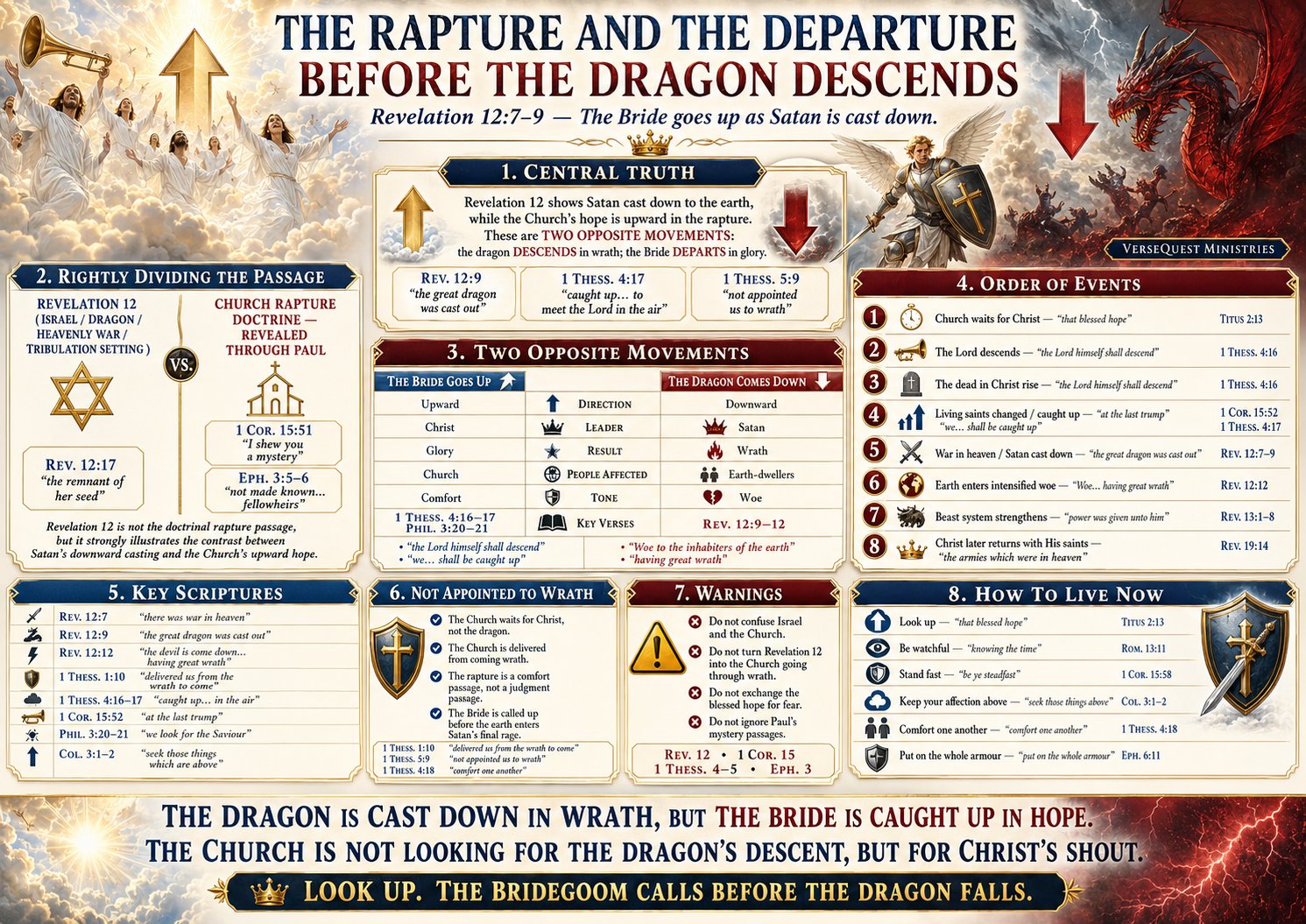
- The Rapture and the Departure Before the Dragon Descends – Printable Bible Study Chart
- Printable KJV Bible study chart on The Rapture and the Departure Before the Dragon Descends, showing the Bride caught up before Satan is cast down in wrath. This premium VerseQuest…
- $4.99
- Add to cart
-
-
Law vs Grace
-
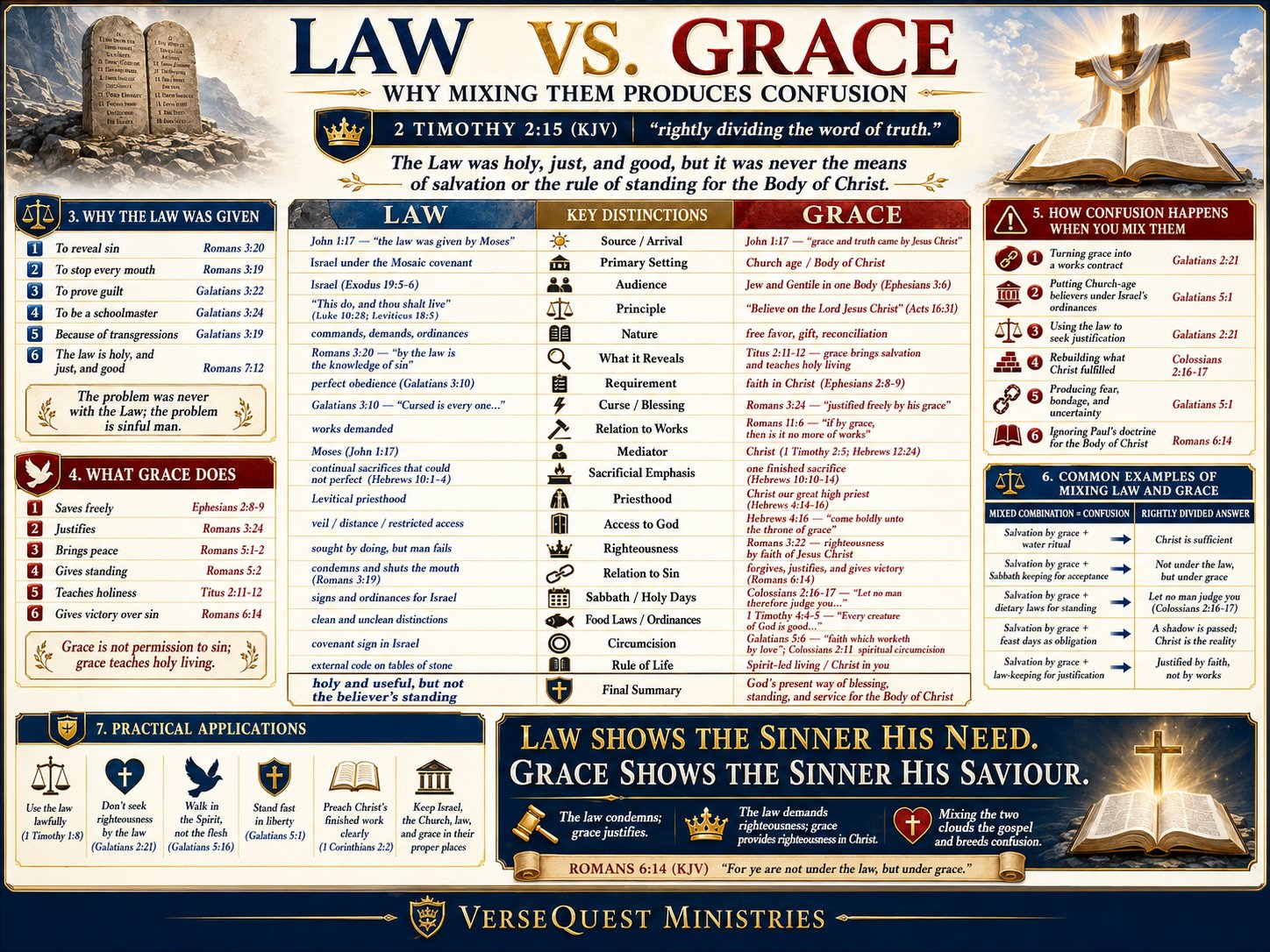
- Law vs. Grace Bible Study Chart – Why Mixing Them Produces Confusion (KJV)
- Compare law and grace with this detailed KJV Bible study chart explaining salvation, justification, holiness, Israel’s Mosaic covenant, Christian liberty, and the danger of mixing law with the gospel.
- $3.99
- Add to cart
-
-
Heavenly Program
-
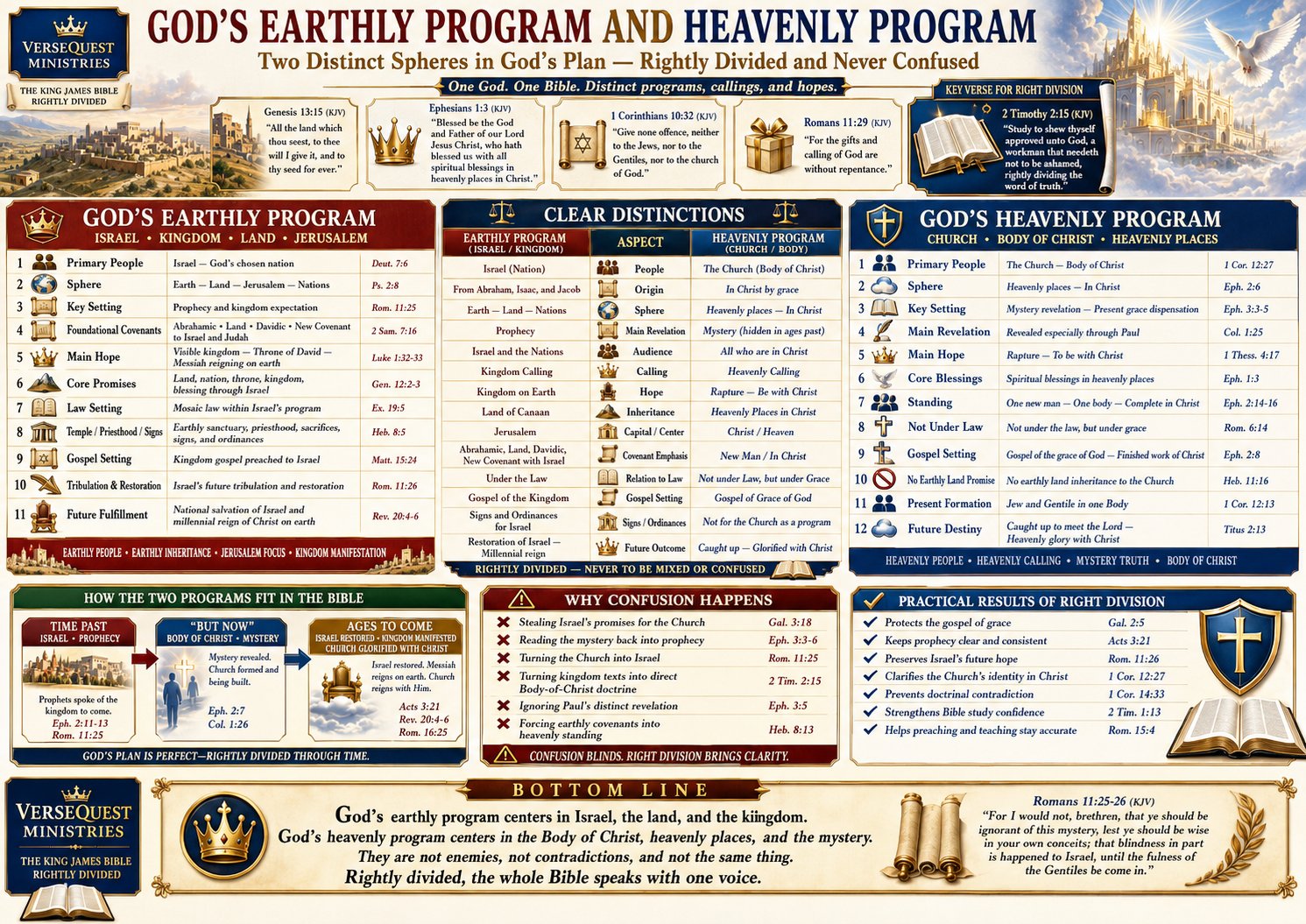
- Israel and the Church: Earthly and Heavenly Callings – KJV Bible Study Chart
- Printable digital KJV Bible study chart comparing Israel’s earthly promises and kingdom hope with the Church’s heavenly calling in Christ. Covers prophecy and mystery, biblical covenants, law and grace, the…
- $3.99
- Add to cart
-
-
Study Books (PDF)
-
-25%
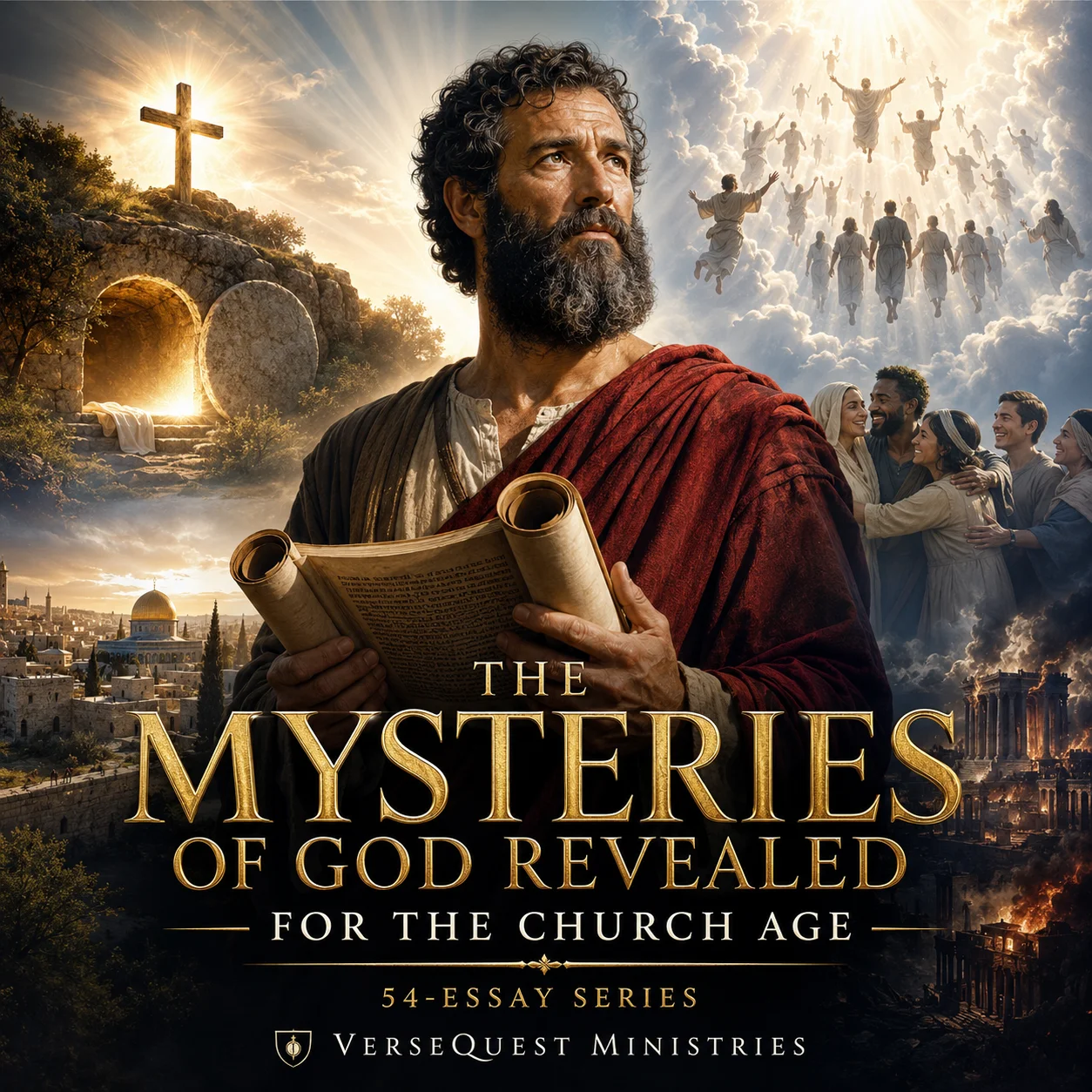
- The Mysteries of God Revealed for the Church Age – Premium Essay Series PDF
- A premium 404-page VerseQuest Ministries digital PDF study book featuring 54 detailed KJV-only essays on the mysteries of God revealed for the Church Age. This rightly divided study covers the…
- Original price was: $39.99.$29.99Current price is: $29.99.
- Add to cart
-
-25%
-
The Gospel of the Kingdom
-
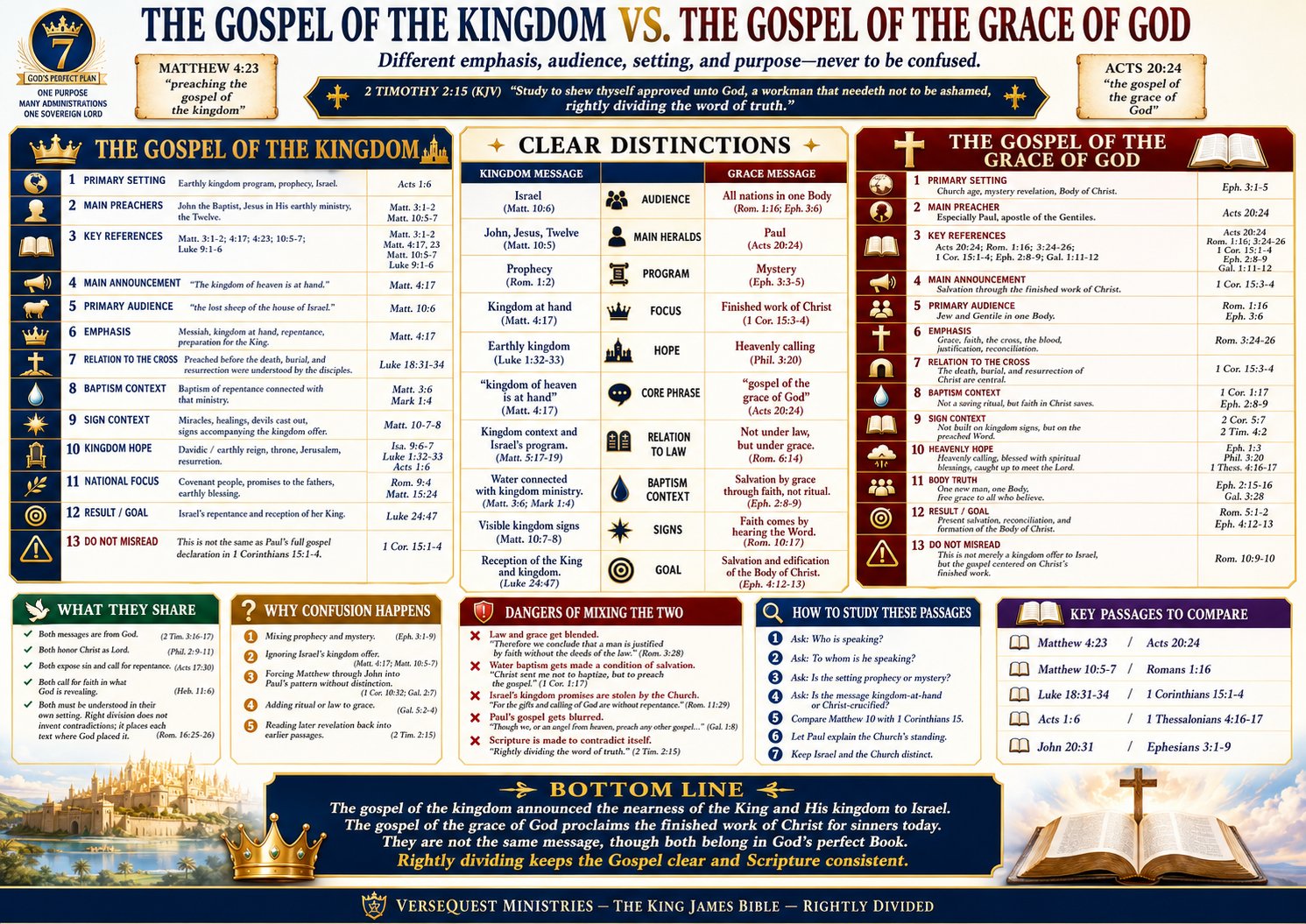
- The Gospel of the Kingdom vs. the Gospel of the Grace of God – KJV Right Division Bible Study Chart
- Compare the gospel of the kingdom and the gospel of the grace of God with this detailed KJV chart covering audience, message, prophecy, mystery, baptism, signs, salvation, and right division.
- $3.99
- Add to cart
-