
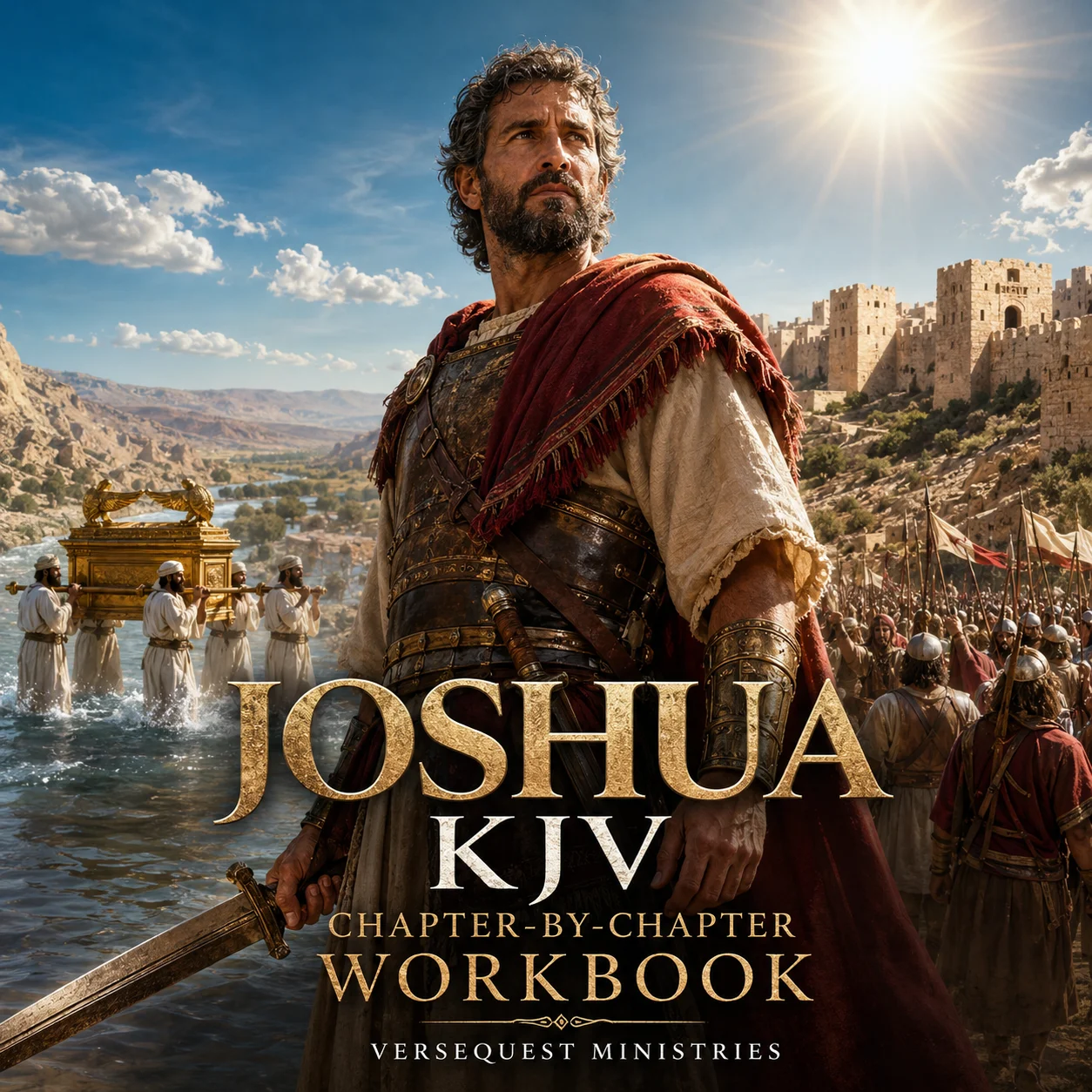
Joshua KJV Chapter-by-Chapter Workbook
The Joshua KJV Chapter-by-Chapter Workbook is a complete 357-page downloadable Bible curriculum covering all 24 chapters of Joshua from a Bible-believing, KJV-centered, rightly divided perspective.
Every chapter contains ten student-study pages followed by a Teacher and Leader Guide and Suggested Answers and Model Summary. Students will examine Joshua’s commission, Rahab and the spies, the crossing of Jordan, the memorial stones, the Captain of the LORD’s host, Jericho, Achan, Ai, Gibeon, the long day, the conquest campaigns, tribal inheritances, Caleb, the cities of refuge, the Levitical cities, Altar Ed, and the covenant renewal at Shechem.
The workbook also includes 24- and 12-week schedules, a 48-lesson teaching plan, maps, chronology, four cumulative reviews with keys, a final assessment and answer key, ten doctrinal reference studies, a KJV glossary, indexes, a final teaching project, further-study guidance, and a certificate of completion.
It may be printed for handwritten study or used digitally with compatible PDF software. It is ideal for personal study, homeschool, Sunday school, church Bible classes, discipleship, small groups, Bible institutes, and ministry training.
Price: $29.99
$29.99
Description
The Joshua KJV Chapter-by-Chapter Workbook is a complete 357-page downloadable Bible curriculum designed to lead students carefully through all 24 chapters of Joshua. It combines direct King James Bible study with structured observation, guided exposition, KJV vocabulary, doctrinal distinctions, cross-reference work, written exercises, special studies, controlled typology, difficult questions, error correction, chapter reviews, teaching assignments, and personal application.
Joshua begins after the death of Moses, with Israel standing at the edge of Jordan, and concludes with Joshua’s final covenant challenge, his death, the burial of Joseph’s bones, and the passing of a faithful generation. Between those scenes, the LORD commissions Joshua, brings Israel through Jordan on dry ground, establishes memorial stones at Gilgal, renews covenant signs, identifies Himself as the Captain of the LORD’s host, brings down Jericho, exposes Achan’s hidden sin, restores Israel at Ai, commands the reading of the law, overrules the Gibeonite deception, defeats the southern and northern coalitions, distributes the land among the tribes, establishes cities of refuge and Levitical cities, preserves unity during the controversy over Altar Ed, and renews the covenant at Shechem.
Every chapter receives a consistent twelve-page treatment. The first ten pages include a chapter-at-a-glance overview, guided exposition, doctrine and right division, KJV vocabulary, cross-reference chains, written Bible exercises, a chapter-specific special study, Christ-centered and canonical connections, difficult questions, error correction, review, teach-back preparation, and written response. These are followed by a Teacher and Leader Guide and a Suggested Answers and Model Summary page.
The workbook approaches Joshua from a Bible-believing, KJV-centered, literal-historical, dispensational, rightly divided, and Christ-centered perspective. Literal Israel remains Israel, and the land promised to Abraham’s physical seed is not transferred to the Body of Christ. Israel’s national warfare under an explicit divine command is distinguished from the spiritual warfare of the present believer. The historical meaning of each passage is established before typology or practical application is considered.
Special attention is given to the relationship between divine promise and human responsibility. The LORD gives Israel the land, breaks organized resistance, establishes tribal allotments, and fulfills His good word; nevertheless, individual tribes remain responsible to occupy their portions, expel remaining enemies, and continue in covenant faithfulness. The workbook carefully distinguishes what was given, conquered, divided, and practically possessed.
The course also examines Joshua’s development as Moses’ minister, Israel’s military leader, administrator of the inheritance, covenant witness, and faithful servant of the LORD. It studies Rahab’s faith, Caleb’s perseverance, Achan’s sin, the Gibeonite deception, the meaning of the memorial stones, the significance of the ark in Jordan, the fall of Jericho, the long day of Joshua 10, the cities of refuge, the Levitical inheritance, incomplete possession, tribal unity, generational responsibility, and Joshua’s final demand: “choose you this day whom ye will serve.”
Extensive course material makes this more than a commentary or collection of study notes. The front matter contains instructions for using the workbook, core and enrichment tracks, course outcomes, doctrinal and interpretive principles, a rightly divided study method, structural and chapter overviews, a 24-week schedule, a 12-week intensive schedule, a 48-lesson teaching plan, chronology and geography studies, a conquest and allotment overview, a study of Joshua as servant and leader, and a student progress record.
The back matter includes four cumulative reviews with answer keys, a four-part final assessment with a complete key, ten doctrinal reference studies, a four-part KJV glossary, subject and doctrine indexes, a Scripture index, a final teaching presentation with evaluation form, further-study projects, a final course challenge, and a certificate of completion. The final teaching assignment guides students in preparing a 20- to 30-minute lesson demonstrating accurate KJV exposition, chapter structure, rightly divided doctrine, responsible cross-references, controlled Christ-centered connections, error correction, and faithful application.
The downloadable PDF contains searchable text and organized navigation bookmarks. It may be printed for handwritten study or used on a computer or tablet. Students using compatible PDF software may highlight passages, insert comments, draw markings, and add text boxes electronically.
The Joshua KJV Chapter-by-Chapter Workbook is suitable for serious individual Bible students, homeschool families, Sunday school classes, church Bible-study groups, discipleship programs, Bible institutes, prison and recovery ministries, pastors, preachers, teachers, and ministry leaders. It can be completed through the 24-week course, followed as a 12-week intensive study, or divided into 48 separate teaching lessons.
This is not merely a book to read and place on a shelf. It is a working Bible curriculum designed to help students open their King James Bible, examine the words, trace Israel’s movements, compare Scripture with Scripture, recognize doctrinal distinctions, answer difficult questions, write their conclusions, and develop the ability to explain and teach the book of Joshua faithfully.
The transition from Moses to Joshua — God’s servant changes, but the authority, covenant purpose, and written word of the LORD continue. Prepared leadership — Joshua’s public ministry follows years of service, warfare, tested faith, instruction, and divine commissioning. Strength and good courage — Biblical courage rests upon God’s command, presence, promises, and written word rather than personality or self-confidence. The authority of the book of the law — Joshua’s success is tied to speaking, meditating upon, and obeying the words given through Moses. The literal land promise — Canaan belongs within God’s covenant dealings with Abraham, Isaac, Jacob, and literal Israel. Promise and responsibility — The LORD gives the land, but Israel must arise, cross, fight, occupy, and remain faithful. Brotherly duty among the tribes — The eastern tribes must help their brethren obtain rest before returning to their own inheritance. Rahab’s faith and confession — Rahab believes the testimony concerning the LORD, receives the spies, acts upon her faith, and seeks mercy for her household. The scarlet line — The visible token identifies the household promised deliverance when Jericho comes under judgment. The ark and divine presence — Israel follows the ark into Jordan, demonstrating that the LORD leads the nation into the land. Jordan crossed on dry ground — The LORD opens an impossible path, exalts Joshua before Israel, and confirms His presence with the new leader. Memorial stones and generational teaching — The twelve stones are designed to provoke questions and preserve testimony for children not present at the crossing. Covenant preparation before conquest — Circumcision and Passover precede the attack upon Jericho, showing that Israel’s relationship with the LORD comes before military action. The cessation of manna — Wilderness provision ends when Israel begins eating the produce of the land. The Captain of the LORD’s host — Joshua must submit and worship before he commands Israel in battle. Jericho’s fall by the word of the LORD — Israel’s unusual battle plan emphasizes obedience and divine power rather than human military genius. Judgment and mercy at Jericho — The city is devoted to judgment while Rahab and her household are delivered according to the pledged word. The accursed thing — Achan’s theft demonstrates that hidden sin can bring public consequences and interrupt national victory. The anatomy of temptation — Achan sees, covets, takes, and hides, exposing the progression of sinful desire. Defeat, correction, and restoration — Israel’s failure at Ai is followed by confession, judgment, renewed direction, and restored victory. The altar and law at Ebal — Israel’s military progress does not remove its responsibility to hear and obey the covenant. Failure to seek counsel from the LORD — The Gibeonite deception succeeds because Israel examines evidence but neglects divine counsel. The binding force of an oath — Israel must honor its covenant with Gibeon even though the agreement was obtained through deception. The long day of Joshua 10 — The LORD fights for Israel through hailstones and an extraordinary extension of the day. Divine judgment upon entrenched iniquity — The conquest occurs under explicit divine command after long-developing Canaanite corruption. Victory over organized coalitions — Southern and northern alliances cannot overturn the word and purpose of the LORD. The record of defeated kings — Joshua 12 transforms conquest into an ordered historical testimony rather than a vague claim of victory. Given, conquered, divided, and possessed — These four terms describe related but distinct stages of Israel’s inheritance. Much land yet to be possessed — Major resistance has been broken, but unfinished work remains and is honestly identified. Caleb’s perseverance — At eighty-five, Caleb claims the mountain promised forty-five years earlier because he wholly followed the LORD. Tribal borders and city lists — Detailed allotments demonstrate that the inheritance is geographic, historical, legal, and tribal. Incomplete possession — Several tribes tolerate remaining Canaanites, foreshadowing compromise and bondage in Judges. Faithful claims and family inheritance — The daughters of Zelophehad preserve their appointed inheritance according to the command given through Moses. Iron chariots and intimidated faith — Formidable opposition tests whether the tribes will act upon the portion God has given them. Slackness at Shiloh — Seven tribes delay possessing their inheritance and must be confronted by Joshua. Joshua receiving his portion last — The leader who supervised Israel’s inheritance receives his own city after the tribes have received theirs. Cities of refuge and justice — Refuge protects an unintentional slayer from immediate vengeance while preserving public hearing and lawful judgment. The Levitical inheritance — Levi receives cities among the tribes and a distinct ministry-centered inheritance. The faithfulness of God’s promises — Joshua 21 declares that not one good thing failed of all the LORD had spoken. Zeal governed by facts — The controversy over Altar Ed demonstrates the danger of acting upon incomplete information. Tribal unity and peaceful investigation — Israel prepares to confront suspected rebellion but first sends representatives to hear the matter. Witnesses, memorials, and testimony — Stones, altars, written words, and covenant declarations preserve the truth for future generations. Joshua’s farewell warning — Past victories do not remove the danger of future compromise, idolatry, and covenant judgment. Choosing whom to serve — Joshua demands an open and exclusive declaration of allegiance to the LORD. The danger of inherited religion — Joshua ends with a faithful generation, but Judges reveals how quickly truth can be lost when God’s works are not taught. Joshua and the greater rest — Joshua leads Israel into Canaan, but later Scripture points to a greater rest available through Jesus Christ. Israel and the Body of Christ distinguished — The workbook preserves Israel’s national warfare, land, law, and covenant while drawing legitimate instruction for present believers. Application after interpretation — Practical lessons are drawn only after the historical audience, covenant setting, and doctrinal meaning are established.
- Central argument: Joshua records the LORD bringing literal Israel into the land promised to the fathers, judging entrenched iniquity, breaking organized resistance, distributing inheritance, and demanding covenant faithfulness.
- Opening and conclusion: The book opens with the death of Moses and closes with the deaths or burials of Joshua, Joseph, and Eleazar.
- The controlling movement: Commission leads to crossing, crossing to conquest, conquest to allotment, allotment to covenant witness, and covenant witness to generational responsibility.
- Four major divisions: Chapters 1–5 concern commission and entrance; Chapters 6–12 concern conquest; Chapters 13–21 concern inheritance; Chapters 22–24 concern covenant loyalty.
- Continuity after Moses: Moses dies, but the word spoken through him continues to govern Joshua and Israel.
- Joshua’s preparation: Joshua serves as soldier, minister, faithful spy, commissioned successor, national leader, administrator, and covenant witness.
- Biblical courage: Joshua’s courage rests upon command, promise, presence, and obedience. It is not positive thinking or confidence in human strength.
- The book of the law: Joshua must speak, meditate upon, observe, and obey the written word.
- Gift and responsibility: God’s gift of the land does not eliminate Israel’s responsibility to cross, fight, possess, and remain faithful.
- The eastern tribes: Reuben, Gad, and half Manasseh demonstrate that receiving personal rest does not cancel responsibility toward brethren.
- Rahab’s confession: Rahab recognizes the LORD as God in Heaven above and earth beneath before Jericho falls.
- Rahab’s faith: Her actions do not replace faith; they demonstrate that her confession is genuine.
- Jordan: The river crossing confirms God’s presence with Joshua and proves that the living God is among Israel.
- The ark: The ark leads the way and remains in Jordan until the people have completely crossed.
- The memorial stones: Biblical memorials are designed to provoke questions and open the way for generational instruction.
- Gilgal: Gilgal becomes a place of memorial, covenant preparation, military return, and later prophetic significance.
- Covenant before campaign: Israel is circumcised and keeps Passover before attacking Jericho.
- The manna ceases: Israel’s wilderness provision ends as the nation begins eating the old corn and fruit of Canaan.
- The Captain’s question: The primary question is not whether the LORD is on Joshua’s side, but whether Joshua is submitted to the LORD.
- Jericho: The walls fall after Israel obeys a battle plan that leaves no room for human boasting.
- Rahab at Jericho: Mercy does not deny judgment; it delivers the household that responds to the pledged word.
- The accursed thing: What belongs under God’s ban cannot be privately seized without consequence.
- Achan’s progression: Sight leads to coveting, coveting to taking, and taking to hiding.
- Corporate consequence: Achan’s private act affects the entire congregation and contributes to Israel’s defeat at Ai.
- Restoration: After sin is exposed and judged, the LORD renews Joshua’s commission and gives victory at Ai.
- Ebal and Gerizim: Israel pauses during conquest to build the altar and hear the words of the law.
- Gibeon: Impressive evidence is not a substitute for seeking counsel from the LORD.
- Oaths: Israel’s leaders must honor their sworn covenant even after discovering the deception.
- Joshua’s long day: Joshua 10 presents an extraordinary historical act in which the LORD fights for Israel.
- The campaigns: Southern and northern coalitions reveal the futility of organized resistance against God’s declared judgment.
- Chariots: Israel must not allow advanced enemy equipment to replace dependence upon the LORD.
- The defeated kings: Scripture preserves names and lists because biblical victory occurs in real history and geography.
- Much land remaining: Joshua honestly distinguishes completed major campaigns from territory not yet occupied.
- Four inheritance terms: Given refers to covenant title; conquered refers to broken resistance; divided refers to legal allotment; possessed refers to practical occupation.
- Levi’s inheritance: Levi’s non-territorial inheritance emphasizes priestly service and dependence upon the LORD’s provision.
- Caleb: Forty-five years of waiting do not weaken Caleb’s faith in the promise.
- The allotment chapters: Borders, towns, families, and tribal portions must be studied rather than skipped as unimportant details.
- Incomplete possession: Tribute is not the same as obedience, and tolerated enemies later become sources of corruption.
- The daughters of Zelophehad: Their claim demonstrates the importance of preserving an inheritance according to God’s command.
- Iron chariots: Difficult opposition does not cancel the responsibility attached to God’s grant.
- Slackness: The tribes at Shiloh possess a promise but delay acting upon it.
- Joshua’s inheritance: Joshua receives Timnath-serah after the tribal portions are distributed.
- Cities of refuge: Refuge is not freedom from justice; it protects the accused while the matter is lawfully heard.
- Levitical cities: The Levites are scattered among Israel for service, instruction, worship, and national testimony.
- Not one good thing failed: Joshua 21:45 provides the book’s great declaration of God’s covenant faithfulness.
- Altar Ed: The western tribes’ concern is understandable, but their conclusions are incomplete until the eastern tribes explain the altar.
- Peace through investigation: Zeal is governed by facts, testimony, and covenant truth.
- Joshua’s farewell: The same God who fulfills promises will also fulfill warnings.
- The final choice: Joshua 24 demands exclusive allegiance and refuses a merely verbal profession unsupported by obedience.
- Joseph’s bones: The burial of Joseph’s bones connects Genesis 50 with the fulfillment of God’s promise in Joshua.
- The unfinished warning: Joshua’s faithful generation is followed by compromise and failure in Judges.
- Christ-centered distinction: Joshua provides temporary national rest in Canaan; Jesus Christ provides the greater and final rest.
- Right-division distinction: Israel’s land and warfare are literal and national. The Church’s warfare is spiritual and its position is heavenly.
- Important caution: Canaan should not be treated as a complete picture of Heaven because warfare, sin, discipline, enemies, and unfinished possession continue after Israel enters.
- Question for further study: How do the memorial stones, Altar Ed, the written law, and the covenant stone function as witnesses?
- Question for further study: How does the conquest relate to the mature iniquity described in Genesis 15 and Leviticus 18?
- Question for further study: How do Joshua’s leadership and limitations point toward the superiority of Jesus Christ?
- Question for further study: Which tribal failures in Joshua become major problems in Judges?
- Memorable teaching point: God’s gift establishes the inheritance, but faith must still rise, cross, obey, and possess.
- Memorable teaching point: Courage without the word becomes presumption; courage governed by the word becomes obedience.
- Memorable teaching point: The walls of Jericho could not stop obedience, but one hidden garment could stop an army.
- Memorable teaching point: A generation may inherit land from its fathers, but it cannot inherit faith without hearing and believing the word of God.
- Memorable teaching point: Joshua begins with “arise” and ends with “choose”; the book demands movement under the word and allegiance to the LORD.
For personal Bible study, the workbook supplies a disciplined method for studying all 24 chapters. The student reads the complete KJV chapter, marks its structure, answers from the text, traces cross-references, defines important words, considers doctrinal distinctions, completes the review, and explains the chapter through teach-back preparation.
For homeschool families, the workbook can function as a complete Bible curriculum. Families may follow the 24-week schedule, use the 12-week intensive schedule, or divide the material into 48 individual lessons. The core track can be used for a manageable survey, while the enrichment track adds every cross-reference, mapping assignment, doctrinal study, cumulative review, assessment, and teaching project. Younger students may complete selected questions orally while preserving the chapter’s historical and doctrinal meaning.
For Sunday school and church Bible classes, teachers can assign chapter reading and selected student pages before class. Each Teacher and Leader Guide provides the lesson aim, learning outcomes, preparation material, teaching flow, discussion questions, cautions, assessment guidance, and extension work. The recurring chapter pattern makes it possible to build a consistent 24- or 48-session course.
For small groups and discipleship, participants can compare written observations, work through cross-reference chains, discuss difficult passages, examine doctrinal distinctions, and take turns presenting chapter summaries. The material encourages direct engagement with Scripture rather than passive dependence upon a lecturer.
For pastors, preachers, and Bible teachers, the chapter structures, special studies, KJV vocabulary, doctrinal notes, error-correction sections, and cross-reference chains provide an organized foundation for sermons, teaching series, introductory studies, and topical lessons. The workbook assists preparation while keeping the King James Bible, rather than secondary commentary, at the center.
For Bible institutes and ministry training, students may complete the enrichment track, cumulative reviews, final assessment, doctrinal reference studies, and final teaching presentation. The evaluation form measures accurate exposition, clear structure, rightly divided doctrine, responsible cross-references, controlled Christ-centered connections, organization, and faithful application.
For prison, recovery, counseling, and care ministries, selected units can support teaching about courage, hidden sin, confession, correction, perseverance, wise counsel, responsibility, brotherly duty, incomplete obedience, refuge, reconciliation, and finishing faithfully. Leaders should preserve the primary historical meaning while making carefully distinguished practical applications.
A King James Bible with readable reference formatting
An exhaustive concordance keyed to the King James Bible
A reliable KJV Bible dictionary for older words, offices, weapons, measures, tribal names, and place names
A cross-reference Bible or treasury of Scripture cross-references
A conservative Bible atlas covering the wilderness, Jordan Valley, Canaan, and the tribal allotments
A blank map showing Shittim, Jordan, Gilgal, Jericho, Ai, Ebal, Gerizim, Gibeon, Hebron, Hazor, Shiloh, and Shechem
A second blank map for recording the twelve tribal allotments, Levitical cities, and cities of refuge
A timeline tracing Abraham, Joseph, the Exodus, Moses, Joshua, the Judges, David, exile, return, and prophetic restoration
A study comparing Joshua’s life in Exodus, Numbers, Deuteronomy, Joshua, Acts, and Hebrews
A study of Rahab using Joshua 2 and 6, Matthew 1, Hebrews 11, and James 2
A study of the ark using Exodus 25, Numbers 10, Joshua 3–6, and related historical passages
A study of the Canaanite conquest using Genesis 15, Leviticus 18, Deuteronomy 7 and 20, and Joshua 6–12
A study of rest using Joshua 1 and 21, Psalm 95, and Hebrews 3–4
A study of Israel and the Body of Christ using Romans 9–11, 1 Corinthians 10, Ephesians 1–3, and Ephesians 6
Psalms 44, 78, 105, 114, 135, and 136 as inspired reflections upon Israel’s inheritance and the LORD’s mighty works
Through the Bible with VerseQuest for placing Joshua within the structure and message of all 66 books
Exodus KJV Chapter-by-Chapter Workbook for studying Israel’s redemption, covenant at Sinai, wilderness beginnings, and the foundation leading toward Joshua
Related products
-
KJV Studies
-
-67%
- The Blood of Christ – 66-Study KJV Bible Doctrine PDF
- A 441-page premium VerseQuest PDF featuring 66 detailed KJV Bible studies on the blood of Jesus Christ. This powerful doctrinal resource covers redemption, justification, propitiation, cleansing, access to God, eternal…
- Original price was: $29.99.$9.99Current price is: $9.99.
- Add to cart
-
-67%
-
VerseQuest Premium Library
-
-67%
- The Book of Psalms Made Plain – 383-Page KJV Psalm Study
- The Book of Psalms Made Plain is a 383-page premium KJV Bible study featuring 54 detailed essays through the major themes, doctrines, prophecies, prayers, laments, and praises of the Psalms.…
- Original price was: $29.99.$9.99Current price is: $9.99.
- Add to cart
-
-67%
-
Doctrine Series
-
- The Lost Tribes Myth Exposed (213-Page Premium Study)
- A 213-page premium KJV study exposing the Lost Tribes myth, tribal identity errors, prophecy abuse, race theories, and false Israel claims through 35 detailed essays.
- $24.99
- Add to cart
-
-
Study Books (PDF)
-
-25%
- The Mysteries of God Revealed for the Church Age – Premium Essay Series PDF
- A premium 404-page VerseQuest Ministries digital PDF study book featuring 54 detailed KJV-only essays on the mysteries of God revealed for the Church Age. This rightly divided study covers the…
- Original price was: $39.99.$29.99Current price is: $29.99.
- Add to cart
-
-25%
-
Jesus Christ Studies
-
-67%
- Jesus Christ Prophet Priest and King – 441-Page PDF Study
- A 441-page premium KJV PDF study on Jesus Christ as Prophet, Priest, and King. This detailed VerseQuest book covers Christ’s prophetic ministry to Israel, His finished sacrifice and present intercession…
- Original price was: $29.99.$9.99Current price is: $9.99.
- Add to cart
-
-67%