
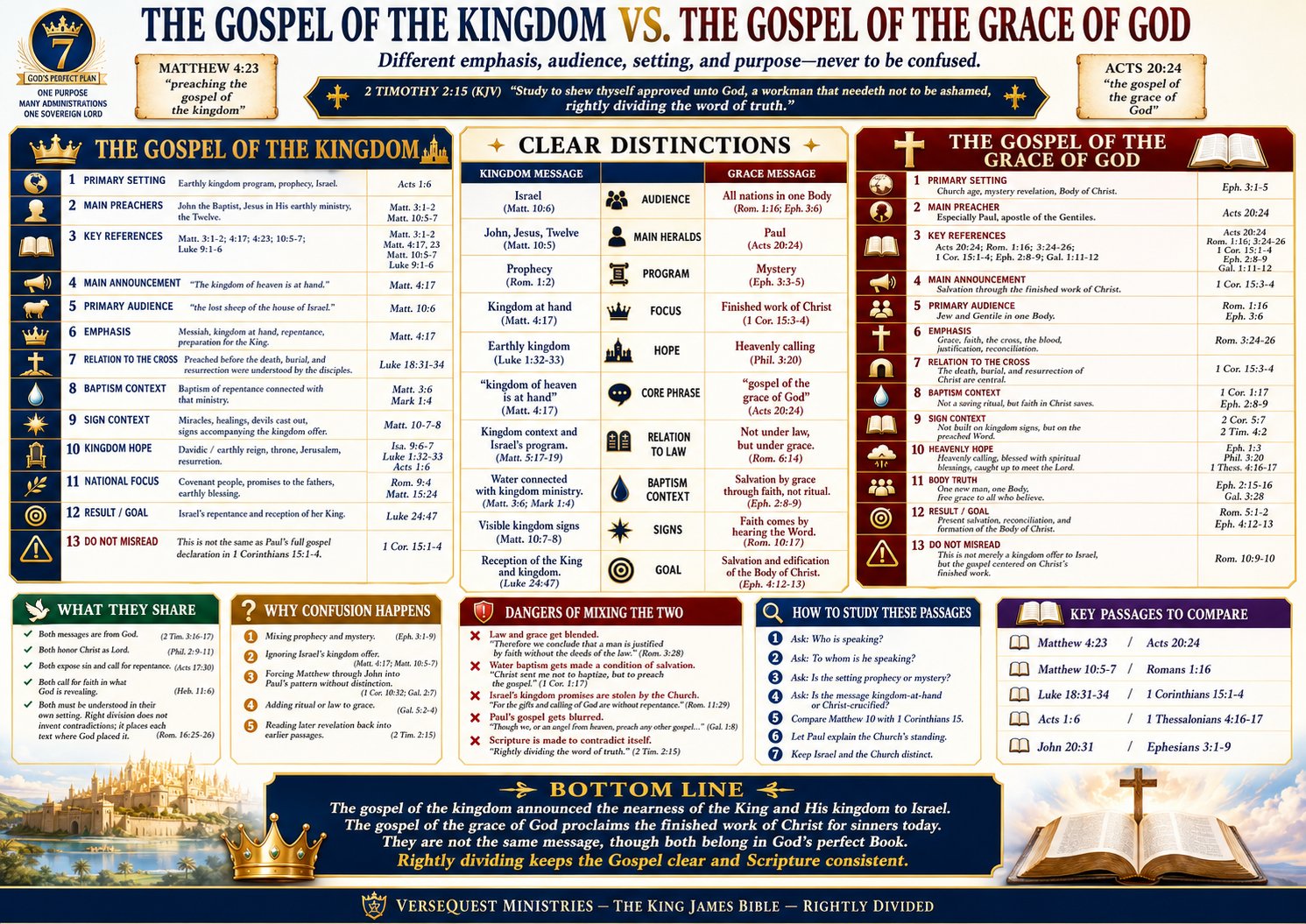
The Gospel of the Kingdom vs. the Gospel of the Grace of God – KJV Right Division Bible Study Chart
Compare the gospel of the kingdom and the gospel of the grace of God with this detailed KJV chart covering audience, message, prophecy, mystery, baptism, signs, salvation, and right division.
$3.99
Description
The Gospel of the Kingdom vs. the Gospel of the Grace of God is a detailed KJV Bible study chart explaining two important biblical messages that belong within God’s one perfect plan but differ in audience, setting, emphasis, program, signs, baptism context, and immediate purpose.
Built around Matthew 4:23, Acts 20:24, and the command to rightly divide the Word of Truth in 2 Timothy 2:15, this chart helps believers distinguish the kingdom message proclaimed to Israel from the gospel of the grace of God committed especially to the apostle Paul for the present Church Age.
The gospel of the kingdom was proclaimed within Israel’s earthly prophetic program. John the Baptist, Jesus Christ during His earthly ministry, and the Twelve announced that the kingdom of heaven was at hand. The primary audience was the lost sheep of the house of Israel, and the message centred upon repentance, preparation for the King, and the nearness of the promised earthly kingdom.
This kingdom announcement rested upon Old Testament prophecy and Israel’s covenant promises. God had foretold a righteous Davidic King, a restored nation, Jerusalem’s future exaltation, and an earthly reign of peace and righteousness. The gospel of the kingdom therefore cannot be separated from Israel’s Messiah, national repentance, prophetic signs, and kingdom expectation.
The chart carefully explains that the gospel of the kingdom was preached before the disciples understood the full meaning of Christ’s coming death, burial, and resurrection. Luke 18:31–34 records that these things were hidden from them at that stage. This demonstrates that the kingdom announcement should not simply be treated as identical in content and emphasis to Paul’s later full gospel declaration in 1 Corinthians 15:1–4.
Water baptism also appears within the kingdom setting as a baptism of repentance connected with Israel’s preparation for the Messiah. John baptized in the wilderness, and the kingdom ministry included public identification, confession, cleansing, and readiness for the King.
Signs and wonders accompanied the kingdom proclamation. Healings, miracles, the casting out of devils, and other supernatural signs authenticated the presence of Israel’s Messiah and the nearness of the promised kingdom. These signs fit the biblical truth that the Jews require a sign.
The gospel of the grace of God has a different primary setting. It belongs to the present Church Age, the revelation of the mystery, and the formation of the Body of Christ. Its principal herald is Paul, the apostle of the Gentiles, who testified to “the gospel of the grace of God.”
The centre of the grace message is the finished work of Jesus Christ. First Corinthians 15 declares that Christ died for our sins according to the Scriptures, was buried, and rose again the third day. Salvation is offered freely to sinners through faith in what Christ accomplished, not through human works, ceremonial observance, national identity, or religious merit.
The primary audience of the grace gospel is all nations without distinction. Jews and Gentiles who believe are reconciled to God and placed into one Body. This truth does not erase Israel’s identity or promises; it reveals a new spiritual organism that had been hidden in God and later made known through Paul.
The chart compares the two messages across several clear categories. The kingdom message is associated primarily with Israel, prophecy, the nearness of the earthly kingdom, water baptism, visible signs, and reception of the King. The grace message is associated with the mystery, the Body of Christ, the finished work of the cross, salvation by grace through faith, heavenly blessings, and the edification of the Church.
The distinction between prophecy and mystery is essential. Prophecy concerns truths spoken by the prophets since the world began. The mystery concerns truth that was hidden in past ages and later revealed. Failing to recognize that distinction causes later revelation to be forced backward into passages where it had not yet been revealed.
The chart also distinguishes the programs’ immediate hopes. Israel’s kingdom hope concerns the earthly reign of the Messiah, national restoration, Jerusalem, the throne of David, and fulfillment of the prophetic covenants. The Church possesses a heavenly calling, spiritual blessings in Christ, and the hope of being caught up to meet the Lord.
These distinctions do not mean that Scripture contains competing gods, contradictory plans, or salvation apart from God’s grace. Both messages belong within the progressive unfolding of God’s revelation and must be interpreted in their proper biblical settings.
A section titled What They Share shows that both messages come from God, honour Jesus Christ as Lord, expose sin, call for a response to divine truth, and belong within the inspired Scriptures. Right division does not manufacture contradictions; it recognizes differences God placed in the Bible.
The chart also explains why confusion occurs. Readers may mix prophecy and mystery, ignore Israel’s kingdom offer, force Matthew through John into Paul’s doctrinal pattern without distinction, add ritual or law to grace, or read later revelation back into earlier passages without considering progressive revelation.
The dangers of mixing the two messages include blending law and grace, turning water baptism into a present condition of salvation, transferring Israel’s kingdom promises to the Church, weakening Paul’s distinct apostleship, and making Scripture appear inconsistent with itself.
A practical study section teaches readers to ask who is speaking, to whom the message is addressed, whether the setting concerns prophecy or mystery, whether the central announcement is the kingdom at hand or Christ’s finished work, and how Paul explains the Church’s standing.
The bottom line is clear: the gospel of the kingdom announced the nearness of Israel’s King and promised kingdom, while the gospel of the grace of God proclaims the completed work of Christ for sinners during the present dispensation. Both belong in the Bible, but they should never be carelessly blended.
This chart is ideal for personal Bible study, right-division classes, dispensational teaching, gospel studies, pastoral training, Sunday school, homeschool Bible curriculum, Bible institutes, sermon preparation, Pauline doctrine, and believers seeking clarity concerning Israel, the Church, prophecy, mystery, law, grace, baptism, and signs.
Gospel of the kingdom, gospel of the grace of God, kingdom gospel, grace gospel, Israel and the Church, prophecy and mystery, right division, kingdom of heaven, finished work of Christ, death burial and resurrection, salvation by grace through faith, Pauline revelation, Body of Christ, water baptism, signs and wonders, earthly kingdom, heavenly calling, law and grace, progressive revelation, dispensational Bible study
The phrase “gospel of the kingdom” appears in connection with Israel’s promised King and earthly kingdom. Its announcement that the kingdom was at hand belonged to the prophetic expectations established in the Old Testament.
John the Baptist, Jesus during His earthly ministry, and the Twelve proclaimed this message primarily to Israel. Matthew 10 specifically directs the Twelve toward the lost sheep of the house of Israel rather than the Gentiles.
The kingdom message included repentance because Israel needed to prepare morally and nationally to receive her King. The call was not merely private self-improvement; it stood within the larger promise of Israel’s restoration.
The disciples preached the kingdom before they understood Christ’s death and resurrection. Luke 18 states that these truths were hidden from them. Their earlier kingdom preaching therefore cannot have contained the same full explanation later recorded in 1 Corinthians 15.
Paul’s gospel proclamation centres upon the finished work of Christ. Jesus died for sins, was buried, and rose again. The sinner is justified by grace through faith apart from works.
The gospel of grace goes to Jew and Gentile alike. Believers are placed into one Body and receive complete spiritual standing in Christ without becoming members of Israel’s national covenant program.
The mystery revealed through Paul was not simply another Old Testament prophecy. It concerned previously hidden truth about the Body of Christ, the equality of believing Jews and Gentiles, and the Church’s heavenly calling.
Right division does not claim that the kingdom message was false. It places it within its proper audience, setting, and purpose while allowing the later revelation of grace to stand in its own fullness.
Water baptism must be interpreted by context. It played an important role in Israel’s kingdom preparation, while Paul emphasized that Christ sent him primarily to preach the gospel and that salvation is not obtained through ritual.
Signs authenticated Israel’s kingdom offer and Messianic message. The present Church is called to walk by faith in the completed written Word rather than build doctrine upon the expectation of Israel’s sign program.
Mixing the two messages can produce legalism, baptismal regeneration, uncertainty about salvation, confusion over Israel’s promises, and neglect of Paul’s distinctive ministry.
The gospel of grace does not cancel Israel’s kingdom. Israel’s prophetic promises remain secure, while the present Body of Christ possesses its own calling and hope.
The faithful Bible student should allow Matthew, Acts, Paul’s epistles, and the prophetic Scriptures to speak within their God-given contexts. The result is not division of the Bible but greater harmony and doctrinal clarity.
Gospel comparison studies, right-division classes, dispensational Bible teaching, Israel and Church distinctions, Pauline doctrine, kingdom studies, salvation by grace teaching, baptism studies, signs and wonders instruction, prophecy and mystery comparisons, Sunday school lessons, homeschool Bible curriculum, Christian school teaching, Bible institute classes, pastoral training, sermon preparation, new-believer discipleship, biblical interpretation
King James Bible, Strong’s Concordance, Thompson Chain-Reference Bible, Treasury of Scripture Knowledge, Nave’s Topical Bible, Matthew kingdom study notes, Acts transition study materials, Romans through Philemon outlines, Pauline epistle charts, Israel and Church comparison resources, prophecy and mystery studies, law and grace comparison notes, baptism study materials, VerseQuest right-division and dispensational charts
Related products
-
Doctrine
-
-50%
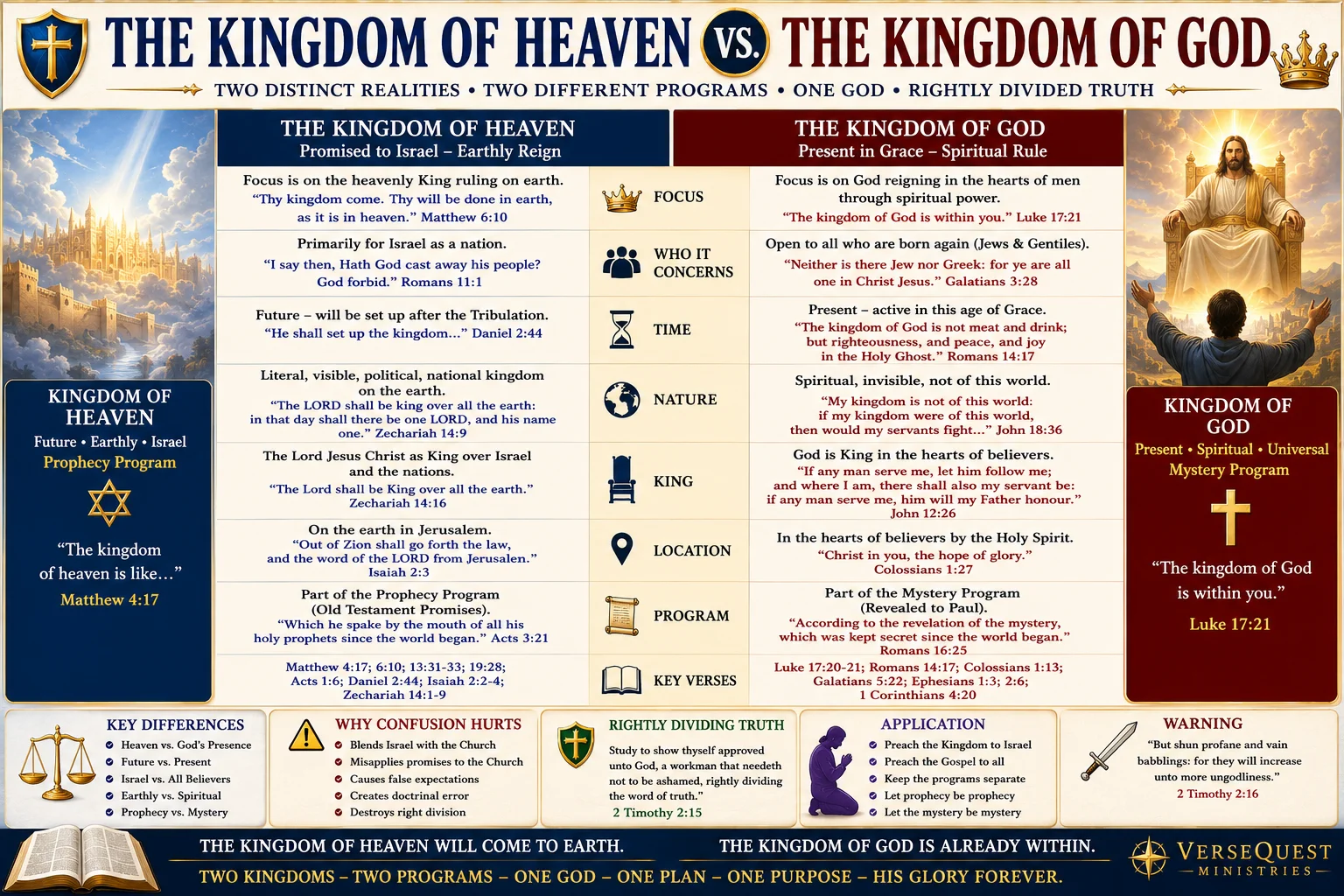
- The Kingdom of Heaven vs. The Kingdom of God Chart — KJV Rightly Divided
- Premium printable KJV Bible study chart comparing the Kingdom of Heaven and the Kingdom of God from a rightly divided perspective, showing their distinctions, purposes, promises, and biblical application.
- Original price was: $10.00.$4.99Current price is: $4.99.
- Add to cart
-
-50%
-
Hebrews Rightly Divided
-
-71%
- Hebrews Without Confusion – 833-Page, 120-Study KJV PDF Commentary
- Hebrews Without Confusion is an enormous 833-page digital KJV commentary containing 120 detailed studies through all thirteen chapters of Hebrews. This rightly divided study explains Christ’s supremacy, His eternal priesthood,…
- Original price was: $34.99.$9.99Current price is: $9.99.
- Add to cart
-
-71%
-
Not Under Law But Grace
-
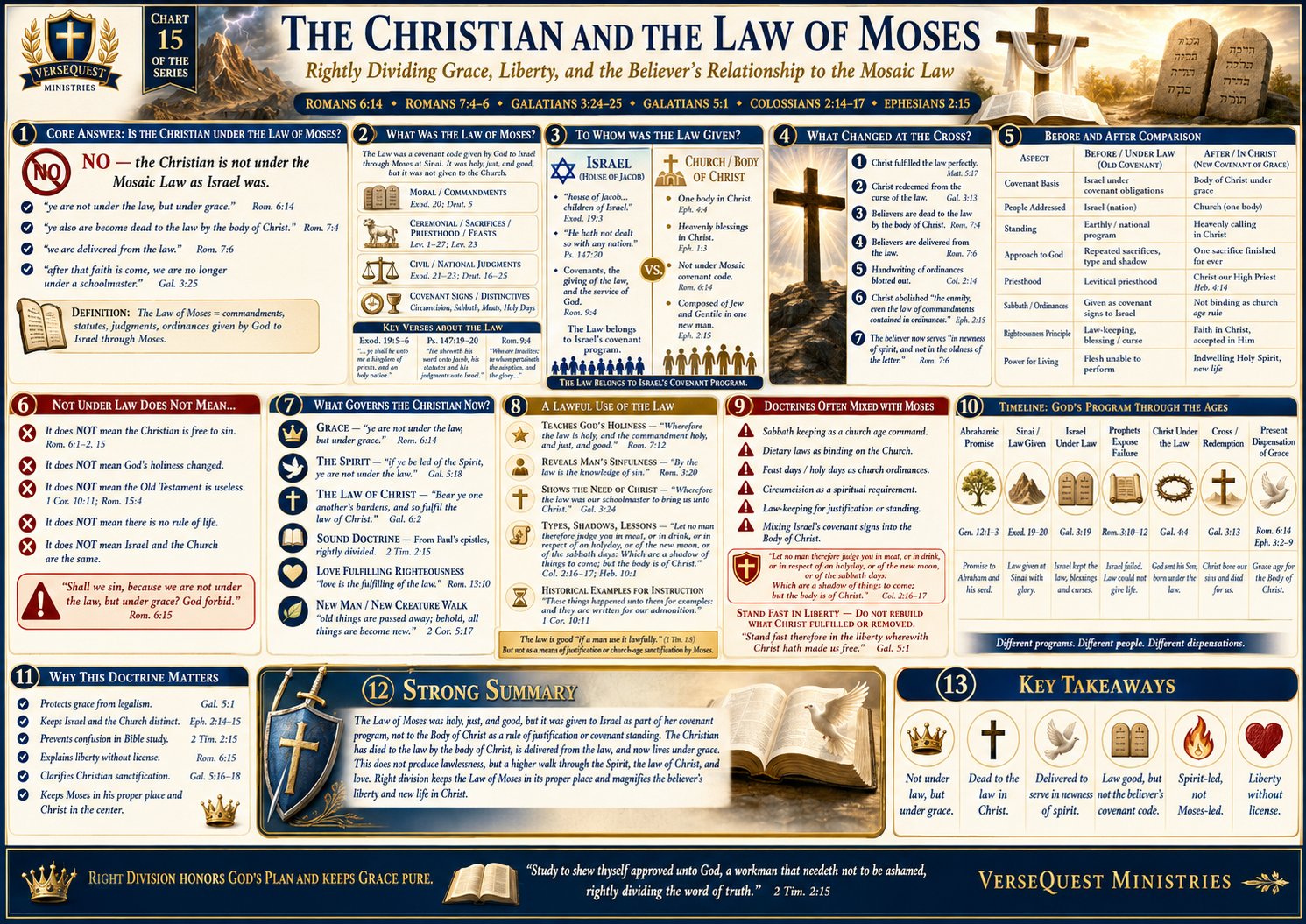
- The Christian and the Law of Moses – Grace, Liberty, and the Believer’s Relationship to the Mosaic Law (KJV Bible Study Chart)
- Understand the Christian’s relationship to the law of Moses with this detailed KJV chart covering Israel’s covenant, grace, liberty, the cross, the law of Christ, and Spirit-led living.
- $3.99
- Add to cart
-
-
Prophecy vs Mystery
-
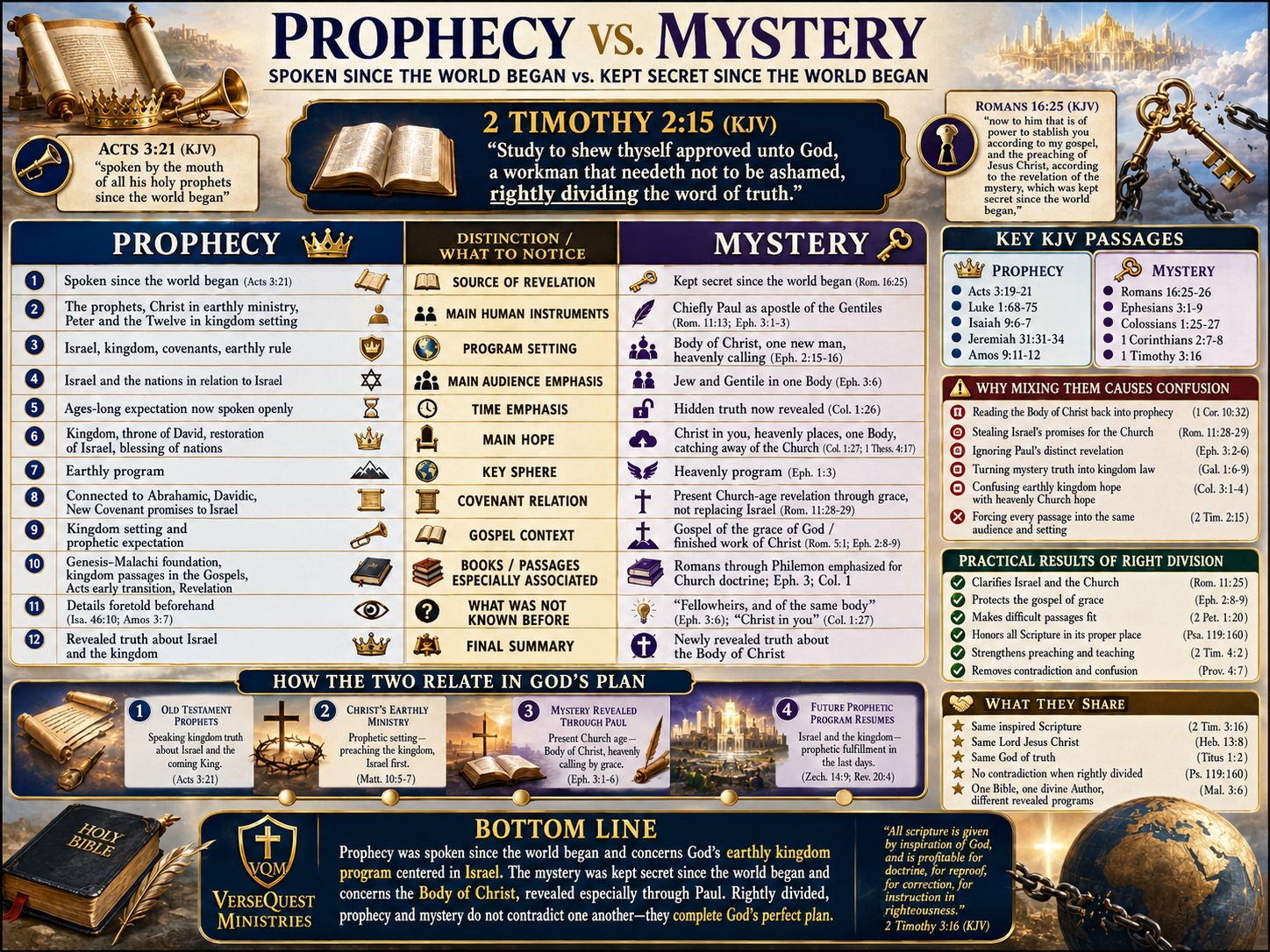
- Prophecy vs. Mystery Bible Study Chart – Spoken Since the World Began vs. Kept Secret Since the World Began (KJV)
- Compare prophecy and mystery with this detailed KJV chart explaining Israel’s earthly Kingdom program, the Body of Christ, Paul’s revelation, the heavenly calling, and the importance of right division.
- $3.99
- Add to cart
-
-
The Rapture
-
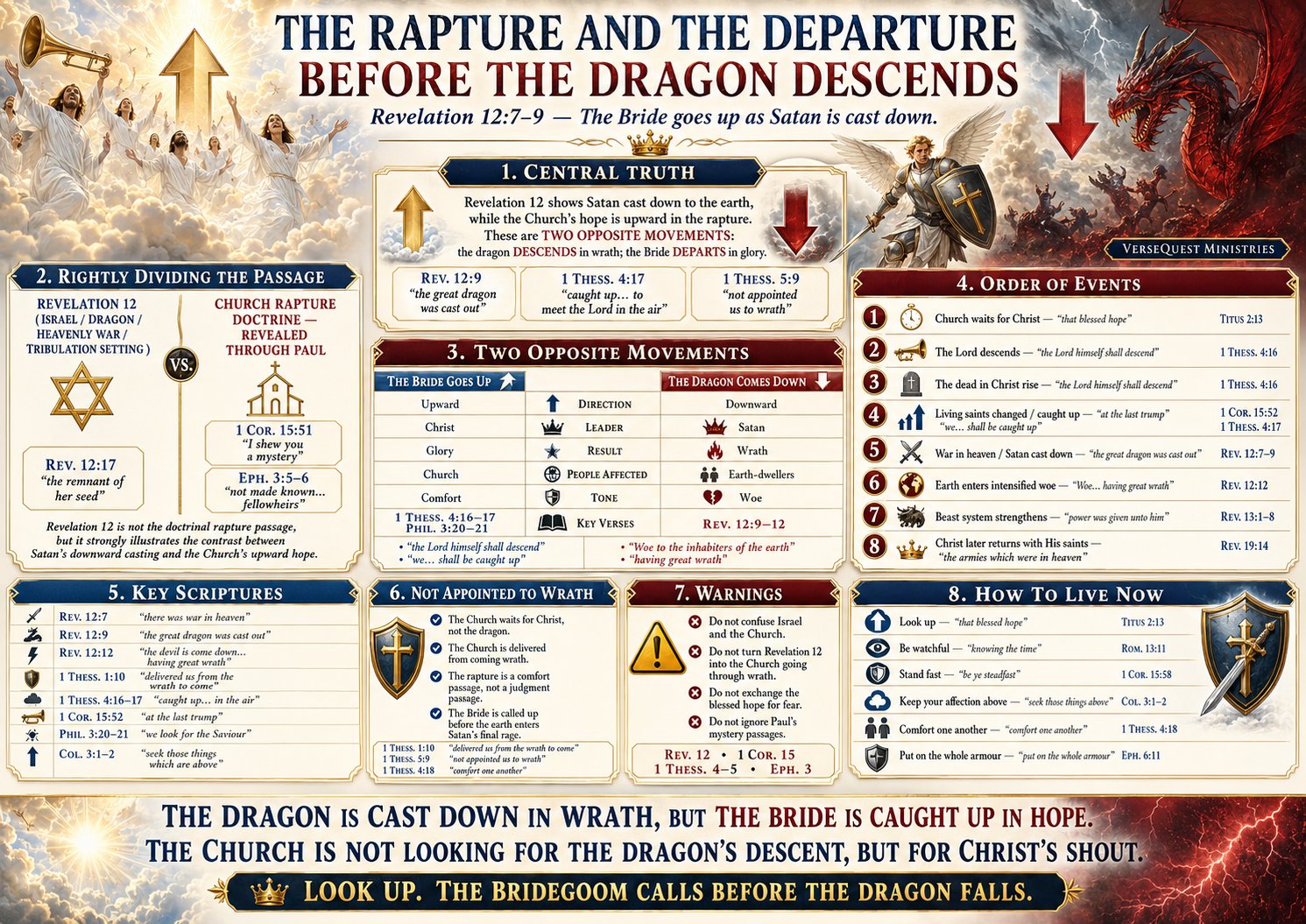
- The Rapture and the Departure Before the Dragon Descends – Printable Bible Study Chart
- Printable KJV Bible study chart on The Rapture and the Departure Before the Dragon Descends, showing the Bride caught up before Satan is cast down in wrath. This premium VerseQuest…
- $4.99
- Add to cart
-