
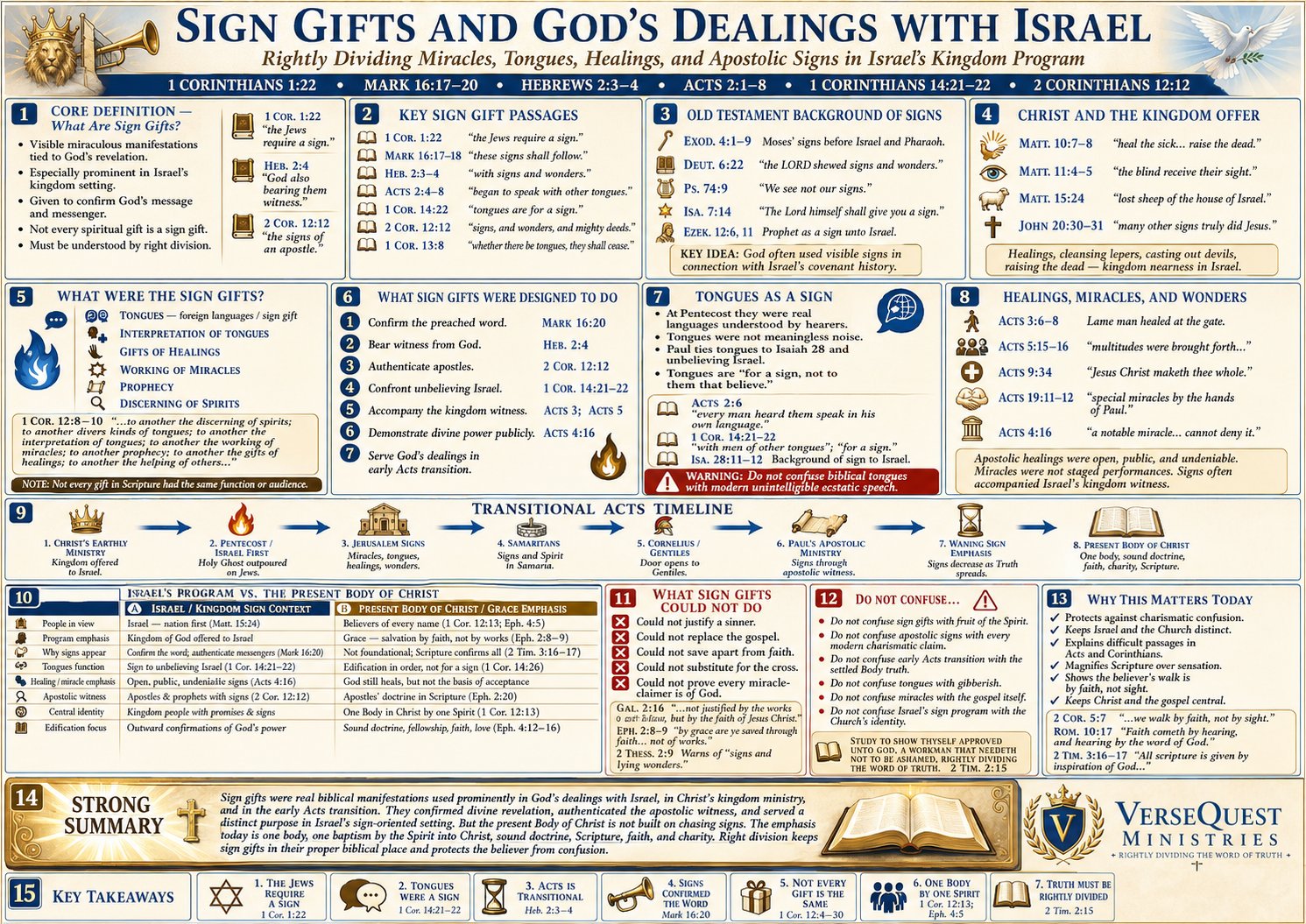
Sign Gifts and God’s Dealings with Israel – Miracles, Tongues, Healings, and Apostolic Signs Rightly Divided (KJV Bible Study Chart)
Understand sign gifts with this detailed KJV chart covering miracles, tongues, healings, apostolic signs, Israel’s Kingdom program, the Acts transition, and the present Body of Christ.
$3.99
Description
Sign Gifts and God’s Dealings with Israel is a detailed KJV Bible study chart examining miracles, tongues, healings, wonders, prophecy, and apostolic signs within Israel’s prophetic and Kingdom program. It explains what biblical sign gifts were, why God gave them, whom they primarily addressed, how they functioned during Christ’s earthly ministry and the transition recorded in Acts, and why they must not be confused with the settled doctrine and spiritual walk of the present Body of Christ.
Built around 1 Corinthians 1:22, Mark 16:17–20, Hebrews 2:3–4, Acts 2:1–8, 1 Corinthians 14:21–22, and 2 Corinthians 12:12, this chart begins with the inspired declaration that “the Jews require a sign.” Miraculous signs were not religious entertainment, emotional excitement, or private experiences designed to make believers feel spiritually superior. They were visible divine manifestations that confirmed God’s revelation, authenticated appointed messengers, and bore witness to Israel during decisive stages of the Kingdom offer.
The chart defines sign gifts as supernatural works connected with a divinely revealed message. Not every spiritual gift mentioned in Scripture was a sign gift, and not every miracle served precisely the same purpose or audience. The context must determine whether a passage concerns Israel, the Kingdom, apostolic authentication, the Acts transition, or instruction for the mature Body of Christ.
The Old Testament establishes the background. Moses received visible signs before Israel and Pharaoh. The LORD displayed signs and wonders during Israel’s deliverance from Egypt. Prophets could function as signs to the nation, and Isaiah foretold the virgin birth itself as a sign. God’s use of signs was therefore deeply rooted in Israel’s covenant history long before Pentecost.
Signs accompanied moments when God publicly confirmed His messenger, confronted unbelief, revealed judgment, or advanced Israel’s prophetic program. They were not random spectacles detached from doctrine. The sign pointed beyond itself to the authority and truth of the God who performed it.
The earthly ministry of Jesus Christ continued within this prophetic setting. Christ was sent first to Israel, and His disciples were commanded to minister to “the lost sheep of the house of Israel.” They healed the sick, cleansed lepers, cast out devils, and raised the dead as visible evidence that Israel’s King and promised Kingdom had drawn near.
Christ’s miracles were not staged performances. Blind people received sight, lame people walked, lepers were cleansed, the dead were raised, and demonic oppression was publicly overcome. These works fulfilled prophetic expectations concerning the Messiah and left Israel responsible for its response to Him.
The miracles authenticated Christ’s identity, but they did not force hardened people to believe. Many witnessed undeniable works and still rejected the Lord. A sign may confirm truth, but it cannot replace a willing response to God’s Word.
The chart identifies several sign gifts described in the New Testament, including tongues, interpretation of tongues, gifts of healing, working of miracles, prophecy, and discerning of spirits. These gifts had distinct functions and should not be collapsed into one undefined category of spiritual experience.
Biblical tongues were real human languages. At Pentecost, visitors from numerous nations heard the apostles speaking in their own languages. The miracle was intelligible communication, not meaningless noise, uncontrolled vocal repetition, or private ecstatic speech requiring modern reinterpretation.
Paul connects tongues with Isaiah’s warning to unbelieving Israel and states plainly that tongues were “for a sign, not to them that believe, but to them that believe not.” This places tongues within a judicial and revelatory context rather than presenting them as the universal evidence that every saved believer has received the Holy Spirit.
The chart warns against confusing biblical tongues with unintelligible emotional speech. Scriptural tongues communicated recognizable language, operated under order, required interpretation when necessary, and served God’s revealed purpose rather than producing confusion within the congregation.
Healings and miracles were likewise public and verifiable. The lame man at the Temple gate was known openly. Multitudes brought their sick to the apostles. Peter raised Tabitha, and Paul performed extraordinary miracles during the apostolic transition.
These healings differed sharply from private claims that cannot be examined. Apostolic miracles were visible, immediate, public, and difficult for opponents to deny. They often accompanied the continued Kingdom witness to Israel and authenticated the apostles through whom God was speaking.
The sign gifts were designed to confirm the preached Word, bear witness from God, authenticate apostles, confront unbelieving Israel, accompany the Kingdom witness, demonstrate divine power publicly, and serve God’s purposes during the early transition recorded in Acts.
Hebrews 2 explains that the great message was confirmed by those who heard the Lord, while God bore them witness with signs, wonders, diverse miracles, and gifts of the Holy Ghost. Mark records that the Lord worked with the disciples and confirmed the Word with signs following.
Second Corinthians 12:12 describes “the signs of an apostle.” This language gives the signs an authenticating function. If every believer in every age automatically possessed the same miraculous credentials, such works could not meaningfully identify an apostle.
The chart provides a transitional Acts timeline beginning with Christ’s earthly ministry and moving through Pentecost, Jerusalem, Samaria, the Gentile opening through Cornelius, Paul’s apostolic ministry, the decreasing sign emphasis, and the settled formation of the present Body of Christ.
Acts begins with Jerusalem, Israel, the Twelve, the Temple, prophecy, and the continuing Kingdom witness. It gradually moves toward Paul, the Gentiles, the revelation of the mystery, and doctrine for the one Body. This historical movement must be respected when interpreting its miracles and unusual events.
Pentecost was a real fulfillment within Israel’s prophetic setting. The Holy Ghost was poured out, Jewish hearers from many nations heard real languages, and Peter addressed the men of Israel concerning their crucified and risen Messiah.
Signs continued in Jerusalem through the apostles. Samaria then received the Word with accompanying apostolic confirmation. Cornelius marked the opening of the Gentile mission, and Paul’s signs authenticated his apostleship and divine commission during the transition.
As revelation progressed and the written doctrinal foundation of the Church was established, the emphasis moved from outward signs toward sound doctrine, faith, hope, charity, fellowship, edification, and confidence in the completed Word of God.
The chart compares Israel’s Kingdom sign setting with the present Body of Christ. Israel was the nation that required a sign, while the Body consists of saved people from every nation united by one Spirit. Israel’s program emphasized the Kingdom offer and prophetic fulfillment; the present dispensation emphasizes grace and the mystery of the one Body.
Israel’s sign program included visible miracles confirming the Word and authenticating Kingdom messengers. The Church’s mature walk is governed by faith in the written revelation. Christians walk by faith, not by sight, and faith comes by hearing the Word of God.
This does not mean God lacks power, cannot answer prayer, cannot heal according to His will, or is absent from the believer’s life. It means the apostolic sign program should not be manufactured, imitated, commercialized, or treated as the standing measure of spirituality for every Christian.
The chart also distinguishes sign gifts from the fruit of the Spirit. Miraculous ability was never proof of personal holiness. The Corinthian church possessed gifts while remaining carnal, divided, proud, and disorderly. Spiritual character is revealed through love, joy, peace, longsuffering, gentleness, goodness, faith, meekness, and temperance.
Sign gifts could not justify a sinner, replace the gospel, impart saving faith automatically, substitute for Christ’s cross, prove every miracle-worker came from God, or establish doctrine apart from Scripture.
False signs are possible. Second Thessalonians warns of “signs and lying wonders.” A supernatural claim must therefore be tested by doctrine rather than accepted merely because something appears impressive, emotional, unexplained, or powerful.
The gospel remains the death, burial, and resurrection of Jesus Christ for sinners. Salvation is by grace through faith, not by receiving a sign, speaking in tongues, experiencing a healing, falling under emotional influence, or obtaining a second religious experience.
The chart provides important doctrinal warnings. Sign gifts must not be confused with the fruit of the Spirit, apostolic signs with modern charismatic claims, the Acts transition with settled Church doctrine, biblical tongues with gibberish, miracles with the gospel itself, or Israel’s sign program with the identity of the Body of Christ.
Right division keeps every passage in its proper audience, time, setting, and purpose. It does not deny that the miracles happened. It honours them as genuine works of God without forcing their original program into the present dispensation.
Understanding this doctrine protects believers from charismatic confusion, keeps Israel and the Church distinct, explains difficult passages in Acts and Corinthians, magnifies Scripture above sensation, and keeps Jesus Christ and His finished gospel at the centre.
The mature believer does not require continual miraculous demonstrations before trusting God. He rests upon the completed revelation of Scripture, walks by faith, prays according to God’s will, serves through the gifts God has provided, and measures every doctrine by the written Word.
The strong summary is clear: sign gifts were genuine biblical manifestations used prominently in God’s dealings with Israel, Christ’s Kingdom ministry, and the early Acts transition. They confirmed revelation, authenticated apostolic witnesses, and confronted unbelief within a sign-oriented setting.
The present Body of Christ is built upon the completed apostolic foundation and is instructed through Scripture, sound doctrine, faith, hope, charity, fellowship, and the one Spirit who places every believer into one Body. Right division protects the gospel and allows every miracle passage to speak exactly where God placed it.
Sign gifts, God’s dealings with Israel, the Jews require a sign, miracles and wonders, biblical tongues, interpretation of tongues, gifts of healing, apostolic signs, signs of an apostle, Christ’s Kingdom ministry, Israel’s prophetic program, early Acts transition, Pentecost, unbelieving Israel, Holy Ghost gifts, visible divine confirmation, fruit of the Spirit, cessation of sign gifts, Body of Christ, walking by faith, rightly dividing Scripture
Sign gifts were visible supernatural manifestations connected with God’s revealed message and appointed messengers. Their purpose must be determined from their biblical audience and setting rather than from modern religious assumptions.
First Corinthians 1:22 states that the Jews require a sign. This does not mean every Jewish person believed every miracle, but it identifies signs as a prominent feature within God’s dealings with Israel.
The Old Testament repeatedly connects Israel with signs and wonders. Moses’ signs authenticated his mission, confronted Pharaoh, and demonstrated that the LORD had visited His covenant people.
Christ’s miracles fulfilled prophetic expectations surrounding Israel’s Messiah and Kingdom. Healings, cleansing, deliverance, and resurrection displayed the authority of the King.
Jesus directed the Twelve first toward the lost sheep of Israel. Their miraculous commission belonged to the Kingdom offer rather than the later mystery revelation concerning the one Body.
Signs confirmed the Word. They were never intended to replace revelation, become doctrine by themselves, or excuse a messenger whose teaching contradicted Scripture.
Biblical tongues were real languages. Acts 2 repeatedly emphasizes that hearers understood the apostles in the languages in which they had been born.
Tongues also possessed a judicial sign function toward unbelieving Israel. Paul connects them with Isaiah’s warning and states that tongues were a sign to unbelievers.
Uncontrolled noise should not be identified automatically with the biblical gift of tongues. Scriptural tongues operated with meaning, interpretation, order, and divine purpose.
Apostolic healings were public, immediate, and verifiable. The lame walked, the blind saw, the sick were restored, and the dead were raised in ways known to whole communities.
Second Corinthians 12:12 calls these works the signs of an apostle. Their rarity and authenticating function helped establish the authority of Christ’s commissioned witnesses.
Acts is transitional. Its unusual sequences and miraculous events record God’s movement from Israel’s Kingdom setting toward Paul’s Gentile ministry and the revelation of the Body of Christ.
Not every event in Acts should be converted automatically into a permanent formula for every believer. Narrative records what occurred; the epistles explain settled Church doctrine.
Paul performed signs during his apostolic ministry, confirming that his commission came from Christ. Yet his later ministry also included sickness, weakness, unhealed companions, and reliance upon sufficient grace.
The decline of sign emphasis does not imply a decline in God’s power. It reflects the movement from foundational apostolic confirmation toward a mature Church governed by completed revelation.
The Church is built upon the foundation of the apostles and prophets, Jesus Christ being the chief cornerstone. A foundation is laid once; it is not continually reconstructed in every generation.
Sign gifts must not be confused with spiritual fruit. A person may display impressive ability while lacking holiness, charity, humility, truth, and obedience.
The Corinthian church possessed gifts but remained deeply carnal. Spiritual ability alone was never proof that a believer was mature or that every practice was approved by God.
No sign can justify a sinner. Salvation rests entirely upon Christ’s finished work and is received by grace through faith.
No miracle can replace the gospel. Healings may affect the body temporarily, but only Jesus Christ can give eternal life and reconcile sinners to God.
A supernatural event is not self-authenticating. Scripture warns that deceptive signs and lying wonders can accompany falsehood.
The believer’s final authority must remain the written Word. Experiences, feelings, healings, dreams, prophecies, and signs must be judged by Scripture rather than allowed to judge Scripture.
The present believer walks by faith, not sight. Faith comes by hearing the Word of God rather than by demanding continual visible proof.
Right division honours every genuine biblical miracle while refusing to imitate, commercialize, exaggerate, or misapply signs that belonged to another program and purpose.
Sign-gift Bible studies, charismatic doctrine evaluation, biblical tongues instruction, apostolic-sign studies, Acts transition teaching, Israel-and-Church distinctions, Kingdom-program studies, prophecy-and-mystery comparisons, healing-ministry evaluation, Pentecost studies, 1 Corinthians 12–14 teaching, defending salvation by grace, testing supernatural claims, pastoral counseling, new-believer discipleship, Sunday school lessons, homeschool Bible curriculum, Bible institute classes, sermon preparation, right-division workshops
King James Bible, Strong’s Concordance, Thompson Chain-Reference Bible, Treasury of Scripture Knowledge, Nave’s Topical Bible, Gospel miracle studies, Acts transition outlines, 1 Corinthians 12–14 commentary notes, Hebrews 2 study materials, Israel-and-Church comparison charts, prophecy-and-mystery resources, Pauline epistle outlines, spiritual-gifts worksheets, biblical tongues studies, salvation-by-grace materials, VerseQuest right-division and doctrine charts
Related products
-
Paul and the Twelve
-
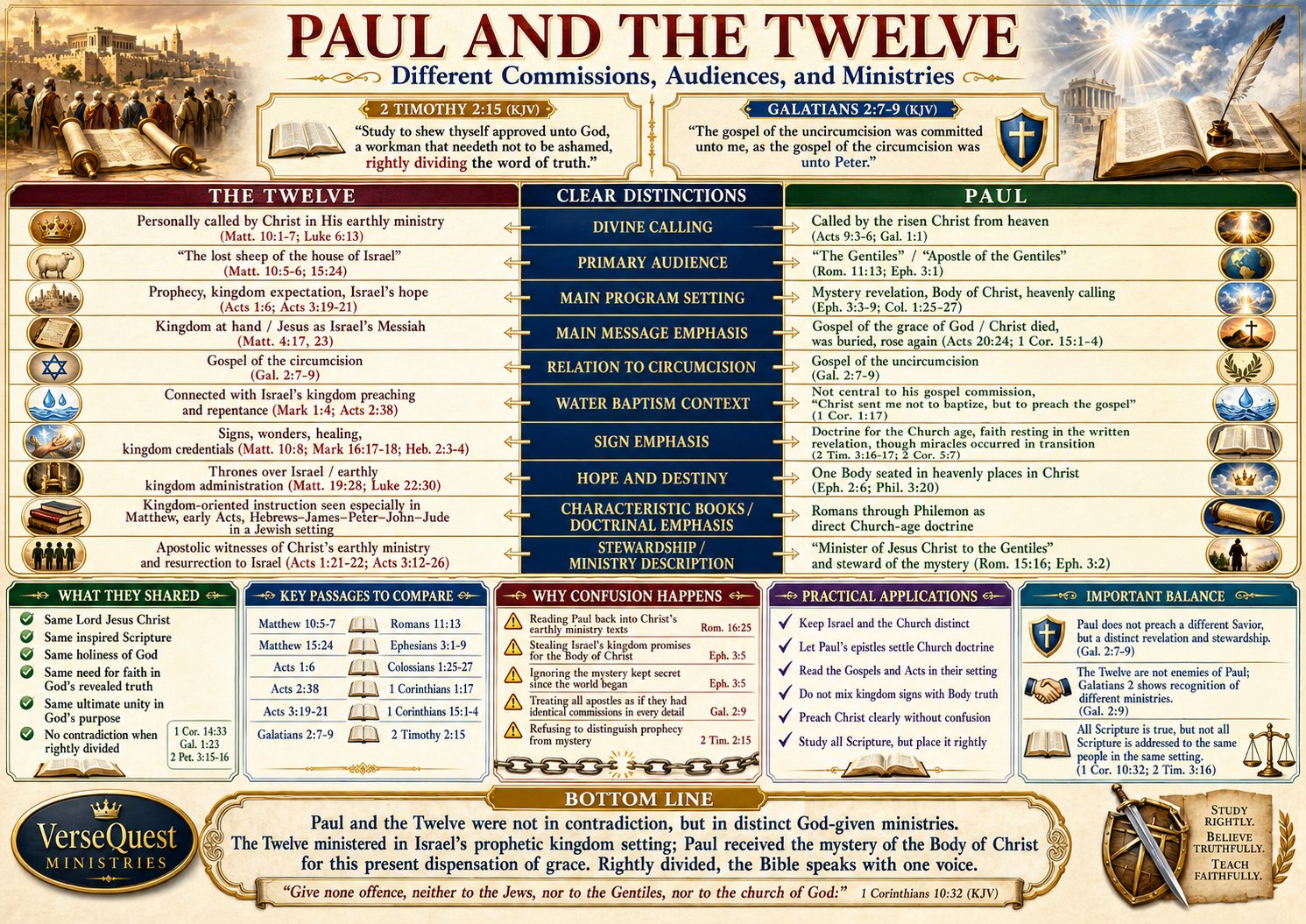
- Paul and the Twelve Bible Study Chart – Different Commissions, Audiences, and Ministries (KJV)
- Compare Paul and the Twelve with this detailed KJV Bible study chart covering their distinct callings, audiences, Kingdom and mystery settings, gospel stewardships, baptism contexts, signs, and future hopes.
- $3.99
- Add to cart
-
-
The Church Age vs The Tribulation
-
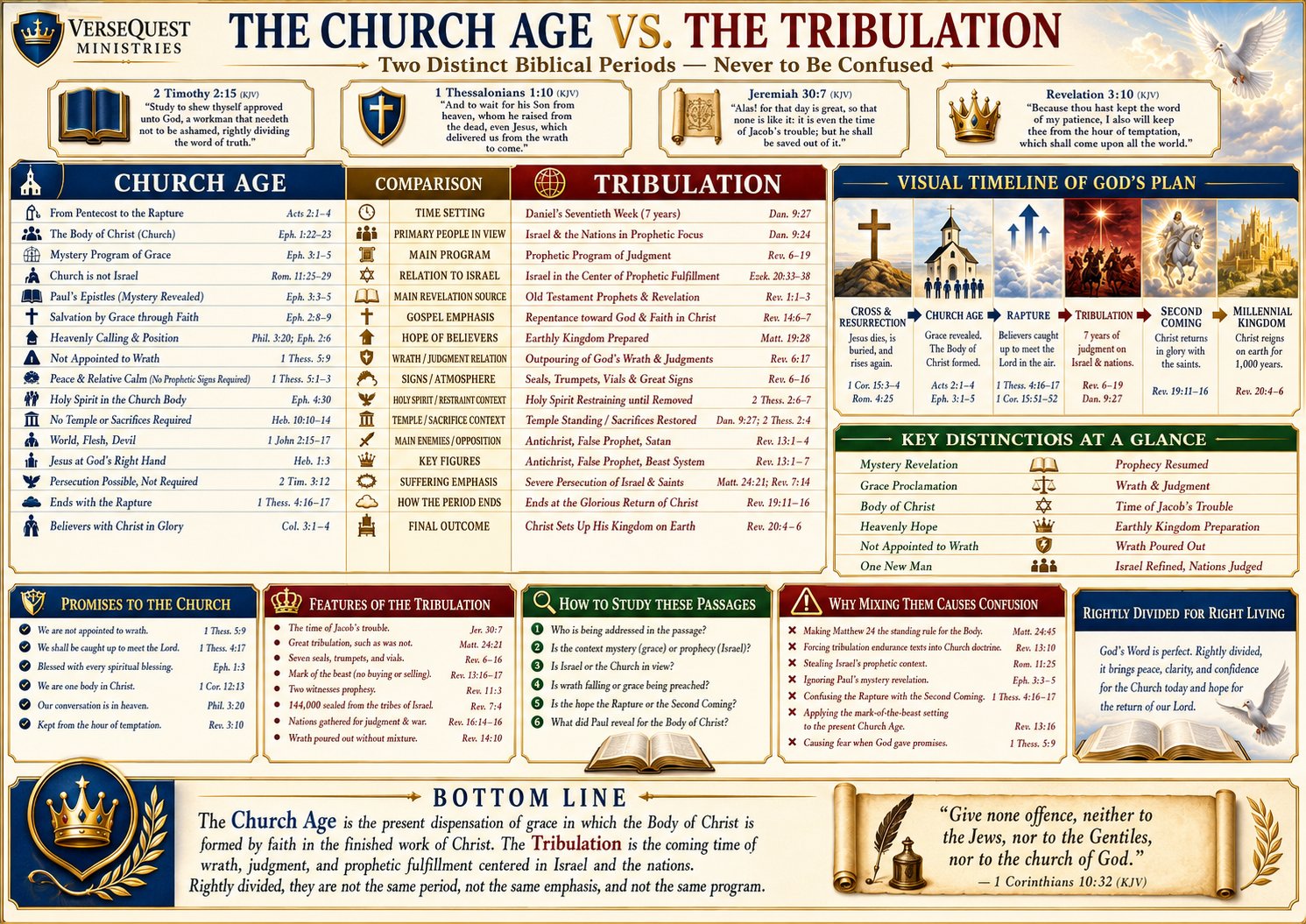
- The Church Age vs. the Tribulation – Two Distinct Biblical Periods KJV Bible Study Chart
- Compare the Church Age and the Tribulation with this detailed KJV chart covering the Body of Christ, Israel, grace, wrath, the Rapture, Antichrist, the Second Coming, and the millennial Kingdom.
- $3.99
- Add to cart
-
-
Rapture vs Second Coming
-
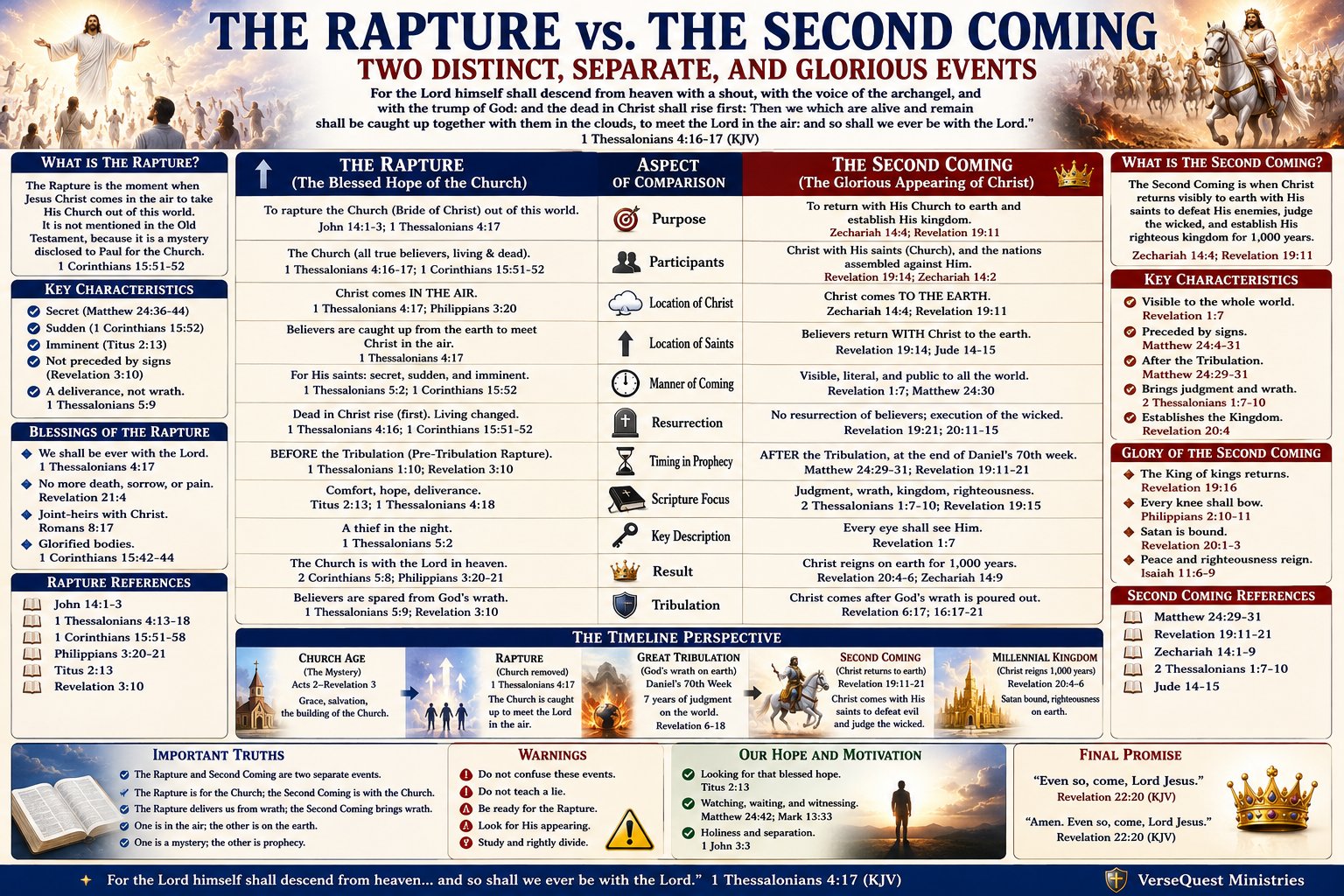
- The Rapture vs. the Second Coming – Two Distinct Events in God’s Prophetic Program (KJV Bible Study Chart)
- Understand the differences between the Rapture and Second Coming with this detailed KJV chart covering purpose, participants, location, timing, resurrection, divine wrath, the Tribulation, Church-versus-Israel distinctions, Christ’s visible return, and…
- $3.99
- Add to cart
-
-
Holy Spirit in the Believer
-
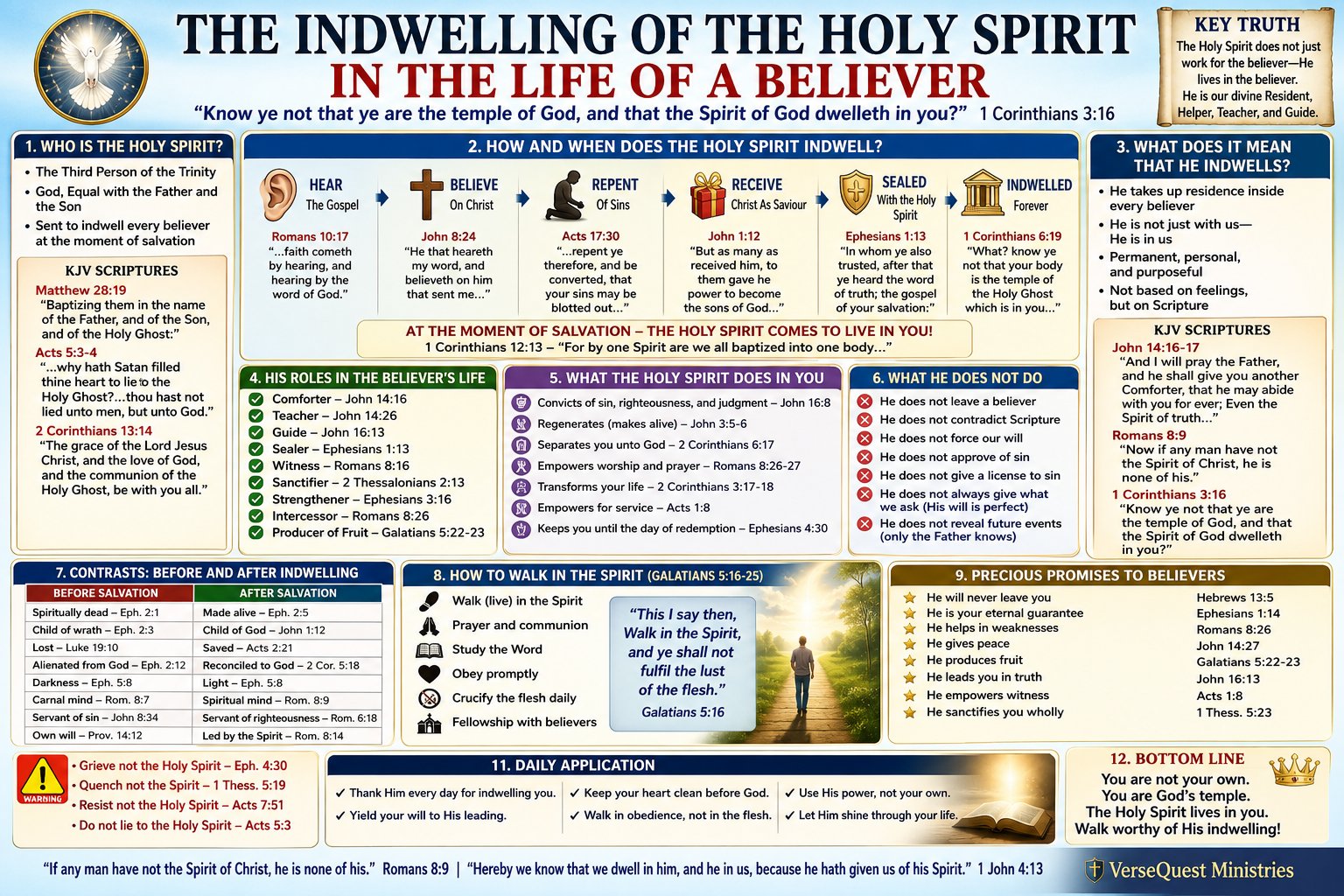
- The Indwelling of the Holy Spirit in the Life of a Believer – Sealed, Taught, Guided, Sanctified, and Empowered (KJV Bible Study Chart)
- Understand the indwelling of the Holy Spirit with this detailed KJV chart covering salvation, regeneration, spiritual baptism, sealing, guidance, prayer, sanctification, fruit, Christian service, and walking in the Spirit.
- $3.99
- Add to cart
-
-
Not Under Law But Grace
-
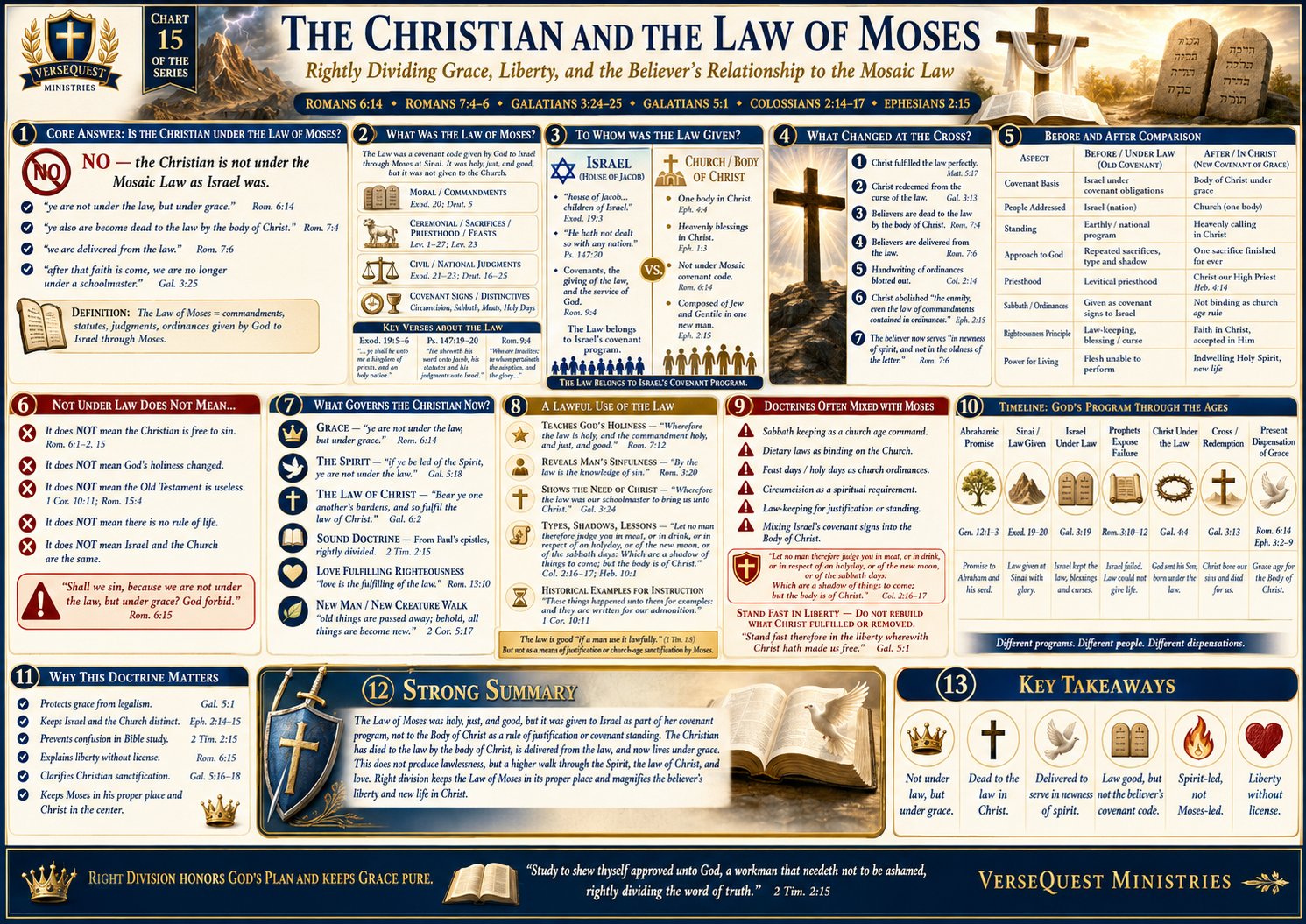
- The Christian and the Law of Moses – Grace, Liberty, and the Believer’s Relationship to the Mosaic Law (KJV Bible Study Chart)
- Understand the Christian’s relationship to the law of Moses with this detailed KJV chart covering Israel’s covenant, grace, liberty, the cross, the law of Christ, and Spirit-led living.
- $3.99
- Add to cart
-