
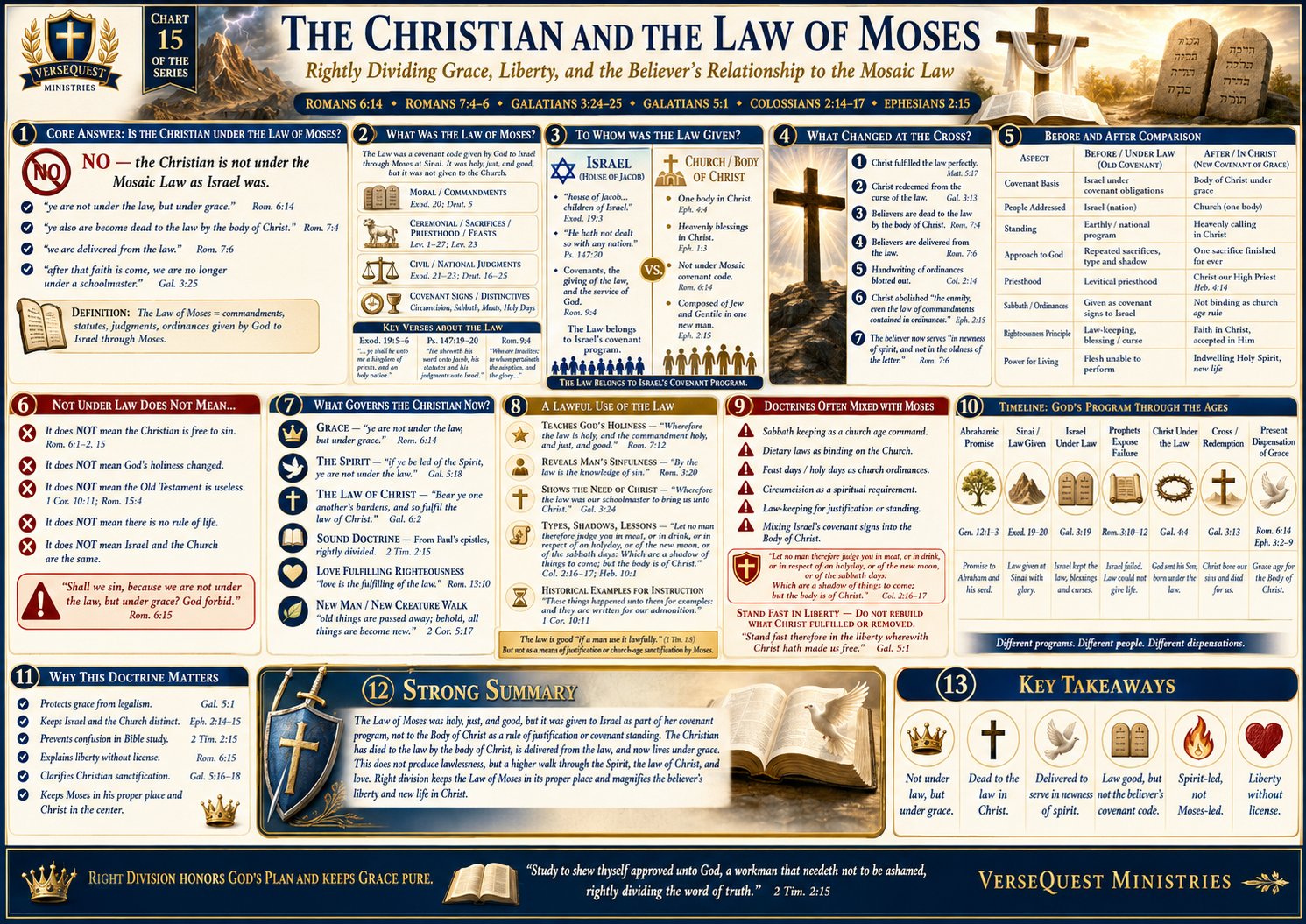
The Christian and the Law of Moses – Grace, Liberty, and the Believer’s Relationship to the Mosaic Law (KJV Bible Study Chart)
Understand the Christian’s relationship to the law of Moses with this detailed KJV chart covering Israel’s covenant, grace, liberty, the cross, the law of Christ, and Spirit-led living.
$3.99
Description
The Christian and the Law of Moses is a detailed KJV Bible study chart explaining why the Church, the Body of Christ, is not under the Mosaic law as Israel was, what changed through the cross of Jesus Christ, and what now governs the believer’s walk during the present dispensation of grace.
Built around Romans 6:14, Romans 7:4–6, Galatians 3:24–25, Galatians 5:1, Colossians 2:14–17, and Ephesians 2:15, this chart provides a clear, rightly divided answer to a question that has produced centuries of doctrinal confusion: Is the Christian under the law of Moses?
The biblical answer is no. The Christian is not under the Mosaic covenant in the same manner that the nation of Israel was. Romans 6:14 plainly declares, “ye are not under the law, but under grace.” Romans 7 teaches that believers have become dead to the law through the body of Christ and are delivered from the law so that they may serve God in newness of spirit.
The chart carefully defines the law of Moses as the covenant body of commandments, statutes, judgments, sacrifices, priesthood regulations, civil laws, ceremonial ordinances, holy days, dietary distinctions, Sabbaths, circumcision, and national responsibilities given by God to Israel through Moses at Sinai.
The Mosaic law was holy, just, and good because it came from God. The problem was never the law itself. The problem was sinful human flesh, which could not fulfill its righteous requirements perfectly or obtain eternal justification through its works.
The chart identifies Israel as the covenant audience of the law. God called Moses to Mount Sinai and addressed “the house of Jacob” and “the children of Israel.” Romans 9 likewise connects the covenants, the giving of the law, the service of God, and the promises with Israel.
The Gentile nations were not collectively placed under the Sinai covenant, and the Church was not yet revealed as the one Body in Christ. The law belongs within Israel’s covenant and prophetic program rather than the mystery program later revealed through the apostle Paul.
The Church is not a nation under Moses but one spiritual Body composed of saved Jews and Gentiles united in Jesus Christ. Believers possess heavenly blessings in Christ and are not placed beneath Israel’s Mosaic covenant code as their means of righteousness, justification, acceptance, or spiritual standing.
A major section explains what changed at the cross. Jesus Christ fulfilled the law perfectly. He was born under the law, obeyed it without sin, magnified its righteousness, and satisfied every demand that fallen mankind had failed to meet.
Christ also redeemed sinners from the curse of the law by becoming a curse for them. The law pronounced condemnation upon every transgressor, but Jesus bore that judgment through His substitutionary death.
Believers are now dead to the law through the body of Christ. This does not mean the law ceased to be inspired, truthful, or profitable. It means the Christian’s former relationship to its condemnation and covenant authority has been changed through union with Christ.
Romans 7 declares that believers are delivered from the law so that they may serve in “newness of spirit, and not in the oldness of the letter.” Christian obedience is not produced by placing saved people beneath Israel’s covenant but by the Holy Spirit, sound doctrine, love, grace, and the believer’s new identity in Christ.
Colossians 2 teaches that the handwriting of ordinances that stood against the sinner was blotted out and nailed to Christ’s cross. Believers are therefore warned not to allow anyone to judge them concerning meat, drink, holy days, new moons, or Sabbath days.
Ephesians 2 explains that Christ abolished the enmity connected with the law of commandments contained in ordinances in order to create one new man. Saved Gentiles are not brought near by becoming national Israelites or adopting Israel’s ceremonial distinctions. They are made nigh by the blood of Christ.
A before-and-after comparison highlights the change. Under the old covenant, Israel stood beneath national covenant obligations, repeated sacrifices, the Levitical priesthood, Sabbath ordinances, ceremonial distinctions, and an earthly program.
In Christ, the Body of Christ stands beneath grace, rests upon one finished sacrifice, approaches God through Jesus Christ as the great High Priest, possesses a heavenly calling, and serves through the indwelling Holy Spirit.
Under the law, righteousness was demanded through complete obedience. Under grace, righteousness is received through faith in Jesus Christ. The believer is accepted in Christ rather than attempting to establish acceptance through law-keeping.
The chart also explains what being free from the Mosaic law does not mean. It does not mean the Christian is free to live in sin. Romans 6 answers that abuse directly: “Shall we sin, because we are not under the law, but under grace? God forbid.”
Grace is not permission for rebellion. The same grace that saves believers teaches them to deny ungodliness and worldly lusts and to live soberly, righteously, and godly. Christian liberty is freedom from legal bondage, not freedom from holiness.
Being outside the Mosaic covenant does not mean God’s holiness has changed. Murder, adultery, theft, idolatry, dishonesty, hatred, and immorality remain contrary to the character of God. Their wrongness does not depend merely upon Israel’s covenant but upon the holy nature of the Lord.
Neither does the doctrine make the Old Testament useless. All Scripture is inspired and profitable. The law reveals God’s holiness, exposes sin, records Israel’s history, teaches through examples, contains types and shadows of Christ, and helps believers understand redemption.
The chart also rejects the idea that Christians have no rule of life. Believers are governed by grace, the indwelling Holy Spirit, the law of Christ, sound Church-age doctrine, love fulfilling righteousness, and the new-creature walk revealed in Paul’s epistles.
Grace governs the Christian by establishing his standing in Christ and teaching him to serve from gratitude rather than fear of covenant condemnation. The Spirit produces fruit that fallen flesh could never manufacture through external commandments.
The law of Christ includes bearing one another’s burdens and serving through love. It does not rebuild the Sinai covenant but expresses the righteous character of Christ through believers who walk in the Spirit.
Sound doctrine, particularly the doctrine written directly to the Body of Christ in Romans through Philemon, instructs believers concerning salvation, sanctification, marriage, family, church order, service, holiness, giving, relationships, spiritual warfare, and Christian conduct.
Love also fulfills righteousness. Biblical love does not excuse sin but seeks God’s glory and the genuine good of others. A Christian walking in love will not steal from, deceive, abuse, or intentionally harm his neighbour.
The chart presents the lawful use of the law. First Timothy 1:8 declares that the law is good when used lawfully. It reveals sin, teaches God’s righteous standard, exposes human guilt, points toward Christ, provides historical instruction, and contains patterns that illuminate the finished work of the Saviour.
The law becomes misused when it is imposed upon the Church as a covenant of justification, acceptance, eternal security, or spiritual superiority. It was never designed as a ladder by which fallen sinners could climb into heaven.
Several doctrines are commonly mixed with Moses. These include mandatory Sabbath observance, dietary restrictions, feast days, circumcision, and law-keeping as conditions for justification or continued acceptance with God.
Colossians 2 warns believers against returning to the shadows after receiving the substance in Christ. Sabbaths, meats, drinks, and holy days pointed toward truths fulfilled in Him. The Body of Christ should not rebuild the religious system that the cross completed.
Galatians warns that placing Christians under the law produces bondage. A person who seeks justification through law becomes responsible to keep the entire law perfectly, while also abandoning the sufficiency of grace as the basis of righteousness.
The chart’s timeline traces God’s program from the Abrahamic promise through Sinai, Israel under the law, the prophets exposing national failure, Jesus Christ fulfilling the law, the cross and redemption, and the present dispensation of grace.
The Abrahamic promise came before the law and was not cancelled by Sinai. The law was added because of transgressions and functioned as a schoolmaster leading toward Christ.
Israel’s repeated failure under the covenant demonstrated the weakness of sinful flesh. The prophets called the nation to repentance while also pointing toward the coming Messiah and a future work of God.
Jesus fulfilled the law and bore its curse. Through His death, burial, and resurrection, sinners can now receive righteousness as a free gift through faith rather than attempting to establish it through law-keeping.
The present dispensation is therefore characterized by grace. The believer is not under law as Israel was, but this liberty produces Spirit-led holiness rather than Moses-led covenant observance.
Understanding this doctrine protects the gospel from legalism, preserves the distinction between Israel and the Church, prevents confusion in Bible study, explains Christian liberty without promoting license, and keeps Jesus Christ at the centre.
The strong doctrinal summary is clear: the law of Moses was holy, just, and good, but it was given to Israel as part of her covenant program—not to the Body of Christ as its rule of justification or covenant standing. The Christian has died to the law through Christ, has been delivered from its condemnation, and now serves God through grace, love, sound doctrine, and the power of the Holy Spirit.
This resource is ideal for personal Bible study, law-and-grace teaching, Pauline doctrine, dispensational classes, Israel-and-Church comparisons, Christian-liberty studies, pastoral training, Sunday school, homeschool Bible curriculum, Bible institutes, sermon preparation, and believers seeking a clear KJV explanation of their relationship to the Mosaic law.
The Christian and the law of Moses, Mosaic law, not under law but under grace, Christian liberty, Israel and the Church, law and grace, dead to the law, delivered from the law, law of Christ, walking in the Spirit, sound doctrine, one new man, handwriting of ordinances, Sabbath observance, dietary laws, circumcision, feast days, lawful use of the law, salvation by grace, rightly dividing Scripture
The Mosaic law was a covenant given to Israel. It included moral commandments, civil judgments, ceremonial ordinances, sacrifices, priesthood regulations, Sabbaths, dietary laws, feasts, circumcision, and national responsibilities.
The law was holy, just, and good because it came from God. Christian liberty should never be explained by attacking the law or treating God’s commands as evil.
The weakness was in sinful flesh. Fallen man could not produce perfect righteousness through the law or satisfy its complete demands.
Romans 6:14 states that the believer is not under the law but under grace. This is a statement about covenant standing and the governing administration of the Christian life.
Romans 7 teaches that believers have become dead to the law through the body of Christ. Their relationship to its condemnation has been changed through union with Him.
Being dead to the law does not mean the Bible’s moral truths have disappeared. It means the Mosaic covenant no longer governs the Body of Christ as it governed Israel.
Christ fulfilled the law perfectly. He obeyed its righteous demands and then bore its curse for guilty sinners upon the cross.
The handwriting of ordinances was blotted out and nailed to the cross. Believers should not permit others to judge their standing by meats, drinks, holy days, new moons, or Sabbaths.
Ephesians 2 connects the law of commandments contained in ordinances with the former separation between Israel and the Gentiles. Christ removed that enmity to create one new man.
The Church is not Israel under a revised form of Moses. It is one Body composed of saved Jews and Gentiles possessing equal standing in Christ.
Freedom from the law is not permission to sin. Romans 6 rejects that conclusion with the words, “God forbid.”
Grace teaches holiness. Titus 2 states that saving grace teaches believers to deny ungodliness and live soberly, righteously, and godly.
The Holy Spirit provides the inward power that external commandments could not produce in fallen flesh. The believer is instructed to walk in the Spirit.
The law of Christ governs Christian service through love, burden-bearing, truth, holiness, and obedience to Christ’s doctrine.
Romans through Philemon provide direct doctrine for the Body of Christ. These epistles explain the Christian’s standing, walk, ministry, relationships, church life, and future hope.
Love fulfills righteousness because biblical love refuses to harm its neighbour. Love does not replace truth but expresses truth through godly conduct.
The law remains profitable when used lawfully. It reveals sin, teaches holiness, explains Israel’s history, provides examples, and points toward Jesus Christ.
The law becomes unlawful in its use when it is turned into a means of Church-age justification, acceptance, salvation maintenance, or spiritual superiority.
Mandatory Sabbath keeping, Mosaic dietary restrictions, feast-day observance, and circumcision belong to Israel’s covenant program and should not be imposed upon the Church as conditions of standing.
The Abrahamic promise preceded the Mosaic law. The law did not cancel God’s promise but was added because of transgressions until Christ came.
Christian liberty must remain balanced by holiness, love, wisdom, conscience, and concern for weaker believers. Liberty should never become selfish indulgence.
Right division keeps Moses in his proper place, Israel in her proper program, grace in its proper dispensation, and Christ at the centre of salvation and Christian living.
Law-and-grace comparison studies, Christian-liberty classes, teaching Romans 6 and 7, explaining Galatians 3 and 5, Israel-and-Church distinctions, refuting legalism, Sabbath-law discussions, dietary-law studies, circumcision and covenant teaching, Pauline doctrine, salvation-by-grace instruction, sanctification studies, new-believer discipleship, Sunday school lessons, homeschool Bible curriculum, Christian school instruction, Bible institute classes, pastoral training, sermon preparation
King James Bible, Strong’s Concordance, Thompson Chain-Reference Bible, Treasury of Scripture Knowledge, Nave’s Topical Bible, Romans 6–8 study notes, Galatians commentary materials, Colossians 2 study worksheets, Hebrews 7–10 comparison notes, law-and-grace charts, Israel-and-Church comparison resources, Mosaic covenant outlines, Pauline epistle studies, Christian-liberty teaching materials, VerseQuest right-division and doctrine charts
Related products
-
The Gospel of the Kingdom
-
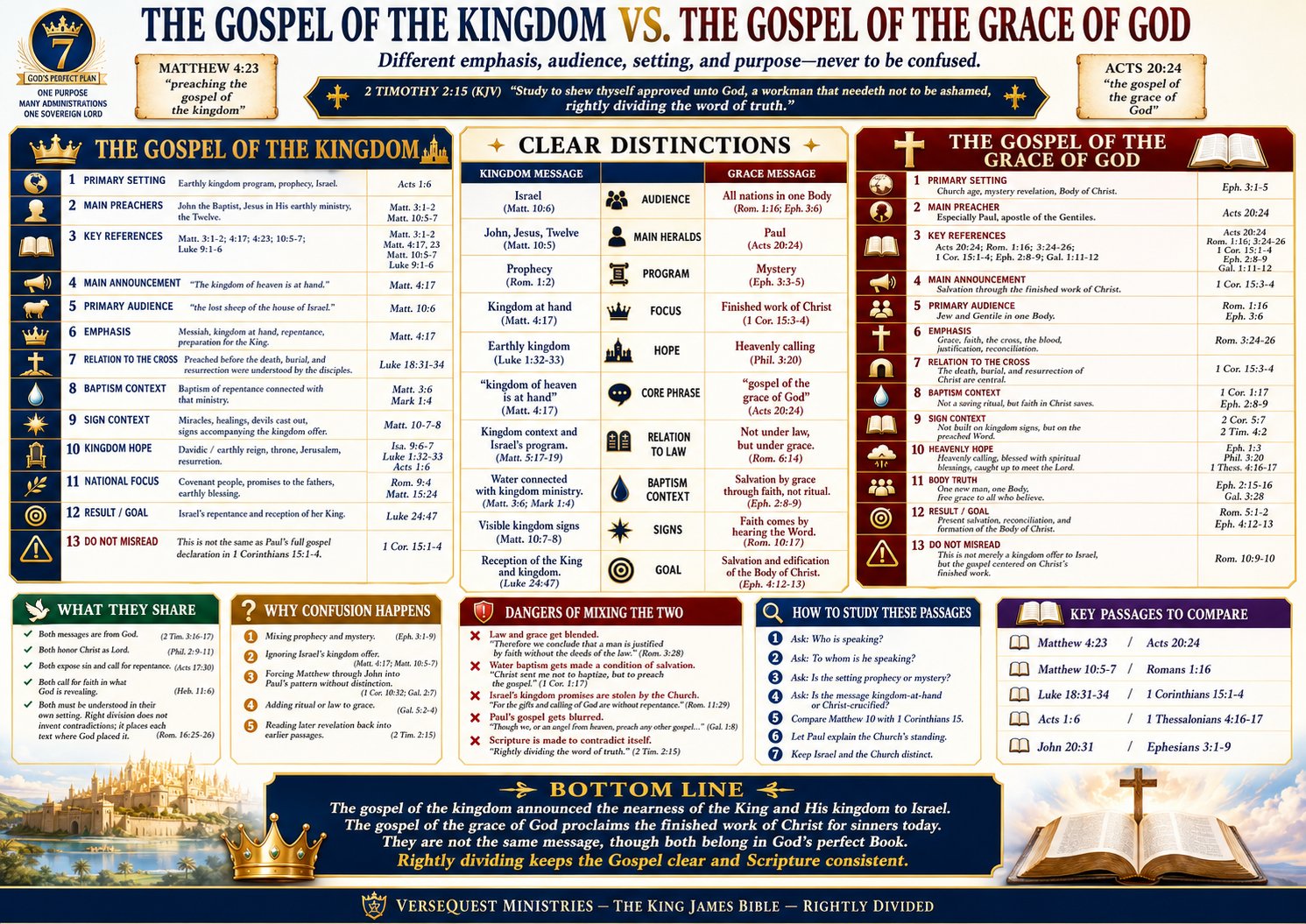
- The Gospel of the Kingdom vs. the Gospel of the Grace of God – KJV Right Division Bible Study Chart
- Compare the gospel of the kingdom and the gospel of the grace of God with this detailed KJV chart covering audience, message, prophecy, mystery, baptism, signs, salvation, and right division.
- $3.99
- Add to cart
-
-
Hebrews Rightly Divided
-
-71%
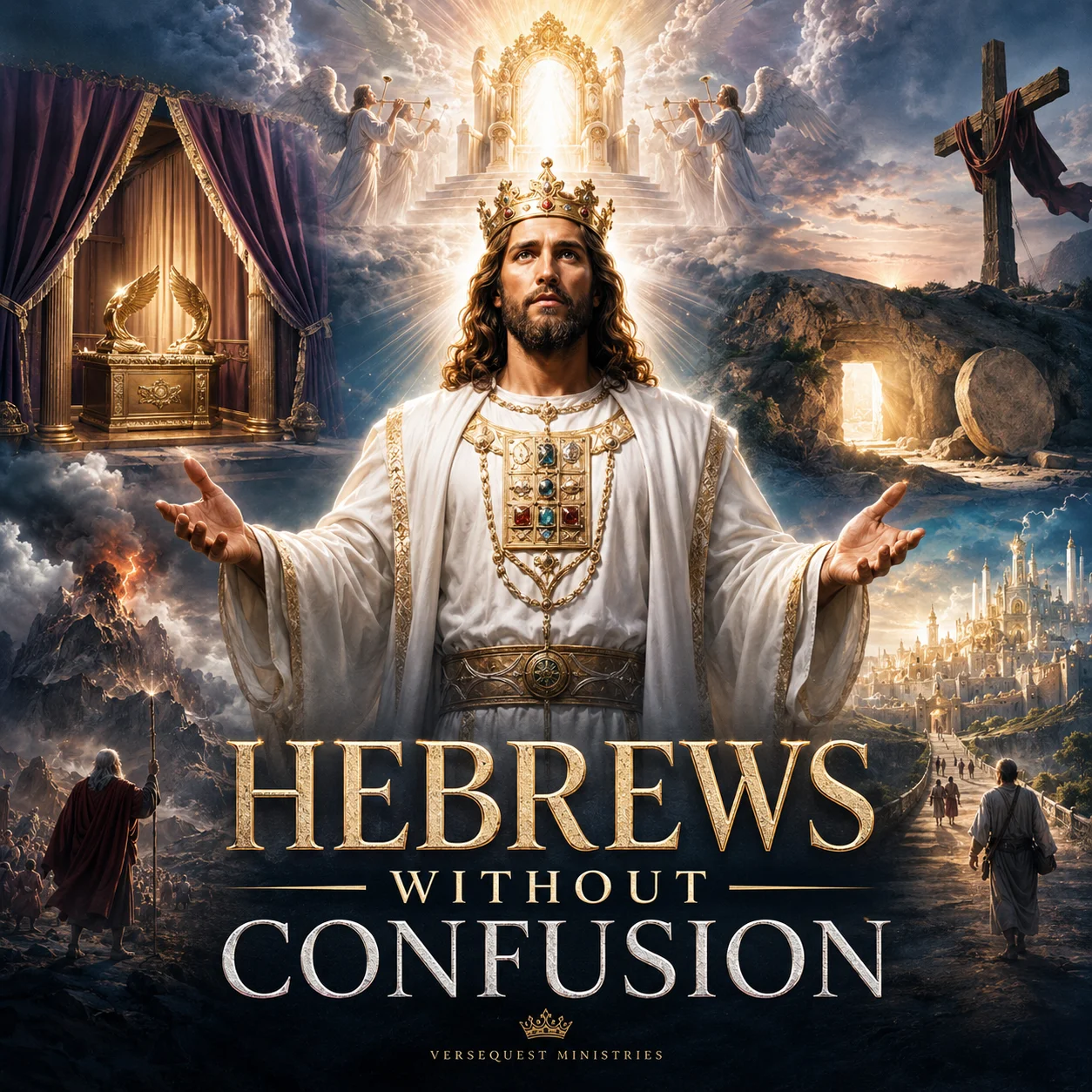
- Hebrews Without Confusion – 833-Page, 120-Study KJV PDF Commentary
- Hebrews Without Confusion is an enormous 833-page digital KJV commentary containing 120 detailed studies through all thirteen chapters of Hebrews. This rightly divided study explains Christ’s supremacy, His eternal priesthood,…
- Original price was: $34.99.$9.99Current price is: $9.99.
- Add to cart
-
-71%
-
Revelation of the Body of Christ
-
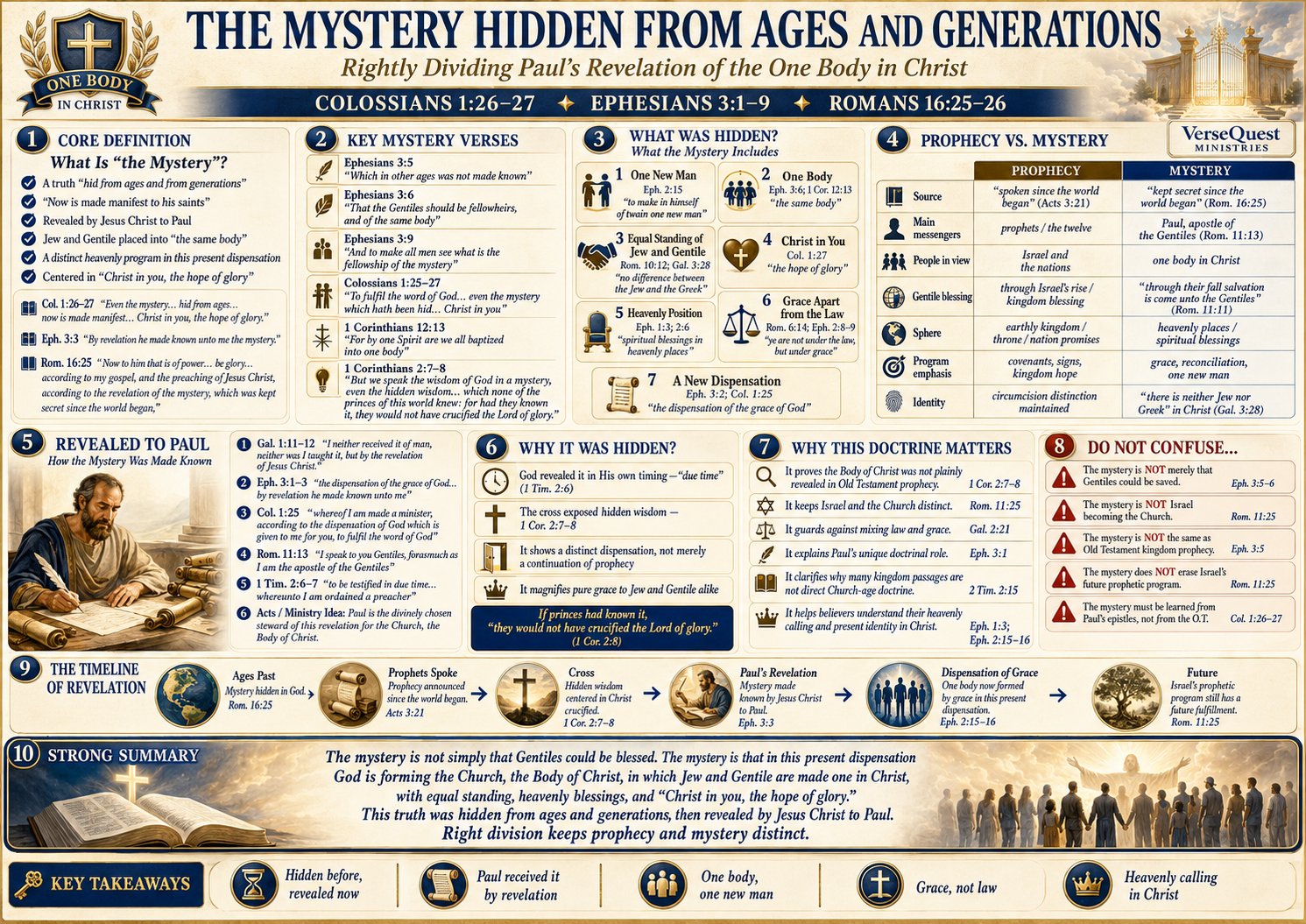
- The Mystery Hidden from Ages and Generations – Paul’s Revelation of the One Body in Christ (KJV Bible Study Chart)
- Understand the mystery hidden from ages and generations with this detailed KJV chart covering Paul’s revelation, the one Body, the one new man, grace, heavenly blessings, and prophecy versus mystery.
- $3.99
- Add to cart
-
-
The Church Age vs The Tribulation
-
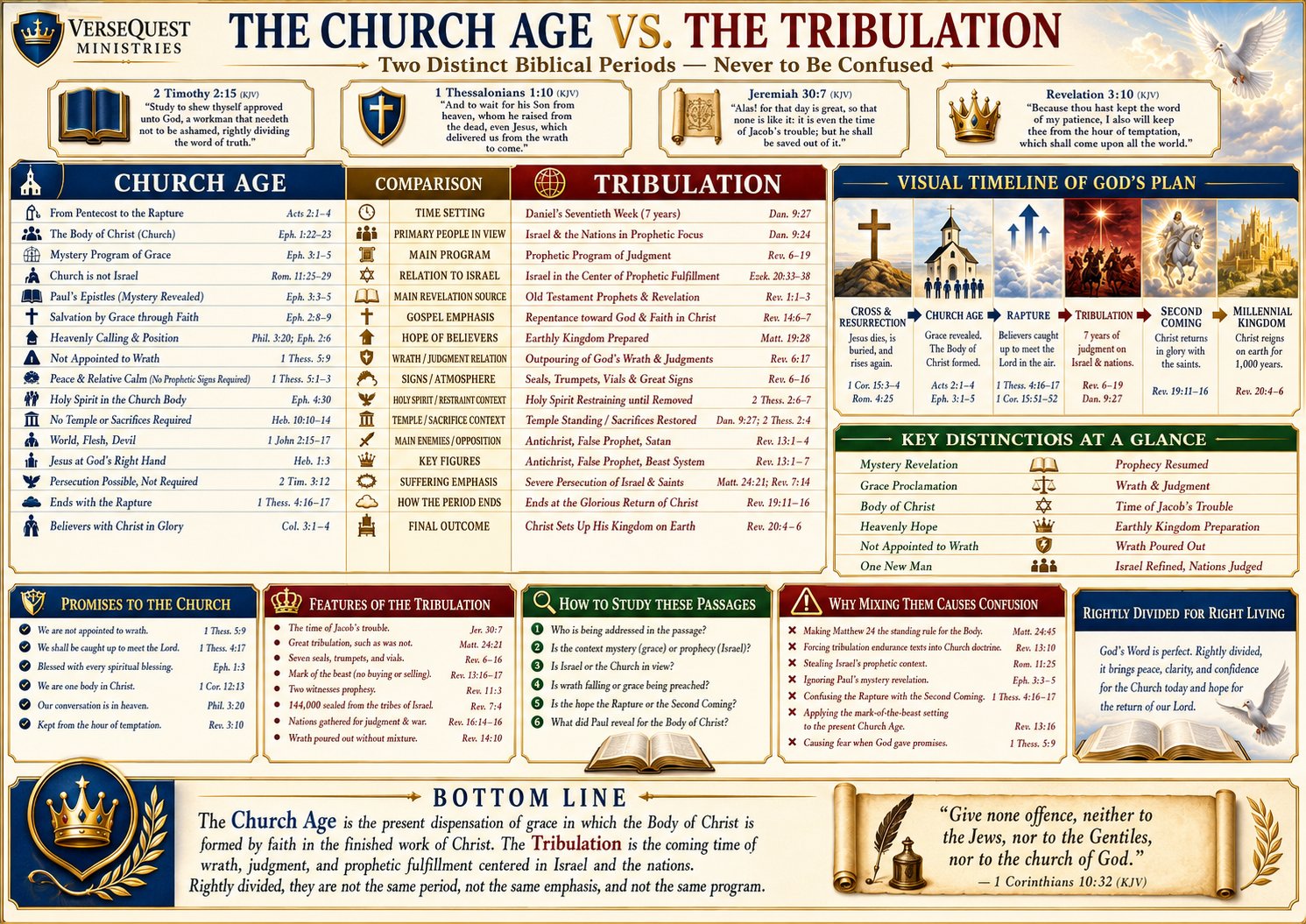
- The Church Age vs. the Tribulation – Two Distinct Biblical Periods KJV Bible Study Chart
- Compare the Church Age and the Tribulation with this detailed KJV chart covering the Body of Christ, Israel, grace, wrath, the Rapture, Antichrist, the Second Coming, and the millennial Kingdom.
- $3.99
- Add to cart
-
-
The Rapture
-
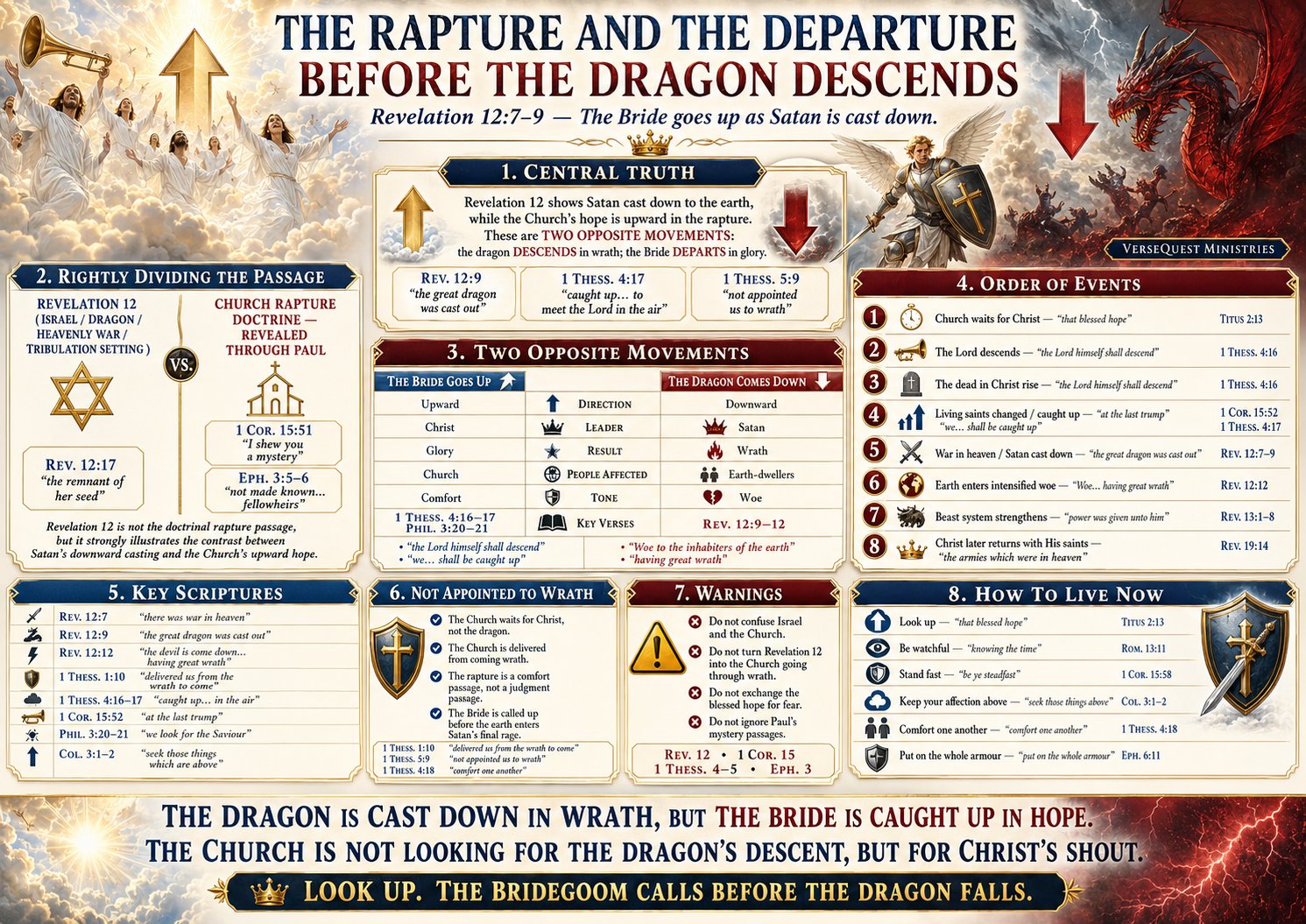
- The Rapture and the Departure Before the Dragon Descends – Printable Bible Study Chart
- Printable KJV Bible study chart on The Rapture and the Departure Before the Dragon Descends, showing the Bride caught up before Satan is cast down in wrath. This premium VerseQuest…
- $4.99
- Add to cart
-