
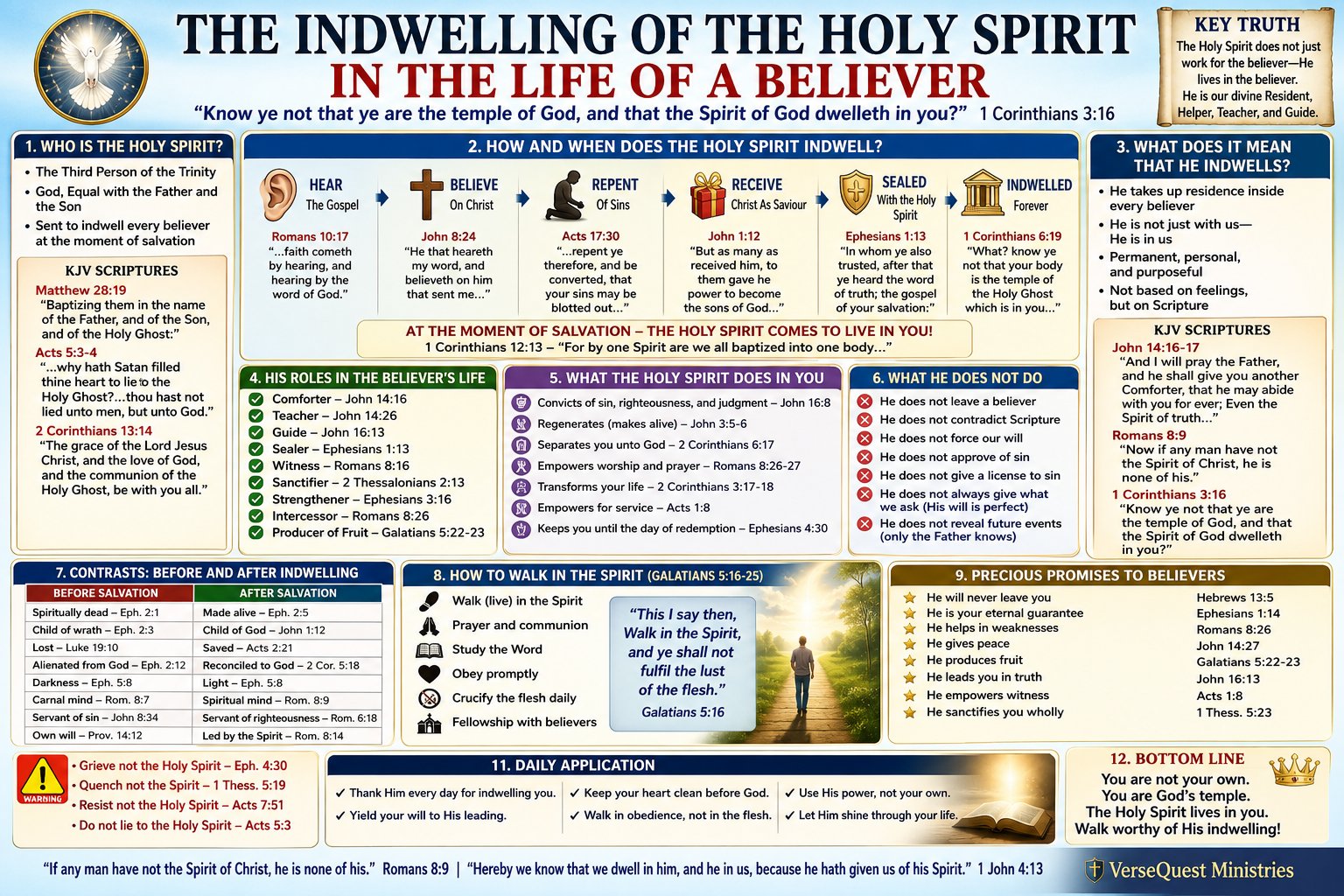
The Indwelling of the Holy Spirit in the Life of a Believer – Sealed, Taught, Guided, Sanctified, and Empowered (KJV Bible Study Chart)
Understand the indwelling of the Holy Spirit with this detailed KJV chart covering salvation, regeneration, spiritual baptism, sealing, guidance, prayer, sanctification, fruit, Christian service, and walking in the Spirit.
$3.99
Description
The Indwelling of the Holy Spirit in the Life of a Believer is a detailed KJV Bible study chart explaining who the Holy Spirit is, when He comes to indwell the believer, what His permanent presence means, how He works within the Christian, and how believers should walk in the Spirit rather than depend upon the flesh.
Built around 1 Corinthians 3:16, Romans 8:9, Ephesians 1:13–14, Ephesians 4:30, John 14:16–17, Romans 8:26, and Galatians 5:16–25, this chart presents the Holy Spirit not as an impersonal force, emotional sensation, religious influence, or temporary visitor, but as the divine Person who permanently lives within everyone who has trusted the gospel of Jesus Christ.
First Corinthians 3:16 asks, “Know ye not that ye are the temple of God, and that the Spirit of God dwelleth in you?” The believer is not merely accompanied by the Holy Spirit from a distance. God has taken up residence within him.
The chart begins by identifying the Holy Spirit as the third Person of the Trinity. He is fully God, equal with the Father and the Son, possessing divine personality, intelligence, will, holiness, power, and authority.
Matthew 28:19 places the Holy Ghost alongside the Father and the Son in the singular divine name. Acts 5 records that lying to the Holy Ghost was lying unto God. Second Corinthians 13:14 presents the grace of Christ, the love of God, and the communion of the Holy Ghost together.
The Holy Spirit is not merely “God’s power” in the same way electricity is power. He speaks, teaches, guides, comforts, witnesses, intercedes, can be grieved, and distributes spiritual gifts according to His will.
The chart explains how and when the Holy Spirit indwells. The sinner hears the gospel, believes on Jesus Christ, receives the Saviour, and is sealed with the Holy Spirit.
Romans 10:17 teaches that faith comes by hearing the Word of God. The gospel announces that Jesus Christ died for our sins, was buried, and rose again the third day according to the Scriptures.
The sinner is saved when he believes on the Lord Jesus Christ. Salvation is not earned through good works, religious ceremonies, emotional experiences, law-keeping, or personal reform. It is received by grace through faith in Christ’s finished work.
Ephesians 1:13 gives the doctrinal order plainly: “after that ye heard the word of truth, the gospel of your salvation: in whom also after that ye believed, ye were sealed with that holy Spirit of promise.”
The Holy Spirit does not begin indwelling only after the believer reaches a higher level of maturity, speaks in tongues, experiences a second blessing, produces enough fruit, or completes a religious ceremony. He comes to live within the believer when the gospel is believed.
First Corinthians 12:13 teaches that by one Spirit believers are baptized into one Body. This spiritual baptism places the saved person into union with Jesus Christ and makes him a member of the Body of Christ.
Every genuine believer therefore possesses the Holy Spirit. Romans 8:9 states that anyone who does not have the Spirit of Christ does not belong to Christ. There is no biblical category of a truly saved Church-age believer who remains permanently without the indwelling Spirit.
The chart distinguishes the Spirit’s permanent indwelling from the believer’s daily experience of His influence and filling. Indwelling concerns His permanent presence in every believer. Filling concerns the believer’s yieldedness, obedience, communion, and submission to the Spirit’s control.
A Christian does not receive more of the Holy Spirit by spiritual growth, but the Holy Spirit should receive more control of the Christian. The Spirit is fully present from salvation, while the believer must continually yield his mind, conduct, speech, desires, and service to God.
John 14 records Christ promising another Comforter who would abide with believers forever. The Spirit’s presence is therefore permanent, personal, and purposeful.
The Holy Spirit is not merely with the believer; He is in the believer. His indwelling does not depend upon a constant emotional awareness of His presence. Feelings may vary, but the promise of God remains settled.
The chart presents the Spirit’s major roles within the believer’s life. He is the Comforter, bringing divine help and strengthening the Christian through truth.
He is the Teacher, illuminating Scripture and helping believers understand the things God has revealed. His teaching never contradicts the Bible He inspired.
He is the Guide, leading believers into truth. He does not lead through confusion, unscriptural impressions, or guidance that opposes clear biblical commands.
He is the Sealer, marking believers as God’s possession and guaranteeing their future redemption. Ephesians 4:30 declares that Christians are sealed unto the day of redemption.
He is the Witness, bearing witness with the believer’s spirit that he is a child of God. This witness agrees with the gospel and the written promises of Scripture rather than replacing them.
He is the Sanctifier, setting the believer apart unto God and working through the Word to develop practical holiness.
He is the Strengthener, providing power beyond human ability. Christian living cannot be produced successfully through fleshly determination alone.
He is the Intercessor, helping believers in their infirmities. Romans 8 teaches that when Christians do not know what they should pray for, the Spirit makes intercession according to the will of God.
He is the Producer of spiritual fruit. Galatians 5 identifies the fruit of the Spirit as love, joy, peace, longsuffering, gentleness, goodness, faith, meekness, and temperance.
The chart also explains what the Holy Spirit does within the believer. He convicts concerning sin, righteousness, and judgment. He regenerates the sinner, making spiritually dead people alive through the new birth.
He separates the believer unto God, empowers worship and prayer, transforms the Christian’s life, strengthens service, and preserves the believer through His sealing ministry until the day of redemption.
Regeneration is not moral repair performed upon the old nature. It is the impartation of spiritual life by God. The sinner does not merely become a better version of the old man; he becomes a new creature in Jesus Christ.
The Spirit’s sanctifying work should produce real change. He uses Scripture to renew the mind, expose sin, correct doctrine, develop obedience, and conform believers increasingly to the character of Jesus Christ.
Second Corinthians 3:18 describes believers being changed into the same image from glory to glory by the Spirit of the Lord. Spiritual transformation is progressive, but it rests upon the believer’s completed position in Christ.
The Holy Spirit also empowers Christian service. Acts 1:8 connects the Spirit’s power with witness. Believers should not rely upon personality, manipulation, emotional pressure, natural talent, or human promotion as substitutes for spiritual power.
The Spirit’s power does not eliminate preparation, study, discipline, or obedience. He works through believers who know the Word, yield to God, walk honestly, and depend upon divine strength.
A necessary section explains what the Holy Spirit does not do. He does not abandon a genuine believer. The Christian may grieve Him, resist His leading, or quench His working, but the Spirit’s seal remains unto redemption.
He does not contradict Scripture. Any voice, dream, impression, prophecy, feeling, or supposed revelation that opposes God’s written Word is not guidance from the Holy Spirit.
He does not force the believer’s will like an impersonal controlling power. Christians remain responsible to yield, obey, walk in the Spirit, and refuse the lusts of the flesh.
He does not approve sin or give license to continue in rebellion. Grace and the Spirit’s indwelling are not permission to live carelessly. The indwelling Spirit produces conviction and calls believers toward holiness.
He does not always give believers everything they request. Romans 8 teaches that His intercession operates according to God’s will. Divine love does not require God to grant every human desire.
The Spirit does not reveal dates and future events that the Father has not revealed. Christians must resist sensational claims that go beyond Scripture and create private authorities alongside the Bible.
The chart provides a powerful before-and-after comparison. Before salvation, the sinner is spiritually dead, under wrath, lost, alienated from God, walking in darkness, controlled by a carnal mind, serving sin, and following his own way.
After salvation, the believer is made alive, becomes a child of God, is saved and reconciled, walks in the light, receives a spiritually renewed mind, becomes a servant of righteousness, and is led by the Spirit.
This change does not mean that the believer becomes instantly sinless or incapable of fleshly conduct. The Christian still faces an internal conflict between the flesh and the Spirit.
Galatians 5 explains that the flesh lusts against the Spirit and the Spirit against the flesh. The believer must therefore choose daily whether to yield to the old nature or walk according to the Spirit’s truth and power.
The command “Walk in the Spirit” describes a continuing manner of life. Walking involves direction, dependence, repeated steps, and steady progress rather than one emotional experience.
The chart gives practical instruction for walking in the Spirit. Believers should maintain prayer and communion with God, study Scripture, obey promptly, crucify the flesh daily, fellowship with sound believers, confess sin honestly, and yield their will to the Lord.
Walking in the Spirit is not achieved by chasing feelings, waiting for visions, or seeking a dramatic supernatural atmosphere. It is cultivated through truth, prayer, obedience, fellowship, faith, and continual dependence upon God.
The Word and the Spirit must never be separated. The Holy Spirit inspired Scripture and works through its truth. A person claiming to be Spirit-led while ignoring biblical doctrine is not demonstrating spiritual maturity.
Prayer is another central part of the Spirit-filled walk. The Holy Spirit helps believers pray in weakness, but prayer should still be guided by Scripture, humility, thanksgiving, confession, and submission to God’s will.
Prompt obedience matters because delayed obedience often strengthens the flesh. When God’s Word exposes sin or commands righteousness, the believer should respond rather than debate, postpone, excuse, or negotiate.
Crucifying the flesh does not mean physically harming the body. It means refusing the old nature’s demands, counting its claims as condemned with Christ, and presenting the members of the body unto God as instruments of righteousness.
Christian fellowship also supports Spirit-led living. God uses local-church preaching, mature believers, correction, encouragement, prayer, worship, and shared service to strengthen His people.
The chart includes several warnings. Christians are commanded not to grieve the Holy Spirit. Sinful speech, bitterness, wrath, dishonesty, malice, and unholy conduct bring sorrow to the divine Person dwelling within them.
Believers are also warned not to quench the Spirit. Quenching describes suppressing or resisting His working through unbelief, disobedience, neglect, or rejection of biblical truth.
Stephen accused Israel of resisting the Holy Ghost. Acts 5 records the seriousness of lying to Him. These warnings demonstrate His personality and holiness.
A believer cannot lose the Holy Spirit’s indwelling, but he can live in a manner that opposes the One who lives within him. The result may be broken fellowship, loss of joy, chastening, damaged testimony, spiritual weakness, and reduced usefulness.
The Spirit’s presence should therefore produce reverence. The Christian’s body is described as the temple of the Holy Ghost. How the believer uses his body, mind, speech, eyes, time, energy, and relationships matters.
The chart gathers precious promises for believers. The Spirit will never leave them. He is the guarantee of their inheritance. He helps in weakness, gives peace, produces fruit, leads into truth, empowers witness, and continues the work of sanctification.
Hebrews 13:5 promises that God will never leave or forsake His people. Ephesians 1 presents the Spirit as the earnest of the inheritance. Romans 8 assures believers that He helps their infirmities.
John 14 connects the Spirit with divine comfort and peace. Galatians 5 presents His fruit. John 16 presents His guidance into truth.
The doctrine of the Spirit’s indwelling also strengthens eternal security. The believer is not preserved by his own ability to hold onto God. He is sealed by the Spirit until the redemption of the body.
The seal does not excuse carelessness; it provides security from which holy living can grow. The believer obeys not to persuade the Spirit to remain but because the Spirit already lives within him.
The chart’s daily applications are direct. Thank God for the Spirit’s indwelling. Yield to His leading. Keep the heart clean through confession. Walk in obedience rather than the flesh.
Use His power rather than self-reliance. Let His character shine through daily conduct. Seek His fruit rather than public display, religious excitement, or outward recognition.
The believer must remember that he is not his own. He has been purchased by Christ and has become God’s temple. The Spirit’s indwelling gives dignity, responsibility, assurance, power, and purpose to Christian living.
The final doctrinal conclusion is clear: the Holy Spirit does not merely work around the believer or visit him during religious services. He lives permanently within every person who has trusted Jesus Christ.
He comforts, teaches, seals, witnesses, sanctifies, strengthens, intercedes, guides, and produces spiritual fruit. The Christian’s responsibility is to believe the Word, yield to God, refuse the flesh, and walk daily in the power of the One who dwells within.
This resource is ideal for personal Bible study, Holy Spirit doctrine, new-believer discipleship, Christian-living classes, spiritual-growth instruction, assurance and eternal-security studies, pastoral counseling, Sunday school, homeschool Bible curriculum, Christian schools, Bible institutes, sermon preparation, and local-church teaching.
Indwelling of the Holy Spirit, Spirit of God dwelling in believers, temple of the Holy Ghost, Holy Spirit at salvation, sealed by the Holy Spirit, Spirit baptism, Body of Christ, regeneration, sanctification, guidance into truth, spiritual comfort, prayer and intercession, power for Christian service, fruit of the Spirit, walking in the Spirit, grieving the Spirit, quenching the Spirit, eternal security, Christian obedience, spiritual transformation
The Holy Spirit is the third Person of the Trinity, fully divine and equal with the Father and the Son.
He is not an impersonal force. He teaches, guides, speaks, witnesses, intercedes, wills, comforts, and can be grieved.
The Holy Spirit indwells every genuine believer at the moment of salvation.
Ephesians 1:13 connects hearing the gospel, believing in Christ, and being sealed with the Holy Spirit.
The Spirit is not received as a reward for spiritual maturity, emotional intensity, speaking in tongues, or religious performance.
Romans 8:9 teaches that anyone who does not possess the Spirit of Christ does not belong to Christ.
First Corinthians 12:13 teaches that the Holy Spirit places believers into one Body.
Spirit baptism is God’s work of spiritually uniting the believer with Jesus Christ and His Body.
Indwelling and filling should be distinguished. Indwelling is permanent; filling concerns yieldedness and spiritual control.
A believer does not receive the Holy Spirit in portions. He should increasingly surrender every area of life to the Spirit already dwelling within him.
The Spirit’s seal identifies believers as God’s possession and guarantees future redemption.
Ephesians 4:30 states that the seal continues unto the day of redemption.
The Spirit comforts believers through truth rather than through unscriptural reassurance.
He teaches Scripture and never contradicts the Bible He inspired.
He guides believers into truth. His guidance agrees with God’s written revelation and righteous character.
He bears witness concerning the believer’s sonship, but this witness does not replace faith in the gospel or the promises of Scripture.
The Spirit sanctifies believers by setting them apart and producing practical holiness through the Word.
He strengthens Christians to obey and serve beyond the power of the flesh.
He helps believers in prayer when they do not know how to pray as they ought.
His intercession operates according to the will of God rather than merely supporting every human desire.
The Spirit produces spiritual fruit. His fruit reflects Christlike character rather than outward religious excitement.
The fruit of the Spirit includes love, joy, peace, longsuffering, gentleness, goodness, faith, meekness, and temperance.
Regeneration makes the sinner spiritually alive. It is divine life, not merely moral improvement.
The believer becomes God’s temple because the Holy Spirit takes up permanent residence within him.
The Spirit does not force obedience. Christians remain responsible to yield, walk in the Spirit, and refuse the flesh.
He does not approve sin or provide license for rebellion.
He does not contradict Scripture, endorse false doctrine, or guide believers away from clear biblical commands.
The believer may grieve the Holy Spirit through sinful conduct, bitterness, corrupt speech, dishonesty, and disobedience.
The believer may quench the Spirit by resisting His working and refusing biblical truth.
Grieving or quenching the Spirit damages fellowship and usefulness but does not break His permanent seal.
Before salvation, the sinner is spiritually dead, alienated, lost, and controlled by the flesh.
After salvation, the believer is made alive, reconciled, indwelt, sealed, and given power to walk in righteousness.
The presence of the Spirit does not remove the flesh. The Christian must continue choosing to walk according to the Spirit.
Walking in the Spirit involves Scripture, prayer, obedience, confession, fellowship, faith, and dependence upon God.
Spiritual guidance should not be reduced to emotion, coincidence, inner voices, or private impressions.
The Word of God remains the objective standard by which supposed guidance is tested.
Christian service requires the Spirit’s power, but spiritual dependence does not excuse laziness, poor preparation, or ignorance of Scripture.
The believer should thank God for the Spirit’s presence, yield his will, confess sin, and depend upon divine strength.
The central truth is that the Christian is not alone. The Holy Spirit lives within him permanently as Comforter, Teacher, Guide, Sealer, Sanctifier, and Helper.
Holy Spirit Bible studies, new-believer discipleship, teaching regeneration, explaining Spirit baptism, eternal-security instruction, spiritual-growth classes, walking in the Spirit, overcoming the flesh, prayer instruction, fruit-of-the-Spirit lessons, Christian service training, guidance and discernment, distinguishing indwelling from filling, pastoral counseling, Sunday school lessons, homeschool Bible curriculum, Christian school teaching, Bible institute classes, sermon preparation
King James Bible, Strong’s Concordance, Thompson Chain-Reference Bible, Treasury of Scripture Knowledge, Nave’s Topical Bible, Gospel of John Holy Spirit passages, Romans 8 study notes, First Corinthians 3 and 6 commentary materials, Ephesians 1 and 4 assurance studies, Galatians 5 fruit-of-the-Spirit worksheets, spiritual-gifts resources, walking-in-the-Spirit studies, prayer journals, Scripture memory cards, Pauline epistle outlines, VerseQuest Holy Spirit and Christian Living charts
Related products
-
Law vs Grace
-
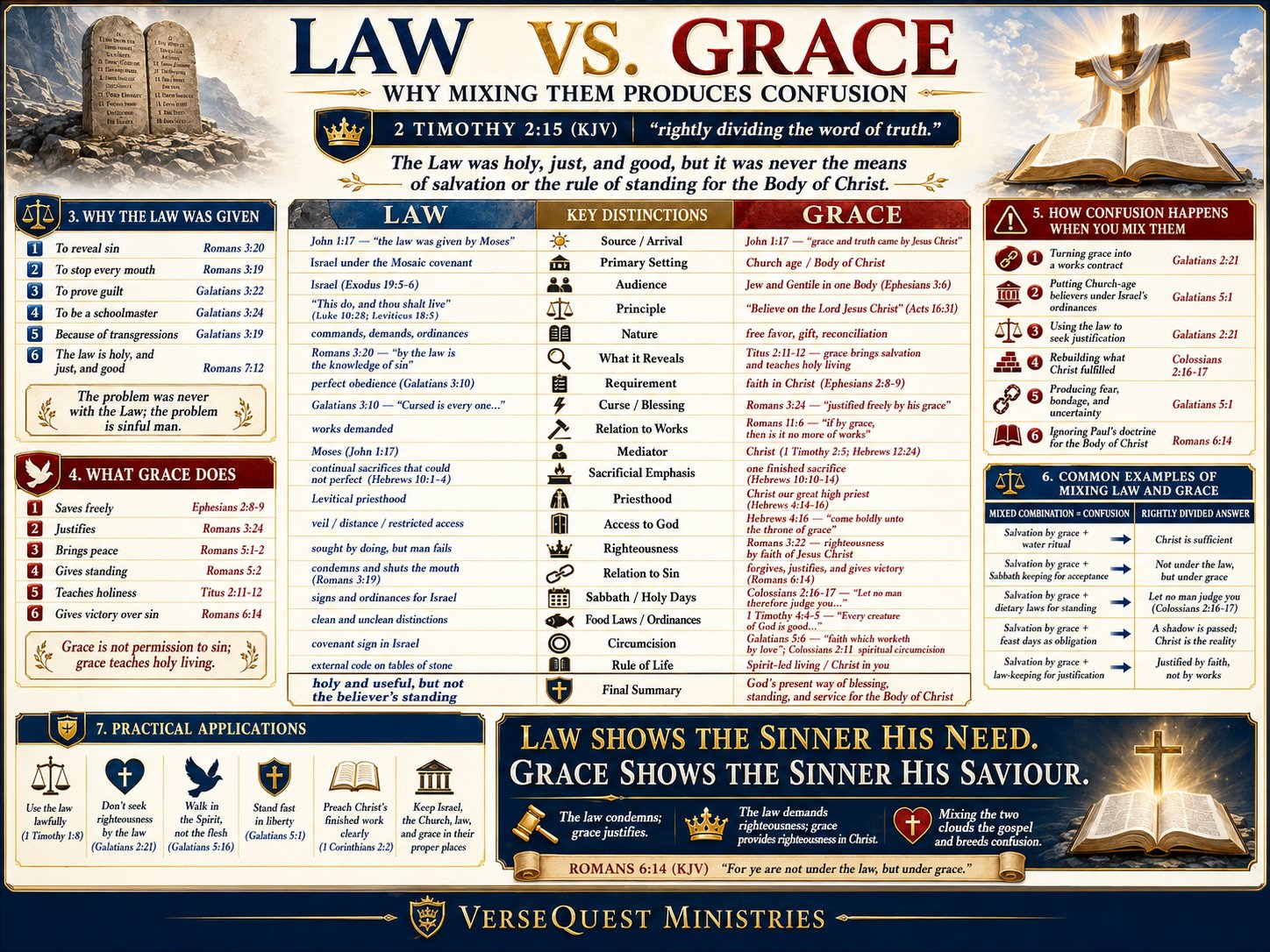
- Law vs. Grace Bible Study Chart – Why Mixing Them Produces Confusion (KJV)
- Compare law and grace with this detailed KJV Bible study chart explaining salvation, justification, holiness, Israel’s Mosaic covenant, Christian liberty, and the danger of mixing law with the gospel.
- $3.99
- Add to cart
-
-
Doctrine
-
-50%
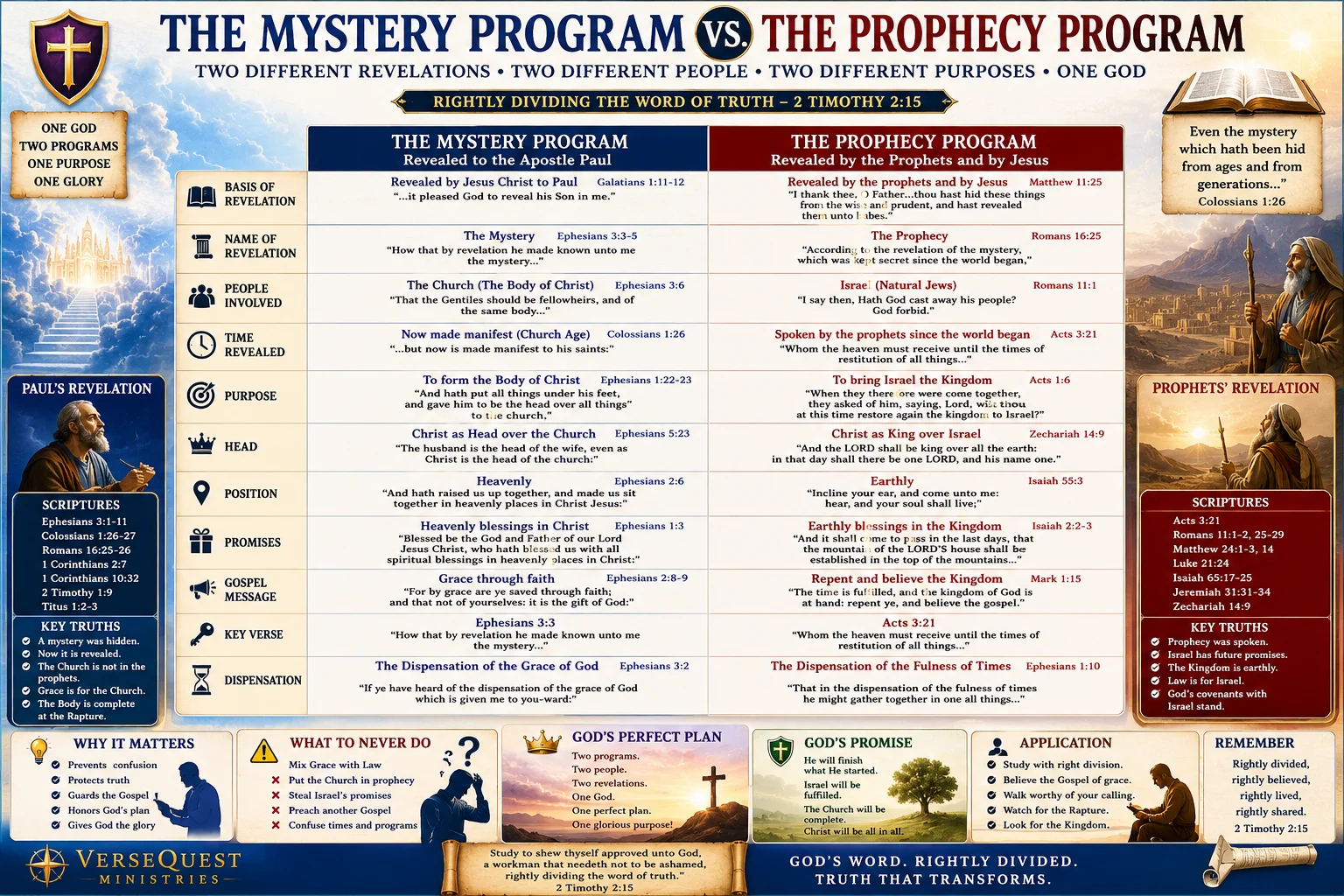
- The Mystery Program vs. Prophecy Program Chart — KJV Rightly Divided
- Premium printable KJV Bible study chart comparing the mystery program revealed through Paul with the prophecy program spoken by the prophets. Rightly divided and designed for teaching and personal study.
- Original price was: $10.00.$4.99Current price is: $4.99.
- Add to cart
-
-50%
-
Circumcision
-
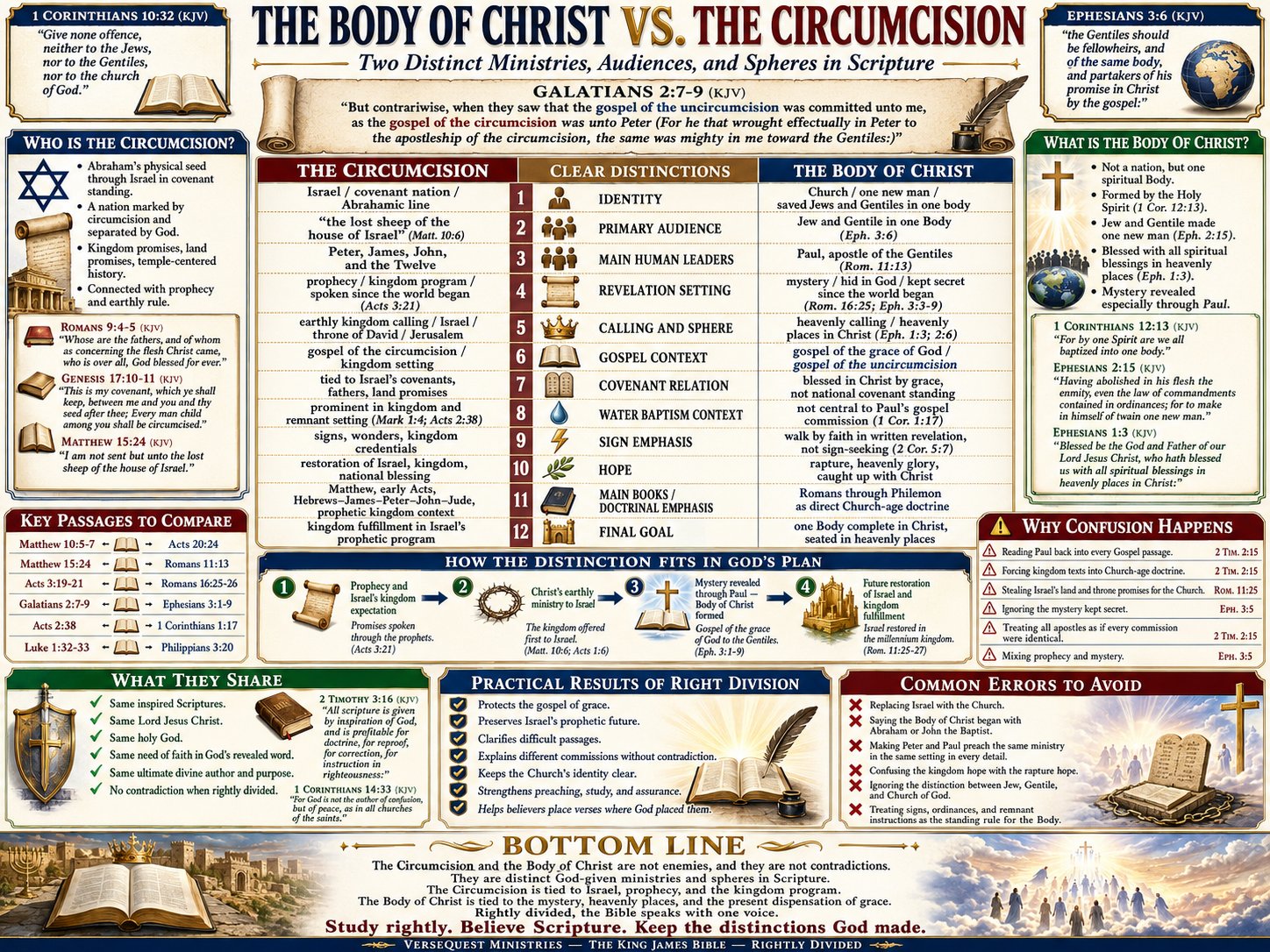
- The Body of Christ vs. the Circumcision – Two Distinct Ministries, Audiences, and Spheres in Scripture (KJV Bible Study Chart)
- Compare the Body of Christ and the circumcision with this detailed KJV chart covering Israel, Peter, Paul, prophecy, mystery, covenant promises, baptism, signs, and the Church’s heavenly hope.
- $3.99
- Add to cart
-
-
Not Under Law But Grace
-
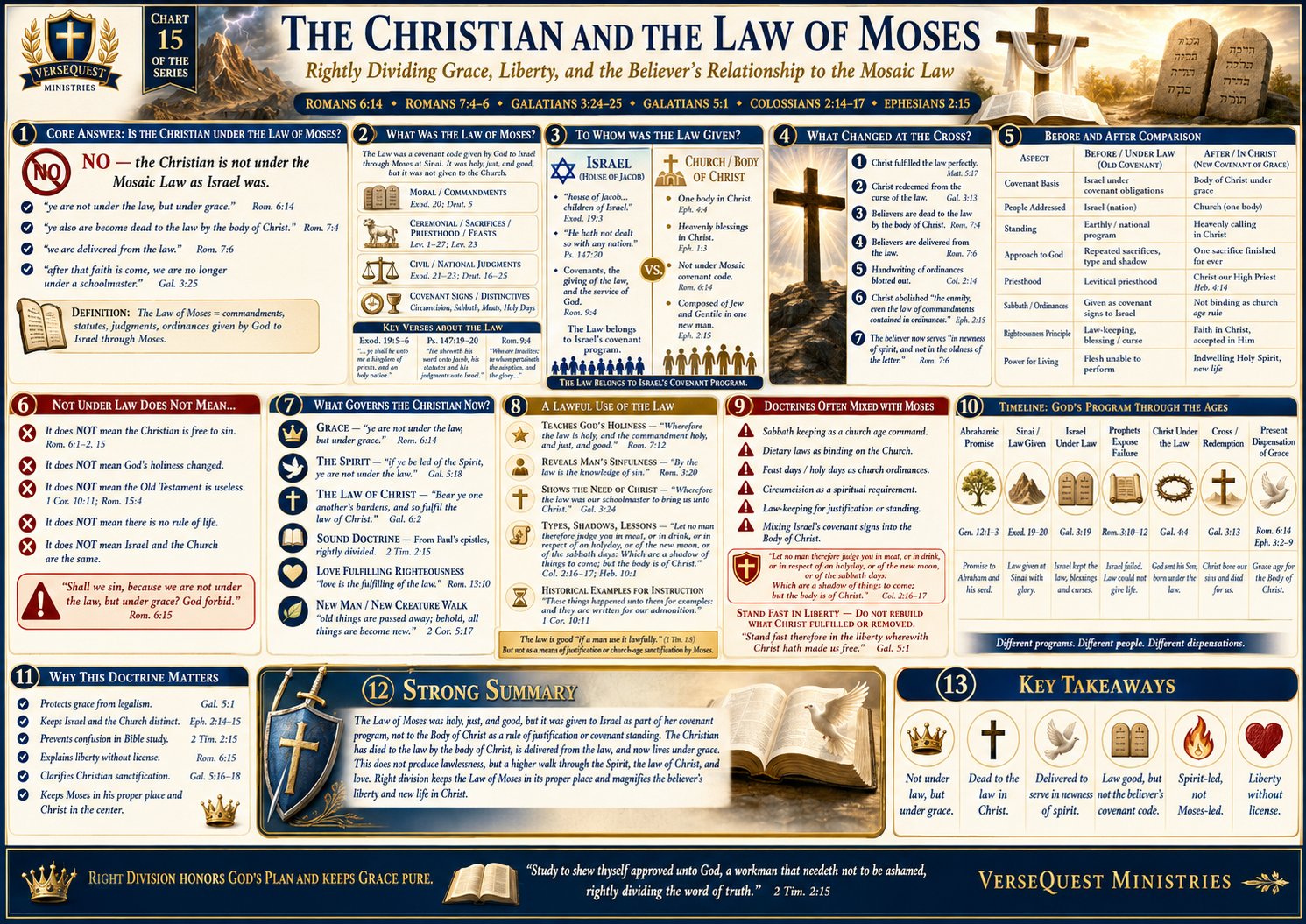
- The Christian and the Law of Moses – Grace, Liberty, and the Believer’s Relationship to the Mosaic Law (KJV Bible Study Chart)
- Understand the Christian’s relationship to the law of Moses with this detailed KJV chart covering Israel’s covenant, grace, liberty, the cross, the law of Christ, and Spirit-led living.
- $3.99
- Add to cart
-
-
The Gospel of the Kingdom
-
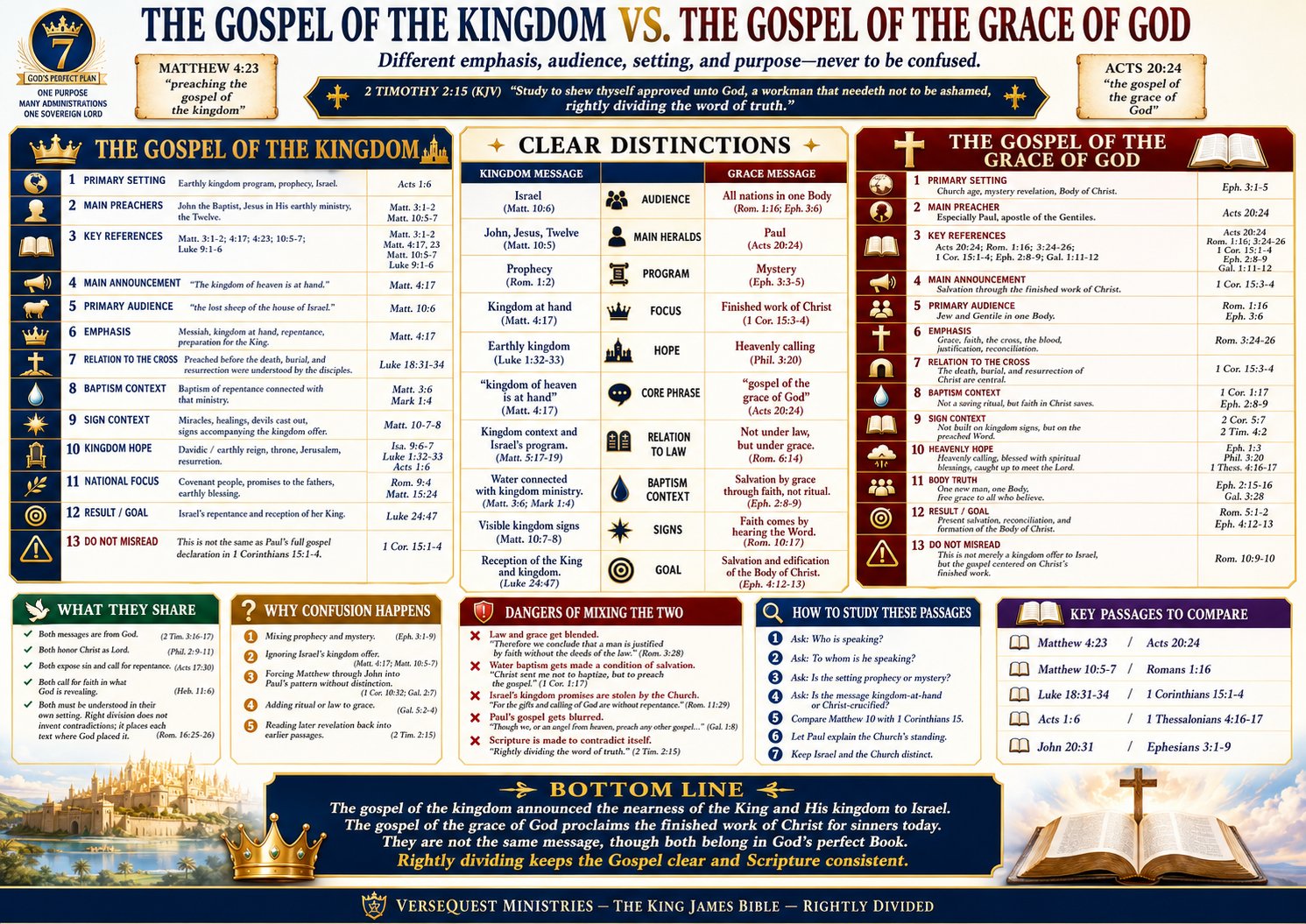
- The Gospel of the Kingdom vs. the Gospel of the Grace of God – KJV Right Division Bible Study Chart
- Compare the gospel of the kingdom and the gospel of the grace of God with this detailed KJV chart covering audience, message, prophecy, mystery, baptism, signs, salvation, and right division.
- $3.99
- Add to cart
-