
The Rapture vs. the Second Coming – Two Distinct Events in God’s Prophetic Program (KJV Bible Study Chart)
Understand the differences between the Rapture and Second Coming with this detailed KJV chart covering purpose, participants, location, timing, resurrection, divine wrath, the Tribulation, Church-versus-Israel distinctions, Christ’s visible return, and the Millennial Kingdom.
$3.99
Description
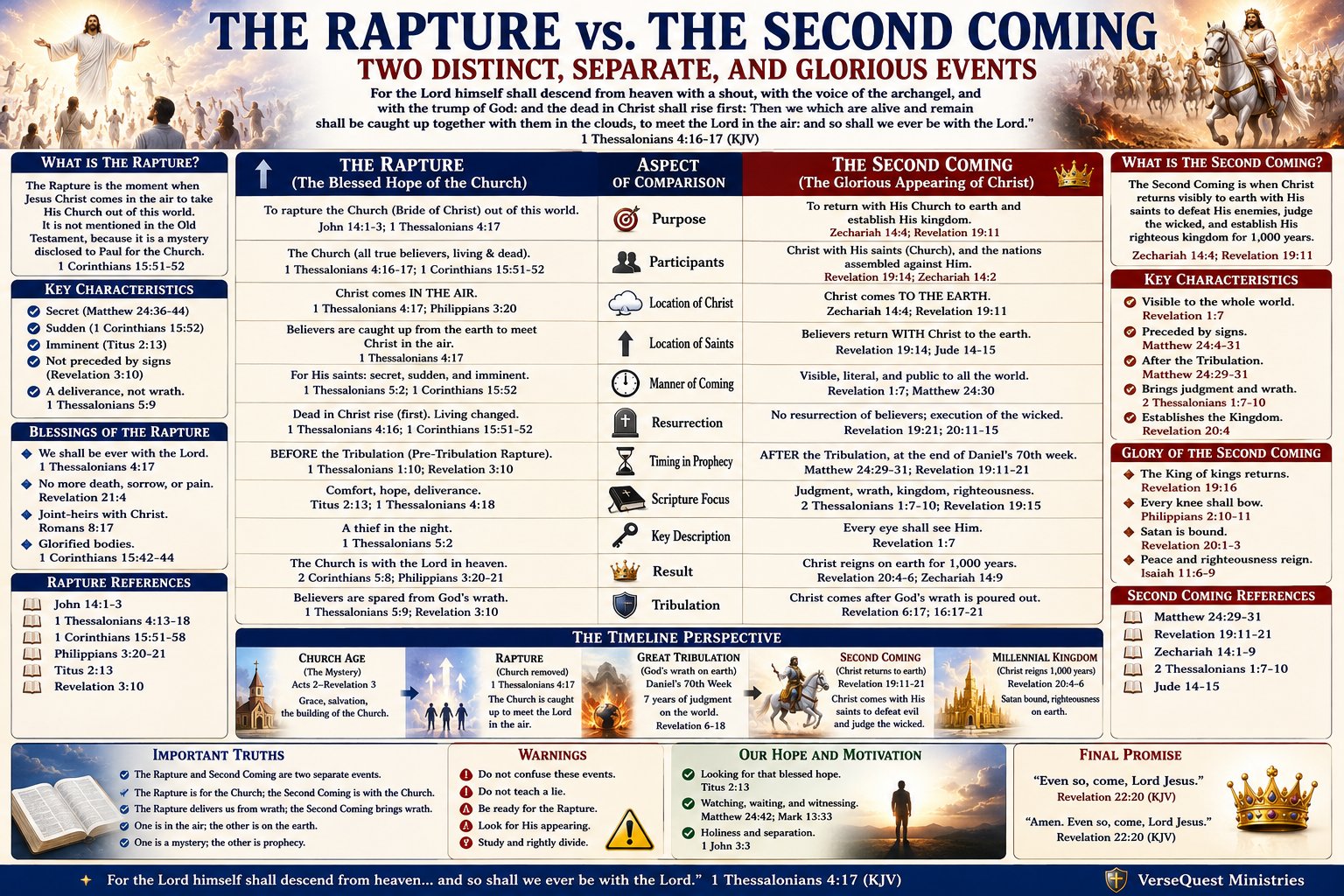
The Rapture vs. the Second Coming: Two Distinct, Separate, and Glorious Events is a detailed, rightly divided KJV Bible study chart explaining the crucial differences between Christ coming for His Church and Christ later returning with His saints to judge the world and establish His Kingdom upon the earth.
Built around 1 Thessalonians 4:13–18, 1 Corinthians 15:51–52, John 14:1–3, Titus 2:13, Philippians 3:20–21, Matthew 24:29–31, Zechariah 14:1–9, 2 Thessalonians 1:7–10, Revelation 19:11–21, and Revelation 20:1–6, this chart demonstrates that the Rapture and Second Coming are not interchangeable descriptions of one event.
Both events involve the Lord Jesus Christ, His saints, resurrection truth, and the fulfillment of God’s plan. Yet they differ in purpose, participants, direction, location, timing, prophetic setting, manner, accompanying signs, relationship to divine wrath, and final result.
The Rapture is the moment when Jesus Christ descends from heaven to gather the Body of Christ unto Himself. The dead in Christ rise first, living believers are changed, and both groups are caught up together in the clouds to meet the Lord in the air.
First Thessalonians 4:16–17 declares, “For the Lord himself shall descend from heaven with a shout, with the voice of the archangel, and with the trump of God: and the dead in Christ shall rise first.” The passage then promises that living believers will be caught up with them and remain forever with the Lord.
The Rapture concerns the Church, the Body of Christ, composed of all genuinely saved believers in this present dispensation of grace. It is not a gathering of an unsaved world, the judgment of rebellious nations, or the establishment of Christ’s earthly throne.
First Corinthians 15:51 calls the transformation of living saints a mystery. Paul writes, “Behold, I shew you a mystery; We shall not all sleep, but we shall all be changed.”
A biblical mystery is truth that was previously hidden and later revealed by God. The Old Testament prophets openly described the Messiah’s glorious return, Israel’s restoration, the judgment of nations, and the coming Kingdom. They did not plainly reveal the one Body of Christ or its sudden catching away before Israel’s final prophetic week.
The Rapture therefore belongs particularly to the mystery revelation given through the apostle Paul. It fits the Church’s heavenly identity, heavenly citizenship, spiritual blessings, and future glorification with Jesus Christ.
The Second Coming, by contrast, belongs to the openly revealed prophetic program. It is the visible, public, glorious return of Jesus Christ to the earth with His saints after the Tribulation.
Revelation 19 presents heaven opened and Jesus Christ descending as the Faithful and True, the Word of God, and the King of kings. The armies of heaven follow Him as He judges and makes war in righteousness.
Zechariah 14 declares that His feet will stand upon the Mount of Olives. The Second Coming is therefore not merely Christ appearing in the atmosphere while believers ascend to meet Him. He returns bodily and visibly to the earth.
The Rapture takes the Church from the earth to meet Christ in the air. The Second Coming brings Christ and His glorified saints from heaven to the earth.
One movement is upward. The other is downward. One removes the Church before the prophetic judgments. The other brings the Judge after those judgments have reached their appointed climax.
The purpose of the Rapture is to gather the Church unto Christ, complete the bodily redemption of believers, reunite the living and dead members of His Body, and bring the saints into His everlasting presence.
John 14:3 records Christ’s promise, “I will come again, and receive you unto myself; that where I am, there ye may be also.” The centre of the Rapture is not merely escape from trouble but personal reception by Jesus Christ.
The purpose of the Second Coming is different. Christ returns to defeat His enemies, deliver Israel, judge the nations, overthrow the beast and false prophet, bind Satan, and establish His righteous reign upon the earth.
The Second Coming fulfills the promises of the Messianic Kingdom, the throne of David, Israel’s national restoration, and the visible rule of the Lord Jesus Christ over the nations.
The participants also differ. At the Rapture, the people in view are the dead in Christ and the living members of the Body of Christ.
At the Second Coming, Jesus Christ returns with His glorified saints while the nations and armies of the rebellious world are gathered against Him. Israel, the Tribulation remnant, the beast, the false prophet, and the hostile kingdoms of the earth stand within the prophetic scene.
The location of Christ differs. At the Rapture, Christ comes into the air, and the Church rises to meet Him. At the Second Coming, Christ descends to the earth.
The location of the saints also differs. At the Rapture, believers leave the earth. At the Second Coming, the saints return with Christ as He claims His earthly inheritance.
The manner of the two events differs. The Rapture is sudden, imminent, and associated with the Church’s expectancy. It occurs in a moment and in the twinkling of an eye.
The Second Coming is visible, public, and preceded by unmistakable prophetic signs. Revelation 1:7 states, “Behold, he cometh with clouds; and every eye shall see him.”
The Second Coming cannot occur before the events Scripture places ahead of it. Matthew 24 describes the Tribulation, the abomination of desolation, cosmic disturbances, and the sign of the Son of Man before Christ appears in glory.
The Rapture, however, is presented as the Church’s imminent hope. Believers are told to wait for God’s Son from heaven, look for the blessed hope, and remain ready for Christ.
The Church is not instructed to wait first for the beast, the mark, the abomination, the two witnesses, the trumpet judgments, or the gathering of the armies at Armageddon.
This distinction is essential to the pre-Tribulation Rapture. The Church expects the Saviour rather than the Antichrist. Its hope is Christ’s coming for His Body, not its survival through the outpouring of Tribulation wrath.
The relationship of the two events to divine wrath also differs. First Thessalonians 5:9 declares, “For God hath not appointed us to wrath, but to obtain salvation by our Lord Jesus Christ.”
The Rapture removes the Body of Christ before the Tribulation judgments. This does not promise that Christians will escape ordinary suffering, persecution, sickness, martyrdom, economic hardship, or satanic opposition during the present age.
The distinction concerns the future prophetic outpouring of God’s wrath described through the seals, trumpets, and vials of Revelation.
The Second Coming occurs after that wrath has been poured out. Christ appears at the conclusion of the Tribulation to destroy the final rebellious coalition and establish the Kingdom.
The scriptural emphasis of the Rapture is comfort, hope, deliverance, resurrection, transformation, reunion, and everlasting presence with Christ.
Paul concludes the primary Rapture passage with the command, “Wherefore comfort one another with these words.” The doctrine was given to strengthen grieving saints, not to fill the Church with terror concerning its prophetic future.
The scriptural emphasis of the Second Coming is judgment, wrath, vengeance, righteousness, deliverance for Israel, the overthrow of evil rulers, and the beginning of Christ’s earthly reign.
Second Thessalonians 1 describes the Lord Jesus being revealed from heaven with His mighty angels in flaming fire, taking vengeance upon those who obey not the gospel.
Revelation 19 shows the beast and false prophet destroyed, the rebellious armies defeated, and Christ openly revealed as King of kings and Lord of lords.
The key descriptions differ. The Rapture comes with the suddenness of a thief in relation to an unsuspecting world. The Second Coming is the visible event in which every eye sees Him.
The Rapture does not inaugurate Christ’s visible earthly reign within the passage itself. It gathers the Church to Christ and places believers with Him in heaven.
The Second Coming directly leads into the judgment of Christ’s enemies, the binding of Satan, and the thousand-year Kingdom described in Revelation 20.
The chart presents a clear timeline. The present Church Age is the mystery period in which the gospel of grace is proclaimed and the Body of Christ is formed.
The Church Age is followed by the Rapture, when the dead in Christ are raised, living believers are changed, and the Church is caught up to meet Christ in the air.
The Rapture is followed by the Great Tribulation, Daniel’s seventieth week, when God resumes His prophetic dealings centred upon Israel, Jerusalem, the nations, and the coming Kingdom.
At the end of that period comes the Second Coming, when Jesus Christ returns visibly with His saints to judge the world.
The Second Coming is followed by the Millennial Kingdom, during which Christ reigns upon the earth for one thousand years and Satan is bound.
This order keeps the Church’s mystery calling distinct from Israel’s prophetic program. It preserves the proper relationship among the Rapture, Tribulation, Second Coming, and Kingdom.
The chart also explains the blessings associated with the Rapture. Believers will be forever with the Lord. The separation caused by death will end.
The bodies of the saints will be glorified. Corruption will put on incorruption, mortality will put on immortality, and believers will be fashioned like Christ’s glorious body.
The Rapture also confirms the believer’s joint-heirship with Christ. Those who have suffered with Him will be glorified together with Him.
The Second Coming displays another kind of glory. Jesus Christ openly returns as the rightful King. Every rebellious power is brought beneath His authority.
The beast and false prophet are destroyed. Satan is bound. Christ’s enemies are judged, and the righteous King establishes His rule.
Philippians 2 declares that every knee will bow and every tongue confess that Jesus Christ is Lord. The Second Coming publicly demonstrates the authority the world presently rejects.
Isaiah 11 describes the righteousness, peace, justice, and knowledge of the Lord associated with Messiah’s reign. The present evil world is not gradually improving into that Kingdom. The King returns and establishes it.
The chart warns believers not to confuse the Rapture with the Second Coming. One is Christ’s coming for His saints; the other is His return with His saints.
One occurs in the air; the other reaches the earth. One removes the Church before wrath; the other brings judgment after wrath.
One belongs to mystery truth revealed through Paul; the other fulfills prophecy spoken throughout the Old Testament.
One brings comfort to the Church; the other brings fear and judgment to the rebellious world.
One is imminent and not preceded by Tribulation signs; the other follows the signs, judgments, and events of Daniel’s seventieth week.
The chart also warns against date-setting. The imminence of the Rapture does not authorize anyone to calculate a secret date, announce a guaranteed year, or manipulate believers through repeated predictions.
The proper response is readiness, faithfulness, holiness, watchfulness, gospel witness, and obedience.
The distinction should never produce careless Christian living. A believer expecting Christ should redeem the time, serve faithfully, keep sound doctrine, confess sin promptly, and remain prepared to appear before the Judgment Seat of Christ.
The Rapture is not an excuse to abandon earthly responsibilities. It gives every responsibility eternal urgency.
The chart’s hope and motivation section calls believers to look for the blessed hope, remain watchful, continue witnessing, pursue holiness, and refuse worldly entanglement.
First John 3:3 connects the believer’s hope with personal purity. Titus 2 connects the blessed hope with sober, righteous, and godly living.
The believer does not purify himself to earn a place in the Rapture. He pursues holiness because he already belongs to Christ and expects to meet Him.
The chart’s important truths are clear. The Rapture and Second Coming are two separate events within the larger return program of Jesus Christ.
The Rapture is for the Church. The Second Coming brings the Church with Christ.
The Rapture delivers believers from the coming prophetic wrath. The Second Coming pours judgment upon the rebellious world.
The Rapture takes place in the air. The Second Coming brings the King to the earth.
The Rapture is mystery truth. The Second Coming is prophetic revelation.
The chart’s final promise is the prayer of every believer who loves Christ’s appearing: “Even so, come, Lord Jesus.”
This resource is ideal for personal Bible study, Rapture instruction, Second Coming studies, pre-Tribulation apologetics, Church-and-Israel distinctions, prophecy timelines, new-believer discipleship, eternal-security teaching, bereavement comfort, Sunday school, homeschool Bible curriculum, Christian schools, Bible institutes, prophecy conferences, sermon preparation, and church teaching.
Rapture versus Second Coming, two distinct events, blessed hope of the Church, pre-Tribulation Rapture, catching away of the Body of Christ, Christ coming for His saints, Christ returning with His saints, meeting the Lord in the air, Second Advent of Christ, dead in Christ rise first, living believers changed, Church versus Israel, mystery versus prophecy, not appointed to wrath, Great Tribulation, Daniel’s seventieth week, visible return of Christ, Judgment Seat of Christ, Millennial Kingdom, rightly dividing prophecy
The Rapture and the Second Coming are related events within Christ’s return program, but they are not identical.
At the Rapture, Jesus Christ comes for His Church.
At the Second Coming, Jesus Christ returns with His glorified saints.
The Rapture concerns the dead in Christ and living members of the Body of Christ.
The Second Coming concerns Christ, His heavenly armies, Israel, the nations, and the rebellious world gathered against Him.
At the Rapture, Christ descends into the air.
At the Second Coming, Christ descends to the earth and His feet stand upon the Mount of Olives.
At the Rapture, believers leave the earth to meet Christ.
At the Second Coming, believers return with Christ to the earth.
The Rapture is sudden and associated with imminence.
The Second Coming is preceded by Tribulation signs and prophetic events.
The Rapture belongs to mystery truth revealed especially through Paul.
The Second Coming belongs to prophecy revealed throughout the Old and New Testaments.
First Corinthians 15 calls the transformation of living believers a mystery.
First Thessalonians 4 presents the resurrection of the dead in Christ and the catching away of the Church.
The Rapture brings comfort, hope, reunion, transformation, and deliverance.
The Second Coming brings judgment, vengeance, deliverance for Israel, and the establishment of Christ’s Kingdom.
The Church is not appointed to divine wrath.
This promise does not mean Christians avoid ordinary suffering, persecution, illness, martyrdom, or human opposition.
The Great Tribulation is a future period of prophetic judgment associated with Daniel’s seventieth week.
The Rapture occurs before that Tribulation in the pre-Tribulation framework.
The Second Coming occurs after the Tribulation.
At the Rapture, living believers are changed in a moment and the dead in Christ rise first.
Revelation 19 emphasizes the destruction of Christ’s enemies and His visible return rather than the primary resurrection event of 1 Thessalonians 4.
The Rapture does not immediately present Christ beginning His earthly reign.
The Second Coming leads directly toward Christ’s thousand-year Kingdom.
The Rapture is compared with the sudden arrival of a thief in relation to an unsuspecting world.
The Second Coming is visible, public, and seen by the world.
John 14 promises that Christ will return and receive His own unto Himself.
Zechariah 14 promises Christ’s bodily return to the earth.
Revelation 19 presents Him as King of kings and Lord of lords.
Revelation 20 describes Satan bound and Christ’s Kingdom reign.
The Church’s hope is Jesus Christ rather than the rise of the Antichrist.
The doctrine does not authorize date-setting.
The imminent Rapture should produce watchfulness, holy living, gospel witness, faithful service, and eternal perspective.
The correct prophetic order is the Church Age, Rapture, Tribulation, Second Coming, and Millennial Kingdom.
The Judgment Seat of Christ concerns the examination of believers’ service rather than the loss of eternal salvation.
Israel’s prophetic program and the Church’s mystery program must remain distinct.
The final Christian prayer remains, “Even so, come, Lord Jesus.”
Rapture-versus-Second-Coming studies, pre-Tribulation teaching, prophecy timelines, Church-and-Israel distinctions, mystery-versus-prophecy instruction, explaining 1 Thessalonians 4, studying Revelation 19, Daniel’s seventieth-week lessons, Tribulation studies, resurrection teaching, blessed-hope instruction, bereavement comfort, watchfulness and readiness, Christian-holiness lessons, eternal-security teaching, Sunday school lessons, homeschool Bible curriculum, Christian school instruction, Bible institute classes, prophecy conferences, sermon preparation
King James Bible, Strong’s Concordance, Thompson Chain-Reference Bible, Treasury of Scripture Knowledge, Nave’s Topical Bible, First Thessalonians 4–5 study notes, First Corinthians 15 commentary materials, Matthew 24 comparison studies, Second Thessalonians 1–2 outlines, Zechariah 14 study notes, Revelation 19–20 charts, Rapture-versus-Second-Coming timelines, Church-versus-Israel resources, Daniel’s seventieth-week studies, resurrection and glorification worksheets, Pauline mystery studies, VerseQuest prophecy and right-division charts
Related products
-
The Rapture
-
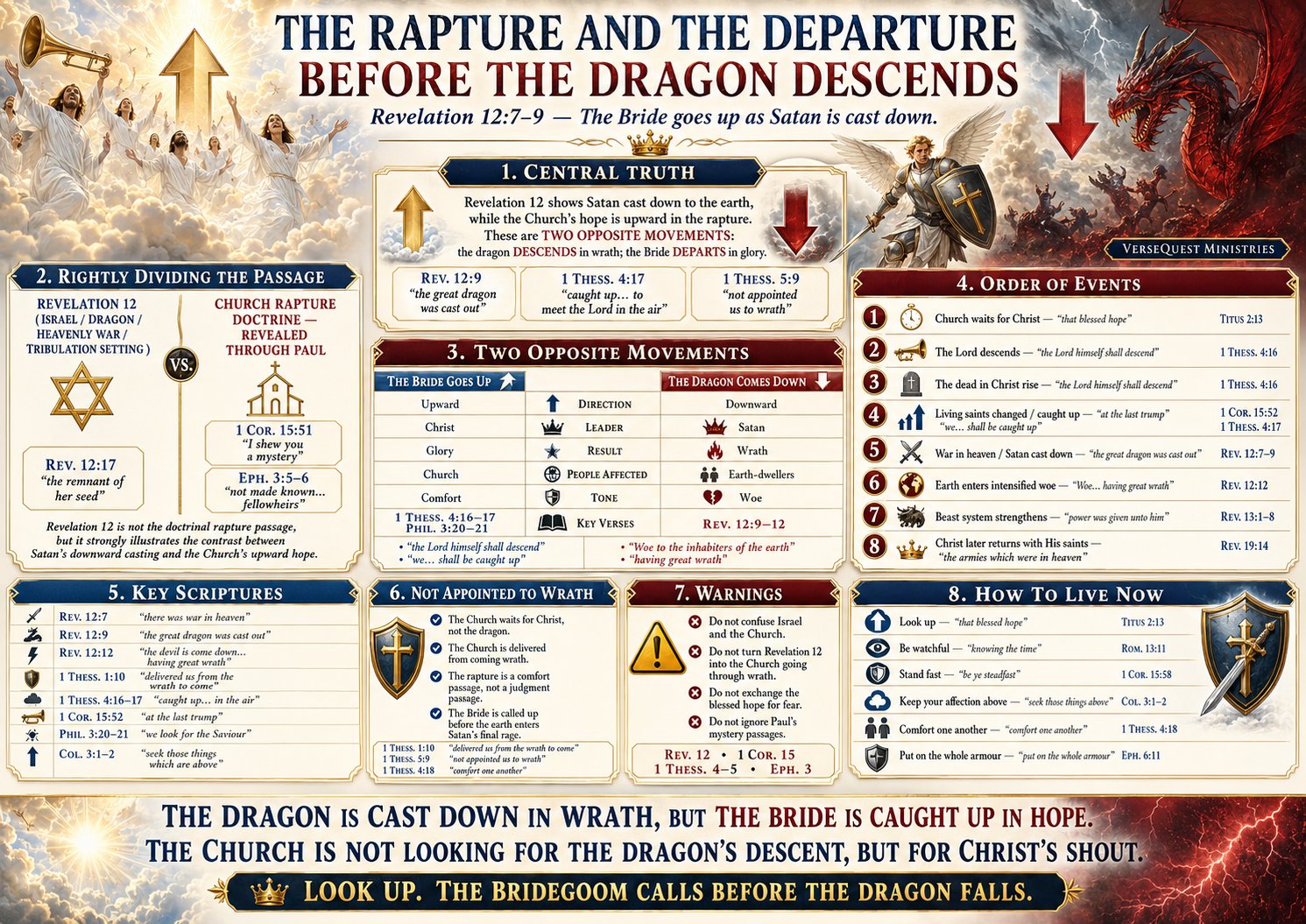
- The Rapture and the Departure Before the Dragon Descends – Printable Bible Study Chart
- Printable KJV Bible study chart on The Rapture and the Departure Before the Dragon Descends, showing the Bride caught up before Satan is cast down in wrath. This premium VerseQuest…
- $4.99
- Add to cart
-
-
The Seven Dispensations
-
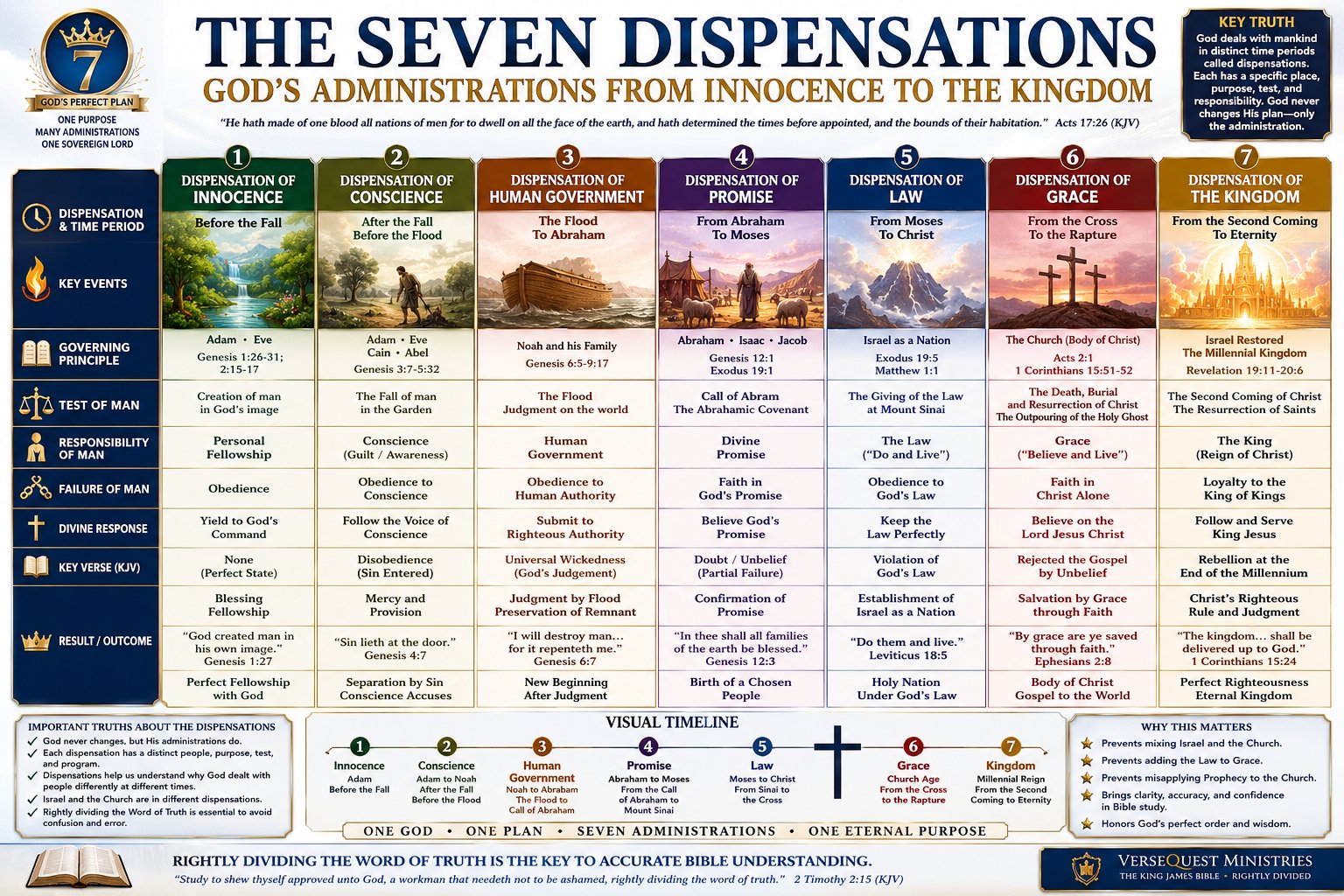
- The Seven Dispensations Bible Study Chart – God’s Administrations from Innocence to the Kingdom (KJV)
- Explore the seven dispensations with this detailed KJV Bible study chart covering Innocence, Conscience, Human Government, Promise, Law, Grace, the Kingdom, and the importance of rightly dividing Scripture.
- $3.99
- Add to cart
-
-
Coming Wrath of God
-
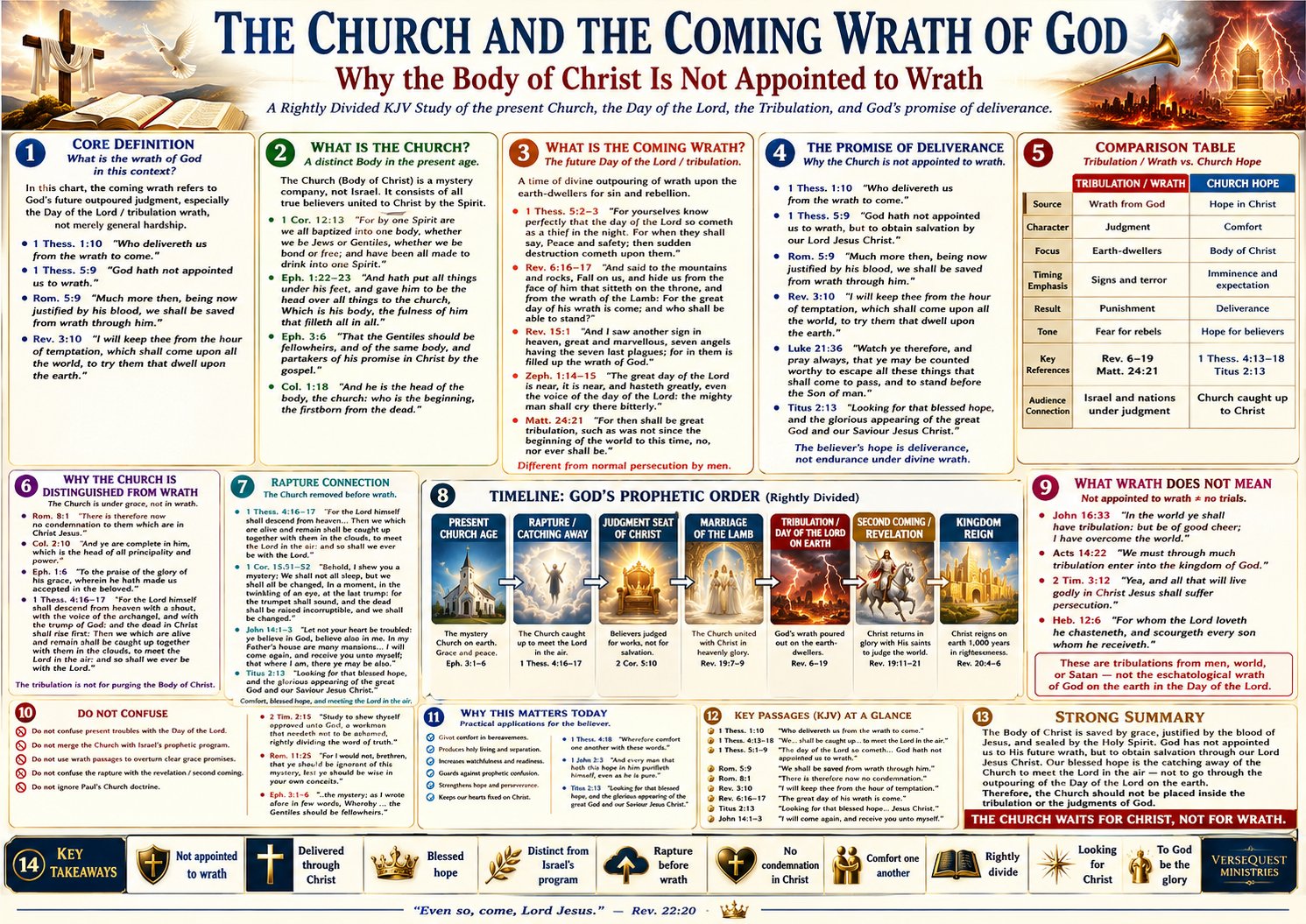
- The Church and the Coming Wrath of God – Why the Body of Christ Is Not Appointed to Tribulation Wrath (KJV Bible Study Chart)
- Understand why the Body of Christ is not appointed to coming Tribulation wrath with this detailed KJV chart covering the Church, Day of the Lord, Revelation judgments, pre-Tribulation Rapture, Israel’s…
- $3.99
- Add to cart
-
-
Blessed Hope
-
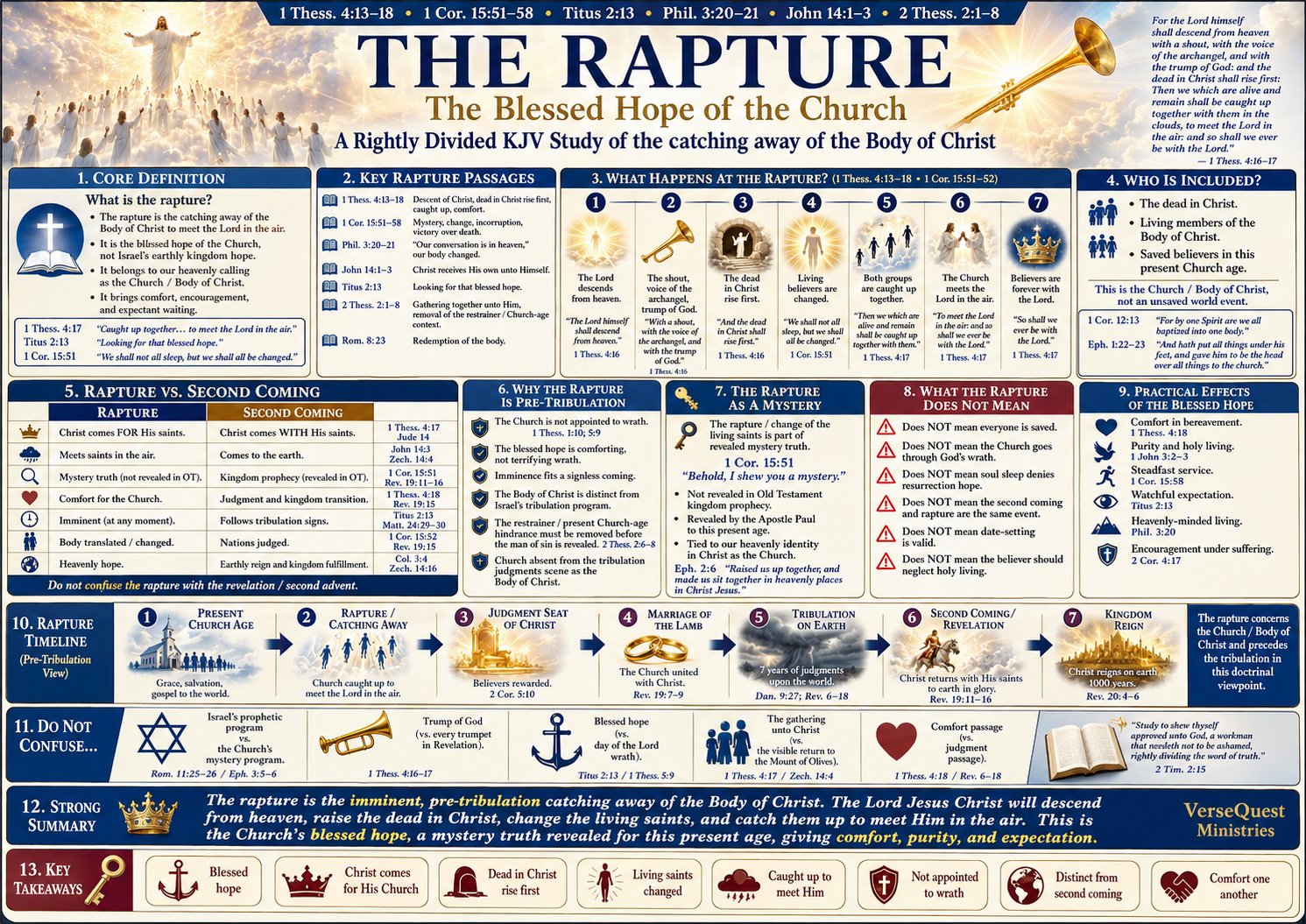
- The Rapture – The Blessed Hope and Pre-Tribulation Catching Away of the Body of Christ (KJV Bible Study Chart)
- Understand the Rapture with this detailed KJV chart covering the dead in Christ, transformation of living believers, meeting the Lord in the air, the blessed hope, pre-Tribulation timing, mystery truth,…
- $3.99
- Add to cart
-
-
The Gospel of the Kingdom
-
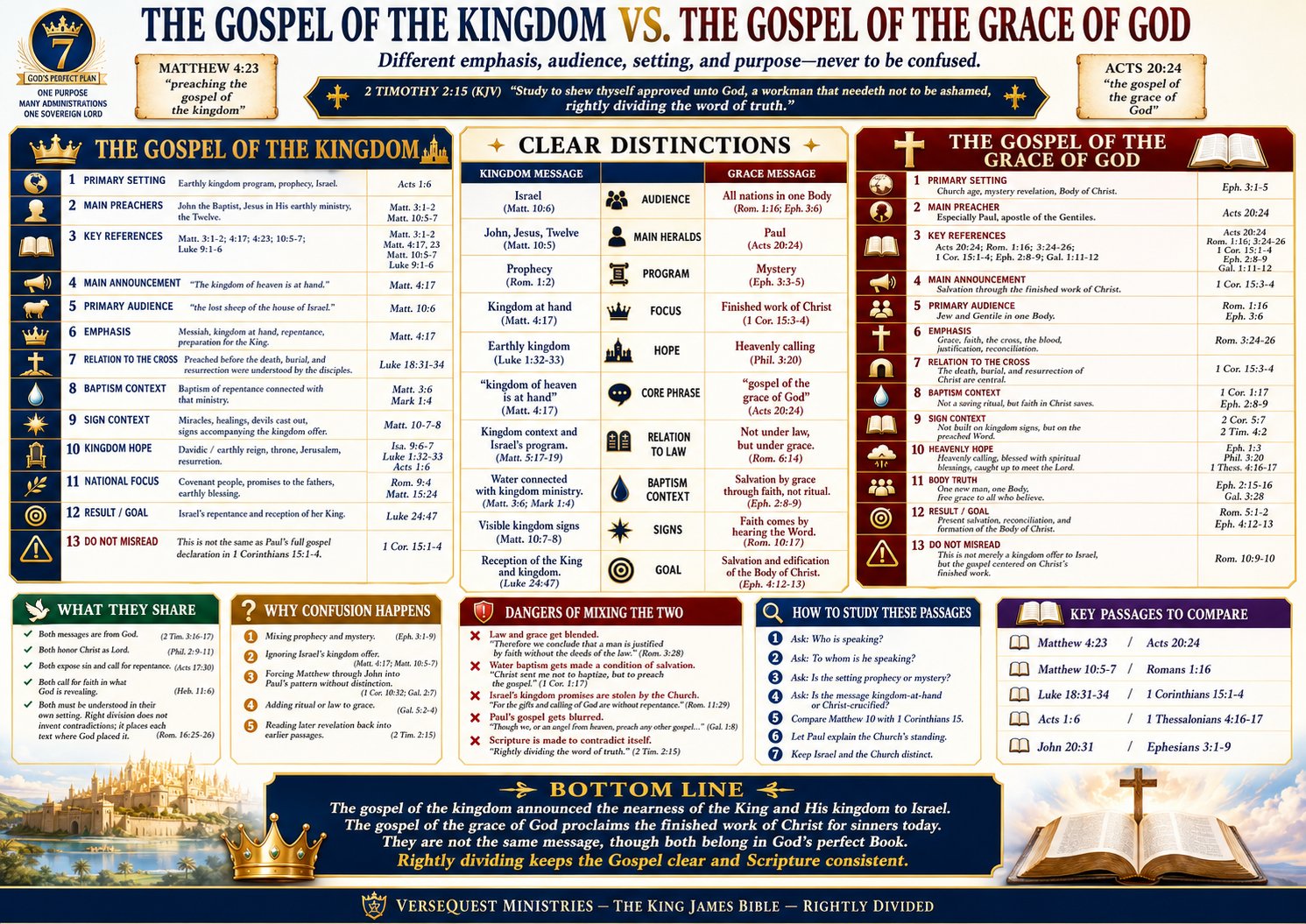
- The Gospel of the Kingdom vs. the Gospel of the Grace of God – KJV Right Division Bible Study Chart
- Compare the gospel of the kingdom and the gospel of the grace of God with this detailed KJV chart covering audience, message, prophecy, mystery, baptism, signs, salvation, and right division.
- $3.99
- Add to cart
-