
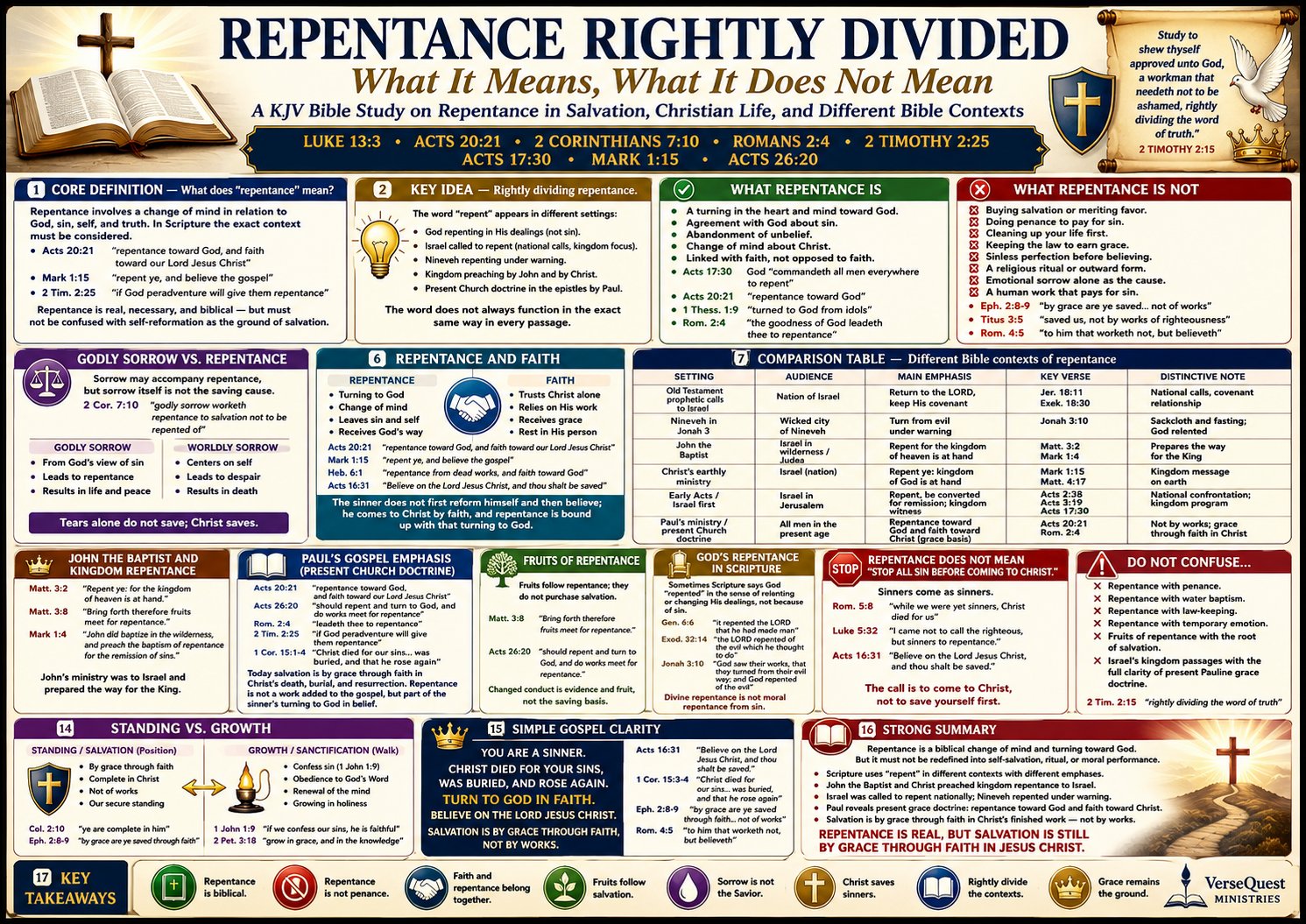
Repentance Rightly Divided – What It Means, What It Does Not Mean, and Its Place in Salvation and Christian Life (KJV Bible Study Chart)
Understand repentance rightly divided with this detailed KJV chart covering change of mind, repentance and faith, godly sorrow, fruits of repentance, Kingdom contexts, Christian growth, and salvation by grace through faith.
$3.99
Description
Repentance Rightly Divided: What It Means, What It Does Not Mean is a detailed KJV Bible study chart explaining the biblical meaning of repentance, its relationship to faith, the different settings in which the word appears, and the danger of redefining repentance as penance, religious performance, emotional sorrow, or self-reformation.
Built around Luke 13:3, Acts 20:21, 2 Corinthians 7:10, Romans 2:4, 2 Timothy 2:25, Acts 17:30, Mark 1:15, and Acts 26:20, this chart demonstrates that repentance is real, necessary, and thoroughly biblical, but must be interpreted according to its audience, message, program, and immediate context.
Repentance involves a change of mind and heart in relation to God, sin, self, unbelief, false religion, and revealed truth. It is an inward turning that produces an altered direction. The exact object, emphasis, and outward application of repentance must be determined by the passage in which it appears.
The word repent does not perform precisely the same function every time it appears in Scripture. The Bible speaks of God repenting in His governmental dealings, Israel being called to national repentance, Nineveh turning from wickedness beneath a warning of judgment, John the Baptist preparing Israel for the King, Christ preaching repentance within Israel’s Kingdom setting, and Paul proclaiming repentance toward God and faith toward the Lord Jesus Christ.
Right division does not deny repentance. It preserves repentance from careless definitions and keeps each passage within the setting where God placed it. A word may retain its basic sense of turning or changed intention while possessing different objects, audiences, consequences, and dispensational applications.
The chart begins with a core definition. Repentance is a change of mind that produces a corresponding turning toward God’s truth. It is not simply feeling regret, experiencing fear, shedding tears, regretting consequences, or attempting to become morally worthy before approaching Christ.
Acts 20:21 joins “repentance toward God” with “faith toward our Lord Jesus Christ.” The sinner turns from false confidence, rebellion, unbelief, self-righteousness, idols, and religious substitutes toward God and rests by faith in Jesus Christ.
Mark 1:15 records Christ’s command, “repent ye, and believe the gospel.” Repentance and faith are not rival methods of salvation. They describe the sinner’s changed response to God’s truth: turning from unbelief and believing what God has revealed.
Second Timothy 2:25 teaches that God may grant repentance to the acknowledging of the truth. This passage demonstrates that repentance is not merely an outward change in habits. It involves the mind being corrected so that error is abandoned and truth is received.
The chart strongly affirms that repentance is biblical. The answer to false teaching is not to erase the word but to define and place it correctly. Repentance must not be confused with self-reformation as the ground of salvation.
A major section explains what repentance is. It is a turning of the heart and mind toward God, agreement with God about sin and truth, abandonment of unbelief, a changed understanding of Jesus Christ, and an inward turning that leads to faith and appropriate fruit.
Acts 17:30 declares that God commands all men everywhere to repent. This universal call confronts the sinner’s rejection of God and demands a changed response to divine revelation.
First Thessalonians 1:9 describes believers who “turned to God from idols to serve the living and true God.” Their conversion involved a real change of mind, loyalty, worship, and direction. They did not merely add Jesus Christ to an existing system of idolatry.
Romans 2:4 teaches that the goodness of God leads to repentance. Divine kindness should not encourage presumption. It should break resistance, expose the folly of rebellion, and lead the sinner to acknowledge God’s truth.
The chart also explains what repentance is not. It is not buying salvation, earning divine favour, doing penance, paying for sin, cleaning up one’s life before receiving grace, keeping the Mosaic law, producing sinless perfection before believing, performing a religious ritual, or presenting a human work that pays the debt of sin.
Ephesians 2:8–9 establishes that salvation is by grace through faith and not of works. Titus 3:5 excludes works of righteousness performed by the sinner. Romans 4 contrasts the person who works with the person who believes on the God who justifies the ungodly.
Any definition of repentance that requires the sinner to reform sufficiently, abandon every bad habit successfully, make himself morally presentable, or produce a lifetime of obedience before he may receive Christ converts repentance into works.
The gospel does not say, “Clean yourself and then come.” It says that Christ died for sinners and that the ungodly person is justified through faith. The sinner comes as he is, but he does not come insisting that his unbelief, self-righteousness, false religion, or idols are correct.
Repentance does not mean that sins become harmless or that salvation has no effect upon life. Genuine conversion should produce changed affections, conduct, priorities, and spiritual fruit. The error comes when those fruits are moved in front of faith and made the price of justification.
The chart carefully distinguishes godly sorrow from repentance. Sorrow may accompany repentance, but sorrow itself is not the saving cause. Tears can reveal grief without proving faith, surrender, or a true change of mind.
Second Corinthians 7:10 states that godly sorrow works repentance to salvation not to be repented of, while the sorrow of the world works death. Godly sorrow views sin from God’s perspective, leads toward repentance, and produces life and peace.
Worldly sorrow centres upon self. It grieves over exposure, embarrassment, lost reputation, painful consequences, or injured pride while leaving the heart unchanged.
Judas displayed intense remorse but did not rest in the saving mercy of Christ. Esau sought a changed outcome with tears but could not undo the despised birthright. Pharaoh repeatedly expressed regret beneath pressure and returned to hardness once relief arrived.
Tears alone do not save; Jesus Christ saves. Emotional intensity must never replace the gospel or become the basis of assurance.
A central section presents the relationship between repentance and faith. Repentance turns toward God, changes the mind concerning sin and self, leaves unbelief, and receives God’s verdict. Faith trusts Jesus Christ, relies upon His work, and rests in His Person and promise.
The sinner does not first complete a long moral renovation and then qualify to believe. He comes to Christ through faith, with repentance bound up in that turning toward God.
Acts 20:21 presents repentance toward God and faith toward Jesus Christ as joined truths. Mark 1:15 joins repentance and belief. Hebrews 6 speaks of repentance from dead works and faith toward God.
Acts 16:31 gives the direct answer to the Philippian jailer: “Believe on the Lord Jesus Christ, and thou shalt be saved.” Paul did not command the jailer to complete a reformation program before receiving eternal life.
Faith without a changed mind concerning Christ is impossible. The person who previously rejected Jesus as unnecessary, insufficient, or false must change his mind and trust Him as Lord and Saviour.
Repentance is not an additional work added beside faith. It describes the inward turning involved when the sinner stops defending himself and believes God’s testimony concerning His Son.
The chart compares repentance in several major Bible contexts. In the Old Testament prophetic setting, Israel was called to return to the LORD, forsake idolatry, and keep covenant obligations.
Jeremiah and Ezekiel addressed a covenant nation that had departed from God. Their calls to repentance involved national responsibility, covenant warning, and the possibility of temporal judgment or restoration.
Nineveh repented beneath Jonah’s preaching. The people believed God, humbled themselves, fasted, and turned from their evil way. God withheld the announced destruction when He saw their response.
Nineveh’s account demonstrates that genuine repentance produces visible fruit, but the sackcloth itself did not purchase God’s mercy. The outward response revealed the inward acceptance of God’s warning.
John the Baptist preached repentance to Israel in the wilderness. His ministry prepared the nation for the arrival of its Messiah and the announcement that the Kingdom of Heaven was at hand.
John demanded “fruits meet for repentance.” The fruits were evidence that the hearers had responded sincerely to the message. They were not the payment that purchased salvation.
Christ’s earthly ministry continued within Israel’s Kingdom program. He called the nation to repent because the Kingdom was at hand and because Israel was accountable for its response to the King.
Luke 13 warns Israel that failure to repent would bring destruction. The passage should be understood within Christ’s ministry to the covenant nation and not carelessly reduced to a generic Church-age formula detached from its setting.
Early Acts continues the national confrontation with Israel. Peter commanded his hearers to repent concerning their rejection of Jesus Christ, receive remission, and respond to the renewed apostolic witness concerning Israel’s Messiah.
Acts 2:38 and Acts 3:19 belong to the Pentecostal and Kingdom setting in which Peter addressed Israel in Jerusalem. These passages must not be isolated from their audience and used to contradict the later clarity of Paul’s gospel of grace.
Paul’s present Church-age emphasis is repentance toward God and faith toward the Lord Jesus Christ. He proclaimed Christ’s death, burial, and resurrection and called sinners to turn from idols, ignorance, unbelief, and false confidence to the living God.
Acts 26:20 records Paul preaching that people should repent, turn to God, and do works meet for repentance. The works followed the turning and demonstrated its reality; they did not become the meritorious basis of justification.
The chart gives special attention to John the Baptist and Kingdom repentance. John’s audience was Israel. His baptism of repentance prepared the way for the King and was connected with the nearness of Israel’s promised Kingdom.
John’s ministry occurred before the cross, before Paul’s conversion, and before the full revelation of the mystery concerning the Body of Christ. His message should not be erased, but neither should every feature be transferred directly into present Church doctrine.
The chart then presents Paul’s gospel emphasis. Paul preached repentance toward God and faith toward Jesus Christ, but salvation remained by grace through faith in Christ’s finished work.
First Corinthians 15:1–4 defines the gospel: Christ died for our sins, was buried, and rose again the third day. Romans 4 describes God justifying the ungodly through faith apart from works.
Paul did not deny repentance. He placed it within the response of faith and refused to turn it into law-keeping, penance, sacramental performance, or human merit.
A major section explains the fruits of repentance. Fruits follow repentance and demonstrate change, but they do not purchase salvation.
Matthew 3:8 calls for fruits meet for repentance. Acts 26:20 speaks of works appropriate to repentance. Changed conduct provides evidence that the mind and heart have truly turned toward God.
The fruit should never be confused with the root. Faith in Christ is not validated by a person’s ability to achieve instant perfection. Growth may involve struggle, correction, chastening, confession, and gradual maturity.
The chart also explains passages where Scripture says that God repented. These references do not teach that God committed sin, held false beliefs, or required moral conversion.
When Scripture says that God repented, it describes a change in His governmental action, announced response, or dealings with people as circumstances changed according to His unchanging character.
Genesis 6 says it repented the LORD that He had made man because human wickedness filled the earth. Exodus 32 records the LORD repenting of announced judgment after Moses’ intercession.
Jonah 3 describes God seeing Nineveh’s works and withholding the destruction He had threatened. God’s holiness did not change. His response to changed human circumstances agreed perfectly with His righteous nature.
Divine repentance must therefore be distinguished from sinful human repentance. God does not repent from sin because God cannot sin.
Another section warns that repentance does not mean “stop all sin before coming to Christ.” Sinners come to Christ as sinners. Romans 5:8 says Christ died for us while we were yet sinners.
Luke 5:32 records Christ calling sinners to repentance. He did not tell righteous people to improve slightly; He called guilty people who needed mercy.
The thief on the cross had no opportunity to rebuild his life, restore years of loss, join a church, receive baptism, or produce a long record of good works. He turned to Christ in faith and received the promise of Paradise.
The call is to come to Jesus Christ—not to become one’s own saviour before approaching Him. A person who believes he must first conquer sin completely has misunderstood both human inability and divine grace.
The chart distinguishes standing from growth. At salvation, the believer receives a complete position in Jesus Christ. He is saved by grace, justified by faith, accepted, and complete in Him.
Christian growth and practical sanctification follow salvation. The believer confesses sin, obeys Scripture, renews his mind, walks in holiness, and grows in grace and knowledge.
Standing is not produced by successful growth. Growth flows from standing. The believer does not obey in order to purchase sonship; he obeys because God has made him His child.
Repentance also has an important role in the Christian life. Saved believers may need to repent of false thinking, doctrinal error, sinful conduct, bitterness, worldliness, rebellion, or spiritual neglect.
Second Corinthians 7 addresses repentance within a church context. Second Timothy 2 discusses repentance to the acknowledgment of truth. Revelation 2–3 calls assemblies to repent of particular errors and failures.
These Christian-life passages concern correction, fellowship, obedience, testimony, and restoration. They should not be used to teach that justified believers must repeatedly earn eternal life again.
The chart offers a section of simple gospel clarity. Every person is a sinner. Jesus Christ died for sins, was buried, and rose again. The sinner must turn to God in faith and believe on the Lord Jesus Christ.
Salvation is by grace through faith, not by works. Romans 4 declares that the ungodly person who believes is counted righteous. Ephesians 2 excludes boasting.
Repentance should never be used as a theological suitcase into which preachers pack every work they believe a sinner must perform. That turns a biblical word into a disguised system of self-salvation.
Neither should repentance be removed from gospel preaching merely because false teachers have abused it. The sinner must change his mind concerning God, Christ, sin, self, and unbelief.
The chart warns against confusing repentance with penance. Penance attempts to pay for sin through suffering, ritual, religious acts, or imposed works. Christ alone paid for sin.
Repentance should not be confused with water baptism. Baptism belongs within particular biblical settings and may testify outwardly to belief, but water cannot create the inward change or complete Christ’s redemption.
Repentance should not be confused with law-keeping. The law exposes sin but cannot justify. A sinner cannot repent successfully enough to earn the righteousness of God.
Repentance should not be confused with temporary emotion. Fear under judgment may disappear when danger passes. True repentance agrees with God and turns toward truth.
The fruits of repentance should not be confused with the root of salvation. A tree produces fruit because it is alive; fruit does not create the life of the tree.
Israel’s Kingdom repentance passages must not be forced into present Pauline grace doctrine without distinction. All Scripture is profitable, but every passage must be interpreted according to its people, purpose, and program.
The strong summary is clear: repentance is a biblical change of mind and turning toward God, but it must never be redefined as self-salvation, penance, ritual, or moral performance.
Scripture uses repentance in different contexts with different emphases. John and Christ preached Kingdom repentance to Israel. Israel was called to national repentance. Nineveh repented beneath warning. God is said to repent in His dealings without repenting from sin.
Paul reveals present grace doctrine: repentance toward God and faith toward Jesus Christ. Salvation is by grace through faith in Christ’s finished death, burial, and resurrection—not by human works.
The chart’s final message is that repentance is real, but salvation is still by grace. Faith and repentance belong together, godly fruit follows salvation, sorrow is not the Saviour, and Jesus Christ remains the only ground of justification.
This resource is ideal for personal Bible study, gospel preaching, salvation counseling, repentance studies, law-and-grace teaching, Pauline doctrine, Kingdom-versus-Church comparisons, pastoral training, Sunday school, homeschool Bible curriculum, Christian schools, Bible institutes, sermon preparation, and anyone seeking a clear KJV explanation of repentance.
Repentance rightly divided, biblical repentance, repentance and faith, repentance toward God, faith toward Jesus Christ, change of mind, turning from idols, turning from unbelief, godly sorrow, worldly sorrow, repentance versus penance, fruits of repentance, repentance in salvation, repentance in Christian life, John the Baptist, Kingdom repentance, Israel’s national repentance, Nineveh’s repentance, God repenting in Scripture, salvation by grace through faith
Repentance is a biblical truth and should neither be erased nor redefined as human merit.
The basic idea of repentance involves a change of mind, purpose, or direction, but the precise object and application must be determined by context.
Acts 20:21 joins repentance toward God with faith toward Jesus Christ. These are complementary responses rather than competing methods of salvation.
Repentance turns from unbelief, false confidence, idols, rebellion, and self-righteousness toward God and His truth.
Faith rests upon Jesus Christ, His death for sins, burial, resurrection, and promise of eternal life.
Repentance is not a work that earns salvation. Ephesians 2 and Titus 3 exclude human merit as the basis of justification.
The sinner does not clean up his life before coming to Christ. He comes as an ungodly sinner and trusts the Saviour who justifies the ungodly.
Repentance does not mean sinless perfection before faith. No sinner could meet that requirement.
Repentance is not penance. Penance attempts to compensate for sin through suffering, ritual, payment, or religious performance.
Christ alone paid for sin. No human sorrow, sacrifice, or ceremony can supplement His finished work.
Godly sorrow may lead to repentance, but sorrow is not repentance itself. A person may feel terrible and remain unchanged.
Worldly sorrow focuses upon self, embarrassment, consequences, and loss. It produces despair rather than life.
Tears cannot become the ground of assurance. Salvation rests upon Jesus Christ and God’s promise.
John the Baptist preached repentance to Israel in preparation for the King and the Kingdom.
Christ’s earthly calls to repentance occurred within His ministry to Israel and often carried national and Kingdom consequences.
Early Acts repentance passages continue the confrontation with Israel concerning its rejected Messiah.
Paul preached repentance toward God and faith toward Christ within the present gospel of grace.
Acts 26:20 places works after repentance. Appropriate fruit demonstrates a changed response but does not purchase justification.
Fruits of repentance should never be moved ahead of faith and made the saving root.
Israel’s prophets called the covenant nation to return to the LORD and abandon idolatry.
Nineveh believed God’s warning, humbled itself, and turned from wickedness. God withheld the announced temporal judgment.
When Scripture says that God repented, it describes a change in His governmental action or announced dealing, not repentance from sin.
God’s character remains unchanging even when His response to human conduct changes.
Repentance remains relevant to believers who require correction, renewed thinking, confession, doctrinal adjustment, and restored obedience.
Christian repentance concerns fellowship, growth, testimony, and sanctification rather than repeated justification.
Standing and growth must remain distinct. The believer is complete in Christ but should continue growing in grace.
Repentance passages should be interpreted by asking who is speaking, who is addressed, what message is being proclaimed, and what turning is required.
The central gospel remains that Christ died for sins, was buried, rose again, and saves the sinner who believes.
Repentance Bible studies, gospel-preaching instruction, salvation counseling, repentance-and-faith teaching, explaining godly sorrow, refuting penance and works salvation, Kingdom-versus-Church distinctions, interpreting Acts 2:38, John the Baptist studies, Nineveh lessons, Pauline grace doctrine, Christian restoration, new-believer discipleship, pastoral counseling, Sunday school lessons, homeschool Bible curriculum, Christian school teaching, Bible institute classes, sermon preparation
King James Bible, Strong’s Concordance, Thompson Chain-Reference Bible, Treasury of Scripture Knowledge, Nave’s Topical Bible, Gospel repentance passages, Acts transition outlines, Romans 2–5 study notes, 2 Corinthians 7 commentary materials, Jonah chapter studies, John the Baptist resources, law-and-grace comparison charts, Kingdom-versus-Church studies, salvation-by-grace worksheets, Pauline epistle outlines, VerseQuest salvation and doctrine charts
Related products
-
How To Be Saved
-
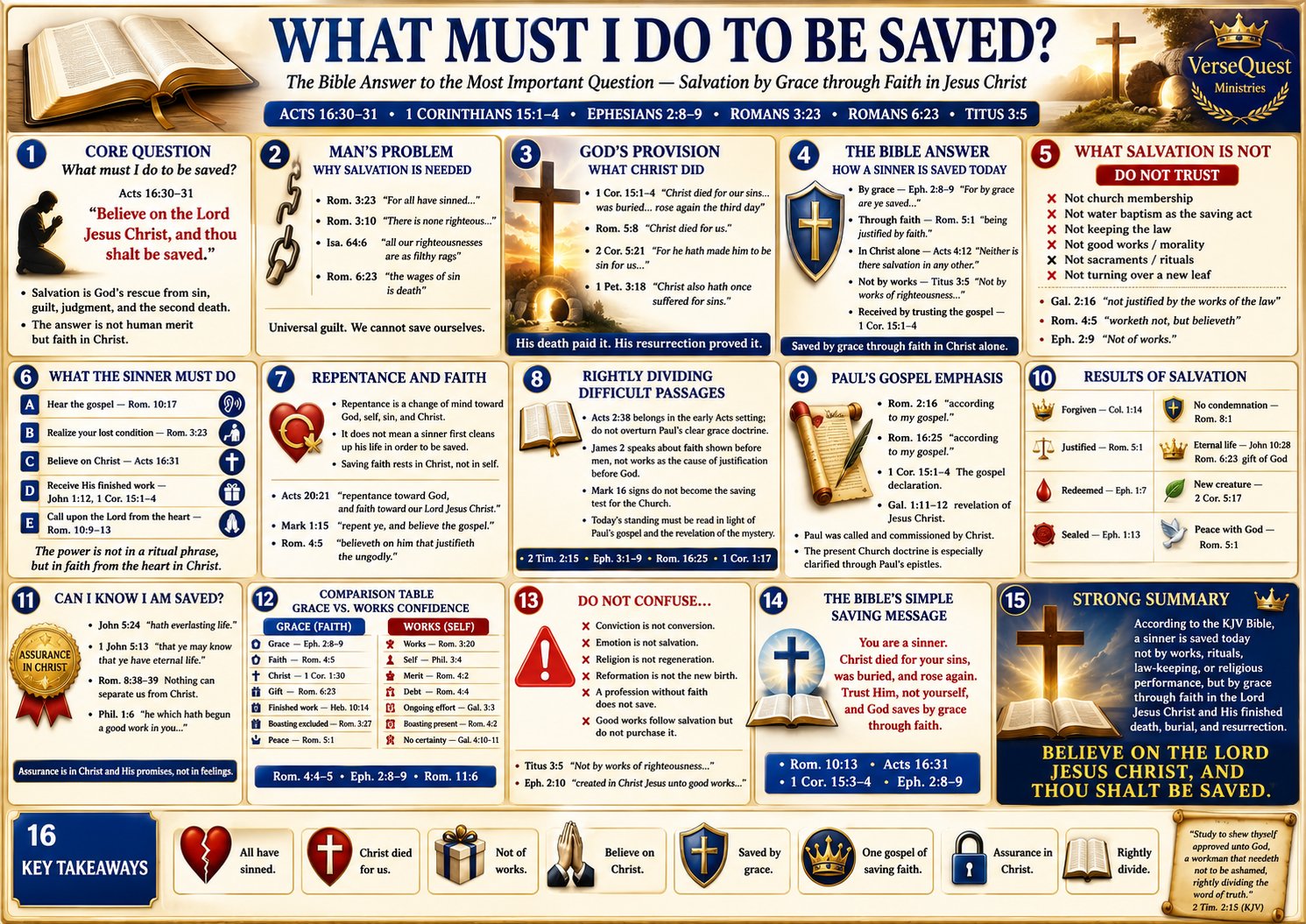
- What Must I Do to Be Saved? – Salvation by Grace Through Faith in Jesus Christ (KJV Bible Study Chart)
- Discover the Bible’s answer to “What must I do to be saved?” with this detailed KJV chart covering sin, Christ’s gospel, grace, faith, repentance, assurance, eternal life, and salvation apart…
- $3.99
- Add to cart
-
-
Biblical Repentance
-
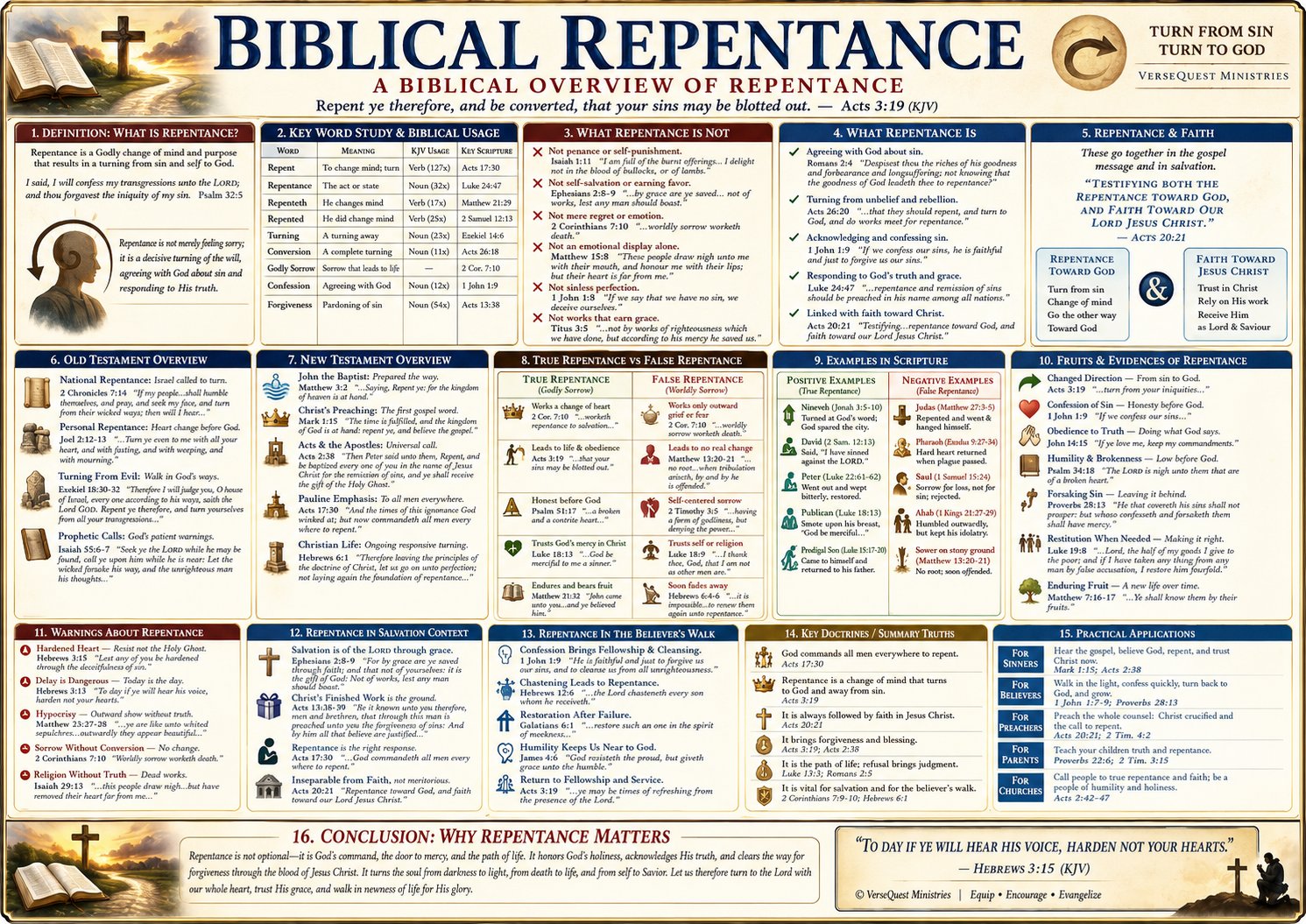
- Biblical Repentance Bible Study Chart – Turning from Sin to God with Faith Toward Jesus Christ (KJV)
- Understand biblical repentance with this detailed KJV chart covering godly sorrow, confession, turning from sin to God, faith in Jesus Christ, false repentance, spiritual restoration, and enduring fruit.
- $3.99
- Add to cart
-
-
No Condemnation
-
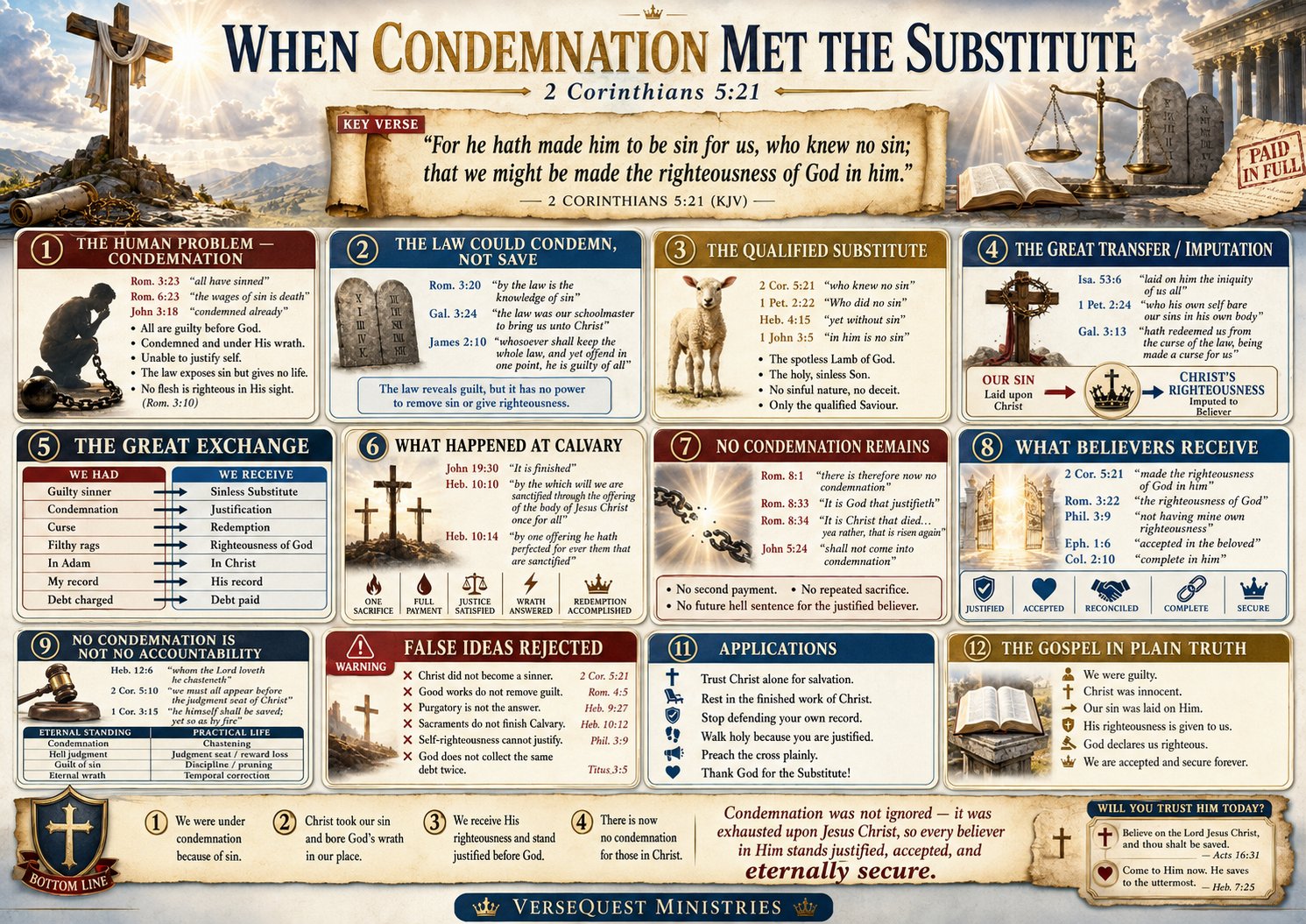
- When Condemnation Met the Substitute – 2 Corinthians 5:21, Imputed Righteousness, and No Condemnation in Christ (KJV Bible Study Chart)
- Understand 2 Corinthians 5:21 with this detailed KJV Bible study chart covering condemnation, Christ the sinless Substitute, imputed righteousness, justification, the great exchange, and eternal security.
- $3.99
- Add to cart
-
-
What Was Completed at Calvary
-
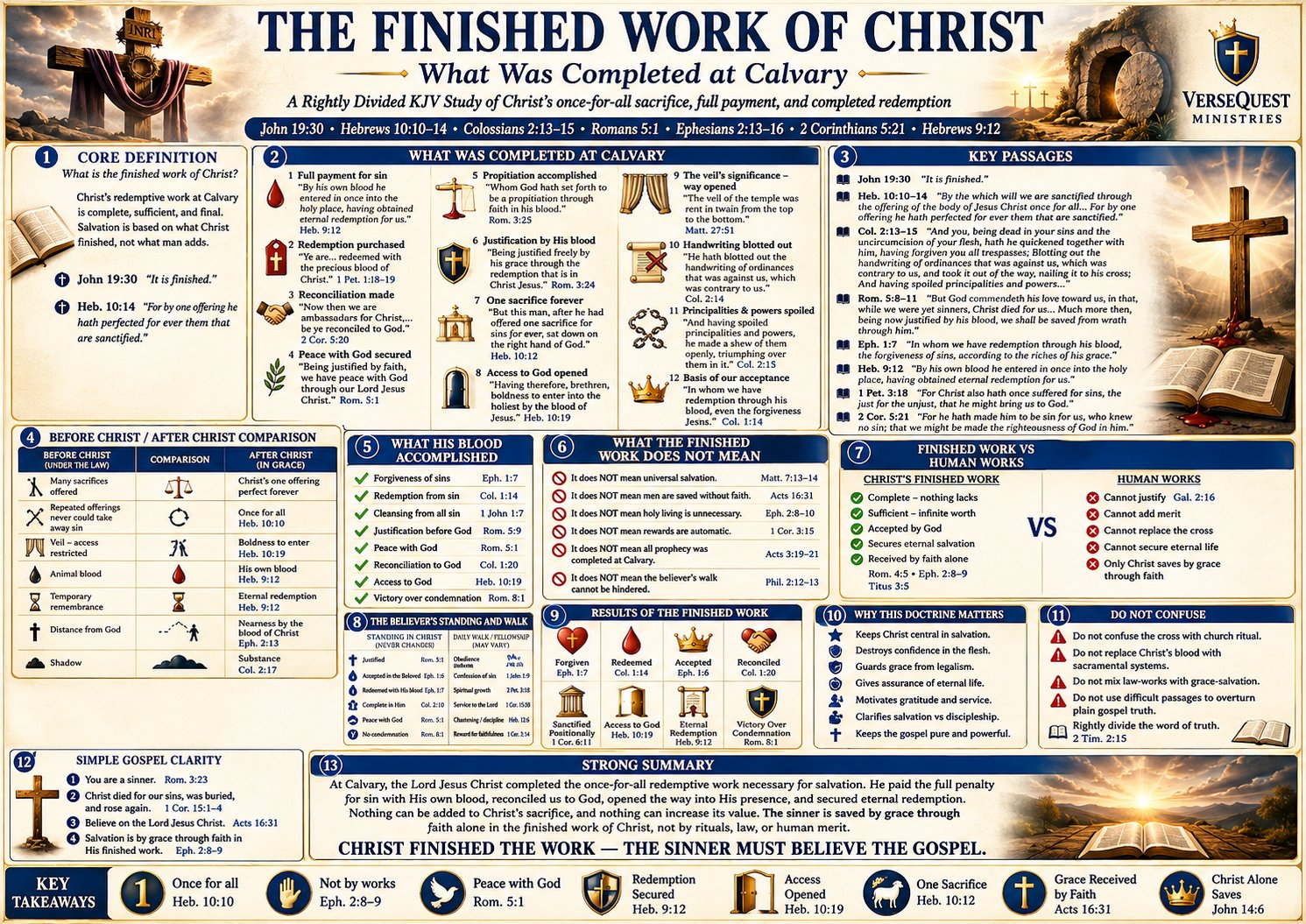
- The Finished Work of Christ – What Was Completed at Calvary Through His Once-for-All Sacrifice (KJV Bible Study Chart)
- Understand the finished work of Christ with this detailed KJV chart covering Calvary’s full payment, redemption, justification, reconciliation, propitiation, access to God, one sacrifice forever, and salvation apart from human…
- $3.99
- Add to cart
-
-
Romans and James
-
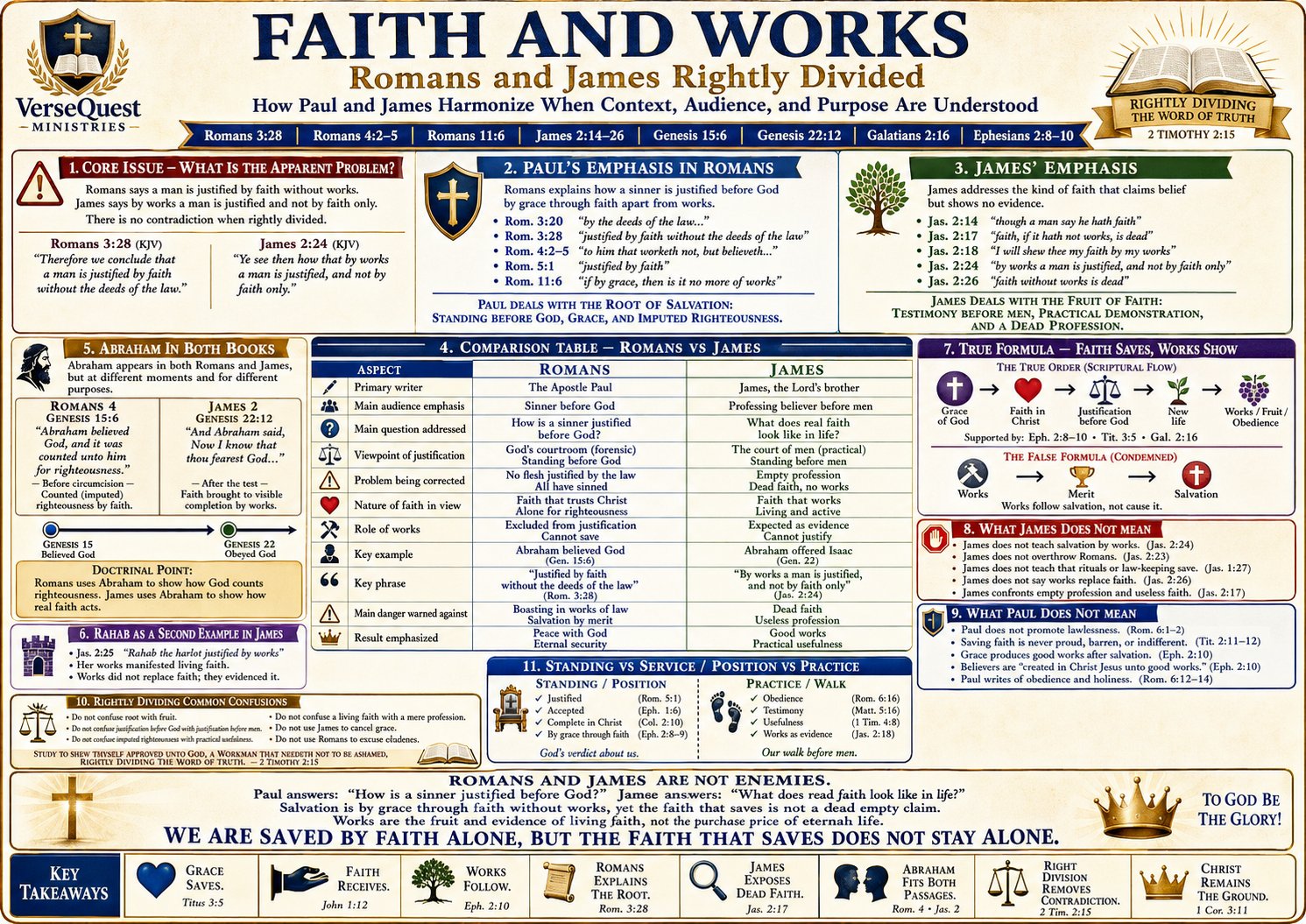
- Faith and Works – Romans and James Rightly Divided: Justification Before God and the Evidence of Living Faith (KJV Bible Study Chart)
- Understand how Romans and James harmonize with this detailed KJV chart covering justification by faith, dead profession, Abraham, Rahab, grace versus works, and the difference between salvation’s root and its…
- $3.99
- Add to cart
-