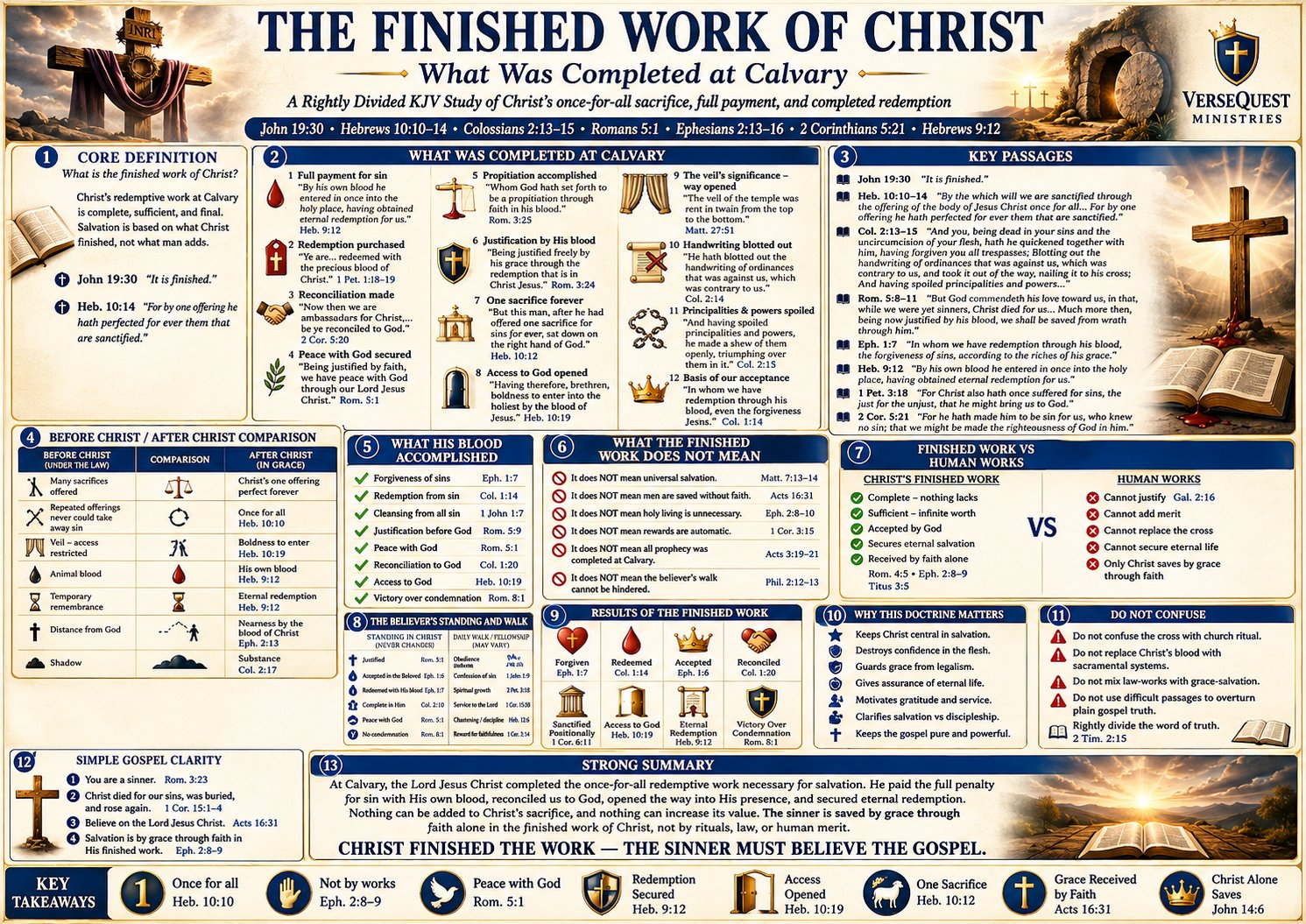
The Finished Work of Christ – What Was Completed at Calvary Through His Once-for-All Sacrifice (KJV Bible Study Chart)
Understand the finished work of Christ with this detailed KJV chart covering Calvary’s full payment, redemption, justification, reconciliation, propitiation, access to God, one sacrifice forever, and salvation apart from human works.
$3.99
Description
The Finished Work of Christ: What Was Completed at Calvary is a detailed KJV Bible study chart explaining the complete, sufficient, and final redemptive work accomplished by the Lord Jesus Christ through His death, shed blood, burial, and resurrection.
Built around John 19:30, Hebrews 10:10–14, Colossians 2:13–15, Romans 5:1, Ephesians 2:13–16, 2 Corinthians 5:21, and Hebrews 9:12, this chart shows why salvation rests entirely upon what Jesus Christ finished rather than upon anything sinners, churches, rituals, religious systems, or human works attempt to add.
When Jesus cried, “It is finished,” He did not announce that His life had merely ended. He declared that the redemptive work assigned by the Father had been completed. The payment for sin was made, the required sacrifice was offered, divine justice was satisfied, and the way of salvation was opened through His blood.
The chart begins by defining the finished work of Christ. It is the completed work of redemption accomplished by Jesus Christ at Calvary and confirmed through His resurrection. It is sufficient because nothing is lacking, final because it needs no repetition, and saving because sinners are reconciled to God through it.
Salvation is therefore based upon what Christ finished rather than what man adds. Human religion continually attempts to place another requirement beside the cross, but the gospel directs the sinner to believe on the Lord Jesus Christ and rest in His completed work.
Hebrews 10:14 declares, “For by one offering he hath perfected for ever them that are sanctified.” Christ did not make salvation partly possible while leaving the sinner responsible for completing the remaining payment. His one offering accomplished what repeated sacrifices could never achieve.
A major section explains what was completed at Calvary. First, the full payment for sin was made. Hebrews 9:12 teaches that Christ entered once into the holy place by His own blood, having obtained eternal redemption.
Sin created a real debt before God. Christ did not merely sympathize with sinners or offer moral inspiration. He paid the penalty through His sacrificial death.
Second, redemption was purchased. Believers are not redeemed by silver, gold, religious effort, or moral reform, but by the precious blood of Jesus Christ.
Redemption means that the sinner has been purchased out of sin’s bondage and brought into God’s ownership. Christ’s blood paid the price completely.
Third, reconciliation was made. Sin had placed mankind in hostility toward God. Through Christ’s death, believing sinners are brought into peace and restored relationship with their Creator.
Second Corinthians 5 presents believers as ambassadors of reconciliation because God was in Christ reconciling the world unto Himself. The message is not that sinners reconcile themselves through works, but that they receive the reconciliation Christ accomplished.
Fourth, peace with God was secured. Romans 5:1 declares, “Therefore being justified by faith, we have peace with God through our Lord Jesus Christ.”
This peace is more than emotional calm. It is the objective removal of the hostility and judgment caused by sin. Christ answered the offense and established peace through the blood of His cross.
Fifth, propitiation was accomplished. Romans 3:25 presents Jesus Christ as the propitiation through faith in His blood.
Propitiation means that God’s righteous judgment against sin was satisfied. Divine wrath was not ignored or dismissed. It was answered at Calvary through the Substitute.
Sixth, justification was secured through Christ’s blood. Romans 5:9 states that believers are justified by His blood and saved from wrath through Him.
Justification is God’s judicial declaration that the believer is righteous in Christ. It rests upon Christ’s sacrifice rather than the sinner’s personal merit.
Seventh, one sacrifice was offered forever. Hebrews 10 contrasts Christ’s completed work with priests who stood daily offering repeated sacrifices that could never take away sins.
Jesus Christ offered one sacrifice for sins forever and sat down at the right hand of God. His seated position testifies that the sacrificial work was finished.
Eighth, access to God was opened. Hebrews 10 teaches that believers may enter the holiest with boldness through the blood of Jesus.
Under the law, access was restricted and approached through earthly priests, sacrifices, ordinances, and appointed ceremonies. Through Christ, believers possess direct access to God.
Ninth, the veil was torn. At Christ’s death, the Temple veil was torn from top to bottom. This was not merely a dramatic physical event but a divine sign that the barrier had been removed through Christ’s sacrifice.
The tearing began from above, showing that God opened the way. Human hands did not climb upward and force entrance into His presence.
Tenth, the handwriting of ordinances was blotted out. Colossians 2 explains that Christ removed the record standing against sinners and nailed it to His cross.
The law exposed guilt, but Christ bore the curse and answered the charge. The believer no longer stands beneath the condemning record as one awaiting judgment.
Eleventh, principalities and powers were spoiled. Through the cross, Christ triumphed openly over spiritual enemies.
What appeared to be Satan’s greatest victory became his decisive defeat. The cross answered sin, broke the legal basis of accusation, and secured Christ’s ultimate triumph.
Twelfth, the basis of the believer’s acceptance was established. Colossians 1:14 states that believers possess redemption through Christ’s blood, even the forgiveness of sins.
The Christian is accepted in Christ rather than through personal performance. The finished work gives the believer a settled standing before God.
The chart also presents key passages explaining the doctrine. John 19:30 records Christ’s declaration, “It is finished.” Hebrews 10 explains the once-for-all sacrifice. Colossians 2 describes forgiveness, the blotted-out handwriting, and victory over principalities.
Romans 5 connects Christ’s blood with justification, salvation from wrath, peace with God, and reconciliation. Ephesians 1 presents redemption and forgiveness through His blood.
Hebrews 9 speaks of eternal redemption through Christ’s own blood. First Peter 3:18 declares that Christ, the Just, suffered for the unjust to bring sinners to God.
Second Corinthians 5:21 presents the great exchange: the sinless Christ was made sin for us so that believers might be made the righteousness of God in Him.
A major comparison contrasts conditions before Christ’s completed sacrifice with the believer’s standing afterward. Under Israel’s law, many sacrifices were offered repeatedly.
After Christ, one sacrifice stands perfect forever. Repeated offerings reminded Israel of sin but could not remove guilt eternally. Christ’s sacrifice obtained eternal redemption.
The veil represented restricted access. Through Jesus Christ, believers have boldness to enter God’s presence.
Animal blood belonged to the temporary sacrificial system. Christ entered by His own blood, which possesses infinite value because of who He is.
The old sacrifices produced temporary remembrance and ceremonial cleansing. Christ’s work provides complete redemption and purges the conscience.
Distance characterized the sinner’s condition. Through Christ’s blood, those who were far off are made nigh.
The law contained shadows. Jesus Christ is the Substance to whom those shadows pointed.
The chart explains what Christ’s blood accomplished: forgiveness, redemption, cleansing, justification, peace, reconciliation, access to God, and victory over condemnation.
These are not religious theories waiting for the believer to complete them. They are saving benefits secured by Christ and received through faith.
The chart also explains what the finished work does not mean. It does not mean universal salvation. Although Christ’s sacrifice is sufficient, salvation is received through faith rather than applied automatically to every person regardless of unbelief.
It does not mean men are saved without believing. Acts 16:31 commands the sinner to believe on the Lord Jesus Christ.
It does not mean holy living is unnecessary. Ephesians 2 places good works after salvation, and Philippians 2 instructs believers to work out what God works within them.
The finished work does not make reward automatic. Christian service will still be examined at the judgment seat of Christ.
It does not mean every prophetic promise has already been fulfilled. Christ completed redemption at Calvary, but God’s prophetic program continues toward future fulfillment.
It does not mean the believer’s daily walk is irrelevant. Salvation is complete, but practical sanctification, obedience, fellowship, service, and growth remain important.
The chart compares Christ’s finished work with human works. Christ’s work is complete, sufficient, accepted by God, and capable of securing eternal salvation.
Human works cannot justify, add merit, replace the cross, secure eternal life, or improve the value of Christ’s sacrifice.
Only Christ saves by grace through faith. The sinner cannot increase the worth of Calvary by adding baptism, rituals, church membership, law-keeping, penance, moral reform, sacraments, or personal suffering.
The chart distinguishes the believer’s standing from his daily walk. Standing in Christ never changes. The believer is justified, accepted in the Beloved, redeemed, complete in Christ, at peace with God, and free from eternal condemnation.
The daily walk may vary. The believer may grow or become stagnant, obey or require correction, maintain fellowship or damage it, serve faithfully or lose opportunities.
Daily failure does not erase Christ’s finished work. However, grace should never be used to excuse disobedience.
The believer’s standing rests upon Christ, while his service affects fellowship, testimony, usefulness, chastening, and reward.
The results of the finished work include forgiveness, redemption, acceptance, reconciliation, sanctified position, access to God, eternal redemption, and victory over condemnation.
Forgiveness means the sinner’s offenses have been pardoned through Christ’s blood. Redemption means the price has been paid.
Acceptance means the believer stands in the Beloved. Reconciliation means hostility has been removed.
Sanctified position means the believer has been set apart in Christ. Access means he may come directly to the Father through Jesus.
Eternal redemption means the saving payment does not expire. Victory over condemnation means the believer’s eternal sentence has been answered completely.
The chart explains why this doctrine matters. It keeps Christ central in salvation, destroys confidence in the flesh, guards grace from legalism, gives assurance of eternal life, motivates gratitude and service, clarifies salvation versus discipleship, and preserves the purity of the gospel.
A believer who understands the finished work stops attempting to impress God with human merit. He rests in Christ and serves from gratitude.
Assurance becomes possible because salvation is grounded in completed redemption rather than unstable human performance.
The doctrine also protects the gospel from sacramental systems. Church ceremonies may possess outward religious significance in their appropriate setting, but none can repeat or complete Calvary.
The cross must not be confused with church ritual. Christ’s blood must not be mixed with sacramental systems. Law works must not be combined with grace salvation.
Difficult passages should not be used to overturn the plain gospel. Second Timothy 2:15 commands believers to rightly divide the Word of Truth.
The simple saving message remains direct. Every person is a sinner. Jesus Christ died for our sins, was buried, and rose again.
The sinner must believe on the Lord Jesus Christ. Salvation is by grace through faith in His finished work.
The gospel does not command the sinner to finish what Jesus began. It commands him to trust what Jesus finished.
The strong summary is clear: at Calvary, the Lord Jesus Christ completed the once-for-all redemptive work necessary for salvation. He paid the full penalty for sin with His own blood, reconciled sinners to God, opened the way into His presence, and secured eternal redemption.
Nothing can be added to His sacrifice, and nothing can increase its value. The sinner is saved by grace through faith alone in the finished work of Jesus Christ.
Christ finished the work—the sinner must believe the gospel.
This resource is ideal for personal Bible study, gospel teaching, salvation counseling, grace-versus-works instruction, blood-atonement studies, justification teaching, eternal-security lessons, new-believer discipleship, Sunday school, homeschool Bible curriculum, Christian schools, Bible institutes, sermon preparation, and evangelism.
Finished work of Christ, what was completed at Calvary, it is finished, once-for-all sacrifice, full payment for sin, redemption through Christ’s blood, reconciliation with God, peace with God, propitiation, justification by faith, one sacrifice forever, access to God, veil torn, handwriting of ordinances blotted out, principalities and powers spoiled, eternal redemption, salvation by grace, Christ versus human works, complete in Christ, gospel of Jesus Christ
The finished work of Christ is the complete redemptive work accomplished through His death, shed blood, burial, and resurrection.
John 19:30 records Christ’s declaration, “It is finished.” The statement announces completion rather than defeat.
Christ paid the full penalty required for sin. The sinner does not complete the payment through religious performance.
His blood obtained eternal redemption. The redemption purchased at Calvary does not expire.
Christ reconciled believing sinners to God by removing the hostility created by sin.
Peace with God is the objective result of justification through Jesus Christ.
Propitiation means divine justice was satisfied through Christ’s sacrifice.
God’s wrath against sin was answered righteously rather than ignored.
The believer is justified through Christ’s blood and received by grace through faith.
Christ offered one sacrifice for sins forever. Repetition is unnecessary because His offering was sufficient.
His seated position at God’s right hand testifies that the sacrificial work was completed.
The veil was torn from top to bottom, showing that God opened access through Christ.
Believers possess bold access into the holiest through the blood of Jesus.
The handwriting of ordinances that stood against the sinner was blotted out and nailed to the cross.
Christ spoiled principalities and powers and triumphed openly through the cross.
The apparent triumph of evil at Calvary became the decisive defeat of Satan’s accusing power.
The believer’s acceptance rests upon redemption and forgiveness through Christ’s blood.
Old Testament sacrifices were repeated because they could not remove sins permanently.
Animal blood belonged to a temporary covenant system and pointed toward Christ.
Jesus fulfilled the sacrificial shadows and became the final Substance.
The finished work does not teach universal salvation. The sinner must believe the gospel.
It does not mean obedience is unnecessary. Christian growth and service follow salvation.
It does not make reward automatic. Believers will give account of their service.
It does not mean every prophecy was completed at Calvary. Redemption is finished while God’s prophetic plan continues.
Human works cannot justify, add merit, replace the cross, or secure eternal life.
Baptism, church membership, sacraments, penance, and law-keeping cannot complete Christ’s sacrifice.
The believer’s standing in Christ is settled, while his daily fellowship and usefulness may vary.
Daily sin may bring chastening, lost joy, damaged testimony, and loss of reward without undoing Christ’s redemption.
The results of the finished work include forgiveness, redemption, justification, reconciliation, peace, access, acceptance, and no condemnation.
The doctrine produces assurance because salvation rests upon Christ’s completed work rather than human performance.
It produces humility because the sinner contributed nothing to redemption.
It produces gratitude and service because the believer has been purchased at an infinite price.
It protects the gospel from legalism, ritualism, and sacramental additions.
Right division prevents passages from other settings from being used to overturn the clear gospel of grace.
The central gospel remains Christ’s death for sins, burial, resurrection, and salvation through faith in Him.
The sinner is not commanded to finish the work. He is commanded to believe the gospel Christ finished.
Finished-work-of-Christ studies, gospel presentation, salvation counseling, justification-by-faith teaching, redemption studies, reconciliation lessons, blood-atonement instruction, grace-versus-works comparisons, eternal-security teaching, assurance of salvation, explaining Hebrews 9–10, teaching Colossians 2, new-believer discipleship, pastoral counseling, Sunday school lessons, homeschool Bible curriculum, Christian school teaching, Bible institute classes, sermon preparation
King James Bible, Strong’s Concordance, Thompson Chain-Reference Bible, Treasury of Scripture Knowledge, Nave’s Topical Bible, Gospel harmony of the crucifixion, John 19 study notes, Romans 3–5 commentary materials, Colossians 2 study resources, Hebrews 7–10 outlines, blood-atonement charts, justification-by-faith worksheets, grace-versus-works studies, salvation-assurance materials, Pauline epistle outlines, VerseQuest salvation and doctrine charts
Related products
-
The Gospel of the Kingdom
-
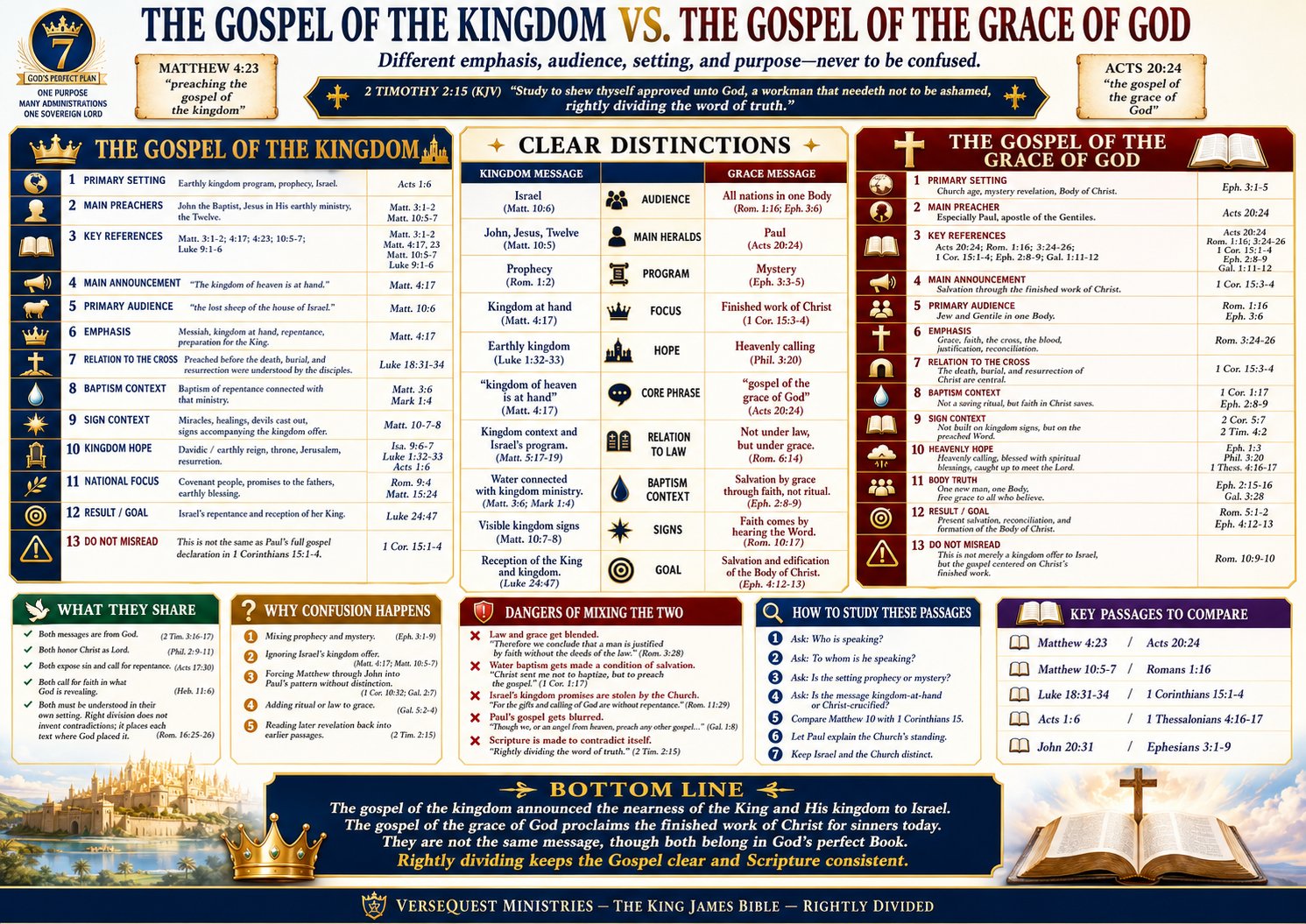
- The Gospel of the Kingdom vs. the Gospel of the Grace of God – KJV Right Division Bible Study Chart
- Compare the gospel of the kingdom and the gospel of the grace of God with this detailed KJV chart covering audience, message, prophecy, mystery, baptism, signs, salvation, and right division.
- $3.99
- Add to cart
-
-
Baptismal Regeneration
-
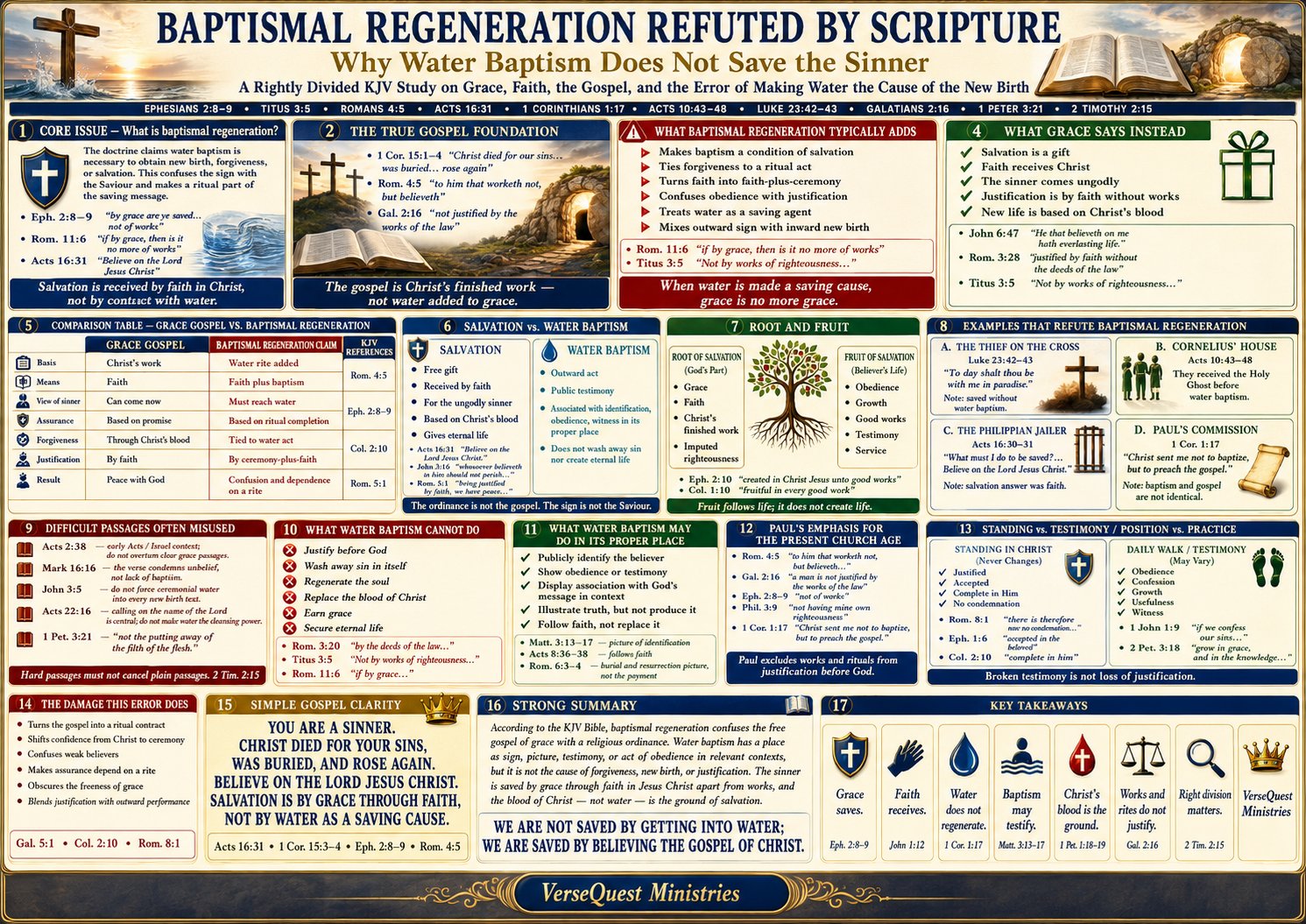
- Baptismal Regeneration Refuted by Scripture – Why Water Baptism Does Not Save the Sinner (KJV Bible Study Chart)
- See why water baptism does not save with this detailed KJV chart covering the gospel of grace, faith versus ritual, the thief on the cross, Cornelius, Paul’s commission, difficult baptism…
- $3.99
- Add to cart
-
-
No Condemnation
-
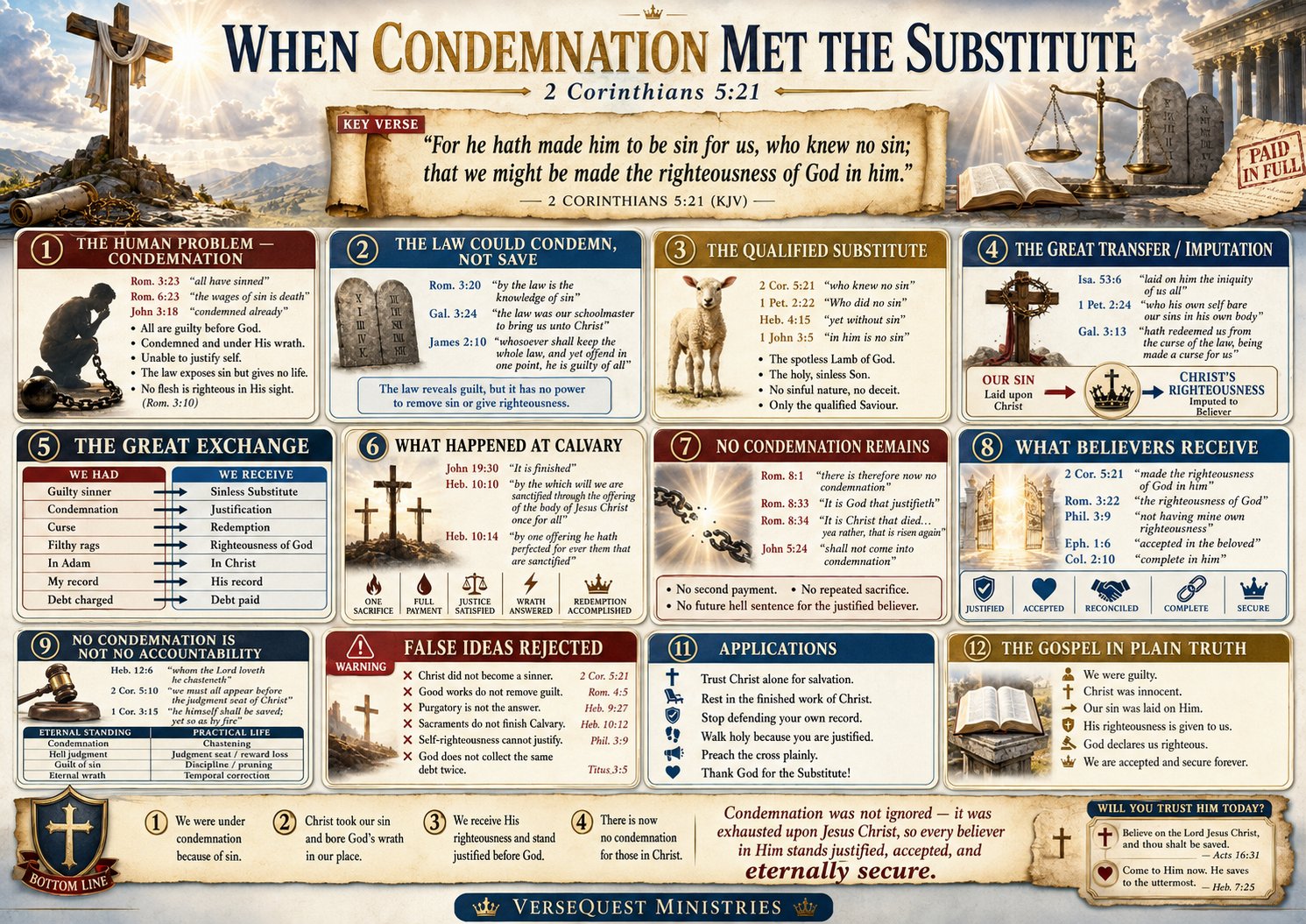
- When Condemnation Met the Substitute – 2 Corinthians 5:21, Imputed Righteousness, and No Condemnation in Christ (KJV Bible Study Chart)
- Understand 2 Corinthians 5:21 with this detailed KJV Bible study chart covering condemnation, Christ the sinless Substitute, imputed righteousness, justification, the great exchange, and eternal security.
- $3.99
- Add to cart
-
-
Wealth of Rome
-
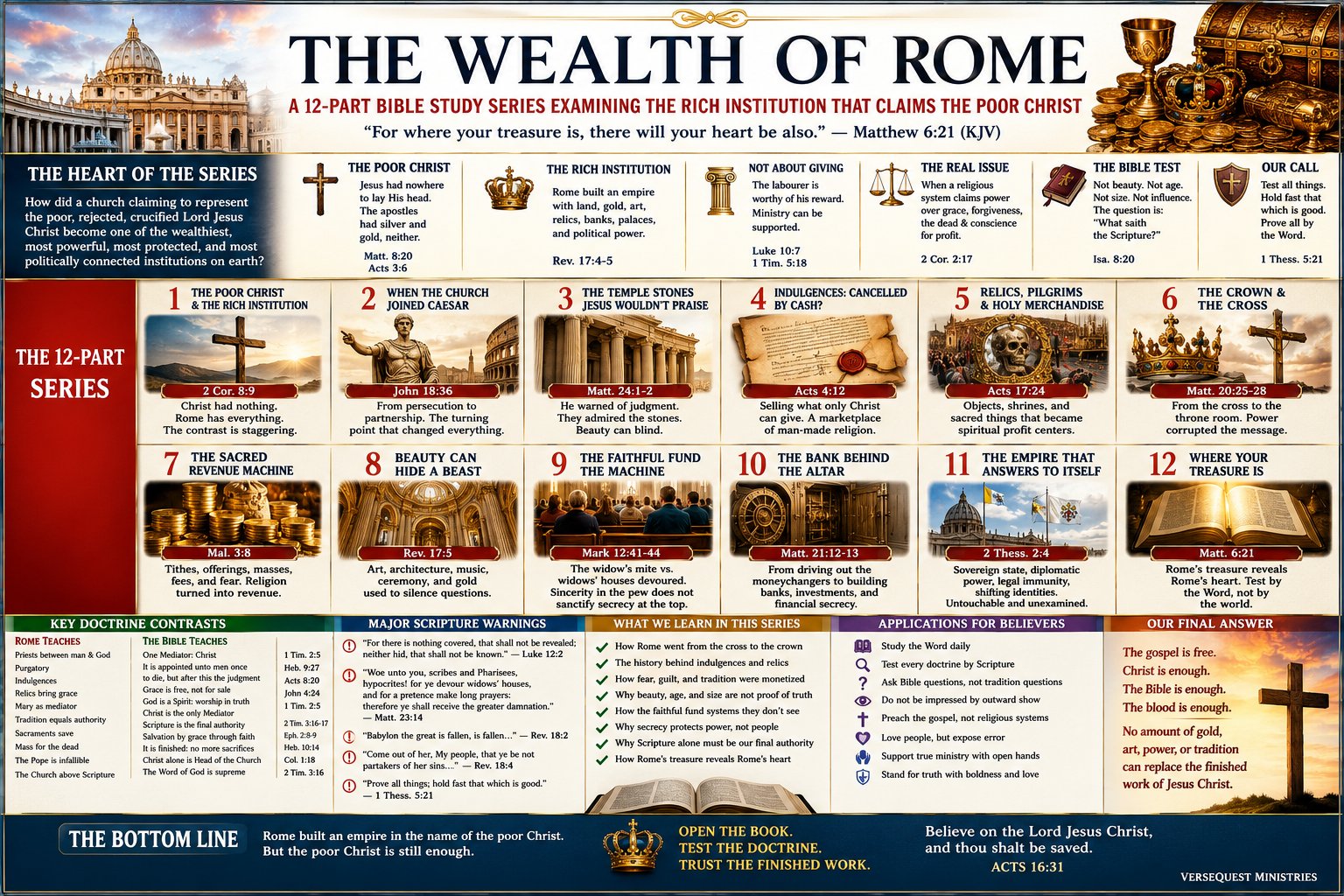
- The Wealth of Rome Bible Study Chart – A 12-Part KJV Examination of Wealth, Power, Doctrine, and Religious Commerce
- Examine the wealth, power, doctrines, indulgences, relics, revenue systems, and political influence of Rome with this detailed twelve-part KJV Bible study chart.
- $3.99
- Add to cart
-
-
Doctrine Series