What Must I Do to Be Saved? – Salvation by Grace Through Faith in Jesus Christ (KJV Bible Study Chart)
Discover the Bible’s answer to “What must I do to be saved?” with this detailed KJV chart covering sin, Christ’s gospel, grace, faith, repentance, assurance, eternal life, and salvation apart from works.
$3.99
Description
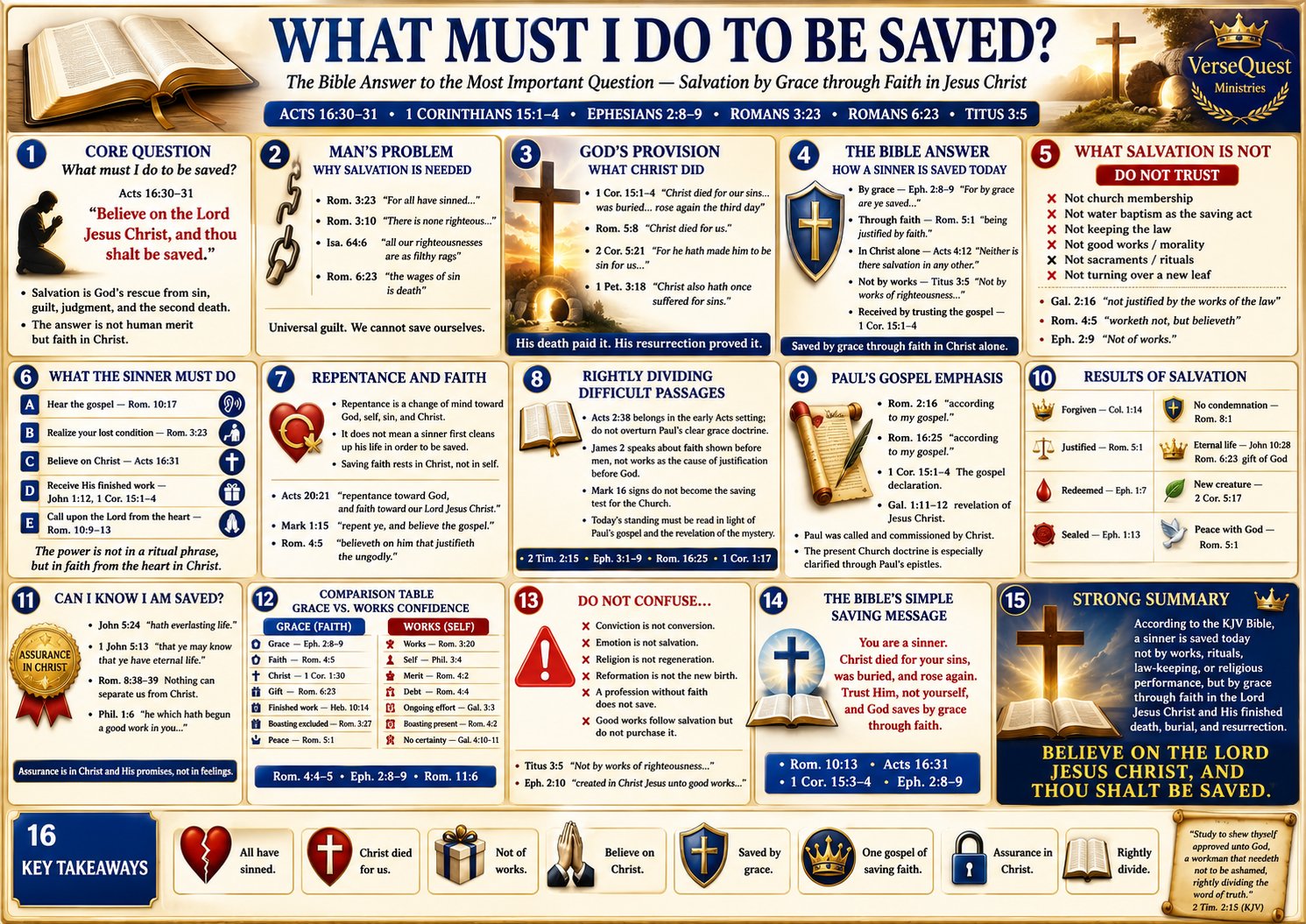
What Must I Do to Be Saved? is a detailed KJV Bible study chart presenting the Bible’s clear answer to the most important question any person can ask. Built around Acts 16:30–31, 1 Corinthians 15:1–4, Ephesians 2:8–9, Romans 3:23, Romans 6:23, and Titus 3:5, this chart explains mankind’s guilt, Christ’s finished work, salvation by grace through faith, the relationship between repentance and belief, assurance of salvation, and the difference between saving faith and religious works.
When the Philippian jailer asked, “Sirs, what must I do to be saved?”, Paul and Silas did not give him a list of ceremonies, laws, sacraments, payments, moral achievements, or religious qualifications. They answered plainly: “Believe on the Lord Jesus Christ, and thou shalt be saved.”
Salvation is God’s rescue from sin, guilt, condemnation, judgment, and the second death. It is not mankind improving itself until God becomes impressed. It is God providing a complete Saviour for guilty people who cannot rescue themselves.
The chart begins with humanity’s universal problem. Romans 3:23 declares that all have sinned and come short of the glory of God. There is none righteous by human nature or personal performance. Isaiah compares mankind’s attempted righteousness to filthy rags, while Romans 6:23 identifies death as the earned wages of sin.
Sin is not merely a mistake, weakness, bad habit, social disadvantage, or lack of education. It is rebellion against God’s holiness and violation of His revealed truth. Every sinner stands guilty before the righteous Judge and lacks the power to erase his own record.
Human beings cannot save themselves through morality, church attendance, religious heritage, generosity, reform, education, sincerity, baptism, law-keeping, or personal sacrifice. These things may affect earthly conduct, but they cannot remove guilt, conquer death, satisfy divine justice, or produce the perfect righteousness required by God.
The chart then presents God’s provision through Jesus Christ. First Corinthians 15:1–4 declares the gospel: Christ died for our sins according to the Scriptures, was buried, and rose again the third day. Salvation rests upon a completed historical work performed by Jesus Christ, not upon an unfinished religious process performed by the sinner.
Jesus Christ was qualified to save because He was the sinless Son of God. He did no sin, knew no sin, and had no sin in Him. He voluntarily took the sinner’s place, bore the judgment sin deserved, shed His blood, died, was buried, and rose bodily from the dead.
Romans 5:8 declares that Christ died for us while we were yet sinners. Second Corinthians 5:21 explains that the sinless Christ was made sin for us so that believers might be made the righteousness of God in Him. First Peter 3:18 teaches that the Just suffered for the unjust to bring sinners to God.
The resurrection proves that Christ’s sacrifice was accepted, death was defeated, and redemption was accomplished. The gospel does not end with a dead religious teacher. Jesus Christ rose again and possesses the power to give eternal life to everyone who believes.
The Bible’s answer to salvation is therefore grace through faith in Christ alone. Ephesians 2:8–9 declares that salvation is God’s gift, not the product of human works. Romans 5:1 states that believers are justified by faith, and Titus 3:5 excludes works of personal righteousness as the basis of salvation.
Grace means God provides salvation freely because Christ paid the full price. Faith means the sinner stops trusting himself, his religion, his morality, and his personal record and rests entirely upon the Lord Jesus Christ and His finished work.
Saving faith is not mere knowledge that Jesus existed. It is not simply admiration for His teachings or intellectual agreement that Christianity is useful. Saving faith personally relies upon Christ as the crucified and risen Saviour.
The chart explains what the sinner must do. First, he must hear the gospel, because faith comes by hearing the Word of God. Second, he must recognize his lost condition and abandon the illusion that he can justify himself.
Third, he must believe on Jesus Christ. Fourth, he must receive the finished work rather than attempting to add his own works to it. Fifth, he may call upon the Lord from a believing heart, openly confessing his dependence upon the Saviour.
The power is not contained in a ritual phrase, repeated prayer, emotional moment, raised hand, aisle walk, or perfectly worded confession. The power is in Jesus Christ and His gospel. A prayer may express faith, but words spoken without genuine reliance upon Christ do not save.
The chart also explains the relationship between repentance and faith. Repentance is a change of mind toward God, sin, self, and Jesus Christ. It does not mean that the sinner must first cleanse his entire life, conquer every habit, or attain moral fitness before he may come to the Saviour.
Repentance turns from rebellion, unbelief, and self-righteous confidence toward God’s truth. Faith rests upon Jesus Christ rather than upon self. Acts 20:21 joins “repentance toward God” with “faith toward our Lord Jesus Christ.”
Repentance and faith are therefore not competing methods of salvation. The sinner changes his mind about the false objects of his confidence and believes the gospel of Jesus Christ. He stops defending his righteousness and receives the righteousness God provides.
The chart carefully distinguishes saving faith from works. Romans 4 describes the person who does not attempt to earn justification but believes on the God who justifies the ungodly. Faith receives what grace provides; works attempt to earn what God offers as a gift.
A comparison between grace and works shows their fundamental difference. Grace depends upon God’s favour, Christ’s work, and the completed payment of redemption. Works depend upon self, personal merit, human effort, and continuing performance.
Grace excludes boasting because the saved sinner contributed nothing to the price of redemption. The believer may boast only in the Lord Jesus Christ, whose death and resurrection secured salvation completely.
The chart identifies several things salvation is not. Church membership cannot save. Water baptism is not the saving act. Keeping the Mosaic law cannot justify. Morality and good works cannot remove guilt. Sacraments and rituals cannot add to Calvary. Turning over a new leaf cannot create the new birth.
Religious activity may produce an outwardly respectable life while leaving the sinner spiritually dead. Nicodemus was moral, religious, educated, respected, and zealous, yet Jesus told him, “Ye must be born again.”
Water baptism should not be trusted as the instrument of regeneration. Baptism may serve as an outward testimony in its proper biblical setting, but water cannot wash away the guilt of the soul, impart Christ’s righteousness, or complete the cross.
Paul explicitly declared that Christ sent him not to baptize but to preach the gospel. If water baptism were the saving power of his message, Paul could not separate it from his primary gospel commission.
The law of Moses cannot save because the law reveals sin rather than curing it. It stops every mouth, establishes guilt, and shows mankind’s need for Christ. A sinner seeking justification through law must keep the entire law perfectly, a standard no fallen person can meet.
Good works cannot purchase salvation because even humanity’s best efforts cannot erase the sins already committed. Works may follow salvation as the fruit of God’s transforming grace, but they can never become its cause.
Sacraments, rituals, priestly systems, church institutions, pilgrimages, religious payments, and ceremonies cannot replace the one Mediator and His finished sacrifice. Jesus Christ does not need an institution to complete what He declared finished.
The chart emphasizes the need to rightly divide difficult salvation passages. Scripture must be interpreted according to audience, setting, program, and progressive revelation rather than forcing every verse into one undifferentiated formula.
Acts 2:38 belongs within the early Acts setting involving Israel, Pentecost, national responsibility concerning the rejected Messiah, and the continuing Kingdom context. It should not be isolated from its audience and used to overthrow Paul’s clear doctrine of salvation by grace through faith.
James 2 addresses the demonstration of faith before men through visible works. It does not teach that sinners are judicially justified before God by adding works to Christ. Romans explains justification before God; James addresses faith shown through conduct.
Mark 16 belongs within Israel’s Kingdom and apostolic-sign setting. Its signs should not be turned into the standing salvation test for the Body of Christ.
Present Church doctrine must be read in the light of the mystery revealed through Paul. Second Timothy 2:15 commands believers to rightly divide the Word of Truth, while Ephesians 3 and Romans 16 explain the revelation of the mystery and Paul’s distinct stewardship.
The chart gives special attention to Paul’s gospel emphasis. Paul repeatedly refers to “my gospel,” not because he invented a new Saviour but because Jesus Christ entrusted him with a distinct revelation, apostleship, and stewardship for the present dispensation.
First Corinthians 15:1–4 provides Paul’s direct gospel declaration. Christ died for our sins, was buried, and rose again. This finished work, received by faith, stands at the centre of the message committed to the apostle of the Gentiles.
Galatians 1 records that Paul received his message by the revelation of Jesus Christ rather than learning it from men. Romans 16 connects his preaching with the revelation of the mystery that had been kept secret since the world began.
Paul’s epistles, particularly Romans through Philemon, provide the primary doctrinal explanation of the Church-age believer’s salvation, standing, sanctification, service, assurance, and future hope.
The results of salvation are immediate and complete. The believer is forgiven, justified, redeemed, reconciled to God, delivered from condemnation, given eternal life, made a new creature, sealed by the Holy Spirit, and brought into peace with God.
Forgiveness means the sinner’s offenses are pardoned through Christ’s blood. Justification means God declares the believer righteous on the basis of Christ’s righteousness rather than personal merit.
Redemption means Christ paid the price required to deliver the sinner from bondage. Reconciliation means the former enemy is brought into peace with God. Regeneration means the spiritually dead sinner receives new life.
The saved person becomes a new creature in Christ. He is also sealed with the Holy Spirit unto the day of redemption. Salvation is not a temporary probation in which eternal life must be continually re-earned.
Romans 8:1 declares that there is no condemnation to those in Christ. John 10 teaches that Christ’s sheep possess eternal life and will never perish. The gift of God is eternal life, not temporary life lasting only until the believer’s next failure.
The chart answers the question, “Can I know I am saved?” First John 5:13 says Scripture was written so believers may know they have eternal life. Assurance rests upon God’s written promises, Christ’s completed work, and the believer’s position in Him—not upon fluctuating feelings.
John 5:24 teaches that the believer has everlasting life, will not come into condemnation, and has passed from death unto life. Philippians 1:6 promises that God will complete the work He began.
Romans 8 declares that nothing can separate the believer from the love of God in Christ Jesus. Assurance is not pride in personal performance; it is confidence in the Saviour’s faithfulness.
The chart warns against several dangerous confusions. Conviction is not the same as conversion. A person may feel guilty without trusting Christ. Emotion is not salvation. Tears, fear, relief, or excitement may accompany belief but do not replace it.
Religion is not regeneration. Outward membership and ceremony cannot produce inward life. Reformation is not the new birth. A person may abandon certain habits while remaining spiritually lost.
A profession without faith does not save. Merely repeating Christian words while continuing to trust personal goodness, baptism, church membership, or religious works is not biblical faith.
Good works should follow salvation, but they do not purchase it. Ephesians 2:10 follows Ephesians 2:8–9. Believers are created in Christ unto good works after being saved by grace, not saved because their works made them worthy.
The chart’s simple saving message is direct: You are a sinner. Jesus Christ died for your sins, was buried, and rose again. Trust Him rather than yourself. God saves by grace through faith.
The Bible does not tell the sinner to join a church, clean himself up, earn divine favour, endure a probationary period, receive a sacrament, or keep the law before he may be saved. It tells him to believe on the Lord Jesus Christ.
This does not make sin unimportant or excuse a careless Christian life. The grace that saves also teaches holiness. Good works, obedience, growth, testimony, and service matter deeply, but they must remain the fruit of salvation rather than its foundation.
A saved person should grow in Scripture, prayer, fellowship, holiness, charity, and service. He should obey Christ because he has been accepted, not attempt to earn acceptance through obedience.
The strong conclusion is clear: according to the King James Bible, a sinner is saved today not by works, rituals, law-keeping, baptism, church membership, or religious performance, but by grace through faith in the Lord Jesus Christ and His finished death, burial, and resurrection.
The most important command remains the simplest: “Believe on the Lord Jesus Christ, and thou shalt be saved.”
This resource is ideal for gospel presentation, personal evangelism, salvation counseling, new-believer discipleship, church outreach, street ministry, prison ministry, Sunday school, homeschool Bible curriculum, Bible institutes, sermon preparation, altar counseling, and anyone asking how to receive eternal life.
What must I do to be saved, salvation by grace through faith, believe on the Lord Jesus Christ, gospel of Jesus Christ, death burial and resurrection, mankind’s sin and guilt, Christ’s substitutionary death, finished work of Christ, repentance and faith, justification by faith, salvation apart from works, eternal life, assurance of salvation, no condemnation in Christ, redemption, reconciliation, new birth, sealing of the Holy Spirit, rightly dividing salvation passages, Paul’s gospel
The question “What must I do to be saved?” demands a biblical answer rather than a denominational, emotional, or traditional response.
Acts 16:31 gives the direct answer: “Believe on the Lord Jesus Christ, and thou shalt be saved.” The object of saving faith is Jesus Christ, not faith itself, a prayer, a ceremony, or a religious institution.
Every person needs salvation because all have sinned. The problem is universal guilt before a holy God, not merely low self-esteem, social failure, or lack of personal fulfillment.
Sin earns death. Eternal life cannot therefore be earned through the same human nature already guilty before God.
Jesus Christ is the only qualified Saviour because He is the sinless Son of God. He bore the sinner’s guilt without possessing guilt of His own.
The gospel is Christ’s death for sins, burial, and bodily resurrection. These historical events form the saving message proclaimed in 1 Corinthians 15.
Christ’s death paid the debt. His burial confirmed His death, and His resurrection demonstrated victory over sin, death, and the grave.
Grace means salvation is provided freely because Christ paid completely. Grace and human merit cannot share the foundation.
Faith receives Christ and His finished work. Saving faith abandons confidence in self, religion, morality, law, ceremonies, and personal achievement.
The amount of faith is not the Saviour. Weak faith resting upon a strong Christ is better than strong confidence resting upon human works.
Repentance is a change of mind toward God, sin, self, and Christ. It does not mean achieving sinless reform before receiving salvation.
Repentance and faith operate together. The sinner turns from false confidence and unbelief toward God and rests upon Jesus Christ.
Calling upon the Lord expresses believing dependence. Vocalizing a formula without trusting Christ does not create salvation.
The sinner should receive the finished work. He is not invited to assist Christ, complete Calvary, or add religious performance to the cross.
Church membership cannot save because an earthly membership roll cannot create spiritual life or remove guilt.
Water baptism cannot save because physical water cannot impart Christ’s righteousness or complete His sacrifice.
The Mosaic law cannot justify because it reveals sin and condemns the lawbreaker. It was never the cure for fallen human nature.
Good works cannot erase previous guilt. Works belong after salvation as evidence and service, not before salvation as payment.
Sacraments and rituals cannot make Christ’s sacrifice more complete. Hebrews declares that He offered one sacrifice for sins forever.
Reformation may improve behaviour but cannot create regeneration. A changed habit is not identical to a new birth.
Conviction is the Holy Spirit exposing sin. Conversion occurs when the sinner responds to the gospel through faith in Christ.
Emotion may accompany salvation but is not its foundation. Feelings change; God’s promise remains settled.
Paul’s gospel must receive central attention in present Church doctrine. His epistles explain salvation, justification, assurance, sanctification, and the believer’s standing in Christ.
Acts contains transitional settings that must be interpreted carefully. Narrative passages should not be used to overturn the clear doctrinal teaching of the epistles.
James 2 discusses faith demonstrated before men through works. Romans explains the ungodly sinner justified before God through faith apart from works.
Mark 16 belongs within an apostolic sign setting and should not become the present test of saving faith.
The believer receives forgiveness, justification, redemption, reconciliation, eternal life, the new birth, the Holy Spirit’s seal, and peace with God.
Eternal life is a present possession. John 5:24 says the believer “hath everlasting life.”
No condemnation means Christ exhausted the believer’s eternal sentence. God does not demand a second payment after accepting Christ’s sacrifice.
Assurance rests upon Scripture. First John 5:13 says believers may know they possess eternal life.
Nothing can separate the believer from God’s love in Christ. Security rests upon Christ’s work and God’s promise rather than flawless Christian performance.
Good works follow salvation. The saved believer should grow, obey, serve, and live godly, but those works never become the cause of his justification.
The gospel’s simplicity should not be weakened by religious additions. Christ is sufficient, grace is free, and faith receives the gift.
Gospel presentations, personal evangelism, salvation counseling, altar-worker training, new-believer instruction, teaching salvation by grace, explaining repentance and faith, assurance-of-salvation studies, refuting works-based salvation, baptismal-regeneration discussions, law-and-grace teaching, street ministry, prison ministry, church outreach, Sunday school lessons, homeschool Bible curriculum, Christian school teaching, Bible institute classes, pastoral training, sermon preparation
King James Bible, Strong’s Concordance, Thompson Chain-Reference Bible, Treasury of Scripture Knowledge, Nave’s Topical Bible, Romans Road salvation outline, 1 Corinthians 15 gospel study, Ephesians 2 grace worksheet, personal evangelism cards, gospel tracts, assurance-of-salvation study notes, justification-by-faith resources, law-and-grace comparison charts, baptism comparison studies, Pauline epistle outlines, VerseQuest salvation and doctrine charts
Related products
-
Baptismal Regeneration
-
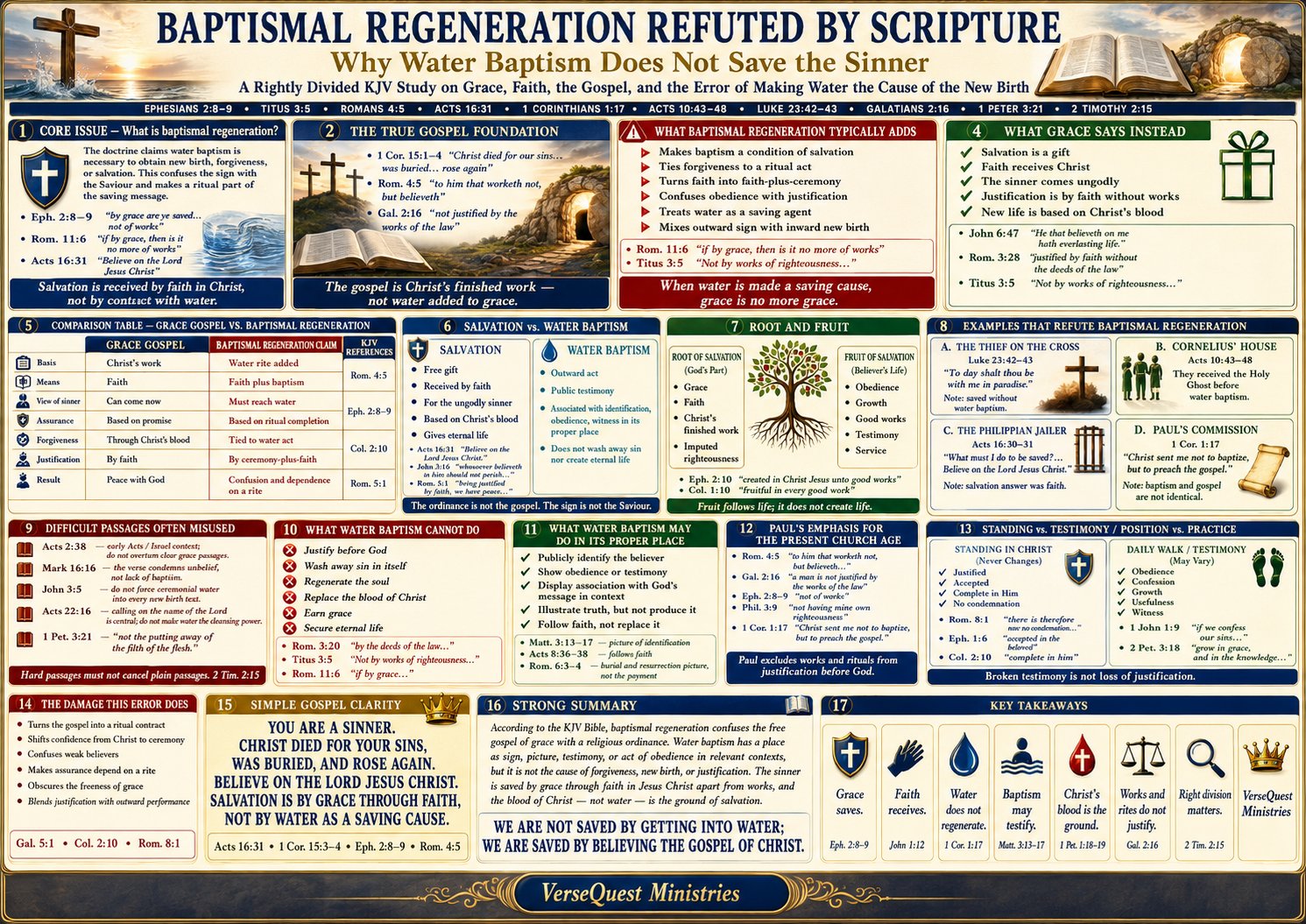
- Baptismal Regeneration Refuted by Scripture – Why Water Baptism Does Not Save the Sinner (KJV Bible Study Chart)
- See why water baptism does not save with this detailed KJV chart covering the gospel of grace, faith versus ritual, the thief on the cross, Cornelius, Paul’s commission, difficult baptism…
- $3.99
- Add to cart
-
-
Biblical Repentance
-
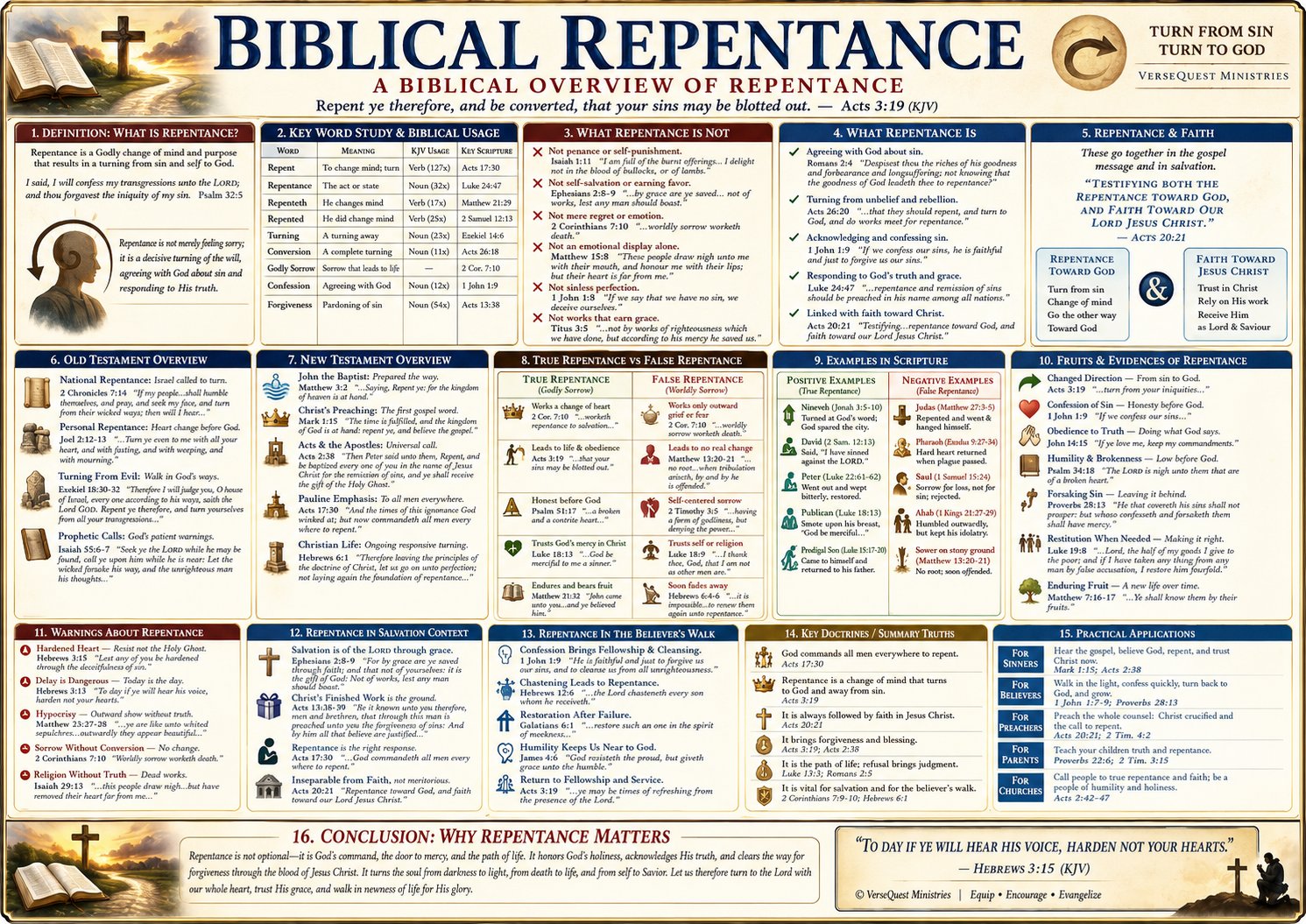
- Biblical Repentance Bible Study Chart – Turning from Sin to God with Faith Toward Jesus Christ (KJV)
- Understand biblical repentance with this detailed KJV chart covering godly sorrow, confession, turning from sin to God, faith in Jesus Christ, false repentance, spiritual restoration, and enduring fruit.
- $3.99
- Add to cart
-
-
Lordship Salvation Exposed
-
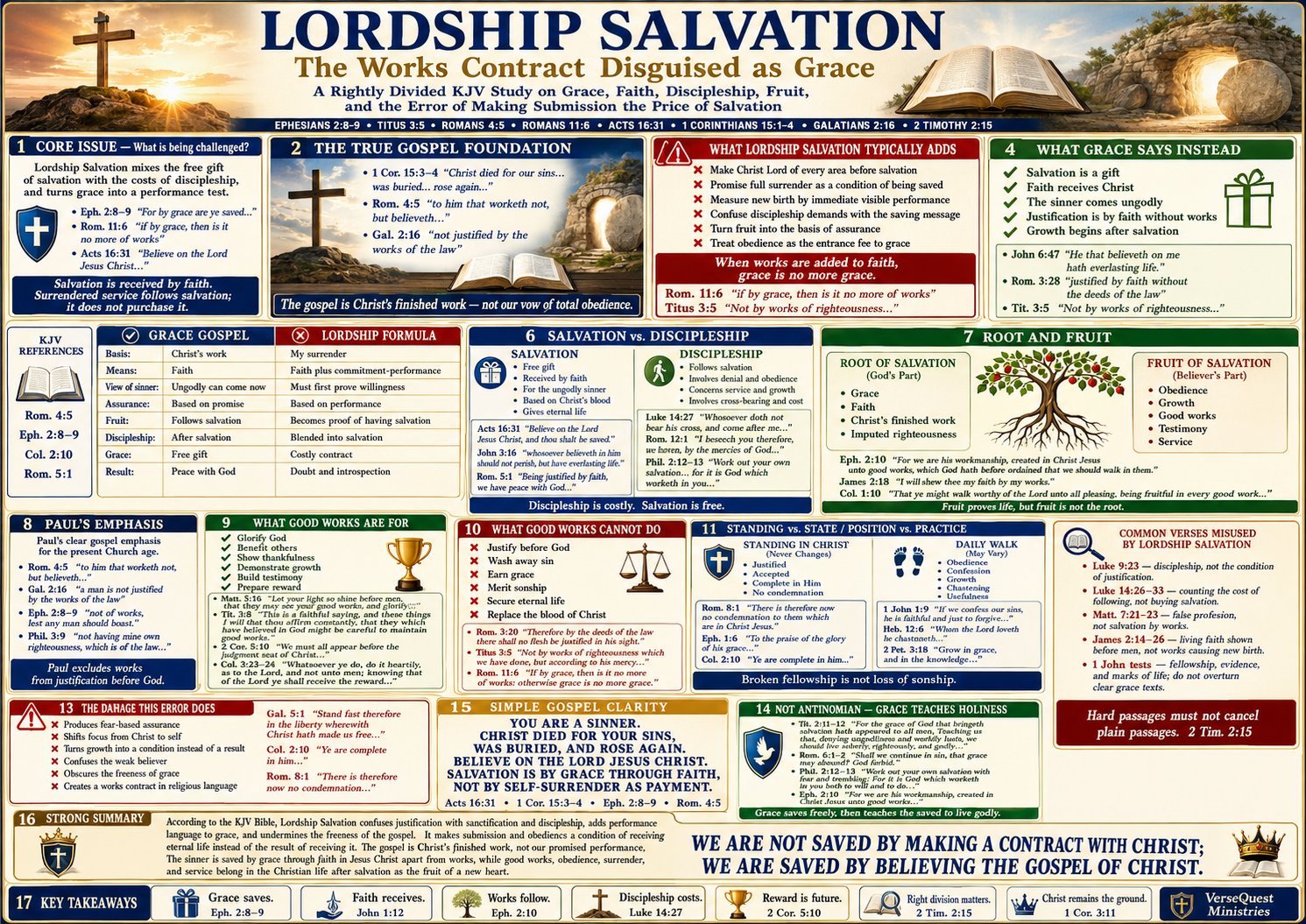
- Lordship Salvation Exposed – The Works Contract Disguised as Grace and the Difference Between Salvation and Discipleship (KJV Bible Study Chart)
- Examine Lordship Salvation with this detailed KJV chart distinguishing the free gift of salvation from costly discipleship, justification from sanctification, and the root of grace from the fruit of Christian…
- $3.99
- Add to cart
-
-
Doctrine Series
-
Another Jesus
-
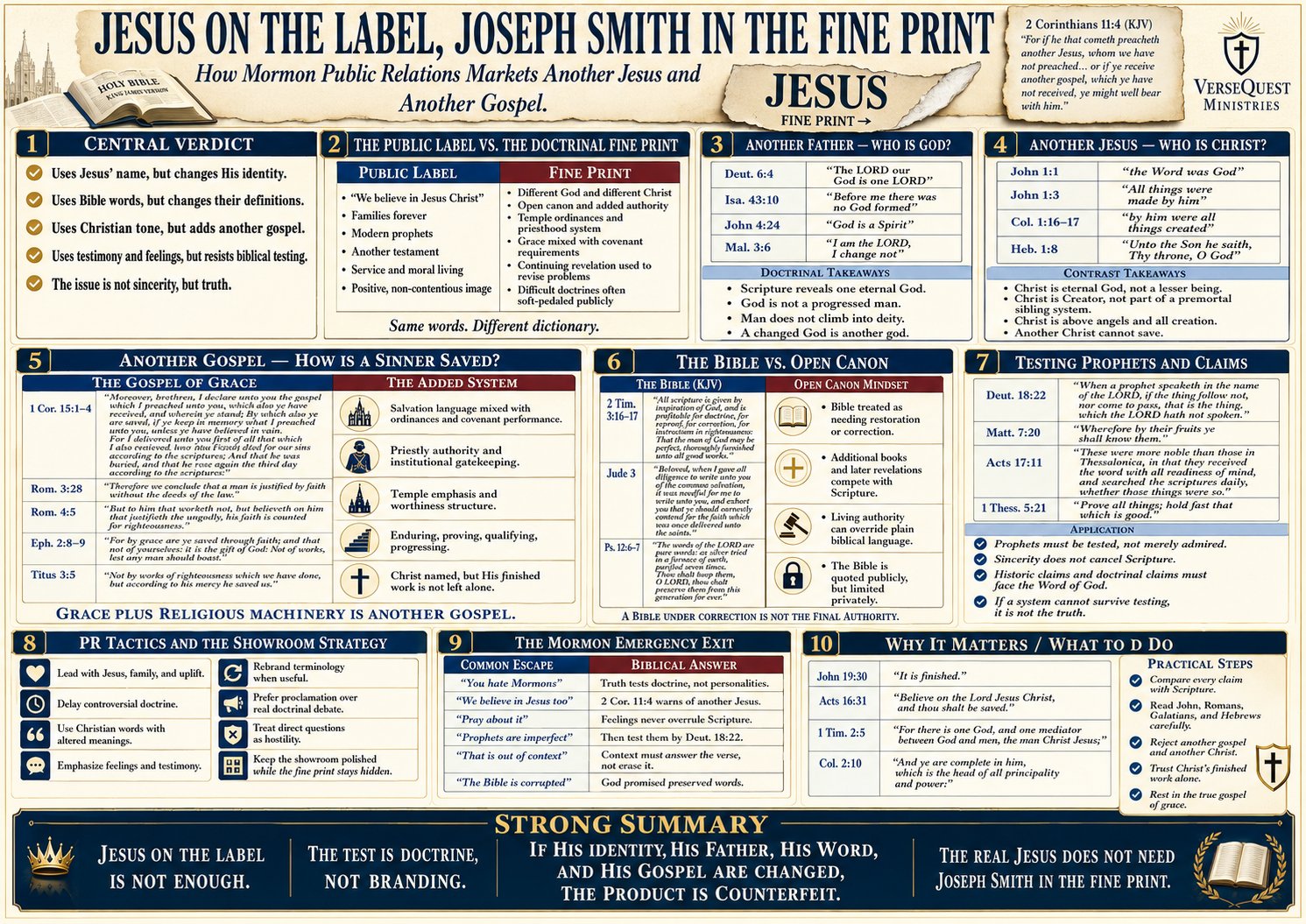
- Jesus on the Label, Joseph Smith in the Fine Print – Mormonism, Another Jesus, and Another Gospel KJV Bible Study Chart
- Compare Mormonism with the King James Bible through this detailed chart covering another Jesus, another gospel, Joseph Smith, modern prophets, open canon, temple ordinances, and salvation by grace.
- $3.99
- Add to cart
-