
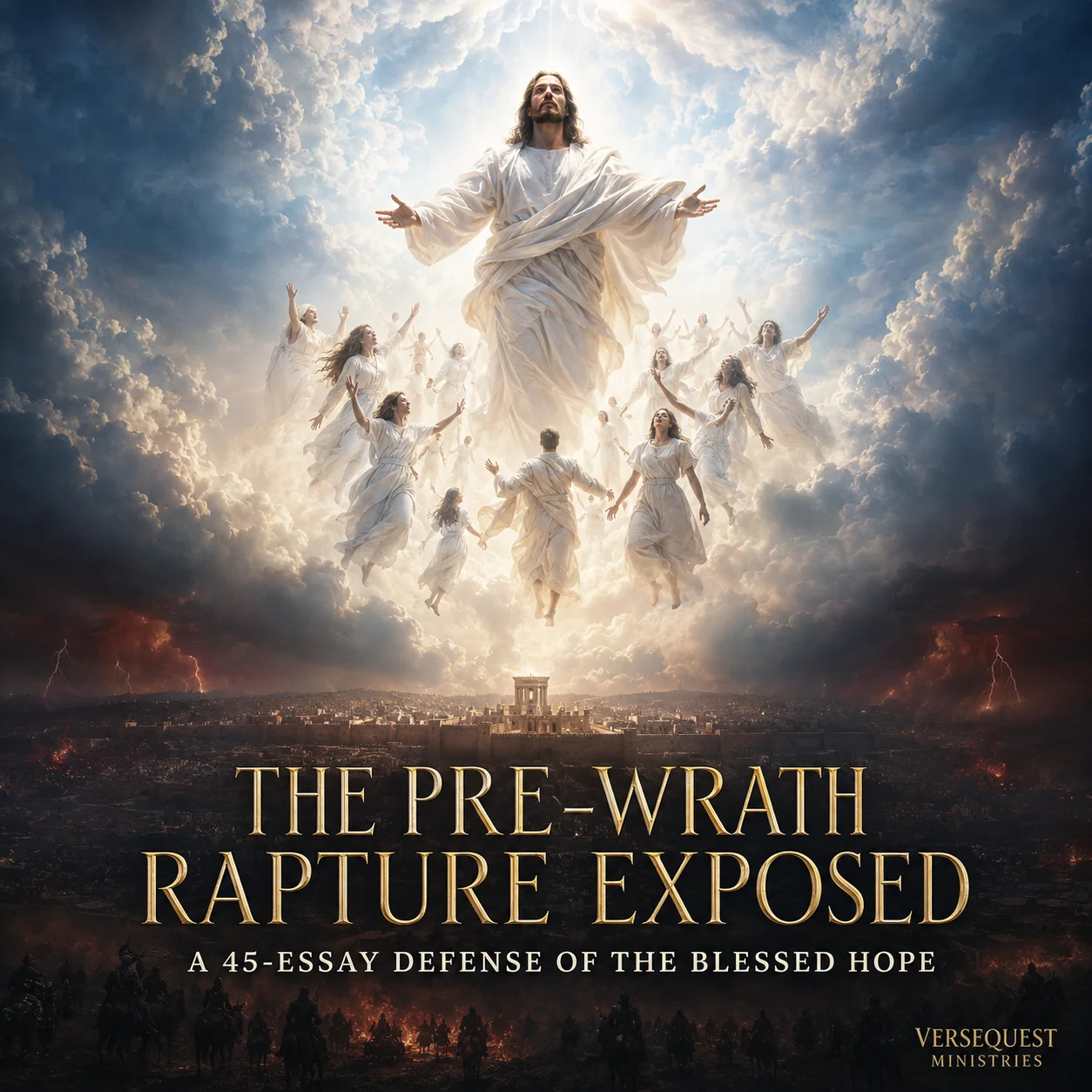
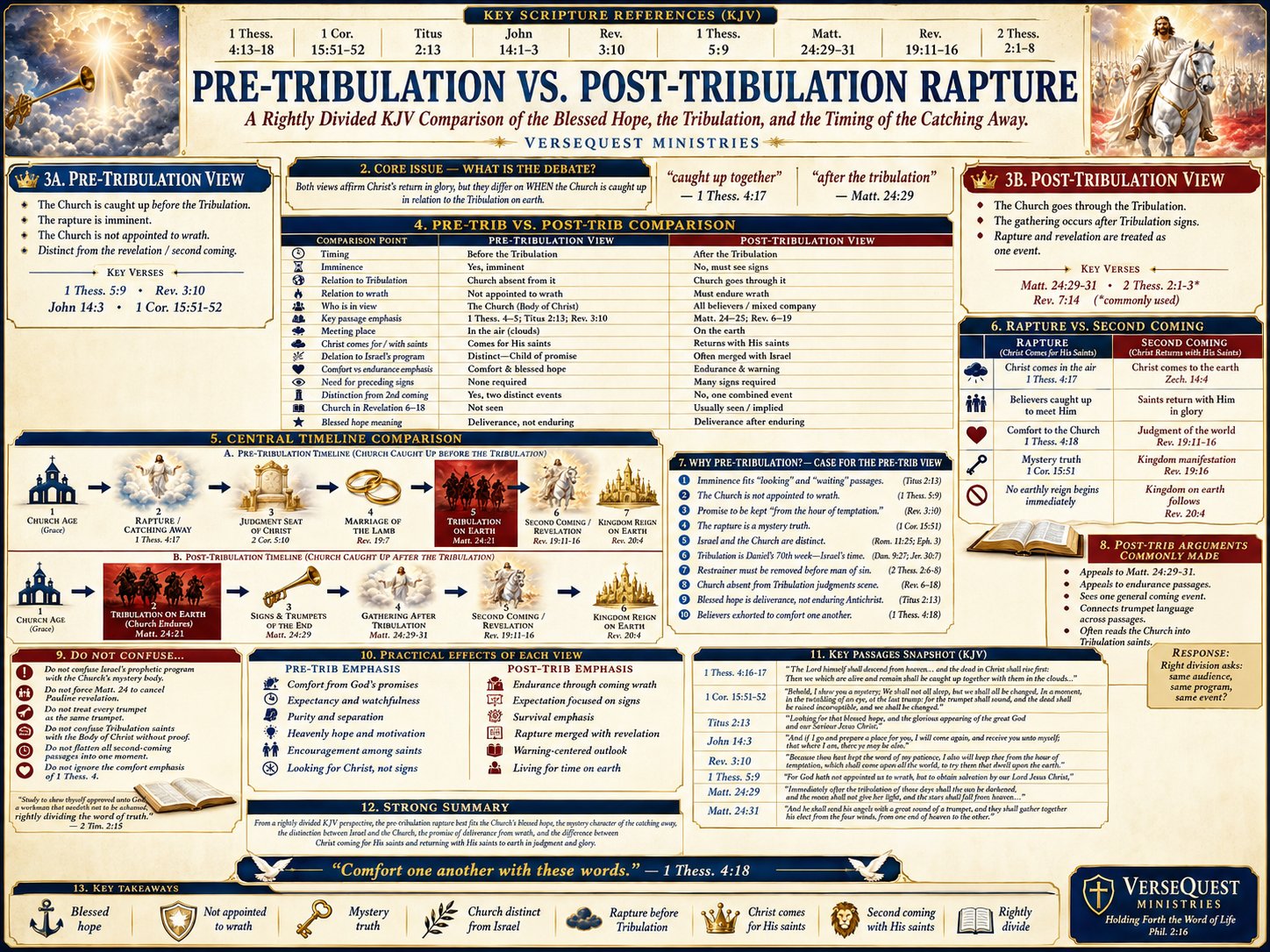
Pre-Tribulation vs. Post-Tribulation Rapture – The Blessed Hope, the Tribulation, and the Timing of the Church’s Catching Away (KJV Bible Study Chart)
Compare the pre-Tribulation and post-Tribulation Rapture positions with this detailed KJV chart covering timing, imminence, divine wrath, Matthew 24, Daniel’s seventieth week, the Church, Israel, Tribulation saints, and the difference between the Rapture and Second Coming.
$3.99
Description
Pre-Tribulation vs. Post-Tribulation Rapture is a detailed, rightly divided KJV Bible study chart comparing the two major positions concerning when the Body of Christ will be caught up to meet the Lord Jesus Christ in the air.
Built around 1 Thessalonians 4:13–18, 1 Corinthians 15:51–52, Titus 2:13, John 14:1–3, Revelation 3:10, 1 Thessalonians 5:9, Matthew 24:29–31, Revelation 19:11–16, and 2 Thessalonians 2:1–8, this chart examines the biblical differences between a Rapture occurring before Daniel’s seventieth week and a gathering placed after the Tribulation.
Both positions affirm that Jesus Christ will return and that believers possess a future hope. The central debate concerns when the Church is caught up, whether the Rapture and Second Coming are two distinct events, whether the Body of Christ enters the Tribulation, and whether passages concerning Israel’s prophetic gathering should be applied directly to the Church.
The chart presents the pre-Tribulation view as the position that the Church is caught away before the Tribulation begins. The Rapture is treated as imminent, distinct from the Revelation or Second Coming, and consistent with the Church’s heavenly calling and exemption from divine wrath.
The post-Tribulation view places the Church upon the earth throughout the Tribulation and identifies its catching away with the gathering described after the Tribulation. This position commonly treats the Rapture and visible Second Coming as different parts of one combined event.
The chart does more than place two labels side by side. It compares their timing, prophetic framework, audiences, signs, meeting places, practical emphases, relationship to Israel, and treatment of the Church throughout Revelation 6–18.
The key Rapture passage is 1 Thessalonians 4:16–17, where Paul declares that the Lord Himself will descend from heaven with a shout, the voice of the archangel, and the trump of God. The dead in Christ will rise first, and living believers will be caught up together with them in the clouds to meet the Lord in the air.
This passage is addressed to believers grieving over saints who had died. Paul gives comfort rather than a survival manual for the Tribulation. His conclusion is, “Wherefore comfort one another with these words.”
The catching away involves the dead in Christ and living members of the Body of Christ. It is not merely a general description of every resurrection, every gathering, or every return of Christ mentioned anywhere in Scripture.
First Corinthians 15:51 identifies the transformation of living believers as a mystery. Paul writes, “Behold, I shew you a mystery; We shall not all sleep, but we shall all be changed.”
A biblical mystery is truth previously hidden and later revealed. Old Testament prophecy openly described the Day of the Lord, Israel’s restoration, judgment upon the nations, resurrection, and the Messiah’s earthly Kingdom, but it did not plainly reveal the one Body of Christ and its catching away before Israel’s final prophetic week.
The pre-Tribulation position therefore connects the Rapture with Paul’s distinct revelation concerning the Church. The Body of Christ is a heavenly people formed during the present dispensation of grace from believing Jews and Gentiles made one in Christ.
The post-Tribulation position frequently reads the Church into passages associated with Israel’s future trouble and national gathering. Matthew 24:29–31 is commonly used because it describes a gathering “immediately after the tribulation.”
The chart urges the student to ask who is speaking, who is addressed, what prophetic program is operating, and whether the gathering in Matthew 24 is identical to the catching away in 1 Thessalonians 4.
Matthew 24 unfolds in an explicitly Jewish and prophetic setting. It mentions Judea, the Sabbath day, the holy place, the abomination of desolation spoken of by Daniel, and the elect gathered after cosmic signs and unparalleled Tribulation.
First Thessalonians 4 concerns the dead in Christ, the Church meeting the Lord in the air, and a message of comfort for the Body of Christ. Similar language about clouds, trumpets, angels, or gathering does not automatically make two passages the same event.
The chart compares the timing taught by each view. The pre-Tribulation position places the Rapture before Daniel’s seventieth week. The post-Tribulation position places the Church’s gathering after the Tribulation.
The pre-Tribulation position maintains imminence. Believers are instructed to look for Jesus Christ rather than wait first for the Antichrist, the abomination of desolation, the mark of the beast, the two witnesses, the trumpet judgments, or the armies gathering for the final conflict.
The post-Tribulation view necessarily places several unmistakable prophetic signs before the Church’s catching away. Under that framework, the Rapture cannot occur until the Tribulation has unfolded and its major signs have appeared.
Titus 2:13 calls the Church’s expectation “that blessed hope.” The pre-Tribulation position understands this hope as the imminent appearing of Christ for His Body, not the prospect of enduring all the judgments of Daniel’s seventieth week before deliverance arrives.
The distinction does not promise that Christians will avoid ordinary suffering. The Church has faced persecution, imprisonment, martyrdom, sickness, hardship, satanic opposition, and human wrath throughout its history.
The issue is not whether Christians may suffer. The issue is whether the Body of Christ has been appointed to the future prophetic outpouring of God’s wrath upon the world during the Tribulation.
First Thessalonians 5:9 states, “For God hath not appointed us to wrath, but to obtain salvation by our Lord Jesus Christ.” The pre-Tribulation view applies this promise to the Church’s deliverance before that period of divine judgment.
Revelation 3:10 promises to keep the faithful assembly “from the hour of temptation, which shall come upon all the world.” The passage describes protection from a global hour rather than merely survival within local persecution.
The post-Tribulation position often distinguishes God’s wrath from earlier Tribulation suffering and argues that the Church may endure much of the period before being removed. The chart answers by emphasizing the unified prophetic character of Daniel’s seventieth week and the Church’s absence from the Tribulation judgment scenes.
The chart also compares who is primarily in view. The pre-Tribulation position identifies the Rapture with the Church, the Body of Christ. The post-Tribulation framework frequently places the Church within a mixed company of Tribulation saints, Israel, and believing survivors.
Right division requires that the Church, Israel, and the nations remain distinct. First Corinthians 10:32 recognizes these categories, while Romans 11 teaches that Israel’s blindness is partial and temporary.
Daniel’s seventieth week concerns Daniel’s people and holy city. Jeremiah calls the future Tribulation the time of Jacob’s trouble. Matthew 24 speaks from within Israel’s prophetic and Kingdom setting.
The Body of Christ belongs to a mystery kept secret in ages past and revealed especially through Paul. Placing the Church inside Israel’s final prophetic week confuses prophecy with mystery and the earthly Kingdom program with the Church’s heavenly calling.
The meeting place also differs. At the Rapture, the Church meets the Lord in the air. At the Second Coming, Jesus Christ returns visibly to the earth in judgment and glory.
Zechariah 14 describes His feet standing upon the Mount of Olives. Revelation 19 presents Him returning upon a white horse with the armies of heaven following Him.
At the Rapture, Christ comes for His saints. At the Second Coming, He returns with His saints.
First Thessalonians 4 presents the saints ascending to meet Him. Revelation 19 presents the heavenly armies descending with Him.
The Rapture is a comfort passage for the Church. The Second Coming is a judgment passage for the rebellious world and the transition into Christ’s earthly Kingdom.
At the Rapture, no earthly reign begins immediately in the passage. At the Second Coming, Jesus Christ destroys His enemies and proceeds toward the establishment of His thousand-year Kingdom.
The pre-Tribulation timeline shown on the chart begins with the present Church Age. During this period, salvation by grace is proclaimed, and the Body of Christ is being formed.
The next event is the Rapture or catching away. The Church meets the Lord in the air before the Tribulation begins.
The Judgment Seat of Christ follows for saved believers. Their service, motive, stewardship, and faithfulness are examined for reward, not to decide eternal salvation.
The marriage of the Lamb follows as the Church is united with Christ in heavenly celebration.
The Tribulation then unfolds upon the earth as Daniel’s seventieth week. Revelation 6–18 describes seals, trumpets, vials, the rise of the beast, persecution, judgment, and the collapse of Babylon’s world system.
Jesus Christ then returns visibly with His saints in the Revelation or Second Coming. He defeats the beast, false prophet, and gathered armies of the world.
The Kingdom reign follows, during which Christ rules upon the earth for one thousand years.
The post-Tribulation timeline places the Church upon the earth throughout the Tribulation. Believers endure the judgments and persecution, observe the predicted signs, and are gathered after the Tribulation in connection with the Lord’s visible return.
The chart gives ten principal reasons for the pre-Tribulation position. The first is imminence. Scripture repeatedly presents the Church as waiting for Christ rather than waiting for Tribulation signs.
The second is that the Church is not appointed to wrath. Divine Tribulation judgment is not the Church’s destiny.
The third is the promise to be kept from the worldwide hour of temptation. The language points toward removal from the appointed period rather than preservation through every judgment within it.
The fourth is that the Rapture is mystery truth. It belongs to Paul’s revelation concerning the present Body of Christ.
The fifth is that Israel and the Church are distinct. Israel retains a future prophetic program that God will resume after the Church’s removal.
The sixth is that the Tribulation is Daniel’s seventieth week and the time of Jacob’s trouble. Its prophetic centre is Israel and Jerusalem, not the mystery Body of Christ.
The seventh is that the present restraining arrangement must be removed before the man of sin is fully revealed. The Spirit-indwelt Body of Christ presently restrains the open development of the final satanic ruler.
This does not mean the Holy Spirit ceases to exist or work after the Rapture. God remains omnipresent, and the Spirit continues His activity. The present Church-age restraining arrangement, however, is removed.
The eighth reason is the absence of the Church from the principal Tribulation judgment scenes of Revelation 6–18. The term church appears repeatedly in Revelation 1–3 but disappears from the earthly judgment narrative until the heavenly Bride is seen with Christ.
The ninth reason is the character of the blessed hope. It is presented as deliverance, comfort, expectation, and joy—not as the promise that the Church will be gathered only after surviving the beast’s global dominion.
The tenth reason is Paul’s command to comfort one another. The Rapture is designed to strengthen grieving and suffering believers with the assurance that Christ will gather His Body and complete their redemption.
The chart also summarizes commonly used post-Tribulation arguments. Matthew 24:29–31 is cited because the gathering occurs after the Tribulation.
Endurance passages are used to argue that the Church must remain through the final crisis. Trumpet language is connected across passages, and the Rapture and Revelation are treated as one general coming.
Some argue that Christ gathers His Church after it has survived the Tribulation alongside the elect described in prophetic passages.
The right-division response is not merely to ask whether two passages contain a trumpet, cloud, gathering, or coming. The student must ask whether they concern the same audience, purpose, program, location, sequence, and result.
The chart warns against confusing Israel’s prophetic program with the Church’s mystery program. A verse addressed to Israel during Daniel’s seventieth week should not be transferred automatically to the Body of Christ.
Matthew 24 must not be used to erase Pauline revelation. Jesus Christ’s earthly ministry occurred within Israel’s Kingdom setting, while Paul later received distinct truth concerning the Body of Christ.
Every trumpet must not be treated as the same trumpet. The trump of God in 1 Thessalonians 4 is connected with the resurrection and catching away of the Church. Revelation’s seventh trumpet occurs within a series of Tribulation judgments.
Tribulation saints must not automatically be identified as the Body of Christ. People will believe God during the Tribulation, but their presence does not prove that the present Church remains on earth.
Separate prophetic events should not be collapsed into one moment merely because both involve Christ’s coming. Scripture records multiple stages and aspects within God’s return program.
The comfort emphasis of 1 Thessalonians 4 should not be ignored. Paul’s purpose is to reassure believers concerning departed saints and the Church’s reunion with Christ.
The chart also compares the practical effects commonly produced by each view. The pre-Tribulation position emphasizes comfort from God’s promises, expectancy, watchfulness, purity, separation, heavenly hope, and looking for Jesus Christ.
The post-Tribulation position naturally emphasizes endurance through coming wrath, preparation for prophetic signs, survival, and the expectation that the Church must remain until the visible return.
Believers should always endure persecution faithfully, prepare spiritually, study prophecy, and refuse compromise. Yet the Church’s appointed hope remains Christ’s coming for His Body rather than a command to await the beast’s kingdom.
The pre-Tribulation doctrine should never produce laziness, indifference, escapism, or neglect of Christian duty. The imminent return of Christ should produce urgency.
A believer who expects the Lord may come should live cleanly, serve faithfully, preach the gospel, redeem the time, maintain sound doctrine, and remain ready to give account at the Judgment Seat of Christ.
The doctrine should also comfort those grieving saved loved ones. The grave has not defeated the Church. The dead in Christ will rise first.
The living saints will be changed. Both groups will be caught up together. Every member of Christ’s Body will be forever with the Lord.
The chart’s strong summary is clear: from a rightly divided KJV perspective, the pre-Tribulation Rapture best fits the Church’s blessed hope, the mystery character of the catching away, the distinction between Israel and the Church, the promise of deliverance from wrath, and the difference between Christ coming for His saints and returning with His saints.
The Rapture and Second Coming are related within the larger plan of God, but they are not the same event. One gathers the Church to Christ in the air. The other brings Christ and His saints to earth in judgment and glory.
The Church is not instructed to watch for the Antichrist as its hope. It is instructed to wait for the Lord Jesus Christ.
The final command remains, “Comfort one another with these words.”
This resource is ideal for personal Bible study, Rapture teaching, pre-Tribulation apologetics, post-Tribulation comparisons, prophecy conferences, Church-and-Israel studies, Daniel’s seventieth-week instruction, new-believer discipleship, Sunday school, homeschool Bible curriculum, Christian schools, Bible institutes, pastoral training, sermon preparation, and anyone seeking a clear visual comparison of Rapture timing positions.
Pre-Tribulation Rapture, post-Tribulation Rapture, timing of the Rapture, blessed hope, catching away of the Church, Body of Christ, dead in Christ rise first, Church not appointed to wrath, Revelation 3:10, Daniel’s seventieth week, time of Jacob’s trouble, Church versus Israel, Rapture versus Second Coming, mystery truth, imminence, trump of God, Matthew 24 gathering, Tribulation saints, man of sin, Second Coming of Jesus Christ
The central question is not whether Jesus Christ will return, but when the Body of Christ is caught up in relation to the Tribulation.
The pre-Tribulation position places the Rapture before Daniel’s seventieth week.
The post-Tribulation position places the gathering of the Church after the Tribulation.
First Thessalonians 4 concerns the dead in Christ, living Church-age believers, and a meeting with the Lord in the air.
The passage was given to comfort believers concerning saints who had died.
First Corinthians 15 identifies the transformation of living believers as a mystery.
Mystery truth was previously hidden and later revealed especially through Paul.
The Church is the Body of Christ composed of believing Jews and Gentiles made one during the present dispensation.
Israel retains a literal future and must not be replaced by or confused with the Church.
Daniel’s seventieth week concerns Daniel’s people and holy city.
Jeremiah identifies the future crisis as the time of Jacob’s trouble.
Matthew 24 contains an Israel-centred prophetic setting involving Judea, the Sabbath, the holy place, Daniel’s abomination, and Tribulation signs.
The gathering of Matthew 24 should not be assumed identical to the catching away of 1 Thessalonians 4 merely because both passages mention a gathering.
Audience, purpose, location, timing, movement, and outcome must be compared.
At the Rapture, Christ comes for His saints.
At the Second Coming, Christ returns with His saints.
At the Rapture, believers meet the Lord in the air.
At the Second Coming, Christ comes to the earth in judgment and establishes His Kingdom.
The Rapture is presented as comfort and blessed hope.
The Second Coming is presented as judgment upon the rebellious world and deliverance for Israel.
The Rapture is imminent under the pre-Tribulation framework.
The post-Tribulation position requires identifiable signs and the completion of the Tribulation before the gathering.
The Church is not appointed to divine wrath.
This promise does not mean Christians avoid ordinary persecution, suffering, sickness, martyrdom, or human opposition.
Revelation 3:10 promises deliverance from a worldwide hour of temptation.
The Tribulation is a prophetic period of divine judgment rather than merely ordinary Christian persecution.
The Church is prominent in Revelation 1–3 but absent by name from the earthly judgment scenes of Revelation 6–18.
Tribulation saints should not automatically be identified as the present Body of Christ.
The present restraining arrangement must be removed before the man of sin is openly revealed.
The Holy Spirit remains omnipresent and active after the Rapture, but the present Spirit-indwelt Body is removed.
The trump of God in 1 Thessalonians 4 should not be confused automatically with Revelation’s seventh trumpet.
Similar terminology does not erase differences in context and purpose.
The Rapture precedes the Judgment Seat of Christ, where saved believers’ service is examined for reward.
The Judgment Seat is not a decision concerning heaven or hell.
The marriage of the Lamb occurs in the heavenly sequence before Christ returns in Revelation 19.
The Tribulation centres upon Israel, Jerusalem, the nations, the beast, and the completion of prophetic judgment.
The Second Coming brings Christ visibly to earth with His saints.
The millennial Kingdom follows the Second Coming.
Pre-Tribulation teaching should produce comfort, expectancy, purity, separation, service, and heavenly hope.
It should not produce laziness, date-setting, carelessness, or withdrawal from Christian responsibility.
Post-Tribulation teaching commonly emphasizes endurance, prophetic signs, survival, and preparation for persecution.
Believers in every age should endure suffering faithfully, but the Church’s appointed hope is Jesus Christ.
The final doctrinal distinction is that Christ catches the Church away before Israel’s final prophetic week and later returns with His saints to judge the world and establish His Kingdom.
Pre-Trib-versus-post-Trib studies, Rapture timing comparisons, prophecy teaching, Church-and-Israel distinctions, Daniel’s seventieth-week instruction, interpreting Matthew 24, explaining 1 Thessalonians 4, studying 2 Thessalonians 2, Rapture-versus-Second-Coming lessons, Tribulation timelines, eternal-security teaching, bereavement comfort, watchfulness and readiness, pastoral training, prophecy conferences, Sunday school lessons, homeschool Bible curriculum, Christian school teaching, Bible institute classes, sermon preparation
King James Bible, Strong’s Concordance, Thompson Chain-Reference Bible, Treasury of Scripture Knowledge, Nave’s Topical Bible, First Thessalonians 4–5 study notes, First Corinthians 15 commentary materials, Second Thessalonians 2 outlines, Matthew 24 comparison studies, Daniel 9 seventy-weeks charts, Revelation 6–19 timelines, Church-versus-Israel charts, Rapture-versus-Second-Coming resources, Pauline mystery studies, pre-Tribulation apologetics, post-Tribulation argument worksheets, VerseQuest prophecy and right-division charts
Related products
-
Study Books (PDF)
-
-25%
- The Mysteries of God Revealed for the Church Age – Premium Essay Series PDF
- A premium 404-page VerseQuest Ministries digital PDF study book featuring 54 detailed KJV-only essays on the mysteries of God revealed for the Church Age. This rightly divided study covers the…
- Original price was: $39.99.$29.99Current price is: $29.99.
- Add to cart
-
-25%
-
Not Under Law But Grace
-
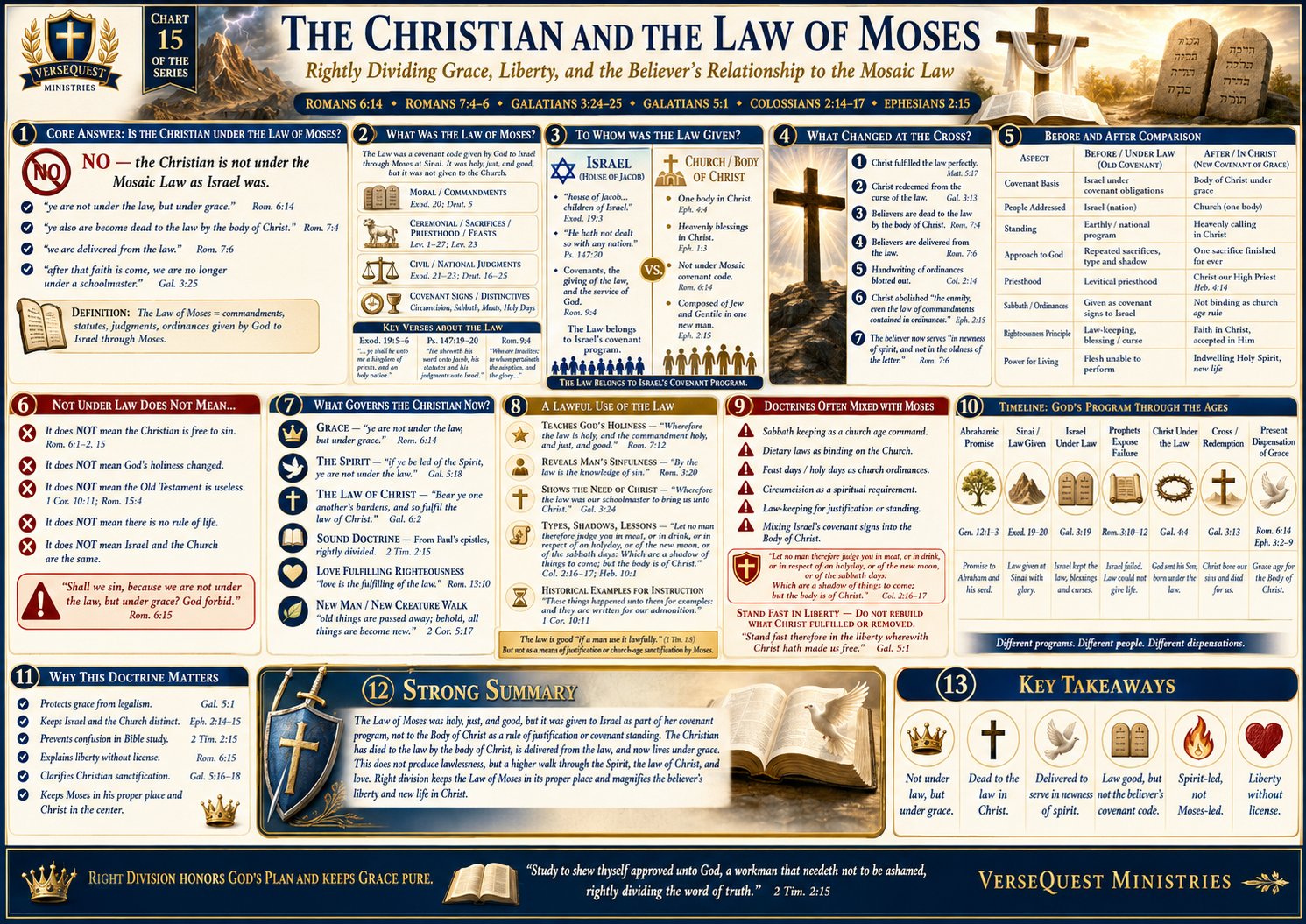
- The Christian and the Law of Moses – Grace, Liberty, and the Believer’s Relationship to the Mosaic Law (KJV Bible Study Chart)
- Understand the Christian’s relationship to the law of Moses with this detailed KJV chart covering Israel’s covenant, grace, liberty, the cross, the law of Christ, and Spirit-led living.
- $3.99
- Add to cart
-
-
Bible Study Chart
-
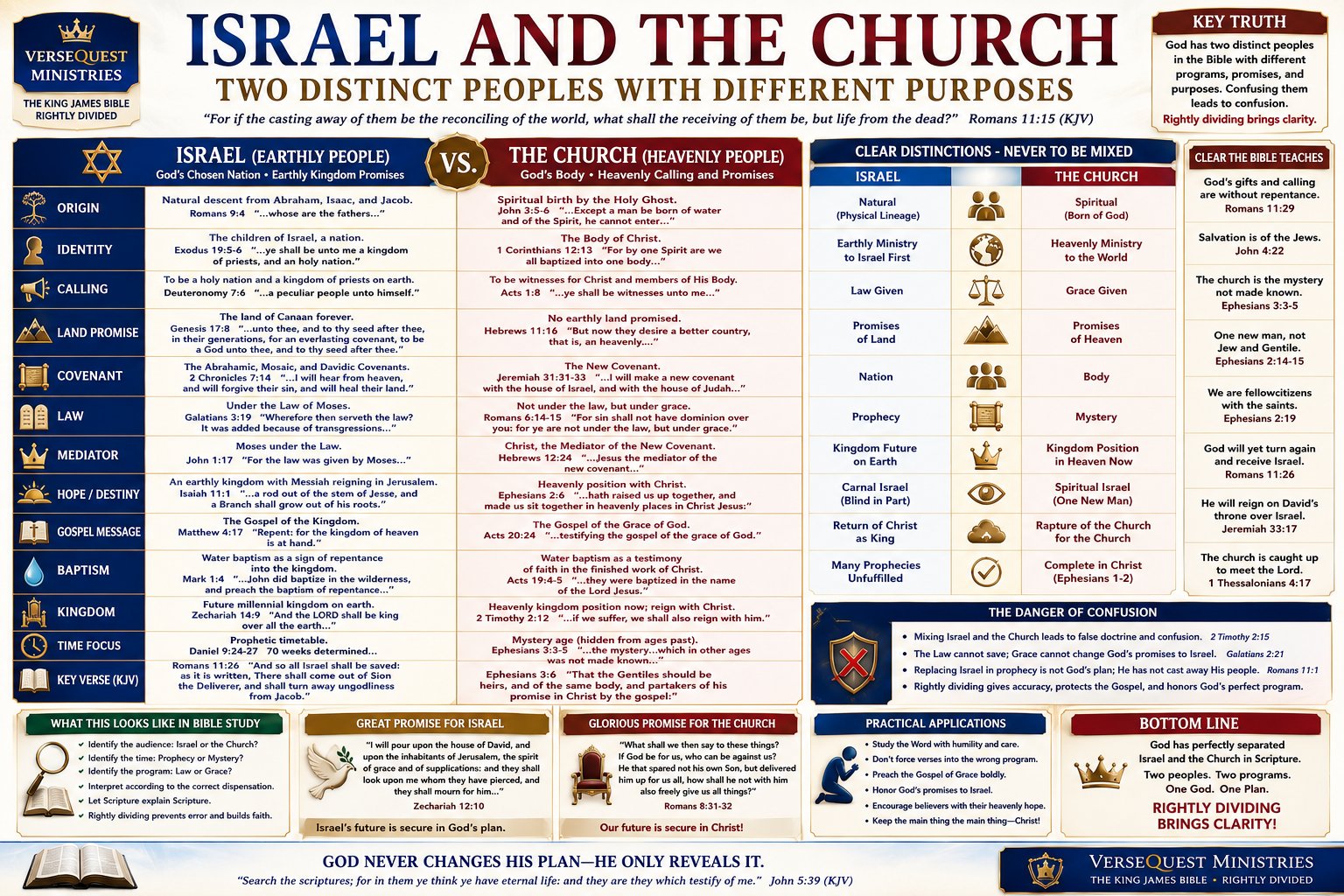
- Israel and the Church Bible Study Chart – Two Distinct Peoples with Different Purposes (KJV)
- Compare Israel and the Church with this detailed KJV Bible study chart covering their distinct origins, identities, covenants, callings, promises, gospel programs, and future destinies.
- $3.99
- Add to cart
-
-
Ages To Come
-
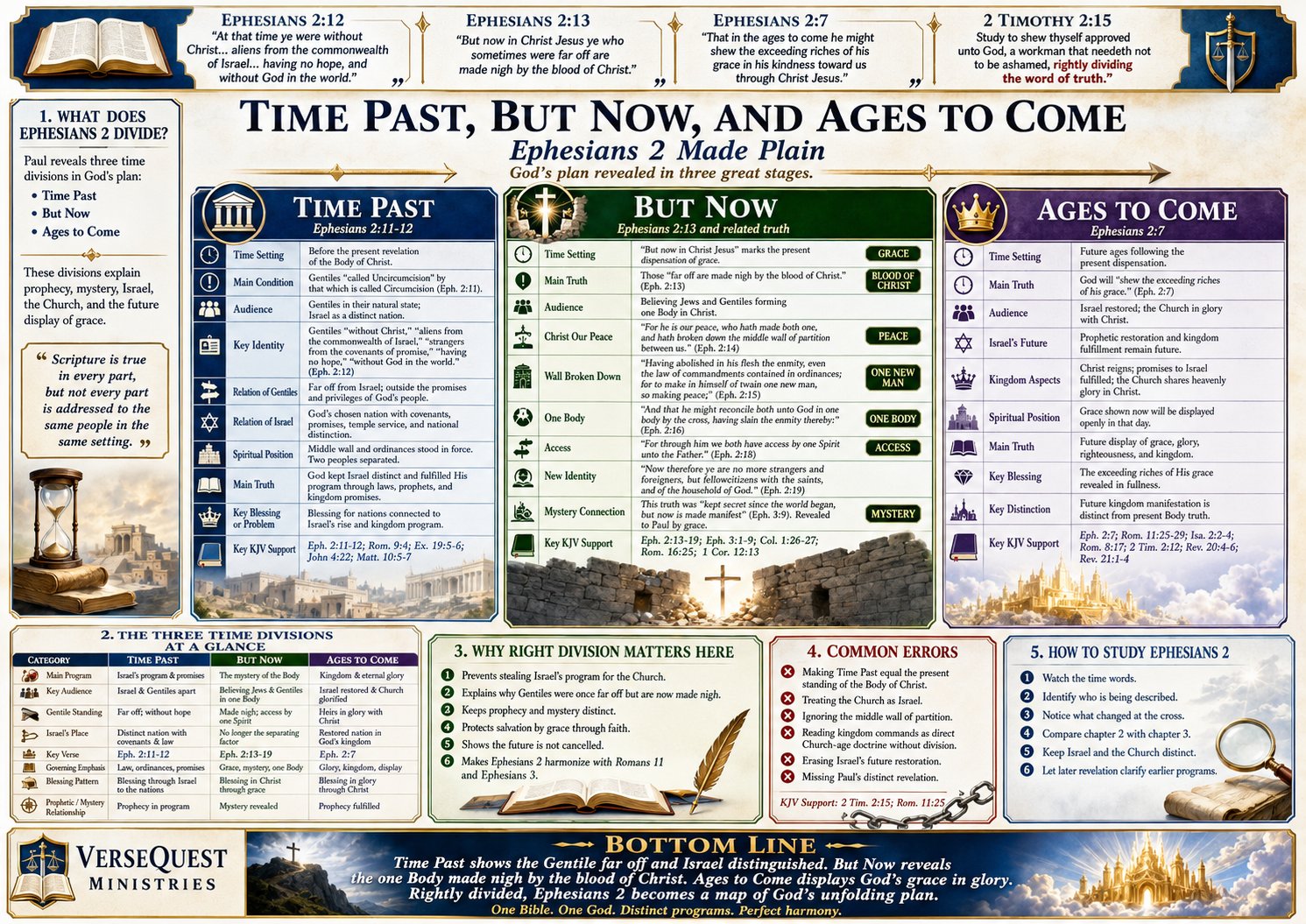
- Time Past, But Now, and Ages to Come – Ephesians 2 Rightly Divided KJV Bible Study Chart
- Understand Ephesians 2 with this detailed KJV chart explaining Time Past, But Now, Ages to Come, Gentile distance, the one Body, Israel’s future, and the importance of right division.
- $3.99
- Add to cart
-
-
Rapture vs Second Coming
-
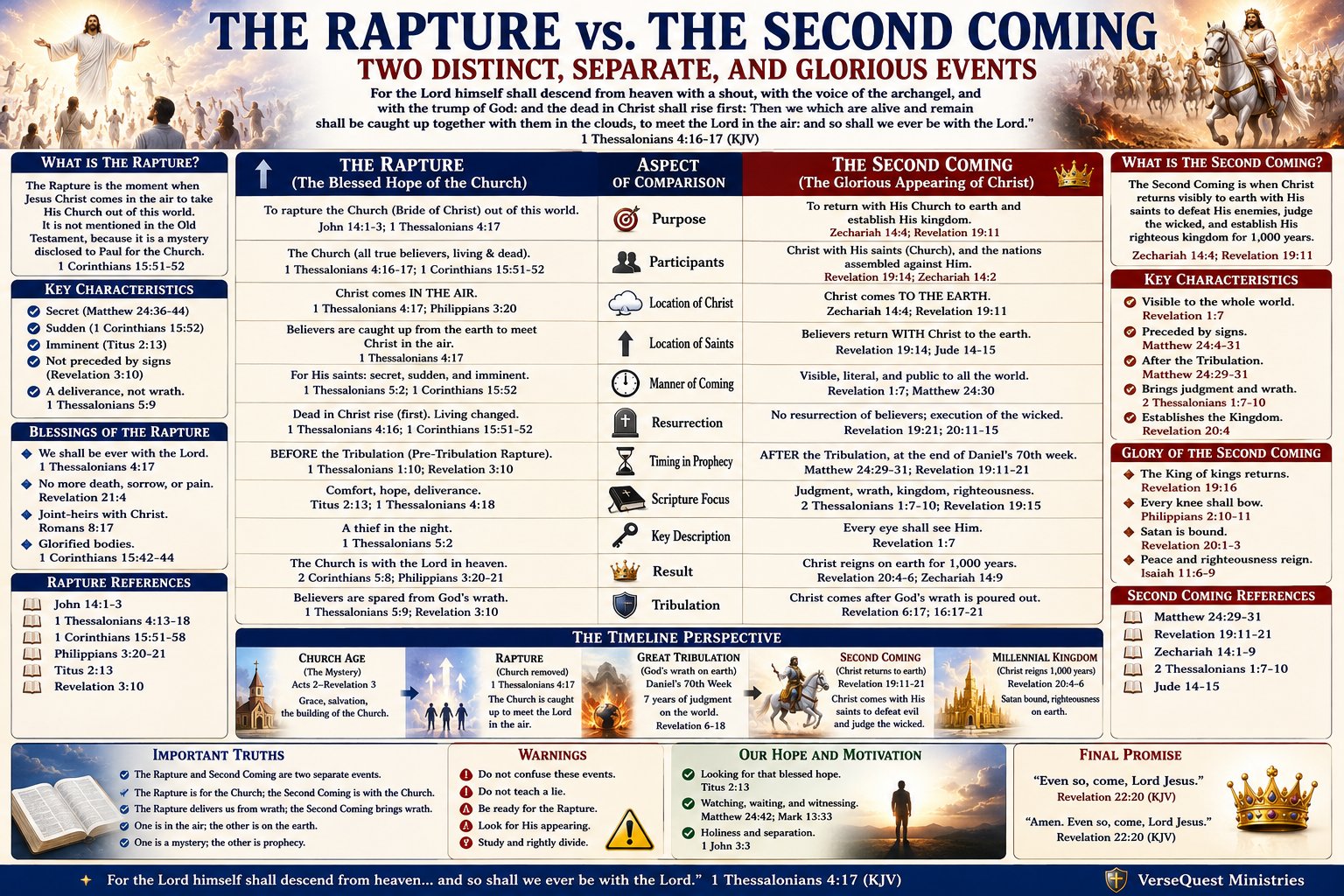
- The Rapture vs. the Second Coming – Two Distinct Events in God’s Prophetic Program (KJV Bible Study Chart)
- Understand the differences between the Rapture and Second Coming with this detailed KJV chart covering purpose, participants, location, timing, resurrection, divine wrath, the Tribulation, Church-versus-Israel distinctions, Christ’s visible return, and…
- $3.99
- Add to cart
-