
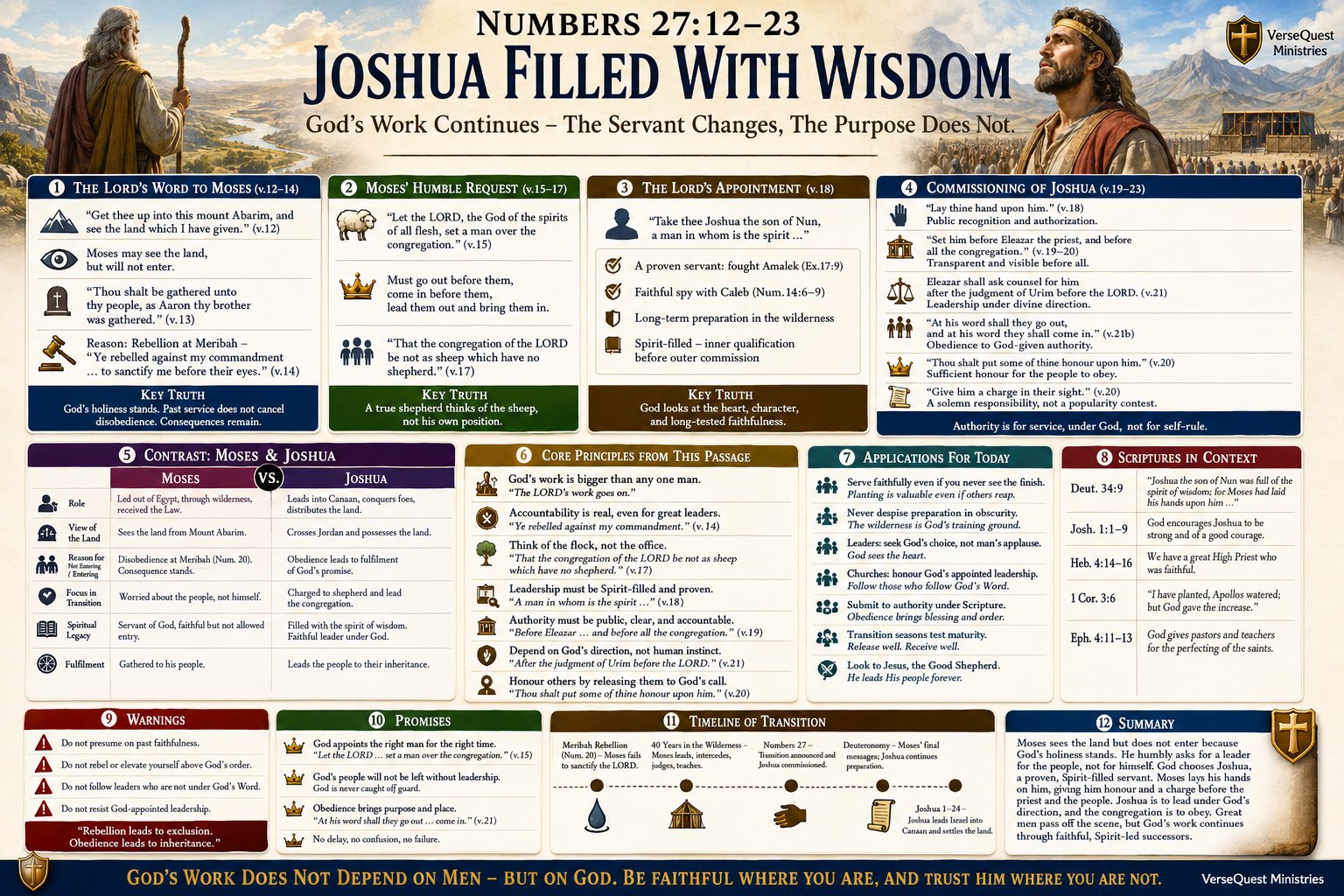
Numbers 27:12–23 Bible Study Chart – Joshua Filled with Wisdom and Commissioned to Lead Israel (KJV)
Study Numbers 27:12–23 with this detailed KJV chart covering Moses’ final request, Joshua’s appointment, the spirit of wisdom, public commissioning, leadership transition, and God’s continuing purpose.
$3.99
Description
Numbers 27:12–23: Joshua Filled with Wisdom—God’s Work Continues, the Servant Changes, the Purpose Does Not is a detailed KJV Bible study chart examining the closing season of Moses’ leadership, his humble concern for Israel, God’s appointment of Joshua, and the public transfer of responsibility before Eleazar the priest and the congregation.
The passage begins with the LORD commanding Moses to ascend Mount Abarim and view the land promised to Israel. Moses is permitted to see the inheritance, but he will not enter it. His exclusion is connected with his rebellion at Meribah, where he failed to sanctify the LORD before the people.
This solemn moment demonstrates that years of faithful service do not make a servant unaccountable. Moses remained God’s servant and one of Scripture’s greatest leaders, but past usefulness did not erase the consequence of direct disobedience. God’s holiness remained unchanged, and His judgment was neither careless nor unjust.
Moses’ response reveals the heart of a true shepherd. He does not demand that God reverse the sentence, attempt to preserve his title, or make the final stage of his ministry about himself. Instead, he asks the LORD to appoint a man over the congregation who will go out before them, come in before them, lead them out, and bring them in.
Moses’ concern is that the congregation of the LORD should not become “as sheep which have no shepherd.” Even while facing the end of his own leadership, he thinks about the welfare of the people. Biblical ministry is not possession of an office but stewardship over people who belong to God.
The LORD answers by choosing Joshua the son of Nun, “a man in whom is the spirit.” Joshua was not selected because of popularity, self-promotion, family privilege, or a sudden desire for leadership. His preparation had been unfolding for years through faithful service, battle, wilderness experience, loyalty beside Caleb, and close attendance upon Moses.
Joshua had already fought Amalek, served as Moses’ minister, remained faithful when others rebelled, and stood with Caleb when the majority of Israel refused to believe God. His public appointment confirmed a calling that had already been demonstrated through private faithfulness and long preparation.
God commands Moses to lay his hand upon Joshua and set him before Eleazar the priest and the entire congregation. The transition is public, orderly, accountable, and unmistakable. Joshua does not seize authority, conduct a private campaign, or gather supporters against Moses. God appoints him, Moses recognizes him, Eleazar witnesses the commission, and the congregation receives clear direction.
Moses is instructed to place some of his honour upon Joshua so that Israel will obey him. The honour is sufficient for Joshua’s responsibility, but he does not become another Moses in every respect. God gives each servant the authority and grace required for his own assignment.
Joshua’s leadership also remains under divine order. Eleazar will inquire for him after the judgment of Urim before the LORD. Joshua is a leader, but he is not autonomous. He must depend upon God’s direction rather than personal instinct, military ability, public enthusiasm, or political calculation.
The command that Israel should go out and come in at Joshua’s word establishes real authority, yet that authority remains delegated and accountable. Biblical leadership is not self-rule. It is service under God, exercised according to His revealed command for the good of His people.
The chart presents a clear comparison between Moses and Joshua. Moses led Israel out of Egypt, received the law, and guided the nation through the wilderness. Joshua will lead Israel across Jordan, confront the inhabitants of Canaan, and distribute the promised inheritance.
Moses sees the land but does not enter because of his failure at Meribah. Joshua enters and leads the people toward fulfillment because he is charged to obey God’s direction. One servant completes his assigned portion; another is raised up to continue the work.
The transition does not diminish Moses’ legacy or elevate Joshua through rivalry. Moses remains the faithful servant through whom God accomplished a foundational work. Joshua receives a different assignment that builds upon what God had already done through Moses.
Major principles include the continuity of God’s work, accountability among leaders, concern for the flock, long-term preparation, Spirit-given qualification, public commissioning, delegated authority, dependence upon divine direction, and honouring another servant by releasing him into God’s calling.
The passage warns against presuming upon past faithfulness, rebelling against God’s order, following leaders who reject Scripture, and resisting a transition God has clearly established. It also promises that God remains fully capable of appointing the right servant for the right season.
Practical applications encourage believers to serve faithfully even when they may not personally see the completed result. Planting remains valuable even when another servant reaps. Obscure seasons of preparation are not wasted; they are often God’s training ground for future responsibility.
Leaders should seek God’s choice rather than man’s applause. Churches and ministries should honour qualified, proven leadership while testing every authority by Scripture. Mature servants should prepare others, release responsibility without jealousy, and recognize that God’s purpose is larger than any individual personality.
The rightly divided application does not turn Joshua’s commissioning into a direct Church ordinance or claim that every modern leadership transfer must reproduce Israel’s national procedure. It draws spiritual lessons from a historical passage while respecting its setting within Israel’s wilderness journey and preparation to enter Canaan.
The chart ultimately directs attention beyond both Moses and Joshua to Jesus Christ, the unfailing Shepherd. Human servants change, age, fail, complete assignments, and leave the scene. The Lord remains, and His care for His people never depends upon the permanence of one human leader.
This resource is ideal for personal Bible study, Numbers teaching, leadership development, pastoral succession, ministry transition, discipleship, church training, Sunday school, homeschool Bible curriculum, Bible institutes, sermon preparation, and studies on Moses, Joshua, accountability, wisdom, and faithful service.
Joshua filled with wisdom, Moses and Joshua, Numbers 27, leadership transition, commissioning Joshua, spirit of wisdom, biblical succession, servant leadership, concern for the flock, accountability before God, Meribah rebellion, delegated authority, public appointment, Eleazar the priest, divine guidance, preparation in obscurity, faithful service, ministry continuity, pastoral responsibility, Jesus the Good Shepherd
Numbers 27 shows that God’s work is larger than any one servant. Moses’ earthly ministry is nearing its conclusion, but the LORD’s covenant purpose for Israel continues without interruption.
Moses is permitted to see the promised land but not enter it. His exclusion demonstrates that faithful leaders remain accountable and that spiritual usefulness does not erase the consequences of disobedience.
The passage does not portray Moses as bitter or self-protective. His request concerns the congregation rather than his reputation. He asks God to provide a shepherd so that the people will not be left without leadership.
A true shepherd thinks about the sheep after his own season of service ends. Ministry that depends entirely upon one personality has not prepared responsibly for the future.
Joshua’s preparation began long before his public appointment. He fought Amalek, served Moses, explored Canaan, stood with Caleb, and remained faithful through years of wilderness testing.
God often prepares future leaders in obscurity. Public commissioning should recognize proven character rather than attempt to create character through a title.
Joshua is described as a man in whom is the spirit, and Deuteronomy 34:9 says he was full of the spirit of wisdom. Inner qualification preceded public authority.
The laying on of Moses’ hand publicly identified Joshua as God’s chosen successor. The act communicated recognition and responsibility, but the authority ultimately came from the LORD.
Joshua was placed before Eleazar and the congregation. Biblical leadership should be clear and accountable rather than secretive, manipulative, or built upon private ambition.
Moses placed some of his honour upon Joshua. The new leader did not receive Moses’ identity or every aspect of his calling. God equips different servants for different assignments.
Joshua remained dependent upon divine counsel. Authority did not give him permission to trust his own instinct independently of the LORD.
Leadership is delegated for service. Joshua was appointed to lead the people into their inheritance, not to build a personal kingdom or treat God’s congregation as his possession.
The contrast between Moses and Joshua demonstrates continuity without sameness. Moses brought Israel to the border; Joshua would take the nation across. Each servant fulfilled a distinct part of God’s plan.
First Corinthians 3 provides a helpful Church-age principle: one servant plants, another waters, but God gives the increase. The glory belongs to God rather than the instrument.
A mature servant knows when to lead, when to prepare another, and when to release responsibility. Holding an office longer than God appoints can become as harmful as abandoning it too soon.
The final confidence of God’s people must never rest entirely upon Moses, Joshua, a pastor, teacher, or ministry leader. Jesus Christ remains the perfect Shepherd who never fails, retires, or leaves His flock without care.
Leadership transition, pastoral succession, preparing future leaders, releasing responsibility faithfully, serving without seeing the final result, accountability in ministry, shepherding God’s people, testing leaders by Scripture, public commissioning, honouring proven servants, responding to God-given authority, discipleship training, ministry leadership classes, Sunday school lessons, homeschool Bible curriculum, Christian school teaching, Bible institute classes, sermon preparation
King James Bible, Strong’s Concordance, Thompson Chain-Reference Bible, Treasury of Scripture Knowledge, Nave’s Topical Bible, Bible atlas, Numbers commentary notes, maps of Israel’s wilderness journey, Moses and Joshua character studies, biblical leadership resources, pastoral succession materials, Scripture memory cards, Deuteronomy 34 study notes, Joshua 1 study materials, VerseQuest leadership and Bible-character charts
Related products
-
True Worship vs False Worship
-
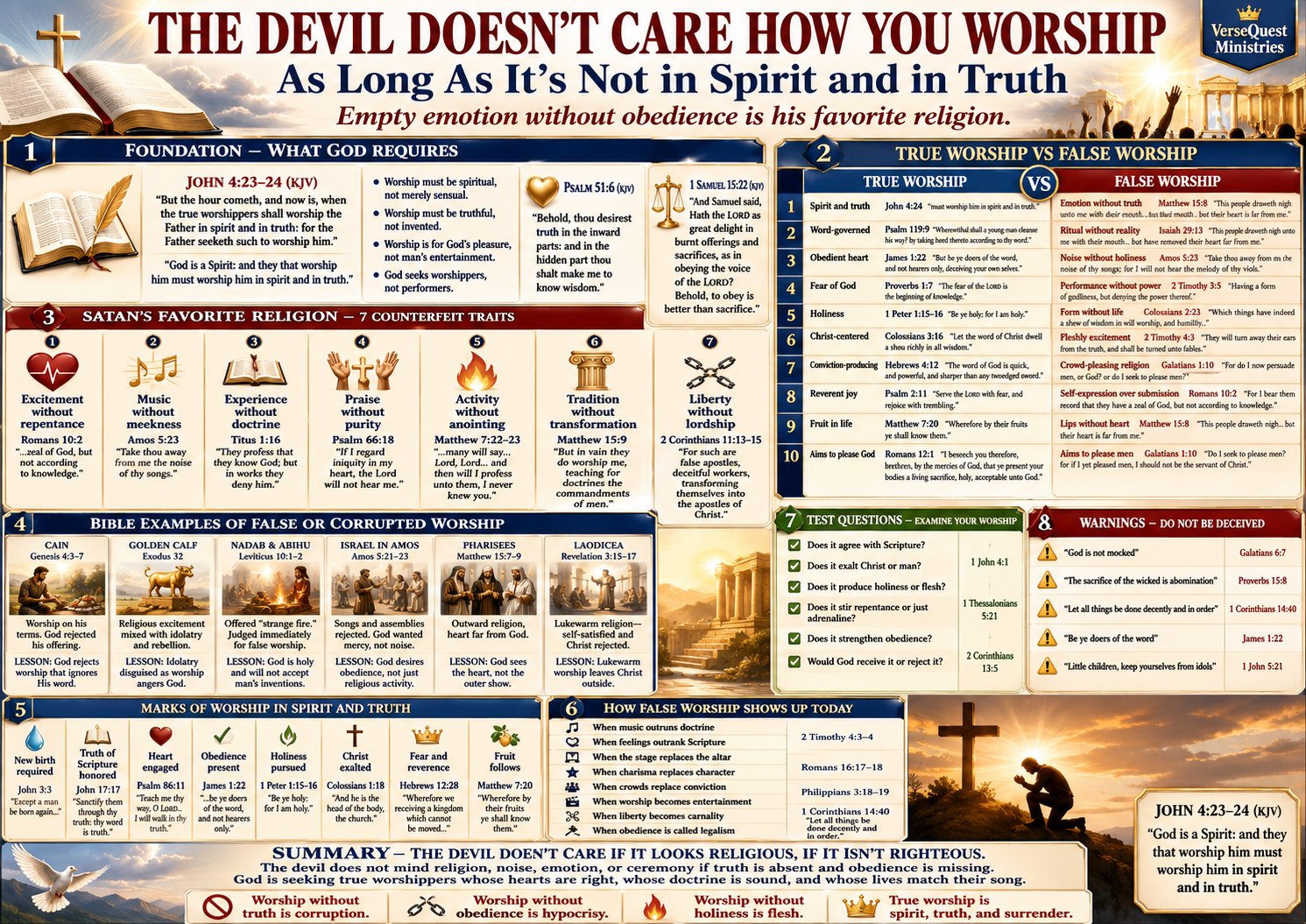
- The Devil Doesn’t Care How You Worship – True Worship in Spirit and in Truth Versus False Religion (KJV Bible Study Chart)
- Examine true and false worship with this detailed KJV Bible study chart covering spirit and truth, counterfeit religion, biblical music, obedience, holiness, discernment, and Christ-centred praise.
- $3.99
- Add to cart
-
-
The Gospel of the Kingdom
-
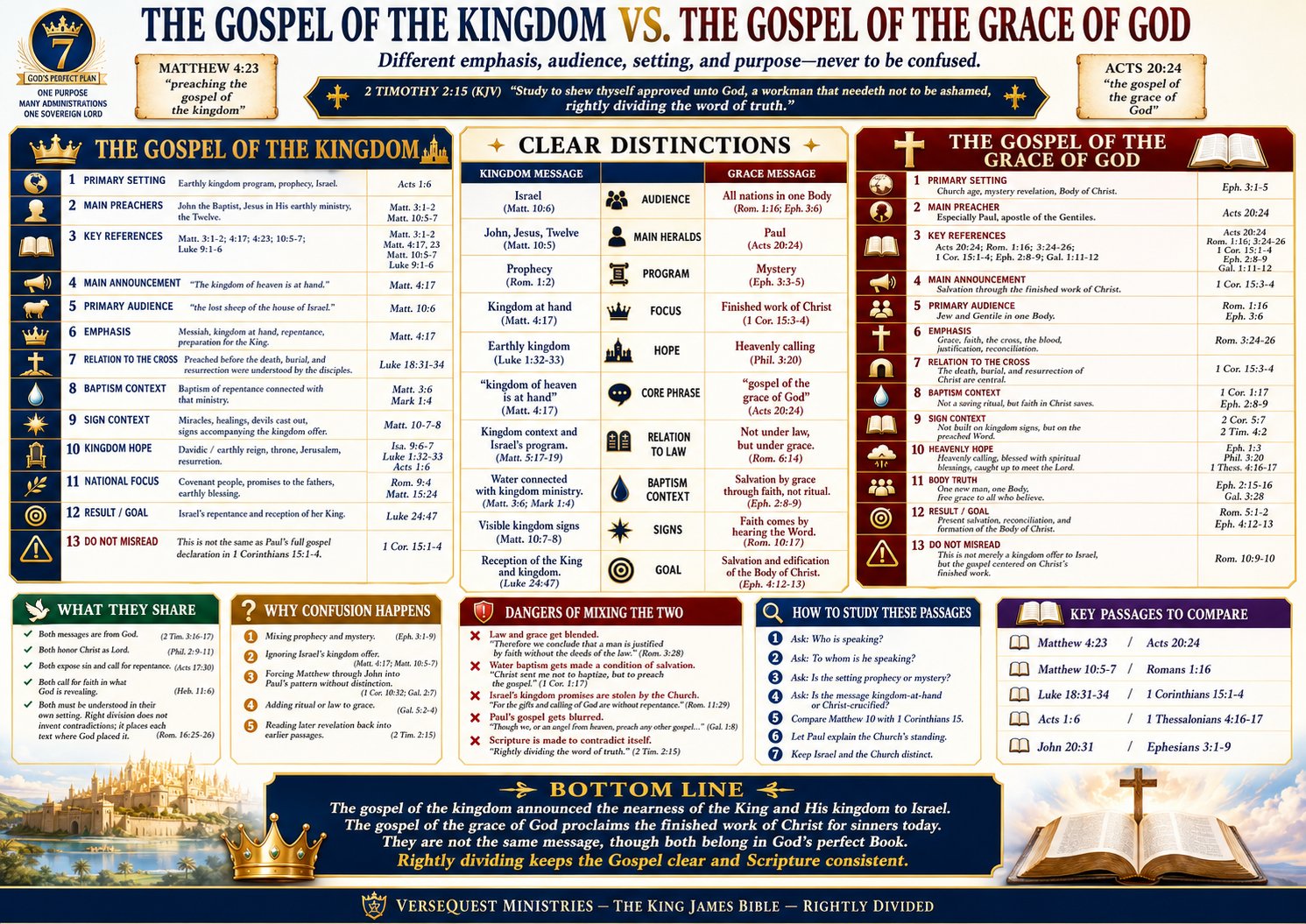
- The Gospel of the Kingdom vs. the Gospel of the Grace of God – KJV Right Division Bible Study Chart
- Compare the gospel of the kingdom and the gospel of the grace of God with this detailed KJV chart covering audience, message, prophecy, mystery, baptism, signs, salvation, and right division.
- $3.99
- Add to cart
-
-
Spiritual Growth
-
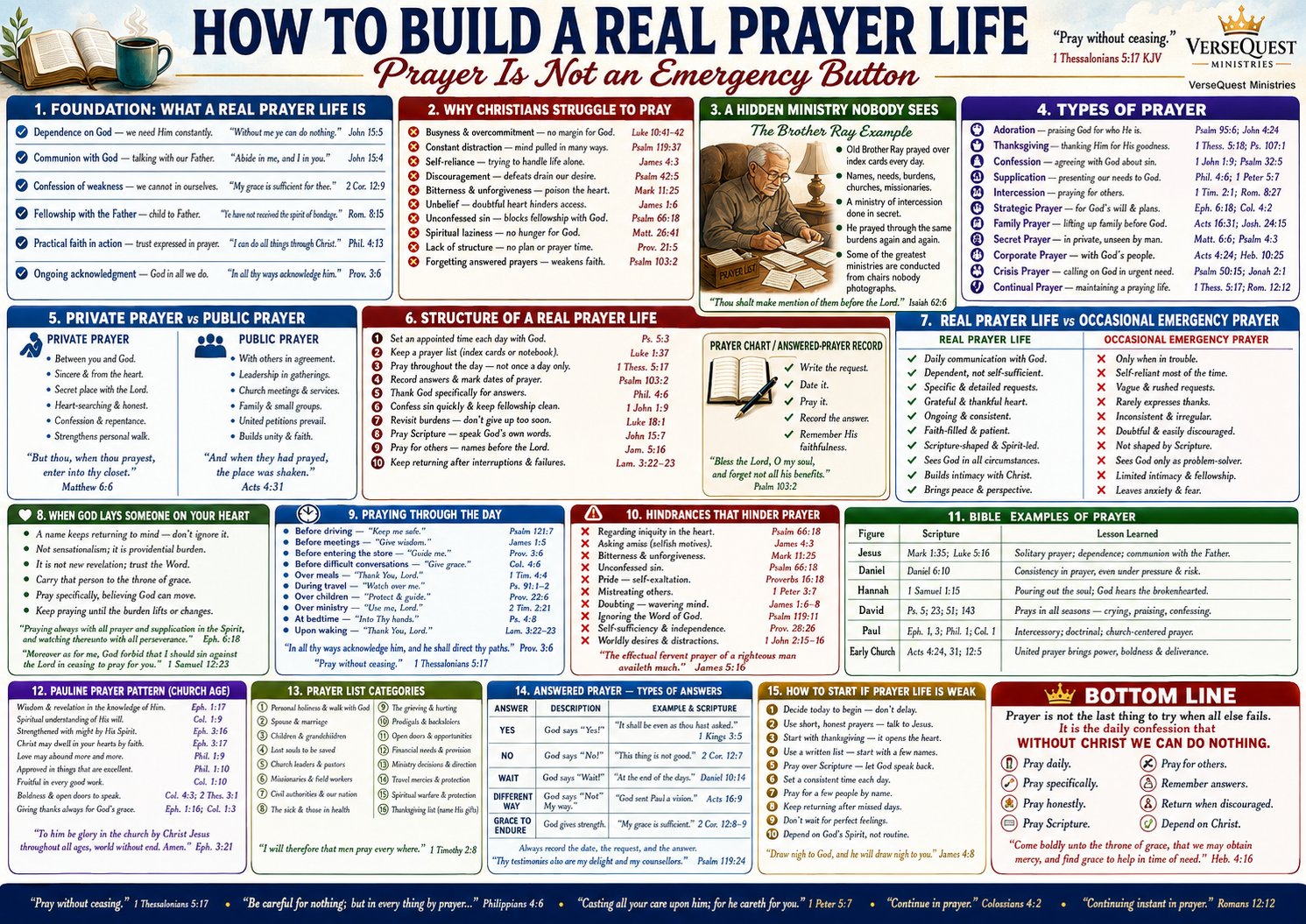
- How to Build a Real Prayer Life – Biblical Prayer Guide and KJV Bible Study Chart
- Build a consistent, biblical prayer life with this detailed KJV Bible study chart. Explore the foundations of prayer, types of prayer, common hindrances, answered prayer, Bible examples, and practical ways…
- $3.99
- Add to cart
-
-
Two Witnesses of Revelation
-
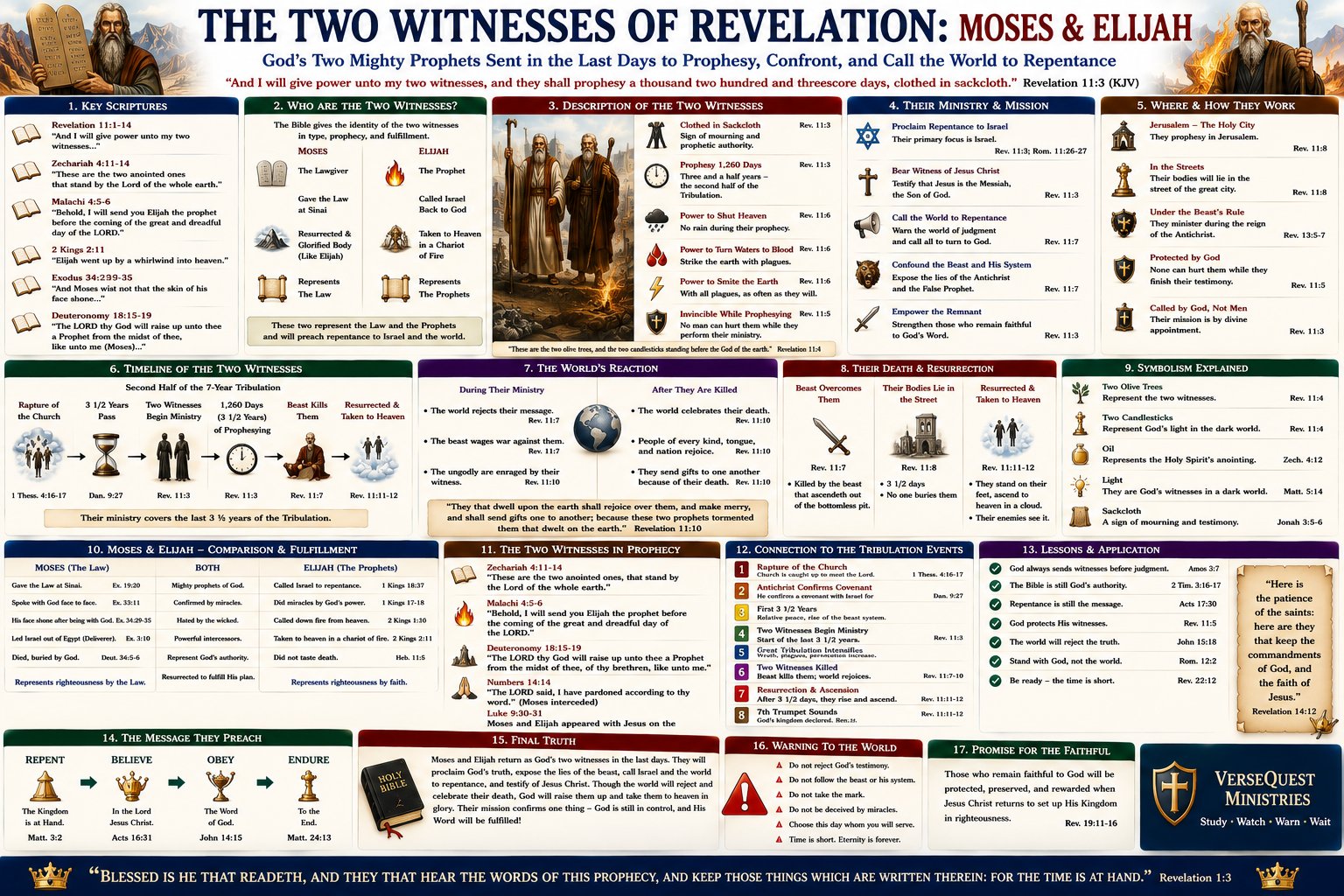
- The Two Witnesses of Revelation – Moses and Elijah, 1,260 Days of Prophecy, Their Death, Resurrection, and Ascension (KJV Bible Study Chart)
- Understand the two witnesses of Revelation with this detailed KJV chart examining the strong Moses-and-Elijah identification, their 1,260-day Tribulation ministry, sackcloth, supernatural powers, Jerusalem setting, conflict with the beast, public…
- $4.99
- Add to cart
-
-
Bitterness
-
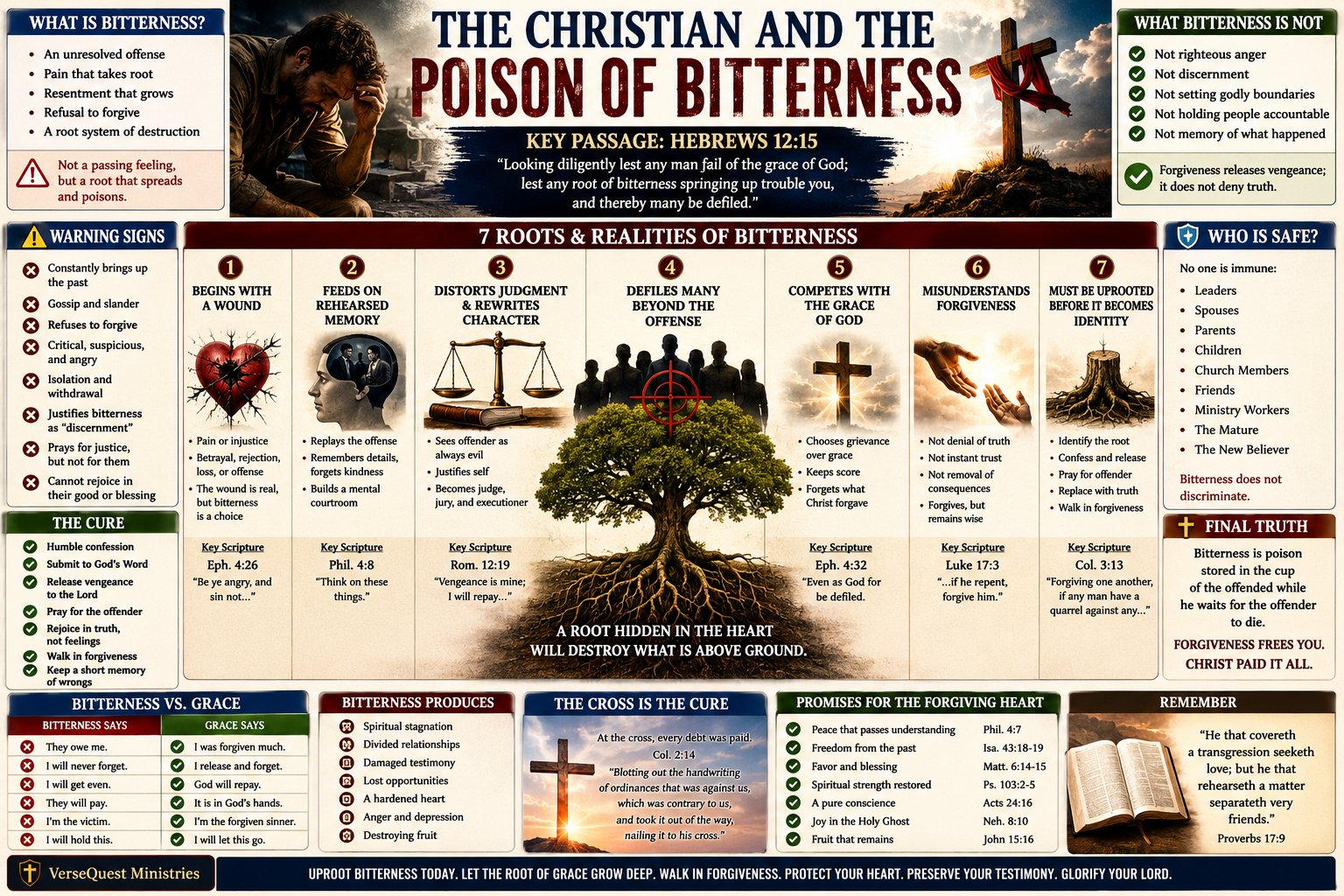
- The Christian and the Poison of Bitterness Bible Study Chart – Forgiveness, Grace, and Healing the Heart (KJV)
- Expose and uproot bitterness with this detailed KJV Bible study chart covering unresolved offenses, warning signs, forgiveness, grace, wise boundaries, the cross, and healing for the Christian heart.
- $3.99
- Add to cart
-