
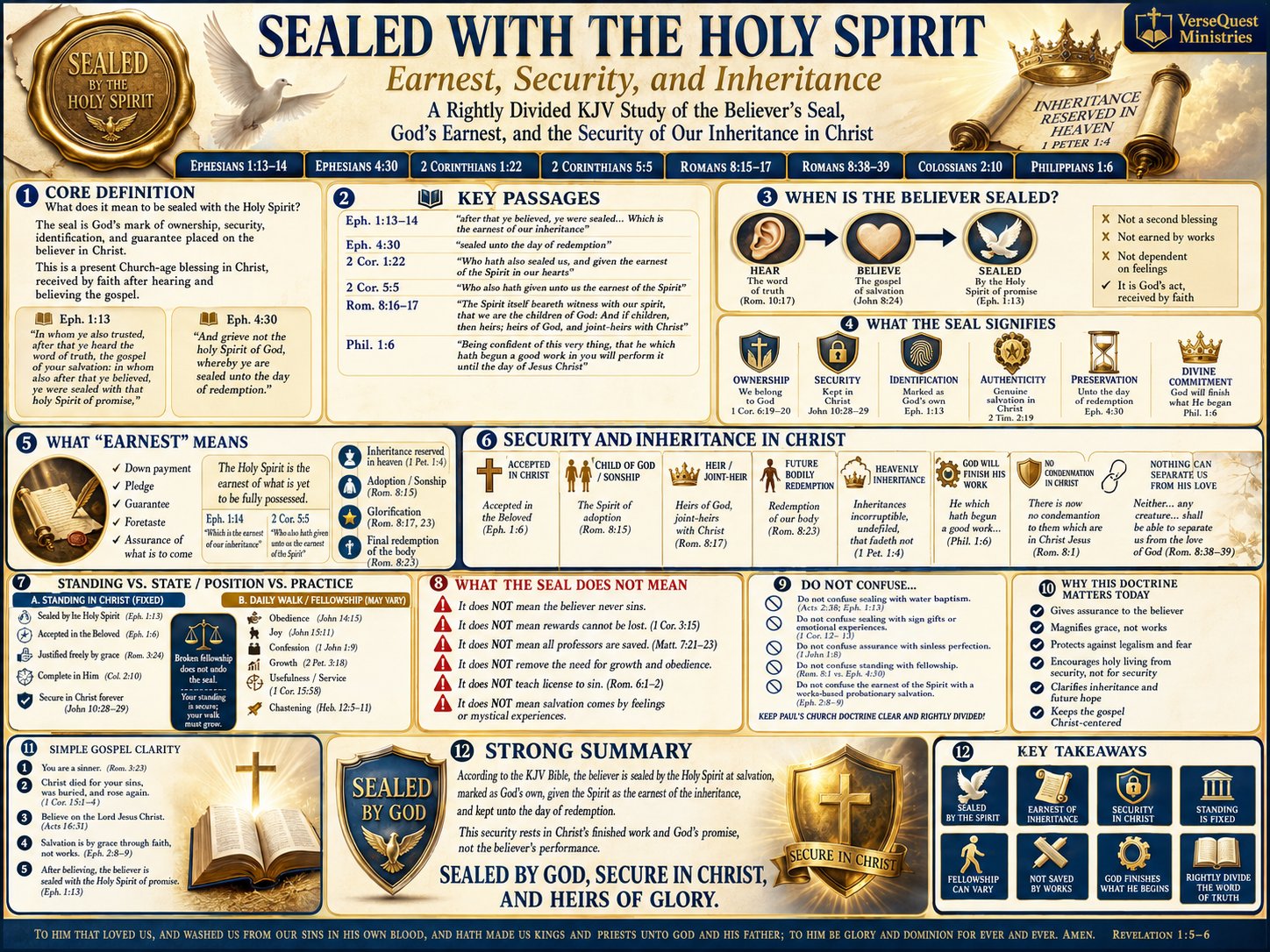
Sealed with the Holy Spirit – God’s Earnest, the Believer’s Security, and Our Guaranteed Inheritance in Christ (KJV Bible Study Chart)
Understand what it means to be sealed with the Holy Spirit with this detailed KJV chart covering God’s ownership, the earnest of the inheritance, eternal security, sonship, bodily redemption, standing versus fellowship, and salvation by grace through faith.
$3.99
Description
Sealed with the Holy Spirit: Earnest, Security, and Inheritance is a detailed KJV Bible study chart explaining what it means for a saved believer to be sealed by the Holy Spirit, when that sealing occurs, what God’s “earnest” guarantees, and how the Spirit’s presence secures the believer’s inheritance until the day of redemption.
Built around Ephesians 1:13–14, Ephesians 4:30, 2 Corinthians 1:22, 2 Corinthians 5:5, Romans 8:15–17, Romans 8:38–39, Colossians 2:10, and Philippians 1:6, this chart presents the seal of the Holy Spirit as God’s mark of ownership, identification, authenticity, preservation, security, and divine commitment upon everyone who has trusted the gospel of Jesus Christ.
Ephesians 1:13 gives the order plainly: “In whom ye also trusted, after that ye heard the word of truth, the gospel of your salvation: in whom also after that ye believed, ye were sealed with that holy Spirit of promise.”
The sinner hears the Word of Truth, believes the gospel of salvation, and is sealed with the Holy Spirit of promise. The seal is not earned after years of exceptional service, received through a second blessing, produced by emotional excitement, or proven by speaking in tongues. It is God’s saving act toward the person who believes on Jesus Christ.
The chart begins by defining the seal. To be sealed with the Holy Spirit means that God places His own mark upon the believer. The Christian is identified as belonging to God, preserved in Christ, and guaranteed the inheritance God has promised.
In ancient and biblical usage, a seal communicated ownership, authority, authenticity, security, and the certainty of an official act. God’s seal upon the believer is far greater than a mark made by any earthly ruler. It is the presence of the Holy Spirit Himself within the saved person.
The Holy Spirit does not merely deliver a certificate declaring that the believer belongs to God. He personally indwells the believer as God’s earnest and guarantee.
The doctrine is a present Church-age blessing belonging to everyone who is in Jesus Christ. It is not based upon Jewish covenant signs, Mosaic ordinances, water baptism, religious ceremony, church membership, human performance, or sacramental administration.
The believer is sealed in Christ. Every saving blessing rests upon the finished work of Jesus Christ and is received by grace through faith.
The chart gathers several foundational passages concerning the Spirit’s seal. Ephesians 1:13–14 states that the Holy Spirit is “the earnest of our inheritance until the redemption of the purchased possession.”
Ephesians 4:30 commands believers, “And grieve not the holy Spirit of God, whereby ye are sealed unto the day of redemption.”
This verse is especially important because it identifies the duration of the seal. The believer is not sealed only until his next failure, discouragement, temptation, or spiritual struggle. He is sealed unto the day of redemption.
The day of redemption includes the future redemption of the body, when the believer is raised or changed and fully conformed to the glorious body of Jesus Christ. The Spirit’s seal continues until God completes outwardly and bodily what He began spiritually at salvation.
Second Corinthians 1:22 states that God “hath also sealed us, and given the earnest of the Spirit in our hearts.” Sealing and earnest are joined together because the indwelling Spirit both marks the believer as God’s possession and guarantees what God will yet complete.
Second Corinthians 5:5 similarly declares that God “hath given unto us the earnest of the Spirit.” The Spirit’s presence within the Christian is the present guarantee of future resurrection, glorification, and heavenly inheritance.
Romans 8:16–17 teaches that the Spirit bears witness with our spirit that we are the children of God. If children, then heirs—heirs of God and joint-heirs with Christ.
The seal therefore connects directly with sonship and inheritance. God does not seal strangers who remain outside His family. He seals those who have been received through Jesus Christ and placed into the Body of Christ.
Philippians 1:6 provides another promise of divine completion: “He which hath begun a good work in you will perform it until the day of Jesus Christ.”
God does not begin salvation and then abandon the believer halfway through the journey. He starts the work, sustains the work, and completes the work.
A major section of the chart asks, “When is the believer sealed?” The biblical sequence begins with hearing the Word of Truth.
Romans 10:17 states, “So then faith cometh by hearing, and hearing by the word of God.” The sinner must hear the gospel before he can knowingly believe it.
The gospel is the good news that Jesus Christ died for our sins according to the Scriptures, was buried, and rose again the third day. Salvation rests upon Christ’s finished work rather than man’s religious performance.
The sinner then believes the gospel. John 6:47 records Christ’s promise, “He that believeth on me hath everlasting life.”
Saving faith rests in the Person and work of Jesus Christ. It does not trust baptism, church membership, law-keeping, sacraments, morality, emotional experience, family tradition, or personal merit.
After hearing and believing, the sinner is sealed with the Holy Spirit of promise. Ephesians 1:13 does not place years of discipleship, visible fruit, charismatic experience, or denominational approval between faith and sealing.
The believer is sealed at salvation. The seal is not a later reward for superior spirituality. It belongs to every person who has truly trusted Jesus Christ.
This means that a young Christian, though immature in knowledge and conduct, possesses the same divine seal as a believer who has walked faithfully with Christ for many decades.
Spiritual maturity affects understanding, usefulness, conduct, testimony, fellowship, and reward. It does not create a stronger grade of the Holy Spirit’s seal.
The chart clearly states what sealing is not. It is not a second blessing reserved for a spiritual elite.
Some systems divide Christians into ordinary believers who have Christ and advanced believers who have finally received the Holy Spirit. Romans 8:9 rejects that division by stating that anyone who does not possess the Spirit of Christ does not belong to Christ.
Every genuine believer is indwelt and sealed by the Holy Spirit. Christians may differ greatly in maturity, yieldedness, filling, understanding, boldness, and fruitfulness, but the Spirit’s indwelling presence belongs to all who are in Christ.
The seal is not earned by works. Ephesians 2:8–9 teaches that salvation is by grace through faith and not of works.
A sinner cannot earn the Holy Spirit through religious achievement. Neither can a saved believer preserve the seal by accumulating sufficient merit.
The seal is also not dependent upon feelings. A Christian may feel spiritually strong one day and weary the next. He may experience joy, sorrow, confidence, fear, victory, temptation, peace, or distress.
Those changing emotions do not open and close God’s seal. The believer’s security rests upon God’s promise rather than emotional awareness.
The seal is God’s act received by faith. Human beings do not place themselves into Christ, regenerate their own spirits, or stamp divine ownership upon their souls.
The Father saves according to His purpose, the Son completes redemption through His blood, and the Holy Spirit seals the person who believes.
A major section explains what the seal signifies. First, it signifies ownership. The believer belongs to God.
First Corinthians 6:19–20 teaches that Christians are not their own because they have been bought with a price. The price was the blood of Jesus Christ.
The Holy Spirit’s presence marks the believer as the purchased possession of God. The Christian’s body, time, abilities, thoughts, relationships, and service should therefore be surrendered to the One who owns him.
Ownership does not produce spiritual oppression. Belonging to Christ is the believer’s liberty, safety, identity, and eternal blessing.
Second, the seal signifies security. John 10:28–29 records Christ declaring that His sheep possess eternal life, shall never perish, and cannot be plucked from His hand or the Father’s hand.
The Spirit’s seal agrees with the promises of the Father and Son. The Trinity does not work at cross purposes, with Christ giving eternal life while the Spirit provides only temporary security.
Third, the seal signifies identification. The believer is marked as one of God’s own.
Ephesians 1:13 calls Him the Holy Spirit of promise. His indwelling presence identifies the believer with Jesus Christ and the Body of Christ.
The believer’s identity is not finally determined by earthly nationality, social status, education, wealth, denomination, former sins, family history, or human reputation. His central spiritual identity is found in Christ.
Fourth, the seal signifies authenticity. The indwelling Holy Spirit confirms genuine salvation.
Second Timothy 2:19 declares, “The Lord knoweth them that are his.” God is never confused concerning who belongs to Him.
Human beings may be deceived by outward profession, religious vocabulary, church activity, or emotional display. God sees the heart and knows those who have truly trusted His Son.
The doctrine of sealing does not teach that every outward professor is saved. It teaches that everyone genuinely saved is known, owned, indwelt, and sealed by God.
Fifth, the seal signifies preservation. Ephesians 4:30 states that the believer is sealed unto the day of redemption.
Preservation does not mean that believers are placed in spiritual storage and never called to obedience. It means that God guards His saving work while continuing to discipline, teach, correct, and sanctify His children.
Sixth, the seal signifies divine commitment. Philippians 1:6 promises that God will finish what He began.
The Christian’s confidence is not that he possesses enough determination to complete salvation. His confidence is that God is faithful, Christ’s work is finished, and the Spirit’s seal remains effective.
The chart gives special attention to the word “earnest.” In Scripture, an earnest is a down payment, pledge, guarantee, first portion, or present assurance of what will later be fully possessed.
The Holy Spirit is not merely a verbal promise that an inheritance exists. He is God’s present guarantee within the believer.
The earnest is not the entire future inheritance in its completed form, but it guarantees that the complete inheritance will come.
A down payment establishes that a transaction is real and that the remaining possession has been secured. God’s earnest is infinitely stronger than a human financial pledge because God cannot lie, fail, weaken, forget, or become unable to complete His promise.
The Spirit’s present indwelling provides a foretaste of what believers will experience in fullness. Christians presently know fellowship with God, spiritual life, divine comfort, scriptural illumination, prayer, transformation, and the fruit of the Spirit.
Yet they still await the redemption of the body, deliverance from the presence of sin, resurrection glory, complete conformity to Christ, and full enjoyment of the heavenly inheritance.
The earnest assures the believer that present weakness will not be the final chapter. The mortal body will be changed. Corruption will put on incorruption. Death will be swallowed up in victory.
Ephesians 1:14 calls the Holy Spirit “the earnest of our inheritance until the redemption of the purchased possession, unto the praise of his glory.”
The phrase “purchased possession” reminds the believer that he belongs to God through redemption. The blood of Christ paid the price, and the Spirit’s seal guarantees the completion.
The chart presents several aspects of the believer’s security and inheritance in Christ. The believer is accepted in Christ.
Ephesians 1:6 states that believers are accepted in the Beloved. The Father does not accept the Christian because of his independent worthiness but because he is united with Jesus Christ.
The believer possesses sonship. Romans 8:15 teaches that Christians have received the Spirit of adoption and may cry, “Abba, Father.”
The Holy Spirit does not make the believer a fearful servant who must continually wonder whether he still belongs in the household. He bears witness to the believer’s standing as a child of God.
The believer is an heir and joint-heir with Christ. Romans 8:17 connects sonship with inheritance.
The Christian’s future is not determined by his present bank account, health, social influence, political conditions, or earthly possessions. His inheritance is connected with Jesus Christ.
The believer possesses the promise of future bodily redemption. Romans 8:23 describes believers waiting for “the adoption, to wit, the redemption of our body.”
This does not mean present sonship is incomplete or uncertain. It means that the full outward manifestation of sonship awaits resurrection and glorification.
The believer presently possesses spiritual life in Christ while continuing to inhabit a mortal, corruptible body. The seal guarantees that the body itself will one day be redeemed.
The believer has a heavenly inheritance. First Peter 1:4 describes an inheritance incorruptible, undefiled, unfading, and reserved in heaven.
Earthly inheritances may be stolen, wasted, taxed, disputed, corrupted, or destroyed. The believer’s inheritance is guarded by God.
The chart also emphasizes that God will finish His work. Philippians 1:6 moves assurance away from self-confidence and places it upon divine faithfulness.
The believer has no condemnation in Christ. Romans 8:1 declares the eternal verdict settled.
The Spirit’s seal does not coexist with an uncertain judicial status. The same believer who is sealed is also justified, accepted, complete, and free from eternal condemnation.
Finally, nothing can separate believers from God’s love. Romans 8:38–39 lists death, life, angels, principalities, powers, present things, future things, height, depth, and every other creature.
None of these can separate the believer from the love of God in Jesus Christ. The believer himself is a creature, which means he is included within the category that cannot overturn God’s saving love.
The chart carefully distinguishes standing from state, or position from practice. The believer’s standing in Christ is fixed.
He is sealed by the Holy Spirit, accepted in the Beloved, justified freely by grace, complete in Christ, and secure in the Saviour forever.
These truths describe God’s saving accomplishments rather than the believer’s fluctuating daily experience.
The believer’s daily walk may vary. His obedience may strengthen or weaken. Joy may rise or fall. Fellowship may be enjoyed or damaged.
He may confess sin promptly or resist conviction. He may grow in grace or become spiritually stagnant. He may serve faithfully or waste opportunities.
He may experience chastening when he disobeys. Hebrews 12 teaches that the Father disciplines His children.
Broken fellowship does not undo the seal. A disobedient child remains a child, though his fellowship, joy, testimony, usefulness, and reward may suffer.
First John 1:9 provides confession and cleansing within the believer’s walk. It does not instruct the Christian to become resealed every time he fails.
The believer’s standing remains secure, but his walk must grow. Eternal security is not a substitute for practical sanctification.
This distinction keeps grace pure without turning grace into carelessness. The Christian does not obey to prevent the Holy Spirit from abandoning him. He obeys because the Spirit of God already lives within him.
The chart explains what the seal does not mean. It does not mean that a believer never sins.
First John 1:8 states that anyone claiming to have no sin deceives himself. The sealed believer still carries the flesh and remains capable of failure.
The Holy Spirit’s seal does not teach sinless perfection. It teaches God’s ownership and preservation of an imperfect believer whom He is progressively sanctifying.
The seal does not mean that Christian rewards cannot be lost. First Corinthians 3 teaches that a believer’s works may be burned while he himself remains saved.
Eternal life is God’s gift; reward is connected with service. The seal guarantees inheritance and salvation but does not promise equal reward regardless of conduct.
The seal does not mean that every outward professor is saved. Matthew 7 describes religious workers whom Christ never knew.
Religious activity, miracles, preaching, emotional experiences, and Christian vocabulary cannot replace personal faith in the true gospel.
The doctrine applies to those who have genuinely heard and believed the gospel, not everyone who claims the name of Christ.
The seal does not remove the need for growth and obedience. Ephesians 4:30 itself commands believers not to grieve the Spirit who sealed them.
The fact that He can be grieved proves that Christian conduct matters. Sin does not break the seal, but it brings sorrow to the Holy Spirit and damages fellowship.
The seal does not provide license to sin. Romans 6 asks whether believers should continue in sin because grace abounds and answers, “God forbid.”
Security should motivate holiness. The believer’s body is God’s temple and should not be surrendered to the flesh.
The seal does not mean salvation comes through feelings or mystical experiences. A person may feel peace and remain unsaved, while a genuine believer may pass through seasons of emotional heaviness.
Assurance must rest upon the gospel and the written promises of God rather than the intensity of a subjective experience.
The chart includes a strong “Do Not Confuse” section. Sealing must not be confused with water baptism.
A minister can place a person into water, but only the Holy Spirit can place a believer spiritually into the Body of Christ and seal him unto redemption.
Acts 16:31 answers the salvation question by directing the sinner to believe on the Lord Jesus Christ. Ephesians 1:13 connects sealing with hearing and believing the gospel.
Water may serve as an outward ceremony in particular biblical settings, but it does not place God’s inward seal upon the soul.
Sealing must not be confused with sign gifts or emotional experiences. The presence of tongues, healings, visions, trembling, excitement, tears, or dramatic feelings is not the biblical test of sealing.
God’s seal belongs to all believers, while spiritual gifts, ministries, temperaments, and emotional experiences vary.
Assurance must not be confused with sinless perfection. A believer may know he is sealed while honestly confessing his continuing need for growth and cleansing.
Standing must not be confused with fellowship. The believer’s position is secure, while daily communion may be damaged by unconfessed sin.
The earnest of the Spirit must not be confused with a works-based probationary system in which God gives temporary salvation and waits to see whether the sinner performs well enough to keep it.
An earnest is a guarantee, not a threat. God gives the Spirit because He has committed Himself to complete the inheritance.
The chart calls believers to keep Paul’s Church doctrine clear and rightly divided. The sealing passages in Ephesians and Corinthians belong directly to the Body of Christ in the present dispensation of grace.
Old Testament saints experienced the Spirit’s working in ways connected with Israel’s covenants, offices, prophets, kings, judges, craftsmen, and national program. The Spirit could come upon particular people for particular service.
The present Church-age believer is spiritually placed into Christ, indwelt by the Spirit, and sealed unto the day of redemption.
Pentecostal signs, apostolic transitions, Israel’s Kingdom offer, and later Church doctrine must not be collapsed into one undifferentiated system.
Right division allows every passage to remain true in the setting where God placed it while preserving the clarity of the gospel and the believer’s present standing.
A major section explains why this doctrine matters. First, it gives assurance to the believer.
The Christian does not need to wake each morning wondering whether God’s seal disappeared overnight. He may examine his walk honestly without questioning Christ’s ability to preserve salvation.
Second, the doctrine magnifies grace rather than works. The believer did not earn the seal and cannot boast in possessing it.
The Holy Spirit’s presence testifies to God’s mercy, Christ’s redemption, and the freeness of salvation.
Third, the doctrine protects against legalism and fear. A works system makes the believer continually afraid that one failure will reverse justification, cancel sonship, remove the Spirit, and destroy eternal life.
The seal teaches that God’s saving relationship rests upon Christ’s finished work rather than human perfection.
Fourth, the doctrine encourages holy living from security rather than for security.
The believer should not serve God as a frightened labourer attempting to prevent expulsion. He should obey as a redeemed son who belongs to the Father.
Fifth, the doctrine clarifies inheritance and future hope. The Holy Spirit is the earnest of what God will complete.
The believer’s body may weaken and die, but the seal remains until bodily redemption. The grave cannot cancel the inheritance.
Sixth, the doctrine keeps the gospel Christ-centred. The believer’s security is not ultimately about his grip upon God but God’s grip upon him.
The Father owns him, the Son redeemed him, and the Holy Spirit sealed him.
The chart includes a simple gospel presentation. Every person is a sinner. Romans 3:23 declares that all have sinned and come short of God’s glory.
Jesus Christ died for our sins, was buried, and rose again according to the Scriptures. His blood paid the penalty, and His resurrection proved the sufficiency of His work.
The sinner must believe on the Lord Jesus Christ. Acts 16:31 gives the direct promise: “Believe on the Lord Jesus Christ, and thou shalt be saved.”
Salvation is by grace through faith and not of works. The sinner does not purchase eternal life through baptism, church activity, surrender contracts, law-keeping, moral reform, or religious performance.
After believing, the sinner is sealed with the Holy Spirit of promise. The seal does not complete an insufficient gospel; it is part of the saving work God performs in the person who trusts Christ.
The chart’s strong summary is clear: according to the King James Bible, the believer is sealed by the Holy Spirit at salvation, marked as God’s possession, given the Spirit as the earnest of the inheritance, and kept until the day of redemption.
This security rests upon the finished work of Jesus Christ and the promise of God rather than the believer’s performance.
The sealed Christian may experience broken fellowship, chastening, temptation, spiritual weakness, and loss of reward. These realities affect his daily walk but do not dissolve God’s seal.
The believer’s position is fixed, although his practical walk must continue to grow. He is sealed by God, secure in Christ, and an heir of glory.
The doctrine’s key takeaways are memorable: sealed by the Spirit, given the earnest of the inheritance, secure in Christ, standing fixed, fellowship able to vary, not saved by works, God finishing what He begins, and the Word of Truth rightly divided.
This resource is ideal for personal Bible study, Holy Spirit doctrine, eternal-security teaching, assurance counseling, Ephesians studies, new-believer discipleship, inheritance and sonship lessons, standing-versus-state instruction, pastoral counseling, Sunday school, homeschool Bible curriculum, Christian schools, Bible institutes, sermon preparation, and church membership classes.
Sealed with the Holy Spirit, Holy Spirit of promise, earnest of the inheritance, Ephesians 1:13–14, Ephesians 4:30, sealed unto the day of redemption, eternal security, assurance of salvation, God’s ownership, spiritual identification, preservation in Christ, divine authenticity, Spirit indwelling, Spirit baptism, inheritance in Christ, heirs of God, joint-heirs with Christ, redemption of the body, standing versus state, salvation by grace
The Holy Spirit’s seal is God’s mark of ownership, identification, security, preservation, and guarantee upon the believer.
The seal is received after hearing and believing the gospel of Jesus Christ.
Ephesians 1:13 gives the order: hear the Word of Truth, believe the gospel, and be sealed with the Holy Spirit of promise.
The seal is not earned by works, spiritual maturity, religious ceremony, or personal merit.
It is not a second blessing reserved for advanced Christians.
Every genuine Church-age believer possesses the indwelling Holy Spirit.
Romans 8:9 teaches that anyone without the Spirit of Christ does not belong to Christ.
The believer may require filling, growth, correction, and greater yieldedness, but he does not require a second indwelling.
The seal does not depend upon feelings. Emotional awareness may change while God’s promise remains settled.
The seal identifies the believer as God’s purchased possession.
Christians are not their own because they were bought with the blood of Jesus Christ.
The seal signifies security. Christ’s sheep possess eternal life and shall never perish.
The seal signifies authenticity. God knows those who truly belong to Him.
Outward profession, church activity, or emotional experience cannot create the seal.
The seal signifies preservation unto the day of redemption.
Ephesians 4:30 connects the seal directly with the future completion of redemption.
The seal signifies God’s commitment to complete the saving work He began.
Philippians 1:6 grounds completion in God’s faithfulness.
The Holy Spirit is the earnest of the believer’s inheritance.
An earnest is a down payment, pledge, guarantee, first portion, and assurance of what is to come.
God’s earnest cannot fail because God cannot lie or default upon His promise.
The Spirit’s present indwelling guarantees the future redemption of the body.
Believers presently possess spiritual life while awaiting resurrection and glorification.
The seal connects with sonship. The Spirit bears witness that believers are God’s children.
Children of God are heirs of God and joint-heirs with Christ.
The believer’s inheritance is incorruptible, undefiled, unfading, and reserved in heaven.
The believer is accepted in Christ, justified, complete, and free from condemnation.
Nothing can separate the believer from God’s love in Jesus Christ.
Standing in Christ is fixed, while daily state and fellowship may vary.
The sealed believer may still sin and must confess honestly.
Broken fellowship does not undo the Spirit’s seal.
The believer may experience chastening because God disciplines His children.
Reward may be lost even though salvation remains secure.
The seal does not guarantee equal reward or excuse unfaithful service.
The seal does not teach that every outward professor is saved.
It belongs to those who have genuinely believed the gospel.
The seal does not eliminate the need for spiritual growth and obedience.
Believers are commanded not to grieve the Holy Spirit who sealed them.
Security is not license to sin. Grace teaches holy living.
Sealing should not be confused with water baptism.
Water is an outward element; the Spirit’s seal is God’s inward saving work.
Sealing should not be confused with tongues, signs, visions, emotion, or mystical experience.
Assurance should not be confused with sinless perfection.
Standing should not be confused with fellowship.
The Spirit’s earnest is not a temporary probationary arrangement based upon future works.
Right division keeps Pauline Church doctrine distinct from Israel’s signs, ordinances, and transitional Acts settings.
The doctrine of sealing gives assurance, magnifies grace, protects against legalism, encourages holiness, clarifies inheritance, and keeps Jesus Christ central.
The believer does not serve to obtain security. He serves because God has already secured him in Christ.
Holy Spirit sealing studies, eternal-security instruction, assurance-of-salvation counseling, Ephesians 1 teaching, Ephesians 4 studies, explaining the earnest of the Spirit, inheritance and sonship lessons, standing-versus-state teaching, fellowship-versus-relationship studies, new-believer discipleship, refuting works-based salvation, baptismal-regeneration apologetics, spiritual-growth classes, pastoral counseling, church membership instruction, Sunday school lessons, homeschool Bible curriculum, Christian school teaching, Bible institute classes, sermon preparation
King James Bible, Strong’s Concordance, Thompson Chain-Reference Bible, Treasury of Scripture Knowledge, Nave’s Topical Bible, Ephesians 1–4 study notes, Romans 8 commentary materials, Second Corinthians 1 and 5 studies, Holy Spirit doctrine worksheets, eternal-security Scripture cards, assurance-of-salvation workbooks, standing-versus-state charts, adoption and inheritance studies, Spirit-baptism resources, Pauline epistle outlines, VerseQuest salvation and Holy Spirit charts
Related products
-
Righteousness of Christ
-
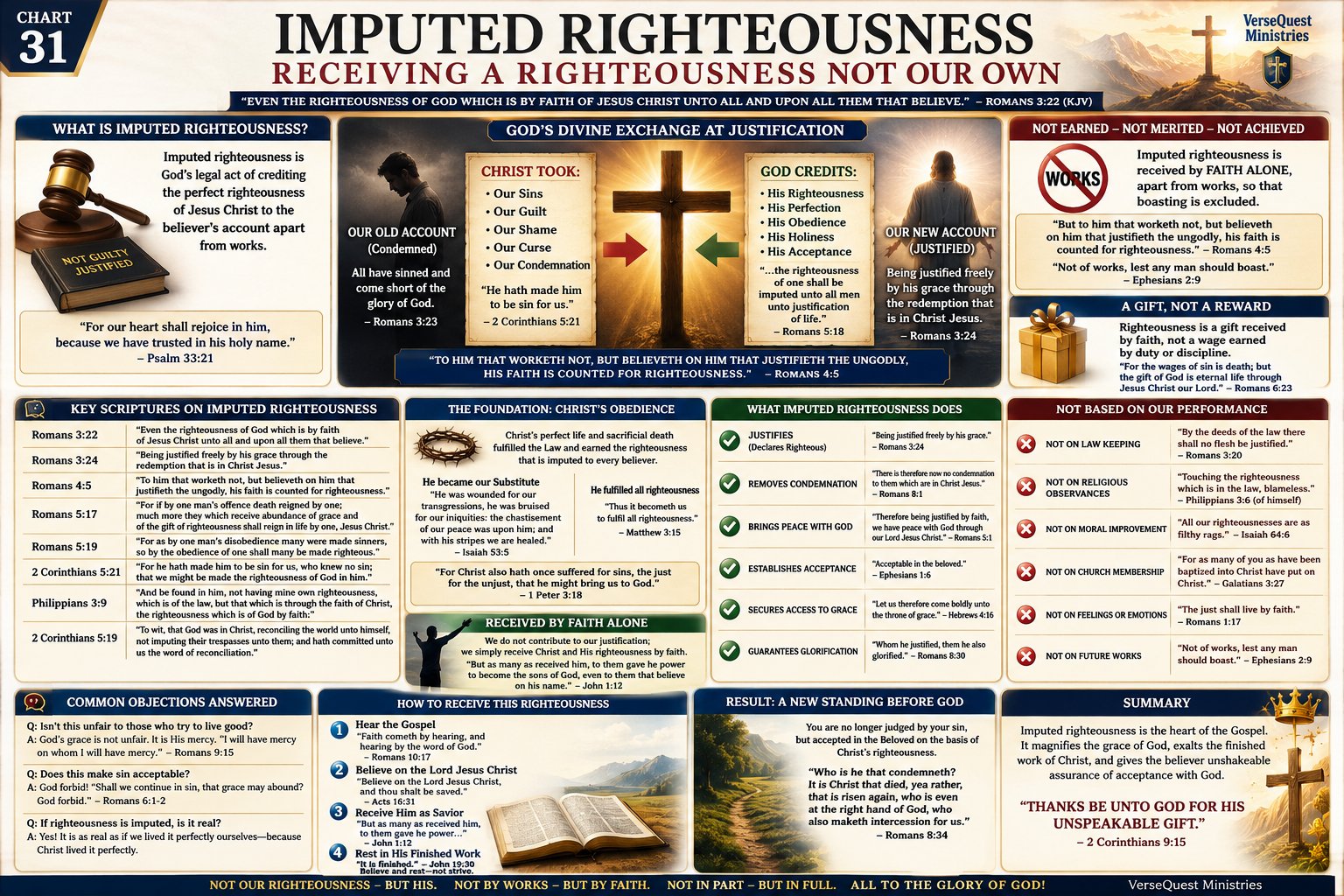
- Imputed Righteousness – The Righteousness of Jesus Christ Credited to the Believer by Faith Alone (KJV Bible Study Chart)
- Understand imputed righteousness with this detailed KJV chart explaining the divine exchange, justification by faith, Christ’s righteousness credited to the believer, peace with God, no condemnation, and acceptance apart from…
- $3.99
- Add to cart
-
-
No Condemnation
-
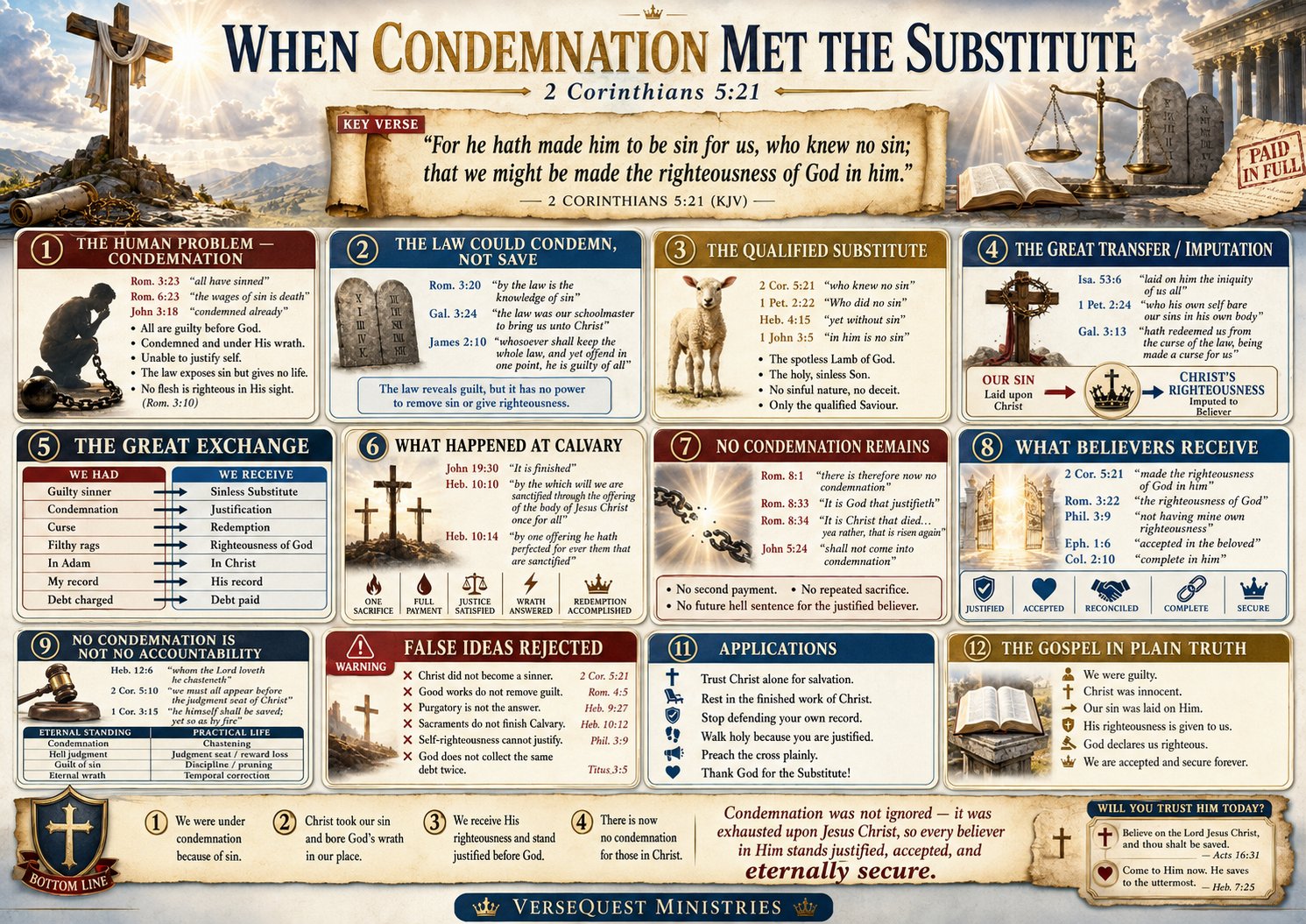
- When Condemnation Met the Substitute – 2 Corinthians 5:21, Imputed Righteousness, and No Condemnation in Christ (KJV Bible Study Chart)
- Understand 2 Corinthians 5:21 with this detailed KJV Bible study chart covering condemnation, Christ the sinless Substitute, imputed righteousness, justification, the great exchange, and eternal security.
- $3.99
- Add to cart
-
-
The Gospel of the Kingdom
-
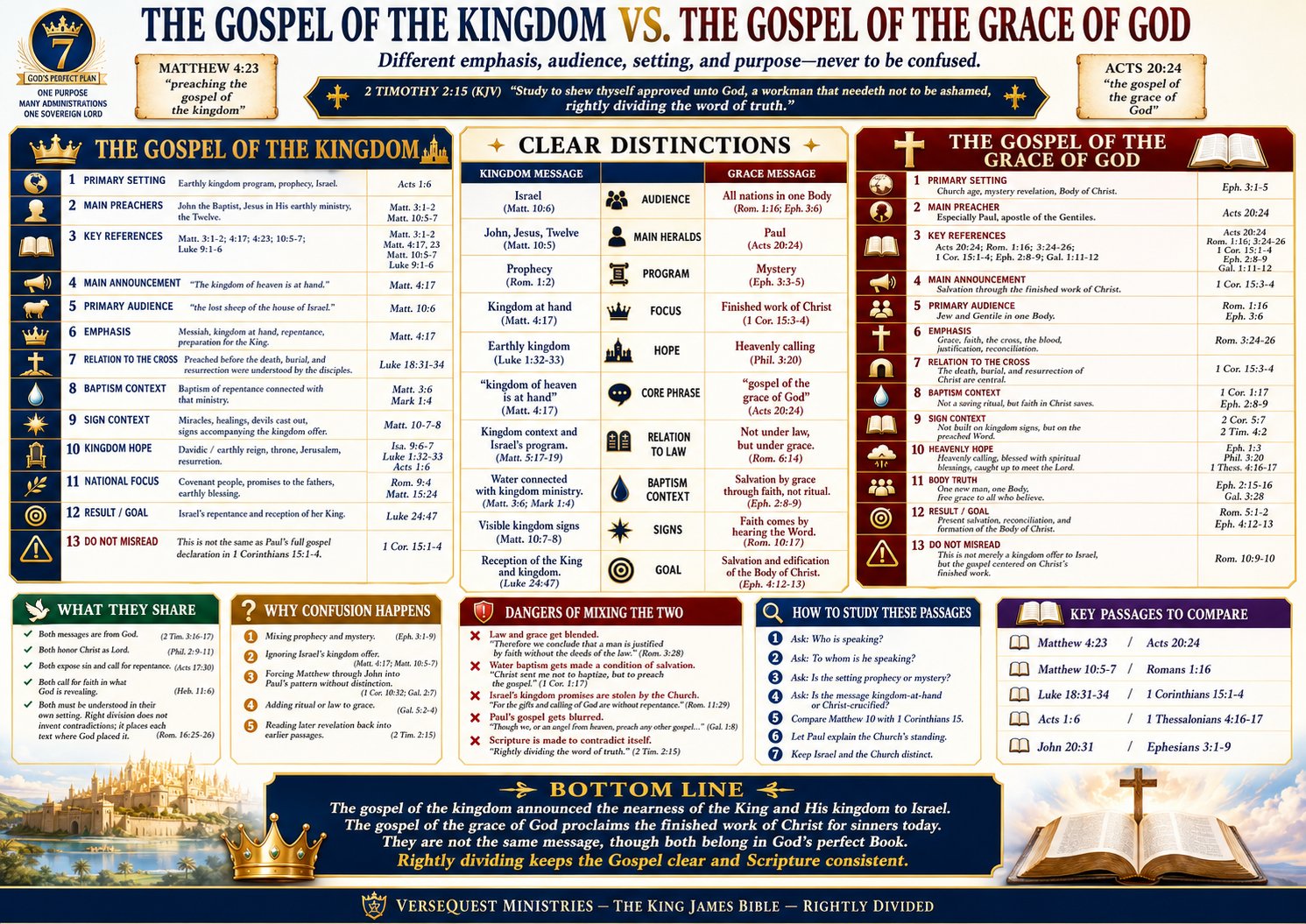
- The Gospel of the Kingdom vs. the Gospel of the Grace of God – KJV Right Division Bible Study Chart
- Compare the gospel of the kingdom and the gospel of the grace of God with this detailed KJV chart covering audience, message, prophecy, mystery, baptism, signs, salvation, and right division.
- $3.99
- Add to cart
-
-
Proper Role of Works
-
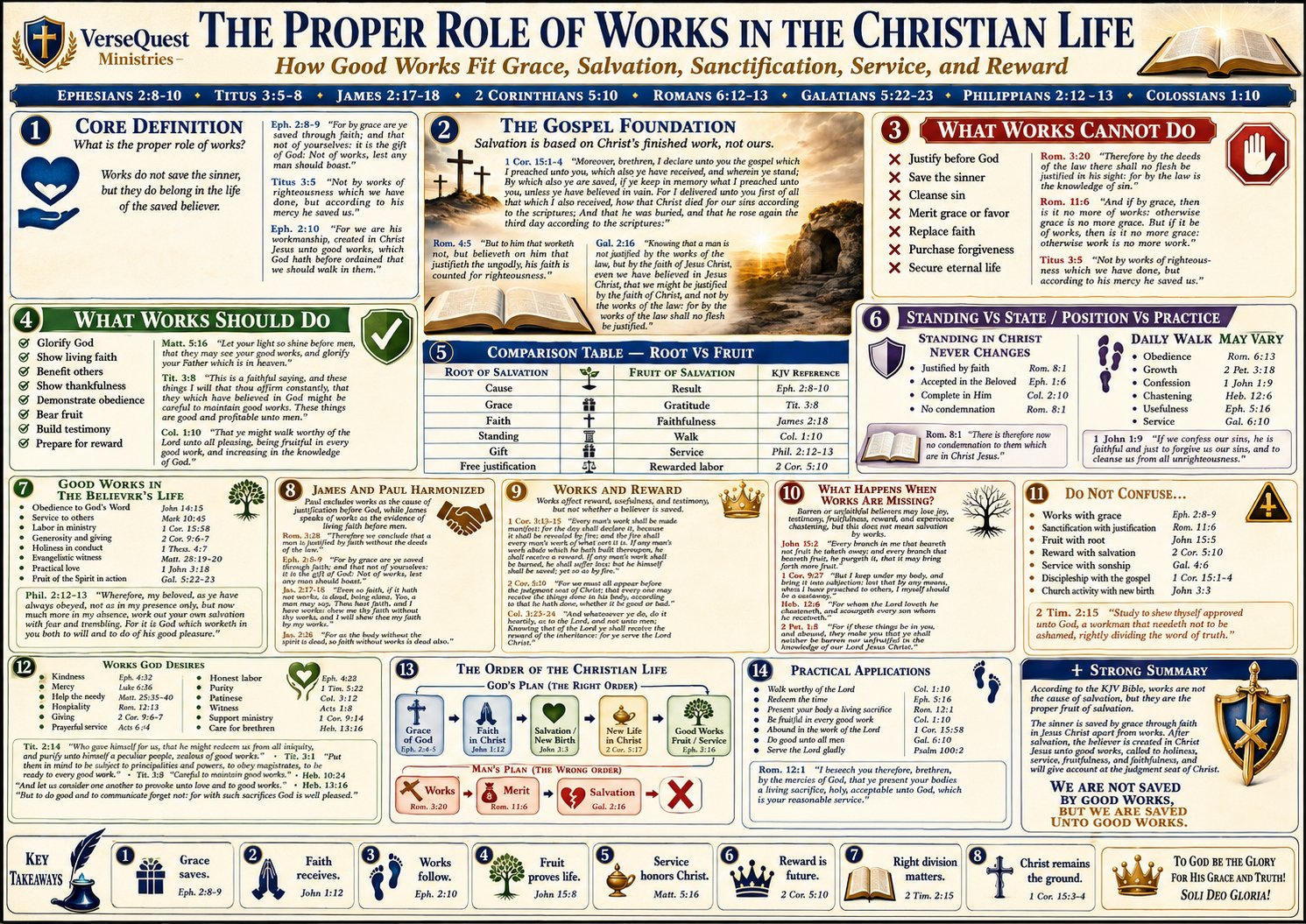
- The Proper Role of Works in the Christian Life – Grace, Salvation, Sanctification, Service, Fruit, and Reward (KJV Bible Study Chart)
- Understand the proper role of good works with this detailed KJV chart covering salvation by grace, sanctification, service, living faith, spiritual fruit, standing versus practice, the judgment seat of Christ,…
- $3.99
- Add to cart
-
-
Romans and James
-
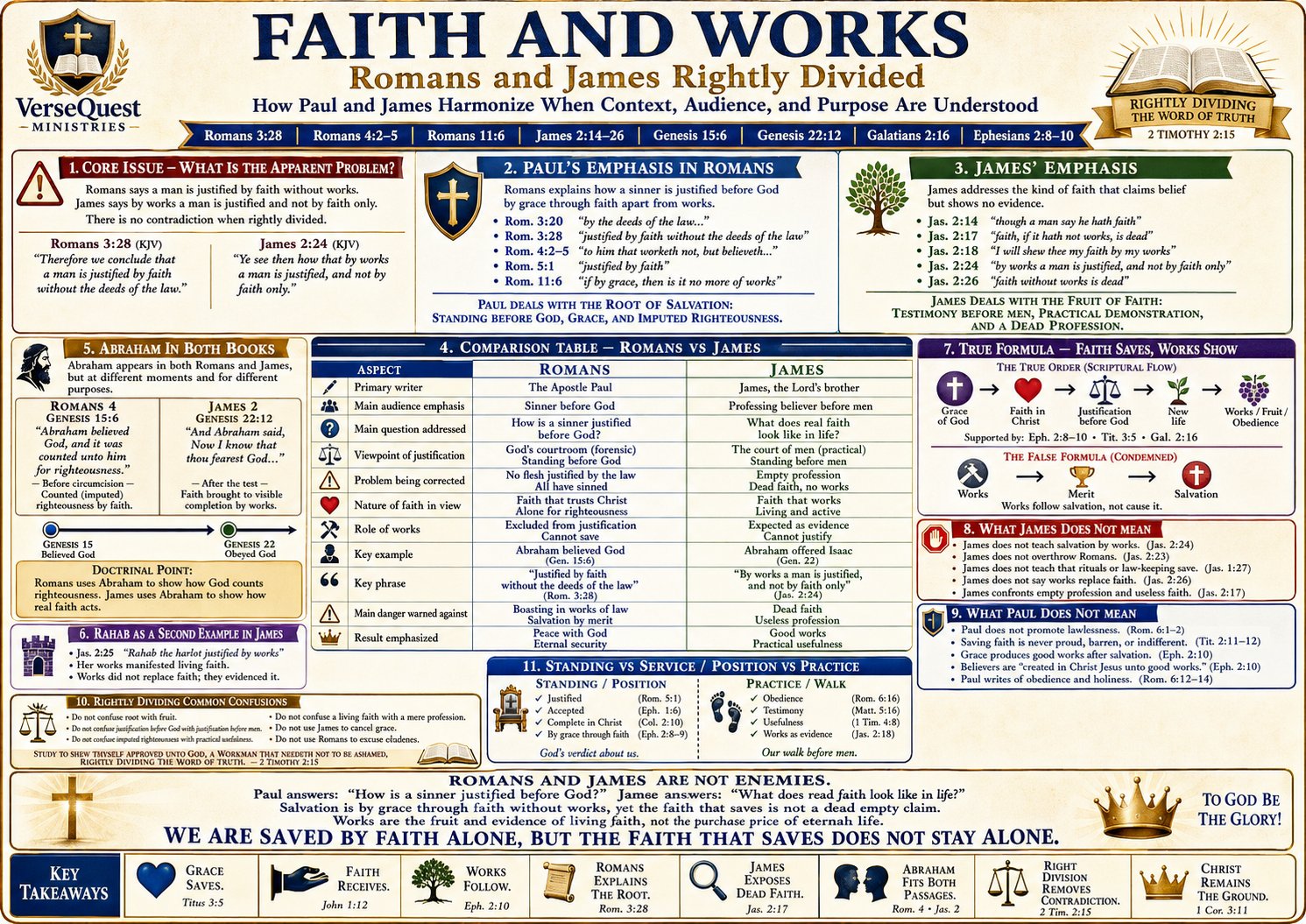
- Faith and Works – Romans and James Rightly Divided: Justification Before God and the Evidence of Living Faith (KJV Bible Study Chart)
- Understand how Romans and James harmonize with this detailed KJV chart covering justification by faith, dead profession, Abraham, Rahab, grace versus works, and the difference between salvation’s root and its…
- $3.99
- Add to cart
-