
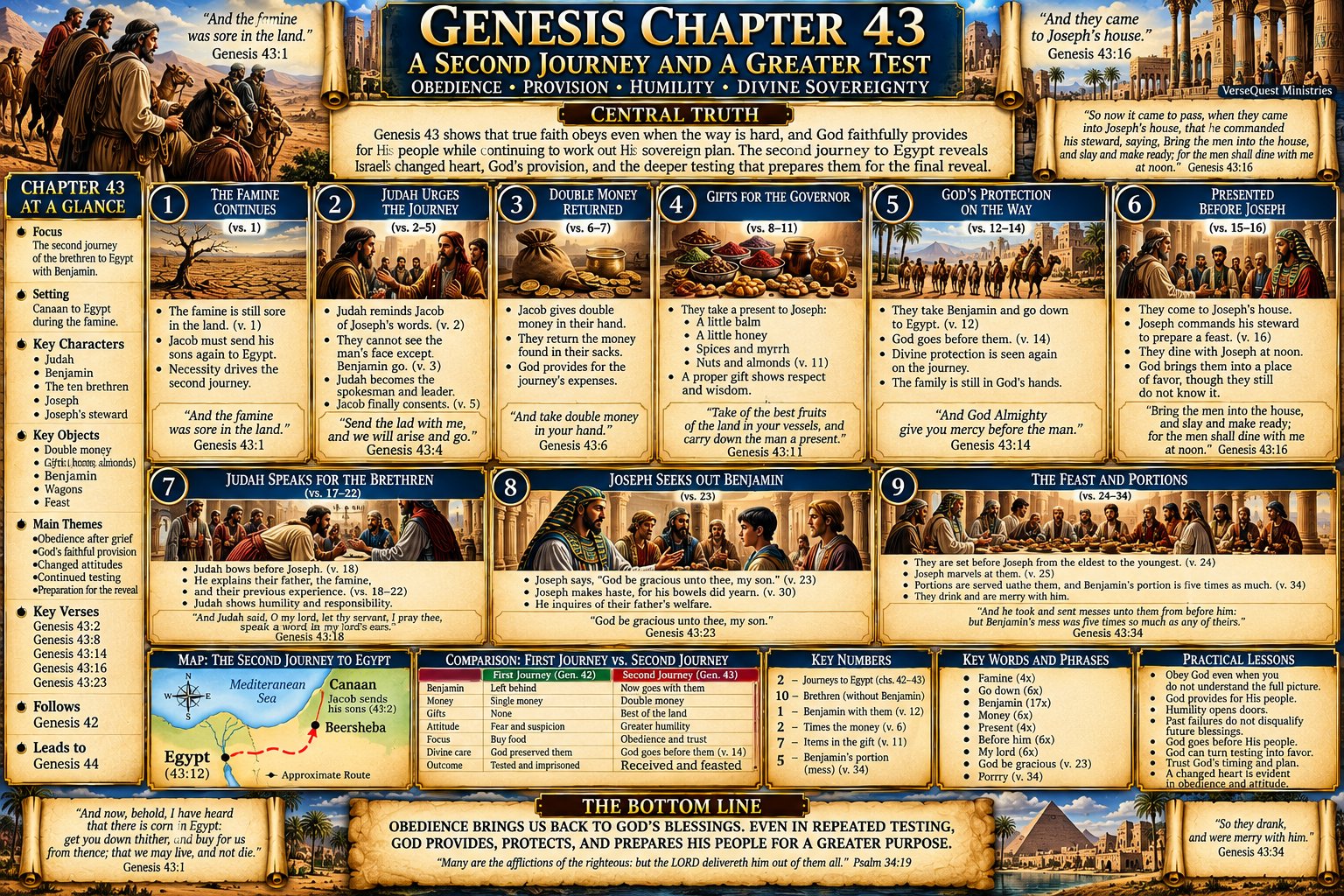
Genesis 43 – The Second Journey to Egypt: Judah Leads, Benjamin Goes, Joseph Weeps, and the Brothers Feast Together (KJV Bible Study Chart)
Explore Genesis 43 with this detailed KJV Bible study chart tracing Jacob’s sons on their second journey to Egypt with Benjamin. Follow Judah as he assumes responsibility for the lad, Jacob sends double money and the best fruits of the land, and the brothers return to Joseph’s house under God’s providential hand. The chart examines their fear over the returned money, the steward’s reassurance, Simeon’s release, the brothers bowing before Joseph, and Joseph’s emotional reaction when he sees Benjamin. It also highlights the carefully ordered feast and Benjamin’s remarkable fivefold portion. Genesis 43 shows a family moving from fear and guilt toward obedience, responsibility, mercy, and eventual reconciliation. Ideal for Bible study, Sunday school, homeschool, sermon preparation, Joseph studies, family teaching, and lessons on providence, surrender, leadership, and restoration.
$4.99
Description
Genesis 43: A Second Journey and a Greater Test is a detailed KJV Bible study chart tracing Jacob’s sons back to Egypt during the continuing famine, this time with Benjamin among them. The chapter advances Joseph’s testing of his brothers while revealing changed attitudes, Judah’s growing leadership, Jacob’s reluctant surrender, God’s providence, Joseph’s deep emotion, and the remarkable feast that prepares the family for the greater test of Genesis 44.
The famine remains severe, and the grain purchased on the first journey is eventually consumed. Jacob tells his sons to return to Egypt, but Judah reminds him that the Egyptian governor had solemnly warned them not to appear again without Benjamin. Judah now emerges as a responsible spokesman, promising, “Send the lad with me, and we will arise and go.” Jacob finally agrees.
Israel instructs the brothers to carry a present consisting of the best fruits of the land: balm, honey, spices, myrrh, nuts, and almonds. They are also to carry double money, including the money mysteriously returned in their sacks. Jacob then entrusts Benjamin to them and prays, “God Almighty give you mercy before the man.” The fearful father must finally surrender what he has tried hardest to protect.
When the brothers arrive, Joseph orders his steward to bring them into his house and prepare a meal. Their first reaction is fear. They assume the invitation is connected with the money found in their sacks and worry that they are being trapped. They therefore explain the entire matter to Joseph’s steward.
The steward responds unexpectedly: “Peace be to you, fear not: your God, and the God of your father, hath given you treasure in your sacks.” Simeon is released, the men are brought into Joseph’s house, and preparations are made for Joseph’s arrival.
When Joseph returns, the brothers bow before him and present their gifts. Joseph asks about Jacob and then sees Benjamin, his full brother through Rachel. He says, “God be gracious unto thee, my son.” Overcome with emotion, Joseph hastens into his chamber and weeps privately.
At the meal, the brothers are seated in exact order from eldest to youngest, causing them to marvel. Benjamin receives a portion five times as much as any of his brothers. The chapter closes with the statement, “And they drank, and were merry with him.”
Genesis 43 therefore shows God moving a fractured family toward restoration one carefully ordered step at a time. Fear gives way to obedience, Judah grows in responsibility, Benjamin enters Joseph’s presence, and Joseph’s hidden love becomes increasingly difficult to restrain. The test is not yet over, but restoration is drawing near.
Genesis 43, Joseph, Benjamin, Judah, Jacob, Israel, second journey to Egypt, famine, double money, gifts for Joseph, balm and honey, spices and myrrh, nuts and almonds, God Almighty give mercy, Simeon released, Joseph’s steward, Joseph’s house, brothers bow before Joseph, Joseph weeps, Benjamin blessed, fivefold portion, family restoration, divine providence, changed hearts, preparation for reconciliation
Genesis 43 continues the testing begun in Genesis 42. The famine remains severe, and Jacob’s household eventually consumes the grain brought from Egypt. When Jacob tells his sons to return for more, Judah reminds him that the Egyptian ruler had forbidden them to appear again without Benjamin. Judah’s role has changed considerably since Genesis 37. He now assumes responsibility and tells Jacob, “Send the lad with me, and we will arise and go.”
Jacob finally yields. He instructs the brothers to take a gift containing balm, honey, spices, myrrh, nuts, and almonds. These gifts belong to Genesis 43:11, not the first journey in Genesis 42. He also tells them to carry double money in verses 12–13, including the money that had been returned in their sacks. Jacob then commits Benjamin to them with the prayer, “God Almighty give you mercy before the man.”
When Joseph sees Benjamin, he orders his steward to bring the brothers into his house and prepare a meal. The invitation frightens them because they assume the returned money has created an accusation against them. In verses 17–22 the brothers collectively, not Judah specifically, explain the money to Joseph’s steward.
The steward answers, “Peace be to you, fear not,” and attributes the treasure to their God and the God of their father. Simeon is then brought out to them. The men receive water, their animals are fed, and they prepare their present for Joseph.
Joseph arrives at noon, and the brothers bow themselves before him, continuing the fulfillment of the dreams recorded in Genesis 37. He asks about Jacob’s welfare. When Joseph sees Benjamin, his full brother, he says, “God be gracious unto thee, my son.” Joseph’s emotions become overwhelming, and he withdraws into his chamber to weep. This occurs in Genesis 43:29–30.
The meal that follows contains remarkable details. Joseph eats separately because Egyptians would not eat bread with Hebrews, while the brothers are seated before him “the firstborn according to his birthright, and the youngest according to his youth.” Their exact placement causes them to marvel.
Joseph then sends portions to them from his own table, but Benjamin’s portion is five times greater than the others. The text does not explicitly explain whether this is itself another deliberate jealousy test, though within the larger narrative it certainly creates another situation in which Benjamin receives conspicuous favor.
The chapter closes peacefully: “And they drank, and were merry with him.” Yet Joseph has still not revealed himself. Genesis 43 is therefore a chapter of preparation. The brothers have returned obediently, Judah has demonstrated responsibility, Benjamin is present, Simeon is restored, and Joseph’s love is visibly stirring. The final moral test will come in Genesis 44 before the revelation of Genesis 45.
Genesis 43 is useful for teaching obedience when circumstances are difficult, surrendering what fear desperately wants to control, growing leadership and responsibility, trusting God with uncertain outcomes, and recognizing providence even when events initially look threatening. Judah’s willingness to assume responsibility for Benjamin shows developing maturity, while Jacob’s decision to release Benjamin demonstrates reluctant but necessary trust. Joseph’s private tears reveal that testing need not come from hatred; sometimes love patiently waits for genuine change. The chapter is valuable for personal Bible study, Sunday school, homeschool instruction, Bible institutes, sermon preparation, family reconciliation studies, discipleship, providence teaching, and lessons on surrender, responsibility, patience, mercy, and God’s timing.
King James Bible, Strong’s Concordance, Thompson Chain-Reference Bible, Treasury of Scripture Knowledge, Nave’s Topical Bible, Genesis 37–45 study notes, Joseph life timeline, Joseph and his brothers charts, Judah life studies, Benjamin studies, maps of Canaan and Egypt, Psalm 105 Joseph studies, Acts 7 studies, biblical providence Scripture chains, family reconciliation resources, Genesis 50:20 studies, VerseQuest Genesis charts
Related products
-
Kingdom Hall
-
-71%

- Jehovah’s Witnesses Made Plain – 574-Page KJV Watchtower Study
- A massive 574-page VerseQuest study exposing the Watchtower system from the King James Bible. This detailed 100-essay book covers the false Christ, false gospel, New World Translation, failed prophecy, 144,000,…
- Original price was: $34.99.$9.99Current price is: $9.99.
- Add to cart
-
-71%
-
Christology Studies
-

- The Deity of Christ Defended — 66 KJV Studies Proving Jesus Christ Is God Manifest in the Flesh
- he Deity of Christ Defended is a 444-page premium KJV Bible study defending the full deity of the Lord Jesus Christ. This 66-study book proves from Scripture that Jesus is…
- $29.99
- Add to cart
-
-
Names of Christ
-

- The Names and Titles of Jesus Christ Made Plain
- A complete 100-essay KJV Bible study on the names and titles of the Lord Jesus Christ, showing His deity, humanity, blood atonement, resurrection, priesthood, headship over the Church, shepherd care,…
- $29.99
- Add to cart
-
-
Chart Collections
-
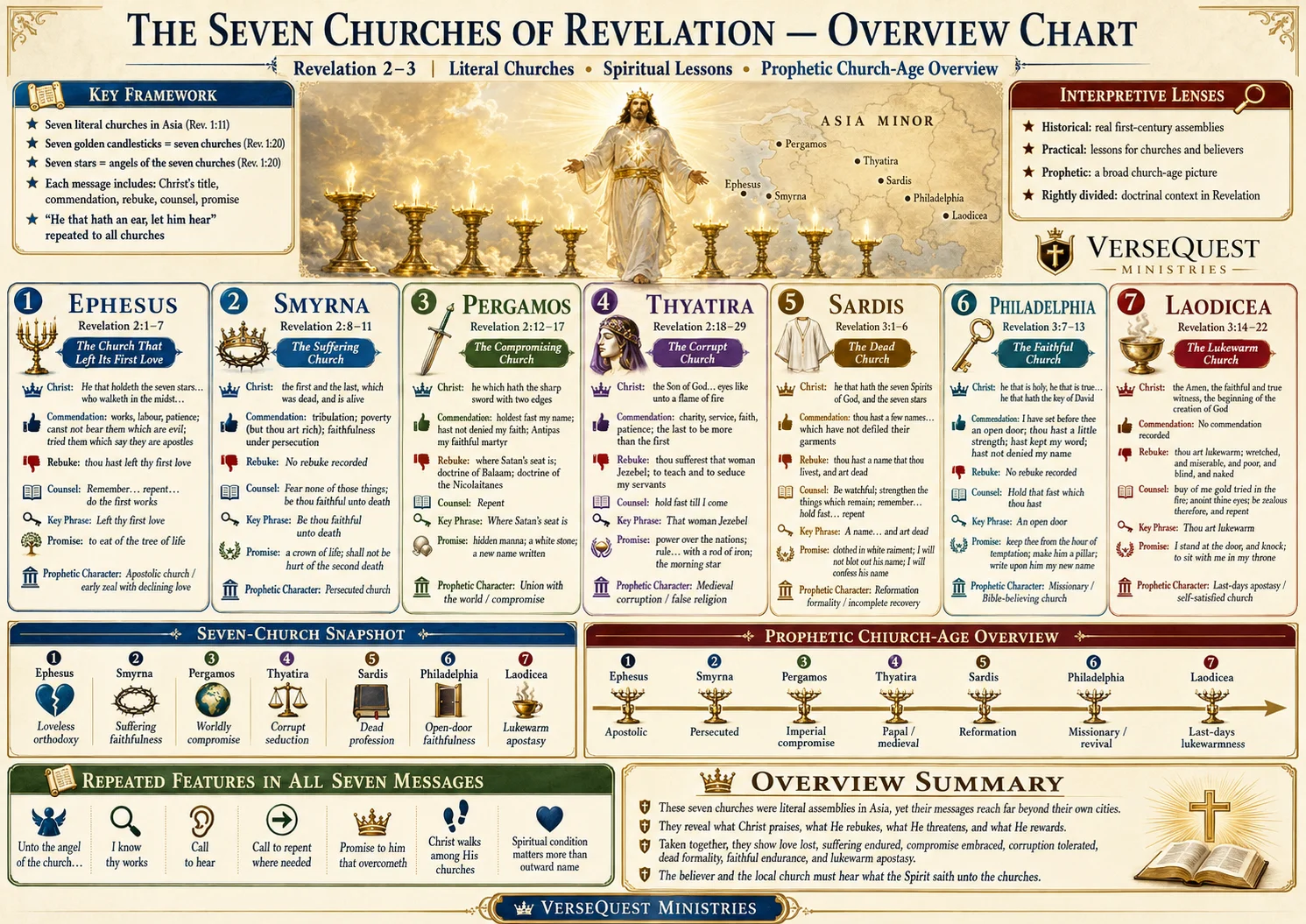
- The Seven Churches of Revelation Chart Collection – Christ Walking Among the Candlesticks
- A premium VerseQuest Ministries™ PDF chart collection covering the Seven Churches of Revelation in Revelation 2–3. Includes one overview chart plus individual KJV Bible study charts for Ephesus, Smyrna, Pergamos,…
- $12.99
- Add to cart
-
-
Doctrine Series
-
-14%
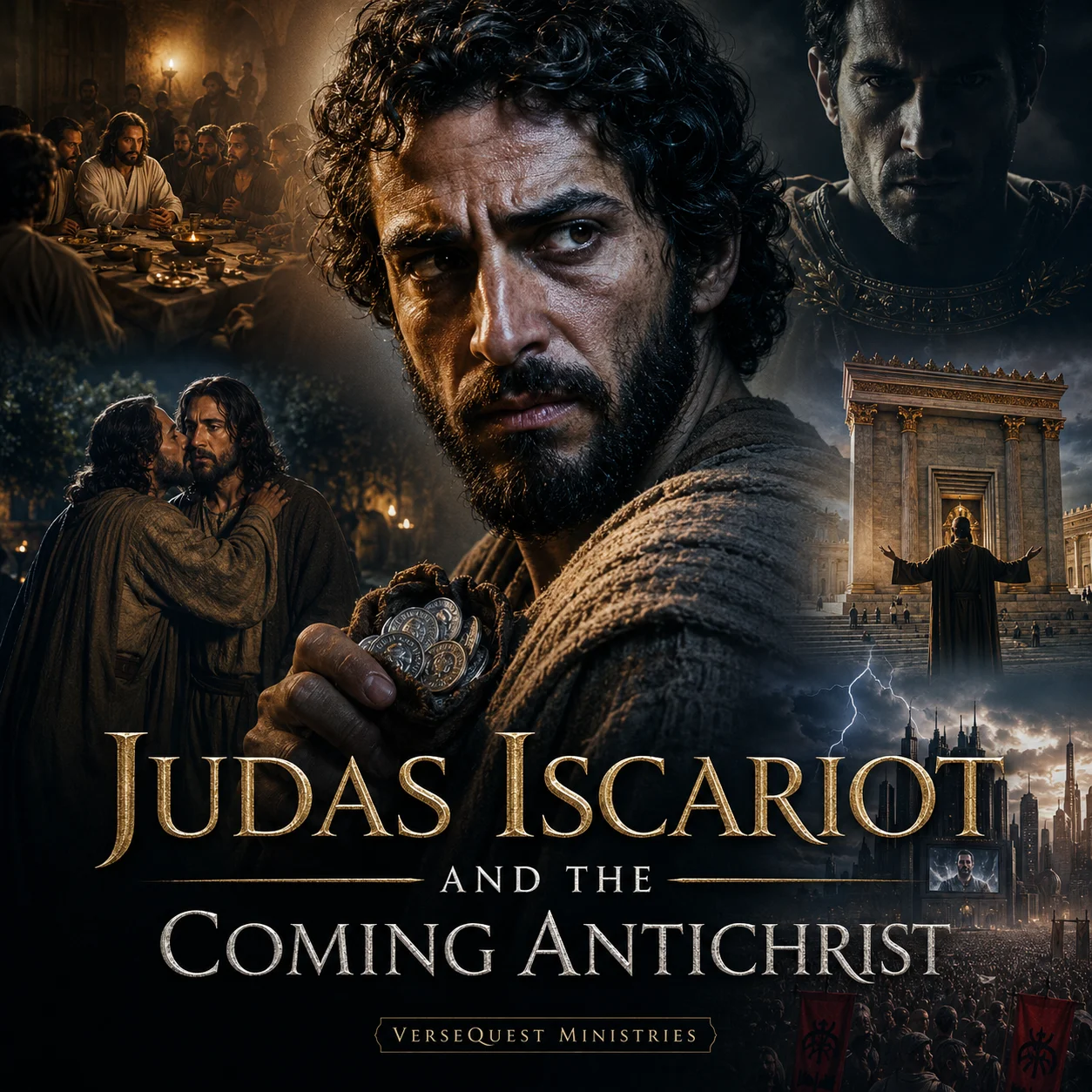
- Judas Iscariot and the Coming Antichrist – Premium KJV Prophecy Study
- A massive 459-page premium KJV prophecy study tracing the biblical connection between Judas Iscariot, the son of perdition, and the coming Antichrist. This detailed VerseQuest Ministries PDF examines Judas’ betrayal,…
- Original price was: $34.99.$29.99Current price is: $29.99.
- Add to cart
-
-14%