Book: Hebrews
-
November 11, 2026
Series: Hebrews 7:25, The Intercession of Christ
Speaker: Paul Tackett
Topic: access to God through Christ, Christ our eternal High Priest, Christ's heavenly intercession, Christ's intercession for believers, eternal security of the believer, finished work of Jesus Christ, Hebrews 7 sermon outline, Hebrews 7:25, Jesus Christ our Advocate, Jesus Christ our Mediator, Jesus saves to the uttermost, KJV Sermon Outline, Melchisedec priesthood, Once for All Sacrifice, Resurrection of Jesus Christ, rightly divided Bible study, Romans 8:34, salvation by grace through faith, The Intercession of Christ, unchangeable priesthood of Christ
Book: Hebrews
This detailed sermon outline examines Hebrews 7:25 and the magnificent declaration concerning Jesus Christ, “Wherefore he is able also to save them to the uttermost that come unto God by him, seeing he ever liveth to make intercession for them,” revealing the complete sufficiency of the Saviour’s finished sacrifice, eternal priesthood, and continuing intercession at the right hand of God. The message carefully establishes the original context of Hebrews 7, where the writer demonstrates the superiority of Christ’s priesthood after the order of Melchisedec over the former Levitical priesthood established under the Mosaic law. Special attention is given to the mortality of Israel’s earthly high priests, the divine oath recorded in Psalm 110:4, the distinction between Aaron’s priesthood and Christ’s unchangeable priesthood, and the significance of the Lord’s resurrection and endless life. The sermon examines the powerful expressions “save them to the uttermost,” “come unto God by him,” and “he ever liveth to make intercession,” explaining why Jesus Christ provides complete redemption rather than a temporary or partial salvation dependent upon human religious performance. Drawing upon Hebrews 4–10, Romans 8:31–39, Ephesians 1–2, 1 Timothy 2:5–6, and 1 John 2:1–2, the outline establishes the difference between Christ’s once-for-all sacrifice and His continuing heavenly ministry, demonstrating that His intercession does not require another offering for sin or repeated payments toward redemption. The message explains why Jesus Christ alone is the Mediator between God and men, why sinners must personally believe the gospel, and why no earthly priest, religious institution, sacrament, or additional mediator can replace His finished work. It also distinguishes Christ’s intercession from the Holy Spirit’s assistance in prayer and the intercessory prayers offered by saved believers for one another. Particular emphasis is placed upon the believer’s eternal security, Christ’s advocacy against condemnation, the relationship between justification and practical sanctification, and why salvation by grace never provides permission for careless or sinful living. The sermon further examines the comfort Christ’s continuing intercession provides during spiritual weakness, temptation, suffering, accusation, persecution, and uncertainty, while connecting the believer’s secure standing in Christ with faithful Christian service and future accountability at the Judgment Seat of Christ. Preachers, pastors, teachers, and Bible students will gain a comprehensive, KJV-based, rightly divided, sermon-ready framework for teaching the intercession of Jesus Christ, His eternal priesthood, salvation to the uttermost, the sufficiency of His blood, the assurance of eternal life, access to the Father, and the believer’s confidence in the risen Saviour who ever lives to make intercession for His own.
-
November 9, 2026
Series: Hebrews 4:16, The Throne of Grace
Speaker: Paul Tackett
Topic: 2 Corinthians 12:9, access to God through Christ, believer's eternal security, biblical prayer and supplication, Christ's heavenly priesthood, come boldly unto the throne of grace, grace sufficient for weakness, Hebrews 4 sermon outline, Hebrews 4:14–16, Hebrews 4:16, help in time of need, Jesus our great High Priest, Jesus the one Mediator, KJV Sermon Outline, mercy and grace, mercy through Jesus Christ, Once for All Sacrifice, rightly divided Bible study, salvation by grace through faith, The Throne of Grace
Book: Hebrews
This detailed sermon outline examines Hebrews 4:16 and the remarkable biblical invitation, “Let us therefore come boldly unto the throne of grace, that we may obtain mercy, and find grace to help in time of need,” revealing the believer’s privilege of approaching Almighty God through Jesus Christ, our great High Priest. The message carefully establishes the passage’s immediate context within Hebrews 4:12–16, where the writer describes the penetrating authority of God’s word, the impossibility of concealing anything from His sight, and the glorious provision of Jesus the Son of God, who has passed into the heavens. It explains why the throne of grace represents divine holiness, sovereign authority, mercy, and gracious access rather than a religious mechanism through which believers may demand whatever earthly benefits they desire. Special attention is given to Hebrews 4:14–15, which identifies Jesus Christ as the great High Priest who can be touched with the feeling of our infirmities and who was tempted in all points like as we are, yet without sin. The sermon explores the superiority of Christ’s eternal priesthood over the former Levitical priesthood, the significance of His once-for-all sacrifice, His entrance into the heavenly sanctuary, and His continuing intercession for those who come unto God through Him. Drawing upon Hebrews 4–10, Romans 5 and 8, Ephesians 2–3, Philippians 4, and 2 Corinthians 12, the outline distinguishes salvation through Christ’s finished work from the saved believer’s continuing responsibility to pray, walk in holiness, and depend upon divine strength. It examines the importance of coming boldly without becoming presumptuous, the distinction between obtaining mercy and finding grace, and why God’s help in time of need does not guarantee the immediate removal of suffering, sickness, persecution, or difficult earthly circumstances. Paul’s testimony concerning his thorn in the flesh receives particular attention, demonstrating why the sufficiency of divine grace may be revealed through continued weakness rather than instant deliverance. The message also explains the believer’s access to the Father through Jesus Christ by the Holy Spirit, the unique mediatorial office of the Saviour, and the importance of approaching God with reverence, thanksgiving, intercession, perseverance, and submission to His revealed will. Preachers, pastors, teachers, and Bible students will gain a comprehensive, KJV-based, rightly divided, sermon-ready framework for teaching the throne of grace, Christ’s heavenly priesthood, redemption through His blood, biblical prayer, divine mercy, sufficient grace, spiritual perseverance, and the believer’s continuing dependence upon the Lord Jesus Christ.
-

November 5, 2026
Series: Hebrews 12:15, The Root of Bitterness
Speaker: Paul Tackett
Topic: biblical forgiveness, bitterness and unforgiveness, bitterness defiles many, Christian reconciliation, Deuteronomy 29:18, Ephesians 4:31–32, Esau and the birthright, failing of the grace of God, Hebrews 12 sermon outline, Hebrews 12:15, KJV Sermon Outline, peace and holiness, rejecting malice, resisting resentment, rightly divided Bible preaching, root of bitterness Bible study, Salvation by Grace, spiritual corruption, The Root of Bitterness, Walking in the Spirit
Book: Hebrews
This detailed sermon outline examines Hebrews 12:15 and the solemn biblical warning, “Looking diligently lest any man fail of the grace of God; lest any root of bitterness springing up trouble you, and thereby many be defiled,” revealing the danger of hidden spiritual corruption and the destructive consequences that can develop when bitterness, unbelief, and fleshly hostility are permitted to take root. The message carefully establishes the passage’s original setting within Hebrews 12:14–17, where the writer calls his Hebrew audience to pursue peace and holiness while warning against spiritual negligence, corruption, and the profane disregard for sacred responsibilities demonstrated by Esau. Special attention is given to Deuteronomy 29:18, where the LORD warns Israel concerning a root producing gall and wormwood through a heart turning away from Him toward idolatry and covenant unfaithfulness. The sermon explains why this Old Testament background is essential to understanding the warning in Hebrews and why the root of bitterness must not be reduced exclusively to personal resentment or hurt feelings. From that doctrinal foundation, the outline develops the practical Christian application of recognizing hidden resentment, refusing unforgiveness, rejecting personal vengeance, and preventing bitterness from corrupting speech, judgment, relationships, churches, families, and ministries. It examines the significance of the expressions “looking diligently,” “fail of the grace of God,” “springing up trouble you,” and “thereby many be defiled,” demonstrating how inward corruption can eventually affect an entire community. Drawing upon Hebrews 12, Deuteronomy 29, Ephesians 4:31–32, Romans 12, Galatians 5, Colossians 3, and other supporting passages, the message carefully distinguishes genuine grief and righteous opposition to wrongdoing from sinful bitterness, while explaining why forgiveness does not require denying legitimate injuries, abandoning necessary boundaries, or eliminating appropriate accountability. The outline also preserves the doctrinal distinction between the original warnings of Hebrews and the Church-Age believer’s eternal security through faith in Jesus Christ, establishing that salvation rests upon the Saviour’s finished work rather than the perfection of one’s emotional condition. Preachers, pastors, teachers, and Bible students will gain a comprehensive, KJV-based, rightly divided, sermon-ready framework for teaching the root of bitterness, spiritual vigilance, unbelief, holiness, Christian forgiveness, reconciliation, freedom from malice, the danger of defiling others, and the transforming influence of God’s grace upon the believer’s daily conduct.
-
November 4, 2026
Series: Hebrews 2:1, The Danger of Spiritual Drift
Speaker: Paul Tackett
Topic: apostolic signs and wonders, Christian Perseverance, Christian spiritual growth, Eternal Security, give the more earnest heed, Hebrews 2 sermon outline, Hebrews 2:1, holding fast to Scripture, importance of Bible study, King James Bible preaching, KJV Sermon Outline, lest we let them slip, neglecting so great salvation, rightly divided Bible study, Sound Doctrine, spiritual negligence, spiritual watchfulness, superiority of Jesus Christ, The Danger of Spiritual Drift, warning against unbelief
Book: Hebrews
This detailed sermon outline examines Hebrews 2:1 and the solemn biblical warning, “Therefore we ought to give the more earnest heed to the things which we have heard, lest at any time we should let them slip,” revealing the danger of spiritual negligence, doctrinal instability, and gradually losing careful attention to divine revelation. The message establishes the passage’s original context within the Book of Hebrews, where the writer has demonstrated the supremacy of Jesus Christ over the angels, His divine authority, His finished work of purging sins, and His exaltation at the right hand of God. It explains why the opening word “Therefore” connects the warning directly to Christ’s superiority, why believers must give earnest attention to God’s revealed truth, and how spiritual drift can develop through continued indifference, neglected biblical instruction, worldly distractions, and increasing susceptibility to false doctrine. Special attention is given to Hebrews 2:1–4, including the warning against neglecting so great salvation, the difference between hearing the gospel and personally believing it, and the divine confirmation of Christ’s message through apostolic witnesses, signs, wonders, and miracles. The sermon carefully distinguishes the historical and doctrinal setting of Hebrews and its warnings concerning unbelief from the Church-Age believer’s eternal security through faith in Jesus Christ, avoiding the erroneous teaching that ordinary spiritual weakness or inconsistent Christian performance can undo the Saviour’s finished work. Drawing upon Hebrews 3–6, Hebrews 12, Ephesians 4, Colossians 2, 2 Timothy 2–3, and other New Testament passages, the outline develops the practical importance of sound doctrine, Scripture rightly divided, spiritual watchfulness, Christian perseverance, renewed thinking, and faithful obedience. It also examines why spiritual negligence can damage Christian growth, weaken biblical discernment, compromise one’s testimony, and waste valuable opportunities for service without invalidating the sufficiency of Christ’s redemption. Preachers, pastors, teachers, and Bible students will gain a comprehensive, KJV-based, rightly divided, sermon-ready framework for teaching the danger of spiritual drift, the authority of God’s Word, the seriousness of neglecting salvation, the preservation of sound doctrine, eternal security, and the importance of remaining firmly established in Jesus Christ rather than being carried away by the changing influences of the world.
-

October 27, 2026
Speaker: Paul Tackett
Topic: author and finisher of faith, biblical perseverance, Chastening of the Lord, Christian discipline, Christian race of faith, enduring trials as a Christian, finish the Christian race, great cloud of witnesses, Hebrews 12 sermon outline, Hebrews 12:1–2, Jesus endured the cross, Judgment Seat of Christ, KJV Sermon Outline, laying aside every weight, looking unto Jesus, rightly dividing the word, run with patience, Running the Race With Patience, sin which easily besets us, spiritual endurance
Book: Hebrews
This detailed sermon outline examines Hebrews 12:1–2 and the biblical command to “run with patience the race that is set before us,” revealing the importance of spiritual endurance, faithful service, and keeping our attention fixed upon the Lord Jesus Christ. Beginning with the great cloud of witnesses described in Hebrews 11, the message explains how the recorded testimony of faithful Old Testament believers encourages perseverance through hardship, opposition, uncertainty, and suffering. It carefully distinguishes unnecessary spiritual weights from actual sins, showing why Christians must examine not only sinful habits but also lawful activities, ambitions, distractions, and earthly concerns that interfere with faithful service. The outline explores the meaning of biblical patience, the importance of running the particular course set before each believer, and the danger of comparing ourselves with other Christians rather than concentrating upon our own responsibilities before God. Special attention is given to Jesus Christ as “the author and finisher of our faith,” His endurance of the cross, His victory over death, and His exaltation at the right hand of God. Drawing upon Hebrews 12:3–13, the sermon also examines divine chastening, spiritual weariness, correction, and the necessity of continuing faithfully when circumstances become difficult. The message further connects the race of faith with Paul’s athletic illustrations in 1 Corinthians 9, his determination in Philippians 3, and his final testimony in 2 Timothy 4:7, while maintaining the important doctrinal distinction between salvation by grace and the believer’s future accountability for Christian service. Preachers, teachers, and Bible students will gain a comprehensive, rightly divided, sermon-ready framework for teaching Christian perseverance, spiritual discipline, resistance to sin, patience during suffering, the example of Christ, eternal rewards, and the importance of finishing the Christian race faithfully.
-
October 10, 2026
Speaker: Paul Tackett
Topic: authority of Scripture, biblical conviction, biblical self examination, confession and correction, deceitfulness of the heart, discerner of thoughts and intents, Hebrews 4:12, Hebrews 4:12 sermon outline, hidden sin, King James Bible study, KJV Sermon Outline, rightly dividing the word, sanctification through Scripture, Scripture exposes sin, Spiritual Discernment, The Word That Discerns the Heart, thoughts and motives, twoedged sword, word of God sermon, word of God sharper than a sword
Book: Hebrews
This detailed sermon outline examines Hebrews 4:12 and its declaration that the word of God is “quick, and powerful, and sharper than any twoedged sword,” piercing deeply enough to discern “the thoughts and intents of the heart.” The message explains the living and powerful character of Scripture, its sword-like ability to cut through spiritual deception, and its capacity to penetrate beyond outward religious appearance into thoughts, motives, hidden sin, and the true condition of the inner man. It explores how the Bible distinguishes spiritual realities that human feelings often confuse, exposes the deceitfulness of the heart, and brings concealed motives under the searching light of divine truth. The outline also shows that biblical conviction is intended to lead to confession, correction, and obedient living rather than mere condemnation, while emphasizing the necessity of rightly dividing Scripture without using doctrinal precision as an excuse to avoid personal application. Preachers, teachers, and Bible students will gain a sermon-ready framework for teaching biblical conviction, spiritual discernment, self-examination, confession, sanctification, right division, and the searching authority of the King James Bible.
-
August 25, 2026
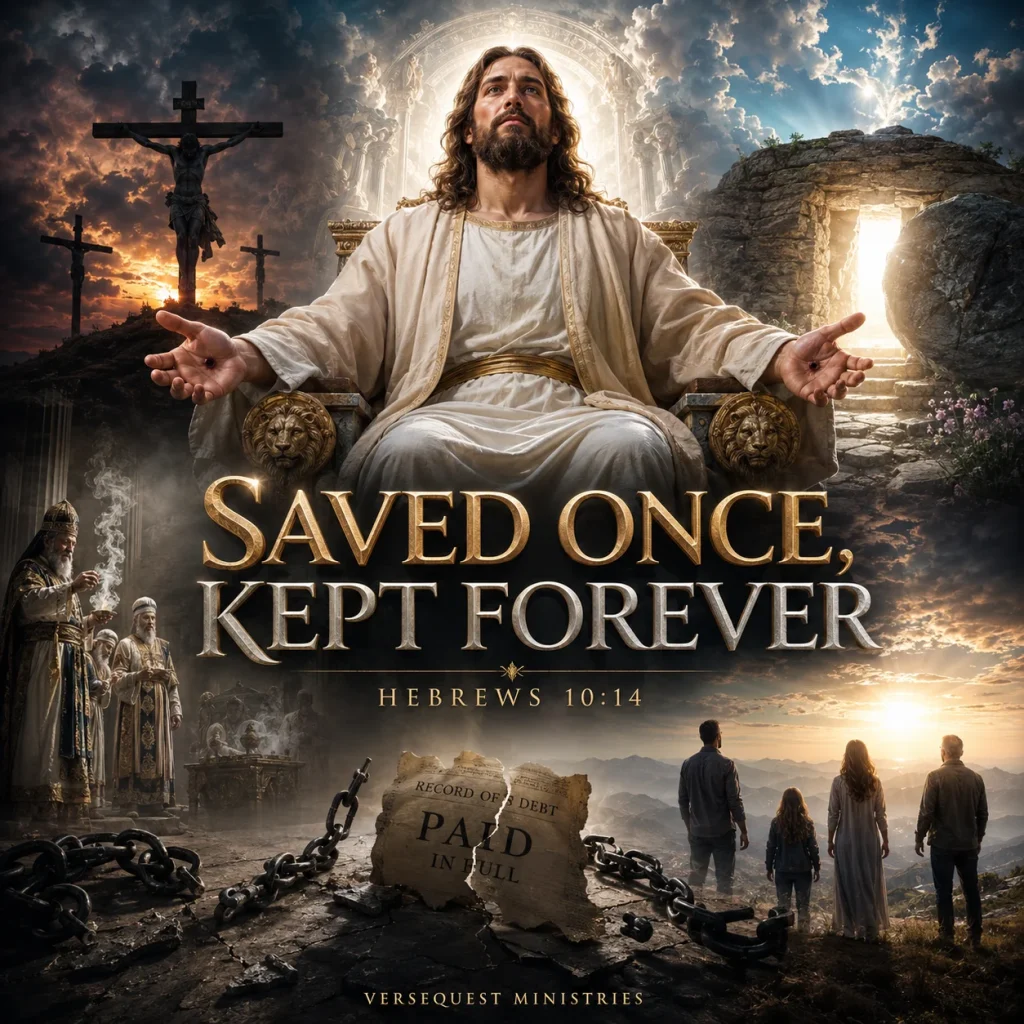
Series: Hebrews 10:14, Saved Once Kept Forever
Speaker: Paul Tackett
Topic: Assurance in Christ, Bible Study Resources, Blood of Jesus Christ, Chastening Not Condemnation, Christ’s Finished Work, Eternal Security, Gospel of Grace, Hebrews 10:14, Kept by the Power of God, KJV Sermon Outline, No More Offering for Sin, Not by Religion, Not by Works, Once for All Sacrifice, One Offering, Perfected for Ever, Rightly Dividing, Saved Once Kept Forever, Saved Once Kept Forever Sermon Outline, Sealed Unto Redemption
Book: Hebrews
This VerseQuest Ministries sermon outline on Hebrews 10:14 explains the finality of Christ’s one offering and the believer’s settled security in Him: “For by one offering he hath perfected for ever them that are sanctified.” The outline contrasts the repeated sacrifices of the law with the finished sacrifice of Jesus Christ, showing that salvation is not maintained by religion, sacraments, law-keeping, church membership, moral effort, or repeated offerings, but rests on the completed work of the Son of God. It carefully distinguishes positional perfection in Christ from practical growth, eternal security from careless living, chastening from condemnation, and standing before God from daily walk. Preachers, teachers, and Bible students will gain a strong KJV-based framework for teaching the sufficiency of Christ’s blood, the finality of Calvary, assurance, no more offering for sin, and the truth that those saved by Christ are kept forever by the power of God.
-

August 23, 2026
Speaker: Paul Tackett
Topic: Assurance in Christ, Bible Study Resources, Chastening Not Damnation, Chastening of the Lord, Christian Correction, Despise Not Chastening, Faint Not Under Rebuke, Father of Spirits, Fatherly Correction, Fellowship With God, God’s Loving Discipline, Hebrews 12:5–11, Holy Living, KJV Sermon Outline, Peaceable Fruit of Righteousness, Rightly Dividing, Sonship Fellowship and Chastening, Sonship Fellowship and Chastening Sermon Outline, Sonship Not Condemnation, Whom the Lord Loveth He Chasteneth
Book: Hebrews
This VerseQuest Ministries sermon outline on Hebrews 12:5–11 explains the vital difference between sonship, fellowship, and chastening in the believer’s life. The outline shows that the chastening of the Lord is not eternal condemnation, loss of salvation, or God casting away His child, but the Father’s loving correction of those whom He receives. It carefully distinguishes sonship from daily fellowship, chastening from condemnation, correction from rejection, and the believer’s settled standing in Christ from his practical walk before God. The sermon addresses why believers must not despise chastening or faint under rebuke, how God uses correction for profit and holiness, and how chastening yields the peaceable fruit of righteousness. Preachers, teachers, and Bible students will gain a strong KJV-based framework for teaching assurance, fatherly discipline, confession, restoration, holy living, and the difference between God’s correcting hand and the wrath reserved for the lost.
-

June 25, 2026
Series: Foundations of the Word of Truth
Speaker: Paul Tackett
Topic: Bible Doctrine, Biblical Authority, Hebrews 4:12, KJV Sermon Outlines, Rightly Dividing, Sound Doctrine, Spiritual Discernment, The Living Sword, VerseQuest Sermons, Word of God
Book: 1 Corinthians, 2 Timothy, Hebrews, John, Psalms
The Book That Divides Men is a KJV sermon outline from VerseQuest Ministries built on Hebrews 4:12 and the living power of the word of God. This study shows how Scripture is quick, powerful, sharper than any twoedged sword, piercing the soul, discerning the heart, and separating truth from error. Designed for pastors, teachers, Bible students, and believers, this outline explains why the King James Bible remains the final authority for preaching, doctrine, discernment, conviction, and right division. It highlights how God’s word exposes unbelief, corrects false doctrine, divides Israel and the Church, distinguishes prophecy from mystery, and brings every man before the God who sees all. With strong emphasis on biblical authority, sound doctrine, gospel clarity, and spiritual conviction, this sermon resource equips believers to submit to Scripture, preach the word faithfully, and point sinners to Jesus Christ through the finished gospel of grace and the living word today.