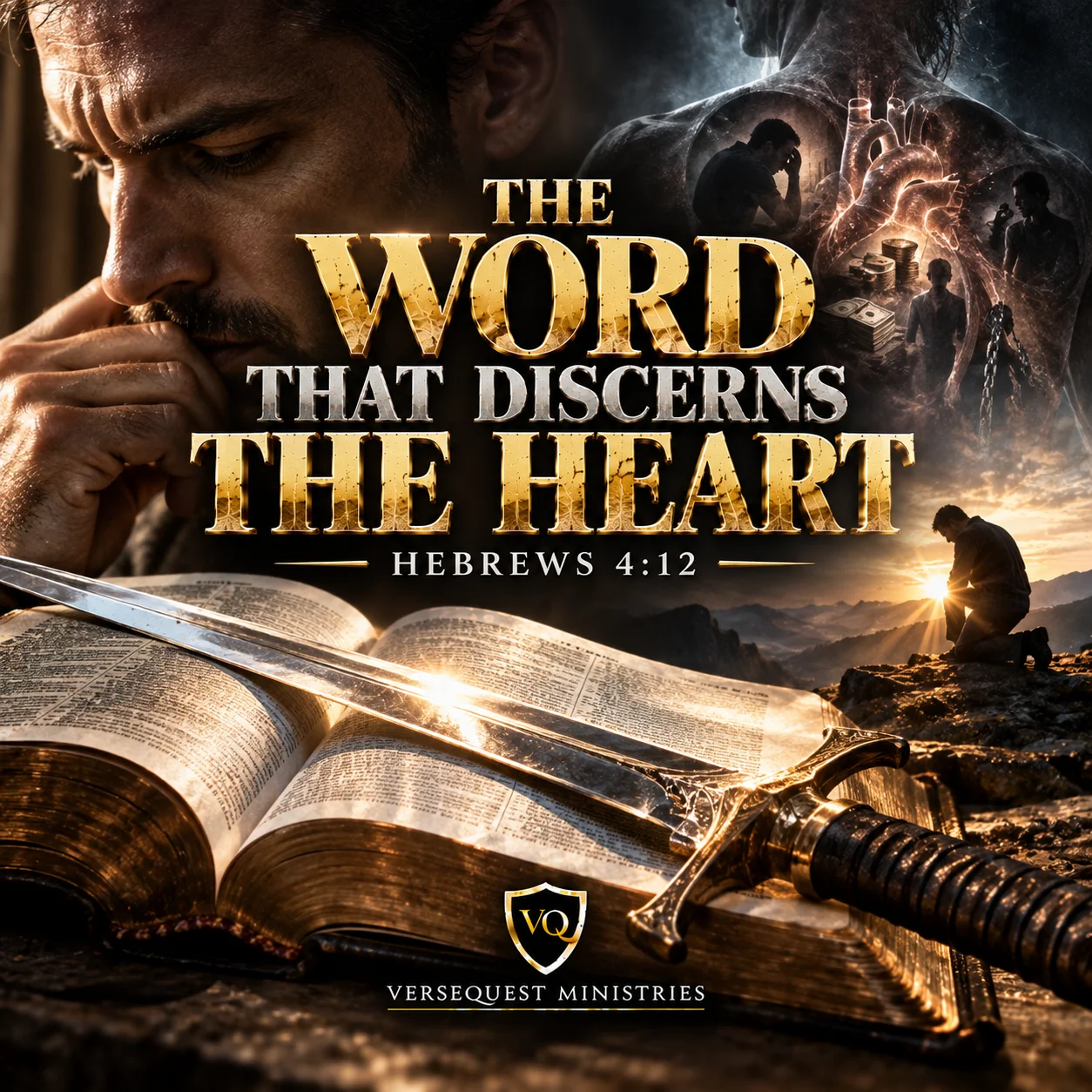
Sermon Title:
The Word That Discerns the Heart
Key Passage:
Hebrews 4:12
“For the word of God is quick, and powerful, and sharper than any twoedged sword, piercing even to the dividing asunder of soul and spirit, and of the joints and marrow, and is a discerner of the thoughts and intents of the heart.” (Hebrews 4:12)
Series:
The Book God Gave
Topic:
How the Word of God Exposes the Thoughts, Motives, Sin, and Spiritual Condition of the Heart
Book:
Hebrews
Speaker:
Paul Tackett
Suggested Sermon Text:
Hebrews 3:7–19; Hebrews 4:1–16; Psalm 19:7–14; Psalm 119:9–11, 59–60, 105, 130, 140; Jeremiah 17:9–10; Jeremiah 23:29; Matthew 15:18–20; John 17:17; Romans 7:7–13; Romans 12:1–2; 1 Corinthians 4:5; Ephesians 6:17; 2 Timothy 2:15; 2 Timothy 3:15–17; James 1:22–25; 1 John 1:8–10
Short Sermon Description:
Hebrews 4:12 presents the word of God as “quick, and powerful, and sharper than any twoedged sword,” capable of piercing beneath outward appearance and discerning “the thoughts and intents of the heart.” This sermon examines the searching, exposing, dividing, correcting, and sanctifying work of Scripture, showing why the Bible does far more than communicate religious information. The word reaches places human observation cannot reach, distinguishing spiritual realities, exposing motives behind outward conduct, revealing sin that the heart has renamed or concealed, and bringing the believer face-to-face with the judgment of God upon his thoughts as well as his actions. The message also examines the immediate warning context of Hebrews, distinguishes conviction through Scripture from emotional manipulation, explains why self-examination must remain subordinate to the Book rather than subjective introspection, and shows how right division keeps the sword from being mishandled. Preachers, teachers, and Bible students will gain a detailed, sermon-ready treatment of biblical conviction, the deceitfulness of the heart, spiritual discernment, correction, confession, sanctification, and the authority of the King James Bible. Sermon Outline Prompt – VerseQu…
THE WORD THAT DISCERNS THE HEART
Introduction
Men spend a tremendous amount of energy managing what other people can see. We manage our appearance, reputation, vocabulary, expressions, explanations, and public behavior. A man can learn how to sound spiritual, look disciplined, quote Scripture, attend church, teach doctrine, defend the Bible, and still conceal things from everybody around him. Human beings are remarkably skilled at presenting the outside while protecting the inside. But Hebrews 4:12 introduces us to something that does not stop at the outside. The word of God gets through the skin.
The verse says the word is “quick, and powerful, and sharper than any twoedged sword.” It pierces. It divides. It discerns. It does not merely report facts to the intellect; it reaches into the hidden chambers of the inner man. The Bible knows how to get past the polished explanation and find the motive beneath it. It can distinguish between what looked like zeal and what was really pride, what looked like caution and what was really unbelief, what looked like righteous anger and what was really bitterness, what looked like stewardship and what was really covetousness. Men see behavior. God’s word exposes the machinery behind the behavior.
The context of Hebrews makes that truth even more serious. Hebrews 3 and 4 repeatedly warn about unbelief, hardened hearts, failing to enter into God’s rest, and the example of Israel in the wilderness. The writer is not delivering a sentimental devotional thought about the Bible being inspiring. He is warning people that God’s word penetrates beneath outward profession and exposes what is actually occurring within. Verse 13 immediately follows: “Neither is there any creature that is not manifest in his sight.” The word searches because the God who gave the word sees everything. There is no mask thick enough to survive that examination.
I. THE WORD OF GOD IS QUICK—IT IS ALIVE
Key Text: Hebrews 4:12
Supporting Texts: 1 Peter 1:23–25; John 6:63; Isaiah 55:10–11; Jeremiah 23:29
Hebrews begins the description with the word “quick.” In the King James Bible, “quick” means living. The word of God is not dead literature preserved merely because religious people value ancient documents. It carries living authority because its source is the living God.
Peter speaks of believers being born again “by the word of God, which liveth and abideth for ever” (1 Peter 1:23). Jesus said, “the words that I speak unto you, they are spirit, and they are life” (John 6:63). Scripture is not alive because a reader becomes excited about it. It is alive whether the reader trembles, laughs, ignores it, attacks it, or closes the cover.
That is why the same verse can strike a believer twenty years after he first memorized it. The ink did not change. The paper did not change. God did not issue a revised revelation overnight. The living word met the believer at a different point in his walk and illuminated something that had been sitting there all along.
A dead book can be studied without being allowed to study you. The Bible is different. You open it, and eventually you discover that while you were examining the text, the text was examining you.
Main Truth: The word of God is living truth from the living God, capable of confronting every generation and every heart with undiminished authority.
II. THE WORD OF GOD IS POWERFUL—IT DOES WHAT HUMAN WORDS CANNOT DO
Key Text: Hebrews 4:12
Supporting Texts: Isaiah 55:11; Jeremiah 23:29; Romans 1:16; 1 Thessalonians 2:13
Hebrews does not merely call the word living. It calls it “powerful.” God’s word possesses an effectiveness human speech cannot duplicate.
Jeremiah compares it to fire and “like a hammer that breaketh the rock in pieces” (Jeremiah 23:29). Isaiah records God saying His word “shall not return unto me void” (Isaiah 55:11). Scripture accomplishes divine purposes even when men resist it. It may save one sinner, harden another through rejection, comfort a saint, rebuke a hypocrite, expose a false teacher, or strip an excuse from somebody who had hidden behind it for years.
Preachers sometimes behave as though the Bible requires human theatrics to become effective. Raise the volume enough. Manipulate the music. Create the right lighting. Manufacture the right emotional moment. None of those things can give divine power to words that supposedly lacked it before the preacher arrived.
Paul commended the Thessalonians because they received his preaching “not as the word of men, but as it is in truth, the word of God, which effectually worketh also in you that believe” (1 Thessalonians 2:13). God’s word works.
Main Truth: Scripture possesses divine power to accomplish spiritual work that human eloquence, emotional manipulation, and religious performance can never manufacture.
III. THE WORD IS SHARPER THAN A TWOEDGED SWORD
Key Text: Hebrews 4:12
Supporting Texts: Ephesians 6:17; Revelation 1:16; Revelation 19:15; Psalm 149:6
Hebrews calls the word “sharper than any twoedged sword.” A sword divides. It cuts. It exposes what was beneath the surface. The comparison is intentionally severe because spiritual surgery is not always comfortable.
A dull blade tears where a sharp blade cuts cleanly. God’s word is precise. It does not merely tell the sinner, “Something somewhere is probably wrong.” It identifies unbelief. Pride. Lust. Envy. Malice. Covetousness. False doctrine. Hypocrisy. Bitterness. Idolatry. Self-righteousness. The Book puts names on things the flesh prefers to leave vague.
Ephesians 6:17 calls Scripture “the sword of the Spirit.” The Holy Spirit does not wield a feather duster. He uses truth. That truth may comfort us, but the same Book that comforts the brokenhearted also slices through excuses.
The two-edged picture carries another practical warning: you cannot handle the sword without coming close to its edge yourself. The preacher who uses Scripture only to cut everybody in his congregation while never allowing it near his own heart has forgotten that the blade cuts both ways.
Main Truth: The word of God cuts precisely through spiritual deception, sin, falsehood, and self-justification with an edge no human reasoning can match.
IV. THE WORD PIERCES BENEATH OUTWARD APPEARANCE
Key Text: Hebrews 4:12
Supporting Texts: 1 Samuel 16:7; Matthew 23:25–28; Luke 16:15; Psalm 139:1–4
Man is impressed with surfaces. God is not.
Samuel was reminded that “man looketh on the outward appearance, but the LORD looketh on the heart” (1 Samuel 16:7). Jesus condemned religious leaders who looked clean outside while remaining corrupt within. He compared them to whited sepulchres—beautiful externally and full of dead men’s bones internally.
Hebrews says the word pierces. It moves beyond outward conduct into the inner man. A person may perform the correct action for the wrong reason. He may give money for applause. Preach for reputation. Serve for control. Correct doctrine for pride. Avoid visible sin because he fears getting caught rather than because he fears God.
People around him may never know the difference. Scripture can reveal it.
That is why genuine Bible reading eventually becomes uncomfortable if it is done honestly. The Book refuses to stay on the safe side of the fence where all the bad people live. Eventually it crosses the yard and knocks on your door.
Main Truth: Scripture penetrates beyond outward religious behavior and exposes the hidden spiritual condition beneath appearances.
V. THE WORD DIVIDES WHAT MAN CANNOT DISTINGUISH
Key Text: Hebrews 4:12
Supporting Texts: 1 Thessalonians 5:23; 1 Corinthians 2:14–15; Romans 7:22–23; Ephesians 3:16
The verse describes Scripture as piercing “even to the dividing asunder of soul and spirit, and of the joints and marrow.” The language emphasizes penetration and distinction beyond ordinary human ability.
Men routinely confuse soul, spirit, emotion, conscience, desire, feeling, instinct, and spiritual leading. A man feels something strongly and assumes it must be the Holy Ghost. Another has a powerful emotional reaction and calls it revelation. Another mistakes fear for discernment or excitement for divine leading.
The word supplies distinctions.
Scripture tells us what comes from the flesh, what belongs to the renewed mind, what the Spirit has actually revealed, what truth God has written, and what human emotion cannot legitimately claim.
This is another reason spiritual experience must remain subordinate to Scripture. The experience cannot accurately interpret itself. The Book must judge it.
Main Truth: The word of God distinguishes spiritual realities that human emotion and natural reasoning routinely confuse.
VI. THE WORD DISCERNS THE THOUGHTS OF THE HEART
Key Text: Hebrews 4:12
Supporting Texts: Proverbs 23:7; Genesis 6:5; Matthew 15:19; 2 Corinthians 10:5
Hebrews says the word is “a discerner of the thoughts…of the heart.” Christianity is not merely behavior modification. God deals with thought.
Jesus taught that evil actions come from the heart: “For out of the heart proceed evil thoughts” (Matthew 15:19). The visible act may occur late in the process. Sin has often been rehearsing privately in the mind long before it appears publicly.
That is why Scripture addresses imagination, meditation, remembrance, attention, wisdom, understanding, and thought. Paul speaks of “bringing into captivity every thought to the obedience of Christ” (2 Corinthians 10:5).
The Bible therefore confronts what nobody else sees. Lust entertained mentally. Arguments replayed repeatedly. Secret jealousy. Fantasies of revenge. Covetous comparisons. Prideful self-congratulation. Fear-fed scenarios. None of them requires visible action before Scripture can expose them.
The world increasingly tells people that thoughts are harmless because “nobody got hurt.” The Bible understands that thoughts eventually train the heart and prepare the feet.
Main Truth: God’s word examines the thought life because inward thinking shapes outward living long before sin becomes publicly visible.
VII. THE WORD DISCERNS THE INTENTS OF THE HEART
Key Text: Hebrews 4:12
Supporting Texts: Proverbs 16:2; Jeremiah 17:9–10; 1 Corinthians 4:5; Psalm 139:23–24
Hebrews moves from thoughts to “intents.” Intent deals with motive—why a person does what he does.
Proverbs 16:2 says, “All the ways of a man are clean in his own eyes; but the LORD weigheth the spirits.” Jeremiah warns that “The heart is deceitful above all things, and desperately wicked: who can know it?” (Jeremiah 17:9).
The frightening thing about a deceitful heart is not merely that it deceives other people. It deceives you. A man can sincerely believe his motive is righteous while Scripture exposes self-interest underneath it.
Why did you say that? Why did you post that? Why did you give that money? Why did you correct that person? Why did you refuse to forgive? Why did you volunteer? Why did you quit? Why do you need everybody to know what you accomplished?
Those questions cannot always be answered by examining the action alone. The word presses deeper.
Paul says the Lord will eventually “make manifest the counsels of the hearts” (1 Corinthians 4:5). Until then, wise believers invite Scripture to search them now.
Main Truth: Scripture exposes not merely what we do but why we do it, revealing motives the deceitful heart often hides even from itself.
VIII. THE WORD EXPOSES THE HEART SO THAT IT CAN BE CORRECTED, NOT MERELY CONDEMNED
Key Text: 2 Timothy 3:16
Supporting Texts: 1 John 1:9; James 1:21–25; Psalm 51:10; Proverbs 28:13
Conviction has a purpose. God does not expose sin simply to leave the believer staring hopelessly at his failure.
Second Timothy 3:16 says Scripture is profitable for “reproof” and “correction.” Reproof reveals what is wrong; correction points toward what is right. God’s word exposes because God intends change.
First John 1:9 says, “If we confess our sins, he is faithful and just to forgive us our sins, and to cleanse us from all unrighteousness.” Proverbs says the man who covers sins will not prosper, while the one who confesses and forsakes them obtains mercy.
The wrong response to biblical conviction is hiding, rationalizing, blaming, redefining, or running from the verse that hurt. The right response is agreement with God.
A mirror is not cruel because it shows dirt on your face. It would be useless if it lied to make you feel better. James compares the word to a mirror because truth shows what is actually there.
Main Truth: God exposes the heart through Scripture so sin can be confessed, corrected, forsaken, and replaced with obedient living.
IX. THE DISCERNING WORD MUST BE RIGHTLY DIVIDED AND PERSONALLY OBEYED
Key Text: 2 Timothy 2:15
Supporting Texts: James 1:22; 1 Corinthians 10:32; Romans 6:14; 2 Timothy 3:16–17
A sharp sword can still be mishandled. Therefore the word that discerns must also be rightly divided.
The book of Hebrews contains a particular doctrinal setting and must not simply be lifted wholesale into Pauline Church doctrine without distinction. Israel, Hebrews, kingdom truth, law, grace, prophecy, and the Church must be handled according to the divisions God established in Scripture.
Right division, however, must never become an escape route from personal application. Some believers become highly skilled at explaining to whom a verse was written and remarkably unskilled at allowing any verse to rebuke them.
James says, “be ye doers of the word, and not hearers only.” The Bible student can become so interested in identifying dispensations that he forgets the Book is identifying him.
Rightly dividing Scripture protects doctrine. Personally obeying Scripture protects the walk. We need both.
Main Truth: The word must be rightly divided doctrinally and honestly applied personally so biblical precision never becomes an excuse for spiritual disobedience.
Conclusion
Hebrews 4:12 does not present Scripture as passive literature. The word is quick. Powerful. Sharp. Piercing. Dividing. Discerning. Every term communicates activity. God gave a Book capable of reaching areas of the human heart that no preacher, counselor, spouse, friend, or psychologist can fully see.
That searching power should produce humility in every Bible believer. It is easy to use Scripture like binoculars for examining everybody else. Hebrews turns the binoculars around. The Book asks about your thoughts, your intents, your hidden motives, your excuses, your secret sins, your unbelief, your pride, and your obedience. The question is not simply, “Do I believe the King James Bible?” The question becomes, “Will I let the King James Bible tell me the truth about me?”
Open the Book and give it permission to cut. Do not blunt the blade with excuses. Do not cover the wound with religious language. Do not run to another translation, commentary, preacher, or interpretation merely because the verse found something you wanted left alone. Let Scripture pierce. Let it reveal. Let it correct. The God who exposes the heart is the same God who offers grace for the heart that agrees with Him.
Final Call
If you are lost, the word of God exposes the deepest problem of the human heart: sin. You do not need behavior modification; you need salvation. Jesus Christ died for our sins according to the Scriptures, was buried, and rose again the third day according to the Scriptures (1 Corinthians 15:3–4). Stop trusting morality, baptism, religion, church membership, good intentions, or your own heart. Believe on the Lord Jesus Christ and trust His finished work.
If you are saved, stop asking the Bible only to confirm what you already believe about yourself. Ask it to search you. Let it correct your doctrine, motives, thought life, attitudes, relationships, habits, and private conduct. Rightly divide it. Believe it. Obey it. The Book can find what you have hidden from everybody else—and what you may even have hidden from yourself.
Closing Verse:
“Search me, O God, and know my heart: try me, and know my thoughts.” (Psalm 139:23)
Closing Statement:
You can hide your heart from people, and you can even deceive yourself about it—but you will never hide it from the word that God made sharp enough to reach it.