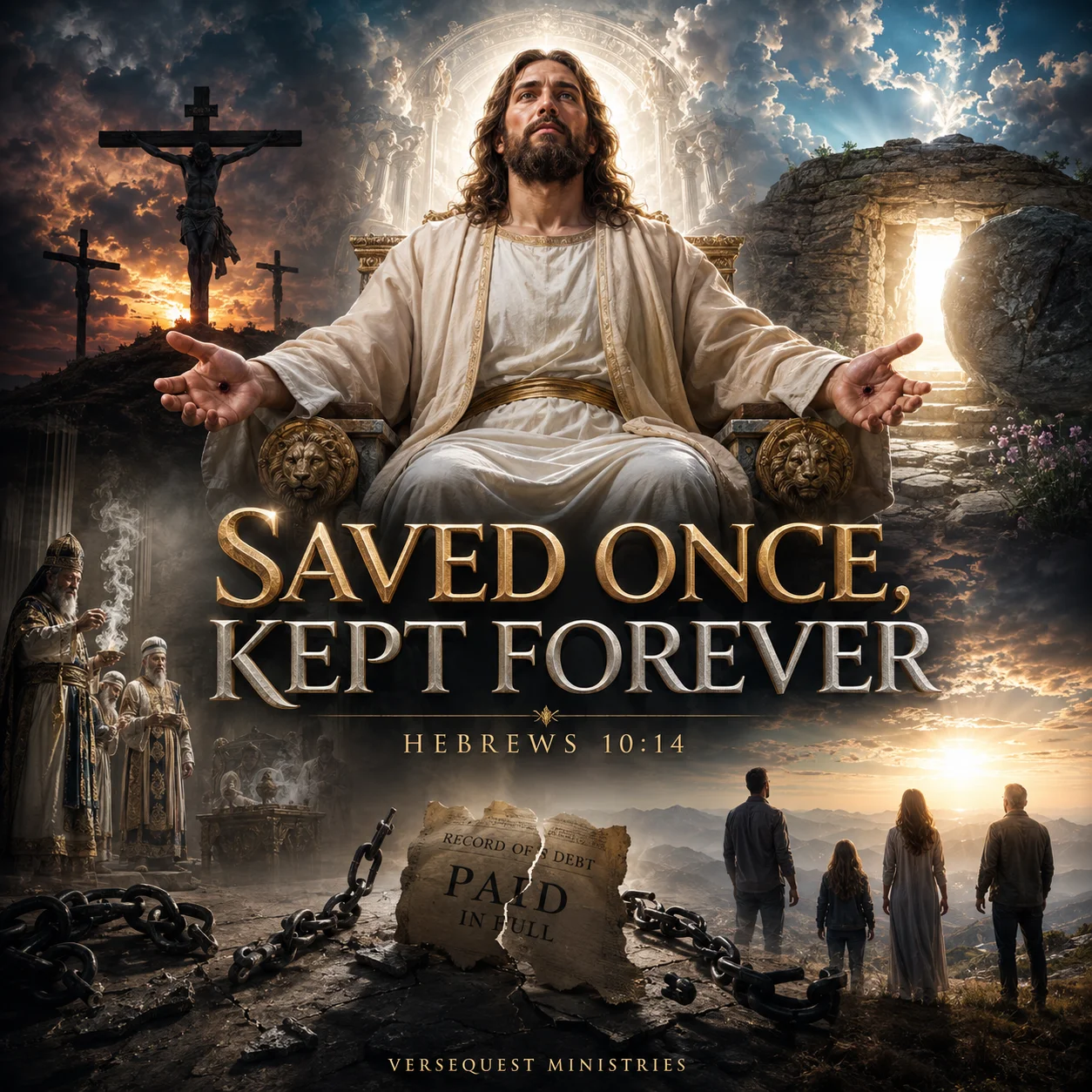
Saved Once, Kept Forever
One Offering, Perfected for Ever
Sermon Title:
Saved Once, Kept Forever: One Offering, Perfected for Ever
Key Passage:
Hebrews 10:14 — “For by one offering he hath perfected for ever them that are sanctified.”
Series:
Foundations of the Gospel of Grace
Topic:
The Finality of Christ’s One Offering, the Believer’s Eternal Security, and the Finished Work That Keeps the Saved Forever
Book:
Hebrews, Romans, John, Ephesians, Colossians, 1 Peter, Jude, 2 Timothy, 1 Corinthians
Speaker:
Paul Tackett
Suggested Sermon Text:
Hebrews 10:1–18; Hebrews 9:11–15; Hebrews 7:25; John 5:24; John 10:27–29; Romans 8:1, 31–39; Ephesians 1:13–14; Ephesians 4:30; Colossians 2:13–14; 1 Peter 1:3–5; Jude 24–25; 2 Timothy 1:12; 1 Corinthians 15:1–4
Short Sermon Description:
This detailed VerseQuest Ministries sermon outline explains Hebrews 10:14 and the glorious truth that Jesus Christ’s one offering has “perfected for ever them that are sanctified.” The sermon shows that salvation is not a repeated sacrifice, religious maintenance plan, sacramental process, law-keeping arrangement, or probationary hope, but a finished work secured by the blood of Jesus Christ. It explains the contrast between Old Testament sacrifices that could never take away sins and Christ’s once-for-all offering that perfects the believer forever. The outline also distinguishes positional perfection in Christ from practical growth, eternal security from careless living, chastening from condemnation, and the believer’s standing from his daily walk. Designed for pastors, preachers, teachers, Bible students, and believers, this sermon magnifies the finished work of Christ, the sufficiency of His blood, the sealing of the Spirit, the believer’s full forgiveness, and the assurance that those saved by Christ are kept forever by the power of God.
Saved Once, Kept Forever
One Offering, Perfected for Ever
Introduction
Hebrews 10:14 is one of the clearest statements in the King James Bible on the finality and sufficiency of the sacrifice of Jesus Christ: “For by one offering he hath perfected for ever them that are sanctified.” That verse does not speak with the trembling voice of unfinished religion. It does not say by many offerings He is trying to improve them. It does not say by one offering He started a process that human works, sacraments, priests, law-keeping, church membership, confession booths, altar rituals, and personal merit must complete. It says “by one offering.” It says “he hath perfected.” It says “for ever.” That is not a weak doctrine. That is a thunderclap from the throne of God against every system that keeps sinners and saints paying on a debt Christ already paid in full.
The book of Hebrews must be handled carefully and rightly. It is written to Hebrews, filled with temple language, priesthood language, covenant language, sacrifice language, endurance warnings, and tribulational weight. A Bible believer must not flatten Hebrews into a shallow pamphlet and ignore its doctrinal placement. Yet when Hebrews speaks of the superiority of Christ’s sacrifice over the old offerings, the truth is unmistakable: the sacrifices of the law could never make the comers thereunto perfect, could never purge the conscience finally, and could never take away sins. But Jesus Christ offered Himself once. He sat down. The work was finished. The sacrifice was accepted. The believer’s standing rests on the one offering of the Son of God, not on a religious treadmill that never stops moving.
This sermon deals with the great truth: saved once, kept forever. That phrase is not an excuse for sin. It is not a slogan for careless flesh. It is not a shield for rebellion. It is a Bible conclusion drawn from the finished work of Christ. If one offering perfected forever them that are sanctified, then the believer’s salvation rests on Christ’s perfection, not Adam’s performance. If Christ sat down after one sacrifice for sins forever, then no priestly system has authority to keep offering what God says is finished. If the believer is sealed unto the day of redemption, kept by the power of God, and held in the hand of the Shepherd, then eternal security is not presumption. It is faith in what God said. The saved man should live holy, not to keep himself saved, but because the Saviour who saved him is holy.
I. The Law Had Shadows, but Christ Is the Substance
Key Text: Hebrews 10:1
Supporting Texts: Colossians 2:16–17; Hebrews 8:5; Galatians 3:24–25
Hebrews 10:1 says, “For the law having a shadow of good things to come, and not the very image of the things.” That is the Holy Ghost’s own description of the ceremonial system. The law had shadows. Those shadows were given by God and served a real purpose, but a shadow is not the body. A shadow can point. A shadow can outline. A shadow can testify that something greater is coming. But a shadow cannot save the sinner, cleanse the conscience, or provide final perfection. It points to Christ.
Colossians 2 says meats, drinks, holy days, new moons, and sabbath days were “a shadow of things to come; but the body is of Christ.” That one phrase should settle the matter. Christ is the body. Christ is the substance. Christ is the fulfillment. When the sun is overhead and the substance has arrived, a man does not crawl back to the shadow and call it spirituality. The old sacrifices, priests, ordinances, and ceremonies pointed forward to a greater offering. They were not the final answer. Jesus Christ is.
This matters because religion is always trying to drag men back into shadows. It may use Hebrew language, priestly clothing, altar talk, candle smoke, ceremonial calendars, sacramental mystery, or law-based fear, but the problem is the same: shadows being treated as though they can complete what only Christ can finish. Hebrews 10 opens by telling us the law’s offerings could never do what Christ’s one offering did. The shadow had its place, but the saved man stands in the substance.
Main Truth:
The law’s sacrifices were shadows pointing to Christ, but Jesus Christ is the substance who finished what the shadows could never accomplish.
II. Repeated Sacrifices Proved the Work Was Not Finished
Key Text: Hebrews 10:1–3
Supporting Texts: Hebrews 9:6–10; Hebrews 10:11; Romans 3:20
Hebrews 10 says the law could never “with those sacrifices which they offered year by year continually make the comers thereunto perfect.” The repetition proved the limitation. If the sacrifice had truly finished the matter, there would have been no need to keep offering it. The same blood, the same priestly routine, the same yearly remembrance, the same altar activity, and the same consciousness of sin continued because the old sacrifices were not final.
Hebrews 10:3 says, “But in those sacrifices there is a remembrance again made of sins every year.” That is not completion. That is reminder. The old sacrifices preached that sin required blood, that guilt required death, and that man needed a substitute, but they could not finally remove the record. They kept pointing forward. They were God-given arrows, not the destination. The destination is Christ and His once-for-all sacrifice.
Hebrews 10:11 says every priest standeth daily ministering and offering oftentimes the same sacrifices, which can never take away sins. The priest stood because his work was never finished. Christ sat down because His work was. That contrast is important. Religion loves standing priests because standing priests mean ongoing work, ongoing offerings, ongoing uncertainty, ongoing dependence on the system. The Bible gives the believer a seated Saviour because the sacrifice is done.
Main Truth:
The repeated sacrifices of the law proved that they could not finally take away sins or perfect the worshipper forever.
III. Christ Offered One Sacrifice for Sins Forever
Key Text: Hebrews 10:12
Supporting Texts: Hebrews 9:26–28; John 19:30; 1 Peter 2:24
Hebrews 10:12 says, “But this man, after he had offered one sacrifice for sins for ever, sat down on the right hand of God.” That sentence is the graveyard of repeated-sacrifice religion. “One sacrifice.” “For sins.” “For ever.” “Sat down.” Every phrase is loaded. Jesus Christ did not offer one sacrifice that needed to be extended through priests. He did not offer one sacrifice that needed to be repeated in ritual. He did not offer one sacrifice that needed to be improved by human merit. He offered one sacrifice for sins forever.
John 19:30 records the cry from the cross: “It is finished.” Christ did not say, “It is started.” He did not say, “It is almost complete if men cooperate.” He did not say, “It will be finished once a religious institution repeats it often enough.” He said, “It is finished.” First Peter 2:24 says He bare our sins in His own body on the tree. The sin question was not pushed aside. It was answered in the body and blood of the Son of God.
The fact that Christ sat down matters. A seated Saviour is heaven’s declaration that the offering has been accepted. The old priests stood daily because the offerings were never final. Christ sat down because His sacrifice was. If Christ is seated, the saved man should stop acting like the altar is still open for payment. The believer’s assurance is not arrogance. It is agreement with the seated Christ and the finished word of God.
Main Truth:
Jesus Christ offered one sacrifice for sins forever, and His seated position proves the saving work is finished.
IV. The One Offering Perfected Believers Forever
Key Text: Hebrews 10:14
Supporting Texts: Colossians 2:10; Romans 5:1; 2 Corinthians 5:21
Hebrews 10:14 says, “For by one offering he hath perfected for ever them that are sanctified.” That is the heart of the sermon. “Perfected” here speaks of the believer’s standing before God through the completed sacrifice of Christ. It does not mean the believer is sinless in daily practice. If that were the case, no honest believer could read the verse without despair. It means the believer’s standing has been perfected before God by the one offering of Jesus Christ.
Colossians 2:10 says, “And ye are complete in him.” Second Corinthians 5:21 says believers are made the righteousness of God in Christ. Romans 5:1 says, “Therefore being justified by faith, we have peace with God through our Lord Jesus Christ.” These are standing truths. The believer is complete in Christ, justified by faith, accepted in the Beloved, and perfected forever by one offering. His flesh still needs correction, growth, and sanctification in practice, but his standing before God rests in Christ’s finished work.
Religion hates the word “forever” when it is attached to Christ’s completed sacrifice. Religion needs men uncertain. It needs the saved man to feel unfinished so it can offer missing pieces. But Hebrews 10:14 says what no church system can honestly improve: perfected for ever. The believer is not made perfect forever by his own performance, but by Christ’s one offering. That is why salvation, once received in Christ, is not kept by the flesh. It is grounded in the sacrifice that perfected forever.
Main Truth:
By one offering, Jesus Christ has perfected forever those who are sanctified in Him, giving believers a settled standing before God.
V. Forever Perfection Does Not Mean Sinless Practice
Key Text: Hebrews 10:14
Supporting Texts: 1 John 1:8–10; Romans 7:18–25; Philippians 3:12–14
The Bible must be believed without twisting it into foolishness. Hebrews 10:14 says believers are perfected forever by one offering, but 1 John 1:8 says if we say that we have no sin, we deceive ourselves. Romans 7 shows the believer’s struggle with the flesh. Philippians 3 shows Paul himself saying, “Not as though I had already attained, either were already perfect.” So the perfection of Hebrews 10:14 is not practical sinlessness in the believer’s daily walk. It is positional perfection in Christ.
This distinction saves a believer from two ditches. The first ditch is legalistic fear, where every failure is treated as proof that salvation has been lost. The second ditch is careless presumption, where standing in Christ is used to excuse sin. The Bible rejects both. The believer is perfected forever in Christ, yet he must still walk in the Spirit, confess sin, grow in grace, put off the old man, and put on the new. Standing is settled; state must be tended.
The saved man who understands this truth will not say, “I am perfected forever, so sin does not matter.” He will say, “I am perfected forever by Christ’s one offering, so sin has no right to rule me.” Grace does not make sin harmless. Grace places the believer on a foundation where he can deal with sin honestly without fearing eternal condemnation. The believer can confess because he is a son, not because he is trying to become one again.
Main Truth:
Hebrews 10:14 teaches the believer’s perfected standing in Christ, not sinless daily practice or careless living.
VI. The Holy Ghost Witnesses to the Finality of the Work
Key Text: Hebrews 10:15–17
Supporting Texts: Jeremiah 31:31–34; Ephesians 1:13–14; Ephesians 4:30
Hebrews 10:15 says, “Whereof the Holy Ghost also is a witness to us.” The Spirit of God bears witness to the finality of Christ’s work through Scripture. Hebrews then quotes the new covenant promise concerning sins and iniquities being remembered no more. The immediate covenantal context belongs to Israel and must be handled rightly, but the application in Hebrews is clear: Christ’s offering has dealt with sin in a way the old sacrifices never could.
For the Church-age believer, Ephesians 1:13–14 gives the order of salvation and sealing. After hearing the word of truth, the gospel of salvation, and after believing, the believer is sealed with that holy Spirit of promise, which is the earnest of the inheritance. Ephesians 4:30 says believers are sealed unto the day of redemption. The Holy Spirit does not seal believers into an unfinished salvation. He seals them because the blood has been shed, the sacrifice has been accepted, and the Saviour is risen.
The Spirit’s witness is stronger than the believer’s feelings. A believer may feel weak, attacked, condemned, discouraged, or unworthy. The Spirit points him to the word of God and the finished work of Christ. Assurance is not built on emotional weather. It is built on divine testimony. The Holy Ghost does not comfort saints by pointing them to their flesh. He points them to Christ, the one offering, the finished sacrifice, and the promise of God.
Main Truth:
The Holy Ghost witnesses through Scripture that Christ’s one offering has finally dealt with sin and secures the believer’s standing.
VII. No More Offering Means No More Payment Remains
Key Text: Hebrews 10:18
Supporting Texts: Colossians 2:13–14; Ephesians 1:7; Romans 4:7–8
Hebrews 10:18 says, “Now where remission of these is, there is no more offering for sin.” That verse should be printed on the front door of every religious system that tries to keep offering something for sins. If sins have been remitted, there is no more offering. If Christ’s sacrifice has perfected forever, there is no more payment. If the handwriting has been blotted out and nailed to the cross, there is no more debt for the believer to pay.
Colossians 2 says God has forgiven all trespasses, blotted out the handwriting of ordinances that was against us, taken it out of the way, and nailed it to Christ’s cross. Ephesians 1:7 says believers have redemption through His blood, the forgiveness of sins. Romans 4 speaks of the blessedness of the man to whom the Lord will not impute sin. These verses do not describe a half-forgiven man hoping religion keeps him afloat. They describe forgiveness grounded in Christ.
This is where saved once, kept forever stands on Scripture. If remission has been accomplished, if no more offering remains, if the believer is perfected forever by one offering, then salvation cannot be a repeated payment plan. The believer’s future sins do not surprise God. Christ died for sins. God’s judicial dealings with the believer’s sin were answered at Calvary. The believer may need confession for fellowship and may face chastening in time, but no more offering remains for salvation because Christ’s one offering was enough.
Main Truth:
Where remission of sins has been secured by Christ, no further offering or payment for sin remains.
VIII. Eternal Security Is Grounded in Christ, Not the Flesh
Key Text: Hebrews 10:14
Supporting Texts: John 10:28–29; 1 Peter 1:5; Jude 24; 2 Timothy 1:12
Eternal security is not confidence in the believer’s flesh. It is confidence in Jesus Christ. Hebrews 10:14 does not say, “By the believer’s consistency he hath perfected himself for as long as he behaves.” It says, “by one offering he hath perfected for ever.” John 10 says Christ gives His sheep eternal life, they shall never perish, and no man shall pluck them out of His hand or the Father’s hand. First Peter 1:5 says believers are kept by the power of God.
Jude 24 says God is able to keep believers from falling and present them faultless before the presence of His glory. Second Timothy 1:12 says Christ is able to keep that which is committed unto Him against that day. The Bible repeatedly places keeping power in God’s hands, not man’s. The believer is not kept by emotional steadiness, sacramental repetition, law-keeping, or personal merit. He is kept by the Saviour who finished the work.
This truth does not flatter the flesh; it humbles it. The saved man does not boast, “I could never fall.” He says, “God is able to keep me.” He does not say, “My grip is strong.” He says, “The Shepherd’s hand is strong.” He does not say, “My performance perfects me.” He says, “Christ’s one offering perfected me forever.” Eternal security is not man-centered presumption. It is Christ-centered faith.
Main Truth:
The believer is kept forever because salvation rests on Christ’s one offering and God’s keeping power, not on human flesh.
IX. Being Saved Once and Kept Forever Calls for Holy Living
Key Text: Hebrews 10:14
Supporting Texts: Romans 6:1–2; Titus 2:11–14; Hebrews 12:5–11; 1 Corinthians 6:19–20
Every time eternal security is preached, the legalist drags out the same tired slander: “So you are saying people can sin all they want?” Paul already answered that: “God forbid.” Hebrews 10:14 is not a license for sin. It is the foundation for worship, gratitude, confidence, and holy service. The believer is perfected forever by Christ’s offering, and therefore his body, tongue, mind, walk, and testimony should belong to the One who bought him.
Titus 2 says the grace of God that brings salvation teaches believers to deny ungodliness and worldly lusts. Grace is not lazy. Grace teaches. Hebrews 12 says the Lord chastens the sons He loves. Security does not remove chastening. First Corinthians 6 says the believer is bought with a price and should glorify God in his body and spirit, which are God’s. Eternal security means the believer belongs to God forever, not that he belongs to himself.
The believer should obey from gratitude, not terror. Fear of damnation is not the highest motive for Christian living. Love for the Saviour, reverence for the Father, the indwelling Spirit, the judgment seat of Christ, the seriousness of sin, and gratitude for grace are better motives. Saved once, kept forever does not make sin safe. It makes Christ glorious and the believer responsible to walk worthy of the salvation he did not earn.
Main Truth:
Being saved once and kept forever does not excuse sin, but calls the believer to holy living, gratitude, and faithful service.
Conclusion
Hebrews 10:14 gives the believer a foundation that religion cannot shake: “For by one offering he hath perfected for ever them that are sanctified.” The law had shadows. The old sacrifices were repeated. The priests stood daily. But Christ offered one sacrifice for sins forever and sat down. The contrast is unmistakable. The old system could never take away sins finally. The Son of God did what the shadows only pictured. He finished the work.
The believer’s security rests on that one offering. Not on sacraments. Not on law-keeping. Not on church membership. Not on emotional stability. Not on human merit. Not on repeating a sacrifice God says is finished. The believer is perfected forever in Christ, sealed by the Spirit, kept by the power of God, held in the Shepherd’s hand, and free from condemnation. That is not because the believer is strong. It is because Christ’s sacrifice is sufficient.
This doctrine must be preached with both assurance and sobriety. Assurance, because Christ’s one offering perfected believers forever. Sobriety, because the saved man still must walk in holiness, confess sin, submit to chastening, and stand before the judgment seat of Christ for service and reward. Security is not carelessness. Grace is not lawlessness. Christ did not save men once and keep them forever so they could live like the world. He saved them to belong to Him, serve Him, worship Him, and rejoice in the finished work forever.
Final Call
Sinner, you cannot save yourself by repeated efforts, religious rituals, law-keeping, church membership, sacraments, morality, or good works. Your sin needs a sacrifice, and God has provided one. Jesus Christ died for your sins according to the Scriptures. He was buried. He rose again the third day according to the Scriptures.
Believe on the Lord Jesus Christ, and thou shalt be saved. Trust His blood. Trust His death. Trust His burial. Trust His resurrection. Trust His one offering. Do not bring God a pile of religious receipts and call it salvation. Come to Christ by faith and rest in the finished work.
Believer, stop letting religion reopen a case Christ closed. Do not live carelessly, but do live confidently. Confess sin, walk holy, serve faithfully, and rejoice deeply. By one offering, He hath perfected for ever them that are sanctified. Saved once. Kept forever. Glory to the Lamb.
Closing Verse:
Hebrews 10:14 — “For by one offering he hath perfected for ever them that are sanctified.”
Closing Statement:
The believer is not kept by repeating what Christ finished, but by resting in the one offering that perfected him for ever.