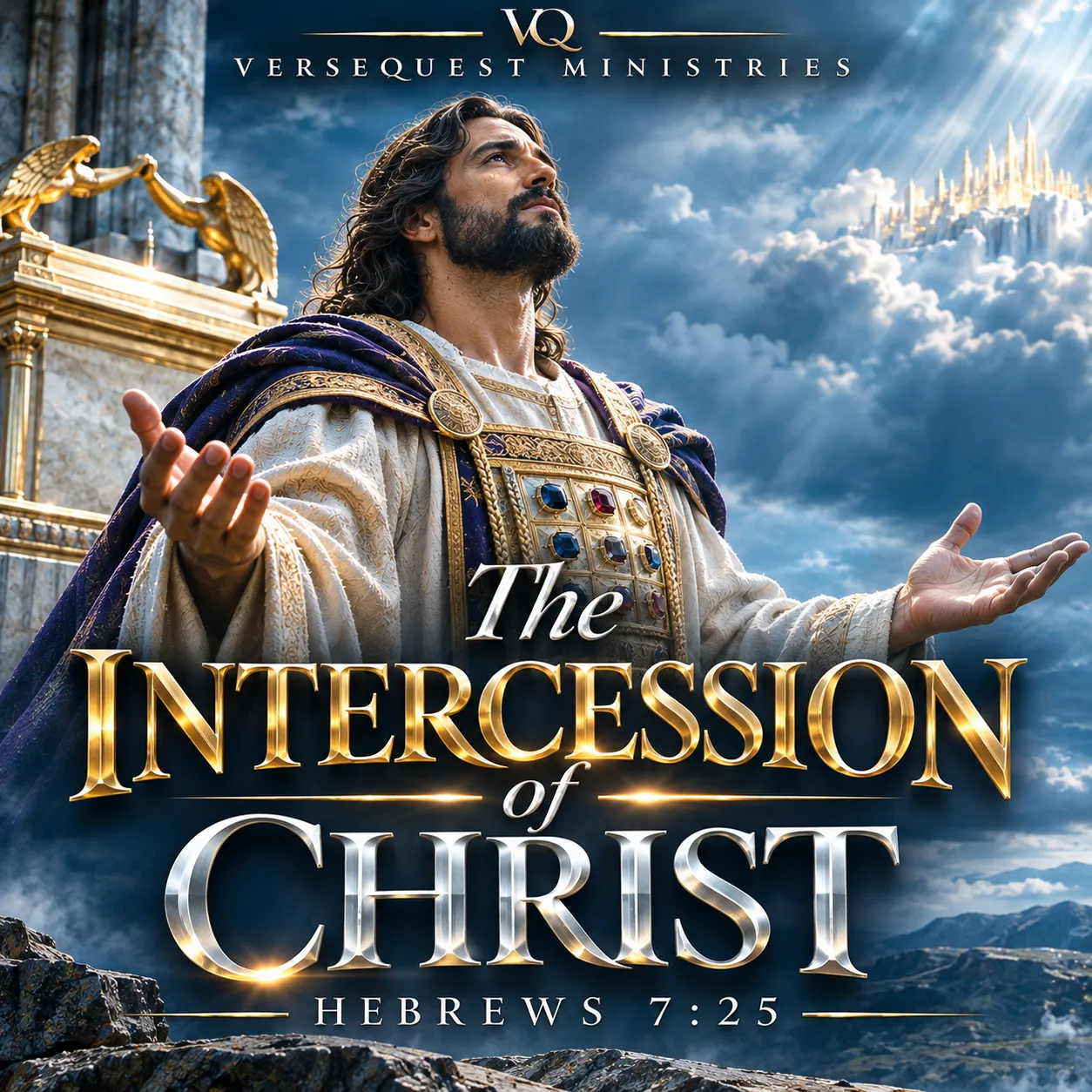
Sermon Title:
The Intercession of Christ
Key Passage:
Hebrews 7:25
“Wherefore he is able also to save them to the uttermost that come unto God by him, seeing he ever liveth to make intercession for them.” (Hebrews 7:25)
Series:
The Book God Gave
Topic:
The Eternal Priesthood of Jesus Christ, His Finished Sacrifice, His Continuing Intercession at the Right Hand of God, and the Complete Salvation and Security of Those Who Come Unto God Through Him
Book:
Hebrews
Speaker:
Paul Tackett
Suggested Sermon Text:
Genesis 14:18–20; Exodus 28:1–43; Exodus 29:1–46; Leviticus 16:1–34; Psalm 110:1–7; Isaiah 53:4–12; Zechariah 3:1–5; Matthew 26:36–46; Luke 22:31–32; Luke 23:32–46; Luke 24:1–53; John 10:27–30; John 14:1–6; John 17:1–26; John 19:28–30; John 20:1–31; Acts 1:9–11; Acts 2:22–36; Acts 7:55–56; Romans 3:21–28; Romans 4:4–8, 23–25; Romans 5:1–11; Romans 6:1–14; Romans 7:14–25; Romans 8:1–39; Romans 10:9–13; Romans 12:1–2; Romans 15:30–33; 1 Corinthians 3:11–15; 1 Corinthians 6:19–20; 1 Corinthians 15:1–4, 20–28, 51–58; 2 Corinthians 4:7–18; 2 Corinthians 5:14–21; 2 Corinthians 12:7–10; Galatians 2:20; Galatians 4:4–7; Galatians 5:16–26; Ephesians 1:3–14, 19–23; Ephesians 2:1–10, 13–18; Ephesians 3:12–21; Ephesians 4:30–32; Ephesians 6:10–20; Philippians 1:3–11; Philippians 3:20–21; Philippians 4:4–9; Colossians 1:12–22; Colossians 2:9–15; Colossians 3:1–4; 1 Thessalonians 4:13–18; 1 Timothy 2:1–8; 2 Timothy 1:9–12; 2 Timothy 2:15; Titus 3:4–7; Hebrews 1:1–14; Hebrews 2:9–18; Hebrews 3:1–6; Hebrews 4:12–16; Hebrews 5:1–10; Hebrews 6:13–20; Hebrews 7:1–28; Hebrews 8:1–13; Hebrews 9:1–28; Hebrews 10:1–25; Hebrews 12:1–3; Hebrews 13:5–8; 1 Peter 1:3–5; 1 John 1:7–10; 1 John 2:1–2; 1 John 5:11–15.
Short Sermon Description:
Hebrews 7:25 contains one of the most magnificent declarations concerning the eternal priesthood and continuing ministry of the Lord Jesus Christ: “Wherefore he is able also to save them to the uttermost that come unto God by him, seeing he ever liveth to make intercession for them.” This sermon examines the believer’s complete salvation through Jesus Christ and explains why His heavenly intercession rests upon His finished sacrifice, victorious resurrection, and unchangeable priesthood rather than any continuing need to repeat the work of Calvary. The message carefully establishes the context of Hebrews 7, where the writer demonstrates the superiority of Christ’s priesthood after the order of Melchisedec over the former Levitical priesthood established under the Mosaic law. Special attention is given to the mortality of Israel’s former high priests, the divine oath recorded in Psalm 110:4, Christ’s endless life, and the meaning of being saved “to the uttermost.” The outline explains why Christ’s intercession is not an attempt to persuade an unwilling Father to forgive sinners but the continuing priestly ministry of the risen Saviour whose blood has already accomplished redemption. It examines the expression “them that come unto God by him,” establishing the exclusive sufficiency of Jesus Christ as the one Mediator between God and men and the necessity of personally believing the gospel. Drawing upon Hebrews 4–10, Romans 8:26–39, Ephesians 1–2, 1 Timothy 2:5, and 1 John 2:1–2, the sermon distinguishes Christ’s intercession from the Holy Spirit’s ministry in prayer and the ordinary intercessory responsibility of saved believers. It also explains why eternal security rests upon Christ’s accomplished redemption and continuing life rather than the believer’s sinless performance, while emphasizing that such security never grants permission for carnal living or doctrinal carelessness. The message develops the practical significance of Christ’s ministry for Christians facing accusation, temptation, suffering, spiritual weakness, and the uncertainties of earthly life. Preachers, pastors, teachers, and Bible students will gain a comprehensive, KJV-based, rightly divided, sermon-ready framework for teaching the eternal priesthood of Jesus Christ, His once-for-all sacrifice, continuing intercession, complete salvation, eternal security, access to the Father, biblical prayer, and the believer’s confidence in the risen Saviour.
THE INTERCESSION OF CHRIST
Introduction
There is something extraordinary about the fact that the greatest work ever accomplished for the salvation of sinners was finished nearly two thousand years ago, yet the Saviour who accomplished that work is still alive and ministering on behalf of those He redeemed. The Lord Jesus Christ did not come into this world, suffer upon Calvary, shed His blood, rise from the dead, ascend into heaven, and then retire from all concern for His people. He did not complete redemption only to leave saved sinners wondering whether they would somehow manage to remain saved until death. He did not provide eternal life through His sacrifice and then place the preservation of that life into the unreliable hands of the fallen flesh. The Bible declares something infinitely greater. Hebrews 7:25 says, “Wherefore he is able also to save them to the uttermost that come unto God by him, seeing he ever liveth to make intercession for them.” There is the person of the Saviour, the extent of His saving ability, the necessary approach through Him, and the certainty of His continuing life and intercession. The verse does not merely declare that Christ was once able to save. It says He “is able.” It does not announce a partial salvation awaiting completion through human religious performance. It says “to the uttermost.” And it does not describe a deceased religious founder whose followers must preserve his memory after his earthly ministry has ended. It declares that “he ever liveth.” That statement should permanently settle the confidence of every person who has genuinely trusted the finished work of Jesus Christ. The Saviour who paid for redemption is not lying in a grave, the blood that purchased salvation has not lost its sufficiency, and the High Priest who represents His people has not surrendered His office to another.
But this magnificent verse is often discussed without carefully examining the argument that makes it so powerful. Hebrews chapter 7 is not an isolated devotional discussion about the comforting thought that Jesus prays for Christians. The writer is explaining the superiority of the priesthood of Jesus Christ over the former Levitical priesthood established under the law given to Israel. He introduces Melchisedec, recalls Abraham’s encounter with that remarkable king and priest, explains the relationship between the priesthood and the law, and demonstrates that Jesus Christ has become a priest after a different order from Aaron. The former priests were many because death prevented them from continuing indefinitely. Jesus Christ, however, possesses an unchangeable priesthood because He continues forever. The earthly priests repeatedly offered sacrifices, including sacrifices necessary because of their own sins. Jesus Christ, the holy and sinless Son of God, offered Himself once. The writer is not comparing two equally sufficient methods of redemption and allowing the reader to select whichever arrangement seems more attractive. He is establishing that the former priestly order was insufficient to accomplish the final perfection secured through Christ. The Old Testament priesthood anticipated something greater, and that greater reality has appeared in the person of Jesus Christ. Therefore, when Hebrews 7:25 declares that He is able to save to the uttermost, the statement rests upon the superiority, permanence, and sufficiency of His priesthood. The Lord Jesus Christ does not need a successor because He cannot die again, does not need another sacrifice because His offering was sufficient, and does not need to be replaced because His priesthood cannot expire.
There is also a serious doctrinal distinction between the finished work of redemption and the continuing ministry of intercession. Some people imagine that Christ must continually plead with an angry Father to prevent Him from condemning believers whom the Son has already saved. Others speak as though every time a Christian sins, Jesus must offer His blood again or persuade God to reconsider the salvation He previously granted. Still others turn the subject of intercession into an argument for additional human mediators, religious ceremonies, priestly authorities, or repeated sacrifices supposedly necessary to maintain fellowship with heaven. But the word of God teaches no such arrangement. Christ declared, “It is finished” (John 19:30). Hebrews 10:12 says that after offering one sacrifice for sins for ever, He sat down on the right hand of God. Romans 8:34 identifies the risen Christ at God’s right hand, making intercession for believers. His sacrifice is complete, while His priestly ministry continues. His intercession does not improve upon Calvary; it rests upon Calvary. His continuing life does not make redemption uncertain; it displays the living sufficiency of the Redeemer. And His priesthood does not excuse the believer from walking in holiness, studying Scripture, praying, and serving faithfully. Salvation by grace establishes the Christian’s secure position, while practical obedience remains his responsibility. The Christian’s eternal security is not maintained by the strength of his grip upon the Saviour, but by the saving sufficiency of the risen Saviour who has promised eternal life and ever lives to make intercession for His own. That is the great truth before us in Hebrews 7:25, and it deserves far more attention than a passing religious expression about Jesus praying in heaven.
I. THE FORMER PRIESTS WERE MANY BECAUSE DEATH PREVENTED THEM FROM CONTINUING
Key Text: Hebrews 7:23–24
Supporting Texts: Exodus 28:1–4; Numbers 20:22–29; Hebrews 5:1–4; Hebrews 7:11–28; Hebrews 9:6–10; Hebrews 10:1–4
The writer of Hebrews establishes a remarkable contrast immediately before our key verse: “And they truly were many priests, because they were not suffered to continue by reason of death: But this man, because he continueth ever, hath an unchangeable priesthood.” The difference is unmistakable. Under the Mosaic law, the priestly office was exercised by mortal men who could not remain in their positions indefinitely. Aaron eventually died. His sons continued the priestly responsibilities, and succeeding generations carried out the duties associated with the Levitical order. The office continued through successive men because no individual priest possessed an endless earthly life. Death interrupted their service. Their responsibilities passed to others. The man standing before the altar today might be buried tomorrow. However faithfully he performed his assigned duties, his mortality placed a limit upon his personal ministry. The priesthood could continue as an institution, but the individual priest could not continue forever. That is precisely the weakness Hebrews places in contrast with the priesthood of Jesus Christ. A priesthood dependent upon dying men must continually find another priest, but the priesthood of Jesus Christ needs no replacement because the Priest Himself lives forever.
This distinction must be understood within the history of Israel. The Levitical priesthood was established under the law, with particular responsibilities concerning sacrifices, the sanctuary, ceremonial cleansing, and the worship of the nation. Those priests were not self-appointed religious entrepreneurs who invented their offices to obtain public recognition. Their responsibilities belonged to the order God established. Yet their ministry was limited by their own humanity and the nature of the sacrificial system. Hebrews 5:3 explains that the high priest needed to offer sacrifices for his own sins as well as for the people’s sins. The priests themselves were sinners. They did not possess an independent righteousness capable of removing the guilt of the nation. Hebrews 10:4 declares, “For it is not possible that the blood of bulls and of goats should take away sins.” The sacrifices belonged to the divinely established system, but they pointed beyond themselves to the greater sacrifice of Jesus Christ. The repeated ceremonies could not accomplish the complete and final redemption provided through His blood.
Now consider the difference when the Lord Jesus Christ enters the discussion. He is not another mortal sinner appointed to offer sacrifices until death removes Him from office. He is the eternal Son of God who became flesh, offered Himself without sin, died for our sins, and rose again victorious over death. His resurrection establishes that death no longer possesses dominion over Him. Romans 6:9 declares, “Knowing that Christ being raised from the dead dieth no more; death hath no more dominion over him.” Consequently, the believer’s confidence does not rest upon the survival of an earthly priestly organization or the availability of another religious official to continue an unfinished work. The Saviour Himself continues forever. The former priests had to be replaced because death ended their earthly ministry. Jesus Christ defeated death, and His heavenly ministry possesses no expiration date.
Main Truth: The mortality of the Levitical priests required continual succession, but Jesus Christ possesses an unchangeable priesthood because He has risen from the dead and lives forever.
II. CHRIST’S PRIESTHOOD AFTER THE ORDER OF MELCHISEDEC IS ESTABLISHED BY DIVINE OATH
Key Text: Hebrews 7:11–22
Supporting Texts: Genesis 14:18–20; Psalm 110:1–4; Hebrews 5:5–10; Hebrews 6:19–20; Hebrews 7:1–28; Hebrews 8:1–6
Hebrews chapter 7 introduces Melchisedec, the king of Salem and priest of the most high God, whose appearance in Genesis 14 provides an extraordinary foundation for understanding the priesthood of Jesus Christ. Abraham encountered Melchisedec after returning from the slaughter of the kings, received his blessing, and gave him tithes. Hebrews examines the significance of that encounter and describes Melchisedec as king of righteousness and king of peace. The writer emphasizes how the Genesis record presents him apart from the genealogical succession that characterized the Levitical priesthood. Hebrews 7:3 says he was “made like unto the Son of God.” That wording deserves careful attention. The text presents Melchisedec as a remarkable priestly figure corresponding to the Son of God. It does not require the preacher to announce dogmatically that Melchisedec was Jesus Christ appearing before the incarnation. The historical record concerning Melchisedec is deliberately limited, and Hebrews uses those features to establish the superiority of the priestly order associated with him. The figure points toward the greater reality fulfilled in Jesus Christ. God did not provide the account of Melchisedec so preachers could spend their lives inventing speculative biographies for a man whose history Scripture has deliberately left largely unrecorded. He provided it to direct attention toward the superior priesthood of His Son.
The distinction becomes especially important when Hebrews 7:14 declares, “For it is evident that our Lord sprang out of Juda; of which tribe Moses spake nothing concerning priesthood.” Jesus Christ was not descended from Aaron and did not qualify for the Levitical priesthood through the genealogy required under the law. He belonged to the tribe of Judah according to His earthly lineage. Therefore, His priesthood cannot be explained as though He merely entered the existing Aaronic order and took the place of another mortal high priest. Hebrews explains that His priesthood belongs to a different order established by God. Psalm 110:4 had already declared, “The LORD hath sworn, and will not repent, Thou art a priest for ever after the order of Melchizedek.” That statement is a divine oath concerning the Messiah. It establishes a priesthood grounded in God’s unchangeable purpose rather than the ordinary succession of mortal priests under the law. Hebrews 7:16 explains that Christ was made a priest “after the power of an endless life.” His qualification is not that He possesses the proper earthly ancestry for Aaron’s office. His priesthood rests upon His person, divine appointment, and endless life.
Hebrews 7:22 then declares, “By so much was Jesus made a surety of a better testament.” The writer is comparing what belonged to the former covenant arrangement with the superior provision established through Jesus Christ. This is not permission to erase Israel’s history or confuse the Church with the nation to whom the law was given. The Mosaic priesthood belonged to Israel, and Christ’s superiority must be understood against that actual historical arrangement. The Church’s heavenly position and the mystery revealed through the Apostle Paul must also be distinguished from the national promises given to Israel. But none of those distinctions weakens the central truth: the Saviour’s priesthood is greater because God appointed Him according to an order that cannot be terminated by death. The former priesthood anticipated something better. Jesus Christ is that greater Priest. When God swore that His Messiah would be a priest forever, He did not establish an office that could be vacated through death, corrupted through sin, or transferred to another man after a few years of service. He appointed His Son, whose priesthood is unchangeable.
Main Truth: Jesus Christ’s eternal priesthood is established by divine oath after the order of Melchisedec, surpassing the Levitical priesthood through His divine appointment, sinlessness, and endless life.
III. “HE IS ABLE ALSO TO SAVE THEM TO THE UTTERMOST” DECLARES THE COMPLETENESS OF CHRIST’S SALVATION
Key Text: Hebrews 7:25
Supporting Texts: Hebrews 7:24–28; Hebrews 9:11–15; Hebrews 10:10–14; John 10:27–30; Romans 5:1–11; Romans 8:1–39; Ephesians 1:7, 13–14
The first great declaration of Hebrews 7:25 is “Wherefore he is able also to save them to the uttermost.” The writer is not describing a Saviour possessing a limited ability to rescue sinners from a portion of their guilt while leaving the remainder of redemption unfinished. He announces a complete saving sufficiency grounded in Christ’s permanent priesthood. The word “uttermost” is an extraordinary expression because it reaches beyond the idea of a temporary improvement in the sinner’s condition. Jesus Christ does not merely offer a short period of religious acceptance while waiting to discover whether the fallen flesh can preserve the arrangement. The Saviour is able to save completely. His sacrifice addresses the guilt of sin. His resurrection establishes His victory over death. His continuing priesthood guarantees that His saving ministry cannot be interrupted by mortality. The sinner’s hope is not that Christ accomplishes most of salvation and leaves the final portion to be purchased through baptism, church membership, good works, personal endurance, or religious dedication. The sinner’s hope is that the Son of God possesses the power and sufficiency to accomplish what fallen man could never perform. A salvation that requires the sinner to finish paying for his own redemption is not the complete salvation Hebrews attributes to Jesus Christ.
Hebrews 10:14 reinforces the same doctrine: “For by one offering he hath perfected for ever them that are sanctified.” Notice the words “one offering” and “for ever.” The value of Christ’s sacrifice does not diminish because earthly time continues moving forward. His blood does not become less sufficient with the passing of centuries. His completed offering is not dependent upon another sacrifice being continually performed to keep redemption effective. Romans 8:1 declares, “There is therefore now no condemnation to them which are in Christ Jesus, who walk not after the flesh, but after the Spirit.” The chapter continues by establishing the security of those who belong to Christ and concludes that nothing can separate them from the love of God which is in Christ Jesus our Lord. Ephesians 1:13–14 identifies the Church-Age believer as sealed with the Holy Spirit of promise after believing the gospel. These passages should be understood according to their respective contexts, but their testimony concerning the sufficiency of Christ and the believer’s secure spiritual position is unmistakable. The saved man is not repeatedly expelled from Christ and then required to become born again every time he encounters weakness in the flesh.
This does not mean the Christian automatically becomes sinless in daily conduct or that every difficulty disappears at salvation. The word “uttermost” must not be turned into a promise that the believer will never experience physical weakness, temptation, persecution, disappointment, or the consequences of unwise earthly decisions. Nor does complete salvation eliminate the responsibility for practical obedience. The Christian remains accountable for his conduct and stewardship, and Scripture teaches that his works will be examined at the Judgment Seat of Christ. First Corinthians 3 distinguishes loss of reward from loss of salvation. The believer’s standing in Jesus Christ must not be confused with the quality of his daily service. Yet that distinction strengthens rather than weakens assurance. The Christian does not need to spend his life desperately attempting to prevent Christ’s completed redemption from becoming incomplete. He should spend his life serving gratefully because Christ’s redemption is sufficient. The Saviour did not announce that He could save a man halfway and then recommend a good religious program for completing the rest. He is able to save to the uttermost, and the glory belongs entirely to Him.
Main Truth: Jesus Christ is able to save completely and permanently through His finished sacrifice and eternal priesthood, while the believer’s daily sanctification and stewardship remain distinct from the salvation secured through Him.
IV. “THEM THAT COME UNTO GOD BY HIM” IDENTIFIES JESUS CHRIST AS THE ONLY WAY TO THE FATHER
Key Text: Hebrews 7:25
Supporting Texts: John 14:6; John 10:9; Acts 4:10–12; Romans 3:21–28; Romans 4:4–5; Ephesians 2:8–18; 1 Timothy 2:5–6
Hebrews 7:25 identifies the recipients of this complete salvation with the words “them that come unto God by him.” That expression is just as important as the promise of being saved to the uttermost. The writer does not announce that every person automatically possesses salvation simply because Jesus Christ is able to save. He identifies those who come unto God through Him. The distinction must not be overlooked. The Lord Jesus Christ possesses the power to save sinners, but the sinner must receive the salvation offered through Him. John 14:6 records Christ’s declaration, “I am the way, the truth, and the life: no man cometh unto the Father, but by me.” That statement leaves no room for the modern religious theory that every pathway eventually reaches God if the person traveling it possesses enough sincerity. Religious sincerity cannot transform false doctrine into divine truth. A man may sincerely trust in baptism, church membership, charitable works, religious ceremonies, or the authority of another mediator while remaining mistaken concerning the foundation of salvation. The Bible does not say that all religions provide equally valid access to the Father. It identifies Jesus Christ as the way.
First Timothy 2:5 declares, “For there is one God, and one mediator between God and men, the man Christ Jesus.” The following verse explains that He gave Himself a ransom for all. That statement establishes the sufficiency and scope of Christ’s redemptive provision without teaching that everybody automatically receives eternal life apart from faith. The message of salvation is to be proclaimed to sinners, and those sinners must believe the gospel. Under the present dispensation, the gospel entrusted to Paul declares that Christ died for our sins according to the Scriptures, was buried, and rose again the third day according to the Scriptures. Romans 4:5 identifies the sinner who is justified as the one who believes on Him who justifies the ungodly. Ephesians 2:8–9 teaches salvation by grace through faith, not of works. Consequently, the way to God is not through a human religious hierarchy possessing authority to distribute redemption. It is through the Saviour who accomplished redemption. There is one Mediator because there is one sufficient Redeemer, and no religious institution has been authorized to manufacture another way into the presence of God.
That truth also explains why the Christian should never confuse intercessory prayer for lost people with their actual salvation. A mother may pray earnestly for her child. A pastor may bring the spiritual needs of his congregation before the Father. A missionary may intercede for an entire community that has never heard the gospel. Such prayer is proper and important. But the prayer of another person cannot substitute for the sinner’s personal need to believe the gospel. Christ is the Saviour. The believer praying is not. The Lord’s redemptive work is sufficient, but no human intercessor possesses the authority to confer eternal life upon someone who remains in unbelief. The Christian should therefore pray for the lost while remaining willing to proclaim the message by which sinners may be saved. The greatest thing you can do for a lost man is not persuade him to admire your religion. It is direct him to the only Saviour through whom he may come unto God and receive eternal life.
Main Truth: The complete salvation accomplished through Jesus Christ belongs to those who come unto God through Him, and no religious ceremony, human mediator, or alternate gospel can replace personal faith in the Saviour.
V. “SEEING HE EVER LIVETH” MAKES THE RESURRECTION CENTRAL TO THE SAVIOUR’S CONTINUING MINISTRY
Key Text: Hebrews 7:25
Supporting Texts: Luke 24:1–7; John 20:19–31; Acts 1:9–11; Romans 6:9–10; Romans 8:34; 1 Corinthians 15:1–28; Revelation 1:17–18
The next expression reveals why the salvation described in Hebrews 7:25 is secure: “seeing he ever liveth.” Those words are not a decorative statement concerning the general immortality of the soul. They identify the continuing life of the risen Jesus Christ. He died upon Calvary. His death was genuine. His body was placed in a tomb. But on the third day He rose again according to the Scriptures. He did not merely survive in the memories of His disciples or continue existing as an inspirational influence upon those who admired His teachings. He literally rose from the dead. The Gospel records testify concerning the empty tomb and the risen Saviour, and the Apostle Paul makes His resurrection an essential part of the gospel. First Corinthians 15:17 declares, “And if Christ be not raised, your faith is vain; ye are yet in your sins.” That statement should settle any attempt to treat the resurrection as an optional doctrine that can be discarded without affecting salvation. If Jesus Christ had remained dead, He could not be the living High Priest described in Hebrews 7:25. The entire argument concerning His unchangeable priesthood rests upon the reality of His endless life.
Romans 6:9 declares, “Knowing that Christ being raised from the dead dieth no more; death hath no more dominion over him.” That is a remarkable distinction between the risen Saviour and every ordinary mortal priest who served under the former order. The priests of Israel eventually died. Their offices passed to others. Their bodies returned to the dust. But the Lord Jesus Christ rose from death and will never die again. His resurrection was not a temporary return to mortal life requiring Him to undergo another death at some future point. He possesses the victory. Revelation 1:18 records the risen Lord declaring, “I am he that liveth, and was dead; and, behold, I am alive for evermore, Amen.” The Christian should recognize the theological weight of those words. The Saviour is not struggling to remain alive. Death has already been conquered. His priesthood is not threatened by mortality. His ministry is not interrupted by the weaknesses that ended the service of earthly priests. The believer’s High Priest is not another dying man trying to extend his religious career. He is the risen Son of God who has already defeated death and possesses an endless life.
The resurrection also gives the believer confidence concerning the future. Jesus Christ is not merely alive in order to preserve a religious office. He is the risen Head of His body, the Church, and the One through whom God has promised future bodily redemption. Philippians 3:21 declares that He “shall change our vile body, that it may be fashioned like unto his glorious body.” First Corinthians 15 reveals that the mortal body will ultimately be transformed according to God’s promise. First Thessalonians 4 describes the future catching away of the saints to meet the Lord in the air. Those truths belong to the Church’s blessed hope and must be distinguished from the prophetic promises concerning Israel’s national restoration and the future earthly reign of Christ. Yet they demonstrate that the believer’s confidence reaches beyond the grave because the Saviour is alive. The One who intercedes today is the same One who will fulfill His promises concerning tomorrow. A dead religious founder can leave behind teachings, institutions, and admirers. Only the risen Jesus Christ can provide an everlasting priesthood, complete redemption, and the certainty of life beyond the grave.
Main Truth: The literal resurrection and endless life of Jesus Christ establish the permanence of His priesthood, the certainty of His continuing intercession, and the believer’s confidence in eternal life and future bodily redemption.
VI. CHRIST’S INTERCESSION DOES NOT REPEAT CALVARY—IT RESTS UPON THE SACRIFICE ALREADY FINISHED
Key Text: Hebrews 7:25–27
Supporting Texts: John 19:28–30; Hebrews 9:11–15, 24–28; Hebrews 10:10–14; Romans 8:31–34; 1 John 2:1–2; Colossians 2:13–15
The central expression of our text is “to make intercession for them.” That is the continuing priestly ministry of Jesus Christ. But before explaining what that intercession accomplishes, we must establish what it does not mean. It does not mean the Lord must be crucified repeatedly. It does not mean His blood must be offered again every time a Christian sins. It does not mean the sacrifice of Calvary was incomplete and requires an ongoing series of religious ceremonies to maintain its effectiveness. Hebrews 7:27 declares concerning Christ, “who needeth not daily, as those high priests, to offer up sacrifice, first for his own sins, and then for the people’s: for this he did once, when he offered up himself.” That verse draws a clear distinction between the repeated offerings associated with the former priesthood and the complete offering of the Lord Jesus Christ. He had no sins of His own for which to offer sacrifice. He offered Himself for sinners. The sacrifice was once. The Saviour’s earthly work of redemption reached its appointed completion. John 19:30 records His declaration, “It is finished.” The Christian must not allow religious tradition to overturn those words.
Hebrews 10:12 reinforces the distinction: “But this man, after he had offered one sacrifice for sins for ever, sat down on the right hand of God.” The seated position of Christ belongs to the writer’s demonstration of the completed sacrifice and exalted ministry of the Saviour. The former priests continued their repeated sacrificial duties. Jesus Christ offered one sufficient sacrifice and sat down. Hebrews 9:24 explains that Christ entered heaven itself, “now to appear in the presence of God for us.” There is the continuing heavenly ministry. The Lord’s intercession rests upon His accomplished redemption. He does not need to create another payment because the original payment was insufficient. The blood of Jesus Christ remains sufficient. The saving work does not need to be reconstructed whenever a believer recognizes another weakness in his flesh. The Christian who has trusted Christ should not imagine that the Father is continually waiting to condemn him until the Son manages to offer another sacrifice. The sacrifice has already been offered, and the risen High Priest now ministers on the basis of that finished work. Calvary is not an unfinished bill requiring another installment every time the believer fails. Jesus Christ paid the price, rose from the dead, and ever lives as the High Priest whose offering is complete.
Romans 8:34 provides a magnificent companion passage: “Who is he that condemneth? It is Christ that died, yea rather, that is risen again, who is even at the right hand of God, who also maketh intercession for us.” Notice the order. Christ died. Christ rose. Christ is at the right hand of God. Christ makes intercession. The continuing intercession does not compete with His death and resurrection. It belongs to the present ministry of the risen Saviour whose sacrifice secured redemption. First John 2:1 likewise declares, “And if any man sin, we have an advocate with the Father, Jesus Christ the righteous.” The next verse identifies Him as the propitiation for our sins. That connection is essential. The believer’s Advocate is the righteous One whose sacrifice satisfies the demands of divine justice. His ministry is not the attempt of a compassionate Son to overcome the unwillingness of a merciless Father. The Father Himself loved sinners and sent His Son to accomplish redemption. The Son’s intercession operates in perfect agreement with the Father’s saving purpose. The believer is not protected by a Saviour desperately arguing against a Father determined to destroy him. He is secure in the redemptive work of the Son whom the Father sent, raised, and exalted for the salvation of those who believe.
Main Truth: Jesus Christ’s continuing intercession rests upon His single, sufficient sacrifice and completed redemption, never requiring another offering or persuading an unwilling Father to accept those already redeemed through His blood.
VII. CHRIST’S INTERCESSION ANSWERS ACCUSATION WITHOUT EXCUSING THE BELIEVER’S SIN
Key Text: Romans 8:33–34
Supporting Texts: Hebrews 4:14–16; Hebrews 7:25–28; Romans 6:1–14; Romans 8:1–39; Ephesians 1:7; Ephesians 4:30–32; 1 John 1:7–10; 1 John 2:1–2
The Apostle Paul asks a question in Romans 8:33 that should bring enormous comfort to everyone who has trusted Jesus Christ as Saviour: “Who shall lay any thing to the charge of God’s elect? It is God that justifieth.” The following verse identifies Christ’s death, resurrection, exaltation, and intercession. The argument concerns the security of those whom God has justified. The believer is not standing before God with a righteousness manufactured through human effort. He possesses justification through faith in Jesus Christ. The One who died for sinners is the same One who rose from the dead and now makes intercession at the right hand of God. Consequently, no accusation can overturn the righteousness supplied through Christ. The devil may accuse. Other people may condemn. The believer’s own conscience may remember failures that cause genuine sorrow. But the final question concerning eternal acceptance is not determined by the strength of those accusations. It is determined by the sufficiency of Christ’s finished work and the righteousness of God in justification. The accuser may know every failure in a Christian’s past, but he cannot produce a sin that Jesus Christ forgot to consider when He accomplished redemption.
First John 2:1 supplies another essential truth: “My little children, these things write I unto you, that ye sin not. And if any man sin, we have an advocate with the Father, Jesus Christ the righteous.” Notice that John does not begin by encouraging sin. He expressly writes “that ye sin not.” The provision of an Advocate is not an invitation to become careless about holiness. It is the divine provision for believers who remain subject to weakness in their practical walk. The old nature has not become holy through the new birth. The saved man may still yield to sinful desires, speak foolishly, entertain bitterness, or behave contrary to Scripture. Such conduct should be acknowledged and corrected, not defended through eternal security. But the Christian must also understand that his failure does not make Christ’s righteousness insufficient. The Advocate is “Jesus Christ the righteous.” His qualification rests upon His own perfect righteousness and accomplished sacrifice, not upon the believer’s ability to produce a flawless daily performance.
This distinction guards against two dangerous extremes. One turns every practical failure into evidence that salvation has been lost and must be purchased again through repentance, religious ceremonies, or personal dedication. That undermines the sufficiency of the finished work of Jesus Christ. The other treats eternal security as permission to remain deliberately carnal because the believer assumes his conduct no longer matters. That contradicts the commands of Scripture. Romans 6:1 asks, “Shall we continue in sin, that grace may abound?” The answer in verse 2 is “God forbid.” Ephesians 4:30 commands believers not to grieve the Holy Spirit, by whom they are sealed unto the day of redemption. The seal establishes security, while the command establishes responsibility. Both are true. The believer should resist sin, receive biblical correction, and walk in the Spirit because he belongs to the Saviour who redeemed him. Christ’s intercession is not a divine arrangement for making sin respectable. It is the continuing ministry of the righteous Advocate whose finished work makes the believer’s salvation secure while the word of God commands him to live accordingly.
Main Truth: The intercession and advocacy of Jesus Christ secure the believer against condemnation through His righteousness while providing no excuse for sinful conduct, spiritual carelessness, or disobedience.
VIII. CHRIST’S INTERCESSION, THE SPIRIT’S INTERCESSION, AND THE BELIEVER’S PRAYERS MUST BE DISTINGUISHED
Key Text: Romans 8:26–27, 34
Supporting Texts: Hebrews 7:25; Ephesians 2:18; Ephesians 6:18–20; Romans 15:30–33; Colossians 4:2–6; 1 Timothy 2:1–6; Hebrews 4:14–16
Romans 8 contains a remarkable revelation concerning the ministry of the Holy Spirit in prayer. Verse 26 declares, “Likewise the Spirit also helpeth our infirmities: for we know not what we should pray for as we ought: but the Spirit itself maketh intercession for us with groanings which cannot be uttered.” Verse 27 explains that the Spirit makes intercession for the saints according to the will of God. Then verse 34 identifies the risen Jesus Christ at the right hand of God making intercession for us. These statements must be distinguished without being separated into competing ministries. The Holy Spirit dwells within the saved believer and helps his infirmities in prayer. The risen Lord Jesus Christ occupies His exalted position at the Father’s right hand and continues His priestly intercession. The Spirit does not replace the Son, and the Son does not make the Spirit unnecessary. The ministries operate according to the perfect purpose of God. The believer should be thankful that his relationship with God does not depend upon his own perfect understanding of every circumstance. The Christian may not always know what he ought to ask, but the God who saved him has not made the preservation of his spiritual standing dependent upon the perfection of his prayer vocabulary.
The Spirit’s intercession must not be confused with the modern claim that Romans 8:26 requires every believer to speak in private ecstatic syllables as evidence of spiritual maturity. The verse specifically describes groanings “which cannot be uttered.” It does not command Christians to manufacture sounds or establish a secret prayer language through which the ordinary meaning of Scripture becomes unnecessary. First Corinthians 14 addresses the subject of tongues in its own historical and congregational setting, and Paul makes understanding an essential concern. Verse 15 declares, “I will pray with the spirit, and I will pray with the understanding also.” The Holy Spirit does not direct believers away from the word of God into religious confusion. He helps those who belong to Jesus Christ according to the will of God. His intercession is divine assistance, not a performance designed to convince spectators that the person praying possesses unusual spiritual superiority. The Christian should therefore approach the Father through Jesus Christ, pray according to Scripture, and depend upon the Spirit rather than the confidence of his own flesh.
There is also a distinction between divine intercession and the ordinary intercessory prayers commanded of believers. First Timothy 2:1 exhorts Christians that “supplications, prayers, intercessions, and giving of thanks, be made for all men.” Ephesians 6:18 commands supplication for all saints. Paul requested prayer for himself and for opportunities to proclaim the gospel. These responsibilities are genuine expressions of Christian concern. A believer may pray for a lost relative, a struggling member of the Church, a missionary serving under opposition, or a pastor laboring to teach sound doctrine. But none of those prayers makes the believer another redemptive mediator between God and man. First Timothy 2:5 identifies Jesus Christ as the one Mediator. The Christian praying for another person remains a redeemed sinner exercising access through the Saviour, not an additional source of redemption. The believer may intercede for his brother, the Holy Spirit helps the believer in his infirmities, and Jesus Christ ever lives as the great High Priest—but only the Son of God shed His blood to redeem sinners and stands as the one Mediator between God and men.
Main Truth: The Holy Spirit assists believers in prayer, Christians are commanded to intercede for others, and Jesus Christ alone occupies the unique redemptive and priestly office through which complete salvation and access to the Father are provided.
IX. THE CONTINUING INTERCESSION OF CHRIST SHOULD PRODUCE ASSURANCE, GRATITUDE, HOLINESS, AND FAITHFUL SERVICE
Key Text: Hebrews 7:25
Supporting Texts: Hebrews 4:14–16; Hebrews 10:19–25; Romans 8:31–39; Romans 12:1–2; Ephesians 2:8–10, 18; Ephesians 6:18–20; Colossians 3:1–17; 1 Corinthians 3:11–15
The practical significance of Christ’s intercession reaches into the daily life of every saved believer. Hebrews 7:25 does not merely provide an interesting subject for theological discussion. It establishes the confidence of those who come unto God through Jesus Christ. The believer should understand that his Saviour is alive, His priesthood continues, and His sacrifice remains sufficient. Consequently, he should not approach the Father in continual uncertainty concerning whether Christ’s redemption has expired. Hebrews 4:16 invites the needy to approach the throne of grace boldly to obtain mercy and find grace to help in time of need. The believer’s boldness rests upon the great High Priest who has passed into the heavens. The Christian may face weakness, discouragement, persecution, illness, or complicated circumstances, but none of those experiences makes Jesus Christ less sufficient. The Lord does not promise the immediate removal of every earthly difficulty. The Apostle Paul himself learned that divine grace could remain sufficient while his thorn in the flesh continued. Yet the believer has access to the Father through the Saviour whose ministry is not interrupted by human weakness. The Christian’s confidence is not that every trial will disappear before tomorrow. It is that the great High Priest will still be alive tomorrow, and His grace will not have become insufficient overnight.
That assurance should also produce practical holiness rather than spiritual indifference. The person who understands the cost of redemption should not treat sin as a harmless companion merely because salvation is secure. Romans 12:1 beseeches believers by the mercies of God to present their bodies as a living sacrifice, holy and acceptable unto God. Colossians 3 commands saved people to set their affections on things above and put away the sinful conduct associated with their former manner of life. Ephesians 4 commands the believer to put off the old man and put on the new man. These instructions do not provide another method of obtaining eternal life. They describe the proper conduct of those who have already been saved through Jesus Christ. The Christian should therefore recognize that Christ’s intercession is not an excuse for becoming lazy in Bible study, careless in doctrine, dishonest in relationships, or indifferent toward fellow believers. The Saviour’s continuing ministry should make the believer more thankful for grace, not less concerned about obedience. The man who rejoices that Jesus Christ ever lives to make intercession for him ought to become increasingly unwilling to live as though the Saviour’s blood and righteousness are matters of little importance.
Finally, the believer should remember the distinction between his secure salvation and his accountability for Christian service. First Corinthians 3 teaches that works built upon the foundation of Jesus Christ will be examined. Some will endure, while others will be burned, resulting in loss. Verse 15 distinguishes that loss from the salvation of the individual. Second Corinthians 5:10 establishes the future Judgment Seat of Christ. The saved man therefore possesses eternal security through Jesus Christ while remaining responsible for the opportunities entrusted to him. He should study to show himself approved unto God, rightly divide Scripture, proclaim the gospel, walk in the Spirit, pray for the saints, fulfill his legitimate responsibilities, and serve the Lord faithfully. The purpose of assurance is not to encourage idleness. It is to establish a firm spiritual foundation upon which grateful service may continue. The Saviour who ever lives to make intercession has not secured your salvation so that you can spend the remainder of your earthly life pretending your service no longer matters. He has provided eternal life, and that life should be lived for His glory.
Main Truth: The continuing intercession of Jesus Christ establishes the believer’s assurance and access to God while encouraging gratitude, practical holiness, prayer, doctrinal faithfulness, and responsible Christian service.
Conclusion
Hebrews 7:25 contains a declaration concerning the Lord Jesus Christ that ought to bring settled confidence to every saved person who understands the sufficiency of His finished work: “Wherefore he is able also to save them to the uttermost that come unto God by him, seeing he ever liveth to make intercession for them.” The verse belongs to the larger argument demonstrating the superiority of Christ’s priesthood over the former Levitical order. Israel’s earthly priests were mortal men whose service ended through death. Their priesthood required succession, their sacrifices were repeated, and their own sins demonstrated the limitations of their humanity. Jesus Christ possesses a priesthood after the order of Melchisedec, established by divine oath and grounded in the power of an endless life. He is the sinless Son of God who offered Himself once, accomplished redemption through His blood, rose victorious over death, and entered heaven itself. His sacrifice is sufficient. His priesthood is unchangeable. His life is endless. His saving ability extends to the uttermost. And His intercession continues because the High Priest Himself continues forever. These truths are not separate religious decorations placed around the gospel. They belong to the glorious sufficiency of the Saviour. The Christian does not have a temporary Redeemer, an unfinished sacrifice, a dying High Priest, or a salvation that must be repurchased every time the flesh fails. He has Jesus Christ, who is able to save to the uttermost and ever lives to make intercession for those who come unto God through Him.
The doctrine must also be rightly divided. Hebrews presents its teaching within the context of Christ’s superiority over the former priestly arrangement given to Israel. Its warnings concerning unbelief, drawing back, and the rejection of divine revelation must be understood within that setting. The Pauline epistles explain the Church-Age believer’s salvation by grace through faith, justification through the righteousness of Christ, sealing by the Holy Spirit, and assurance of eternal life. These truths should not be confused with the repeated offerings of the Mosaic sacrificial system or with a works-based arrangement in which salvation continually disappears and must be regained through religious performance. Nor should the intercession of Christ be distorted into the idea that the Son must continually persuade a hostile Father to overlook sins that Calvary failed to address. The Father sent the Son. The Son accomplished redemption. The Holy Spirit seals and indwells those who believe the gospel. Jesus Christ is the one Mediator between God and men, and His heavenly intercession operates upon the foundation of His finished sacrifice. Romans 8:34 identifies the risen Lord at the right hand of God making intercession, and 1 John 2:1 identifies Him as the righteous Advocate. That provision does not authorize sin, but it establishes the complete sufficiency of Christ for the believer’s standing before God. The security of salvation is not found in the Christian’s ability to remain personally impressive. It is found in the Saviour whose righteousness is perfect, whose sacrifice is complete, and whose priesthood will never come to an end.
So take the King James Bible and examine where you have placed your confidence. Are you trusting the finished work of Jesus Christ, or have you quietly begun imagining that your personal religious performance must complete what He accomplished? Are you living in continual fear that one weakness in the flesh can undo the redemption purchased through His blood? Have you allowed religious traditions to persuade you that another mediator, another priestly sacrifice, or another ceremonial payment is necessary to maintain your acceptance before God? Are you neglecting prayer because you have forgotten that the great High Priest has opened the way for you to approach the Father? Are you using eternal security as an excuse for carnal living, or are you responding to salvation through gratitude and obedience? Are you faithfully studying Scripture, rightly dividing the word of truth, and proclaiming the gospel to those who have not yet believed? If these questions expose confusion, return to what God has written. Read Hebrews 7. Compare it with Hebrews 9 and 10. Study Romans 8. Examine the revelation given to the Church through the Apostle Paul. Believe what Scripture declares concerning redemption, justification, intercession, and eternal life. Stop attempting to improve upon the finished work of Jesus Christ. Stop treating human religious traditions as though they possess greater authority than the written word of God. And stop allowing the weaknesses of the flesh to persuade you that the risen Saviour has become insufficient. The Christian does not need to spend his life searching for another priest to finish the work of redemption. He needs to recognize the eternal High Priest who has already finished the sacrifice and now ever lives to make intercession for His people.
Final Call
If you are lost, the intercession of Jesus Christ is not a substitute for personally believing the gospel. You cannot become saved simply because somebody else has prayed for you, because a religious institution has performed ceremonies on your behalf, or because you possess an inherited association with Christianity. You cannot purchase forgiveness through baptism, church membership, moral improvement, charitable works, religious sincerity, or submission to an earthly priest. The Bible declares that “all have sinned, and come short of the glory of God” (Romans 3:23). You need redemption, and Jesus Christ has accomplished what you could never accomplish for yourself. First Corinthians 15:3–4 declares “that Christ died for our sins according to the scriptures; And that he was buried, and that he rose again the third day according to the scriptures.” He paid the price for sin through His own blood, was buried, and rose again victorious over death. Romans 4:5 declares that God justifies the ungodly who believe on Him. Ephesians 2:8–9 explains that salvation is by grace through faith, not of works. Acts 16:31 declares, “Believe on the Lord Jesus Christ, and thou shalt be saved.” Do not attempt to become righteous through religious performance. Do not imagine that your sincerity can make another mediator necessary. Come unto God through the Lord Jesus Christ. Believe the gospel. Trust His finished work. Receive eternal life through faith in the risen Saviour. The Son of God did not die and rise again merely to offer you a better religious system. He accomplished redemption so that sinners who believe on Him may be saved to the uttermost.
If you are saved, remember that Jesus Christ has already purchased your redemption through His blood, justified you through faith, sealed you with the Holy Spirit, and established your access to the Father. You do not have to obtain another salvation every time you recognize weakness in your flesh. You do not need another sacrifice whenever you fail in practical obedience. And you do not require another mediator to persuade God to accept what Jesus Christ has already purchased. Your great High Priest is alive. His priesthood is unchangeable. His sacrifice is sufficient. His intercession continues. But those blessings should produce gratitude, reverence, humility, and faithful service rather than carnality or neglect. Read the Book. Study it. Rightly divide the word of truth. Walk in the Spirit. Refuse provision for the flesh. Put away bitterness, pride, and dishonesty. Maintain sound doctrine. Pray for the saints. Proclaim the gospel. Fulfill the responsibilities God has placed before you. Approach the throne of grace through Jesus Christ. And when trials, accusations, spiritual weakness, or personal discouragement threaten your confidence, remember the Saviour who represents you before the Father. Your salvation does not rest upon a priest who may die tomorrow, a sacrifice that must be offered again, or a promise that may expire. It rests upon the risen Lord Jesus Christ, who is able to save to the uttermost and ever lives to make intercession for those who belong to Him.
Closing Verse:
“Who is he that condemneth? It is Christ that died, yea rather, that is risen again, who is even at the right hand of God, who also maketh intercession for us.” (Romans 8:34)
Closing Statement:
The Christian’s salvation is not hanging upon the uncertain strength of his own faithfulness—it rests upon the finished sacrifice of Jesus Christ, the righteousness of a sinless Saviour, and the unchangeable priesthood of the risen Son of God, who conquered death, saves to the uttermost, and ever lives to make intercession for His own.