
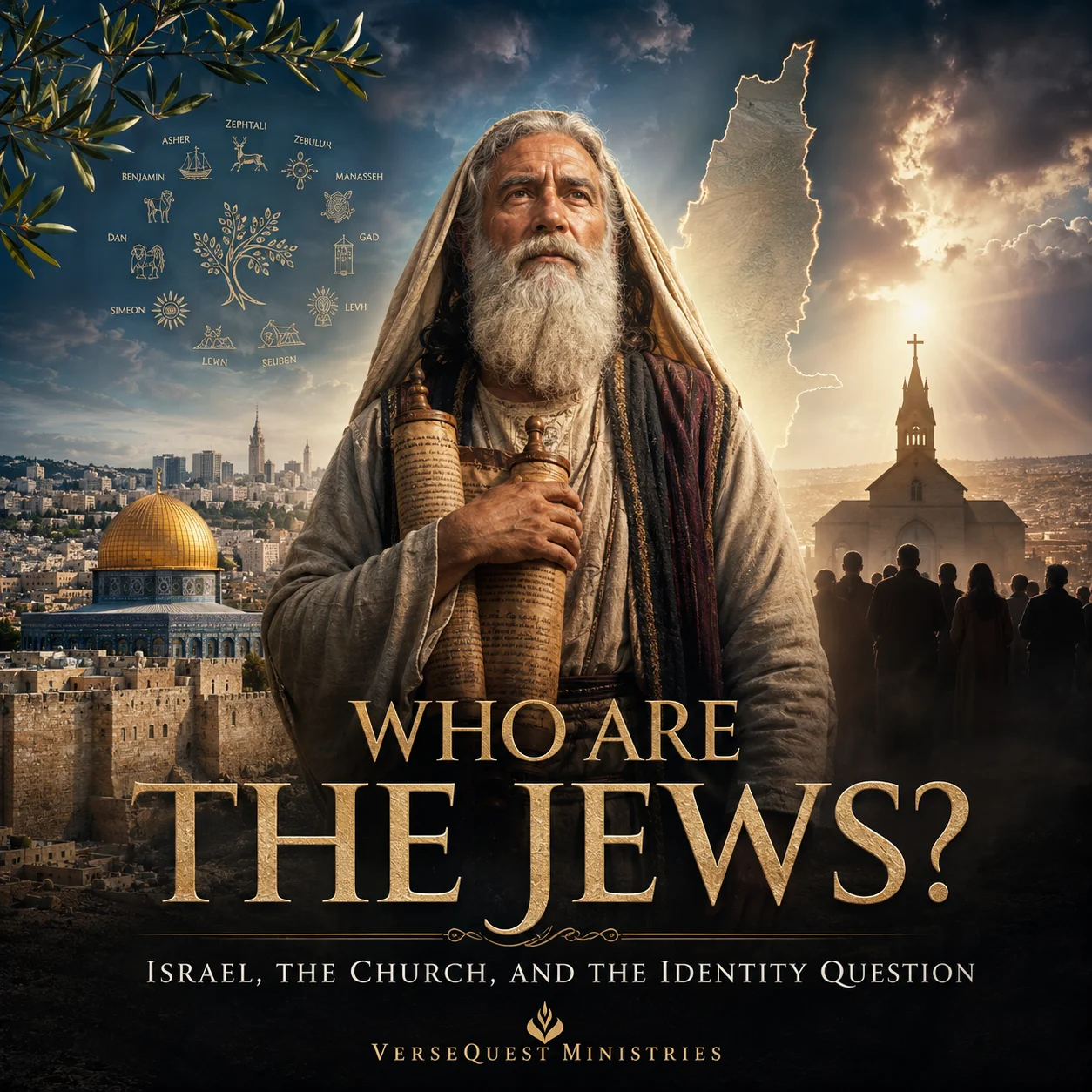
Who Are the Jews? — Israel, the Church, and the Identity Question | 273-Page KJV Bible Study PDF
Who Are the Jews? — Israel, the Church, and the Identity Question is a comprehensive 273-page downloadable KJV Bible study PDF examining Jewish identity, Israel, the Church, Romans 9–11, replacement theology, the lost tribes, Hebrew Israelite claims, the Khazar question, Jewish history, Zionism, 1948, the land promise, and Israel’s prophetic future.
The study contains 35 full chapters, a detailed introduction, a comprehensive conclusion, and a dedicated Bible-study chart for quick review. It is designed to give serious Bible students a clear framework for understanding where Jew, Gentile, Israel, and the Church belong in Scripture without collapsing them into one another.
For $14.99, you receive the complete 273-page digital study for personal Bible study, teaching, sermon preparation, reference, and printing for personal use.
$14.99
Description
Who Are the Jews? — Israel, the Church, and the Identity Question is a 273-page downloadable VerseQuest PDF study created to bring biblical clarity to one of the most confused and controversial subjects in modern Christianity: the identity of the Jewish people, the continuing place of Israel in Scripture, and the distinction between Israel, the Gentiles, and the Church of God.
This study begins where the Bible begins—with Abraham the Hebrew—and carefully traces the development of the biblical terms Hebrew, Israel, Israelite, Judah, Jew, Gentile, Church of God, Body of Christ, remnant, house of Israel, house of Judah, and restored Israel. Rather than forcing these words into a theological system, the book follows them through the King James Bible and shows where they overlap, where they differ, and why those distinctions matter.
A major purpose of the book is to confront replacement theology and the claim that the Church permanently replaced Israel. Romans 9–11 receives extensive treatment, including Romans 2:28–29, “they are not all Israel, which are of Israel,” the olive tree, Israel’s partial blindness, the warning to Gentiles not to boast against the branches, “all Israel shall be saved,” and Paul’s direct answer to the question, “Hath God cast away his people?” The study also examines Galatians 3, Galatians 6:16, Ephesians 2, 1 Corinthians 10:32, and the phrase “the Israel of God.”
The book also deals directly with modern identity controversies. It examines the “lost tribes,” British Israelism, Hebrew Israelite claims, the Khazar theory, Ashkenazi, Sephardi, and Mizrahi Jewish communities, DNA and genealogy, conversion and intermarriage, and the misuse of Revelation 2:9 and 3:9 to declare modern Jewish populations fraudulent. It distinguishes legitimate historical investigation from theories that begin with a conclusion and then force every migration, bloodline, word similarity, or conspiracy claim into the same framework.
Considerable attention is also given to Jewish religious history after the destruction of Jerusalem in A.D. 70. The study traces the transition from Temple-centered Mosaic worship into post-Temple rabbinic Judaism and examines the development of the Mishnah, Midrash, Gemara, Talmudic tradition, Kabbalah, Hasidism, and later Jewish movements. The distinction is kept clear throughout: religious development or doctrinal error does not automatically erase ancestry.
The prophetic side of the subject is treated just as thoroughly. Ezekiel 36–37, the valley of dry bones, the “whole house of Israel,” Jeremiah’s New Covenant with “the house of Israel and the house of Judah,” Zechariah’s national mourning over the pierced Messiah, the twelve tribes, Revelation’s 144,000, Jacob’s trouble, the Second Advent, the future salvation of Israel, and the Millennial kingdom are brought together into one coherent biblical framework.
The modern State of Israel and the events of 1948 are also examined carefully. The book distinguishes physical national restoration from future spiritual regeneration, allowing the reader to recognize the historical and prophetic significance of Jewish return to the land without carelessly declaring every restoration prophecy completely fulfilled. It also addresses the land promise to Abraham, Isaac, and Jacob while maintaining the necessary distinction between God’s covenant faithfulness and the moral accountability of modern governments and political leaders.
Another major section confronts antisemitic conspiracy claims. The study distinguishes actual conspiracies involving identifiable people, plans, and wrongdoing from ethnic collectivization that blames “the Jews” as one worldwide unit. Khazars, the Protocols, banking theories, wealthy families, secret societies, media influence, political influence, and related claims are considered within the larger biblical demand for evidence, individual guilt, and truthful witness.
The result is a substantial KJV-centered reference work designed to answer the question Who are the Jews? without replacement theology, racial mythology, political idolatry, or theological confusion. It is written for serious Bible students, pastors, preachers, Sunday school teachers, families, ministry leaders, and readers who want a clear doctrinal framework they can return to whenever questions about Israel and the Church arise.
The PDF includes the full 35-part study, a detailed introduction, a comprehensive conclusion, and a dedicated Who Are the Jews? KJV Bible Study Chart at the end for quick review and teaching.
Format: Downloadable digital PDF
Length: 273 pages
Price: $14.99
The biblical origin and development of the terms Hebrew, Israel, Israelite, Judah, and Jew Abraham, Isaac, and Jacob as the covenant line The twelve tribes of Israel and the divided kingdom Judah versus Israel in Old Testament history The biblical development of the word Jew Physical Israel versus individual salvation “Israel after the flesh” Jews, Gentiles, and the Church of God as distinct biblical categories Replacement theology and its misuse of Scripture Romans 2:28–29 and inward Jewish reality Romans 9:6 and the believing remnant within Israel Romans 11 and God’s continuing purpose for Israel The olive tree and the warning against Gentile boasting Israel’s blindness “in part” and the prophetic word “until” The future salvation of Israel “The Israel of God” One new man and the Body of Christ The New Covenant with Israel and Judah A.D. 70 and the destruction of the Second Temple The rise of rabbinic Judaism Mishnah, Midrash, Gemara, and the Talmudic tradition Kabbalah and Hasidism Ashkenazi, Sephardi, and Mizrahi Jewish history The Khazar theory Conversion, intermarriage, genealogy, and DNA British Israelism Hebrew Israelite movements Lost-tribe speculation Biblical Zion versus modern political Zionism The establishment of the State of Israel in 1948 Physical restoration versus spiritual regeneration The biblical land promise Palestine and covenant title Antisemitic conspiracy theories and ethnic scapegoating Ezekiel’s valley of dry bones The 144,000 and the twelve tribes in Revelation Jacob’s trouble and the Tribulation Israel at the Second Advent The Millennial kingdom The continuing distinction between Israel and the Church
Central Argument: God has not confused Israel, the Jews, the Gentiles, and the Church. Biblical confusion begins when interpreters move one term into another category without textual authority.
Major Biblical Sequence: Abraham is first called a Hebrew. Jacob becomes Israel. His sons become the twelve tribes. Judah becomes both a tribe and later the southern kingdom. The word Jew develops historically from Judah but becomes broader in biblical usage.
Important Distinction: Physical ancestry is real, but ancestry does not save. A Jew can remain physically Jewish while spiritually lost.
Church-Age Categories: Paul continues to distinguish Jews, Gentiles, and the Church of God after Pentecost.
Romans 2:28–29: The passage condemns outward religious confidence without inward reality; it does not turn Gentiles into ethnic Jews.
Romans 9:6: “They are not all Israel, which are of Israel” distinguishes spiritual reality within Israel rather than announcing Israel’s extinction.
Romans 11: God has not cast away His people. Israel’s blindness is partial and temporary, the natural branches may be grafted in again, and future national salvation remains ahead.
Olive Tree: The olive tree should not be casually identified with the Body of Christ. It illustrates historical covenant privilege and God’s dealings with Israel and Gentiles.
New Covenant: Jeremiah and Hebrews both name the house of Israel and house of Judah as the covenant recipients.
A.D. 70: The destruction of Jerusalem transformed Jewish religious life but did not erase the Jewish people.
Rabbinic Judaism: Modern Judaism includes substantial post-biblical development and cannot simply be equated with the Temple-centered Mosaic system.
Jewish Diversity: Ashkenazi, Sephardi, and Mizrahi histories demonstrate that modern Jewry cannot be reduced to one European stereotype.
Khazars: Historical Khazar conversion does not automatically prove that modern Ashkenazi Jews are entirely Khazar or disconnected from older Jewish ancestry.
Genetics: DNA can illuminate ancestry and admixture but cannot define covenant theology or spiritual standing.
Lost Tribes: Scripture calls the tribes scattered and still recognizes twelve tribes later in the biblical record.
1948: Modern Israel’s establishment can reasonably be viewed as highly significant within a physical restoration framework without claiming every restoration prophecy was completely fulfilled in 1948.
Physical and Spiritual Restoration: Ezekiel presents national gathering before full spiritual regeneration.
Antisemitism: Legitimate investigation identifies actual wrongdoers. Ethnic collectivization replaces evidence with scapegoating.
Christian Zionism: Believing God’s promises to Israel does not require treating every modern political action as righteous.
Salvation: Jewish ancestry does not save, Gentile ancestry does not condemn, and the gospel remains centered in Jesus Christ.
Memorable Teaching Point: “The cross levels standing before God; it does not rewrite the birth certificate.”
Memorable Teaching Point: “A tribe can be lost to historians without being lost to God.”
Memorable Teaching Point: “Temporary setting aside is not permanent abandonment.”
Memorable Teaching Point: “The flag went up, but the King has not come down.”
Memorable Teaching Point: “Genes can provide evidence about ancestry; they cannot write a covenant.”
Further Study Questions: How does Romans 11 define Israel’s present and future condition? What is the relationship between Jeremiah 31 and Hebrews 8? How should Ezekiel 36–37 be divided between physical and spiritual restoration? How does 1 Corinthians 10:32 protect the distinction between Israel and the Church? What does Revelation’s continued use of tribal terminology require of a literal prophetic interpretation?
This resource is especially useful for personal topical Bible study because it brings the major passages concerning Jewish identity and Israel into one sustained investigation. A reader can work through the complete book or use individual chapters as reference studies when questions arise about Romans 9–11, Revelation 2:9, the lost tribes, the Khazars, modern Israel, or replacement theology.
Pastors and preachers can use the book as a source for sermon preparation on Israel, the Church, prophecy, the Abrahamic covenant, the New Covenant, the olive tree, Jewish evangelism, and the Second Advent. The chapters are sufficiently focused that individual studies can serve as the foundation for separate sermons or teaching sessions.
Sunday school teachers and Bible-class leaders can use the material for a multi-week study on Israel and the Church, particularly where students need help distinguishing national promises from Church doctrine. The final Bible-study chart provides a concise overview that can be used for review after more detailed lessons.
Small groups and discipleship classes can use the book to address questions frequently encountered online concerning Jewish identity, Hebrew Roots teaching, Hebrew Israelite claims, replacement theology, Khazar arguments, genetics, Zionism, and prophecy.
Families with older children or teenagers studying prophecy, biblical history, or current religious controversies can use selected chapters to teach the importance of reading terms in context and refusing racial, political, or denominational assumptions that override Scripture.
Ministry training settings can use the resource to teach right division, contextual interpretation, covenant distinctions, Israelology, dispensational theology, and responsible handling of controversial historical and ethnic claims.
The book is also useful as a reference resource for pastors and teachers who regularly receive questions about whether modern Jews are biblical Jews, whether Christians became Israel, whether the Church replaced Israel, or what role modern Israel may have in prophecy.
The most important companion resource is a King James Bible, preferably one with strong cross-references so the reader can trace Israel, Judah, covenant, remnant, land, restoration, and kingdom terminology across both Testaments.
A Strong’s Exhaustive Concordance or comparable KJV concordance can help trace every occurrence of major terms such as Israel, Jew, Judah, Gentile, covenant, Zion, Jerusalem, seed, remnant, and tribe.
A reliable Bible dictionary can assist with historical background on Assyria, Babylon, Persia, Jerusalem, the Temple, the Diaspora, the Roman period, and geographical names appearing throughout the study.
A Bible atlas and historical map collection is valuable for tracing the divided kingdom, Assyrian and Babylonian captivities, the ancient Near East, the Jewish Diaspora, Roman Palestine, and the geographical setting of restoration prophecies.
A Bible chronology or timeline can help organize Abraham, Jacob, the monarchy, the divided kingdom, Assyrian captivity, Babylonian exile, the Second Temple period, A.D. 70, and later Jewish history.
Cross-reference study of Genesis 12–49, Deuteronomy 28–30, Jeremiah 30–33, Ezekiel 36–48, Daniel 9–12, Zechariah 12–14, Romans 9–11, Ephesians 2, Hebrews 8, and Revelation 7–20 will deepen the major doctrinal trails developed throughout the book.
The included Who Are the Jews? KJV Bible Study Chart is also recommended as a quick-reference companion after completing the full study.
Related products
-
Law vs Grace
-
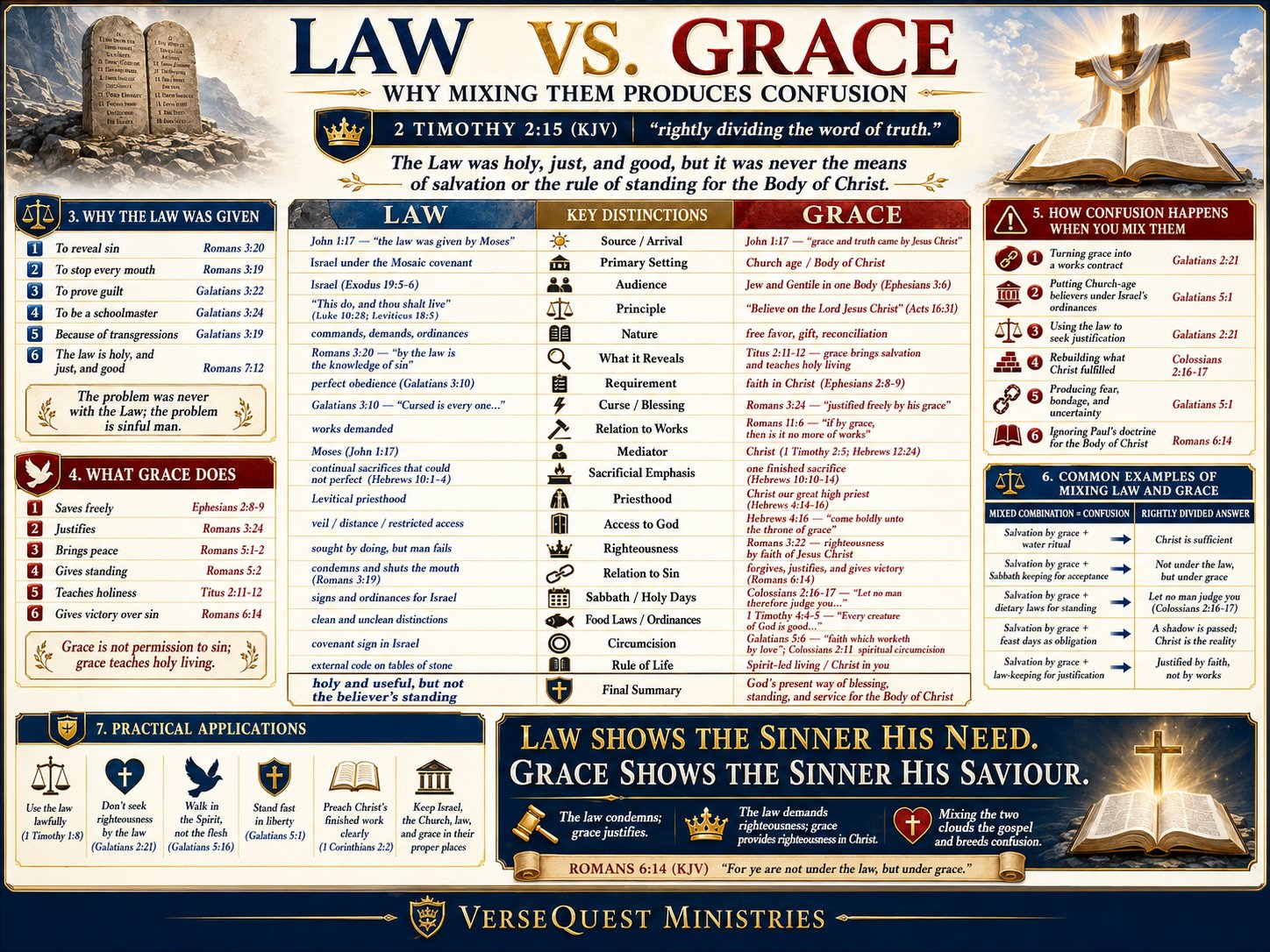
- Law vs. Grace Bible Study Chart – Why Mixing Them Produces Confusion (KJV)
- Compare law and grace with this detailed KJV Bible study chart explaining salvation, justification, holiness, Israel’s Mosaic covenant, Christian liberty, and the danger of mixing law with the gospel.
- $3.99
- Add to cart
-
-
The Gospel of the Kingdom
-
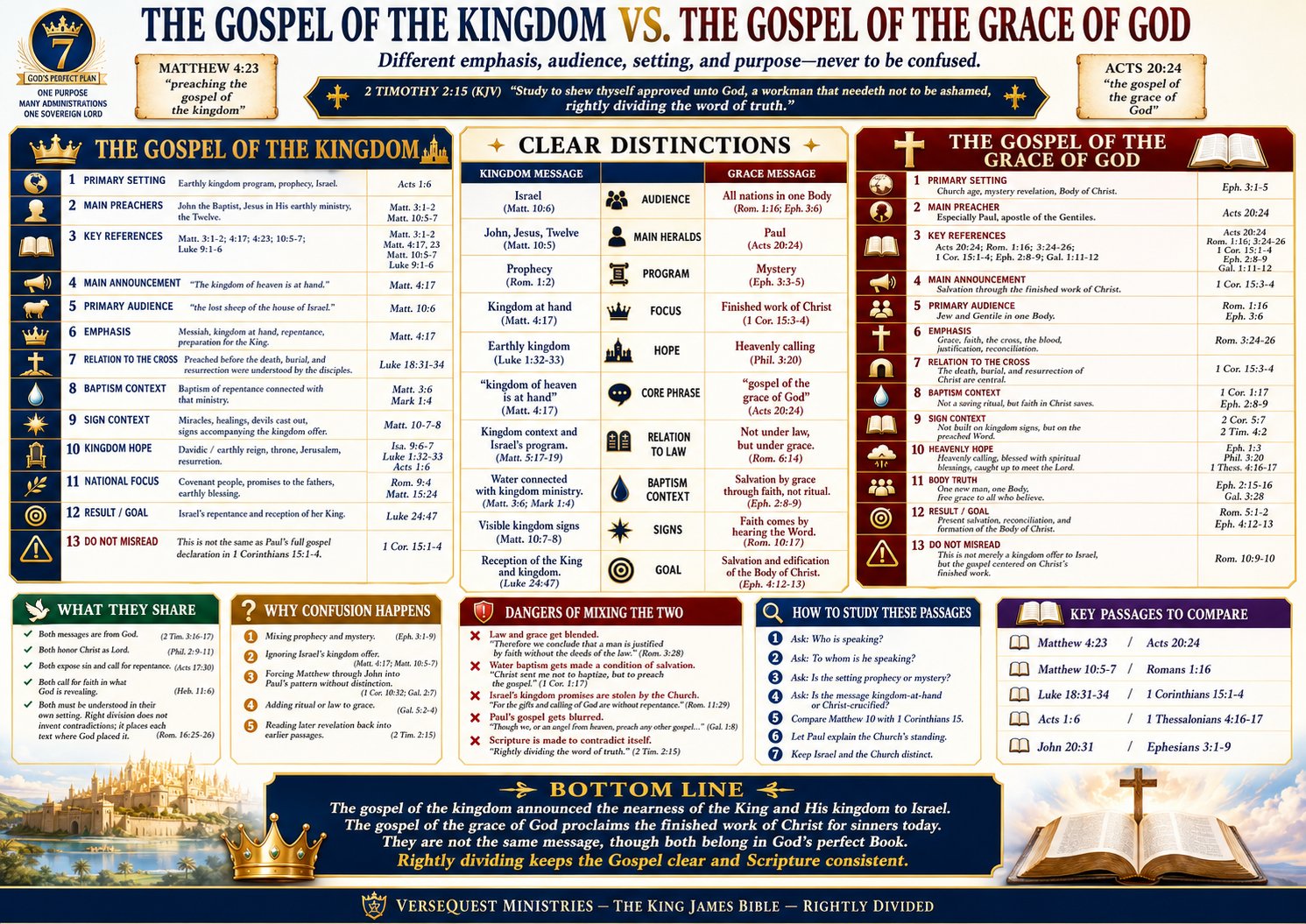
- The Gospel of the Kingdom vs. the Gospel of the Grace of God – KJV Right Division Bible Study Chart
- Compare the gospel of the kingdom and the gospel of the grace of God with this detailed KJV chart covering audience, message, prophecy, mystery, baptism, signs, salvation, and right division.
- $3.99
- Add to cart
-
-
Reconciliation Through the Cross
-
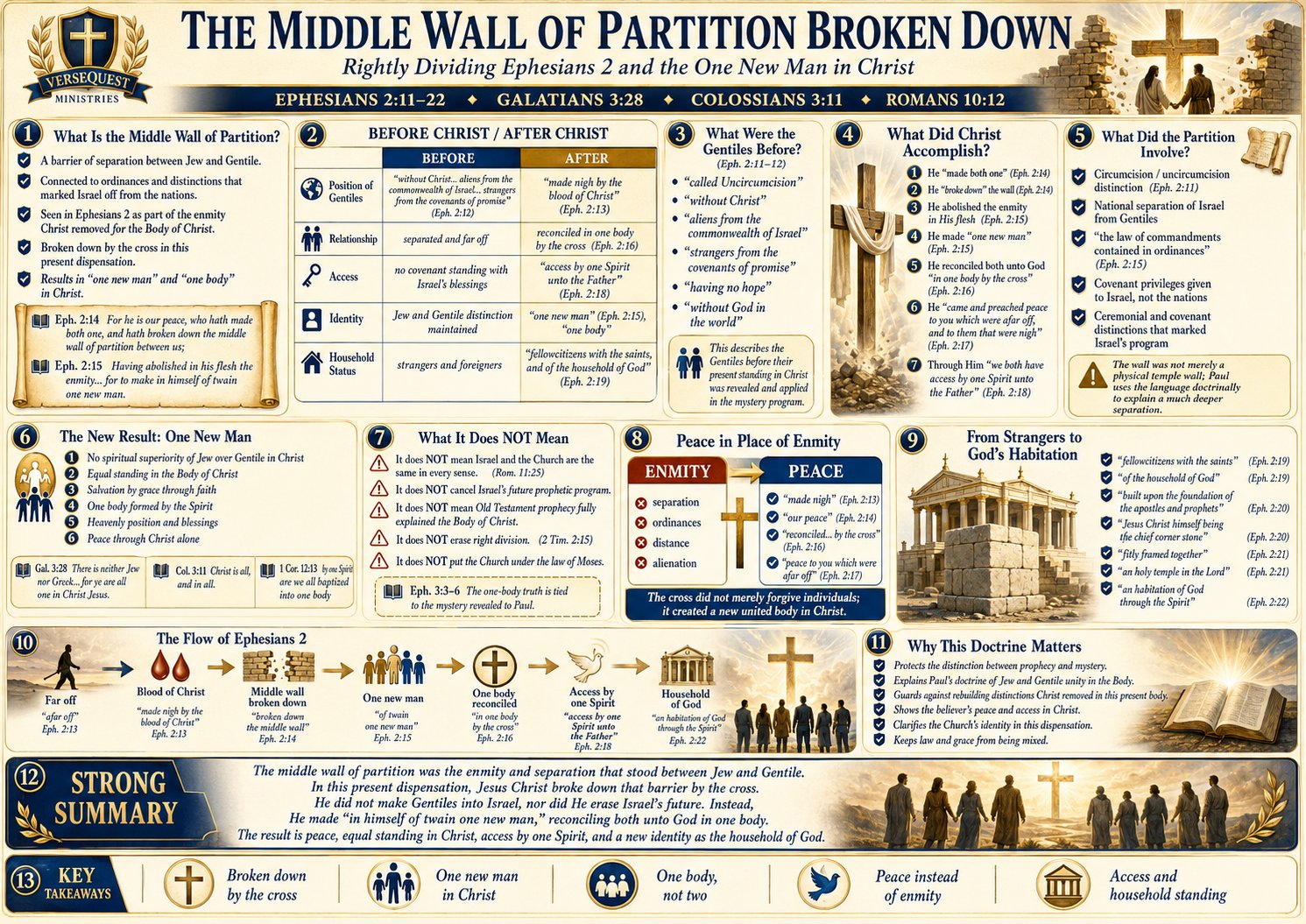
- The Middle Wall of Partition Broken Down – Ephesians 2, the One New Man, and the Body of Christ (KJV Bible Study Chart)
- Understand the middle wall of partition with this detailed KJV chart covering Ephesians 2, Christ’s blood, Jew-and-Gentile reconciliation, the one new man, one Body, and access to the Father.
- $3.99
- Add to cart
-
-
The Seven Dispensations
-
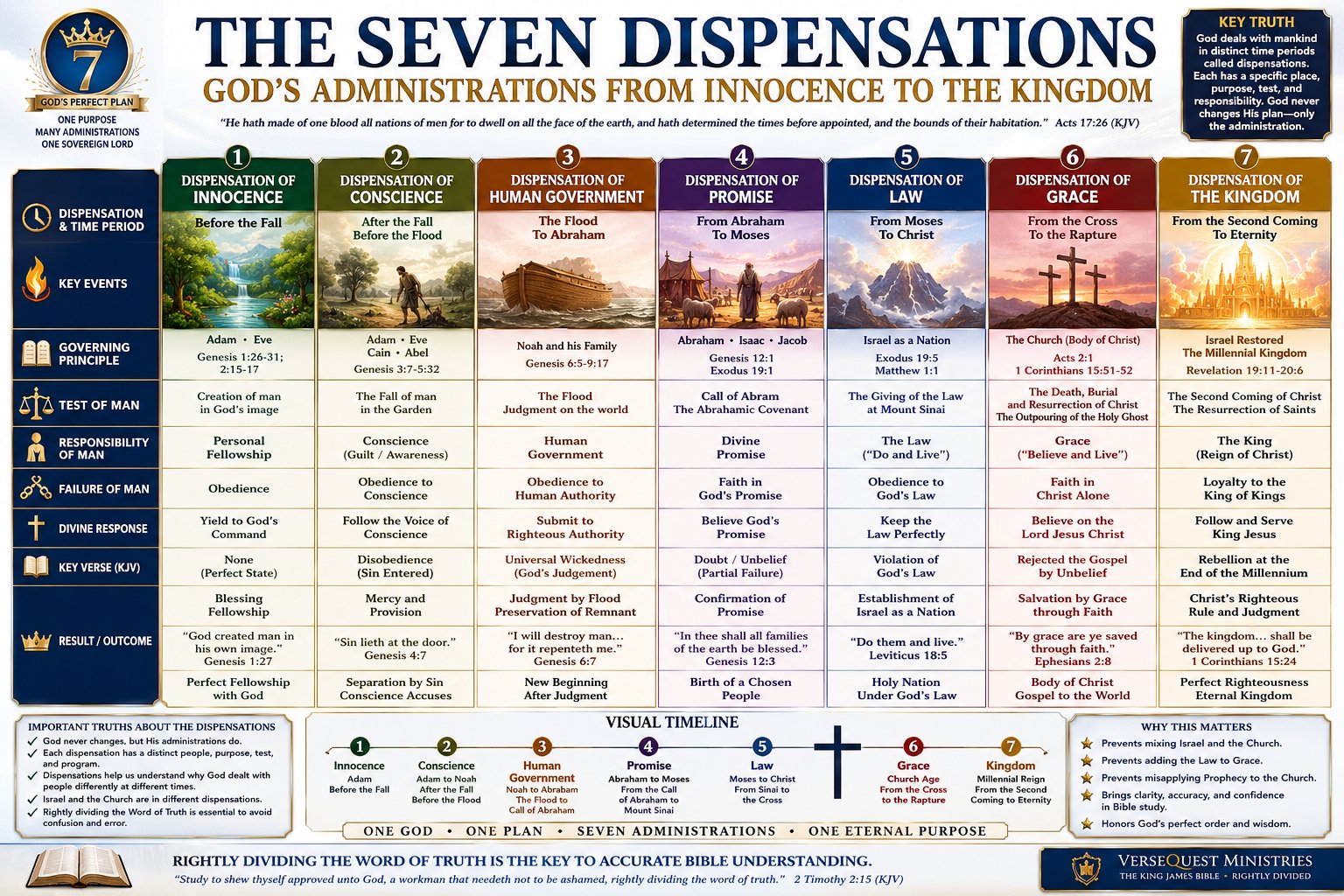
- The Seven Dispensations Bible Study Chart – God’s Administrations from Innocence to the Kingdom (KJV)
- Explore the seven dispensations with this detailed KJV Bible study chart covering Innocence, Conscience, Human Government, Promise, Law, Grace, the Kingdom, and the importance of rightly dividing Scripture.
- $3.99
- Add to cart
-
-
Doctrine
-
-50%
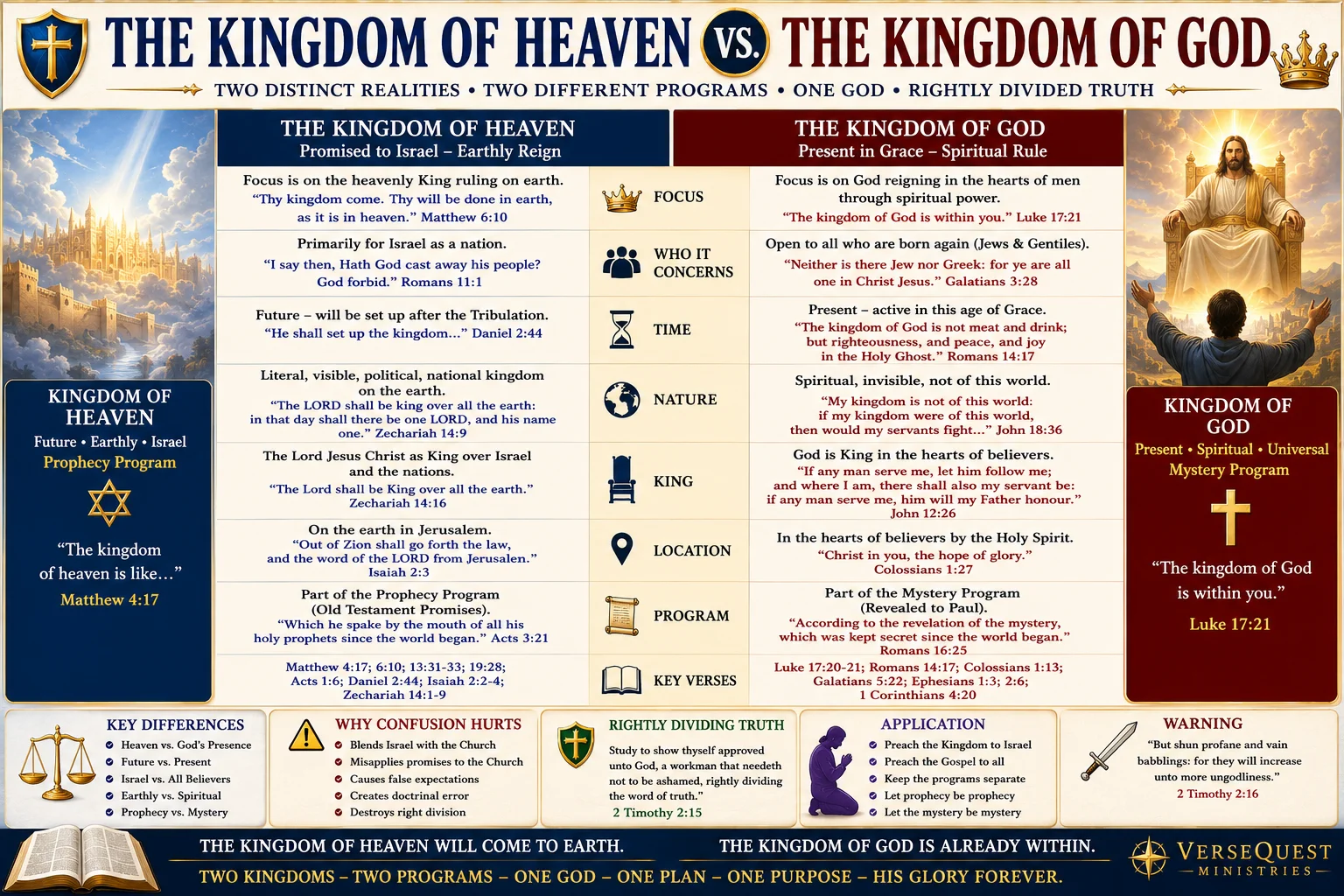
- The Kingdom of Heaven vs. The Kingdom of God Chart — KJV Rightly Divided
- Premium printable KJV Bible study chart comparing the Kingdom of Heaven and the Kingdom of God from a rightly divided perspective, showing their distinctions, purposes, promises, and biblical application.
- Original price was: $10.00.$4.99Current price is: $4.99.
- Add to cart
-
-50%