
When Patience Outlives the Pressure – Proven Through Endurance in 2 Corinthians 6:4 (KJV Bible Study Chart)
Learn how patience proves genuine ministry with this detailed KJV chart covering 2 Corinthians 6:4, afflictions, necessities, distresses, delayed results, pressure, endurance, and faithful Christian service.
$3.99
Description
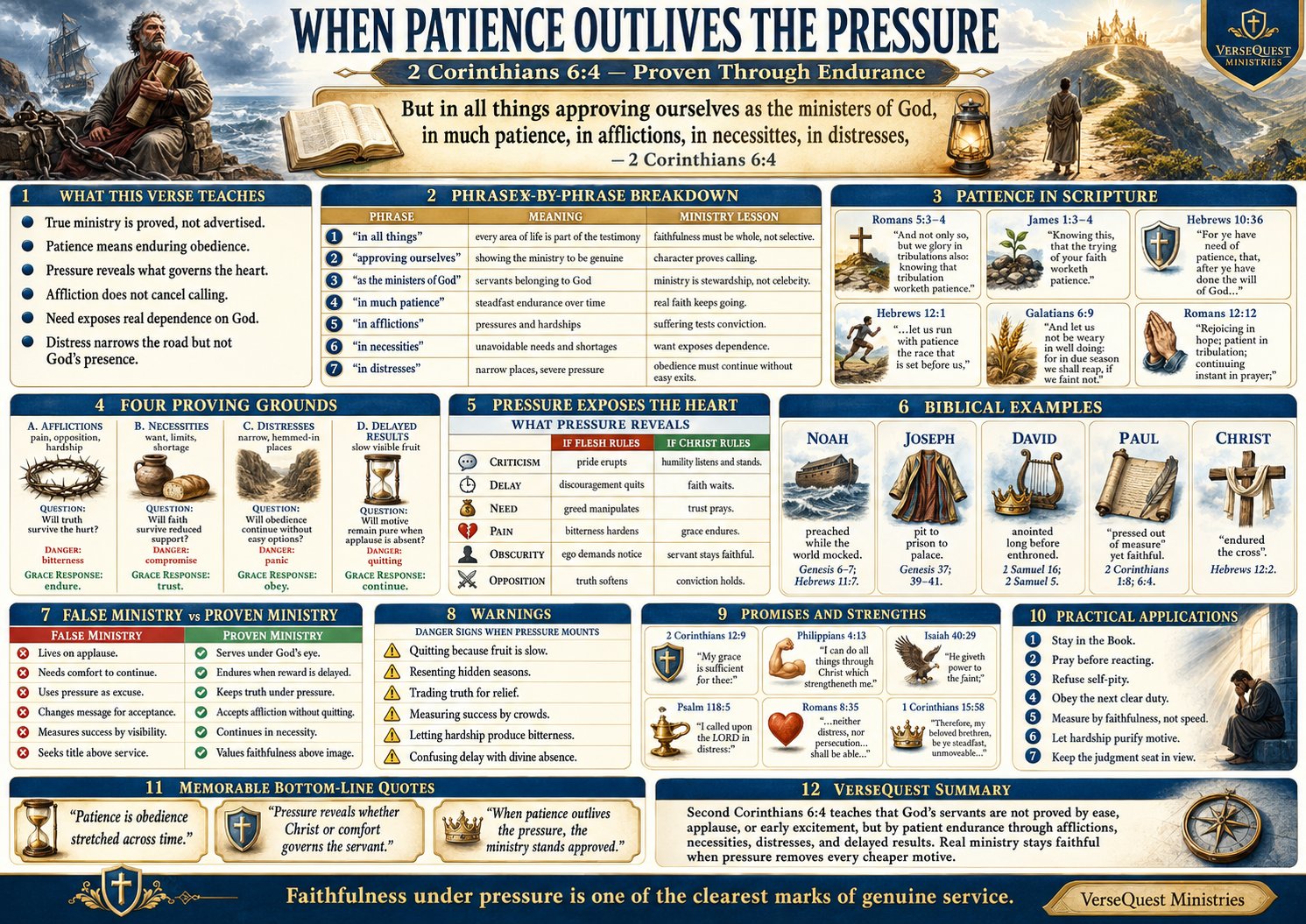
When Patience Outlives the Pressure: Proven Through Endurance is a detailed KJV Bible study chart examining 2 Corinthians 6:4 and the role of patience, affliction, necessity, distress, delayed results, and steadfast obedience in proving genuine Christian ministry.
Paul wrote, “But in all things approving ourselves as the ministers of God, in much patience, in afflictions, in necessities, in distresses.” His ministry was not authenticated by comfort, applause, impressive surroundings, immediate success, or freedom from hardship. It was proved by continued faithfulness when circumstances supplied every natural reason to quit.
The chart begins with a foundational truth: true ministry is proved rather than advertised. A title may be printed, a platform may be built, and an audience may be gathered, but pressure eventually reveals what governs the servant’s heart. Genuine ministry continues obeying God when public excitement fades, visible fruit develops slowly, and personal sacrifice becomes costly.
Biblical patience is not passive waiting, timid inactivity, or spiritual laziness. It is obedient endurance stretched across time. It keeps praying, serving, preaching, believing, and walking uprightly when the expected answer has not arrived and the burden has not lifted.
The phrase “in all things” teaches that every area of life contributes to a servant’s testimony. Faithfulness cannot be selective. A person cannot appear spiritual in public while tolerating compromise in private and still claim that his ministry has been approved by God.
The words “approving ourselves” concern demonstrating that ministry is genuine. Paul was not attempting to manufacture a public image or earn salvation through suffering. His conduct under pressure provided evidence that his calling, message, motives, and service were real.
The phrase “as the ministers of God” establishes ownership. Christian servants belong to God. They do not own the ministry, the people, the message, or the results. Ministry is stewardship beneath divine authority rather than a platform for personal celebrity.
The words “in much patience” identify the governing response to every hardship that follows. Paul did not merely survive one difficult day. His ministry displayed continued endurance through repeated trials, opposition, deprivation, misunderstanding, rejection, and delay.
The chart explains four major proving grounds. Afflictions include pain, opposition, persecution, hardship, and suffering. The question is whether truth will survive the hurt or whether pain will produce bitterness and compromise.
Necessities include unavoidable needs, limitations, shortages, and situations in which a servant lacks what he would naturally prefer to have. These conditions expose whether faith truly depends upon God or whether service continues only when resources are plentiful.
Distresses describe narrow places, pressure, restriction, and circumstances that appear to offer no easy escape. They test whether obedience will continue when every available choice is difficult and relief does not come quickly.
Delayed results test whether a servant will remain faithful when visible fruit grows slowly. Some ministries are abandoned not because God closed them but because applause, numbers, recognition, or immediate success did not arrive soon enough.
Pressure does not create the contents of the heart; it exposes them. Criticism reveals whether pride or humility governs the response. Delay reveals whether discouragement or faith possesses the heart. Need exposes greed or prayerful dependence. Pain reveals bitterness or enduring grace. Obscurity exposes self-promotion or servant-minded faithfulness.
Opposition also tests conviction. When the flesh rules, truth is softened to reduce resistance. When Christ rules, the servant continues speaking truth in love without becoming cruel, cowardly, or compromised.
The chart gathers several biblical examples of patience under pressure. Noah preached and built while the world mocked. Joseph endured betrayal, slavery, false accusation, and imprisonment before being elevated in Egypt. David was anointed long before he was enthroned and spent years fleeing Saul.
Paul remained faithful while being pressed out of measure, persecuted, imprisoned, opposed, and misunderstood. Jesus Christ endured the cross, despised the shame, and completed the Father’s will rather than abandoning His redemptive mission.
These examples demonstrate that delay is not always denial. Joseph’s prison did not cancel his future service. David’s wilderness did not invalidate his anointing. Paul’s chains did not silence the gospel, and the cross did not mark the defeat of Jesus Christ.
A comparison between false ministry and proven ministry exposes their different motives. False ministry feeds upon applause, requires comfort, uses hardship as an excuse, changes its message for acceptance, measures success by visibility, and seeks titles above service.
Proven ministry serves under God’s eye, endures when reward is delayed, maintains truth under pressure, accepts affliction without abandoning duty, continues during necessity, and values faithfulness above appearance.
The chart presents several warnings for seasons of mounting pressure. Servants must resist quitting merely because fruit is slow, resenting hidden seasons, trading truth for relief, measuring success by crowds, allowing hardship to produce bitterness, or interpreting delay as proof that God is absent.
God may accomplish some of His deepest work during seasons that appear outwardly unproductive. Hidden years can purify motives, deepen doctrine, strengthen prayer, expose self-reliance, and prepare a servant for responsibilities that public success alone could never develop.
Promises and sources of strength include Christ’s sufficient grace, His power made perfect in weakness, strength through Christ, renewed power for those who wait upon the LORD, divine help in distress, God’s inseparable love, and the assurance that faithful labour in the Lord is never in vain.
The chart’s practical applications are direct. Stay in the Book. Pray before reacting. Refuse self-pity. Obey the next clear duty. Measure faithfulness rather than speed. Allow hardship to purify motives, and remember that every Christian servant will eventually appear before Christ.
Patience should never be used as an excuse to tolerate false doctrine, abuse, corruption, or preventable disorder. Biblical endurance remains obedient to truth. It does not remain indefinitely beneath sinful control when Scripture requires correction, separation, or decisive action.
Neither does endurance mean that the servant never rests. Elijah’s experience demonstrates that physical exhaustion can affect perspective and usefulness. Rest may be necessary, but abandoning God’s calling through unbelief is not the same as receiving needed renewal.
Patience outlives pressure because its confidence rests in God rather than circumstances. Pressure may continue, visible results may be delayed, and human approval may disappear, but the faithful servant keeps doing what God has clearly commanded.
The chart’s memorable conclusion is that patience is obedience stretched across time. Pressure reveals whether Christ or comfort governs the servant. When patience outlives the pressure, the ministry stands approved—not necessarily by the crowd, but before God.
This resource is ideal for personal Bible study, pastors, missionaries, ministry workers, Christian leaders, teachers, church staff, discipleship classes, leadership development, pastoral counseling, Sunday school, homeschool Bible curriculum, Bible institutes, sermon preparation, and believers enduring long seasons of pressure or delayed results.
Christian patience, biblical endurance, 2 Corinthians 6:4, proven ministry, faithfulness under pressure, afflictions, necessities, distresses, delayed results, obedient endurance, ministry approval, suffering for Christ, perseverance, pressure reveals the heart, faith during delay, dependence upon God, resisting compromise, servant leadership, faithful Christian service, eternal reward
Second Corinthians 6:4 presents patience as evidence of genuine ministry. Paul’s calling was not proved by an easy road but by faithful conduct when the road became painful, narrow, and demanding.
The phrase “in all things” leaves no room for selective faithfulness. Private character, public conduct, doctrine, relationships, money, suffering, and response to criticism all belong to the servant’s testimony.
Approving oneself as a minister of God does not mean self-promotion. It means living in such a way that pressure demonstrates the ministry’s sincerity and spiritual reality.
Patience is steadfast obedience over time. It continues doing what is right after emotion fades and the expected reward remains delayed.
Affliction tests whether truth survives pain. A servant may preach correctly during comfort yet reveal bitterness, retaliation, or compromise when personally wounded.
Necessity exposes dependence. Limited resources, unmet needs, and unavoidable restrictions reveal whether confidence rests in God or favourable circumstances.
Distress places the servant in a narrow space. It tests whether he will obey when every available option carries difficulty and no immediate exit appears.
Delayed results test motives. A servant working primarily for recognition will become restless when fruit is slow. A servant working for God can remain faithful while waiting.
Pressure reveals what governs the heart. It exposes pride, insecurity, greed, bitterness, fear, faith, humility, conviction, and dependence.
Noah’s long obedience continued while the world mocked. His example demonstrates that faithfulness cannot be measured only by immediate public response.
Joseph’s prison years were not wasted. God used betrayal, servitude, false accusation, and delay to prepare him for future responsibility.
David was anointed before he was enthroned. The gap between promise and fulfillment developed patience, courage, restraint, and dependence upon God.
Paul continued preaching while experiencing pressure beyond his natural strength. His weakness became the setting in which Christ’s power was displayed.
Jesus Christ is the supreme example of endurance. He did not escape the cross to preserve comfort but completed the redemptive work appointed by the Father.
False ministry requires applause, comfort, visibility, and quick results. Proven ministry remains faithful when these things disappear.
Endurance does not mean refusing necessary rest. Physical exhaustion should be addressed honestly, but weariness must not become an excuse for abandoning truth.
Patience does not require tolerating abuse, false doctrine, or unlawful control. Biblical endurance remains governed by Scripture and may require confrontation, separation, or correction.
The servant should measure success by faithfulness rather than speed. God may produce fruit slowly, invisibly, or after the present worker has completed his assignment.
The judgment seat of Christ places ministry in its proper perspective. Human applause is temporary, but the Lord’s evaluation is final.
Pastoral encouragement, missionary training, ministry leadership, endurance during persecution, coping with delayed results, Christian patience studies, faithfulness in obscurity, overcoming discouragement, resisting ministry burnout, servant-leadership classes, maintaining truth under pressure, strengthening discouraged workers, Sunday school lessons, homeschool Bible curriculum, Christian school instruction, Bible institute classes, discipleship training, sermon preparation
King James Bible, Strong’s Concordance, Thompson Chain-Reference Bible, Treasury of Scripture Knowledge, Nave’s Topical Bible, 2 Corinthians commentary notes, personal prayer journal, ministry self-examination worksheet, Scripture memory cards, studies on Joseph and David, Pauline suffering passages, Hebrews 12 endurance studies, James 1 patience notes, pastoral-care resources, VerseQuest Christian Living and leadership charts
Related products
-
Biblical Submission
-

- Biblical Submission Bible Study Chart – Strength Under God’s Order, Authority, and Scriptural Limits (KJV) Product Description
- Study biblical submission with this detailed KJV chart covering God-ordained authority, servant leadership, obedience, marriage, church, government, and the Scriptural limits of submission.
- $3.99
- Add to cart
-
-
Prayer
-
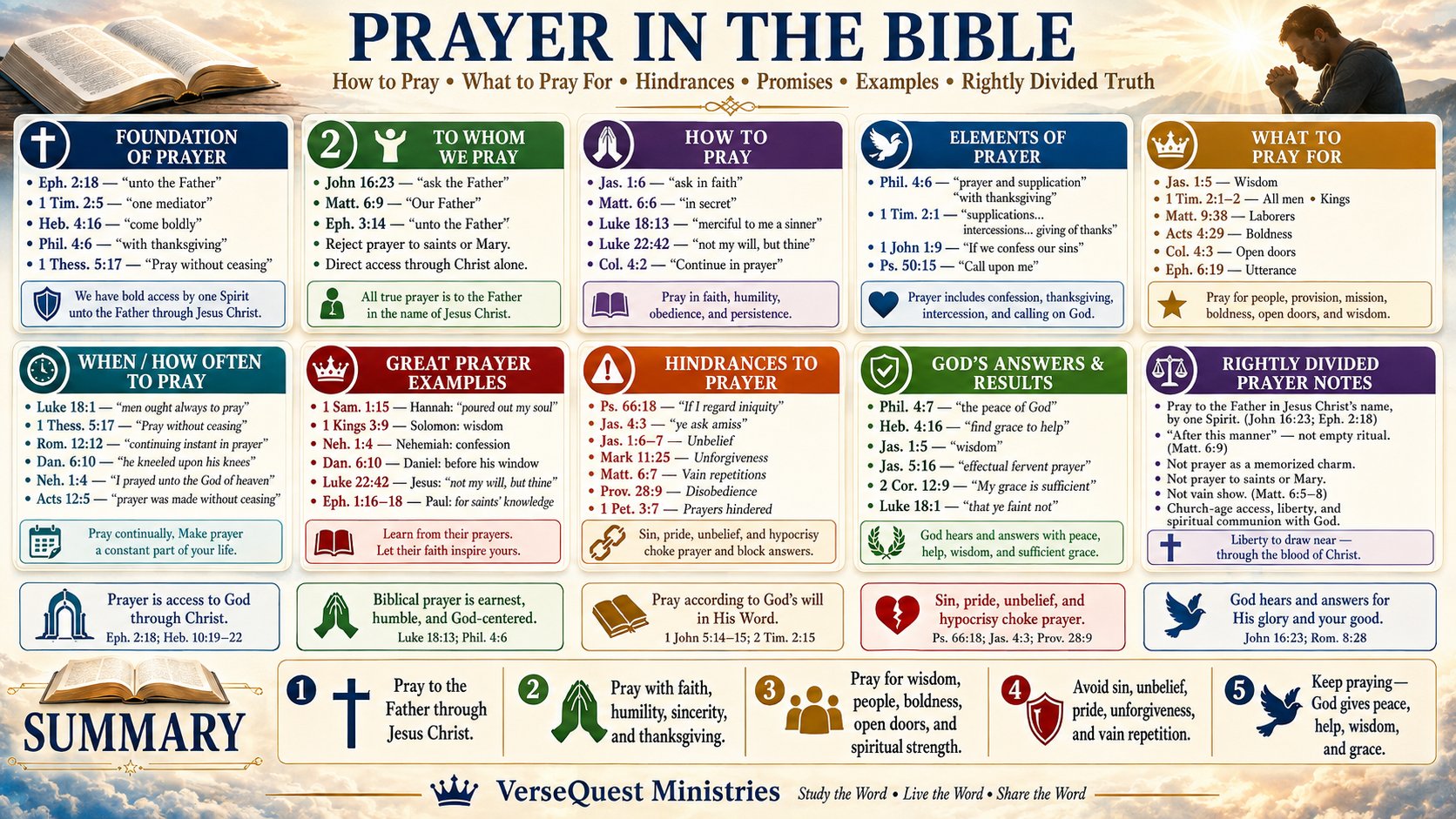
- Prayer in the Bible Chart – How to Pray According to Scripture
- Discover what the Bible teaches about prayer through this easy-to-follow VerseQuest study chart. Learn who to pray to, how to pray, what hinders prayer, what to pray for, and key…
- $4.99
- Add to cart
-
-
How To Live By Faith
-

- How to Live by Faith, Not by Sight – Seven Pillars of Trusting God’s Word Through Every Circumstance (KJV Bible Study Chart)
- Learn how to live by faith rather than sight with this detailed KJV chart covering God’s Word, obedience, waiting, suffering, Hebrews 11 examples, trials of faith, and trust in God’s…
- $3.99
- Add to cart
-
-
Uncategorized
-
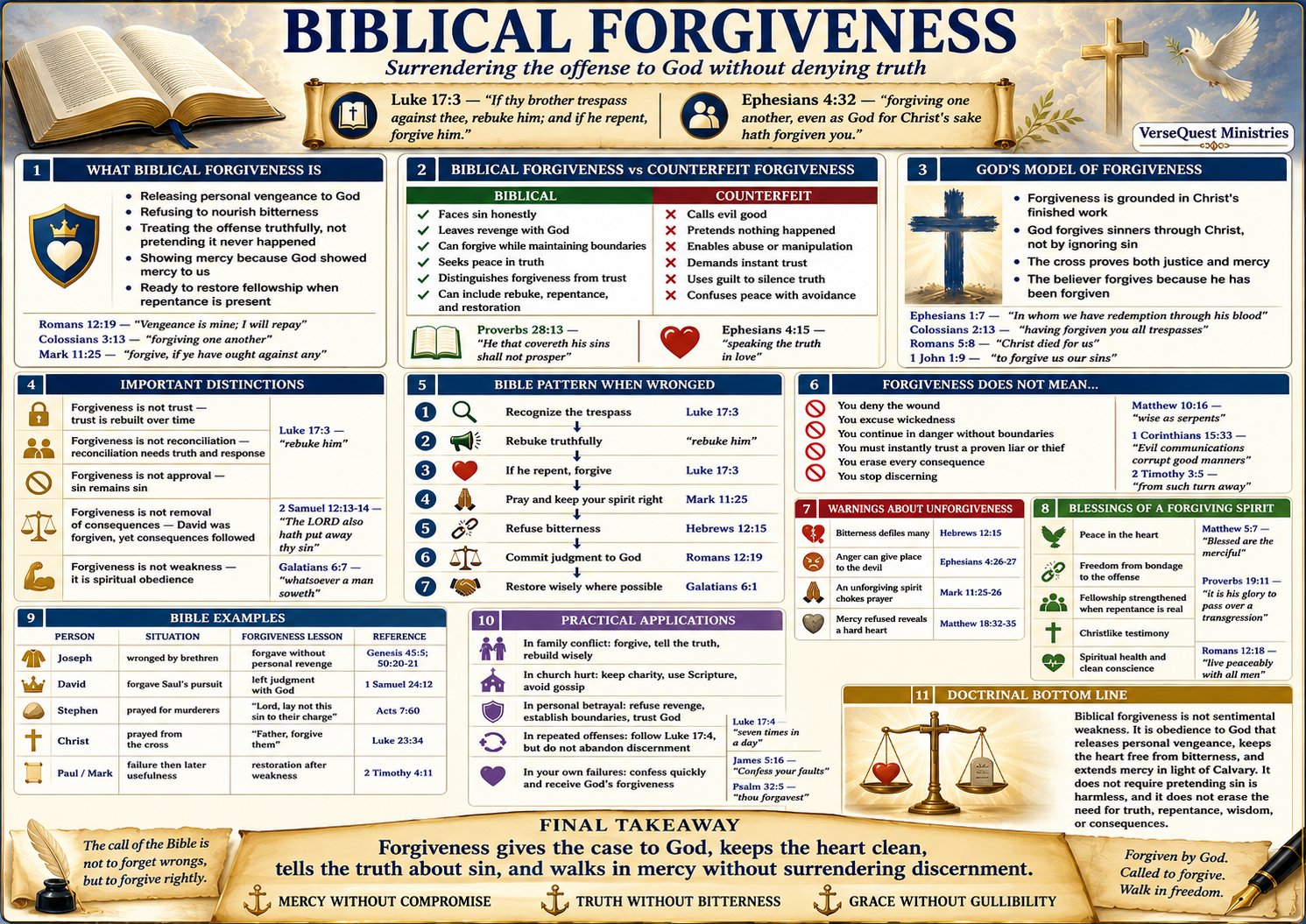
- Biblical Forgiveness Bible Study Chart – Mercy, Truth, Repentance, Boundaries, and Wise Restoration (KJV)
- Understand biblical forgiveness with this detailed KJV chart covering mercy, truth, repentance, trust, reconciliation, wise boundaries, accountability, consequences, bitterness, and restoration.
- $3.99
- Add to cart
-
-
When Fear of God Vanishes
-
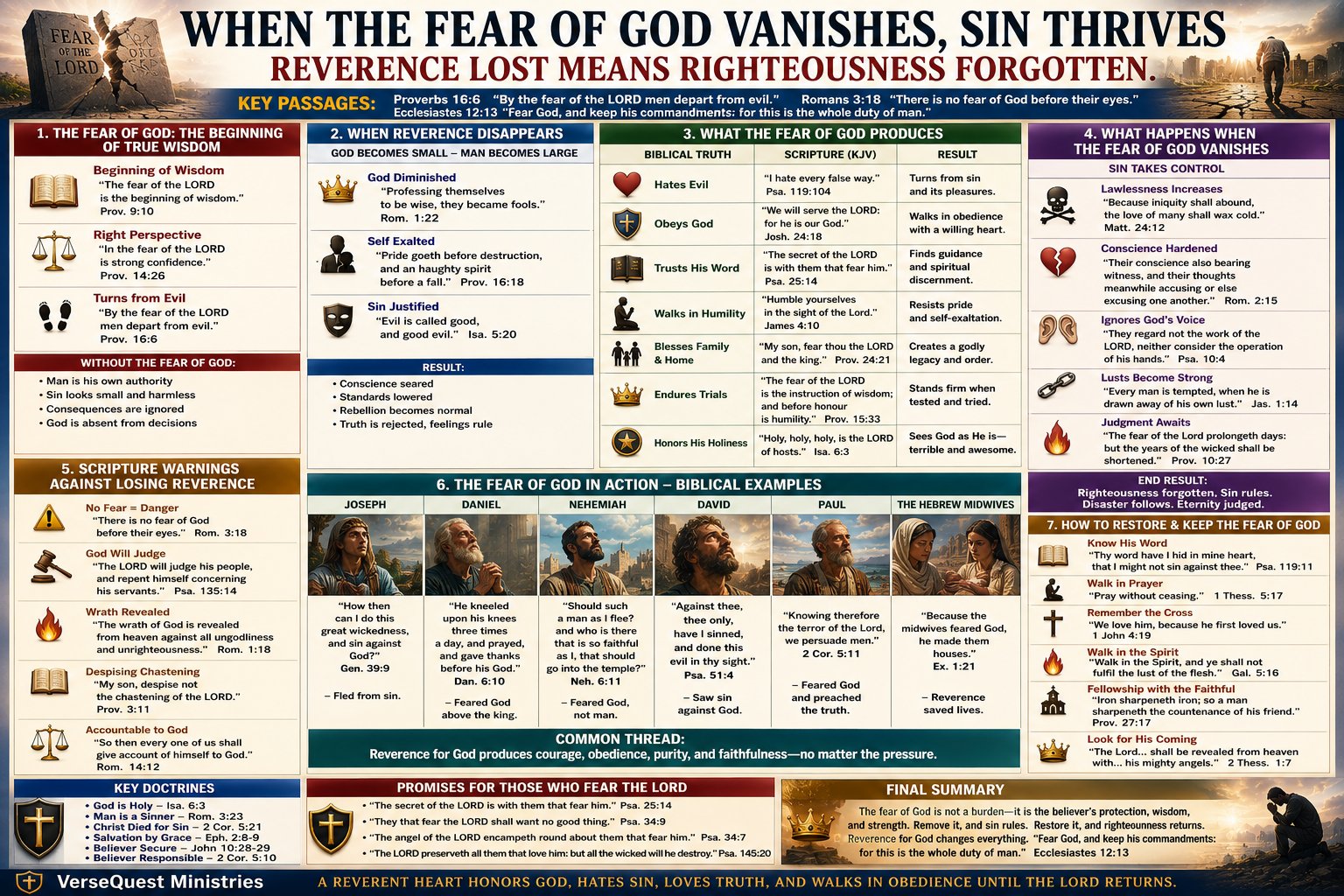
- When the Fear of God Vanishes, Sin Thrives – Reverence, Wisdom, Holiness, and Obedience (KJV Bible Study Chart)
- Understand the fear of God with this detailed KJV Bible study chart covering reverence, wisdom, holiness, obedience, hardened conscience, divine judgment, biblical examples, and restoring godly fear.
- $3.99
- Add to cart
-