
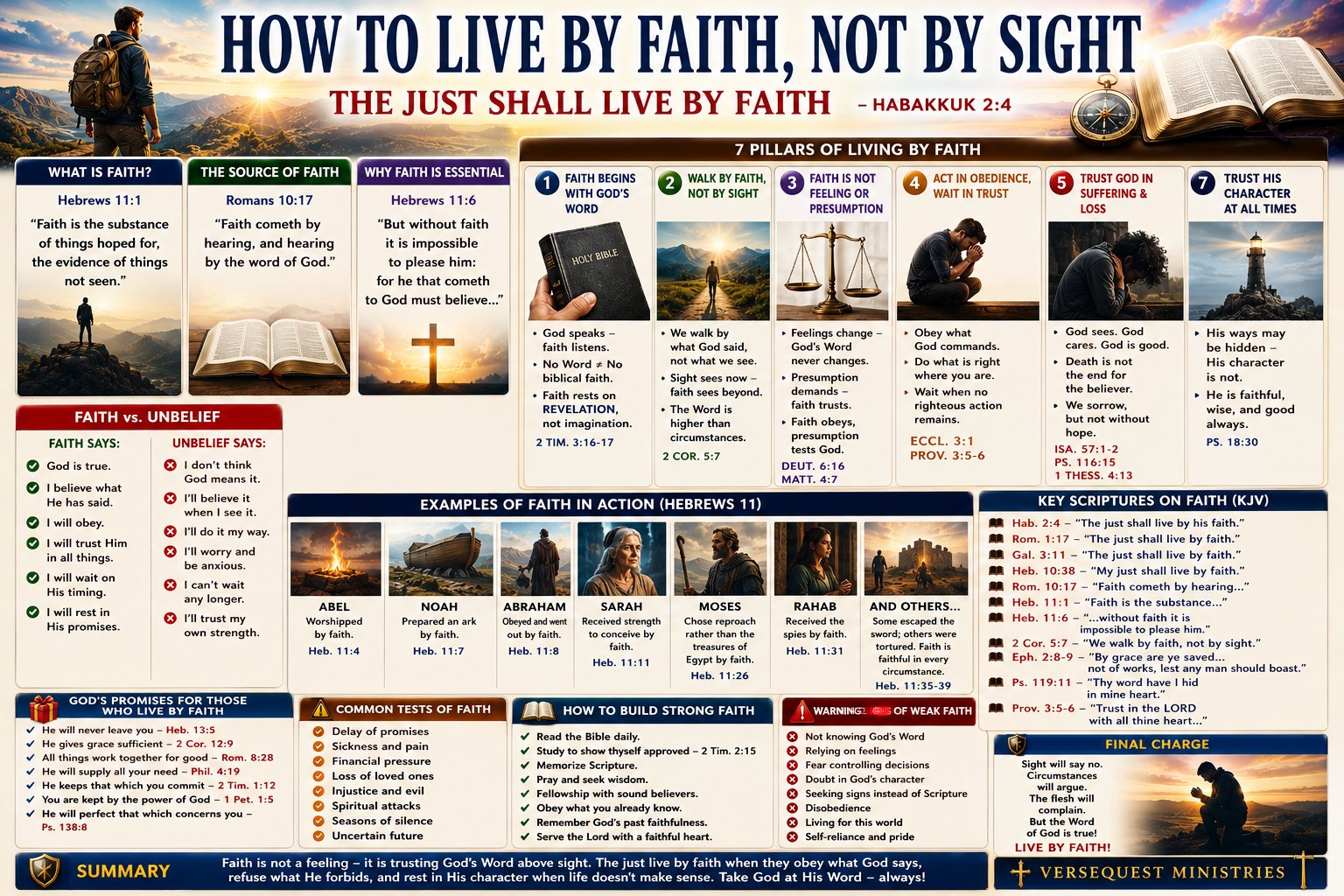
How to Live by Faith, Not by Sight – Seven Pillars of Trusting God’s Word Through Every Circumstance (KJV Bible Study Chart)
Learn how to live by faith rather than sight with this detailed KJV chart covering God’s Word, obedience, waiting, suffering, Hebrews 11 examples, trials of faith, and trust in God’s character.
$3.99
Description
How to Live by Faith, Not by Sight is a detailed KJV Bible study chart explaining how Christians can trust God’s Word, obey His commands, endure uncertainty, and remain faithful when circumstances, feelings, losses, delays, and unanswered questions appear to contradict His promises.
Built around Habakkuk 2:4, Romans 10:17, Hebrews 11:1, and 2 Corinthians 5:7, this chart establishes that biblical faith is not positive thinking, emotional confidence, imagination, or blind optimism. Faith rests upon the revealed character and written Word of God.
Hebrews 11:1 defines faith as “the substance of things hoped for, the evidence of things not seen.” Faith deals with realities that may not yet be visible but are certain because God has spoken. The believer does not trust an uncertain possibility; he trusts the faithful God who cannot lie.
Romans 10:17 identifies the source of faith: “Faith cometh by hearing, and hearing by the word of God.” Biblical faith cannot be separated from Scripture. The stronger a believer’s knowledge of God’s Word becomes, the more clearly he can distinguish genuine faith from emotional impulse, wishful thinking, superstition, and presumption.
Faith is essential because Hebrews 11:6 declares that without faith it is impossible to please God. The believer must come to God convinced that He is real, truthful, faithful, and able to reward those who diligently seek Him.
The chart presents seven pillars of living by faith. The first is that faith begins with God’s Word. God speaks, faith listens, and obedience responds. No promise should be claimed apart from Scripture, and no impression should be treated as divine guidance when it contradicts the written Bible.
Faith rests upon revelation rather than imagination. It does not invent promises God never made, demand outcomes He never guaranteed, or build doctrine upon dreams, emotions, signs, coincidences, and private impressions.
The second pillar is to walk by faith rather than sight. Sight evaluates only what is immediately visible. Faith considers what God has declared, including truths and purposes that circumstances cannot yet reveal.
Second Corinthians 5:7 teaches, “For we walk by faith, not by sight.” This does not require Christians to deny reality or ignore obvious facts. It means visible conditions do not possess greater authority than God’s unchanging Word.
The third pillar explains that faith is not feeling or presumption. Feelings change rapidly, but God’s Word remains settled. A person may feel strong while standing in error or feel weak while obeying truth.
Presumption attempts to force God to support a decision He never commanded. When Satan tempted Jesus to cast Himself from the Temple, Christ refused to test God. Biblical faith obeys God; presumption creates unnecessary danger and then demands divine rescue.
The fourth pillar calls believers to act in obedience, wait in trust. Faith does not remain inactive when God has given a clear command. It obeys the truth already revealed and refuses to use uncertainty about tomorrow as an excuse for disobedience today.
At the same time, faith knows how to wait when no righteous action remains. It does not manipulate circumstances, force timing, manufacture open doors, or run ahead of God. Proverbs 3:5–6 directs the believer to trust in the LORD rather than lean upon his own understanding.
The fifth pillar concerns trusting God through suffering and loss. Faith is not proved only when prayers are answered quickly and circumstances improve. It is often revealed most clearly when believers continue trusting during sickness, grief, persecution, financial pressure, disappointment, and death.
Christians sorrow, but they do not sorrow as those who possess no hope. Death is not the end for the believer, suffering is not permanent, and present hardship cannot separate the saved person from the love of God in Jesus Christ.
Faith does not require pretending pain is pleasant. It acknowledges the wound while continuing to confess that God sees, cares, understands, and remains good.
The final pillar emphasizes trusting God’s character at all times. His immediate purpose may remain hidden, but His holiness, goodness, wisdom, faithfulness, and truthfulness never change.
Psalm 18:30 declares that God’s way is perfect and His Word is tried. The believer may not understand the road, but he can trust the One who designed it.
A major comparison contrasts faith with unbelief. Faith says God is true, believes what He has spoken, obeys before every result is visible, waits upon His timing, and rests in His promises. Unbelief demands visible proof, chooses its own way, feeds anxiety, refuses to wait, and depends upon human strength.
The chart presents several examples of faith in action from Hebrews 11. Abel worshipped by faith and brought the offering God accepted. Noah built the ark before the Flood appeared. Abraham obeyed God and departed without seeing the full destination.
Sarah received strength to conceive because she judged God faithful. Moses chose the reproach of Christ rather than Egypt’s temporary treasures. Rahab believed the warning of judgment and received the spies in peace.
Other believers escaped danger, endured torture, suffered rejection, and remained faithful under pressure. Faith does not always produce immediate earthly deliverance, but it always honours God when it believes and obeys His truth.
The chart also identifies common tests of faith: delayed promises, sickness, pain, financial need, loss of loved ones, injustice, spiritual attack, seasons of silence, and uncertainty about the future.
These trials do not automatically prove that God has abandoned the believer. They may expose fear, strengthen endurance, deepen prayer, correct misplaced confidence, and teach the Christian to rely upon God rather than favourable circumstances.
God’s promises provide strength for those who live by faith. He will never leave or forsake His people. His grace is sufficient. He supplies every genuine need according to His will, preserves those who belong to Him, and completes the work He began.
Romans 8:28 assures believers that God works within all things for good to those who love Him and are called according to His purpose. This promise does not call every circumstance good; it declares that God remains sovereign over every circumstance.
The chart gives practical instruction for building strong faith. Christians should read Scripture daily, study to show themselves approved unto God, memorize verses, pray for wisdom, fellowship with sound believers, obey known truth, remember God’s past faithfulness, and serve the Lord with a faithful heart.
Warnings concerning weak faith include ignorance of Scripture, dependence upon feelings, fear-controlled decisions, doubts concerning God’s character, sign-seeking, disobedience, self-reliance, pride, and living primarily for the present world.
The cure for weak faith is not emotional hype. It is deeper acquaintance with God through His Word, obedient response to truth, prayer, remembrance, fellowship, patience, and continued dependence upon Jesus Christ.
Faith is not the means by which believers control God or compel Him to perform their preferred outcome. It is the means by which believers trust and obey God even when His outcome differs from their expectations.
Salvation itself is received by grace through faith. The sinner does not earn acceptance through works but trusts the death, burial, and resurrection of Jesus Christ. The Christian life then continues according to the same principle of dependence upon God rather than confidence in the flesh.
The chart’s final charge is direct: sight will say no, circumstances will argue, feelings will complain, and delays will test the heart—but the Word of God remains true. The just shall live by faith.
This resource is ideal for personal Bible study, Christian discipleship, faith-building classes, pastoral counseling, new-believer instruction, suffering and grief ministry, Sunday school, homeschool Bible curriculum, youth ministry, Bible institutes, sermon preparation, and anyone learning to trust God when life does not make sense.
Living by faith, faith not sight, the just shall live by faith, biblical faith, source of faith, faith through God’s Word, faith versus unbelief, obedience and trust, waiting upon God, faith during suffering, trusting God’s character, spiritual endurance, faith in action, Hebrews 11, avoiding presumption, God’s promises, building strong faith, trials of faith, salvation by faith, Christian perseverance
Biblical faith is confidence in God based upon His revealed Word. It is not confidence in personal desire, imagination, emotion, or an outcome that God never promised.
Hebrews 11:1 does not define faith as pretending unseen things exist. It describes confidence in realities God has revealed even though they are not presently visible.
Romans 10:17 makes Scripture foundational. Faith grows as the believer hears, understands, believes, remembers, and obeys the Word of God.
Faith and salvation must remain connected to grace. The sinner is not saved by possessing an impressive quantity of faith but by trusting the sufficient Saviour.
The power is not in faith itself as a mystical force. The power is in the faithful God and the finished work of Jesus Christ upon whom faith rests.
Walking by faith does not require denying visible circumstances. Abraham recognized the weakness of his body but remained convinced that God could fulfill His promise.
Sight is limited to the present appearance. Faith considers God’s knowledge of the entire story, including purposes and results not yet visible.
Feelings may accompany faith, but they cannot define it. A believer may obey while afraid, sorrowful, exhausted, or uncertain.
Presumption acts without God’s command and then expects Him to prevent the consequences. Faith follows revealed truth; presumption attempts to recruit God into a self-directed plan.
Waiting is not always inactivity. The believer may continue praying, working, preparing, serving, and obeying while leaving the final result with God.
Noah’s faith was demonstrated through long obedience before there was visible evidence of the coming Flood. His actions showed that he believed God’s warning.
Abraham’s faith required leaving familiar surroundings without knowing every detail of the journey. God often gives enough light for the next step rather than a complete map.
Sarah’s faith rested upon the faithfulness of the One who promised. The believer’s confidence should focus less upon personal ability and more upon God’s reliability.
Moses valued eternal reward above temporary pleasure. Faith changes the way a Christian evaluates wealth, popularity, comfort, suffering, and earthly opportunity.
Rahab’s faith responded to God’s warning with action. Genuine faith does not merely agree intellectually; it acts upon what God has revealed.
Hebrews 11 contains both deliverance and suffering. Some escaped, while others endured torture and death. Faithfulness cannot be measured only by visible earthly success.
Delayed answers test whether the believer wants God Himself or merely the result he expects God to provide.
Suffering does not prove God’s promises have failed. Christian hope includes resurrection, eternal life, future glory, and complete deliverance in Christ’s presence.
Strong faith is ordinarily built through repeated exposure to Scripture, small acts of obedience, answered prayer, remembered faithfulness, and endurance through trials.
The believer should not seek signs as a replacement for Scripture. God has given a completed written Word capable of furnishing His people unto every good work.
Living by faith means trusting God’s character when His immediate purpose remains hidden. His way is perfect even when the road is painful.
The final rule is simple: believe what God has said, obey what He has commanded, refuse what He has forbidden, wait upon His timing, and rest in His unchanging character.
Faith-building Bible studies, Christian discipleship, helping anxious believers, trusting God during suffering, new-believer instruction, overcoming fear, waiting upon God’s timing, distinguishing faith from presumption, teaching obedience, grief ministry, financial-pressure counseling, Christian perseverance, spiritual-warfare instruction, Sunday school lessons, homeschool Bible curriculum, youth ministry, Bible institute classes, pastoral counseling, sermon preparation
King James Bible, Strong’s Concordance, Thompson Chain-Reference Bible, Treasury of Scripture Knowledge, Nave’s Topical Bible, personal prayer journal, Scripture memory cards, Hebrews 11 study notes, Romans 4 commentary notes, Habakkuk study materials, faith-and-anxiety worksheets, Christian counseling resources, biographies of faithful Christians, spiritual-warfare study materials, VerseQuest Christian Living charts
Related products
-
The Clock Is Eating Your Life
-
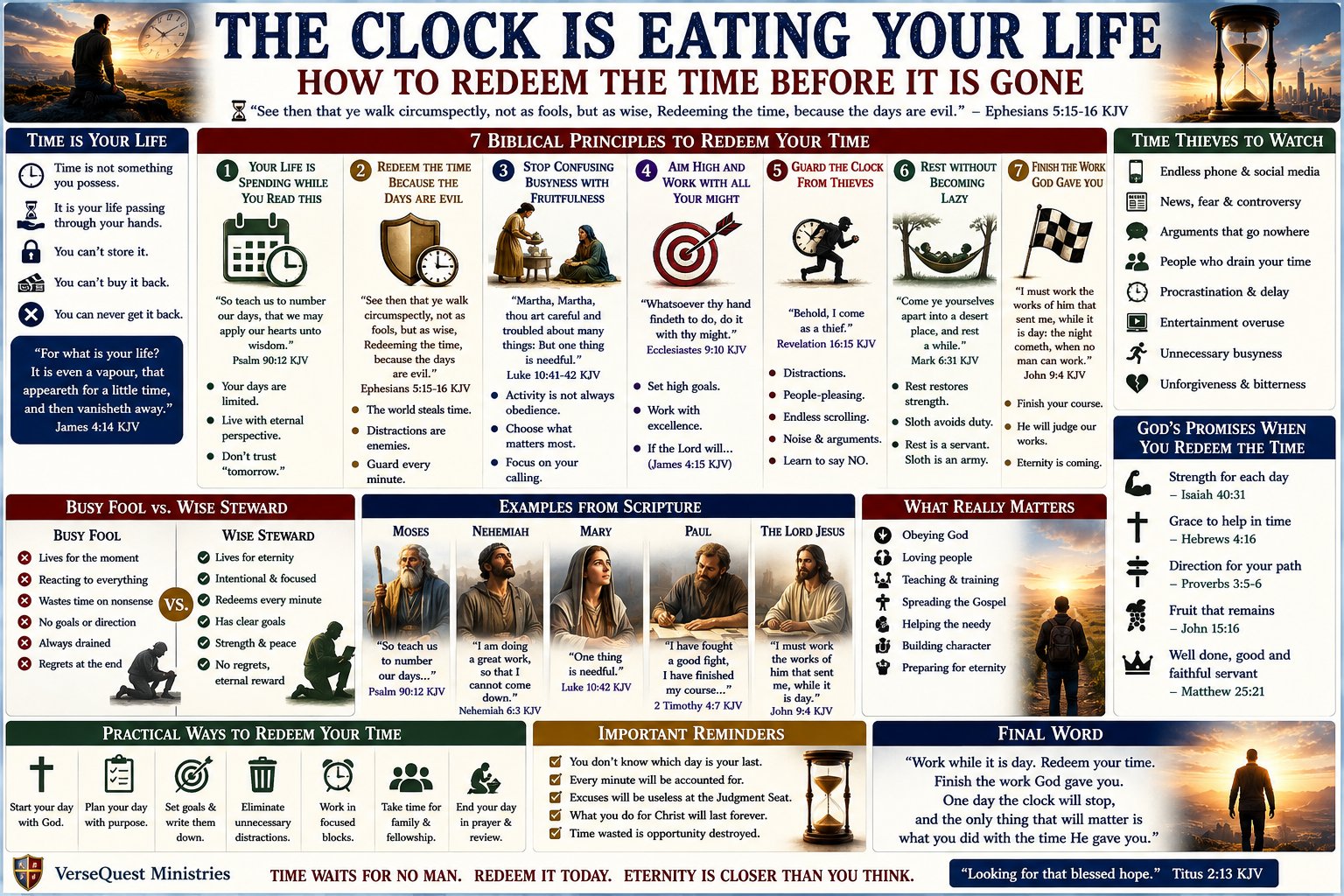
- The Clock Is Eating Your Life – How to Redeem the Time Before It Is Gone (KJV Bible Study Chart)
- Learn how to redeem the time with this detailed KJV chart covering biblical priorities, busyness versus fruitfulness, time thieves, diligence, proper rest, practical scheduling, eternal purpose, and finishing the work…
- $3.99
- Add to cart
-
-
Prayer
-
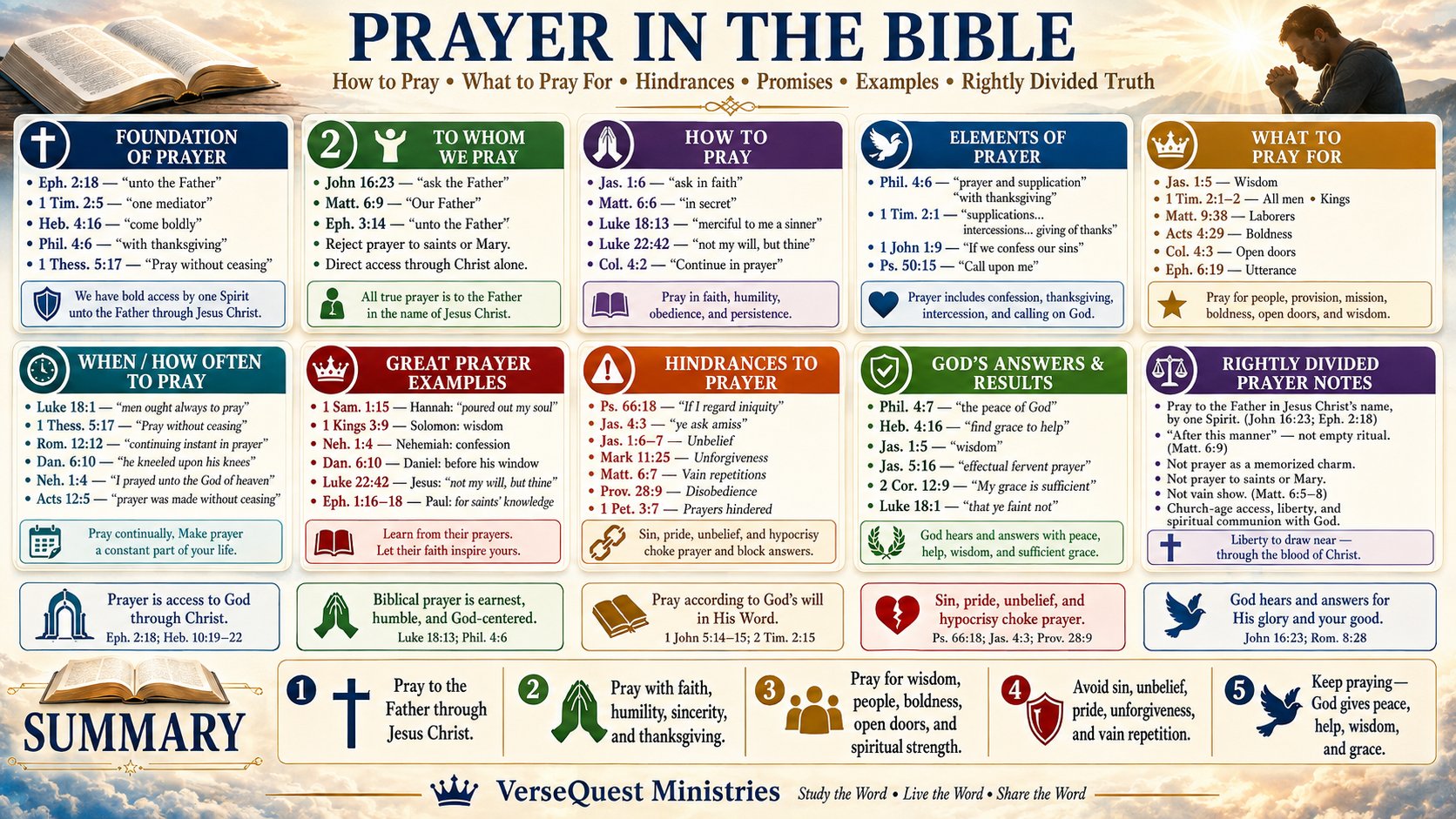
- Prayer in the Bible Chart – How to Pray According to Scripture
- Discover what the Bible teaches about prayer through this easy-to-follow VerseQuest study chart. Learn who to pray to, how to pray, what hinders prayer, what to pray for, and key…
- $4.99
- Add to cart
-
-
Christian Living
-
-50%
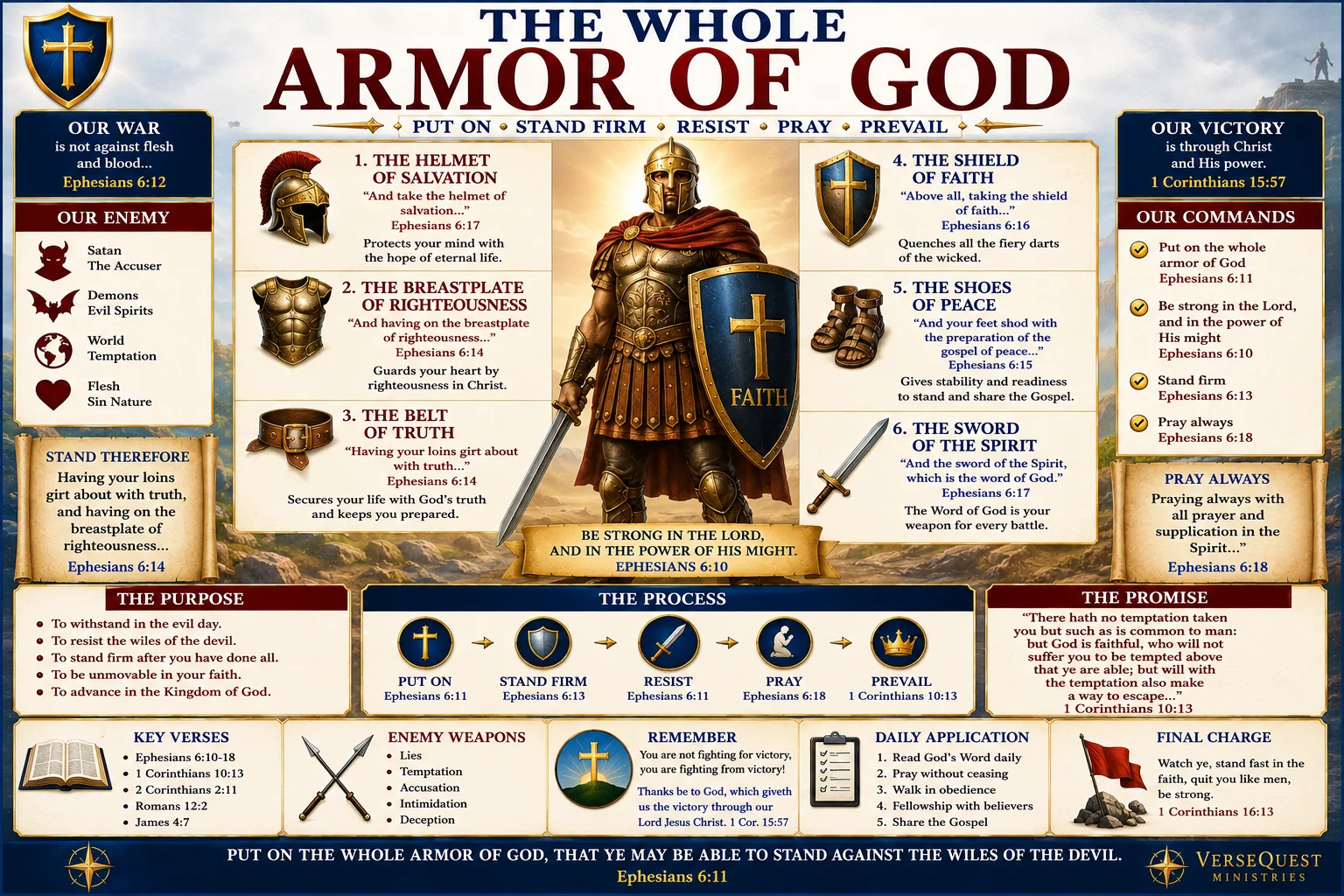
- The Whole Armor of God Chart — KJV Bible Study
- Premium printable KJV Bible study chart explaining the whole armor of God from Ephesians 6, including the helmet, breastplate, belt, shield, shoes, sword, prayer, and spiritual victory in Christ.
- Original price was: $10.00.$4.99Current price is: $4.99.
- Add to cart
-
-50%
-
Patience
-
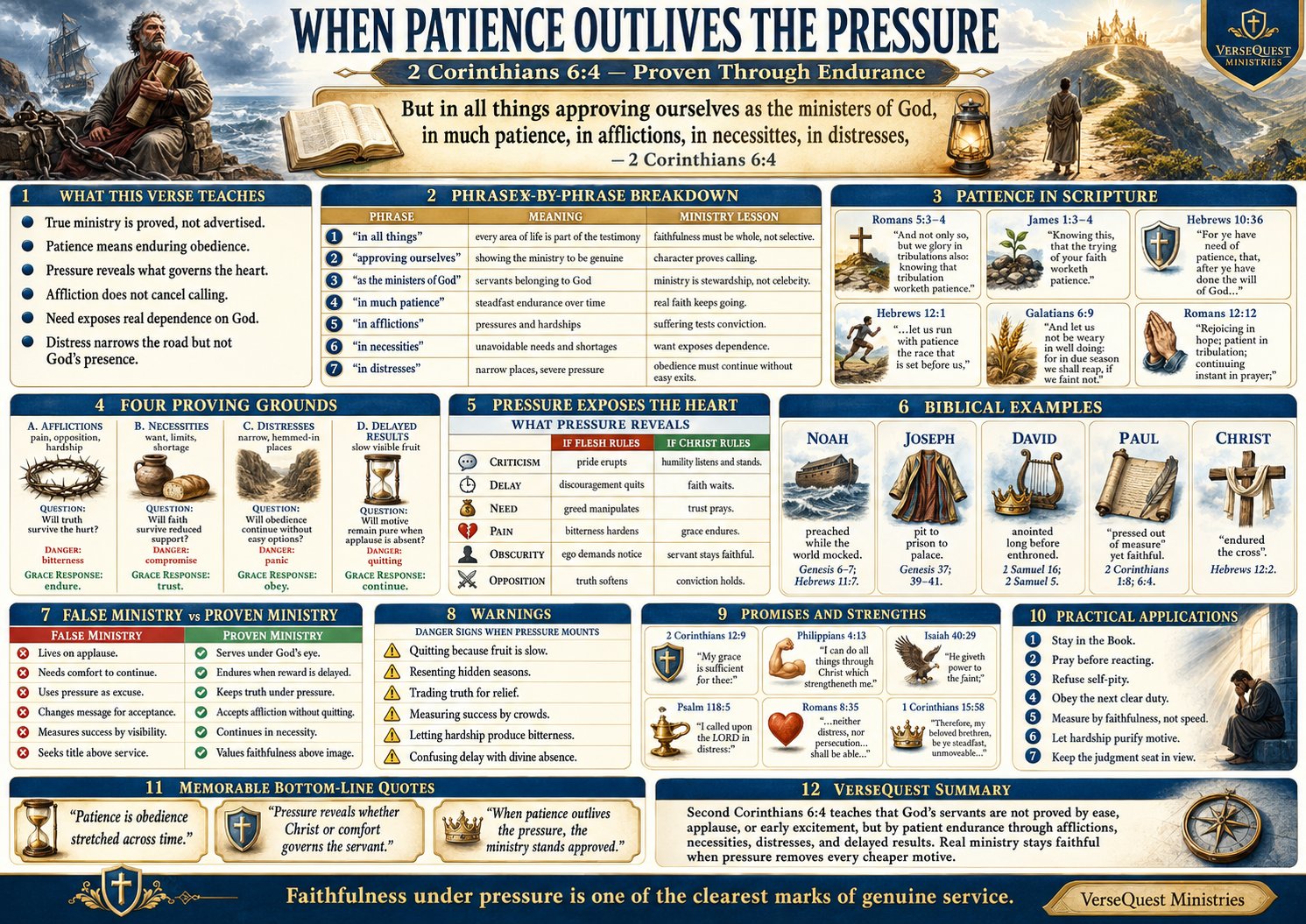
- When Patience Outlives the Pressure – Proven Through Endurance in 2 Corinthians 6:4 (KJV Bible Study Chart)
- Learn how patience proves genuine ministry with this detailed KJV chart covering 2 Corinthians 6:4, afflictions, necessities, distresses, delayed results, pressure, endurance, and faithful Christian service.
- $3.99
- Add to cart
-
-
Spiritual Growth
-
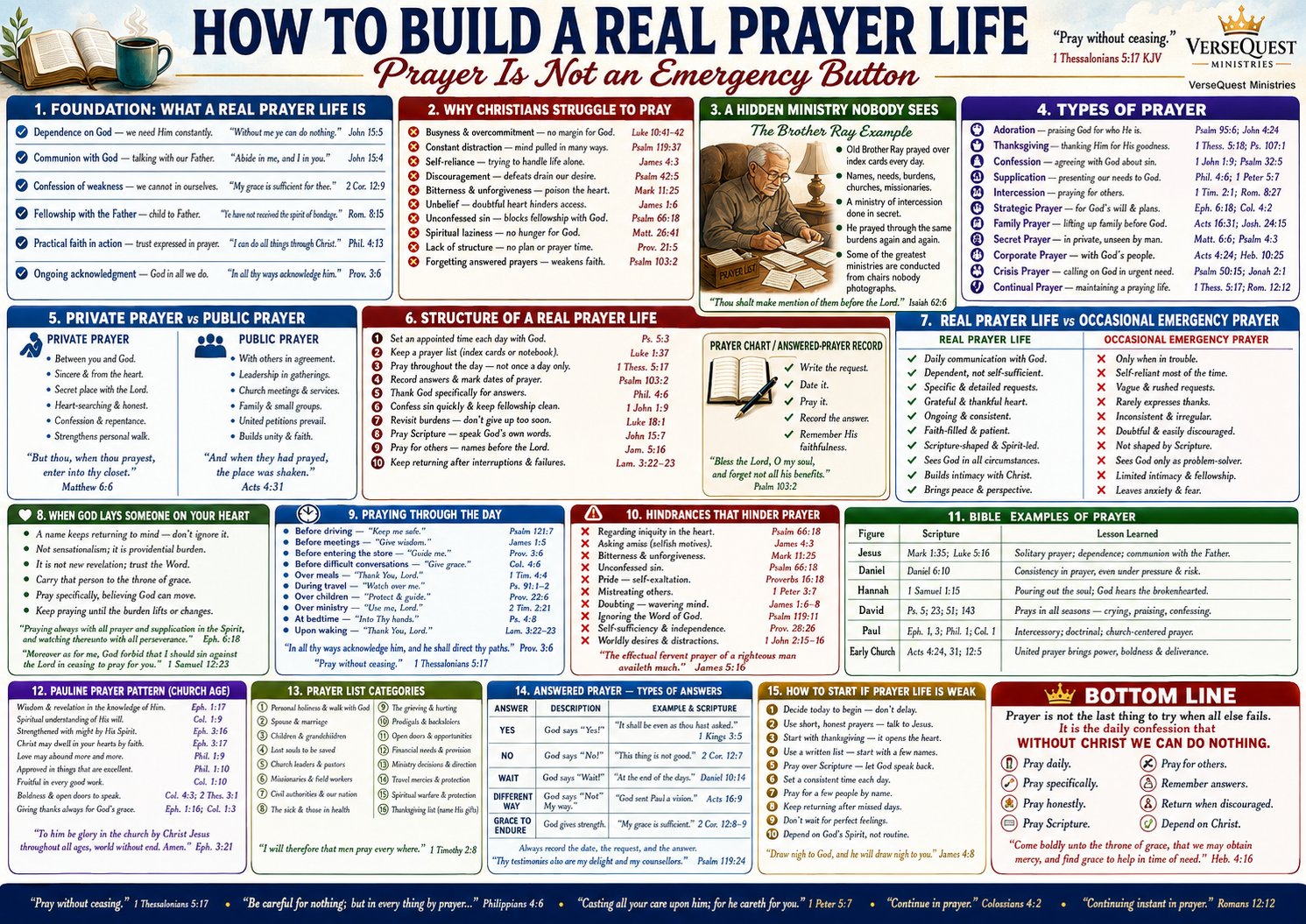
- How to Build a Real Prayer Life – Biblical Prayer Guide and KJV Bible Study Chart
- Build a consistent, biblical prayer life with this detailed KJV Bible study chart. Explore the foundations of prayer, types of prayer, common hindrances, answered prayer, Bible examples, and practical ways…
- $3.99
- Add to cart
-