
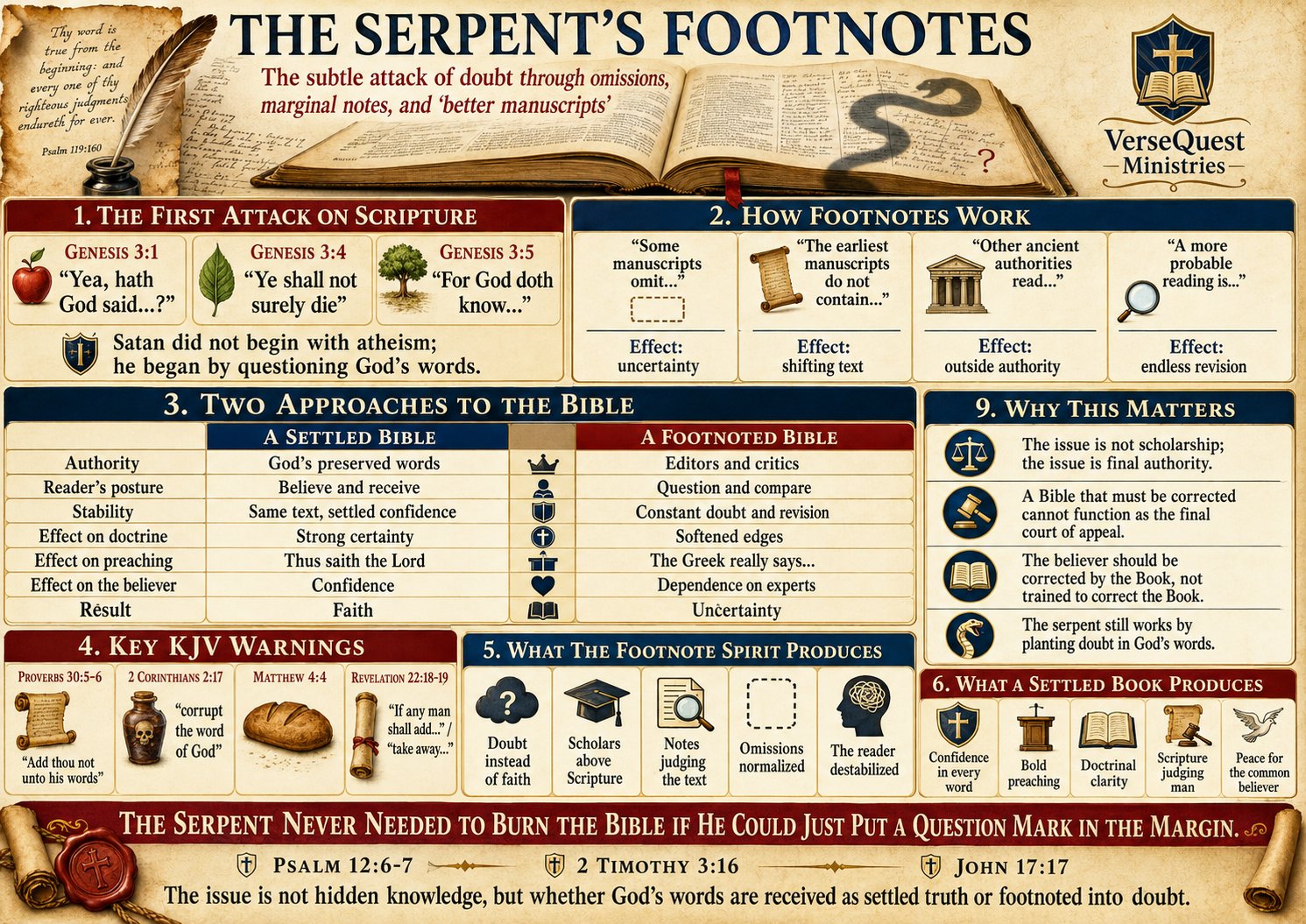
The Serpent’s Footnotes Bible Study Chart – KJV Preservation, Textual Criticism, Omissions, and Manuscript Doubt
Examine the attack of textual doubt with this detailed KJV Bible study chart covering manuscript footnotes, omissions, biblical preservation, final authority, and confidence in God’s settled words.
$3.99
Description
The Serpent’s Footnotes: The Subtle Attack of Doubt Through Omissions, Marginal Notes, and “Better Manuscripts” is a detailed KJV Bible study chart presenting a Bible-believing examination of textual footnotes, disputed readings, manuscript claims, and the repeated questioning of the words of God.
The chart begins in Genesis 3, where the serpent’s first recorded attack upon mankind was not an open declaration of atheism but a question directed toward God’s words: “Yea, hath God said?” Satan then contradicted God’s warning and offered his own interpretation of what God really meant. This progression—from questioning to denial and reinterpretation—establishes the chart’s central warning about religious doubt disguised as scholarship.
Modern Bible footnotes often contain statements such as “some manuscripts omit,” “the earliest manuscripts do not contain,” “other ancient authorities read,” or “a more probable reading is.” This chart examines the spiritual effect of repeatedly placing such qualifications beneath the biblical text. Instead of allowing Scripture to stand as the believer’s final authority, the reader may be trained to suspend judgment until editors, textual critics, scholars, or manuscript theories approve the passage.
The issue is not the existence of historical study, language tools, or manuscript research. The issue is authority. A Bible that must continually be corrected by an outside authority cannot function practically as the believer’s final court of appeal. When the reader is taught that the true wording may be missing, uncertain, misplaced, or recoverable only through specialists, confidence gradually shifts from the Book to those appointed to judge the Book.
A major comparison contrasts a settled Bible with a footnoted Bible. The settled-Bible position receives Scripture as God’s preserved words, approaches the text with faith, maintains doctrinal stability, supports bold preaching, and produces confidence in the believer. The footnoted approach continually questions and compares, introduces revision, softens doctrinal certainty, elevates expert opinion, and can leave the ordinary reader dependent upon authorities outside the Bible.
The chart does not argue that every explanatory note is automatically wrong. Cross-references, definitions, historical information, and helpful study notes can serve the reader. The danger arises when notes function as judges over the text, normalize omissions, encourage endless uncertainty, or imply that the inspired wording cannot be known without reconstructing a lost original.
Key KJV warnings establish the biblical standard. Deuteronomy 4:2 and Proverbs 30:5–6 forbid adding to or diminishing from God’s words. Second Corinthians 2:17 warns against corrupting the Word of God. Matthew 4:4 teaches that man lives by every word proceeding from the mouth of God. Revelation 22:18–19 closes Scripture with a severe warning against adding to or taking away from its words.
The chart also examines what the footnote spirit can produce: doubt instead of faith, scholars positioned above Scripture, notes judging the text, omissions becoming normalized, doctrinal edges being softened, and readers becoming destabilized. A qualification appearing occasionally may seem harmless, but the cumulative effect of hundreds of questioning notes can train the reader to approach every passage with suspicion.
By contrast, a settled Book produces confidence in every word, bold preaching, doctrinal clarity, Scripture judging the believer, and peace for the common reader. The preacher can say, “Thus saith the Lord,” rather than continually retreating into “the Greek really says,” “the oldest manuscript omits,” or “the original may have read.”
The chart emphasizes that the believer should be corrected by the Book rather than trained to correct the Book. Scripture is not merely religious source material awaiting editorial reconstruction. It is the written authority by which doctrine, conduct, preaching, worship, and spiritual experience must be judged.
Psalm 12:6–7 declares that the words of the LORD are pure words and connects those words with divine preservation. Psalm 119:160 states that God’s Word is true from the beginning. Second Timothy 3:16 identifies all Scripture as given by inspiration of God, while John 17:17 declares, “thy word is truth.”
The title The Serpent’s Footnotes captures the chart’s main warning: Satan does not always need to destroy the Bible physically when he can weaken confidence by placing a question mark beside it. Open hostility is easily recognized; subtle uncertainty presented as intellectual caution can be more difficult to detect.
This resource is designed for personal Bible study, KJV Bible classes, Scripture-preservation studies, pastoral training, Sunday school, Bible institutes, Christian schools, apologetics, textual-criticism discussions, sermon preparation, and believers seeking a clear visual explanation of why final biblical authority matters.
KJV Bible preservation, final biblical authority, textual criticism, manuscript footnotes, disputed readings, biblical omissions, adding to Scripture, taking away from Scripture, questioning God’s words, Genesis 3 deception, settled Bible, inspired Scripture, preserved words, doctrinal certainty, confidence in the Bible, scholars and Scripture, marginal notes, manuscript authority, Scripture judging man, King James Bible
The first recorded attack upon God’s revelation begins with the question, “Yea, hath God said?” The serpent creates uncertainty before offering contradiction. Doubt becomes the doorway through which denial and reinterpretation enter.
The central issue in textual criticism is final authority. Historical information may be useful, but no scholar, manuscript theory, committee, or marginal note should occupy a position above the words by which doctrine and conduct are judged.
A footnote can appear modest while carrying a significant implication. Statements that a passage is absent, doubtful, secondary, later, or less probable train the reader to view the printed text as provisional rather than settled.
Repeated uncertainty creates dependence upon experts. The ordinary believer may begin to assume that he cannot confidently know what God said without access to languages, manuscript databases, academic credentials, or editorial conclusions.
A settled Bible does not forbid study. It establishes the authority from which study begins. Concordances, dictionaries, histories, maps, and commentaries should help readers understand the Bible rather than encourage them to sit in judgment over it.
Scripture repeatedly warns against adding to or taking away from God’s words. These warnings demonstrate that individual words matter and that altering revelation is not a harmless academic exercise.
Second Timothy 3:16 refers to Scripture as given by inspiration of God. Inspiration concerns written words, not merely general religious ideas. A doctrine of inspiration without practical preservation leaves the present believer praising a Bible he cannot possess.
Psalm 12:6–7 presents the words of the LORD as pure and preserved. The believer’s confidence rests not upon human perfection but upon God’s ability to preserve what He inspired.
The statement “the Greek really says” should never be used to overturn the Bible placed in the hands of the English-speaking believer. Language study can illuminate usage, but it must not become a device for replacing the text with the teacher’s preferred reconstruction.
Doctrinal certainty produces bold preaching. A preacher who believes he possesses God’s words can proclaim them plainly. A preacher trained to question every disputed verse may replace authority with endless qualification.
The common believer needs a Bible he can read, believe, memorize, preach, and obey. God did not design Scripture to remain inaccessible until specialists reconstruct its wording.
The serpent does not need to remove every Bible from the world when he can persuade readers that no Bible is entirely trustworthy. The answer is to receive God’s preserved words with faith, study them diligently, and allow Scripture to remain the final authority.
KJV Bible teaching, Scripture-preservation classes, pastoral training, textual-criticism discussions, apologetics, Sunday school lessons, homeschool Bible curriculum, Christian school instruction, Bible institute classes, sermon preparation, discipleship training, new-believer instruction, doctrinal studies, church leadership training, Bible-version studies, personal Bible study, Christian worldview instruction, defence of biblical authority
King James Bible, Strong’s Concordance, Thompson Chain-Reference Bible, Treasury of Scripture Knowledge, Nave’s Topical Bible, King James Bible cross-reference tools, Scripture-preservation study notes, Bible manuscript history resources, personal doctrinal notebook, verse-comparison worksheets, studies on Psalm 12, studies on 2 Timothy 3, studies on Revelation 22, VerseQuest KJV and doctrine charts
Related products
-
Finding The Will of God
-
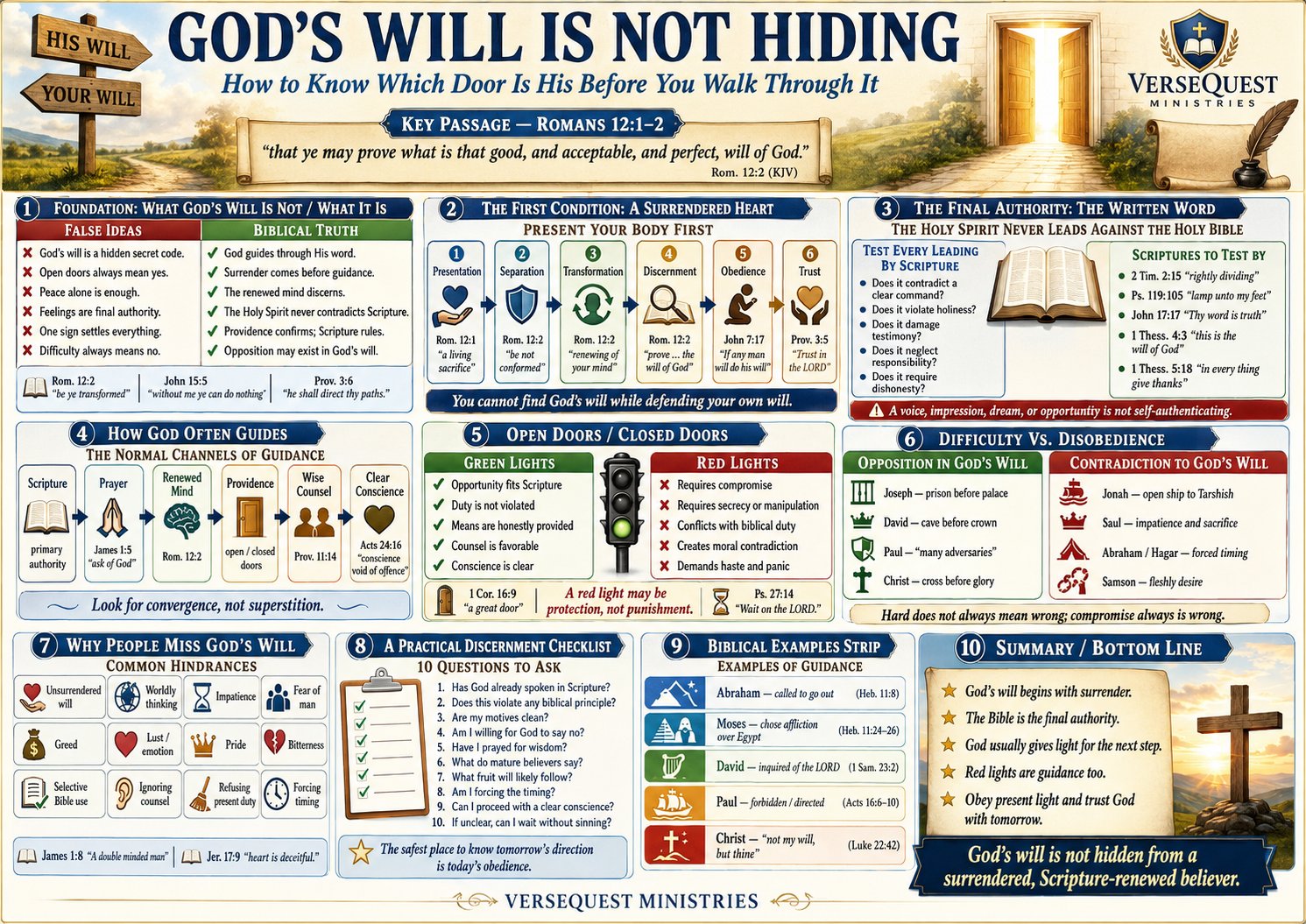
- God’s Will Is Not Hiding – How to Discern Biblical Guidance and Know Which Door Is His (KJV Bible Study Chart)
- Learn how to discern God’s will with this detailed KJV Bible study chart covering surrender, Scripture, prayer, wise counsel, open doors, closed doors, and practical decision-making.
- $3.99
- Add to cart
-
-
The Seven Dispensations
-
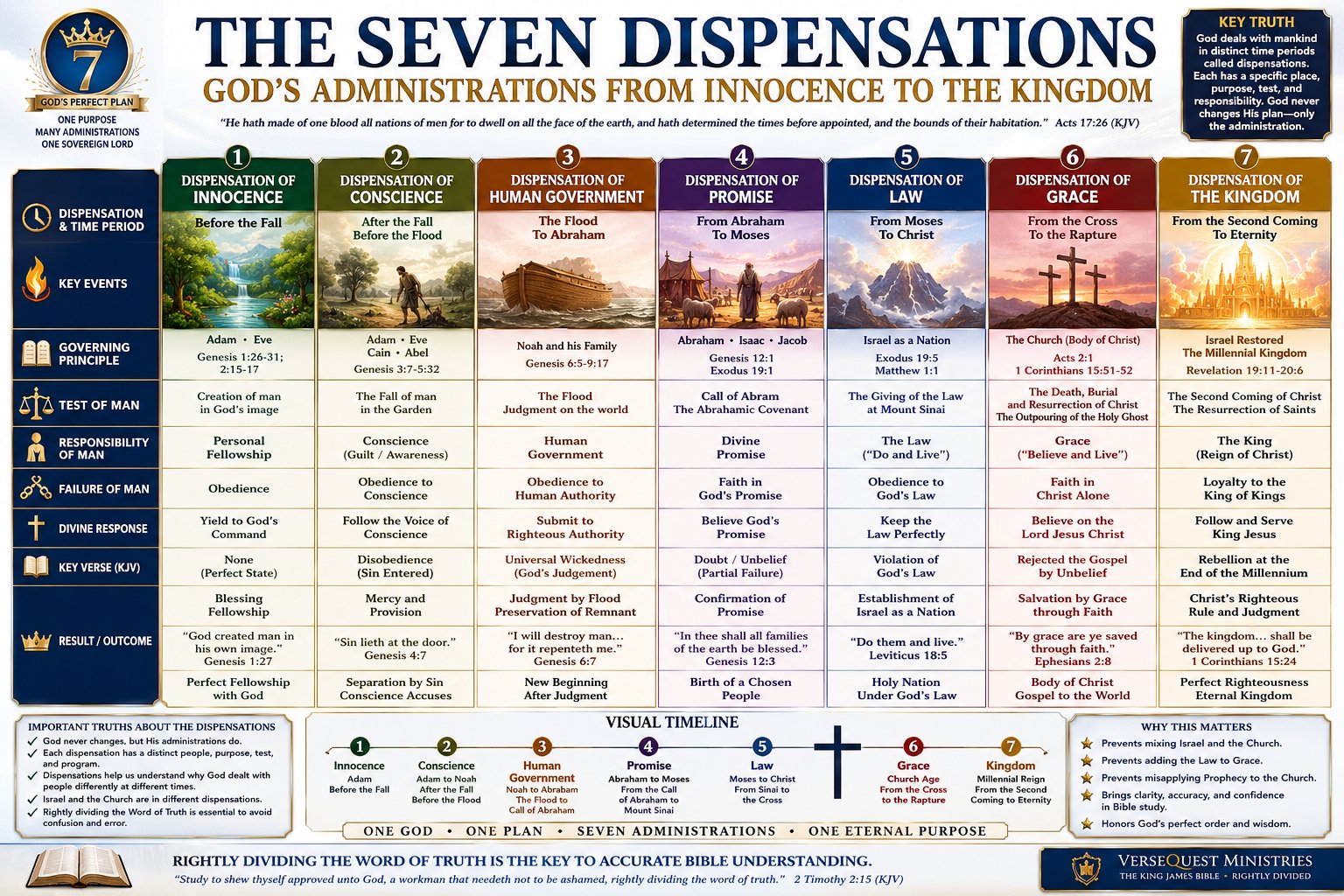
- The Seven Dispensations Bible Study Chart – God’s Administrations from Innocence to the Kingdom (KJV)
- Explore the seven dispensations with this detailed KJV Bible study chart covering Innocence, Conscience, Human Government, Promise, Law, Grace, the Kingdom, and the importance of rightly dividing Scripture.
- $3.99
- Add to cart
-
-
Biblical Humility
-
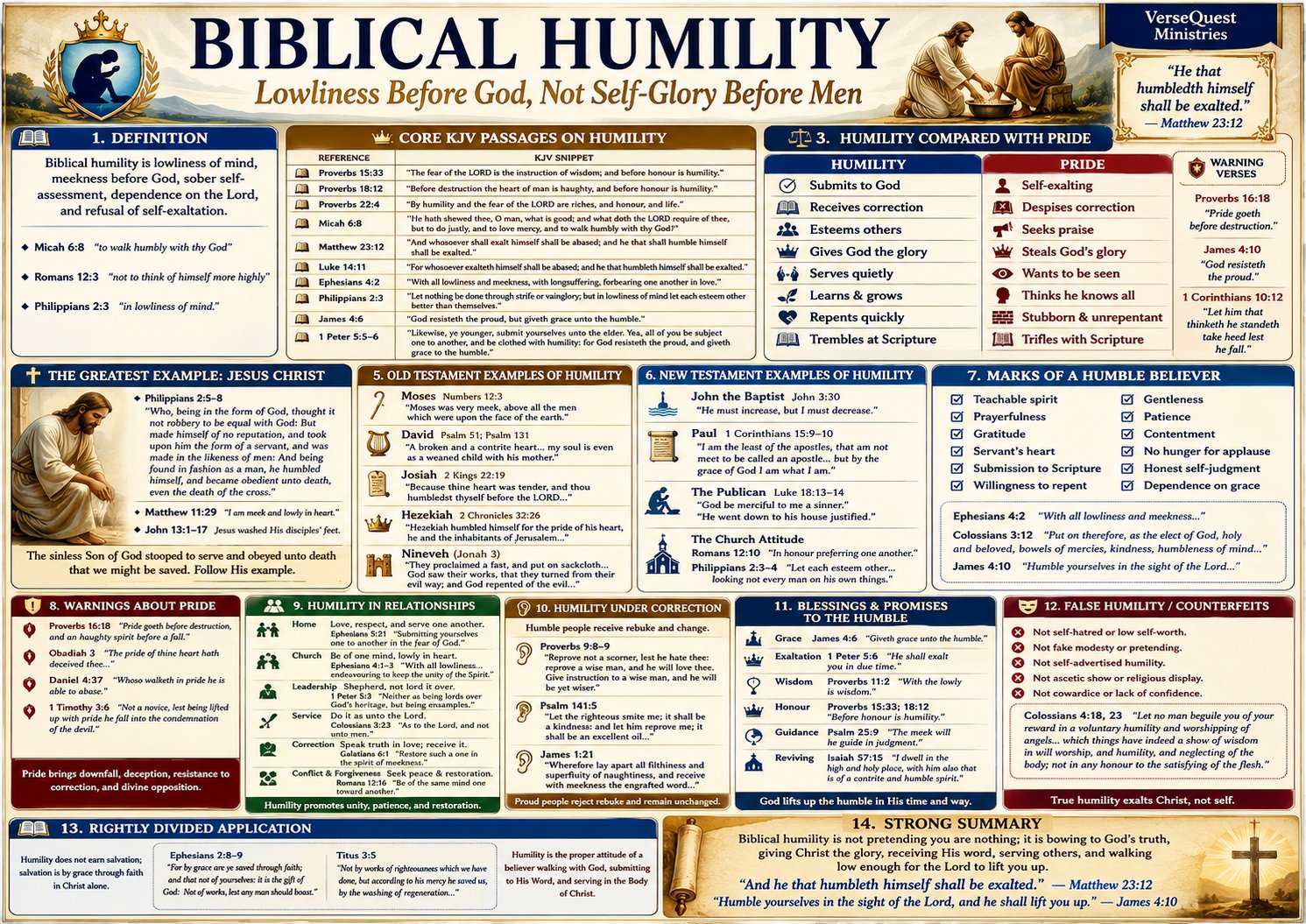
- Biblical Humility Bible Study Chart – Lowliness Before God, Not Self-Glory Before Men (KJV)
- Study biblical humility with this detailed KJV chart comparing humility and pride, Christ’s example, receiving correction, servant leadership, grace, and practical Christian living.
- $3.99
- Add to cart
-
-
Spritual Dryness
-
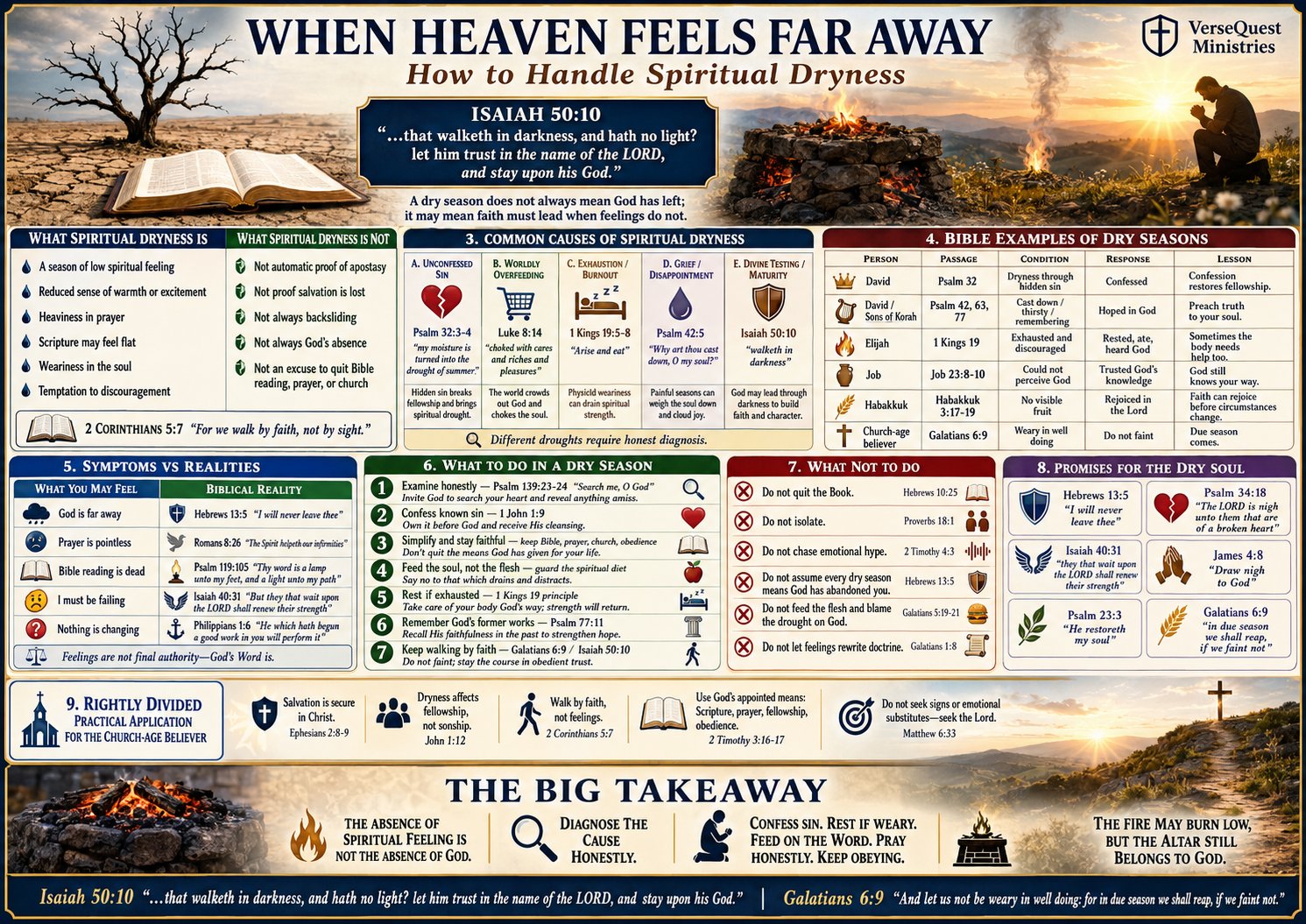
- When Heaven Feels Far Away – How to Handle Spiritual Dryness and Walk by Faith (KJV Bible Study Chart)
- Walk through spiritual dryness with this detailed KJV Bible study chart covering its causes, biblical examples, warning signs, promises, faithful habits, and the difference between feelings and truth.
- $3.99
- Add to cart
-
-
Cain and Abel
-
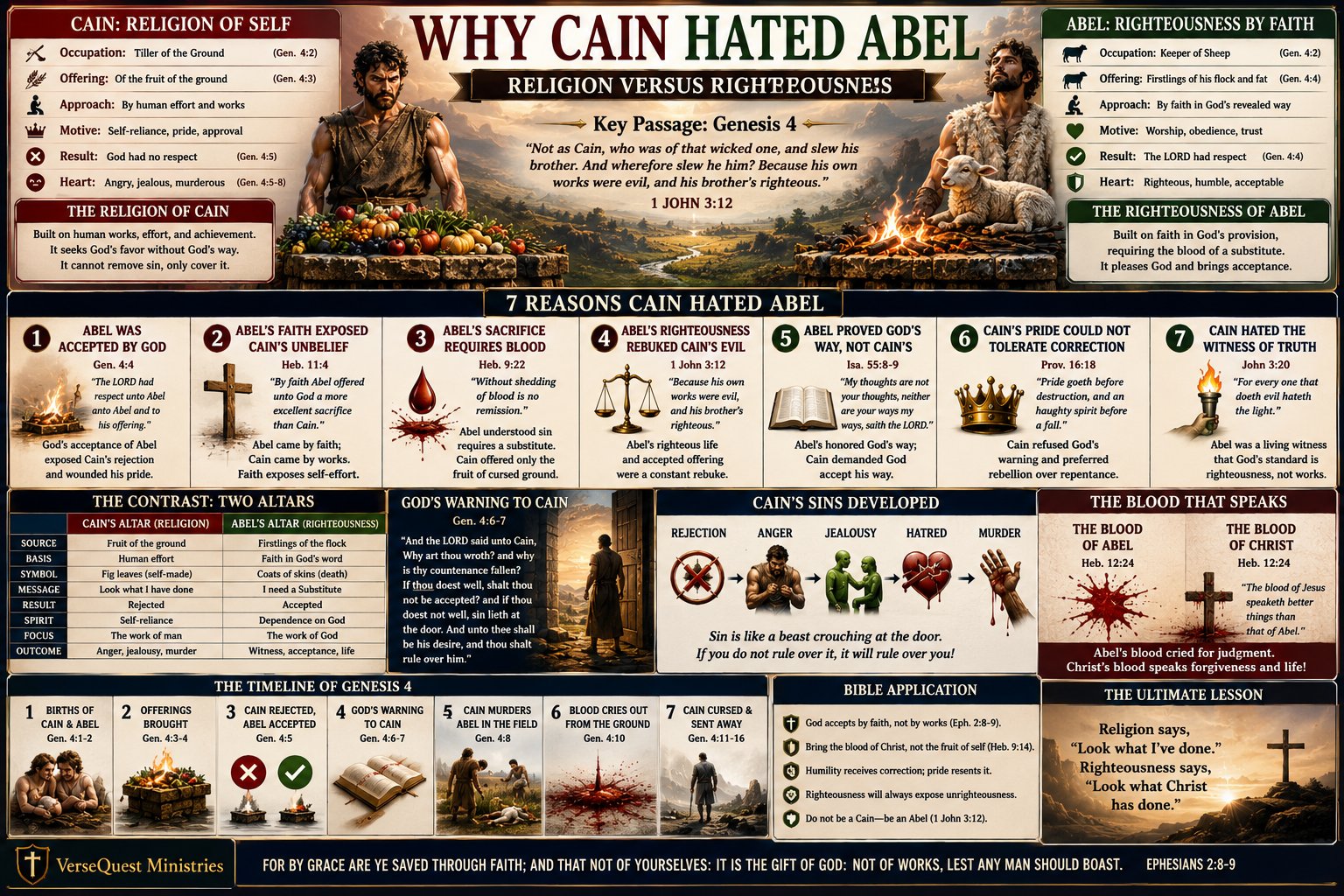
- Why Cain Hated Abel Bible Study Chart – Religion Versus Righteousness, Faith, Works, and Blood Sacrifice (KJV)
- Discover why Cain hated Abel with this detailed KJV Bible study chart comparing religion and righteousness, human works and faith, rejected worship, blood sacrifice, pride, jealousy, and salvation through Christ.
- $3.99
- Add to cart
-