
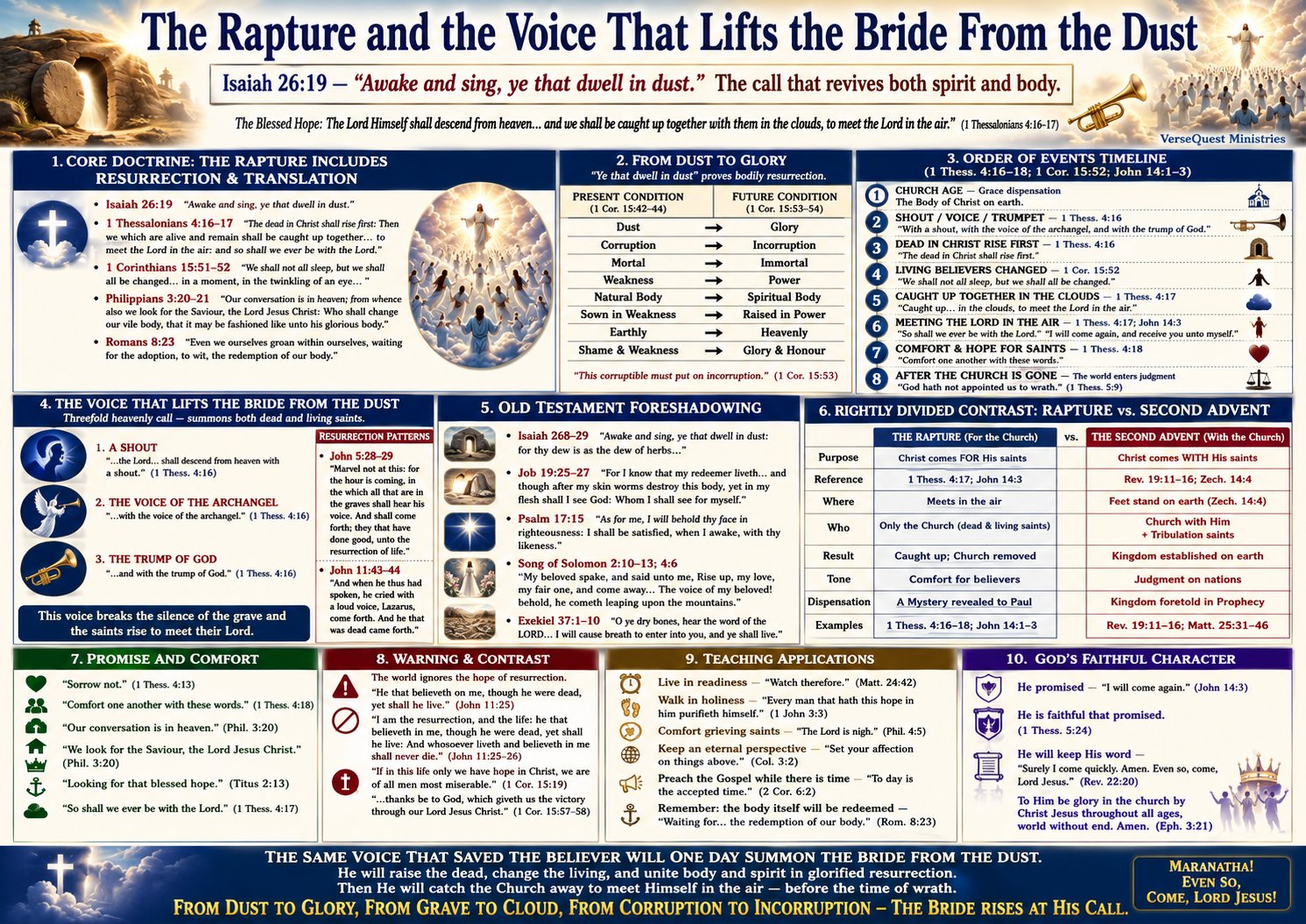
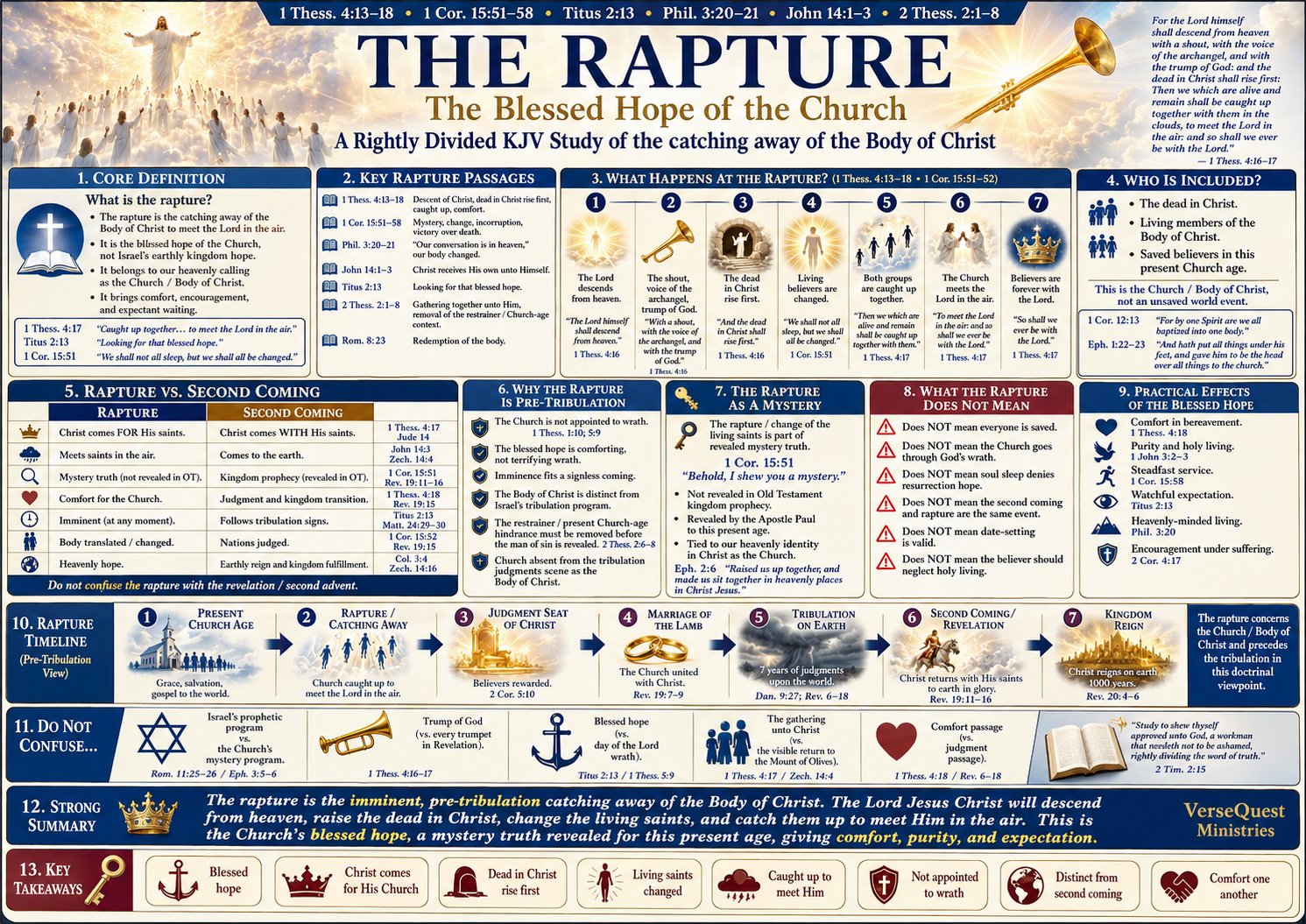
The Rapture – The Blessed Hope and Pre-Tribulation Catching Away of the Body of Christ (KJV Bible Study Chart)
Understand the Rapture with this detailed KJV chart covering the dead in Christ, transformation of living believers, meeting the Lord in the air, the blessed hope, pre-Tribulation timing, mystery truth, Church-versus-Israel distinctions, and the difference between the Rapture and Second Coming.
$3.99
Description
The Rapture: The Blessed Hope of the Church is a detailed, rightly divided KJV Bible study chart explaining the future catching away of the Body of Christ, the resurrection of the dead in Christ, the instantaneous transformation of living believers, and the Church’s meeting with the Lord Jesus Christ in the air.
Built around 1 Thessalonians 4:13–18, 1 Corinthians 15:51–58, Titus 2:13, Philippians 3:20–21, John 14:1–3, 2 Thessalonians 2:1–8, and Romans 8:23, this chart presents the Rapture as the Church’s blessed hope—a distinct, imminent, pre-Tribulation event belonging to God’s present mystery program for the Body of Christ.
The Rapture is not merely a general reference to death, heaven, resurrection, or the Second Coming. It is the specific moment when the Lord Jesus Christ descends from heaven, the dead in Christ rise first, living believers are changed, and both groups are caught up together in the clouds to meet the Lord in the air.
First Thessalonians 4:16–17 declares that “the Lord himself shall descend from heaven with a shout, with the voice of the archangel, and with the trump of God.” The passage does not describe angels quietly carrying individual souls to heaven at death. It describes a future corporate event involving the Lord’s descent, bodily resurrection, transformation, reunion, and removal of the Church.
The chart begins with a clear definition of the Rapture. It is the catching away of the Body of Christ to meet the Lord Jesus in the air. It belongs to the Church’s heavenly calling and should not be confused with Israel’s earthly Kingdom hope.
The word rapture does not need to appear in the English text for the doctrine to be biblical. The doctrine comes from the inspired words “caught up” in 1 Thessalonians 4:17. A theological term may summarize a scriptural truth without replacing the words of Scripture.
The Rapture brings comfort because believers do not sorrow as those who possess no hope. Christians grieve the death of loved ones, but their grief is transformed by the promise of resurrection and reunion.
Paul wrote First Thessalonians 4 because believers were concerned about saints who had died before the Lord’s return. His answer was not that the dead had missed the promise. He revealed that the dead in Christ would rise first and participate fully in the catching away.
The Rapture is therefore inseparable from bodily resurrection. It is not the escape of spirits from physical existence. God will raise the bodies of deceased Church-age believers and transform them into incorruptible, immortal, glorified bodies.
First Corinthians 15:51 introduces this truth with the words, “Behold, I shew you a mystery.” Paul explains that not every believer will experience physical death, but every believer included in the event will be changed.
The change occurs “in a moment, in the twinkling of an eye.” The believer’s corruptible body will put on incorruption, and the mortal body will put on immortality.
This transformation is necessary because flesh and blood in its present corruptible condition cannot inherit the completed heavenly destiny God has prepared for the Church. Salvation includes more than forgiveness of the soul; it ultimately includes the redemption and glorification of the body.
Philippians 3:20–21 teaches that the believer’s conversation is in heaven and that the Lord Jesus Christ will change the Christian’s vile body so that it may be fashioned like His glorious body.
The Rapture therefore completes an essential part of salvation’s future aspect. The believer has already been justified and spiritually saved, but he still waits for the redemption of the body.
Romans 8:23 describes believers groaning within themselves while waiting for “the adoption, to wit, the redemption of our body.” The Holy Spirit’s seal guarantees that God will finish this bodily redemption.
The chart presents the sequence of events clearly. The Lord Himself descends from heaven. A shout is heard, accompanied by the voice of the archangel and the trump of God.
The dead in Christ rise first. These are believers who died during the present Church Age and belong to the Body of Christ.
Living believers are then changed instantly. They do not need to die first. Mortality is swallowed up by life through the transforming power of Jesus Christ.
The resurrected and transformed believers are caught up together. The Rapture unites saints who died in Christ with believers who remain alive at the Lord’s coming for His Church.
The Church meets the Lord in the air. This location helps distinguish the Rapture from the Second Coming, when Christ’s feet stand upon the earth and He returns visibly to judge nations and establish His Kingdom.
The final result is permanent: “so shall we ever be with the Lord.” The Rapture is not a temporary excursion followed by separation from Christ. It brings the Church into everlasting presence and fellowship with the Saviour.
The chart identifies who is included. The dead in Christ are included. Living members of the Body of Christ are included. Saved believers belonging to the present Church Age are included.
The Rapture concerns the Church, which is Christ’s Body. First Corinthians 12:13 teaches that believers are baptized by one Spirit into one Body.
The event should not be expanded automatically to include every person from every age and biblical program. Right division keeps the resurrection and destiny of the Church within the mystery revelation given particularly through Paul.
The chart provides a major comparison between the Rapture and the Second Coming. At the Rapture, Christ comes for His saints. At the Second Coming, Christ returns with His saints.
At the Rapture, believers meet the Lord in the air. At the Second Coming, Christ comes to the earth in judgment and glory.
The Rapture belongs to mystery truth not revealed as part of Old Testament Kingdom prophecy. The Second Coming was foretold openly by the prophets and is central to Israel’s expectation.
The Rapture provides comfort to the Church. The Second Coming brings judgment upon rebellious nations and transitions the earth into Christ’s Kingdom reign.
The Rapture is imminent and does not require the Church to wait for Tribulation signs. The Second Coming follows identifiable prophetic events associated with Daniel’s seventieth week.
At the Rapture, the Body of Christ is translated and changed. At the Second Coming, nations are judged, Israel’s enemies are defeated, and the King establishes His visible earthly rule.
The Rapture expresses the Church’s heavenly hope. The Second Coming brings the fulfillment of Christ’s earthly Kingdom promises.
These events are related within God’s larger prophetic plan, but they are not identical. Collapsing them into one event creates confusion concerning the Church, Israel, the Tribulation, resurrection, judgment, imminence, and the Kingdom.
The chart presents several reasons the Rapture is pre-Tribulation. First, the Church is not appointed to wrath. First Thessalonians 5:9 states, “For God hath not appointed us to wrath, but to obtain salvation by our Lord Jesus Christ.”
The Tribulation is not merely an ordinary period of persecution or hardship. It is a future prophetic period of divine wrath, judgment, seals, trumpets, vials, and national dealings centred upon Israel and the nations.
The Church has experienced persecution throughout history, and believers may suffer greatly before the Rapture. The promise of deliverance from divine wrath does not guarantee freedom from human opposition, satanic attack, illness, loss, or martyrdom.
The distinction concerns the future outpouring of God’s eschatological wrath. The Body of Christ is removed before that appointed period begins.
Second, the blessed hope is presented as comforting rather than terrifying. Paul tells believers to comfort one another with the promise of the catching away.
If the Church were required to endure the rise of the Antichrist, the mark of the beast, global persecution, the trumpet judgments, and the vials of wrath before being caught up, the primary emphasis would be survival through prophetic terror rather than watchful expectation for Christ.
Third, imminence supports a signless coming for the Church. Believers are instructed to wait for God’s Son from heaven and look for the blessed hope.
The Church is not told first to wait for a rebuilt Temple, the abomination of desolation, the two witnesses, the 144,000, the mark of the beast, or the armies gathering at Armageddon.
Those events belong to the prophetic Tribulation setting. The Church’s expectation is Christ Himself.
Fourth, the Body of Christ is distinct from Israel’s Tribulation program. Daniel’s seventieth week concerns Daniel’s people and holy city.
The Tribulation brings Israel again into the centre of prophetic fulfillment. God seals Jewish servants, preserves a remnant, judges nations, confronts Jerusalem’s enemies, and prepares Israel for the return of her King.
The Church is not Israel and should not be forced into a period specifically connected with Jacob’s trouble and the completion of Israel’s prophetic calendar.
Fifth, Second Thessalonians 2 indicates that the restraining presence must be removed before the man of sin is fully revealed. The present Church-age restraint associated with the Spirit-indwelt Body of Christ will no longer operate in the same manner after the Church is caught away.
This does not mean the Holy Spirit ceases to exist or becomes inactive on earth. God’s Spirit remains omnipresent and continues working during the Tribulation. The doctrinal point concerns the removal of the present restraining arrangement before the Antichrist’s open revelation.
The chart explains that the Rapture is a mystery. First Corinthians 15:51 explicitly identifies the transformation of living saints as mystery truth.
A mystery in Paul’s epistles is not something permanently unknowable. It is truth previously hidden and later revealed by God.
Old Testament prophecy openly described resurrection, the Day of the Lord, Israel’s restoration, the Messiah’s return, judgment of nations, and the earthly Kingdom. It did not plainly reveal the one Body of Christ or the catching away of that Body before Israel’s final prophetic week.
The Rapture belongs to the same mystery program that reveals Jew and Gentile united in one Body, heavenly blessings in Christ, and the Church’s heavenly position.
Ephesians 2:6 teaches that believers are raised together and made to sit together in heavenly places in Christ Jesus. The Church’s destiny fits its heavenly identity.
The chart also explains what the Rapture does not mean. It does not teach universal salvation. Only those who belong to Jesus Christ are included.
The Rapture does not mean the Church passes through God’s Tribulation wrath and is removed at the final moment. The event precedes that future period in the pre-Tribulation framework presented by the chart.
The Rapture does not deny bodily resurrection or teach soul sleep. The dead in Christ rise bodily, demonstrating that death does not erase Christian identity or hope.
The Rapture does not mean the Second Coming and the Rapture are the same event. They involve different movements, purposes, settings, audiences, and outcomes.
The doctrine does not authorize date-setting. Jesus Christ may come at any time, but Scripture does not permit Christians to announce dates God has not revealed.
Repeated failed predictions bring reproach upon sound prophecy teaching and distract from the command to remain ready.
The Rapture also does not mean believers should neglect daily living, family responsibilities, work, ministry, or spiritual growth.
The blessed hope should produce diligence rather than escapism. A person truly expecting Christ should desire to be found faithful.
The chart outlines the practical effects of the blessed hope. First, it brings comfort in bereavement.
Christians may mourn deeply, but death is not final for the believer. The grave cannot retain those who belong to Jesus Christ.
Second, the hope promotes purity and holy living. First John teaches that the person possessing this hope purifies himself.
Expectation of Christ’s coming should expose secret sin, worldly compromise, spiritual laziness, and misplaced priorities.
Third, the doctrine encourages steadfast service. First Corinthians 15 concludes its resurrection teaching by commanding believers to remain steadfast, unmovable, and always abounding in the Lord’s work.
The promise of resurrection means Christian labour is not in vain. Service performed for Christ survives beyond death and present circumstances.
Fourth, the Rapture encourages watchful expectation. Titus 2:13 describes believers as “looking for that blessed hope, and the glorious appearing of the great God and our Saviour Jesus Christ.”
The believer should not live with his heart buried entirely in this present world. He should maintain an upward expectation and eternal perspective.
Fifth, the doctrine promotes heavenly-minded living. Philippians 3 reminds believers that their citizenship is in heaven.
Heavenly-mindedness does not make believers useless on earth. It enables them to perform earthly responsibilities with eternal priorities and freedom from worldly bondage.
Sixth, the Rapture gives encouragement during suffering. Paul reminds believers that present affliction is temporary compared with the glory ahead.
The Church may be hated, mocked, persecuted, and rejected, but Jesus Christ will gather every member of His Body and complete the promised redemption.
The chart presents a simple pre-Tribulation timeline. The first stage is the present Church Age, in which the gospel of grace is preached and the Body of Christ is formed.
The second stage is the Rapture, when the Church is caught up to meet the Lord in the air.
The third stage is the Judgment Seat of Christ, where believers’ service is examined and rewarded. This judgment concerns reward rather than eternal condemnation.
The fourth stage is the marriage of the Lamb, presenting the union and celebration of Christ with His redeemed Church.
The fifth stage is the Tribulation upon the earth, a seven-year period associated with Daniel’s seventieth week and the judgments described in Revelation 6–18.
The sixth stage is the Second Coming or Revelation of Jesus Christ, when He returns visibly with His saints to defeat His enemies.
The seventh stage is the Kingdom reign, when Christ rules upon the earth for one thousand years.
This order preserves the distinction between the Church’s heavenly hope and Israel’s future prophetic fulfillment.
The chart also warns against several common confusions. Israel’s prophetic program must not be confused with the Church’s mystery program.
Romans 11 teaches that Israel’s blindness is partial and temporary. Ephesians 3 explains the mystery revealed concerning the Body of Christ.
The trump of God in 1 Thessalonians 4 should not automatically be identified with the seventh trumpet in Revelation. Similar words do not require identical events when context, audience, purpose, and sequence differ.
The blessed hope should not be confused with the Day of the Lord’s wrath. The Church waits for the Saviour, while the prophetic world moves toward judgment.
The gathering of the Church unto Christ must not be confused with the visible return described in Matthew 24 and Revelation 19.
The comfort passage of 1 Thessalonians 4 should not be turned into the same event as Revelation’s judgment scenes.
Right division keeps the Rapture, Tribulation, Second Coming, Israel, and the Church in their proper places.
The chart’s strong summary is clear: the Rapture is the imminent, pre-Tribulation catching away of the Body of Christ.
The Lord Jesus Christ will descend from heaven, raise the dead in Christ, transform living saints, and catch them up together to meet Him in the air.
This is the Church’s blessed hope, a mystery truth revealed for the present dispensation, and a doctrine intended to produce comfort, purity, steadfast service, heavenly expectation, and confidence in the promises of God.
The believer does not look primarily for the Antichrist, global catastrophe, or prophetic terror. He looks for Jesus Christ.
The dead in Christ will rise first. The living saints will be changed. The Church will be caught up. Believers will be forever with the Lord.
The practical command remains: “Wherefore comfort one another with these words.”
This resource is ideal for personal Bible study, pre-Tribulation Rapture teaching, prophecy classes, Israel-and-Church distinctions, new-believer discipleship, eternal-security instruction, bereavement comfort, resurrection studies, Sunday school, homeschool Bible curriculum, Christian schools, Bible institutes, sermon preparation, and church prophecy conferences.
The Rapture, blessed hope of the Church, pre-Tribulation Rapture, catching away of the Body of Christ, dead in Christ rise first, living saints changed, caught up together, meeting the Lord in the air, resurrection of believers, redemption of the body, mystery truth, Church versus Israel, Rapture versus Second Coming, not appointed to wrath, imminence, trump of God, Judgment Seat of Christ, Tribulation prophecy, heavenly hope, comfort one another
The Rapture is the future catching away of the Body of Christ to meet the Lord Jesus Christ in the air.
The doctrine is based upon the inspired words “caught up” in 1 Thessalonians 4:17.
The Lord Jesus Christ personally descends from heaven.
The event includes a shout, the voice of the archangel, and the trump of God.
The dead in Christ rise first.
Living believers are changed instantly without passing through physical death.
Both groups are caught up together in the clouds.
The Church meets the Lord in the air and remains with Him forever.
The Rapture includes bodily resurrection and transformation rather than merely the movement of disembodied souls.
First Corinthians 15 identifies the transformation of living believers as a mystery.
A biblical mystery is truth previously hidden and later revealed by God.
The Rapture belongs to the Church’s mystery program and heavenly calling.
The Body of Christ is formed by the Holy Spirit from saved Jews and Gentiles during the present dispensation.
The Rapture does not concern an unsaved world. It concerns those who are in Christ.
The Rapture and Second Coming are distinct events.
At the Rapture, Christ comes for His saints. At the Second Coming, He returns with His saints.
At the Rapture, believers meet Christ in the air. At the Second Coming, Christ comes to earth.
The Rapture brings comfort to the Church. The Second Coming brings judgment upon rebellious nations and establishes the Kingdom.
The Rapture is imminent. The Second Coming follows Tribulation events and visible prophetic signs.
The Rapture produces bodily transformation. The Second Coming includes national judgment and earthly rule.
The Church is not appointed to divine wrath.
This does not promise believers freedom from ordinary persecution, suffering, sickness, or human hostility.
The Tribulation is a future period of divine judgment associated with Daniel’s seventieth week, Israel, and the nations.
The Church is distinct from Israel and should not be placed into Jacob’s future time of trouble.
The present restraining arrangement must be removed before the man of sin is fully revealed.
The Spirit remains omnipresent and active after the Rapture, but the present Spirit-indwelt Body of Christ is removed.
The Rapture does not teach universal salvation.
It does not deny bodily resurrection.
It does not teach that the Church endures God’s Tribulation wrath before being removed.
It does not make the Rapture identical to the Second Coming.
It does not authorize date-setting.
It does not excuse negligent Christian living.
The blessed hope should comfort grieving believers.
It should produce purity and holy living.
It should encourage steadfast Christian service.
It should promote watchfulness and expectation.
It should create heavenly-minded living.
It should strengthen believers enduring suffering.
The present Church Age is followed by the Rapture, the Judgment Seat of Christ, the marriage of the Lamb, the Tribulation on earth, the Second Coming, and Christ’s Kingdom reign.
The Judgment Seat concerns reward for saved believers rather than justification.
The trump of God should not be confused automatically with Revelation’s seventh trumpet.
Israel’s prophetic program should not be confused with the Church’s mystery program.
Matthew 24 and Revelation 19 should not be made identical to the comfort passage of 1 Thessalonians 4.
The believer’s hope is centred upon Jesus Christ rather than fear of the Antichrist.
The final promise is that every believer included in the Body of Christ will be forever with the Lord.
Pre-Tribulation Rapture studies, blessed-hope teaching, Rapture-versus-Second-Coming comparisons, resurrection instruction, bereavement comfort, Church-and-Israel distinctions, prophecy timelines, Tribulation studies, mystery-doctrine classes, eternal-security teaching, new-believer discipleship, Christian-holiness lessons, watchfulness and readiness, Judgment Seat instruction, Sunday school lessons, homeschool Bible curriculum, Christian school teaching, Bible institute classes, prophecy conferences, sermon preparation
King James Bible, Strong’s Concordance, Thompson Chain-Reference Bible, Treasury of Scripture Knowledge, Nave’s Topical Bible, First Thessalonians 4–5 study notes, First Corinthians 15 commentary materials, Second Thessalonians 2 outlines, Romans 8 studies, Rapture-versus-Second-Coming charts, pre-Tribulation timelines, Israel-and-Church comparison materials, Daniel’s seventieth-week studies, Revelation 6–19 outlines, resurrection and glorification worksheets, Pauline mystery studies, VerseQuest prophecy and right-division charts
Related products
-
Not Under Law But Grace
-
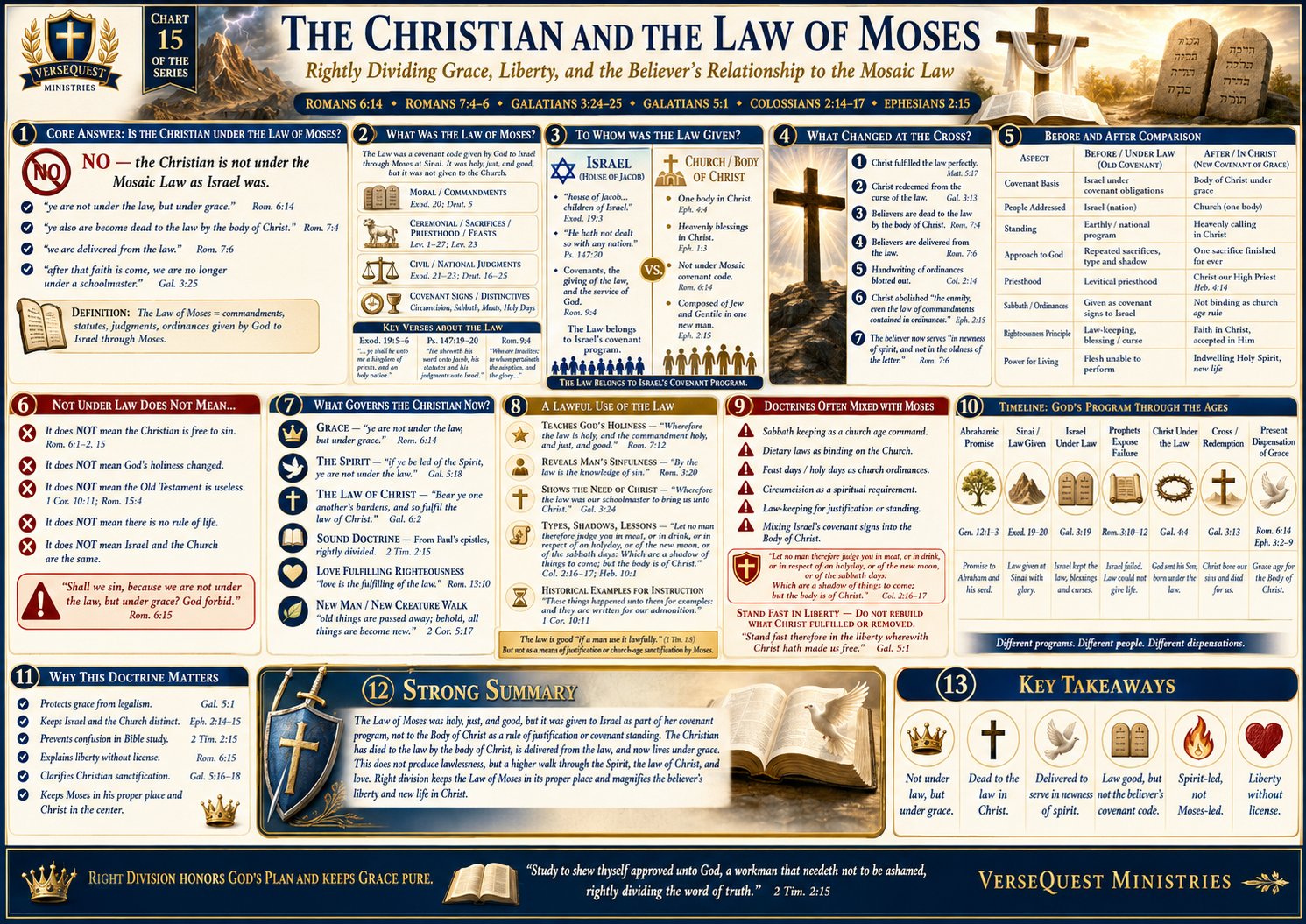
- The Christian and the Law of Moses – Grace, Liberty, and the Believer’s Relationship to the Mosaic Law (KJV Bible Study Chart)
- Understand the Christian’s relationship to the law of Moses with this detailed KJV chart covering Israel’s covenant, grace, liberty, the cross, the law of Christ, and Spirit-led living.
- $3.99
- Add to cart
-
-
Mystery of Iniquity
-
- The Mystery of the Restrainer — 50-Study Bible Prophecy PDF Book
- Who is restraining the man of sin—and what happens when that restraint is removed? The Mystery of the Restrainer is a massive 399-page, 50-study Bible prophecy book examining 2 Thessalonians…
- $9.99
- Add to cart
-
-
Revelation of the Body of Christ
-
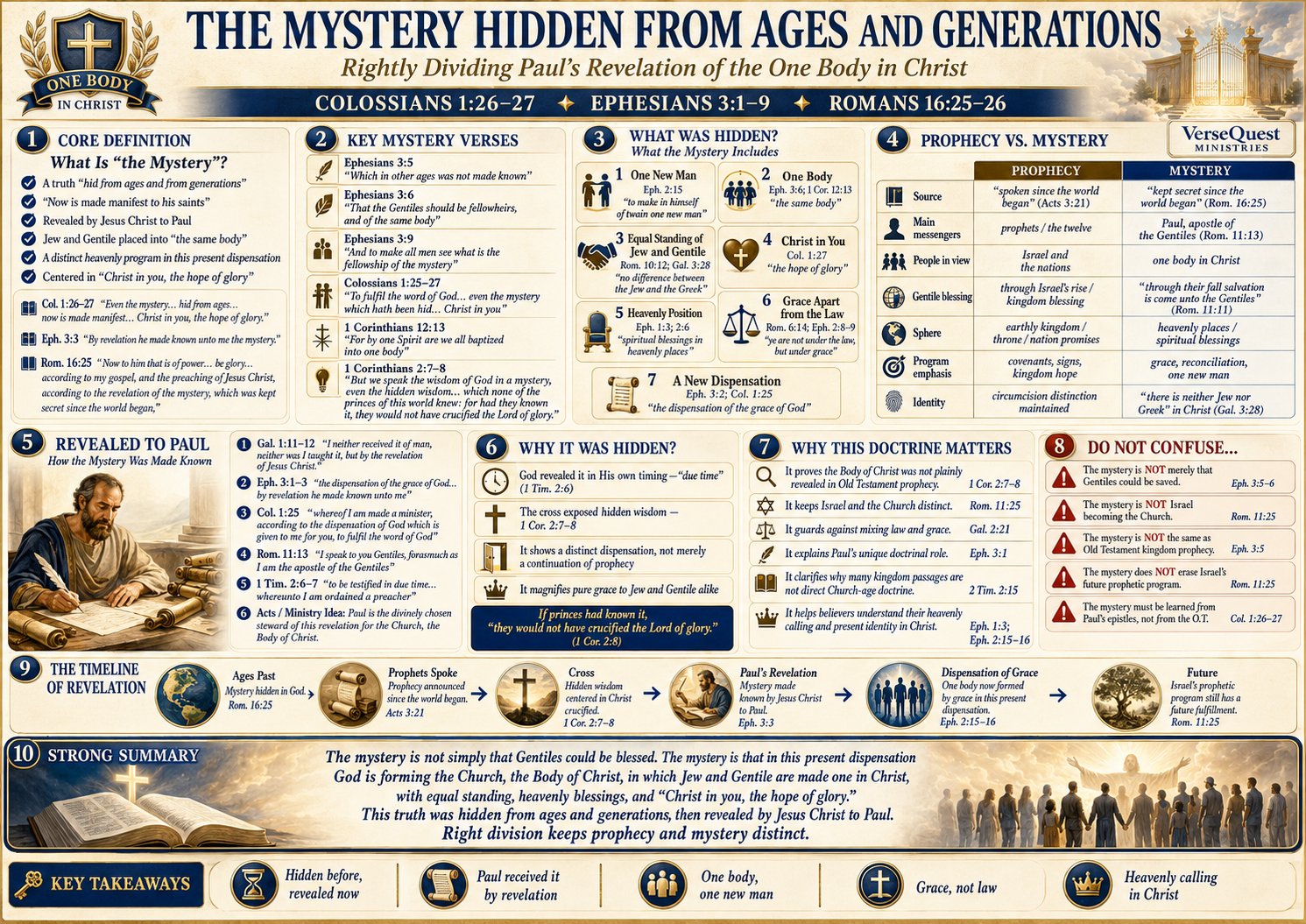
- The Mystery Hidden from Ages and Generations – Paul’s Revelation of the One Body in Christ (KJV Bible Study Chart)
- Understand the mystery hidden from ages and generations with this detailed KJV chart covering Paul’s revelation, the one Body, the one new man, grace, heavenly blessings, and prophecy versus mystery.
- $3.99
- Add to cart
-
-
Prophecy vs Mystery
-
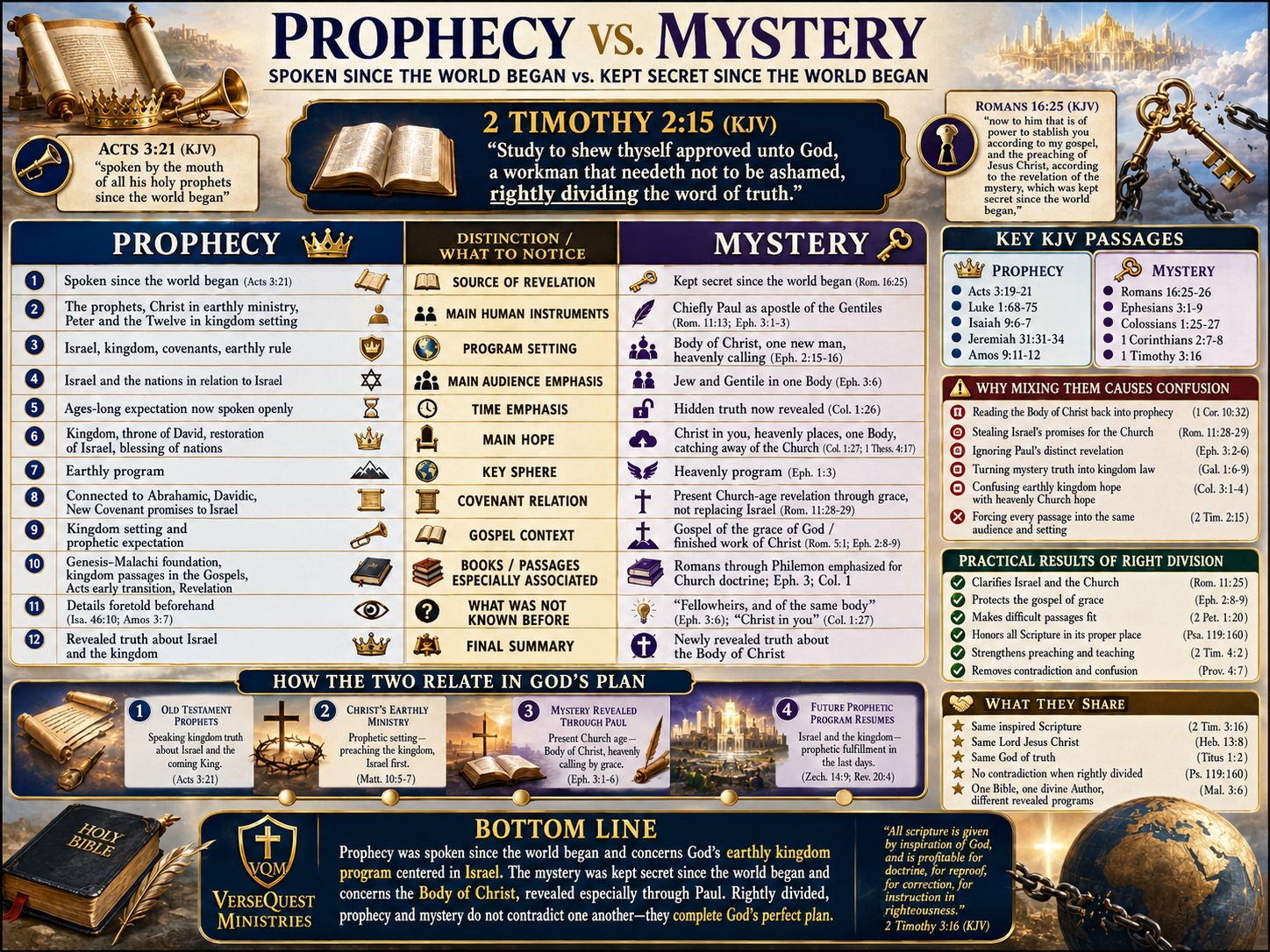
- Prophecy vs. Mystery Bible Study Chart – Spoken Since the World Began vs. Kept Secret Since the World Began (KJV)
- Compare prophecy and mystery with this detailed KJV chart explaining Israel’s earthly Kingdom program, the Body of Christ, Paul’s revelation, the heavenly calling, and the importance of right division.
- $3.99
- Add to cart
-
-
Reconciliation Through the Cross
-
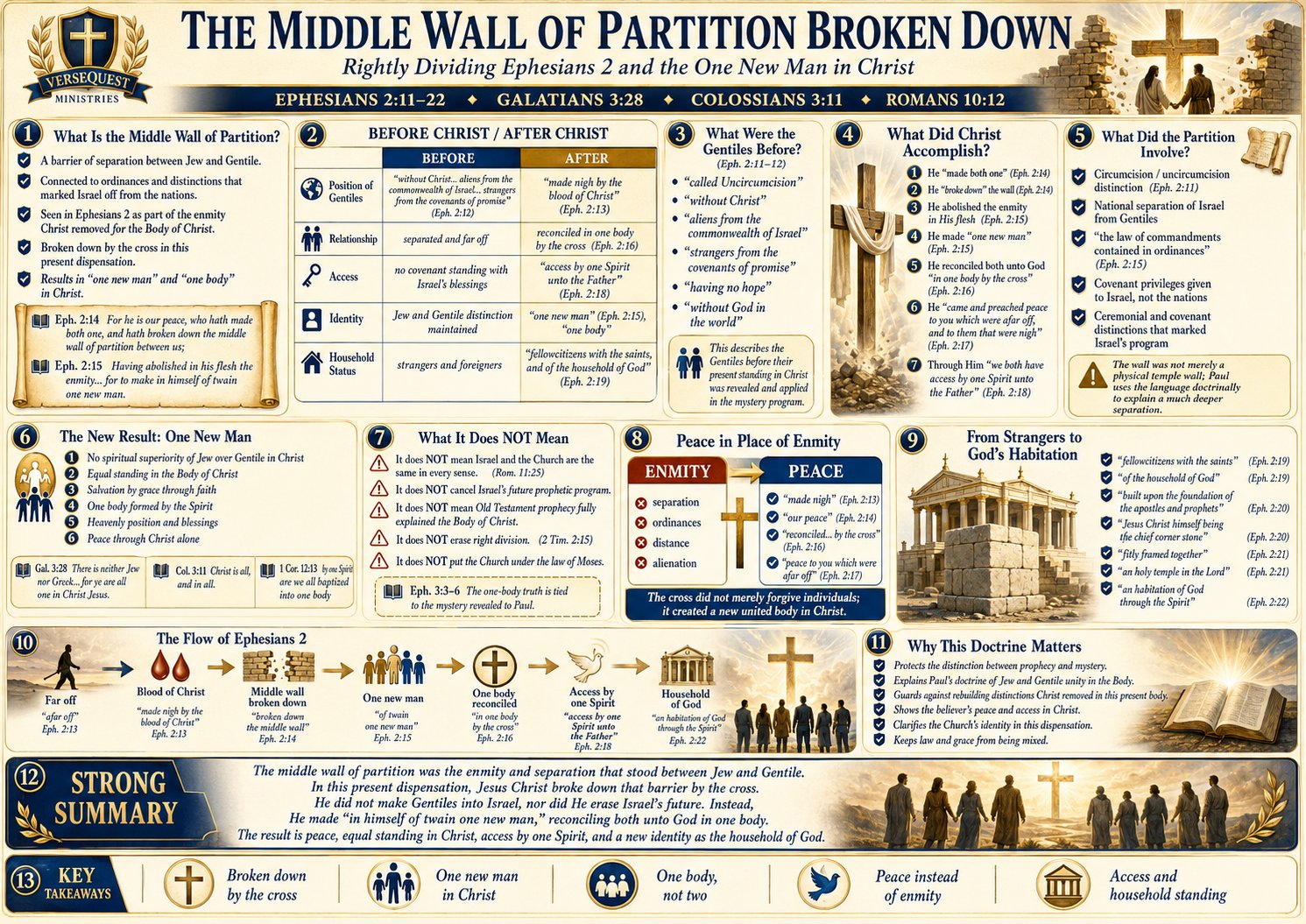
- The Middle Wall of Partition Broken Down – Ephesians 2, the One New Man, and the Body of Christ (KJV Bible Study Chart)
- Understand the middle wall of partition with this detailed KJV chart covering Ephesians 2, Christ’s blood, Jew-and-Gentile reconciliation, the one new man, one Body, and access to the Father.
- $3.99
- Add to cart
-