
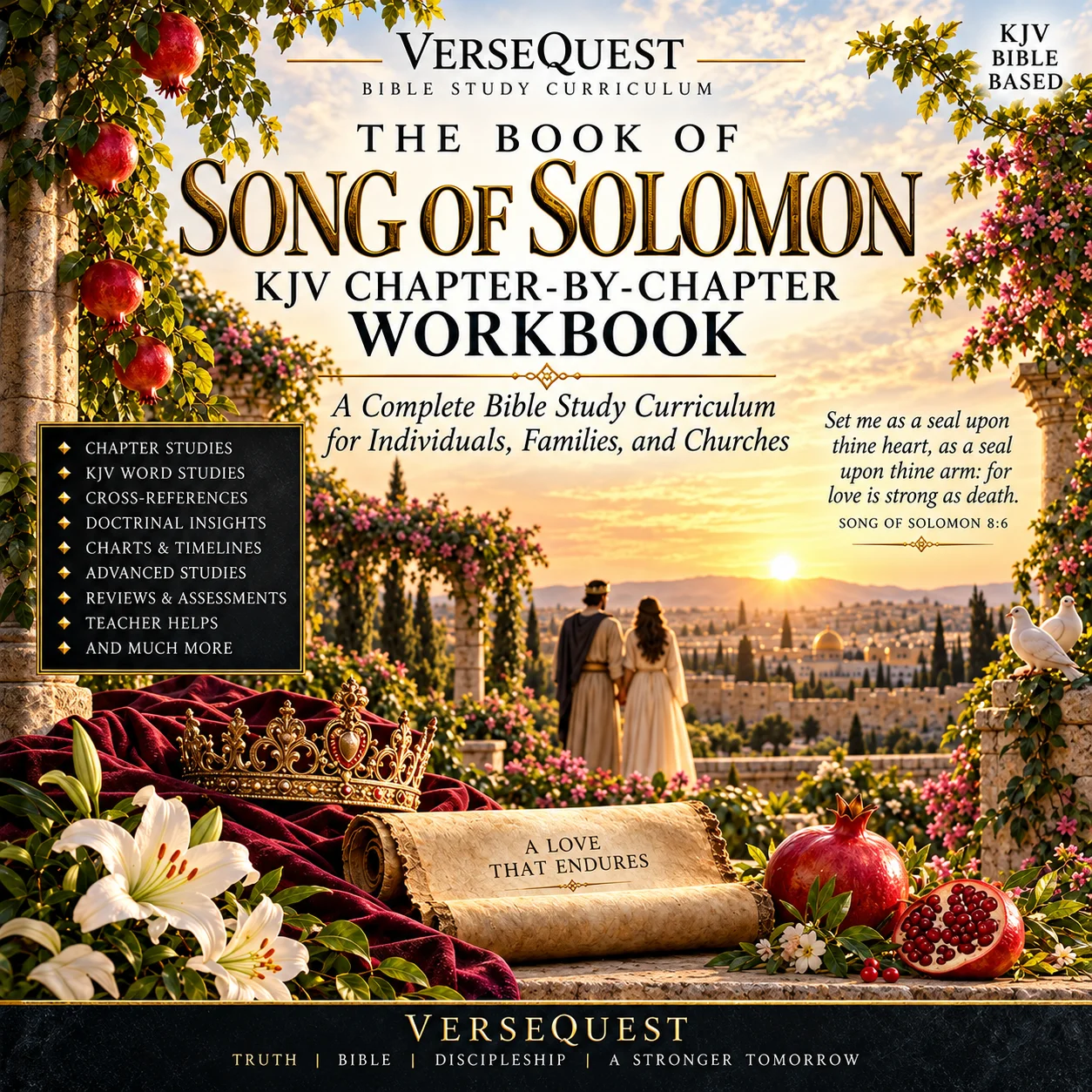
The Book of Song of Solomon KJV Chapter-by-Chapter Workbook
The Song of Solomon KJV Chapter-by-Chapter Workbook is a complete 400-page downloadable PDF Bible-study curriculum covering all eight chapters of this beautiful and frequently misunderstood book.
Students are guided through speaker identification, literal exposition, KJV vocabulary, imagery, geography, doctrine and right division, cross-references, difficult passages, controlled typology, prophetic possibilities, TEXT — TYPE — TRUTH studies, written reviews, teach-back exercises, teacher guidance, and suggested answers.
The workbook also includes 20 advanced studies with worksheets, 20 two-page master charts, an expanded glossary, geographical and imagery tools, subject and Scripture indexes, cumulative reviews, final assessment material, teaching tools, a final project, reflection pages, course record, and certificate of completion.
At $29.99, this digital curriculum is designed for serious Bible students, pastors, teachers, homeschool families, Sunday schools, church classes, small groups, and anyone who wants to understand Song of Solomon without either ignoring its literal love story or forcing unsupported allegory into the text.
$29.99
Description
The Song of Solomon KJV Chapter-by-Chapter Workbook is a complete 400-page downloadable PDF Bible-study curriculum designed to take serious students systematically through all eight chapters of one of the most beautiful, unusual, and frequently misunderstood books in the King James Bible.
Song of Solomon is far more than a collection of memorable romantic expressions. It contains changing speakers, poetic dialogue, courtship and marriage language, separation and reunion, gardens, vineyards, mountains, lilies, pomegranates, spices, perfumes, royal imagery, geographical references, repeated expressions of belonging, and some of Scripture’s strongest statements concerning love. The challenge is learning how to interpret all of that responsibly without either ignoring the literal text or turning every image into an unsupported allegory.
This workbook therefore begins with the actual KJV text and its immediate meaning. Students learn to identify the speakers, follow the movement of the dialogue, examine the relationship between Solomon, the Shulamite, and the daughters of Jerusalem, trace repeated expressions, investigate geographical locations, define unfamiliar vocabulary, and study the imagery within its biblical setting.
A major feature of the course is its disciplined approach to literal meaning, typology, doctrine, and prophecy. The workbook does not assume that every flower, mountain, animal, perfume, or romantic expression secretly represents something else. Instead, possible connections are tested by Scripture and distinguished with certainty labels such as Explicit, Strong Inference, Possible, and Speculative. This allows the student to explore Bridegroom imagery, Israel, the Church, the Second Coming, the Rapture, and other prophetic or typological possibilities while keeping interpretation under biblical control.
The workbook introduces a special TEXT — TYPE — TRUTH method. First, the student asks what the passage actually says in context. Second, the student examines whether a legitimate biblical type or picture is present. Third, the student compares that possible type with explicit doctrine elsewhere in Scripture. This method allows the rich imagery of Song of Solomon to be studied without replacing the literal text with imagination.
All eight chapters receive extensive treatment. The course examines the opening expressions of love in chapter 1; the rose of Sharon, lily of the valleys, banqueting house, little foxes, and coming beloved of chapter 2; the night search and royal procession of chapter 3; the extraordinary bridal imagery, garden, spices, and living waters of chapter 4; the withdrawal and search for the beloved and his remarkable description in chapter 5; the reunion, royal imagery, Shulamite, sun, moon, and armies language of chapter 6; mature mutual love and vineyard imagery in chapter 7; and the powerful conclusion of chapter 8 with love strong as death, many waters, the seal, the vineyard, and the closing cry for the beloved to make haste.
The course also contains speaker-identification exercises, imagery mapping, KJV vocabulary studies, geographical studies, doctrine and right division, cross-reference workshops, difficult-passage analysis, prophetic and typological studies, written reviews, teach-back exercises, teacher and leader guidance, and suggested answers. Remaining working space is intentionally used for study notes, observations, cross-references, questions, and teaching preparation.
Beyond the eight main chapter units, the workbook includes 20 advanced studies with worksheets and 20 two-page master charts. These expanded studies trace major subjects including the Bridegroom, the Shulamite, the daughters of Jerusalem, gardens and vineyards, mountains, flowers, animals, perfumes and spices, separation and reunion, repeated charges concerning awakening love, Bride imagery throughout Scripture, prophetic possibilities, and the progression of mutual belonging found across the Song.
Additional course material includes an expanded glossary, geographical and imagery tools, subject and Scripture indexes, cumulative reviews, final assessment and answer guidance, supplemental teaching tools, a final teaching project, student reflection, course record, and certificate of completion.
This is not designed merely to tell the student what someone else thinks Song of Solomon means. It is designed to teach the student how to work through the book carefully from the King James Bible, test interpretations, compare Scripture with Scripture, distinguish certainty from speculation, and finally explain the book without depending upon the workbook.
The 400-page digital PDF is suitable for personal Bible study, homeschool curriculum, Sunday school, church Bible classes, discipleship, marriage and biblical-love studies, sermon preparation, ministry training, small groups, and serious independent study. At $29.99, it provides a complete VerseQuest curriculum for readers who want to understand the Song of Solomon chapter by chapter rather than simply knowing a handful of famous verses.
Biblical Love — Romantic affection, desire, admiration, commitment, longing, exclusivity, and enduring love are central to the Song. Solomon and the Shulamite — Careful identification of the principal figures and the interpretive questions surrounding their relationship. Speaker Identification — Determining whether Solomon, the woman, the beloved, or the daughters of Jerusalem are speaking at each point. Literal Meaning Before Typology — The romantic and literary meaning of the text is established before secondary spiritual connections are considered. TEXT — TYPE — TRUTH — A disciplined method for separating the actual text from possible typology and explicit doctrine. Certainty Labels — Interpretations are classified as Explicit, Strong Inference, Possible, or Speculative. Bride and Bridegroom Imagery — The Song is compared carefully with biblical marriage imagery concerning Israel, Christ, and the Church. Separation and Reunion — Repeated movements of absence, searching, longing, finding, and restored fellowship structure major sections of the Song. Mutual Belonging — The repeated expressions concerning the beloved and his bride form an important literary progression through the book. Love Strong as Death — Song of Solomon 8:6–7 provides one of Scripture’s strongest statements about the power, permanence, and value of love. Gardens and Vineyards — Cultivation, fruitfulness, ownership, protection, beauty, and intimacy are repeatedly expressed through garden and vineyard imagery. Flowers and Plants — Lilies, roses, pomegranates, mandrakes, vines, figs, spices, and other plant imagery contribute to the Song’s poetic richness. Perfumes and Spices — Myrrh, frankincense, camphire, spikenard, saffron, calamus, cinnamon, and other fragrances receive contextual study. Animal Imagery — Roes, hinds, doves, goats, sheep, horses, foxes, and other animals appear throughout the poetic comparisons. Royal Imagery — Solomon, crowns, chariots, queens, concubines, guards, banners, towers, and royal splendour provide another major interpretive layer. Geography — Jerusalem, Sharon, Lebanon, En-gedi, Gilead, Tirzah, Hermon, Amana, Shenir, Kedar, Heshbon, and Baal-hamon receive study. The Daughters of Jerusalem — Their recurring presence and dialogue are traced throughout the book. The Repeated Charge Not to Awaken Love — The recurring injunction concerning love is studied in its immediate context and across the entire Song. Marriage and Sexual Purity — The Song’s celebration of desire is examined within the biblical boundaries of committed love and marriage. Prophetic Possibilities — Possible connections to the Rapture, Second Coming, Israel, the Church, and future events are examined with strict certainty distinctions. The Closing Call for the Beloved — Song of Solomon ends with longing and anticipation, giving the workbook an important final comparison with biblical expectation of the Lord’s coming.
Song of Solomon should first be allowed to be what its language clearly presents: a poetic celebration of love involving real people, real desire, real longing, real admiration, real separation, and real reunion. Typology can enrich interpretation, but it must not erase the text itself.
One of the greatest difficulties in the Song is speaker identification. The reader should continually ask who is speaking, who is being addressed, and whether the scene has changed. Pronouns, gender, number, context, and repeated expressions become important interpretive clues.
The book introduces the woman immediately as deeply conscious of her beloved and of how others see her. Song 1 contains beauty, fragrance, royal setting, pastoral imagery, and important questions about the relationship of the principal characters.
Song 2 develops several of the book’s most famous images. The rose of Sharon and lily of the valleys must first be interpreted according to the actual speaker. The coming beloved, springtime, flowers, singing birds, figs, vines, rocks, and little foxes create a movement from longing toward union and fruitfulness.
The recurring charge “stir not up, nor awake my love” deserves to be traced wherever it appears. Repetition in inspired literature is rarely accidental. The student should record the setting of each occurrence and ask what has changed between them.
Song 3 combines personal searching with spectacular royal imagery. The woman seeks the one whom her soul loves, while the latter part of the chapter presents Solomon, his bed, his mighty men, his chariot, the daughters of Zion, and his crown. The transition should be observed rather than artificially flattened.
Song 4 is one of Scripture’s richest collections of poetic imagery. The bride is described using doves, goats, sheep, scarlet, pomegranates, towers, mountains, gardens, springs, fountains, fruits, spices, and living waters. The purpose is not to turn every comparison into doctrine but to understand how biblical poetry communicates beauty, exclusivity, abundance, desire, and delight.
Song 5 changes the emotional tone. The beloved comes, the woman delays, he withdraws, she searches, and the watchmen wound her. Her subsequent description of her beloved becomes one of the most famous passages in the Song. Possible connections to Christ deserve examination, but each claimed connection must be measured against explicit Scripture.
Song 6 contains reunion and renewed praise. The woman again declares mutual belonging. The chapter also introduces queens, concubines, virgins, Tirzah, Jerusalem, banners, the morning, moon, sun, armies, gardens, pomegranates, and the Shulamite. This chapter therefore requires careful separation of literal description from prophetic possibility.
A significant progression can be traced through three statements: “My beloved is mine, and I am his” (Song of Solomon 2:16); “I am my beloved’s, and my beloved is mine” (Song of Solomon 6:3); and “I am my beloved’s, and his desire is toward me” (Song of Solomon 7:10). The changing emphasis is worthy of close literary and practical study without claiming more than the wording permits.
Song 8 contains the theological and emotional climax of the book. “Love is strong as death” and “many waters cannot quench love” express love’s strength and immeasurable value. The seal, fire, jealousy, grave, floods, substance, little sister, wall, door, and vineyard all demand careful contextual study.
The closing words, “Make haste, my beloved” (Song of Solomon 8:14), leave the book in an attitude of anticipation. That expectation provides legitimate ground for comparison with other biblical passages that end in longing for the arrival or return of the beloved Lord, but comparison must remain comparison unless Scripture explicitly identifies the connection.
The controlling interpretive rule throughout this workbook is therefore simple: Text first. Context next. Scripture compared with Scripture. Type tested by truth. Certainty stated honestly.
The goal is not merely to finish 400 pages. The goal is to reach the point where the student can open Song of Solomon, follow the dialogue, recognize the principal imagery, explain the difficult passages, identify legitimate biblical connections, reject unsupported allegory, and teach the book clearly from the King James Bible.
For personal Bible study, this workbook provides a systematic way to work through a book that many readers find difficult to interpret. Instead of skipping unusual images or relying upon inherited allegories, students are taught to identify speakers, mark recurring expressions, examine the literal setting, define KJV vocabulary, trace imagery, compare references, and test possible spiritual connections.
For homeschool Bible curriculum, the 400-page workbook provides substantial written study rather than a brief overview. Students can complete chapter units, speaker exercises, imagery maps, word studies, advanced worksheets, cumulative reviews, charts, assessment material, and a final teaching project.
For Sunday school and church Bible classes, the material can be taught sequentially through all eight chapters. Teacher guidance, review questions, cross-reference work, difficult-passage studies, and teach-back exercises help keep the class centered on Scripture rather than speculative discussion.
For marriage and family studies, selected sections can be used to examine biblical affection, admiration, exclusivity, marital desire, commitment, communication, separation, reunion, and the enduring character of love. The workbook does not reduce Song of Solomon to a modern marriage manual, but its literal celebration of marital love provides legitimate material for biblical instruction.
For sermon and lesson preparation, pastors and teachers can draw from chapter movements, KJV vocabulary, geography, imagery, speaker identification, cross-references, typological studies, and difficult-passages analysis. The workbook is especially useful for teachers who want to preach or teach Song of Solomon without simply repeating an allegorical system.
For ministry training, the book provides a practical exercise in hermeneutics. Students learn to distinguish text from type, type from doctrine, possibility from certainty, and literary imagery from explicit prophetic revelation.
For small groups and discipleship, the workbook supplies guided questions that move discussion beyond subjective impressions. Participants are continually brought back to the KJV wording and required to support conclusions with Scripture.
For advanced Bible study, students can use the master charts, advanced studies, geographical tools, Scripture index, imagery index, and certainty framework to build their own comprehensive understanding of the Song.
The primary companion to this workbook should always be an Authorized King James Bible, since every lesson is designed to send the student back into the biblical text itself.
A KJV concordance is useful for tracing repeated expressions such as my beloved, my love, daughters of Jerusalem, garden, vineyard, lily, dove, mountain, spices, love, and related words throughout Scripture.
A KJV cross-reference Bible or cross-reference system can help extend the biblical chains developed in the workbook, particularly those concerning marriage, bride and bridegroom imagery, Israel, Christ, the Church, gardens, vineyards, and prophetic passages.
A reliable Bible dictionary can assist with unfamiliar plants, perfumes, animals, customs, royal language, ancient marriage practices, and geographical terminology after the immediate KJV context has first been studied.
A Bible atlas is particularly useful for Song of Solomon because the poetry references numerous locations, including Jerusalem, Lebanon, Sharon, En-gedi, Gilead, Tirzah, Hermon, Heshbon, and other places.
The Proverbs KJV Chapter-by-Chapter Workbook complements this study through its treatment of wisdom, marriage, sexual purity, the strange woman, the virtuous woman, speech, character, and family instruction.
The Ecclesiastes KJV Chapter-by-Chapter Workbook provides valuable additional study of Solomon, wisdom, earthly experience, human desire, and the limitations of life under the sun.
The Psalms KJV Chapter-by-Chapter Workbook complements Song of Solomon through its extensive treatment of Messianic passages, royal imagery, suffering, worship, prophetic interpretation, and Scripture-to-Scripture comparison.
Related products
-
Premium VerseQuest Books
-
-75%
- Christ in the Old Testament Made Plain — 100-Essay KJV Study PDF
- A massive 670-page premium KJV Bible study PDF featuring 100 detailed essays showing Jesus Christ throughout the Old Testament in promise, type, sacrifice, Christophany, prophecy, suffering, resurrection, priesthood, and future…
- Original price was: $39.99.$9.99Current price is: $9.99.
- Add to cart
-
-75%
-
Bible Overview Series
-
- The New Jerusalem Made Plain — 621-Page PDF Study
- The New Jerusalem Made Plain is a massive 621-page KJV/rightly divided PDF study on the literal holy city revealed in Revelation 21–22. This 100-essay book makes the New Jerusalem plain…
- $34.99
- Add to cart
-
-
Doctrine Series
-
- The Lost Tribes Myth Exposed (213-Page Premium Study)
- A 213-page premium KJV study exposing the Lost Tribes myth, tribal identity errors, prophecy abuse, race theories, and false Israel claims through 35 detailed essays.
- $24.99
- Add to cart
-
-
Jesus Christ
-
-10%
- The Lord Jesus Christ Made Plain – 637-Page KJV Bible Study
- A massive 637-page, 100-part KJV Bible study on the Person and work of the Lord Jesus Christ. This premium VerseQuest resource covers His deity, incarnation, blood, cross, resurrection, present ministry,…
- Original price was: $39.00.$34.99Current price is: $34.99.
- Add to cart
-
-10%
-
Jesus Christ
-
-67%

- The Millennium Made Plain – 416-Page KJV Study on Christ’s Future Reign
- A premium 416-page KJV, rightly divided Bible study on the literal future Millennial reign of Jesus Christ. The Millennium Made Plain explains Revelation 19–20, Israel’s restoration, Satan’s binding, the Kingdom…
- Original price was: $29.99.$9.99Current price is: $9.99.
- Add to cart
-
-67%