
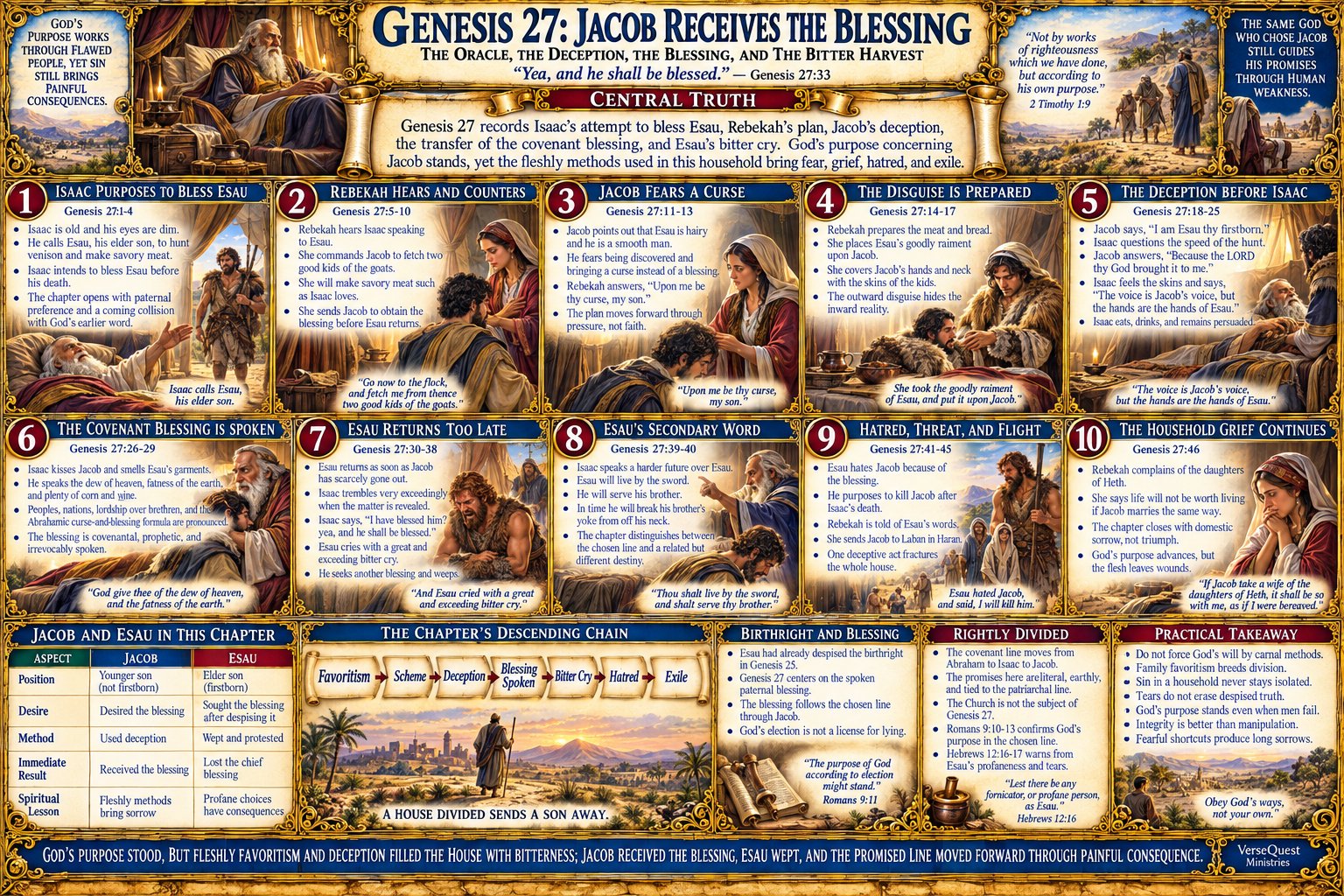
Genesis 27 – Jacob Receives the Blessing: Isaac, Rebekah, Esau, Deception, the Bitter Cry, and the Chosen Line (KJV Bible Study Chart)
Explore Genesis 27 with this detailed KJV Bible study chart tracing Isaac’s plan to bless Esau, Rebekah’s counterplan, Jacob’s disguise and deception, and the patriarchal blessing pronounced upon the chosen son. Follow Esau as he returns too late, cries with a “great and exceeding bitter cry,” receives a secondary prophetic word, and begins planning revenge against Jacob. The chart also compares Jacob and Esau, examines the distinction between the birthright and blessing, and places the chapter within God’s earlier declaration that “the elder shall serve the younger.” Genesis 27 provides a powerful study of divine sovereignty, human responsibility, family favoritism, deception, bitterness, and the painful consequences of trying to accomplish God’s purpose by fleshly methods. Ideal for Bible study, Sunday school, homeschool, sermon preparation, Romans 9 studies, and patriarchal teaching.
$4.99
Description
Genesis 27: Jacob Receives the Blessing is a detailed KJV Bible study chart examining Isaac’s intention to bless Esau, Rebekah’s counterplan, Jacob’s deception, the spoken patriarchal blessing, Esau’s bitter cry, and the hatred that eventually sends Jacob away from home. The chapter demonstrates that God’s previously revealed purpose concerning Jacob stands, yet the fleshly methods used by the family produce fear, division, grief, and lasting consequences.
Isaac is old and his eyes are dim. Believing his death may be near, he calls Esau, his elder son, and instructs him to hunt venison and prepare the savoury meat he loves so that he may bless him. Yet Genesis 25 has already recorded God’s oracle concerning the twins: “the elder shall serve the younger.” The problem is therefore not whether God’s purpose will stand, but how a divided household responds to what God has already spoken.
Rebekah overhears Isaac’s plan and instructs Jacob to obtain two young goats. She prepares the food, places Esau’s garments upon Jacob, and covers his smooth hands and neck with goatskins. Jacob fears being discovered and receiving a curse, but his concern is largely about consequences rather than the morality of deception. Rebekah accepts responsibility, and the scheme proceeds.
Jacob enters Isaac’s presence and repeatedly lies about his identity. He even invokes the LORD while explaining how he supposedly found the game so quickly. Isaac recognizes Jacob’s voice but is persuaded by the hairy hands, Esau’s clothing, the food, and Jacob’s false testimony.
Isaac then pronounces the blessing: dew from heaven, fatness of the earth, plenty, national prominence, lordship, and the familiar covenant pattern, “Cursed be every one that curseth thee, and blessed be he that blesseth thee.” The blessing accords with the chosen line already revealed by God, but the deception used to obtain it receives no divine endorsement.
Esau returns and discovers what has happened. He cries “with a great and exceeding bitter cry” and pleads for another blessing. Isaac gives him a different prophetic word concerning his future and subjection to his brother. Esau’s grief does not erase his earlier contempt for the birthright recorded in Genesis 25.
Hatred follows. Esau plans to kill Jacob after Isaac’s death, and Rebekah arranges Jacob’s departure to Haran. Genesis 27 therefore ends not in family triumph but division. God’s purpose stands, but favoritism, manipulation, deception, and uncontrolled appetite leave deep wounds. The chapter powerfully teaches that God does not need sinful methods to accomplish what He has already promised.
Genesis 27, Jacob receives the blessing, Jacob and Esau, Isaac, Rebekah, patriarchal blessing, birthright and blessing, family favoritism, deception, goatskins, Esau’s garments, savoury meat, Jacob’s lies, Isaac’s dim eyes, bitter cry, Esau’s hatred, Jacob flees, chosen line, elder shall serve younger, covenant promise, divine election, human responsibility, fleshly methods, consequences of sin
Genesis 27 must be read in light of Genesis 25:23, where God had already declared concerning Jacob and Esau, “the elder shall serve the younger.” Jacob did not become the chosen covenant son because he successfully deceived Isaac. God’s purpose concerning the line had been revealed before the twins were born. Genesis 27 instead records the confused and sinful manner in which the family attempts to handle that already-revealed purpose.
Isaac intends to bless Esau and asks him to prepare venison. Rebekah overhears and constructs a counterplan involving Jacob, young goats, Esau’s clothing, and goatskins. The household is already divided by parental favoritism: Genesis 25:28 states that Isaac loved Esau while Rebekah loved Jacob. What begins as preference develops into manipulation.
Jacob objects that Isaac may discover the deception and curse him, but he does not reject the plan because lying is wrong. Rebekah responds, “Upon me be thy curse, my son,” and presses forward. Jacob then appears before his father claiming to be Esau. When Isaac wonders how the game was obtained so quickly, Jacob compounds the deception by saying, “Because the LORD thy God brought it to me.” Invoking God does not sanctify a lie.
Isaac remains suspicious. He recognizes Jacob’s voice but feels the hairy hands, smells Esau’s clothing, eats the food, and accepts the disguise. He then blesses Jacob with agricultural abundance, authority over peoples and brethren, and the covenantal blessing-and-cursing formula reminiscent of Genesis 12.
The blessing agrees with God’s previously announced purpose, but Scripture never teaches that deceit was necessary to secure it. God could have fulfilled His own Word without Rebekah’s manipulation or Jacob’s falsehood. Divine sovereignty and human responsibility remain side by side.
Esau returns and responds with “a great and exceeding bitter cry.” Hebrews 12 later warns concerning Esau as a “profane person” who sold his birthright for one morsel of meat. His sorrow in Genesis 27 must therefore be read alongside his earlier contempt for covenant privilege in Genesis 25.
Isaac gives Esau a secondary prophetic word involving his manner of life, service to Jacob, and eventual breaking of the yoke. The brothers therefore move toward distinct historical lines: Jacob toward Israel and Esau toward Edom.
Esau’s bitterness turns into murderous intent, forcing Jacob to flee toward Haran. Rebekah hoped separation would last only “a few days,” but the consequences become much longer and more painful. Genesis 27 therefore teaches that God’s purpose will stand, but sinful methods still reap consequences. The right promise should be pursued by faith and obedience, not manipulation.
Genesis 27 is useful for teaching that God’s sovereign purpose does not justify dishonest methods, that favoritism can divide a household, and that fear-driven shortcuts often create consequences far beyond the immediate moment. It also provides important instruction on Jacob and Esau, the distinction between the birthright and paternal blessing, God’s prior oracle in Genesis 25, human responsibility within divine sovereignty, and the dangers of deception and resentment. The chart is valuable for personal Bible study, Sunday school, homeschool instruction, Bible institutes, sermon preparation, family studies, Romans 9 teaching, Hebrews 12 studies, discipleship, and lessons on integrity, patience, obedience, and trusting God’s timing.
King James Bible, Strong’s Concordance, Thompson Chain-Reference Bible, Treasury of Scripture Knowledge, Nave’s Topical Bible, Genesis 25–33 study notes, Jacob and Esau comparison charts, Isaac and Rebekah studies, Abrahamic covenant charts, patriarchal genealogy charts, Romans 9 election studies, Hebrews 12 Esau studies, biblical birthright studies, family favoritism studies, deception and integrity Scripture chains, maps of Canaan Haran and Padan-aram, VerseQuest Genesis charts
Related products
-
Genesis Chapter 2
-
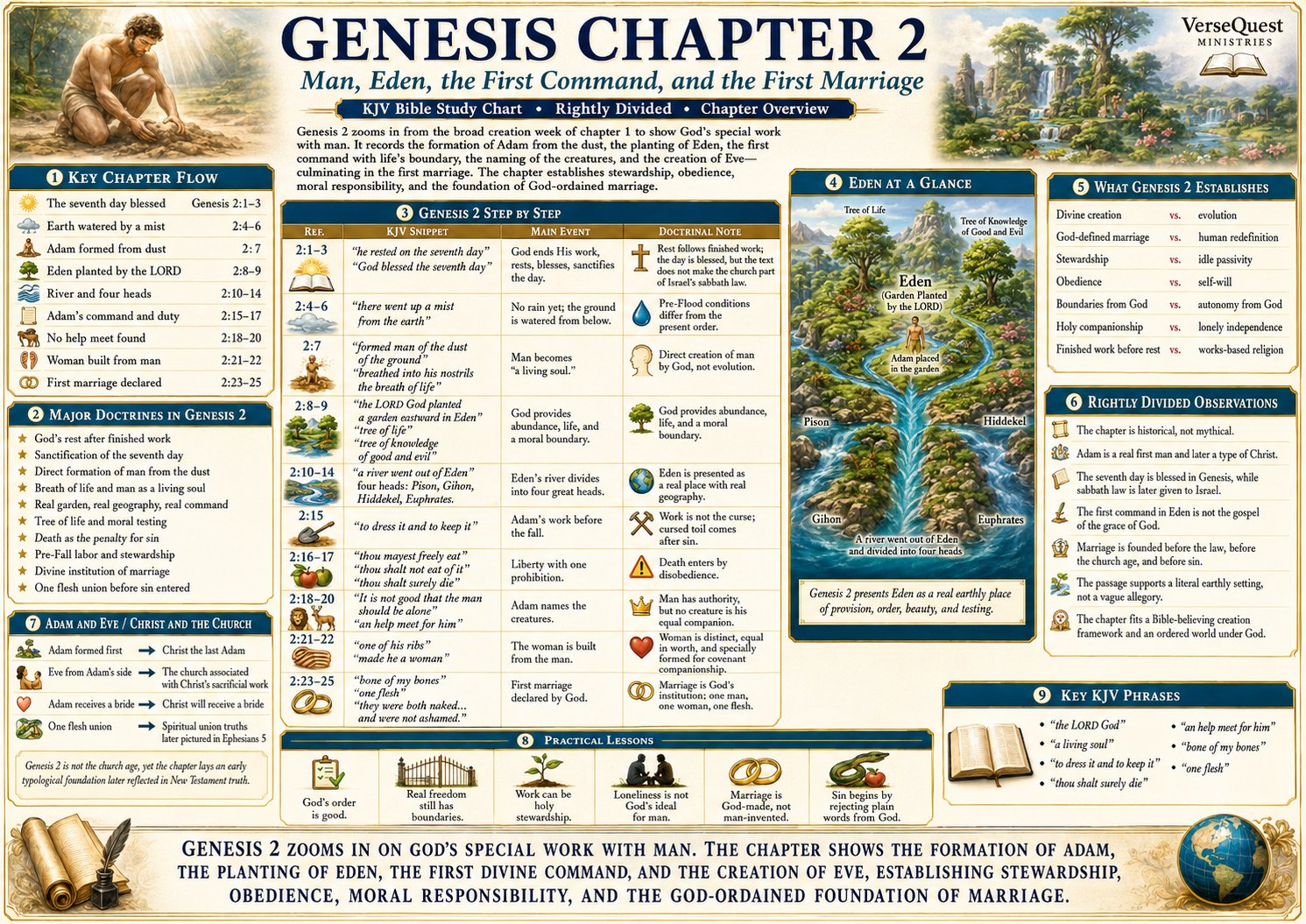
- Genesis Chapter 2 Bible Study Chart – Adam, Eden, the First Command, and the First Marriage (KJV)
- Explore Genesis Chapter 1 with this detailed KJV Bible study chart covering the six days of creation, the firmament, light, fixed kinds, man in God’s image, major doctrines, recurring phrases,…
- $3.99
- Add to cart
-
-
Ages To Come
-
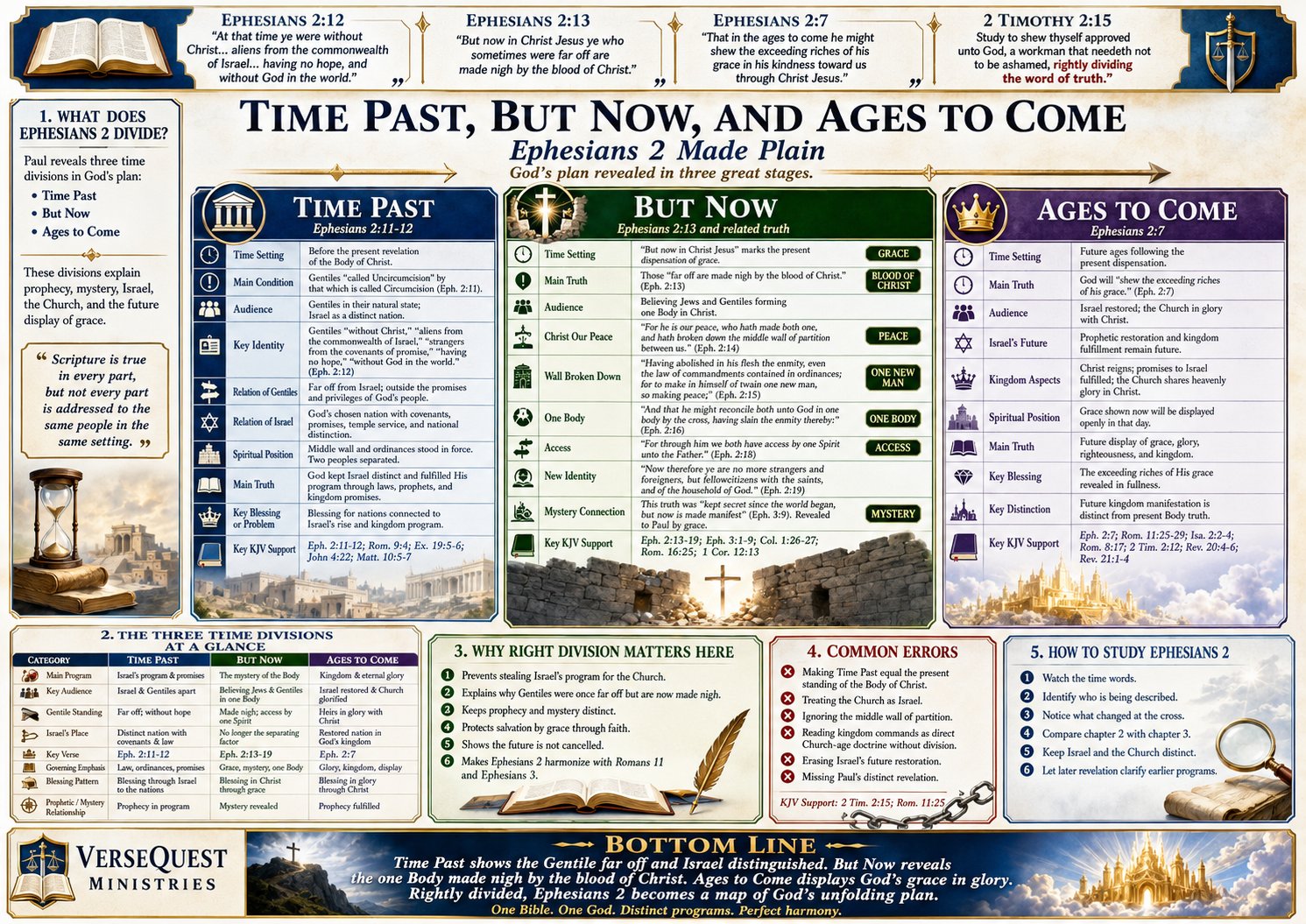
- Time Past, But Now, and Ages to Come – Ephesians 2 Rightly Divided KJV Bible Study Chart
- Understand Ephesians 2 with this detailed KJV chart explaining Time Past, But Now, Ages to Come, Gentile distance, the one Body, Israel’s future, and the importance of right division.
- $3.99
- Add to cart
-
-
The Serpent's Footnotes
-
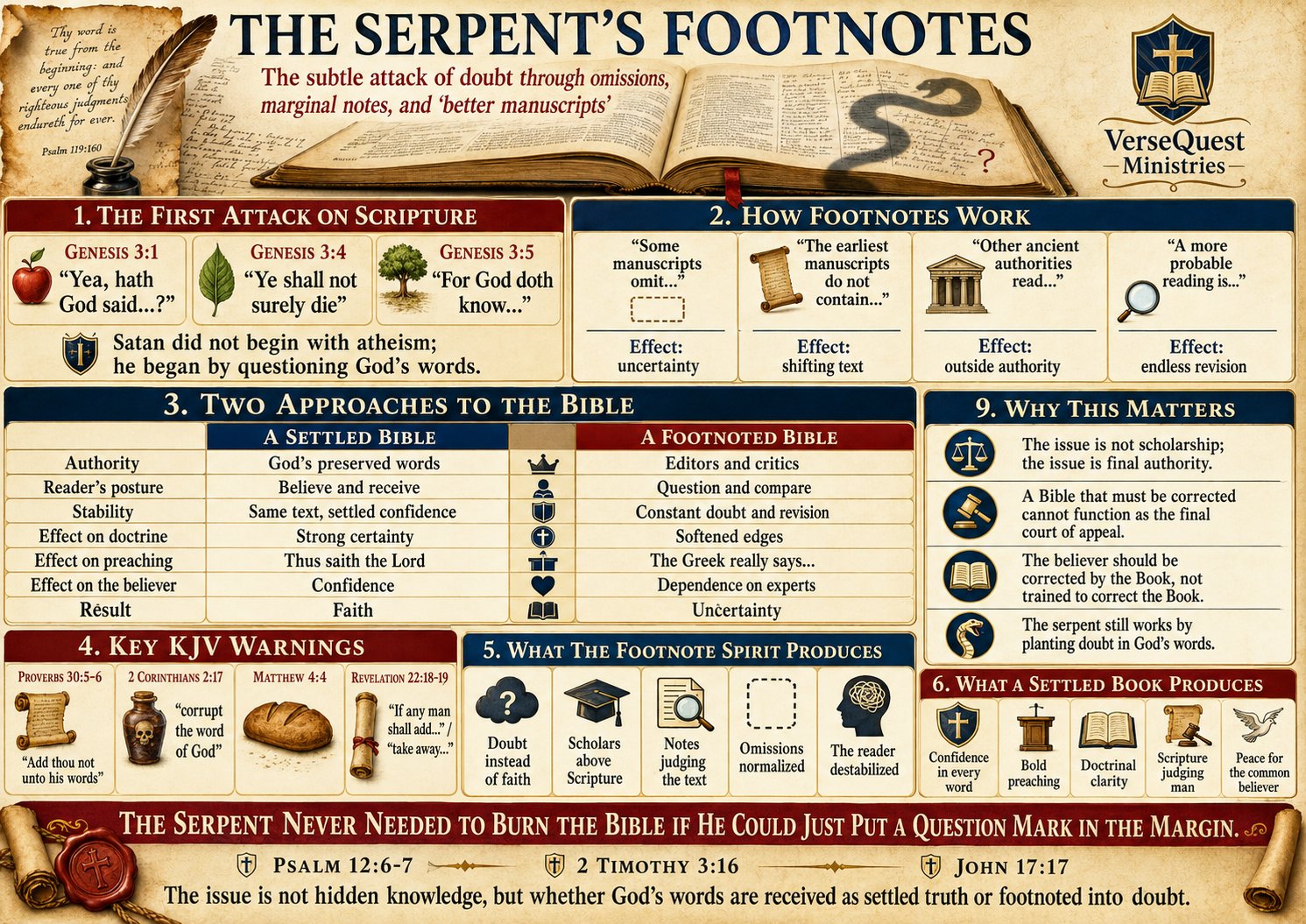
- The Serpent’s Footnotes Bible Study Chart – KJV Preservation, Textual Criticism, Omissions, and Manuscript Doubt
- Examine the attack of textual doubt with this detailed KJV Bible study chart covering manuscript footnotes, omissions, biblical preservation, final authority, and confidence in God’s settled words.
- $3.99
- Add to cart
-
-
Uncategorized
-
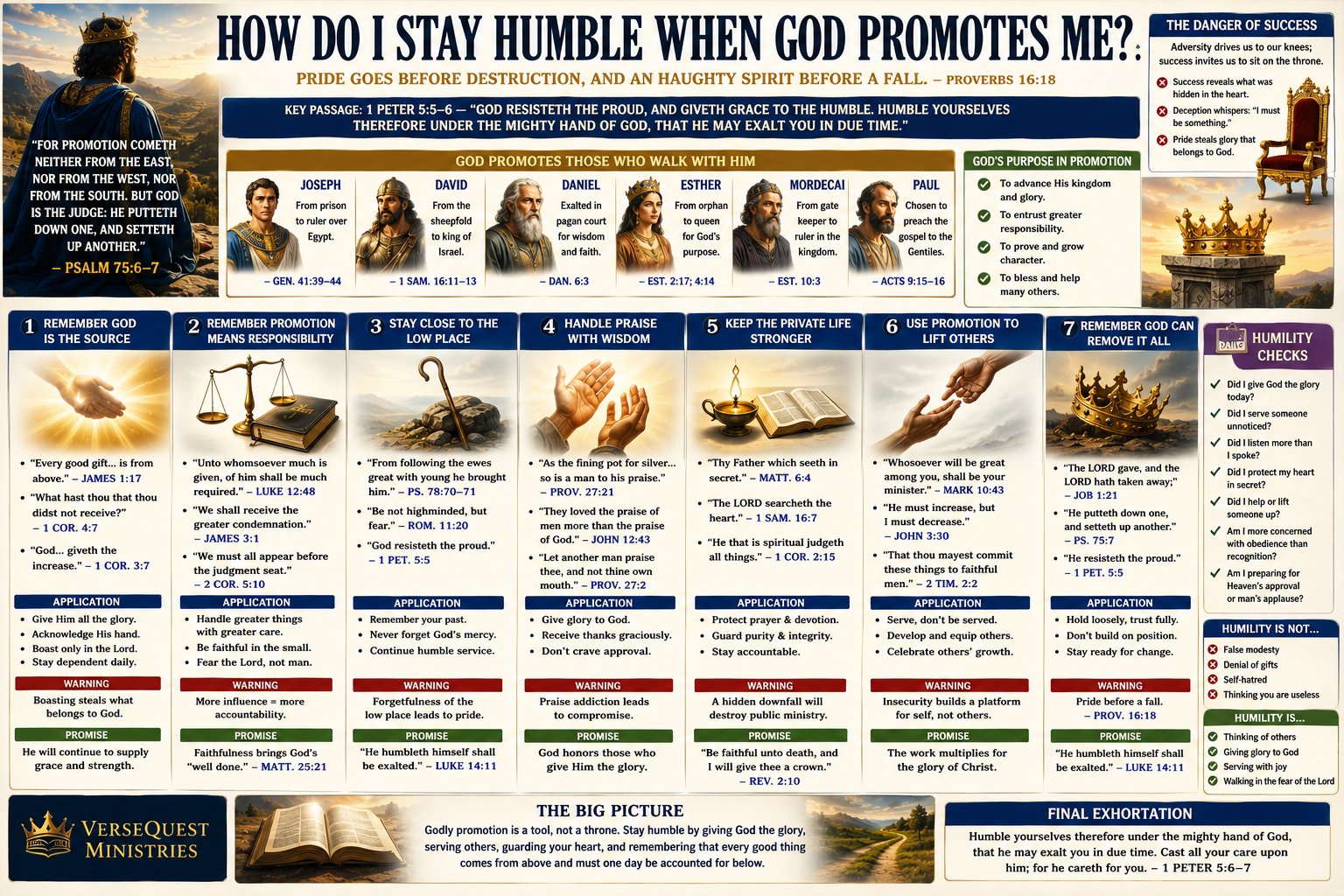
- How to Stay Humble When God Promotes You – Biblical Humility, Success, and Faithful Stewardship (KJV Bible Study Chart)
- Learn how to remain humble when God increases your influence with this detailed KJV Bible study chart covering pride, praise, responsibility, private devotion, servant leadership, and faithful stewardship.
- $3.99
- Add to cart
-
-
The Gospel of the Kingdom
-
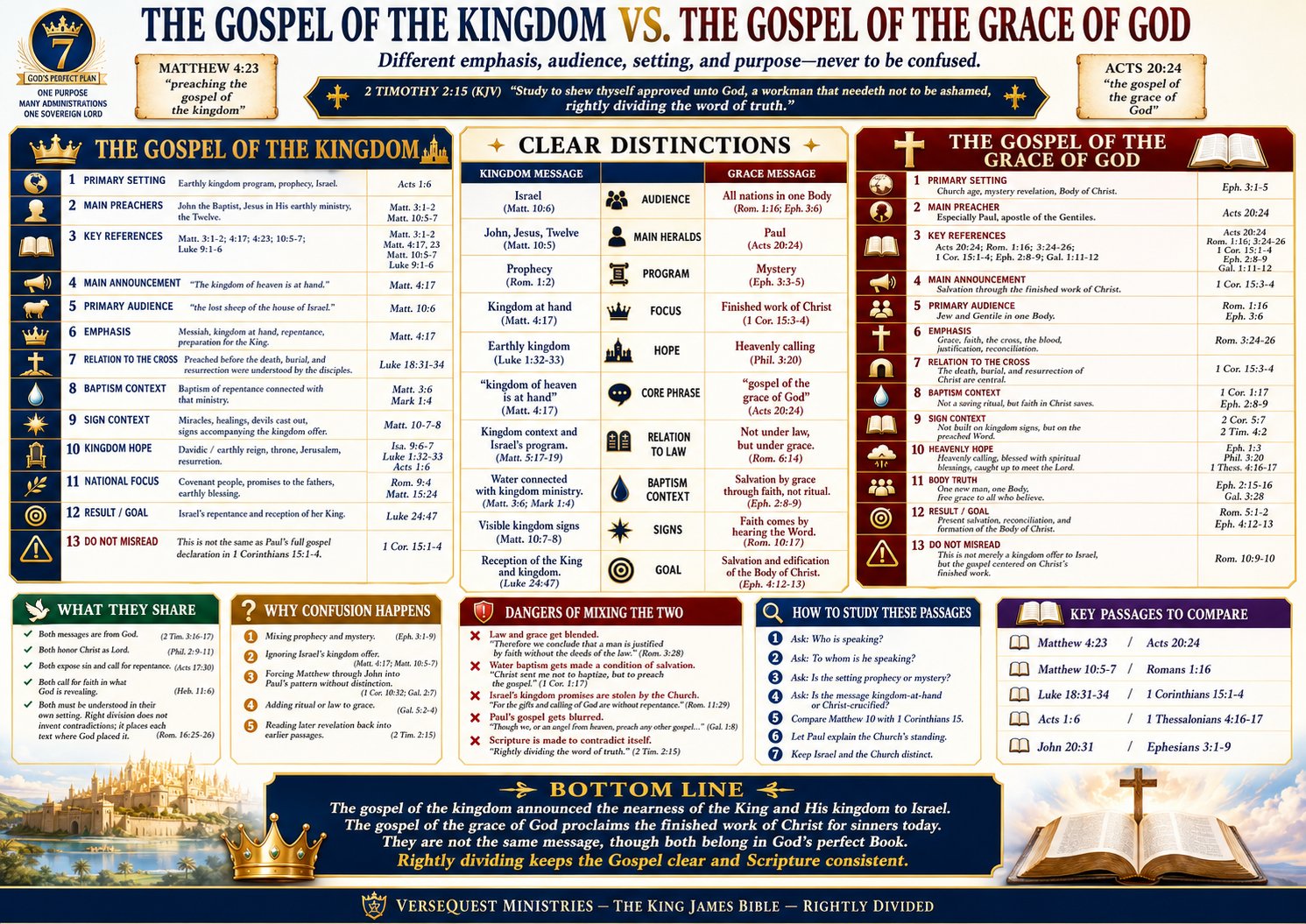
- The Gospel of the Kingdom vs. the Gospel of the Grace of God – KJV Right Division Bible Study Chart
- Compare the gospel of the kingdom and the gospel of the grace of God with this detailed KJV chart covering audience, message, prophecy, mystery, baptism, signs, salvation, and right division.
- $3.99
- Add to cart
-