
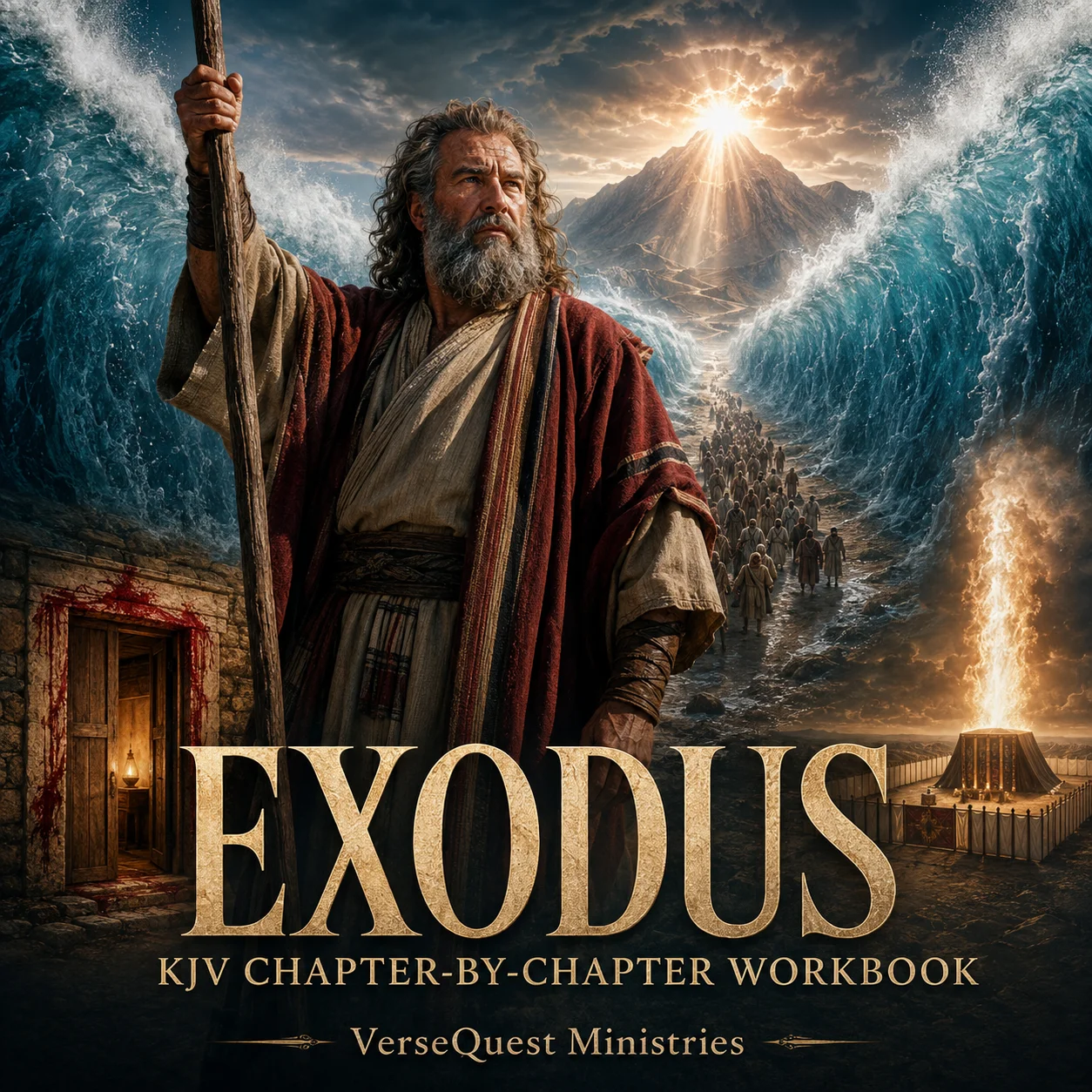
Exodus KJV Chapter-by-Chapter Workbook
The Exodus KJV Chapter-by-Chapter Workbook is a complete 530-page downloadable Bible curriculum covering all 40 chapters of Exodus from a King James Bible-believing, rightly divided perspective.
Every chapter includes ten student-study pages followed by a Teacher and Leader Guide and suggested answers. Students will examine Israel’s bondage, Moses, the plagues, Passover, the Red Sea, wilderness testing, Sinai, the Ten Commandments, the golden calf, the priesthood, the tabernacle, and the glory of the LORD.
The workbook also includes course schedules, cumulative reviews, a final assessment, answer guide, glossary, doctrinal reference studies, indexes, bookmarks, and a certificate of completion. It can be printed for handwritten work or studied and annotated digitally using a compatible PDF reader.
Ideal for personal study, homeschool, Sunday school, church classes, Bible-study groups, discipleship, and ministry training.
Price: $49.99
$49.99
Description
The Exodus KJV Chapter-by-Chapter Workbook is a complete 530-page downloadable Bible curriculum designed to lead students carefully through all 40 chapters of Exodus. Rather than simply presenting information for the reader to absorb, this workbook encourages direct interaction with the King James Bible through observation, exposition, written exercises, doctrinal study, cross-references, review questions, teaching assignments, and personal application.
Exodus begins with the children of Israel suffering under Pharaoh’s cruel bondage and concludes with the glory of the LORD filling the completed tabernacle. Between those two scenes unfolds one of Scripture’s greatest accounts of redemption: God remembers His covenant, raises Moses as Israel’s deliverer, judges Egypt and its gods, shelters His people through the blood of the Passover lamb, opens the Red Sea, provides for Israel in the wilderness, establishes His covenant at Sinai, reveals His law, ordains the priesthood, gives the pattern of the tabernacle, judges the sin of the golden calf, renews the covenant, and dwells among His redeemed people.
Every chapter receives a consistent twelve-page treatment. The first ten pages guide the student through the chapter’s structure, key passage, principal movements, KJV vocabulary, doctrinal distinctions, cross-reference chains, written exercises, special studies, biblical typology, difficult questions, error correction, review, and teach-back preparation. The final two pages provide a coordinated Teacher and Leader Guide followed by suggested answers and a model chapter summary.
The workbook approaches Exodus from a Bible-believing, rightly divided perspective. Literal Israel remains Israel, the Mosaic covenant is kept distinct from the Body of Christ, and national promises are not transferred to the Church. Historical events are established before typological connections are considered. Types of Christ—including Moses, the Passover lamb, the manna, the smitten rock, the tabernacle, the priesthood, the sacrifices, the veil, the ark, and the mercy seat—are examined in the light of clear supporting passages rather than imaginative speculation.
Special attention is given to the identity and character of the LORD, the call and preparation of Moses, Pharaoh’s rebellion and progressive hardening, the ten plagues, the Passover, the Red Sea crossing, Israel’s wilderness testing, the giving of the Ten Commandments, Israel’s civil judgments, the Sinai covenant, the golden calf, Moses’ intercession, the tabernacle pattern, the garments and consecration of the priests, the willing offerings of Israel, and the glory cloud that fills the finished sanctuary.
The additional course material turns the workbook into a flexible curriculum rather than a simple study book. It includes instructions for using the workbook, course outcomes, doctrinal and interpretive principles, structural overviews of Exodus, chapter summaries, multiple suggested schedules, an eighty-lesson teaching plan, chronology and geography studies, cumulative reviews, a final course assessment, an answer guide, a KJV glossary, doctrinal reference studies, subject and Scripture indexes, further-study recommendations, and a certificate of completion.
This downloadable PDF can be printed for handwritten work or studied on a computer or tablet. Readers using a compatible PDF application may also highlight passages, insert comments, draw markings, and add text boxes electronically. The file contains searchable text and organized navigation bookmarks for convenient digital study.
The Exodus KJV Chapter-by-Chapter Workbook is suitable for serious individual Bible students, homeschool families, Sunday school classes, church Bible-study groups, discipleship programs, Bible institutes, prison and recovery ministries, pastors, preachers, and teachers. Students may work through it independently, complete one chapter each week, follow an intensive semester schedule, or divide every chapter into two separate teaching sessions.
This is not merely a commentary to be read and placed on a shelf. It is a working Bible curriculum designed to help students open their King James Bible, examine the words, trace the movements, compare Scripture with Scripture, write their own conclusions, recognize important doctrinal distinctions, and develop the ability to explain and teach the book of Exodus faithfully.
Israel’s bondage in Egypt — The bitter service imposed by Pharaoh establishes the need for divine redemption. The covenant faithfulness of God — The LORD acts because He remembers His covenant with Abraham, Isaac, and Jacob. The preservation and preparation of Moses — God preserves the appointed deliverer through Pharaoh’s death decree and prepares him through rejection and obscurity. The revelation of the great I AM — The burning bush reveals God’s holiness, self-existence, covenant identity, and authority. The call and commission of God’s servant — Moses’ weakness, objections, signs, spokesman, and responsibility illustrate the demands of divine service. Pharaoh’s rebellion against the word of God — Pharaoh’s question, “Who is the LORD?” becomes the central challenge answered by the plagues. The hardening of Pharaoh’s heart — The narrative records Pharaoh’s repeated refusal alongside God’s judicial hardening and sovereign purpose. The judgment of Egypt and its gods — The plagues expose counterfeit power and demonstrate the LORD’s supremacy. The distinction between Egypt and Israel — God repeatedly places a difference between His covenant people and the nation under judgment. Pharaoh’s compromises — Worship in the land, limited separation, divided households, and retained possessions reveal the enemy’s attempts to weaken obedience. The Passover lamb and applied blood — Judgment passes over the houses where the blood is applied according to God’s word. Redemption by blood and deliverance by power — Passover and the Red Sea present connected but distinguishable aspects of Israel’s deliverance. Separation from Egypt — Israel is brought out of Pharaoh’s dominion to belong to and serve the LORD. Divine guidance — The pillar of cloud and fire visibly directs Israel’s route and movements. The Red Sea crossing — The LORD makes a way where none exists and destroys the power pursuing His redeemed people. Wilderness testing and provision — Marah, manna, quail, water from the rock, Amalek, and Jethro reveal both human weakness and divine sufficiency. Murmuring and unbelief — Israel’s repeated complaints expose the flesh even after unmistakable redemption. Israel’s national covenant at Sinai — The Mosaic covenant is given to a nation already delivered from Egypt. The purpose and limits of the law — The law reveals God’s holiness, defines Israel’s covenant responsibility, and exposes transgression but does not impart life. The Sabbath as Israel’s covenant sign — The seventh-day Sabbath is specifically identified as a sign between the LORD and the children of Israel. Civil justice and restitution — Israel’s judgments regulate servants, injuries, property, negligence, lending, vulnerable persons, testimony, and restitution. The holiness of God — Boundaries at Sinai, priestly consecration, sacrifices, washings, and sanctuary restrictions emphasize that God determines the way of approach. The tabernacle pattern — The sanctuary is constructed according to the pattern revealed by God rather than human religious invention. The Aaronic priesthood — Aaron and his sons are clothed, washed, anointed, and consecrated for Israel’s sanctuary service. Sacrifice, blood, washing, and incense — These elements establish the divinely ordered approach connected to Israel’s worship. The golden calf and covenant failure — Israel violates the covenant almost immediately, demonstrating the weakness of the flesh under perfect commandments. Moses as mediator and intercessor — Moses stands between a holy God and a guilty nation while pointing toward the need for a greater mediator. The mercy and name of the LORD — God proclaims Himself merciful, gracious, longsuffering, abundant in goodness and truth, yet righteous in judgment. Willinghearted service — Israel’s contributions and craftsmanship show people responding freely to a work God has revealed. Spirit-enabled craftsmanship — Bezaleel and Aholiab demonstrate that practical ability and skilled workmanship can be appointed and empowered for divine service. Exact obedience to God’s pattern — The repeated statement that the work was completed “as the LORD commanded Moses” emphasizes careful obedience. God dwelling among His redeemed people — Exodus reaches its goal when the glory of the LORD fills the finished tabernacle. Moses as a type of Christ — Moses serves as deliverer, prophet, mediator, leader, and intercessor while remaining inferior to the sinless Son of God. The tabernacle and priesthood as types — Later Scripture uses the sanctuary system to explain Christ, access to God, sacrifice, mediation, and heavenly realities. Israel and the Body of Christ distinguished — The workbook preserves Israel’s national history and covenants while identifying legitimate instruction and application for present believers.
- Central argument: Exodus demonstrates how the LORD remembers His covenant, redeems literal Israel from Egyptian bondage, brings the nation into covenant at Sinai, and establishes His dwelling among them according to a divinely revealed pattern.
- Opening and conclusion: The book opens with Israel serving Pharaoh under rigour and closes with Israel gathered around a tabernacle filled with the glory of the LORD.
- The controlling movement: Bondage leads to judgment, judgment to Passover blood, Passover to deliverance, deliverance to separation, separation to covenant, covenant to sanctuary, and sanctuary to glory.
- The theological center: The question “Who is the LORD?” is answered through God’s name, words, judgments, redemption, provision, holiness, mercy, and presence.
- The covenant foundation: God’s deliverance of Israel rests upon His covenant with Abraham, Isaac, and Jacob rather than Israel’s strength or merit.
- Moses’ preparation: Moses spends his early life in Egypt, is rejected when acting in fleshly zeal, and is prepared in Midian before being sent back by God.
- God’s answer to human weakness: Moses repeatedly emphasizes his insufficiency; God answers by promising His presence, supplying signs, appointing Aaron, and placing the necessary words in His servant’s mouth.
- Pharaoh’s progression: Pharaoh moves from ignorance and refusal to temporary concessions, false confessions, repeated hardening, and final destruction.
- The plagues: The plagues are public judgments through which Egypt learns that the LORD is God and that He can distinguish Israel from Egypt.
- Counterfeit power: Egypt’s magicians imitate certain early signs but cannot reverse God’s judgments, create deliverance, or continue indefinitely.
- The enemy’s compromises: Pharaoh attempts to keep Israel worshipping within Egypt, prevent complete separation, divide families, and retain their possessions. Moses refuses incomplete obedience.
- Passover: The lamb is selected, slain, and eaten; the blood is applied as commanded; judgment passes over the marked houses; and Israel departs.
- Blood and power distinguished: The Passover blood shelters Israel from judgment, while the LORD’s power opens the sea and delivers the nation from Pharaoh’s dominion.
- The Red Sea: Israel contributes no engineering, military strategy, or escape route. The LORD commands the people to go forward and makes the way.
- The wilderness: Redemption does not remove testing. Israel’s wilderness experiences expose unbelief while revealing God’s provision and patience.
- Manna: Manna is literal wilderness provision and later supplies an inspired comparison with Christ as the true bread from heaven.
- The smitten rock: The rock supplies literal water for Israel and is connected with Christ in 1 Corinthians 10.
- Amalek: Amalek attacks Israel after the water from the rock, presenting an enduring picture of conflict following provision.
- Redemption before law: Israel is brought out of Egypt before the law is given at Sinai. The covenant does not become the means by which Israel escapes Egypt.
- The Mosaic covenant: The covenant at Sinai is made with literal Israel and includes national, civil, ceremonial, and moral responsibilities.
- The law’s limitation: The law is holy and exposes sin, but it cannot change the flesh or provide justification.
- The Sabbath: Exodus identifies the Sabbath as a sign between the LORD and the children of Israel. It must not be misaddressed to the Body of Christ.
- The tabernacle: God initiates the sanctuary, reveals its pattern, specifies its materials, appoints its workers, and determines the arrangement of worship.
- The direction of approach: The court gate, brazen altar, laver, holy place, veil, most holy place, ark, and mercy seat demonstrate ordered access.
- The priesthood: Aaron’s priesthood belongs to Israel’s sanctuary system and is contrasted in Hebrews with the superior priesthood of Christ.
- The golden calf: Israel breaks the covenant while Moses is still in the mount, proving that perfect commandments do not overcome sinful flesh.
- Moses’ intercession: Moses repeatedly stands between divine judgment and the guilty nation, but he remains a servant who points toward a greater mediator.
- God’s proclaimed name: Exodus 34 joins mercy and grace with holiness and judgment. God’s goodness never requires Him to ignore guilt.
- Willing offerings: The tabernacle is constructed from offerings brought by willing hearts rather than through Pharaoh-like compulsion.
- Gifted workmen: Bezaleel and Aholiab show that God values wisdom, craftsmanship, precision, order, and practical ability in revealed service.
- Exact obedience: The construction chapters repeatedly state that the work was completed as the LORD commanded Moses. Sincerity does not replace obedience to the pattern.
- The finished tabernacle: Moses inspects and blesses the completed work before the sanctuary is erected, anointed, and filled with glory.
- The continuing journey: The cloud resting upon or rising from the tabernacle governs Israel’s movements. Exodus ends with God present among His people, but the journey toward the land continues.
- Important distinction: Israel’s experiences provide instruction, examples, warnings, and types, but Israel must not be transformed into the Body of Christ.
- Question for further study: How do the Exodus plagues anticipate later prophetic judgments without requiring every detail to be treated as identical?
- Question for further study: Which elements of the Passover are directly applied to Christ in later Scripture, and which belong specifically to Israel’s historical ordinance?
- Question for further study: How does Hebrews interpret the tabernacle, priesthood, sacrifices, veil, and blood?
- Question for further study: What does Exodus teach about leadership, delegation, intercession, accountability, and exact service?
- Memorable teaching point: Exodus is not merely the story of people coming out of Egypt; it is the record of God bringing a redeemed nation unto Himself.
- Memorable teaching point: The blood kept judgment out, the sea brought Israel out, the covenant marked Israel out, and the glory showed whom they belonged to.
For personal Bible study, the workbook provides a disciplined path through all 40 chapters. The student can complete one chapter at a time, write observations before consulting the suggested answers, build cross-reference chains, develop KJV vocabulary, and prepare personal chapter summaries. The searchable PDF and organized bookmarks make it practical for both printed and digital study.
For homeschool families, the workbook can function as a complete Bible course. Parents may follow the forty-week schedule, use the twenty-week intensive schedule, or divide each chapter into shorter lessons. The repeated chapter format supplies predictable structure while the written assignments, vocabulary work, memory passages, cumulative reviews, final assessment, and certificate provide genuine curriculum components.
For Sunday school and church Bible classes, teachers can assign the chapter reading and selected student pages before class. The Teacher and Leader Guide provides lesson outcomes, teaching flow, cautions, discussion prompts, assessment standards, and extension assignments. The material can be adapted for youth, adult, or mixed-age classes according to the teacher’s selection of core and enrichment work.
For small groups and discipleship, each chapter offers enough material for guided discussion without depending upon lectures alone. Participants can compare their written observations, work through doctrinal distinctions, examine cross-references, discuss difficult questions, and complete the teach-back section together.
For pastors, preachers, and Bible teachers, the chapter movements, doctrinal studies, KJV vocabulary, typological connections, and cross-reference chains can assist in preparing sermons, teaching series, topical lessons, and introductory studies. The material provides an organized framework while leaving the teacher responsible to study and preach directly from the Bible.
For Bible institutes and ministry training, the workbook can be used as a Pentateuch or Old Testament course focused specifically on Exodus. Students may be required to complete every enrichment assignment, reproduce chapter structures without notes, defend right-division distinctions, prepare lessons, and complete the final course assessment.
For prison, recovery, counseling, and care ministries, selected chapters can support studies concerning bondage, deliverance, obedience, testing, provision, worship, responsibility, and the presence of God. Teachers should preserve the historical and doctrinal meaning of Exodus while making carefully distinguished practical applications.
A King James Bible with readable paragraph and reference formatting
An exhaustive concordance keyed to the King James Bible
A reliable KJV Bible dictionary for older words, objects, offices, measurements, and customs
A cross-reference Bible or treasury of Scripture cross-references
A blank map of Egypt, the Sinai region, and Israel’s wilderness route
A printable timeline covering Genesis 46 through Exodus 40
A tabernacle floor plan based directly upon Exodus 25–30 and 35–40
A comparative chart of the ten plagues and Pharaoh’s responses
A study chart tracing Pharaoh’s four principal compromises
A study of the names and titles of God in Exodus
A comparison of Moses and Christ using Acts 7 and Hebrews 3
A Passover study using Exodus 12, John 1, 1 Corinthians 5, 1 Peter 1, and Revelation 5
A law-and-grace study using Exodus 19–24, Romans 3–8, Galatians 3–5, Colossians 2, and Hebrews 8–12
A tabernacle and priesthood study using Exodus, Leviticus, and Hebrews
Psalms 78, 105, and 106 as inspired summaries of Israel’s Exodus and wilderness history
Genesis KJV Chapter-by-Chapter Workbook for the covenant history leading into Exodus
Through the Bible with VerseQuest for a broader survey of all 66 books of the King James Bible
Related products
-
Bible Prophecy Charts
-
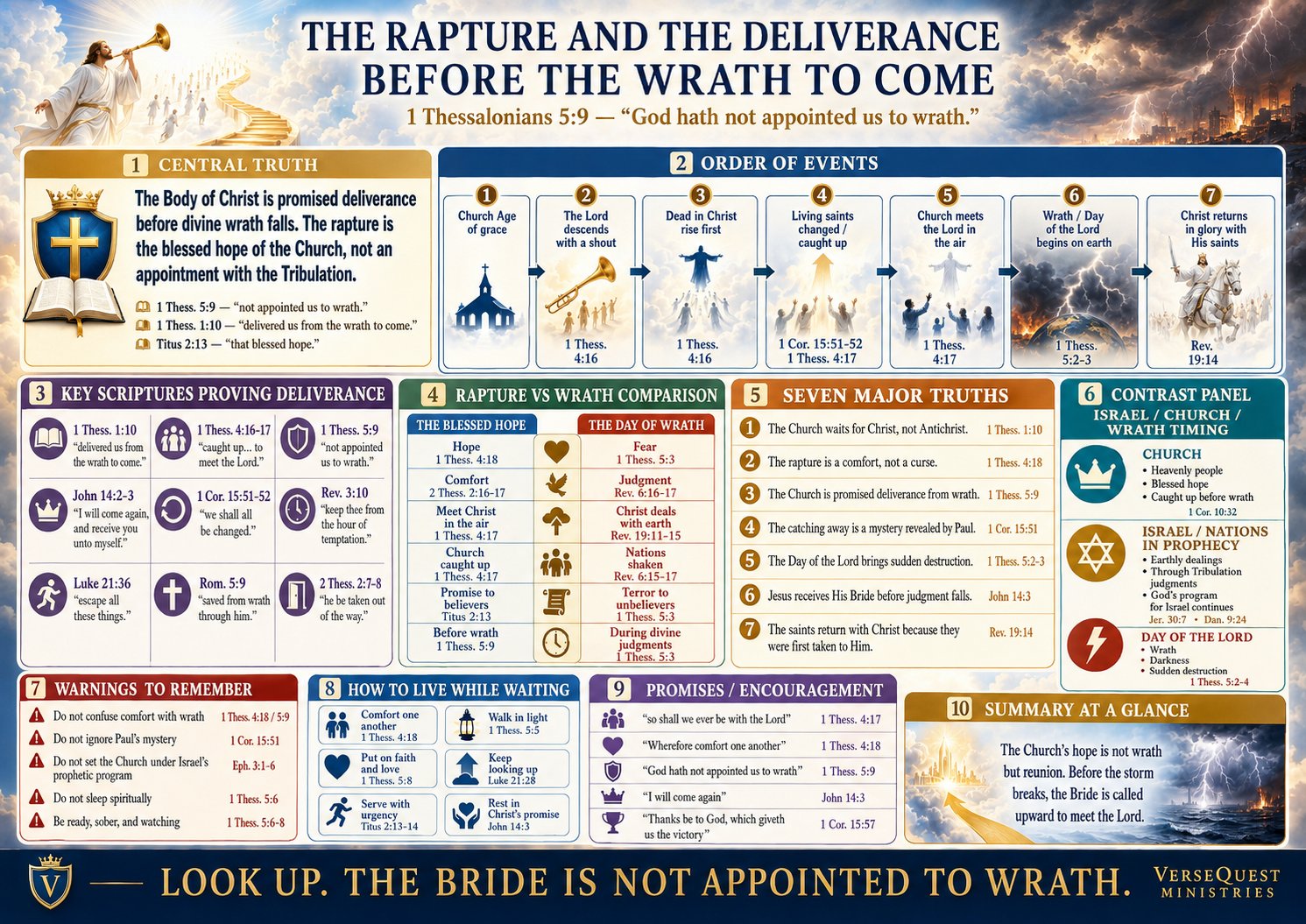
- The Rapture and the Deliverance Before the Wrath to Come – Printable Bible Study Chart
- Printable KJV Bible study chart on The Rapture and the Deliverance Before the Wrath to Come, showing from 1 Thessalonians 5:9 that the Church is not appointed to wrath. This…
- $4.99
- Add to cart
-
-
Christology Studies
-
- The Deity of Christ Defended — 66 KJV Studies Proving Jesus Christ Is God Manifest in the Flesh
- he Deity of Christ Defended is a 444-page premium KJV Bible study defending the full deity of the Lord Jesus Christ. This 66-study book proves from Scripture that Jesus is…
- $29.99
- Add to cart
-
-
Heaven
-
- The Doctrine of Heaven Made Plain — 599-Page KJV Bible Study PDF
- A massive 599-page KJV, rightly divided study on heaven, covering the present heaven, resurrection body, Rapture, Millennium, New Jerusalem, eternal state, hard questions, funeral lies, and cult errors.
- $34.99
- Add to cart
-
-
Doctrine Series
-
- The Lost Tribes Myth Exposed (213-Page Premium Study)
- A 213-page premium KJV study exposing the Lost Tribes myth, tribal identity errors, prophecy abuse, race theories, and false Israel claims through 35 detailed essays.
- $24.99
- Add to cart
-
-
VerseQuest Premium Library
-
-67%
- The Book of Psalms Made Plain – 383-Page KJV Psalm Study
- The Book of Psalms Made Plain is a 383-page premium KJV Bible study featuring 54 detailed essays through the major themes, doctrines, prophecies, prayers, laments, and praises of the Psalms.…
- Original price was: $29.99.$9.99Current price is: $9.99.
- Add to cart
-
-67%