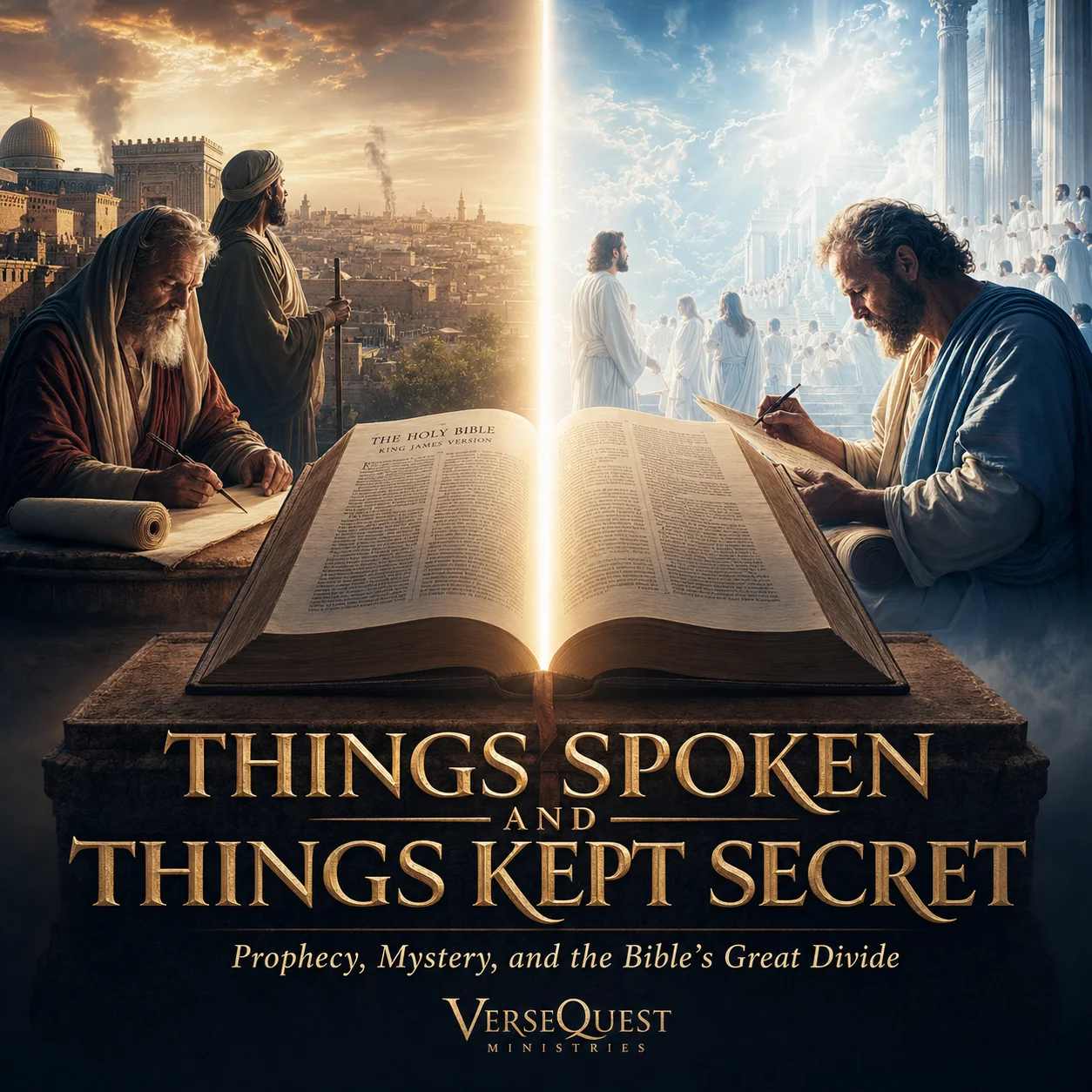
Things Spoken and Things Kept Secret
Prophecy, Mystery, and the Bible’s Great Divide
Introduction
One of the clearest ways to understand the Bible is to ask a simple question: was this truth spoken since the world began, or was it kept secret since the world began? That question comes straight from Scripture. In Acts 3:21, Peter preached about things “which God hath spoken by the mouth of all his holy prophets since the world began.” In Romans 16:25, Paul preached Jesus Christ “according to the revelation of the mystery, which was kept secret since the world began.” Those two statements cannot be the same if words mean anything. One was spoken. One was kept secret. One was revealed through the prophets. One was hidden until God revealed it in due time. One belongs to the prophetic program. One belongs to the mystery program.
The modern religious world has made a disaster of Bible interpretation by flattening everything into one pile. It takes what God said to Israel through the prophets and blends it with what Christ revealed to Paul for the Body of Christ. It makes Peter and Paul preach the exact same doctrinal message under the exact same commission. It reads Israel’s kingdom promises as if they are Church-age blessings. It drags the Church into Jacob’s trouble. It confuses the gospel of the kingdom with the gospel of the grace of God. It treats the mystery as though Isaiah, Daniel, and David already preached it plainly. But Romans 16:25 says the mystery was “kept secret since the world began.” That sentence ought to stop a Bible believer in his tracks.
Right division is not a hobby for people who like charts. It is the only way to keep the Bible from becoming a maze of apparent contradictions. When prophecy and mystery are distinguished, the Book opens with clarity. Israel keeps her promises. The Church keeps her heavenly calling. The gospel of grace remains pure. The kingdom remains literal. The rapture remains blessed hope. The tribulation remains the time of Jacob’s trouble. Paul’s apostleship becomes understandable. Peter’s kingdom preaching stays in its place. The Bible student no longer has to force every passage into the same doctrinal box. He can let God speak where He speaks, to whom He speaks, about what He is actually revealing.
I. God Himself Makes the Distinction Between Spoken Prophecy and Hidden Mystery
Key Text: Acts 3:21; Romans 16:25
Supporting Texts: 2 Timothy 2:15; 1 Corinthians 2:13; Deuteronomy 29:29
The distinction between prophecy and mystery is not invented by dispensational teachers. It is stated by the Holy Ghost. Acts 3:21 says certain things were “spoken by the mouth of all his holy prophets since the world began.” Romans 16:25 says the mystery was “kept secret since the world began.” That is a Bible contrast. “Spoken” and “kept secret” are not the same. If God says one body of truth was proclaimed by the prophets and another body of truth was hidden, the approved workman is required to believe the distinction.
Deuteronomy 29:29 says, “The secret things belong unto the LORD our God: but those things which are revealed belong unto us and to our children for ever.” God does not reveal everything at once. He reveals truth according to His own purpose and timing. The Bible is progressive revelation. That does not mean God changes His character. It means God reveals more of His plan as history unfolds. Adam did not know everything Abraham knew. Abraham did not know everything Moses knew. Moses did not know everything David knew. David did not know everything Peter knew. Peter did not know everything Paul was given to reveal about the Body of Christ.
Second Timothy 2:15 commands the workman to rightly divide the word of truth. Right division begins by honoring the divisions God Himself placed in Scripture. The issue is not whether all Scripture is inspired. It is. The issue is whether all Scripture is revealing the same program to the same people under the same conditions. It is not. Prophecy and mystery must be compared, distinguished, and placed where God put them.
Main Truth:
God Himself distinguishes between things spoken since the world began and the mystery kept secret since the world began.
II. Prophecy Concerns What God Spoke Through the Prophets
Key Text: Acts 3:21
Supporting Texts: Luke 1:68–75; 2 Peter 1:19–21; Amos 3:7
Peter preached in Acts 3 that Jesus Christ would remain in heaven “until the times of restitution of all things.” He then said those things were spoken “by the mouth of all his holy prophets since the world began.” That is prophecy. It concerns what God openly declared through His prophets concerning Israel, the kingdom, Messiah, judgment, restoration, and the earth. The prophets were not silent about Israel’s future. They spoke of her scattering, repentance, restoration, kingdom, land, city, throne, temple, and King.
Luke 1:70 says God spoke “by the mouth of his holy prophets, which have been since the world began.” The context in Luke 1 is not the Body of Christ. It is Israel, the house of David, the fathers, the covenant, the oath to Abraham, deliverance from enemies, and service to God in holiness. That is prophetic language. Zacharias was not preaching the mystery of Jew and Gentile in one Body seated in heavenly places in Christ. He was rejoicing in the coming of Israel’s Redeemer and the fulfillment of promises spoken to the fathers.
Second Peter 1:19 says, “We have also a more sure word of prophecy.” Prophecy is not guesswork. It is not newspaper speculation. It is not mystical code-hunting. It is the sure word God spoke. When the prophets spoke by the Holy Ghost, they revealed God’s declared program. The Bible believer does not need to spiritualize those prophecies into church tradition. He needs to believe them as God gave them.
Main Truth:
Prophecy is the body of truth God openly spoke through the prophets concerning Israel, the kingdom, judgment, restoration, and Messiah’s reign.
III. Mystery Concerns What God Kept Secret Until Revealed
Key Text: Romans 16:25
Supporting Texts: Ephesians 3:1–9; Colossians 1:25–27; 1 Corinthians 2:7
Romans 16:25 speaks of “the revelation of the mystery, which was kept secret since the world began.” A mystery in Paul’s epistles is not something spooky, occult, or unknowable. It is truth once hidden in God but now revealed. The issue is not that the truth is still impossible to know. The issue is that it was not previously revealed. The mystery was not preached plainly by the Old Testament prophets because Paul says it was kept secret.
Ephesians 3:5 says the mystery “in other ages was not made known unto the sons of men, as it is now revealed.” Ephesians 3:9 speaks of “the mystery, which from the beginning of the world hath been hid in God.” Colossians 1:26 calls it “the mystery which hath been hid from ages and from generations, but now is made manifest to his saints.” Those verses do not need to be softened. They need to be believed. The mystery was hidden. Now it is revealed.
This mystery includes the truth that believing Jews and Gentiles are made fellowheirs, of the same Body, and partakers of God’s promise in Christ by the gospel. It includes the Church as the Body of Christ, Christ in you the hope of glory, the one new man, the heavenly calling, and the dispensation of grace committed to Paul. This is not Israel’s kingdom program with a new coat of paint. It is truth hid in God until revealed through the apostle of the Gentiles.
Main Truth:
Mystery truth is not Old Testament prophecy repeated; it is hidden truth now revealed, especially concerning the Body of Christ and the dispensation of grace.
IV. Peter Preached the Prophetic Program to Israel
Key Text: Acts 3:19–21
Supporting Texts: Acts 2:14–36; Acts 1:6; Matthew 10:5–7
Peter’s preaching in early Acts is rooted in Israel’s prophetic program. In Acts 2, Peter addresses “ye men of Judaea,” “ye men of Israel,” and “all the house of Israel.” He quotes Joel. He quotes David. He preaches Jesus Christ as the risen Messiah whom Israel crucified. He does not stand up and announce the mystery of the Body of Christ as later revealed through Paul. He preaches in light of Israel’s prophetic Scriptures.
In Acts 3, Peter tells Israel to repent so that the times of refreshing may come and God may send Jesus Christ. That message concerns the national repentance of Israel and the return of Christ in connection with the restitution of all things spoken by the prophets. Peter’s audience is Jewish. His proof is prophetic. His expectation is kingdom restoration. This matches the apostles’ question in Acts 1:6: “Lord, wilt thou at this time restore again the kingdom to Israel?” Jesus did not tell them there would never be such a kingdom. He told them the times and seasons were in the Father’s power.
This matters because many people read Peter as though he is preaching Paul’s later revealed mystery in full form. He is not. Peter is not wrong. He is preaching exactly what God gave him to preach at that stage in the transition. The kingdom was offered to Israel on the basis of their Messiah’s death and resurrection. Israel as a nation continued in unbelief. As Acts unfolds, God raises up Paul and reveals the dispensation of grace for the Gentiles.
Main Truth:
Peter’s early Acts preaching is rooted in Israel’s prophetic kingdom program, not the full revelation of the mystery later committed to Paul.
V. Paul Was Given the Revelation of the Mystery
Key Text: Ephesians 3:2–3
Supporting Texts: Galatians 1:11–12; Romans 11:13; Colossians 1:25
Paul wrote in Ephesians 3:2–3, “If ye have heard of the dispensation of the grace of God which is given me to you-ward: how that by revelation he made known unto me the mystery.” That is not arrogance. That is Scripture. Paul did not receive his gospel and doctrine from a Jerusalem committee. Galatians 1:11–12 says the gospel he preached was “not after man” and that he received it “by the revelation of Jesus Christ.”
Romans 11:13 says Paul is “the apostle of the Gentiles.” Colossians 1:25 says a dispensation was given to him “to fulfil the word of God.” That means Paul’s ministry completes the doctrinal revelation necessary for the Church age. The risen Christ revealed to Paul truth concerning the Body of Christ, justification by faith apart from the law, Jew and Gentile in one Body, the believer’s position in Christ, the Church’s heavenly calling, the rapture, and the doctrine by which the Church is established.
A man does not honor Christ by ignoring the apostle Christ sent to the Gentiles. The same Lord Jesus who sent Peter to Israel also sent Paul to the Gentiles. The same Holy Ghost who empowered Peter also revealed mystery truth through Paul. Refusing Paul’s distinct ministry does not make a man more biblical. It makes him disobedient to the order of revelation God gave.
Main Truth:
Paul was given the revelation of the mystery for the Church age, and believers must consider what Christ revealed through him.
VI. Prophecy Centers on Israel’s Earthly Kingdom Hope
Key Text: Luke 1:32–33
Supporting Texts: Genesis 12:1–3; 2 Samuel 7:12–16; Isaiah 2:1–4; Zechariah 14:4
Prophecy centers heavily on Israel’s earthly kingdom hope. God promised Abraham land, seed, and blessing. God promised David a throne and a kingdom. Luke 1:32–33 says Jesus Christ will receive “the throne of his father David” and “reign over the house of Jacob for ever.” Those words are not symbolic fog. David’s throne is David’s throne. The house of Jacob is the house of Jacob. The kingdom promised to Israel is a real kingdom.
Isaiah 2 speaks of the law going forth from Zion and the word of the LORD from Jerusalem. Zechariah 14 says the Lord’s feet shall stand upon the mount of Olives. The prophets repeatedly speak of Israel’s restoration, the nations coming to Jerusalem, the Messiah reigning, and righteousness filling the earth. Those promises do not disappear because Gentile theologians got nervous about a literal Jewish kingdom.
If prophecy is spiritualized into the Church, then God’s promises to Israel become unstable. But God does not need help keeping His word. Israel’s failure brought judgment and temporary blindness, but it did not cancel the covenant faithfulness of God. Romans 11 teaches that Israel will yet be restored. Prophecy must be allowed to mean what it says.
Main Truth:
Prophecy centers on Israel’s earthly kingdom hope, including land, throne, restoration, and Messiah’s reign from Jerusalem.
VII. Mystery Centers on the Church’s Heavenly Calling
Key Text: Ephesians 1:22–23
Supporting Texts: Ephesians 2:6; Colossians 3:1–4; Philippians 3:20; 1 Corinthians 12:13
The mystery centers on the Church which is Christ’s Body. Ephesians 1:22–23 says God gave Christ to be “the head over all things to the church, which is his body.” That is not Israel under another name. That is a new spiritual organism joined to a risen Head in heaven. First Corinthians 12:13 says believers are baptized by one Spirit into one Body. This is not water, ceremony, or national covenant. It is the Spirit’s operation placing saved people into Christ.
Ephesians 2:6 says believers are seated together in heavenly places in Christ Jesus. Philippians 3:20 says, “For our conversation is in heaven; from whence also we look for the Saviour.” Colossians 3 tells believers to set their affection on things above, where Christ sits. The Church’s calling is heavenly. Her Head is in heaven. Her hope comes from heaven. Her blessings are spiritual blessings in heavenly places in Christ.
This does not mean the Church is more important than Israel or that Israel is discarded. It means God has more than one program in Scripture. Israel has an earthly prophetic kingdom hope. The Church has a heavenly mystery calling in Christ. Right division protects both. It keeps Israel from being robbed and keeps the Church from being dragged into prophecies that belong to Israel’s future.
Main Truth:
Mystery truth centers on the Church’s heavenly calling as the Body of Christ, seated in Christ and awaiting the Saviour from heaven.
VIII. Mixing Prophecy and Mystery Corrupts the Gospel and Confuses the Hope
Key Text: Galatians 2:7–9
Supporting Texts: Acts 20:24; 1 Corinthians 15:1–4; Matthew 24:13–14; Titus 2:13
When prophecy and mystery are mixed, the gospel gets muddy. Galatians 2:7 speaks of “the gospel of the uncircumcision” committed to Paul and “the gospel of the circumcision” committed to Peter. That does not mean there are two Saviours. It means there are different commissions and contexts in God’s unfolding revelation. Paul’s gospel for salvation today is clearly stated in 1 Corinthians 15:1–4: Christ died for our sins, was buried, and rose again the third day according to the Scriptures.
Acts 20:24 calls Paul’s message “the gospel of the grace of God.” It is salvation by grace through faith, apart from works of the law. But when men mix Matthew 24 tribulation endurance, kingdom preaching, Jewish signs, water ordinances, and Mosaic law into Paul’s gospel, they produce insecurity and confusion. They make salvation sound like a probationary contract instead of a finished work. They turn grace into a religious payment plan.
Mixing prophecy and mystery also confuses the believer’s hope. The Church is looking for “that blessed hope,” not the Antichrist. The rapture of the Body of Christ is not the same event as the Second Advent in judgment. Israel’s tribulation passages are not the Church’s appointment. The time of Jacob’s trouble is not the Body of Christ’s destiny. Right division preserves both the gospel of grace and the blessed hope.
Main Truth:
Mixing prophecy and mystery corrupts the gospel of grace and replaces the Church’s blessed hope with prophetic confusion.
IX. Jesus Christ Is the Center of Both Prophecy and Mystery
Key Text: Colossians 1:18
Supporting Texts: Luke 24:44; Romans 16:25–27; Revelation 19:10; Ephesians 1:10
Right division does not divide Christ. It magnifies Christ by honoring all that God has revealed about Him. In prophecy, Christ is the promised Seed, the Son of David, the King of Israel, the Lamb of God, the suffering Servant, the coming Judge, and the King who will reign over the earth. Luke 24:44 says the law of Moses, the prophets, and the Psalms speak concerning Him. Revelation 19:10 says “the testimony of Jesus is the spirit of prophecy.”
In mystery, Christ is the Head of the Body, the Saviour of the Church, the believer’s life, the One in whom Jew and Gentile are made one new man, and the One in whom all spiritual blessings are found. Colossians 1:27 says the mystery includes “Christ in you, the hope of glory.” The same Jesus who will sit on David’s throne is the risen Head of the Church. The same Christ promised by prophecy revealed mystery truth from heaven through Paul.
Ephesians 1:10 says God will gather together in one all things in Christ, both which are in heaven and which are on earth. That verse shows the greatness of God’s full plan. Prophecy concerns the earth. Mystery reveals the heavenly calling. Both are gathered in Christ. Right division does not reduce Christ. It lets Him have every glory God gave Him without forcing every passage into the same program.
Main Truth:
Jesus Christ is the center of both prophecy and mystery, and right division magnifies every part of His glory.
Conclusion
Acts 3:21 and Romans 16:25 form one of the greatest contrasts in Bible study. One speaks of things God spoke by the mouth of all His holy prophets since the world began. The other speaks of the revelation of the mystery kept secret since the world began. The Bible believer must not pretend those statements are the same. Prophecy and mystery are both inspired. Both are true. Both exalt Jesus Christ. But they are not the same program.
When prophecy and mystery are rightly divided, the Bible becomes clear. Israel keeps her covenants, land, throne, kingdom, and restoration. The Church keeps her heavenly calling, Pauline doctrine, spiritual blessings, and blessed hope. Peter’s ministry remains connected to Israel’s prophetic program. Paul’s ministry is recognized as the revelation of the mystery for the Body of Christ. The gospel of grace remains free from law, ordinances, tribulation endurance, and kingdom confusion. The believer can read the whole Bible profitably without stealing what belongs to someone else.
The Church does not need less Bible. It needs better Bible handling. It does not need to flatten Scripture. It needs to rightly divide it. God is not confused. His Book is not broken. His promises are not unstable. The confusion comes from men who refuse the words on the page. Let prophecy stand where God put it. Let mystery stand where God revealed it. Let Israel be Israel. Let the Church be the Church. Let Paul’s gospel remain clear. Let Jesus Christ receive glory in all things, both spoken and once kept secret.
Final Call
The sinner does not need to understand every prophetic detail to be saved. He needs to believe the gospel of Christ. The Lord Jesus Christ died for our sins according to the Scriptures. He was buried. He rose again the third day according to the Scriptures. Salvation today is not by law, works, sacraments, endurance, temple worship, priestcraft, or religious performance. It is by grace through faith in the finished work of Jesus Christ.
Do not hide behind religion. Do not trust your church membership, baptism, morality, feelings, or tradition. Christ finished the work. Believe on the Lord Jesus Christ, and thou shalt be saved.
Believer, study the Book God gave you. Do not be satisfied with a denominational blender. Learn the difference between prophecy and mystery. Consider what Paul says. Let the Holy Ghost establish you according to the preaching of Jesus Christ and the revelation of the mystery. The Bible will open when you stop mixing what God divided.
Closing Verse:
2 Timothy 2:15 — “Study to shew thyself approved unto God, a workman that needeth not to be ashamed, rightly dividing the word of truth.”
Closing Statement:
The Bible becomes clear when the workman learns to keep things spoken and things kept secret exactly where God placed them.