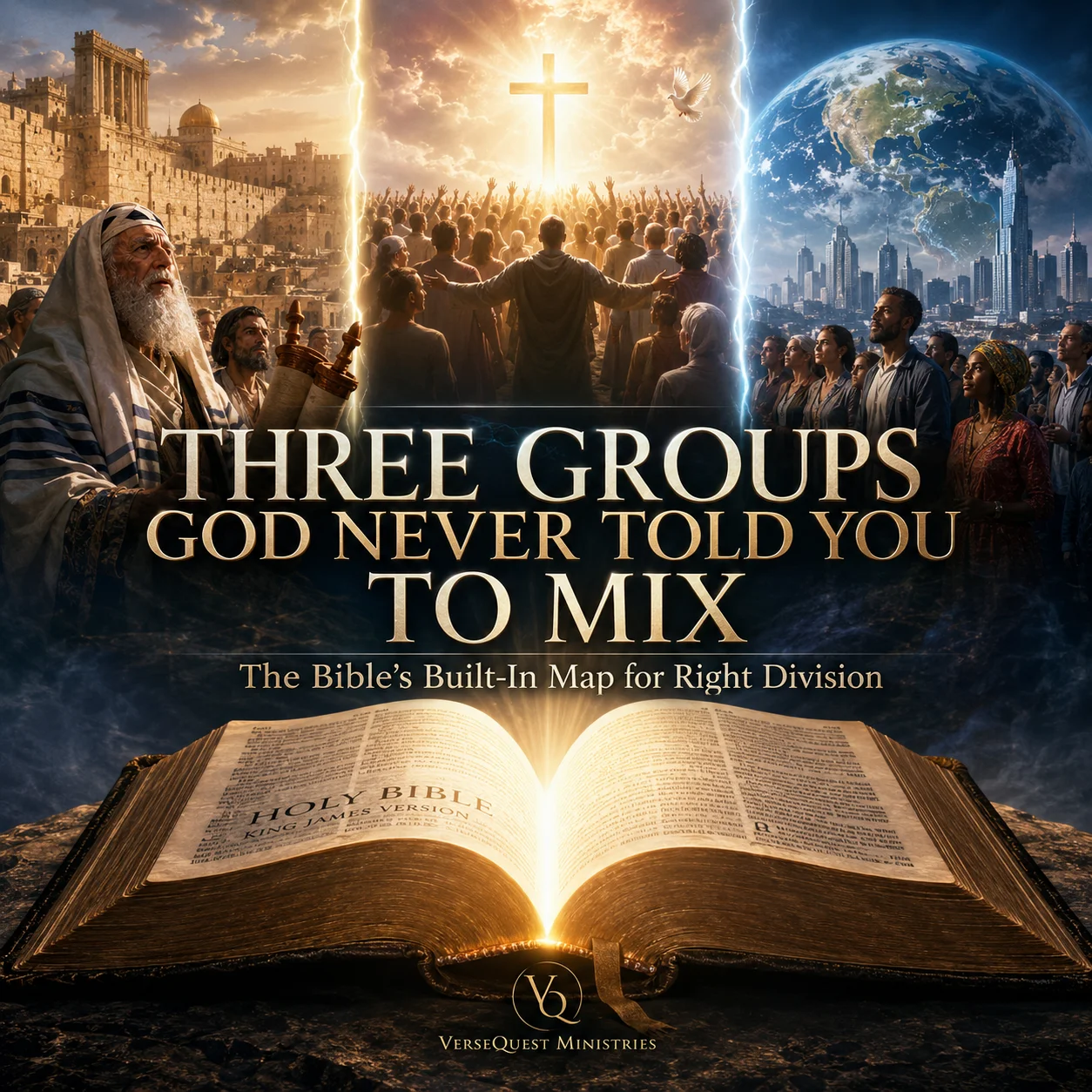
Three Groups God Never Told You to Mix
The Bible’s Built-In Map for Right Division
Introduction
One of the clearest verses in the Bible is also one of the most ignored verses in theology. First Corinthians 10:32 says, “Give none offence, neither to the Jews, nor to the Gentiles, nor to the church of God.” In one verse, the Holy Ghost gives the Bible student three groups that must be recognized when studying Scripture: the Jews, the Gentiles, and the Church of God. That is not a man-made chart. That is not a denominational preference. That is not a dispensational trick. That is Bible language. God Himself names the categories, and the approved workman is expected to handle the Book accordingly.
The religious world has spent centuries mixing what God divided. It takes Israel’s covenants and hands them to the Church. It takes Israel’s tribulation passages and uses them to terrify saved people in the Body of Christ. It takes kingdom doctrine and tries to force it into the gospel of grace. It takes the law given to Moses and puts it back on believers who are seated in heavenly places in Christ. It takes the Sermon on the Mount, Hebrews, James, Revelation, Acts 2, and Paul’s epistles and blends them into one theological stew, then acts surprised when nobody has assurance, nobody understands prophecy, and nobody can tell the difference between salvation, discipleship, rewards, and judgment.
God is not the author of confusion. The confusion comes when men refuse the divisions God placed in His own Book. The Bible is not difficult because God failed to explain Himself. It becomes difficult when men refuse to believe the words where they stand. Israel is not the Church. The Church is not the Gentiles. The Gentiles are not Israel. A saved Jew and a saved Gentile in this dispensation are baptized by one Spirit into one Body, but that Body is not the nation of Israel. When 1 Corinthians 10:32 is believed, hundreds of doctrinal problems begin to clear up. When it is ignored, men will spend the rest of their lives stealing mail from somebody else’s mailbox.
I. God Names the Three Groups Himself
Key Text: 1 Corinthians 10:32
Supporting Texts: 1 Corinthians 1:2; 2 Timothy 2:15; 1 Corinthians 2:13
The first thing to notice is that 1 Corinthians 10:32 is not a theological invention. God names the three groups Himself: “the Jews,” “the Gentiles,” and “the church of God.” The Bible student does not have to create these distinctions. He only has to believe them. God could have said “all mankind” and left it there, but He did not. He could have said “believers and unbelievers” and left it there, but He did not. He could have said “Israel and the nations” and left it there, but He did not. In the Church age, through Paul, God gives three categories that explain the Bible’s dealings with men.
This is especially important because Paul is writing to “the church of God which is at Corinth” in 1 Corinthians 1:2. The Church of God existed in Corinth, a Gentile city, and yet Paul still distinguished it from both Jews and Gentiles. That means the Church of God is not merely another name for Gentiles who became religious. It is a distinct spiritual body made up of saved Jews and saved Gentiles in Christ. A man may be born a Jew or born a Gentile, but when he is saved in this dispensation, he becomes part of the Church of God, the Body of Christ.
This is why right division begins with believing Bible words. First Corinthians 2:13 says the Holy Ghost teaches by “comparing spiritual things with spiritual.” The Bible gives the categories, and Scripture explains them. If a preacher refuses these three groups, he will misplace doctrines, promises, warnings, signs, covenants, judgments, and hopes. He may quote many verses, but he will not handle them as an approved workman.
Main Truth:
God Himself names three groups in Scripture, and the Bible student must not mix what God has distinguished.
II. The Jews Are God’s Covenant Nation
Key Text: Genesis 12:1–3
Supporting Texts: Romans 9:4–5; Genesis 17:7–8; Deuteronomy 7:6–8
The Jew begins with God’s call of Abram. In Genesis 12, God separated one man from the nations and made promises concerning land, seed, blessing, and a great nation. That calling was not given to the Church. It was not given to Rome. It was not given to America. It was not given to Protestant denominations. It was given to Abraham and his seed through Isaac and Jacob. From that point forward, the Bible begins to unfold a distinct covenant program connected to Israel.
Romans 9:4–5 says of Israel, “Who are Israelites; to whom pertaineth the adoption, and the glory, and the covenants, and the giving of the law, and the service of God, and the promises.” Notice the wording. The covenants pertain to Israel. The giving of the law pertained to Israel. The temple service pertained to Israel. The promises pertained to Israel. A Gentile theologian may try to move those things around, but the Holy Ghost already identified their place. Israel had a land, a priesthood, a temple, a throne, prophets, covenants, promises, and a national hope.
This does not mean every individual Jew was saved. It does not mean Israel never sinned. It does not mean Israel received eternal life by bloodline. The nation often rebelled, and God judged them severely. But their failure did not erase God’s covenant promises. Romans 11:29 says, “For the gifts and calling of God are without repentance.” God’s covenant nation remains distinct in His prophetic program, even while individual Jews today must be saved the same way any sinner is saved — by grace through faith in the Lord Jesus Christ.
Main Truth:
The Jews are God’s covenant nation, chosen for an earthly prophetic program involving land, promises, kingdom, and Messiah.
III. The Gentiles Are the Nations Outside Israel’s Covenants
Key Text: Ephesians 2:11–12
Supporting Texts: Romans 1:18–32; Acts 14:16; Genesis 10:5
Before a saved Gentile can appreciate grace, he ought to understand where he stood without Christ. Ephesians 2:11–12 says Gentiles were “without Christ,” “aliens from the commonwealth of Israel,” “strangers from the covenants of promise,” having “no hope,” and “without God in the world.” That is not flattering language. That is the Holy Ghost telling Gentiles the truth about their natural position outside Israel’s covenant blessings.
The Gentiles were not given the law at Sinai. They were not given the temple service. They were not given the Levitical priesthood. They were not given the throne of David. They were not promised the land of Canaan as a national inheritance. They were the nations. In times past, God “suffered all nations to walk in their own ways” according to Acts 14:16. That does not mean God had no witness among the Gentiles, but it does mean the main covenant channel of revelation and promise ran through Israel.
This is why Gentile pride is foolish. Modern Gentile religion often wants to steal Israel’s blessings while despising Israel’s calling. Some want Israel’s promises without Israel’s sufferings. Others want Israel’s kingdom without Israel’s King. Still others want to erase Israel altogether and replace her with their church system. But Ephesians 2 reminds the Gentile where he was: outside, alien, stranger, hopeless, and without God. The Gentile did not climb into blessing by merit. He was brought nigh by the blood of Christ.
Main Truth:
The Gentiles are the nations outside Israel’s covenant program, and any blessing they receive comes by the mercy and grace of God.
IV. The Church of God Is the One New Man in Christ
Key Text: Ephesians 2:15
Supporting Texts: Ephesians 1:22–23; 1 Corinthians 12:13; Colossians 1:18
The Church of God is not Israel with a new name. It is not the Gentile nations becoming moral. It is not a political kingdom. It is not a continuation of the synagogue. It is the Body of Christ. Ephesians 1:22–23 says the Church is “his body, the fulness of him that filleth all in all.” That is a spiritual organism joined to a risen Head in heaven. No Old Testament nation had that position. No Gentile empire had that calling. This is a distinct work of God in the present dispensation.
Ephesians 2:15 says Christ made “in himself of twain one new man.” The “twain” refers to Jew and Gentile. In Christ, saved Jews and saved Gentiles are not two competing covenant groups inside the Body. They are one new man. Galatians 3:28 says, “There is neither Jew nor Greek… for ye are all one in Christ Jesus.” That does not erase Israel’s future national promises, but it does explain the believer’s present spiritual position inside the Body of Christ.
First Corinthians 12:13 says, “For by one Spirit are we all baptized into one body.” That baptism is not water baptism. It is the Spirit’s operation placing the believer into Christ. A sinner may be born a Jew or a Gentile, but once saved in this dispensation, he belongs to the Church of God. That is why the Church must not be treated as Israel under law, Gentiles under pagan darkness, or tribulation saints under end-time endurance. The Body of Christ has its own doctrine, position, hope, and calling revealed chiefly through Paul.
Main Truth:
The Church of God is the one new man in Christ, made up of saved Jews and Gentiles baptized by one Spirit into one Body.
V. Mixing Israel and the Church Produces Prophetic Confusion
Key Text: Romans 11:25–26
Supporting Texts: Jeremiah 30:7; Zechariah 14:4; Luke 1:32–33
When Israel and the Church are mixed, prophecy becomes a wreck. Romans 11:25 warns against being “wise in your own conceits” and says “blindness in part is happened to Israel, until the fulness of the Gentiles be come in.” That verse alone proves Israel has not been permanently replaced by the Church. Israel is presently blinded in part, but that blindness has an “until.” Romans 11:26 then says, “And so all Israel shall be saved.” God is not finished with the nation.
If the Church replaces Israel, then the promises of a restored nation, a Davidic throne, a kingdom from Jerusalem, and Israel’s future repentance must all be spiritualized. Luke 1:32–33 says Christ will receive “the throne of his father David” and “reign over the house of Jacob for ever.” Those words are not hard to understand until theology gets involved. David’s throne is not a Gentile church office. The house of Jacob is not a metaphor for all believers. The kingdom promised to Israel is real, earthly, visible, and connected to Messiah’s reign.
Mixing Israel and the Church also confuses the tribulation. Jeremiah 30:7 calls it “the time of Jacob’s trouble.” It is not called the time of the Body of Christ’s trouble. Daniel’s seventieth week concerns Daniel’s people and Daniel’s holy city. Matthew 24 contains Jewish, kingdom, tribulation, and Second Advent language. When men drag the Church into Israel’s prophetic trouble, they rob believers of the blessed hope and replace comfort with fear. God’s program is clear when His groups are kept in their places.
Main Truth:
When Israel and the Church are mixed, prophecy is stolen from Israel and confusion is forced upon the Body of Christ.
VI. Mixing the Gentiles and the Church Produces Identity Confusion
Key Text: Ephesians 2:13
Supporting Texts: 1 Corinthians 6:11; Colossians 1:13; Titus 3:3–7
The Church is not merely a cleaned-up Gentile society. A saved Gentile has been spiritually removed from his former standing. Ephesians 2:13 says, “But now in Christ Jesus ye who sometimes were far off are made nigh by the blood of Christ.” That “but now” matters. In time past, Gentiles were far off. But now, saved Gentiles in Christ are no longer viewed as pagan outsiders. They are members of the Body of Christ.
First Corinthians 6:11 says, “And such were some of you: but ye are washed, but ye are sanctified, but ye are justified.” The believer has a past, but he is not to live in that past as his identity. A Gentile saved by grace is not still standing in darkness with the nations. He has been translated into the kingdom of God’s dear Son according to Colossians 1:13. He is in Christ. He is sealed. He is accepted. He is complete in Him. He belongs to the Church of God.
This distinction matters because many believers live beneath their position. They still think like outsiders. They still define themselves by race, nationality, background, culture, failure, denomination, or former sins. But the Bible gives the saved man a higher identity. In Christ, he is a member of the Body. His primary standing is not national, cultural, or earthly. His life is hid with Christ in God. He is not called to return to Gentile darkness or borrow Israel’s ordinances. He is called to walk worthy of his calling in Christ.
Main Truth:
The saved Gentile is no longer spiritually identified with Gentile darkness, but with the Church of God in Christ.
VII. Mixing Law and Grace Produces Gospel Confusion
Key Text: Romans 6:14
Supporting Texts: John 1:17; Galatians 3:24–25; Ephesians 2:8–9
One reason God’s three groups must be recognized is that law and grace are connected to different dispensational settings. John 1:17 says, “For the law was given by Moses, but grace and truth came by Jesus Christ.” Romans 6:14 says to the believer, “ye are not under the law, but under grace.” That verse does not say the believer is free to sin. It says the believer is not under the Mosaic law as his governing covenant system. He is under grace.
When Israel’s law program is mixed with Church-age grace, the gospel gets polluted. Men begin adding works, sacraments, commandments, Sabbath keeping, water baptism, religious endurance, confession systems, and church loyalty to the finished work of Christ. The result is no longer the gospel of the grace of God. It becomes religious probation. It tells sinners Christ did most of it, but they must finish the rest. That is not Paul’s gospel. That is confusion.
Galatians 3:24–25 says the law was a schoolmaster to bring men unto Christ, “but after that faith is come, we are no longer under a schoolmaster.” The law exposes sin, but it cannot save the sinner. It can condemn, but it cannot justify. It can point to Christ, but it cannot become Christ. The Church of God must preach salvation by grace through faith, not a religious mixture of Moses and Paul, Sinai and Calvary, law and grace.
Main Truth:
Mixing law and grace corrupts the gospel by adding religious obligation to the finished work of Jesus Christ.
VIII. Mixing Prophecy and Mystery Produces Doctrinal Confusion
Key Text: Romans 16:25
Supporting Texts: Acts 3:21; Ephesians 3:1–9; Colossians 1:25–27
Acts 3:21 speaks of things “which God hath spoken by the mouth of all his holy prophets since the world began.” Romans 16:25 speaks of “the revelation of the mystery, which was kept secret since the world began.” Those statements are opposites. One was spoken since the world began. The other was kept secret since the world began. If a man cannot tell the difference between spoken prophecy and hidden mystery, he will never properly understand the Bible.
Prophecy concerns Israel’s kingdom program, the land, the covenants, the day of the Lord, the restoration of Israel, the coming King, and the reign of Messiah on earth. Mystery truth concerns the Body of Christ, the one new man, the dispensation of the grace of God, the heavenly calling of the Church, and truth revealed through Paul. Ephesians 3 says this mystery was “not made known unto the sons of men, as it