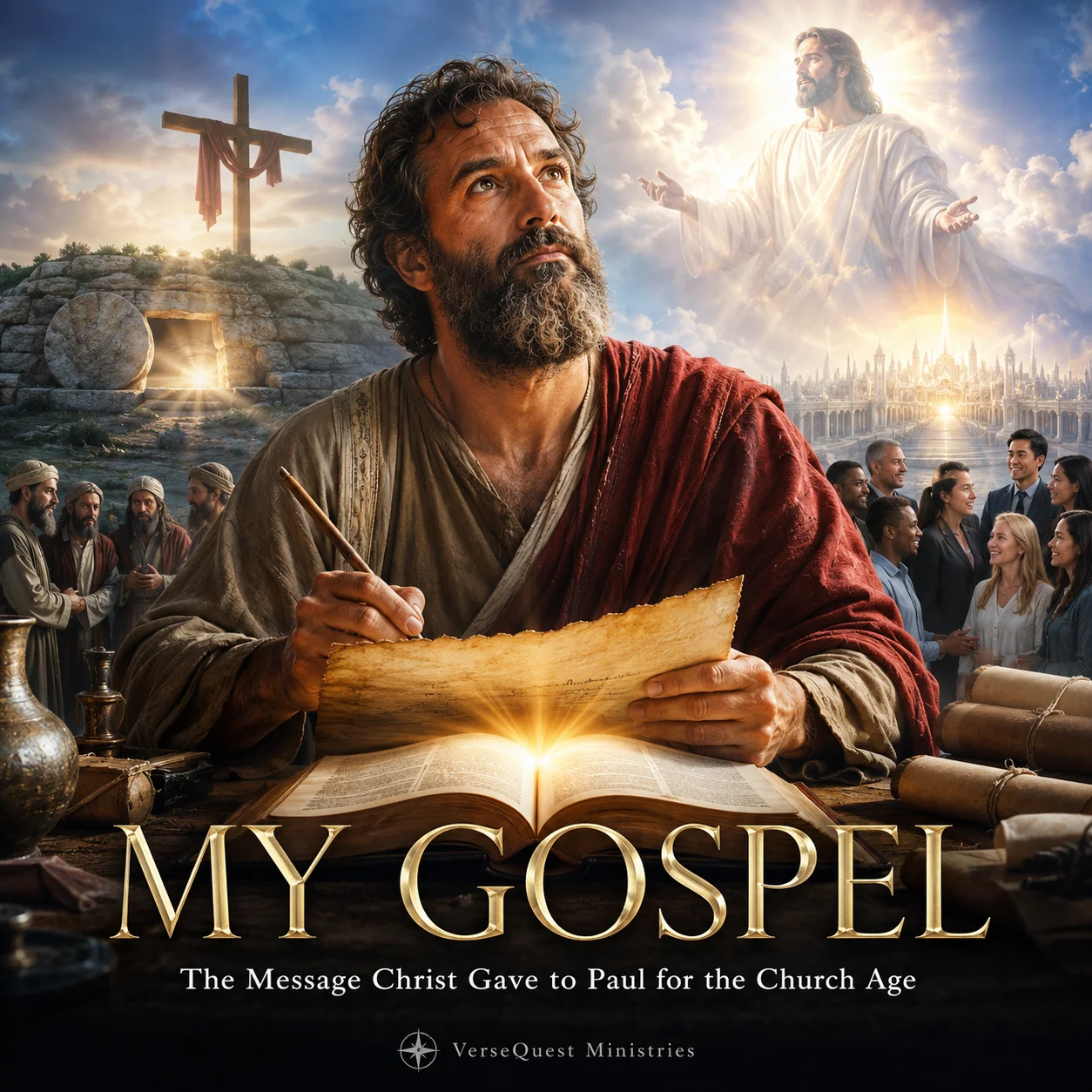
My Gospel
The Message Christ Gave to Paul for the Church Age
Introduction
There are phrases in the Bible that a man can read for years and still never stop long enough to ask why God wrote them the way He did. One of those phrases is found in Romans 2:16, where Paul says, “according to my gospel.” That is not casual language. The Holy Ghost did not waste words. Paul did not say “according to the gospel” only, though it certainly is the gospel of Christ. He said, “my gospel.” That phrase appears again in Romans 16:25 and 2 Timothy 2:8. A Bible believer ought to stop and ask why the apostle to the Gentiles would call it “my gospel.” Was Paul boasting in himself? No. Was Paul inventing a religion? No. Was Paul preaching another Jesus? Absolutely not. Paul was identifying a message and revelation committed to him by the risen Lord Jesus Christ for the present dispensation.
The confusion begins when men refuse to recognize Paul’s distinct apostleship. The average religious system reads Matthew, Mark, Luke, John, Acts, Hebrews, James, Revelation, and Paul’s epistles as though every passage is giving the same doctrinal message to the same people under the same commission. That is how sinners end up being told to believe, repent, keep commandments, endure to the end, confess sins, get baptized, take sacraments, join the church, keep the Sabbath, stay faithful, follow the Sermon on the Mount, and hope they make it. That is not the gospel of the grace of God. That is a denominational blender. The gospel Paul preached for salvation today is clear: “Christ died for our sins according to the scriptures; and that he was buried, and that he rose again the third day.”
Right division does not make Paul the Saviour. Jesus Christ is the Saviour. Right division does not replace Christ with Paul. God forbid. Right division recognizes that the risen Christ gave Paul a distinct commission and revelation for the Body of Christ. Paul’s gospel magnifies the finished work of Christ, clarifies salvation by grace, reveals the mystery, establishes the Church’s doctrine, and separates Church-age truth from Israel’s kingdom program. If a man gets Paul’s gospel wrong, he will eventually get assurance wrong, the Church wrong, prophecy wrong, Christian liberty wrong, and the judgment seat wrong. But if he gets Paul’s gospel right, the Bible begins to open with order, clarity, and spiritual power.
I. Paul Called It “My Gospel” Because It Was Committed to Him
Key Text: Romans 2:16
Supporting Texts: Romans 16:25; 2 Timothy 2:8; 1 Timothy 1:11
Romans 2:16 says that God will judge the secrets of men by Jesus Christ “according to my gospel.” Romans 16:25 says God is able to stablish believers “according to my gospel, and the preaching of Jesus Christ, according to the revelation of the mystery.” Second Timothy 2:8 says, “Remember that Jesus Christ of the seed of David was raised from the dead according to my gospel.” That repeated phrase is not accidental. Paul identifies a gospel committed to him in a special way.
First Timothy 1:11 speaks of “the glorious gospel of the blessed God, which was committed to my trust.” Paul did not take this message upon himself. It was committed to him. A steward does not own the treasure; he is entrusted with it. Paul was a steward of truth given by revelation. The gospel he preached belonged to God, centered on Christ, and was empowered by the Holy Ghost, but it was committed to Paul as the apostle of the Gentiles.
This is why careless Bible handling is dangerous. When men ignore Paul’s distinctive ministry, they blur the gospel committed to him. They may still use the word “gospel,” but they begin adding elements from other settings: water baptism from Acts 2, endurance from Matthew 24, law from Moses, kingdom demands from the Sermon on the Mount, and works from tribulation passages. Paul’s “my gospel” must be left where God put it and preached as God revealed it.
Main Truth:
Paul called it “my gospel” because the risen Christ committed a distinct gospel and doctrinal revelation to him for the present dispensation.
II. Paul’s Gospel Was Received by Revelation, Not Religious Tradition
Key Text: Galatians 1:11–12
Supporting Texts: Galatians 1:15–17; Ephesians 3:3; Acts 9:15–16
Paul writes in Galatians 1:11–12, “But I certify you, brethren, that the gospel which was preached of me is not after man. For I neither received it of man, neither was I taught it, but by the revelation of Jesus Christ.” That is one of the strongest statements in the New Testament concerning Paul’s authority. Paul did not learn his gospel in a Bible college. He did not receive it from the twelve. He did not get it from a church council in Jerusalem. He received it by revelation from Jesus Christ.
That matters because Paul’s ministry begins after the cross, after the resurrection, after the ascension, and after Israel’s continued rejection in early Acts. Paul was not one of the twelve apostles who followed Christ during His earthly ministry to Israel. He was saved as the chief of sinners and made a pattern of longsuffering. Christ arrested the persecutor and turned him into the apostle of the Gentiles. That alone should tell the Bible student that God is doing something significant in Paul’s calling.
Ephesians 3:3 says, “How that by revelation he made known unto me the mystery.” Paul’s gospel and doctrine are inseparably connected to revelation. This does not mean Paul preached against Christ’s earthly ministry. It means the risen Christ revealed truth through Paul that had not been made known before in the same way. A man who treats Paul as merely a later echo of Peter will miss the doctrine God gave the Church through him.
Main Truth:
Paul’s gospel was not received from man or religious tradition, but by direct revelation from the risen Lord Jesus Christ.
III. Paul’s Gospel Centers on the Death, Burial, and Resurrection of Christ
Key Text: 1 Corinthians 15:1–4
Supporting Texts: Romans 4:24–25; Romans 5:8–9; 2 Timothy 2:8
First Corinthians 15:1–4 gives the clearest statement of the gospel by which men are saved today. Paul writes, “Moreover, brethren, I declare unto you the gospel which I preached unto you,” then says, “by which also ye are saved,” and defines it: “how that Christ died for our sins according to the scriptures; and that he was buried, and that he rose again the third day according to the scriptures.” That is the heart of Paul’s gospel. Not religion. Not sacraments. Not law-keeping. Not moral reform. Not turning over a new leaf. Christ died, Christ was buried, Christ rose again.
This gospel rests on a finished historical work. The death of Christ was not a tragedy that God turned into an object lesson. It was a substitutionary sacrifice for sins. Romans 5:8 says, “Christ died for us.” Romans 5:9 says we are “justified by his blood.” The burial proves He truly died. The resurrection proves God accepted the payment, conquered death, and raised Christ for our justification. Romans 4:25 says He “was delivered for our offences, and was raised again for our justification.”
This is where the sinner must be brought. Not to a baptistry first. Not to a confessional booth. Not to a denominational altar. Not to a priest. Not to a religious system. The sinner must be brought to the crucified, buried, risen Christ. Paul’s gospel is not advice for self-improvement. It is good news concerning a completed redemption. The gospel does not say, “Do your best and maybe God will accept you.” It says Christ did the work sinners could never do.
Main Truth:
Paul’s gospel centers on the finished work of Christ: His death for our sins, His burial, and His resurrection the third day.
IV. Paul’s Gospel Is the Gospel of Grace, Not the Gospel of Religious Works
Key Text: Acts 20:24
Supporting Texts: Ephesians 2:8–9; Romans 3:24–28; Titus 3:5
Paul called his ministry “the gospel of the grace of God” in Acts 20:24. That title matters. Grace means the sinner is saved by what God provides, not by what man performs. Ephesians 2:8–9 says, “For by grace are ye saved through faith… not of works, lest any man should boast.” That verse is hated by every religious system that wants to keep the sinner dependent upon its machinery. But God’s gospel does not leave room for boasting.
Romans 3:24 says believers are “justified freely by his grace through the redemption that is in Christ Jesus.” The word “freely” destroys human merit. Romans 3:28 says, “Therefore we conclude that a man is justified by faith without the deeds of the law.” That conclusion is not a suggestion. It is apostolic doctrine. Salvation in this dispensation is not faith plus Moses, faith plus sacraments, faith plus church membership, faith plus endurance, faith plus water, faith plus Sabbath, or faith plus good works. It is faith in Jesus Christ and His finished work.
Titus 3:5 says, “Not by works of righteousness which we have done, but according to his mercy he saved us.” Religious men are always trying to sneak their works back into the gospel. They may call them conditions, evidences, sacraments, covenant faithfulness, perseverance, or obedience, but if those works become part of the ground of salvation, grace is corrupted. Paul’s gospel protects the sinner from boasting and gives all glory to Christ.
Main Truth:
Paul’s gospel is the gospel of grace, saving sinners by faith in Christ apart from religious works or human merit.
V. Paul’s Gospel Must Be Distinguished From the Gospel of the Kingdom
Key Text: Galatians 2:7–9
Supporting Texts: Matthew 10:5–7; Matthew 24:14; Acts 20:24
Galatians 2:7–9 says that “the gospel of the uncircumcision” was committed unto Paul, as “the gospel of the circumcision” was unto Peter. That passage does not teach two Saviours. It does not teach that Christ’s blood is unnecessary in one program. It teaches that God committed different commissions and messages to different apostles in different settings. Peter’s ministry was connected to the circumcision. Paul’s ministry was connected to the Gentiles.
In Matthew 10:5–7, the twelve were told, “Go not into the way of the Gentiles,” and “go rather to the lost sheep of the house of Israel,” preaching, “The kingdom of heaven is at hand.” That message was true and God-given, but it is not the same commission Paul later received to preach the gospel of the grace of God among the Gentiles. Matthew 24:14 speaks of “this gospel of the kingdom” being preached in a tribulation setting before the end comes. That is not the same doctrinal setting as 1 Corinthians 15:1–4.
Confusing these messages produces confusion about salvation, endurance, works, baptism, signs, Israel, and the Church. The gospel of the kingdom announces the King and kingdom in connection with Israel’s prophetic hope. Paul’s gospel announces the finished work of Christ for sinners and reveals the Body of Christ in the dispensation of grace. Both exalt Christ, but they must be rightly divided.
Main Truth:
Paul’s gospel must be distinguished from kingdom preaching so the gospel of grace is not mixed with Israel’s prophetic program.
VI. Paul’s Gospel Is Connected to the Revelation of the Mystery
Key Text: Romans 16:25
Supporting Texts: Ephesians 3:1–9; Colossians 1:25–27; 1 Corinthians 2:7
Romans 16:25 says God is able to stablish believers “according to my gospel, and the preaching of Jesus Christ, according to the revelation of the mystery.” That verse connects Paul’s gospel with the mystery. The mystery was not a spiritual riddle that nobody can know. It was truth once hidden in God but now revealed. Paul’s gospel does not stand alone as a bare salvation formula; it belongs to a larger doctrinal revelation concerning Christ and the Church.
Ephesians 3:5 says the mystery “in other ages was not made known unto the sons of men, as it is now revealed.” Colossians 1:26 calls it “the mystery which hath been hid from ages and from generations, but now is made manifest to his saints.” This mystery includes Jew and Gentile in one Body, Christ in you the hope of glory, the dispensation of grace, the Church’s heavenly calling, and the truth that saved Jews and Gentiles are fellowheirs in Christ.
This is why Paul’s gospel establishes believers. A man may be saved and still confused if he does not learn the doctrine that follows. He may know Christ died for his sins but still mix Israel and the Church, law and grace, prophecy and mystery, the rapture and the Second Advent, the judgment seat and the Great White Throne. Romans 16:25 shows that believers are established by Paul’s gospel and the revelation of the mystery. Salvation begins the Christian life, but sound doctrine establishes it.
Main Truth:
Paul’s gospel is joined to the revelation of the mystery, which establishes the believer in Church-age truth.
VII. Paul’s Gospel Reveals the One Body of Christ
Key Text: Ephesians 2:15–16
Supporting Texts: 1 Corinthians 12:13; Ephesians 1:22–23; Galatians 3:28
Ephesians 2:15 says Christ made “in himself of twain one new man.” That “one new man” is not Israel under another name. It is not Gentiles becoming spiritual Jews. It is not a denomination. It is the Body of Christ. Ephesians 1:22–23 says the Church is “his body, the fulness of him that filleth all in all.” This truth is central to Paul’s doctrine and connected to the present dispensation.
First Corinthians 12:13 says, “For by one Spirit are we all baptized into one body.” That baptism is not water baptism. It is the Spirit placing the believer into Christ. In this Body, saved Jews and saved Gentiles stand together in Christ without covenant superiority. Galatians 3:28 says, “There is neither Jew nor Greek… for ye are all one in Christ Jesus.” That is positional truth inside the Body of Christ.
This truth does not erase Israel’s national future. It does not cancel the promises God made to the fathers. It does not mean the Church replaces Israel. It means that during the present dispensation, God is forming the Body of Christ through Paul’s gospel. Saved sinners are placed into Christ, sealed by the Spirit, blessed with spiritual blessings, and given a heavenly calling. This is part of the glory of Paul’s gospel.
Main Truth:
Paul’s gospel reveals the one Body of Christ, where saved Jews and Gentiles are made one new man in Him.
VIII. Paul’s Gospel Establishes Assurance, Liberty, and the Believer’s Standing
Key Text: Romans 5:1–2
Supporting Texts: Romans 8:1; Colossians 2:10; Galatians 5:1; Ephesians 1:6
Romans 5:1 says, “Therefore being justified by faith, we have peace with God through our Lord Jesus Christ.” That is assurance. The believer is not hoping to get peace someday if he performs well enough. He has peace with God because he has been justified by faith. Romans 8:1 says, “There is therefore now no condemnation to them which are in Christ Jesus.” Paul’s gospel gives the believer a settled standing in Christ.
Colossians 2:10 says, “And ye are complete in him.” Religion hates that verse because religious systems need sinners to feel incomplete without their rituals, priests, sacraments, traditions, and institutions. But the Bible says the believer is complete in Christ. Ephesians 1:6 says he is “accepted in the beloved.” That is not temporary probation. That is a standing God gives in His Son.
Galatians 5:1 says, “Stand fast therefore in the liberty wherewith Christ hath made us free.” Paul’s gospel frees the believer from the law as a covenant system, from religious bondage, from condemnation, and from the fear that Christ’s work was insufficient. Christian liberty is not liberty to sin. It is liberty to serve God from a position of acceptance rather than from fear of rejection. The believer works because he is saved, not to become saved.
Main Truth:
Paul’s gospel establishes the believer in assurance, liberty, acceptance, and completeness in Christ.
IX. Paul’s Gospel Will Be the Standard of Judgment for the Secrets of Men
Key Text: Romans 2:16
Supporting Texts: 2 Corinthians 5:10; 1 Corinthians 3:11–15; Revelation 20:11–15
Romans 2:16 says God will judge the secrets of men by Jesus Christ “according to my gospel.” That is a solemn statement. Paul’s gospel is not merely an invitation to be considered. It is the divine standard by which men will be held accountable in this dispensation. Men may hide behind religion, morality, philosophy, church membership, education, family tradition, baptism, or good intentions, but God sees the secrets of men. He knows what they did with the light they had and what they did with Jesus Christ.
For the lost, rejection of the gospel will end in judgment. Revelation 20 shows the Great White Throne, where the dead stand before God. No religious excuse will survive there. The issue will not be whether a man admired Jesus, respected religion, joined a church, or lived better than his neighbor. The issue will be sin, guilt, righteousness, and whether he believed on the Lord Jesus Christ. Paul’s gospel leaves no room for boasting and no shelter for unbelief.
For the saved, Paul’s doctrine also teaches the judgment seat of Christ. Second Corinthians 5:10 says believers must appear before the judgment seat of Christ. First Corinthians 3 shows that service will be tried by fire. This is not the Great White Throne. It is not a judgment to determine salvation. It is the judgment of the believer’s service. Paul’s gospel saves the sinner, and Paul’s doctrine prepares the saint to serve with eternity in view.
Main Truth:
Paul’s gospel will expose the secrets of men, condemn unbelief, and establish the standard by which Church-age truth is judged.
Conclusion
When Paul said “my gospel,” he was not exalting himself. He was magnifying the message committed to him by the risen Lord Jesus Christ. That message centers on the finished work of Christ: His death for our sins, His burial, and His resurrection the third day. It is the gospel of grace. It saves apart from works. It establishes the believer in assurance. It reveals the mystery. It explains the one Body. It distinguishes the Church from Israel and keeps the gospel from being polluted with law, kingdom demands, religious ordinances, or tribulation confusion.
The Church desperately needs to recover Paul’s gospel. Not as a slogan. Not as a debate point. Not as a chart on a wall. It must recover Paul’s gospel as the living message by which sinners are saved and saints are established. Modern religion has buried the gospel under sacraments, systems, covenants, emotionalism, legalism, Calvinistic fatalism, charismatic confusion, and denominational tradition. But the Bible still says salvation is by grace through faith. The Bible still says Christ died for our sins. The Bible still says the believer is justified freely by grace. The Bible still says the Church is Christ’s Body. The Bible still says Paul is the apostle of the Gentiles.
A man who rejects Paul’s gospel does not become more faithful to Jesus Christ. He rejects the message Jesus Christ revealed from heaven. A man who ignores Paul’s doctrine does not become more balanced. He becomes confused. The approved workman must consider what Paul says, rightly divide the word of truth, preach the gospel of the grace of God clearly, and refuse to mix the finished work of Christ with religious conditions God never added. The gospel Paul called “my gospel” is the message this lost world needs and the message the Church must never surrender.
Final Call
The sinner does not need a religious improvement plan. He needs the gospel. He does not need a priest, a sacrament, a church system, a law code, a water ceremony, or a list of promises to try harder. He needs the crucified, buried, and risen Lord Jesus Christ. Christ died for your sins. He was buried. He rose again the third day. That is the gospel by which men are saved today.
Do not trust your works. Do not trust your church. Do not trust your baptism. Do not trust your emotions. Do not trust your morality. Believe on the Lord Jesus Christ, and thou shalt be saved. The work is finished. The blood has been shed. The tomb is empty. The Saviour lives.
Believer, stop letting religion complicate what God made clear. Learn Paul’s gospel. Stand in grace. Rejoice in your position in Christ. Study the mystery. Rightly divide the word of truth. Preach the gospel of grace plainly, boldly, and without apology.
Closing Verse:
1 Corinthians 15:3–4 — “For I delivered unto you first of all that which I also received, how that Christ died for our sins according to the scriptures; And that he was buried, and that he rose again the third day according to the scriptures.”
Closing Statement:
The gospel Paul called “my gospel” is not man’s religion improved, but Christ’s finished work revealed, preached, believed, and defended for the Church age.