Sermon Title:
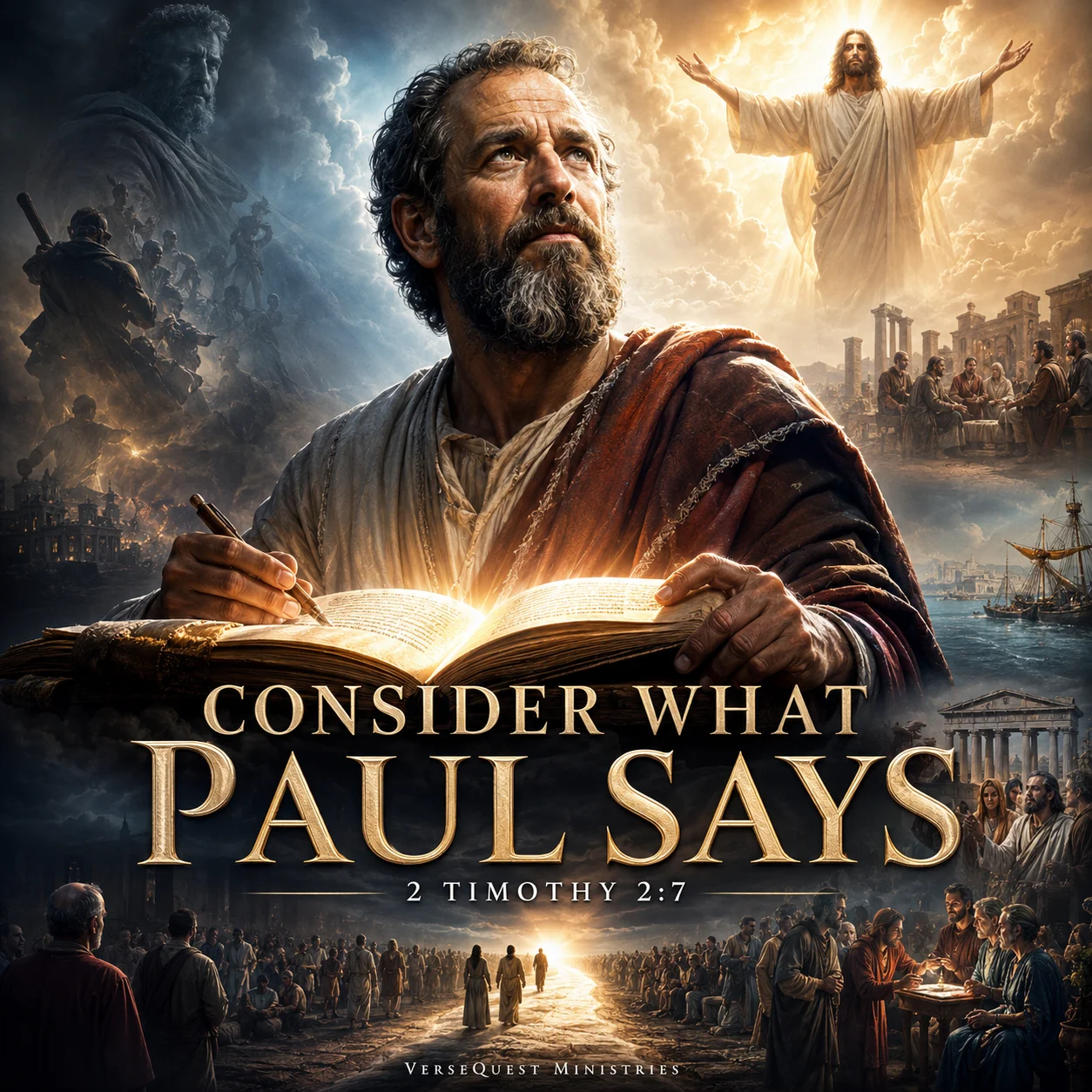
Consider What Paul Says: The Key Christ Gave the Church to Understand All Things
Key Passage:
2 Timothy 2:7 — “Consider what I say; and the Lord give thee understanding in all things.”
Series:
Foundations of Right Division
Topic:
Pauline Doctrine, Church-Age Understanding, and the Command to Consider Paul’s Words
Book:
2 Timothy, Romans, Galatians, Ephesians, Colossians, 1 Corinthians, Acts
Speaker:
Paul Tackett
Suggested Sermon Text:
2 Timothy 2:1–15; Romans 11:13; Romans 16:25–26; Galatians 1:11–12; Galatians 2:7–9; Ephesians 3:1–9; Colossians 1:25–27; 1 Corinthians 11:1; 1 Corinthians 15:1–4; Acts 20:24
Short Sermon Description:
This sermon outline explains why Paul’s command in 2 Timothy 2:7 is essential for understanding Church-age doctrine: “Consider what I say; and the Lord give thee understanding in all things.” Paul was not exalting himself above Jesus Christ or asking believers to follow a man blindly. He was identifying the doctrine, gospel, and revelation entrusted to him by the risen Christ for the present dispensation of grace. This study shows how considering Paul clarifies salvation by grace, the revelation of the mystery, the Body of Christ, Israel and the Church, law and grace, prophecy and mystery, the rapture, Christian liberty, and the believer’s heavenly calling. It also exposes the confusion caused when churches quote Paul selectively while rejecting his distinct apostleship. This outline equips pastors, teachers, Bible students, and believers to receive all Scripture while recognizing Paul’s God-given doctrinal authority for the Church.
Consider What Paul Says
The Key Christ Gave the Church to Understand All Things
Introduction
Second Timothy 2:7 contains one of the simplest and most neglected keys to Bible understanding: “Consider what I say; and the Lord give thee understanding in all things.” Paul does not say, “Ignore what I say and create your own theology.” He does not say, “Treat my epistles as optional commentary beneath every other passage.” He does not say, “Blend my doctrine with Moses, the kingdom commission, tribulation endurance, temple ordinances, and every sign passage in Acts.” He says, “Consider what I say.” Then he connects considering his words with the Lord giving understanding. That means there is something in Paul’s God-given message that brings order, clarity, and doctrinal stability to the believer.
The religious world often claims to honor Paul while resisting nearly everything distinctive about his ministry. It quotes Romans 8 for comfort, Ephesians 2:8–9 for salvation, Philippians 4:13 for encouragement, and 1 Corinthians 13 for weddings, yet refuses Romans 11:13, Galatians 2:7–9, Romans 16:25, Ephesians 3:1–9, and Colossians 1:25–27. It likes Paul when he sounds inspirational, but rejects him when he says, “I am the apostle of the Gentiles,” “my gospel,” “the dispensation of the grace of God,” and “the revelation of the mystery.” That selective use of Paul produces selective understanding. Men keep the verses they enjoy and discard the apostolic framework that explains them.
Considering Paul does not mean worshipping Paul. Paul did not die for our sins. Paul did not rise from the dead. Paul is not the Head of the Church. Paul is not the Mediator between God and men. Jesus Christ alone is the Saviour, Lord, Head, and Mediator. But the risen Christ chose Paul, saved Paul, commissioned Paul, revealed truth to Paul, and sent Paul to the Gentiles. Therefore, to consider what Paul says is to receive what Christ revealed through His chosen apostle for the Body of Christ. The Church cannot claim to honor Christ while despising the apostolic channel through which Christ revealed Church-age doctrine.
I. “Consider” Means More Than Merely Reading Paul
Key Text: 2 Timothy 2:7
Supporting Texts: Proverbs 4:20–22; 1 Timothy 4:15; 2 Timothy 2:15
The word “consider” demands attention, thought, comparison, and serious reflection. Paul does not tell Timothy merely to glance at his words. He tells him to consider them. A man may read Romans and never consider Romans. He may quote Ephesians and never understand the dispensation revealed there. He may memorize 1 Corinthians 15:3–4 and still mix the gospel of grace with kingdom conditions, law, sacraments, endurance, or religious works. Reading alone does not guarantee understanding. The words must be studied, weighed, believed, and placed in their proper context.
First Timothy 4:15 says, “Meditate upon these things; give thyself wholly to them; that thy profiting may appear to all.” Paul’s doctrine requires more than superficial church attendance. It requires a workman. Second Timothy 2:15 commands Timothy to study, to shew himself approved unto God, and to rightly divide the word of truth. A lazy reader sees every verse as identical in application. An approved workman asks who is speaking, to whom, under what commission, in what dispensation, and with what doctrinal purpose.
This is why so many Christians remain confused even while owning several Bibles. The issue is not always lack of access. It is lack of consideration. They rush through passages, depend on denominational assumptions, repeat inherited slogans, and never stop to ask why Paul uses phrases like “my gospel,” “but now,” “the mystery,” “one new man,” “the Body of Christ,” and “the dispensation of grace.” Understanding begins when the believer slows down, opens the Book, and considers exactly what Paul says.
Main Truth:
To consider Paul means to study, weigh, believe, and rightly place the doctrine Christ revealed through him.
II. Paul’s Words Carry Apostolic Authority From Jesus Christ
Key Text: Galatians 1:11–12
Supporting Texts: Acts 9:15; Acts 26:16–18; 1 Corinthians 14:37
Paul’s authority did not originate in himself. Galatians 1:11–12 says, “the gospel which was preached of me is not after man. For I neither received it of man, neither was I taught it, but by the revelation of Jesus Christ.” Paul did not develop his gospel through philosophical reflection. He did not receive it from Peter, James, John, a Jerusalem school, or a church council. The risen Lord Jesus Christ revealed it to him. That gives Paul’s words apostolic authority.
Acts 9:15 calls Paul “a chosen vessel” to bear Christ’s name before Gentiles, kings, and the children of Israel. Acts 26 records Christ telling Paul that He appeared to make him a minister and witness of things already seen and of things Christ would later reveal. Paul’s ministry therefore came through repeated revelation from the glorified Christ. His authority is not the authority of a religious celebrity. It is the authority of an apostle commissioned by the Lord from heaven.
First Corinthians 14:37 says, “If any man think himself to be a prophet, or spiritual, let him acknowledge that the things that I write unto you are the commandments of the Lord.” That verse destroys the idea that Paul’s epistles are merely personal opinions. Paul’s writings contain the commandments of the Lord for the Church. A man does not prove spirituality by rejecting Paul. He proves rebellion. The spiritual man acknowledges the authority of the doctrine Christ gave through Paul.
Main Truth:
Paul’s words carry authority because they were revealed and commanded by the risen Lord Jesus Christ.
III. Considering Paul Clarifies the Gospel That Saves Today
Key Text: 1 Corinthians 15:1–4
Supporting Texts: Acts 20:24; Romans 3:24–28; Ephesians 2:8–9
Paul clearly defines the gospel by which men are saved today. First Corinthians 15:1–4 says Christ died for our sins according to the Scriptures, was buried, and rose again the third day according to the Scriptures. That message is not a vague call to become religious. It is not the announcement that the kingdom is at hand. It is not a command to endure through the tribulation. It is the good news of a finished work accomplished by Jesus Christ for sinners.
Acts 20:24 calls Paul’s message “the gospel of the grace of God.” Romans 3:24 says believers are justified freely by grace through the redemption that is in Christ Jesus. Romans 3:28 concludes that a man is justified by faith without the deeds of the law. Ephesians 2:8–9 says salvation is by grace through faith, not of works. These passages give unmatched clarity concerning salvation in the present dispensation.
When Paul is not considered, men start mixing the gospel. They add water baptism from Acts 2, endurance from Matthew 24, law from Moses, sacraments from religious tradition, and works from passages directed to other settings. The sinner is left wondering whether Christ’s finished work is enough. Considering Paul clears the fog. Christ died for our sins, was buried, and rose again. The sinner believes and is justified by grace through faith.
Main Truth:
Considering Paul clarifies that salvation today rests entirely upon Christ’s death, burial, and resurrection, received by faith apart from works.
IV. Considering Paul Reveals the Dispensation of Grace
Key Text: Ephesians 3:2
Supporting Texts: 1 Corinthians 9:17; Colossians 1:25; Romans 6:14
Ephesians 3:2 says Paul was given “the dispensation of the grace of God” to the Gentiles. The word “dispensation” is not a man-made theological invention. It is Bible language. It describes a stewardship or administration committed by God. Paul was entrusted with a specific administration of grace connected to the present work of God among the Gentiles and the formation of the Body of Christ.
First Corinthians 9:17 says “a dispensation of the gospel is committed unto me.” Colossians 1:25 says Paul was made a minister according to a dispensation given to him “to fulfil the word of God.” These verses establish Paul as a steward. The truth did not originate in him, but it was entrusted to him. He was responsible to reveal, preach, and preserve it for the Church.
Romans 6:14 summarizes the believer’s standing in this administration: “ye are not under the law, but under grace.” That does not mean grace encourages sin. It means the believer is not under the Mosaic law as his covenant system. He stands in Christ. When Paul is ignored, churches drag believers back under Sinai, ordinances, Sabbath signs, meats, holy days, and religious bondage. Considering Paul reveals where the believer stands: under grace.
Main Truth:
Considering Paul reveals the present dispensation of grace and the believer’s freedom from the Mosaic law as a covenant system.
V. Considering Paul Unveils the Mystery Hid From Ages
Key Text: Romans 16:25
Supporting Texts: Ephesians 3:3–9; Colossians 1:25–27; Acts 3:21
Romans 16:25 speaks of “the revelation of the mystery, which was kept secret since the world began.” That statement must be compared with Acts 3:21, where Peter speaks of things God had spoken by the mouth of all His holy prophets since the world began. One body of truth was spoken. The other was kept secret. One is prophecy. The other is mystery. If those two categories are mixed, the entire Bible becomes confused.
Ephesians 3 says the mystery was made known to Paul by revelation and had been hid in God. Colossians 1 says it was hid from ages and generations but was now made manifest to the saints. The mystery includes Christ in the believer, the Body of Christ, Jew and Gentile of the same Body, the one new man, and the Church’s heavenly calling. These truths were not Israel’s kingdom program reworded. They were hidden truth now revealed.
Considering Paul therefore opens a major division in Scripture. Prophecy concerns what God spoke regarding Israel, the kingdom, the land, the covenants, the throne, and Messiah’s earthly reign. Mystery concerns the Body of Christ, the dispensation of grace, and the heavenly calling revealed through Paul. Right division preserves both. Confusion comes from forcing one into the other.
Main Truth:
Considering Paul reveals the mystery once hidden in God and distinguishes it from Israel’s prophetic program.
VI. Considering Paul Clarifies Israel and the Church
Key Text: Romans 11:25–29
Supporting Texts: 1 Corinthians 10:32; Ephesians 2:14–16; Ephesians 1:22–23
First Corinthians 10:32 names three groups: Jews, Gentiles, and the Church of God. Paul’s doctrine preserves those distinctions. Israel is not the Church. The Gentile nations are not the Church. The Church is the Body of Christ, made up of saved Jews and Gentiles placed into one Body by the Holy Ghost. This is not replacement theology. It is mystery truth.
Romans 11 teaches that Israel’s blindness is partial and temporary. Paul says blindness in part has happened to Israel “until the fulness of the Gentiles be come in.” He then says, “And so all Israel shall be saved.” He explains that Israel remains beloved for the fathers’ sakes and that the gifts and calling of God are without repentance. Paul’s revelation of the Church does not cancel Israel. It protects Israel’s future.
Ephesians 2 explains that Christ made of Jew and Gentile “one new man.” He did not make Gentiles into Israel. He did not make Israel disappear. He created something new in Himself: the Body of Christ. Considering Paul keeps Israel’s earthly promises intact and the Church’s heavenly identity clear. Ignoring Paul leads to stolen promises, spiritualized kingdoms, and confusion about prophecy.
Main Truth:
Considering Paul distinguishes Israel from the Church while preserving both Israel’s future and the Body’s present calling.
VII. Considering Paul Establishes the Believer in the Body of Christ
Key Text: 1 Corinthians 12:13
Supporting Texts: Ephesians 1:22–23; Colossians 1:18; Romans 12:4–5
First Corinthians 12:13 says, “For by one Spirit are we all baptized into one body.” That baptism is the Spirit’s operation placing the believer into Christ. It is not a water ceremony performed by man. The moment a sinner believes the gospel, he is sealed by the Spirit, placed into Christ, and made a member of the Body of Christ. This truth is central to Pauline doctrine.
Ephesians 1:22–23 says the Church is Christ’s Body. Colossians 1:18 says Christ is the Head of the Body, the Church. The believer is not merely attached to a religious organization. He is spiritually united to the risen Lord Jesus Christ. His life, standing, acceptance, security, and hope are found in the Head. The Body is not Israel renamed, nor is it a denomination claiming exclusive ownership of salvation.
Romans 12 says believers, being many, are one Body in Christ and members one of another. Considering Paul therefore affects practical Christian living. The members are to serve, love, edify, forgive, and labor together under Christ’s Headship. Pauline doctrine is not cold information. It establishes identity and produces faithful service within the Body.
Main Truth:
Considering Paul establishes believers in their spiritual identity as members of the Body of Christ under Christ the Head.
VIII. Considering Paul Explains the Church’s Heavenly Hope
Key Text: Philippians 3:20
Supporting Texts: 1 Thessalonians 4:13–18; Titus 2:13; Colossians 3:1–4
Philippians 3:20 says, “For our conversation is in heaven; from whence also we look for the Saviour, the Lord Jesus Christ.” The Church’s calling is heavenly. Its Head is in heaven. Its life is hid with Christ in God. Its blessings are in heavenly places. Its hope comes from heaven. This differs from Israel’s earthly kingdom hope centered on land, Jerusalem, David’s throne, and Messiah’s reign over the nations.
First Thessalonians 4 reveals the catching away of the Body of Christ. The dead in Christ rise first, living believers are caught up together with them, and the saints meet the Lord in the air. Paul concludes, “Wherefore comfort one another with these words.” This is not the same scene as the Second Advent in judgment, when Christ comes to earth and His feet stand upon the mount of Olives.
Titus 2:13 calls the Church’s hope “that blessed hope.” The believer is not instructed to look first for the Antichrist, the mark, the abomination of desolation, or Jacob’s trouble. He is looking for the Saviour. Considering Paul clarifies the rapture, protects the blessed hope, and keeps the Church from being dragged into Israel’s prophetic wrath.
Main Truth:
Considering Paul reveals the Church’s heavenly hope in the catching away of the Body before Israel’s prophetic judgments.
IX. Considering Paul Produces Understanding, Stability, and Approved Service
Key Text: 2 Timothy 2:7
Supporting Texts: Romans 16:25; Ephesians 4:14; 2 Timothy 2:15
Paul says the Lord gives understanding when Timothy considers what he says. Romans 16:25 adds that God establishes believers according to Paul’s gospel and the preaching of Jesus Christ according to the revelation of the mystery. The believer is not established by religious excitement, personality-driven preaching, church traditions, or vague spiritual impressions. He is established through sound doctrine.
Ephesians 4 warns believers not to be tossed to and fro by every wind of doctrine. That instability comes when believers do not know where they stand. One preacher puts them under law. Another places them in the tribulation. Another says baptism saves. Another tells them Israel has been replaced. Another mixes signs from Acts with Paul’s doctrine. The believer who understands Paul’s gospel, mystery, Body doctrine, and right division is protected from those winds.
Second Timothy 2:15 connects understanding to approved workmanship. The goal is not merely winning arguments. The goal is being approved unto God. A workman must handle the Book faithfully, preach the gospel clearly, teach saints sound doctrine, and serve Christ without shame. Considering Paul turns the confused reader into an established believer and the established believer into a useful servant.
Main Truth:
Considering Paul brings doctrinal understanding, spiritual stability, and approved service before God.
Conclusion
“Consider what I say; and the Lord give thee understanding in all things.” That verse is not Paul demanding personal admiration. It is an apostolic command directing believers to the doctrine Christ revealed through him. Paul’s gospel explains salvation by grace. Paul’s dispensation explains the believer’s present standing. Paul’s mystery explains the Body of Christ. Paul’s teaching distinguishes Israel from the Church. Paul’s doctrine reveals the blessed hope. Paul’s epistles establish the saints in sound Church-age truth.
When Paul is ignored, confusion multiplies. Law is mixed with grace. Israel is confused with the Church. The kingdom is blended with the Body. Water is added to the gospel. Tribulation endurance is preached to Church-age saints. The rapture is merged with the Second Advent. Acts becomes a doctrinal blender. Religious systems fill the vacuum left by rejected Pauline doctrine. Men may quote many verses, but they cannot place them properly because they refuse the apostolic key Christ gave the Gentiles.
The answer is not to throw away any part of Scripture. All Scripture is profitable. The answer is to rightly divide all Scripture. Believe Moses where Moses stands. Believe the prophets where the prophets stand. Believe Matthew in its kingdom setting. Believe Peter in his circumcision ministry. Believe Paul in his Gentile apostleship. Let Israel be Israel. Let the Church be the Body of Christ. Let prophecy remain prophecy. Let mystery remain mystery. Consider what Paul says, and let the Lord give understanding.
Final Call
The sinner today does not need a religious system, law code, sacrament, water ceremony, denominational membership, or personal righteousness. He needs the Lord Jesus Christ. Paul’s gospel is clear: Christ died for our sins according to the Scriptures, He was buried, and He rose again the third day according to the Scriptures.
Believe on the Lord Jesus Christ, and thou shalt be saved. Trust the finished work. Trust the blood. Trust the risen Saviour. Do not trust your works, baptism, feelings, morality, church, or tradition. Salvation is by grace through faith in Christ.
Believer, consider what Paul says. Study Romans through Philemon. Learn the gospel of grace. Understand the mystery. Recognize the Body of Christ. Stand in grace. Rejoice in the blessed hope. Preserve Israel’s future. Rightly divide the word of truth. Let the doctrine Christ revealed through Paul establish your faith and guide your service.
Closing Verse:
Romans 16:25 — “Now to him that is of power to stablish you according to my gospel, and the preaching of Jesus Christ, according to the revelation of the mystery, which was kept secret since the world began.”
Closing Statement:
The believer who considers what Paul says will see the gospel clearly, the Church correctly, Israel faithfully, and the Bible in the order God revealed it.