
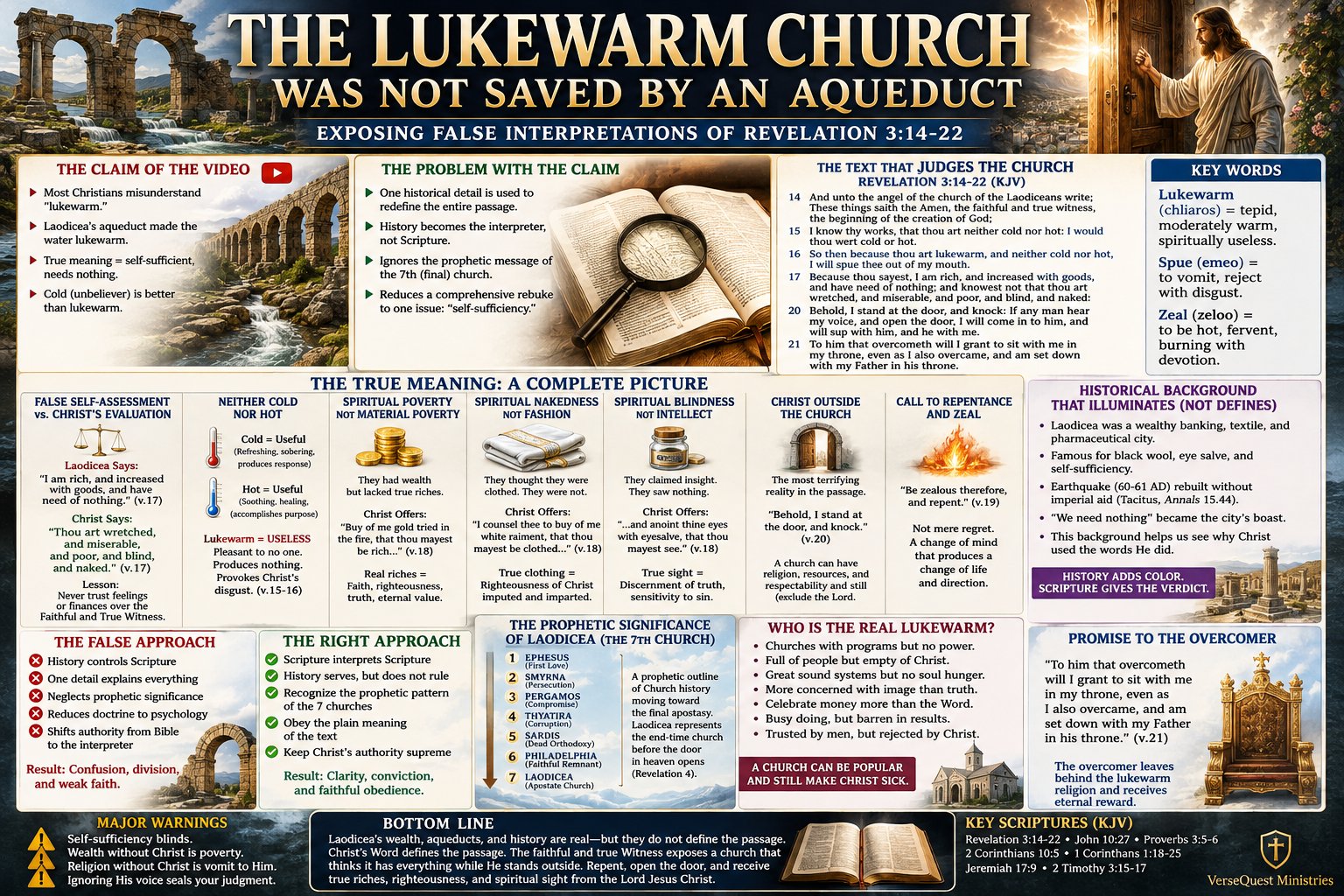
The Lukewarm Church Was Not Saved by an Aqueduct – Revelation 3:14–22 and the True Meaning of Laodicea (KJV Bible Study Chart)
Examine the true meaning of Revelation 3:14–22 with this detailed KJV chart exposing the aqueduct-controlled interpretation while explaining Laodicea’s self-deception, spiritual poverty, blindness, nakedness, Christ outside the church, repentance, and the promise to the overcomer.
$3.99
Description
The Lukewarm Church Was Not Saved by an Aqueduct: Exposing False Interpretations of Revelation 3:14–22 is a detailed KJV Bible study chart examining Christ’s severe message to the church of the Laodiceans and correcting the popular claim that an ancient water system supplies the controlling interpretation of the entire passage.
Built around the complete text of Revelation 3:14–22, this chart places the words of Jesus Christ above historical reconstruction, archaeological speculation, modern sermon illustrations, psychological reductionism, and internet explanations that allow one cultural detail to redefine a comprehensive doctrinal rebuke.
Historical information about Laodicea may help illustrate the setting in which the church lived. The city was prosperous, commercially important, associated with banking, textiles, black wool, medicine, and eye treatments. After a devastating earthquake, Laodicea became known for rebuilding without imperial financial assistance. Such facts help explain why the church could boast, “I am rich, and increased with goods, and have need of nothing.”
The problem begins when historical background stops serving Scripture and starts controlling it. A reconstruction involving hot water, cold water, distant springs, and an aqueduct may provide an interesting illustration, but it cannot be allowed to replace Christ’s own inspired interpretation of the church’s condition.
The title makes the issue memorable: the lukewarm church was not saved by an aqueduct. Its real problem was not municipal plumbing. It was spiritual uselessness, proud self-deception, misplaced confidence, blindness, nakedness, poverty, exclusion of Christ, and refusal to recognize its actual condition.
The message begins with the identity of the Speaker. Jesus Christ introduces Himself as “the Amen, the faithful and true witness, the beginning of the creation of God.” His evaluation is final, accurate, and incapable of error.
The word Amen presents Christ as the certainty, confirmation, and final authority of God. Human opinion may flatter the church, but Christ’s verdict stands.
He is “the faithful and true witness.” Laodicea’s self-assessment was false, but Christ’s testimony was faithful. The church looked at its possessions, success, influence, and outward appearance and concluded that it lacked nothing. Jesus looked through the image and exposed the reality.
Christ is also “the beginning of the creation of God.” This does not teach that Jesus Christ was the first creature made. Scripture reveals Him as the Creator, source, origin, and sovereign Head of creation. All things were made by Him, and without Him was not anything made that was made.
The Lord then declares, “I know thy works.” His judgment is not based upon rumours, denominational reports, attendance totals, financial statements, architectural beauty, online reputation, or public relations.
Jesus Christ knows what a church does, why it does it, what doctrine governs it, what spirit energizes it, what motives hide beneath its ministry, and whether its outward activity possesses genuine spiritual life.
Laodicea was “neither cold nor hot.” The popular aqueduct interpretation frequently argues that hot water was useful for healing, cold water was useful for refreshment, and lukewarm water was useless and nauseating. As an illustration, this may communicate the practical uselessness of lukewarmness.
The chart’s objection is not that every historical observation is worthless. The objection is that the historical illustration must not become the doctrinal authority that defines every detail of the passage.
Some presentations go further and insist that cold cannot mean unbelieving or spiritually dead because cold water was supposedly useful. They then reconstruct the entire passage around local water temperatures and imply that Christ prefers two useful forms of spirituality to one useless form.
The text itself remains the judge. Christ condemns a church that was neither decisively hot nor openly cold. Its condition produced no faithful testimony, no spiritual heat, no refreshing truth, and no honest recognition of need.
Lukewarmness is not biblical balance, moderation, tolerance, calmness, or maturity. It is spiritual uselessness produced by compromise and self-satisfaction.
The church had enough religion to remain respectable but not enough truth to burn. It had enough Christian language to maintain an appearance but not enough conviction to submit to Christ.
Its members did not consider themselves rebellious, poor, blind, or naked. They believed they were successful. That false self-evaluation is the heart of the rebuke.
Laodicea said, “I am rich.” Christ said, “Thou art wretched.” Laodicea said it was “increased with goods.” Christ called it “miserable.” Laodicea said it needed nothing. Christ said it was “poor, and blind, and naked.”
The issue was not merely the possession of wealth. Scripture does not teach that every financially successful person or church is automatically apostate. The issue was trusting material prosperity as evidence of spiritual approval.
Money can purchase buildings, equipment, advertising, professional music, comfortable seating, education, influence, and institutional stability. It cannot purchase the gold Christ offers, the white raiment He provides, or the spiritual eyesight only He can give.
A church may possess a full treasury and an empty altar. It may own property while lacking power. It may be praised by its community while standing beneath Christ’s rebuke.
The Laodiceans possessed material prosperity but suffered spiritual poverty. Christ therefore counseled them to buy from Him “gold tried in the fire.”
The gold represents genuine spiritual riches that endure divine examination. Faith, truth, righteousness, tested character, and eternal value cannot be manufactured by human finance.
Christ also offered “white raiment.” Laodicea’s textile reputation and costly garments could not cover its spiritual nakedness.
The white raiment points to righteousness, purity, acceptance, and the covering supplied by Christ. Religious appearance cannot hide spiritual shame from the eyes of the faithful and true Witness.
The church also needed its eyes anointed with eyesalve so that it might see. Laodicea may have been associated with treatments for physical eyes, yet the church itself was spiritually blind.
It claimed insight but lacked discernment. It possessed information but not illumination. It could evaluate markets, culture, institutions, and outward success while remaining unable to evaluate itself.
Spiritual blindness is especially dangerous when the blind person believes he sees clearly. The Laodiceans did not ask for help because they did not recognize their need.
Christ’s counsel exposes the insufficiency of everything the church trusted. Its money could not purchase true riches. Its clothing could not cover its shame. Its medicine could not restore spiritual sight.
The chart’s central picture is therefore broader than economic self-sufficiency alone. The church was materially rich, spiritually poor, outwardly clothed, inwardly naked, intellectually confident, spiritually blind, religiously active, and practically without Christ at the centre.
One of the most terrifying statements in the passage is Revelation 3:20: “Behold, I stand at the door, and knock.”
The primary context is not Christ standing outside the heart of an entirely unchurched pagan. He is standing outside a church bearing His name.
The church possessed religion, organisation, property, programmes, identity, and reputation, yet Jesus Christ stood outside seeking entrance.
This does not mean Christ had lost sovereignty or become helpless before a wooden door. The image exposes the church’s practical exclusion of the One it claimed to represent.
A church may sing about Christ while refusing His authority. It may preach inspirational messages while avoiding His words. It may use His name to support an institution that no longer submits to Him.
Revelation 3:20 contains an individual invitation within a corporate rebuke: “if any man hear my voice, and open the door.” Even when an assembly has become corrupt, individual hearers remain responsible to respond to Christ.
The Lord promises fellowship: “I will come in to him, and will sup with him, and he with me.” The remedy is not improved branding, a larger crowd, louder music, more polished production, or another historical explanation.
The remedy is hearing Christ’s voice, opening the door, repenting, receiving His counsel, and restoring fellowship with the Lord who has been excluded.
Christ says, “As many as I love, I rebuke and chasten.” His severity does not reveal cruelty. It reveals holy love unwilling to flatter a church toward destruction.
Biblical love does not conceal spiritual disease beneath positive language. Christ exposes the condition because restoration remains possible.
The command is direct: “Be zealous therefore, and repent.” Lukewarmness must not be managed, defended, rebranded, or explained away.
The word zealous communicates heat, earnestness, fervency, intensity, and devoted concern. Christ does not command emotional noise without truth, but He does command a decisive response rather than indifferent religion.
Repentance means a real change of mind producing a changed direction. Laodicea needed to abandon its false evaluation, agree with Christ’s verdict, reject its self-sufficiency, and receive what only He could provide.
The chart refuses to reduce repentance to mere regret. The Lord did not ask the church to feel embarrassed that others had discovered its condition. He commanded a response to His truth.
The passage also contains a promise to the overcomer: “To him that overcometh will I grant to sit with me in my throne.”
The overcomer does not remain behind the lukewarm religious system. He responds to Christ, remains faithful to truth, and receives eternal reward from the true King.
Laodicea’s earthly wealth, influence, and reputation will vanish. Christ’s throne and reward remain.
The chart places the message within the prophetic significance of the seven churches. Ephesus pictures lost first love. Smyrna represents persecution. Pergamos displays compromise. Thyatira reveals corruption. Sardis presents dead orthodoxy. Philadelphia pictures the faithful remnant. Laodicea portrays the apostate church at the end of the sequence.
The seven churches were literal historical assemblies, but their order also presents a prophetic outline of church history moving toward final apostasy. Laodicea stands immediately before the heavenly door opens in Revelation 4.
This prophetic placement magnifies the relevance of the warning. The final religious system is not pictured as outwardly destitute but as rich, confident, self-congratulatory, organised, and blind.
It does not say, “We deny Christ.” It uses Christian identity while keeping Christ outside its practical life.
The chart distinguishes the historical background from the prophetic message. History may add colour, but Scripture gives the verdict.
Historical information should remain a servant. It may clarify the city’s wealth, clothing trade, medical reputation, and civic pride. It cannot define the passage independently of Christ’s words.
The false approach allows history to control Scripture, reduces the passage to one local illustration, neglects its prophetic significance, and shifts authority from the biblical text to the interpreter’s reconstruction.
The right approach allows Scripture to interpret Scripture, recognises the literal church and prophetic pattern, receives the plain meaning of the text, and keeps the authority of Jesus Christ supreme.
The chart asks, “Who is the real lukewarm?” It is the church with programmes but no spiritual power, people but no hunger for Christ, sound equipment but no appetite for truth, activity but little fruit, and public reputation without Christ’s approval.
The lukewarm church becomes more concerned with image than truth, applause than obedience, comfort than conviction, and popularity than faithfulness.
It celebrates success measured by attendance, revenue, influence, networking, buildings, and presentation while neglecting doctrine, repentance, holiness, prayer, biblical authority, and the gospel.
It may remain busy while barren in results. Activity becomes a substitute for anointing, and religious motion conceals the absence of spiritual life.
The chart’s warning is sharp: a church can be popular and still make Christ sick. Human approval does not overturn the verdict of the faithful and true Witness.
The Greek word translated “lukewarm” communicates a tepid condition. The word translated “spue” carries the force of vomiting or rejecting with disgust.
Christ’s language is intentionally severe. He does not say lukewarm religion is mildly disappointing. He presents it as nauseating.
Modern readers may attempt to soften the language because it conflicts with sentimental ideas of Jesus Christ. The biblical Christ loves, rebukes, chastens, commands repentance, judges churches, and rewards overcomers.
The word “zeal” points toward burning devotion. The proper opposite of lukewarmness is not artificial excitement but fervent obedience rooted in truth.
The chart includes major warnings applicable to churches and individual believers. Self-sufficiency blinds. Wealth without Christ is poverty. Religion without Christ is vomit to Him. Ignoring His voice seals the judgment.
These warnings should not be used merely to attack other churches. Every believer should allow the passage to search his own heart, priorities, dependence, doctrine, obedience, and fellowship with Christ.
The practical questions are unavoidable. Has material success become the measure of spiritual approval? Has comfort replaced conviction? Has religious activity replaced fellowship with Christ?
Does Scripture govern the church, or is Scripture adjusted to protect the institution? Is Jesus Christ truly central, or is His name being used to market a programme that would continue almost unchanged without Him?
The passage also protects believers from trusting feelings over faithful evaluation. Laodicea felt secure, prosperous, and satisfied. Christ’s words exposed a reality its emotions could not detect.
Proverbs warns against trusting one’s own heart. The believer must judge spiritual condition by Scripture rather than confidence, popularity, or outward success.
The doctrine of Laodicea also warns against confusing biblical Christianity with cultural Christianity. A church may retain crosses, songs, religious vocabulary, holiday services, and a Christian name while abandoning biblical authority.
Christ’s counsel remains the only cure. True riches come from Him. True righteousness comes from Him. True spiritual sight comes from Him. Fellowship is restored through hearing His voice and responding in repentance.
The final focus must remain upon Jesus Christ. The chart does not merely expose a false aqueduct interpretation for the sake of winning an argument.
It calls churches and believers back to the faithful and true Witness whose verdict outranks historians, scholars, influencers, institutions, traditions, and popular teachers.
The bottom line is clear: Laodicea’s wealth, civic confidence, commercial success, and possible water history may illuminate the background, but they do not define the passage.
Christ’s Word defines the passage. The church was self-deceived, spiritually poor, naked, blind, lukewarm, and practically separated from its Lord.
The answer was not a better aqueduct theory. The answer was repentance, zeal, true riches, Christ’s righteousness, spiritual sight, renewed fellowship, and faithful overcoming.
This resource is ideal for personal Bible study, Revelation teaching, Laodicean church studies, KJV prophecy classes, church-history instruction, pastoral training, warnings against apostasy, Christian self-examination, sermon preparation, Sunday school, homeschool Bible curriculum, Bible institutes, apologetics, and anyone encountering popular historical interpretations of Revelation 3:14–22.
The lukewarm church, Laodicean church, Revelation 3:14–22, lukewarm Christianity, aqueduct interpretation, history versus Scripture, faithful and true Witness, spiritual self-deception, rich yet poor, spiritual blindness, spiritual nakedness, Christ outside the church, be zealous and repent, the overcomer, seventh church of Revelation, prophetic church history, apostate church, religious self-sufficiency, biblical repentance, authority of Scripture
Revelation 3:14–22 is Christ’s direct message to the literal church of the Laodiceans and also carries broader prophetic and practical significance.
Historical background can illuminate the passage, but it must not become the final interpreter of Scripture.
The possible condition of Laodicea’s water supply does not replace Christ’s own description of the church as wretched, miserable, poor, blind, and naked.
The Lord identifies Himself as the Amen and the faithful and true Witness. His evaluation outranks the church’s self-assessment.
The phrase “the beginning of the creation of God” identifies Christ as the source and sovereign origin of creation, not as a created being.
Christ knows the church’s works, motives, doctrine, spiritual condition, and actual usefulness.
Lukewarmness is not biblical moderation. It is a useless, compromised condition that provokes Christ’s disgust.
The church’s material wealth did not prove spiritual approval.
Self-sufficiency blinded Laodicea to its desperate spiritual need.
Christ’s counsel concerning gold, white raiment, and eyesalve directly answered the church’s poverty, nakedness, and blindness.
True riches are spiritual and eternal rather than merely financial.
True covering comes through Christ’s righteousness rather than religious appearance.
True spiritual sight comes through Scripture, divine truth, and honest submission to Christ.
Revelation 3:20 primarily pictures Christ outside a church bearing His name.
The verse contains an individual invitation within a corporate rebuke.
Religious organisation can continue while Christ’s authority is practically excluded.
Christ’s rebuke and chastening proceed from holy love rather than cruelty.
The command is to become zealous and repent, not merely regret the consequences of lukewarmness.
Repentance requires agreement with Christ’s verdict and a genuine change of direction.
The promise to the overcomer directs attention from temporary religious success to eternal reward with Christ.
The seven churches were literal assemblies, but their order also presents a prophetic progression culminating in Laodicean apostasy.
History serves Scripture; it does not rule Scripture.
A local illustration should never be allowed to erase the passage’s doctrinal, prophetic, and practical meaning.
Church popularity, wealth, technology, programmes, and public image cannot substitute for truth, holiness, prayer, and fellowship with Jesus Christ.
A church may appear successful to men while standing beneath Christ’s rebuke.
The proper response is renewed submission to Scripture, honest self-examination, repentance, zeal, dependence upon Christ, and restoration of fellowship.
Revelation 3 studies, Laodicean church teaching, correcting popular Bible interpretations, biblical hermeneutics, church self-examination, warnings against apostasy, pastoral accountability, distinguishing background from interpretation, teaching repentance and zeal, Christ-centred ministry, evaluating church success biblically, prophecy classes, KJV Bible studies, church-history instruction, Sunday school lessons, homeschool Bible curriculum, Christian school teaching, Bible institute classes, sermon preparation
King James Bible, Strong’s Concordance, Thompson Chain-Reference Bible, Treasury of Scripture Knowledge, Nave’s Topical Bible, Revelation 1–3 study notes, charts of the seven churches, maps of the seven churches of Asia, historical background resources on Laodicea, biblical hermeneutics worksheets, church-history timelines, prophecy and mystery comparison charts, apostasy studies, pastoral-accountability materials, KJV word-study resources, VerseQuest Revelation and right-division charts
Related products
-
Christian Growth
-
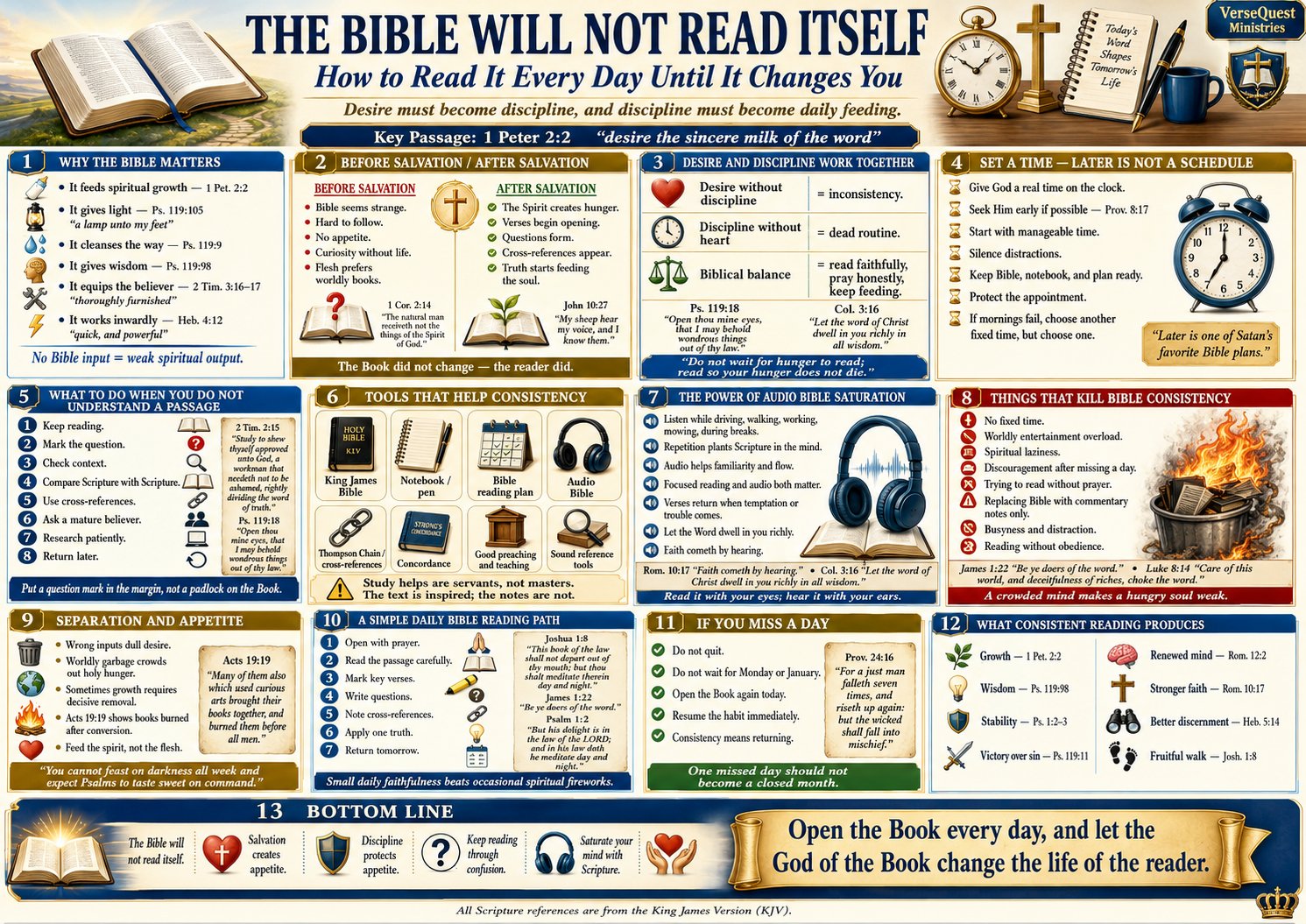
- The Bible Will Not Read Itself – How to Read the Bible Every Day Bible Study Chart (KJV)
- Build a consistent daily Bible reading habit with this detailed KJV Bible study chart. Learn practical steps for reading Scripture faithfully, overcoming inconsistency, understanding difficult passages, and growing spiritually through…
- $3.99
- Add to cart
-
-
True Worship vs False Worship
-
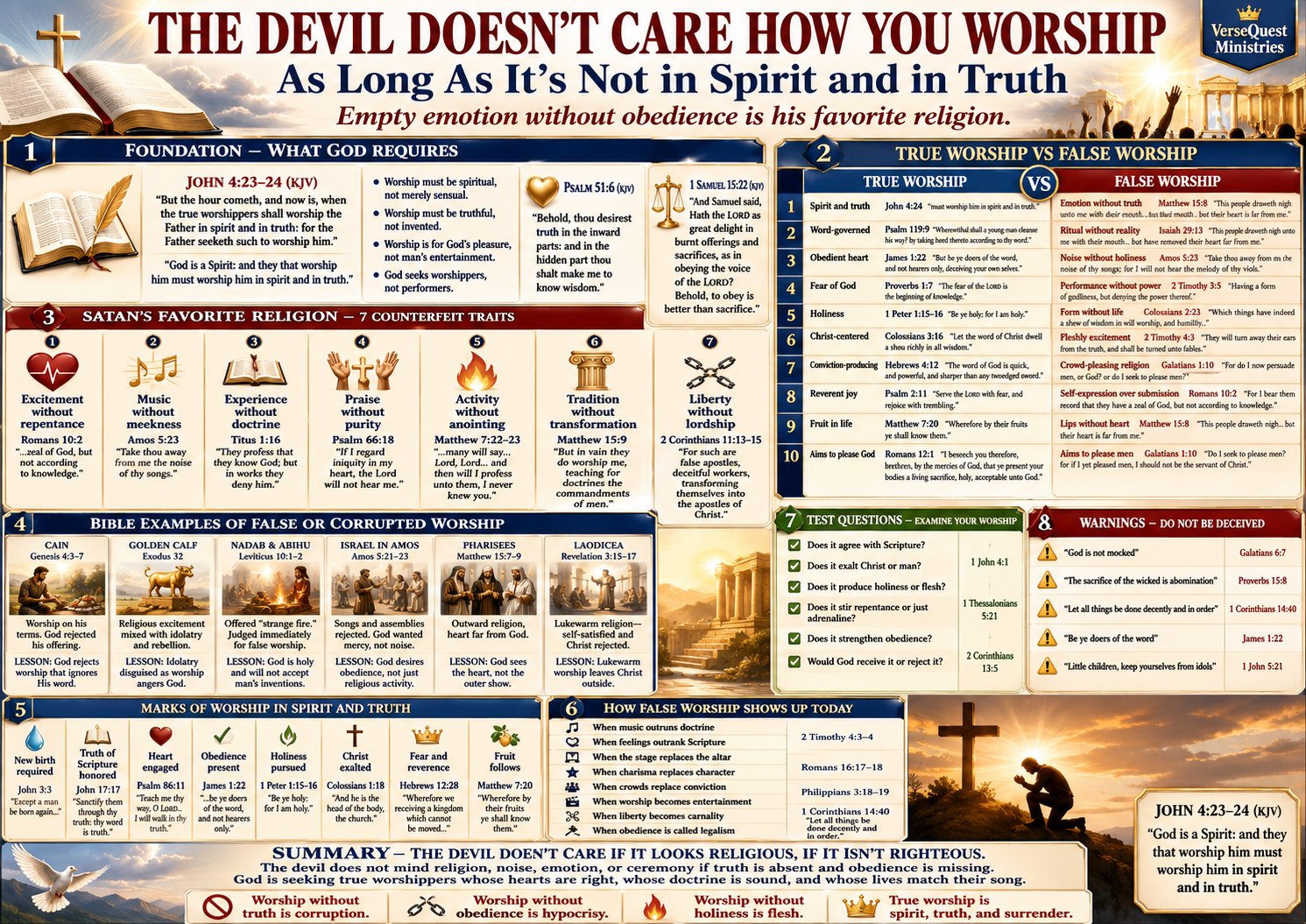
- The Devil Doesn’t Care How You Worship – True Worship in Spirit and in Truth Versus False Religion (KJV Bible Study Chart)
- Examine true and false worship with this detailed KJV Bible study chart covering spirit and truth, counterfeit religion, biblical music, obedience, holiness, discernment, and Christ-centred praise.
- $3.99
- Add to cart
-
-
Christian Living
-
-50%
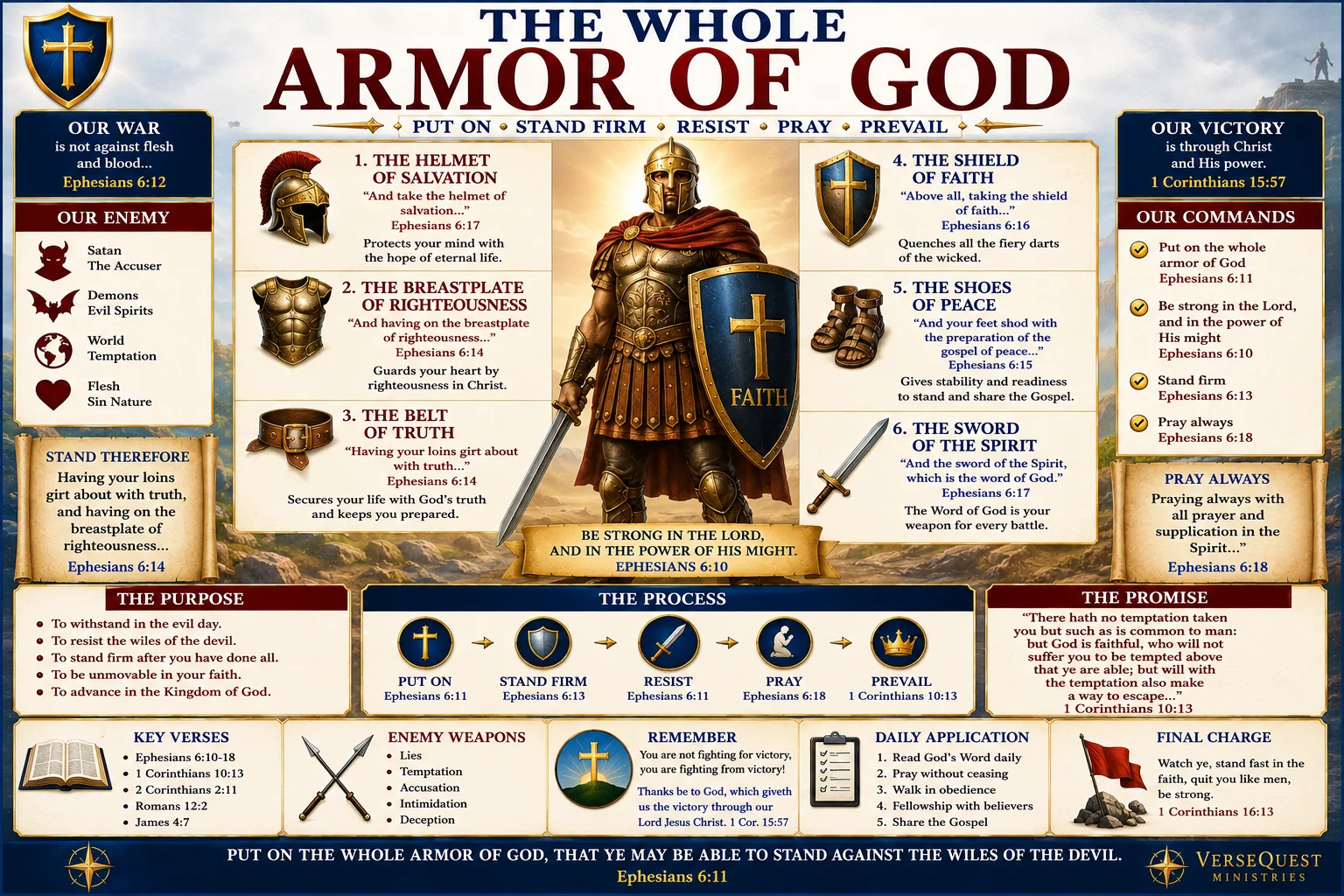
- The Whole Armor of God Chart — KJV Bible Study
- Premium printable KJV Bible study chart explaining the whole armor of God from Ephesians 6, including the helmet, breastplate, belt, shield, shoes, sword, prayer, and spiritual victory in Christ.
- Original price was: $10.00.$4.99Current price is: $4.99.
- Add to cart
-
-50%
-
Genesis Chapter 2
-
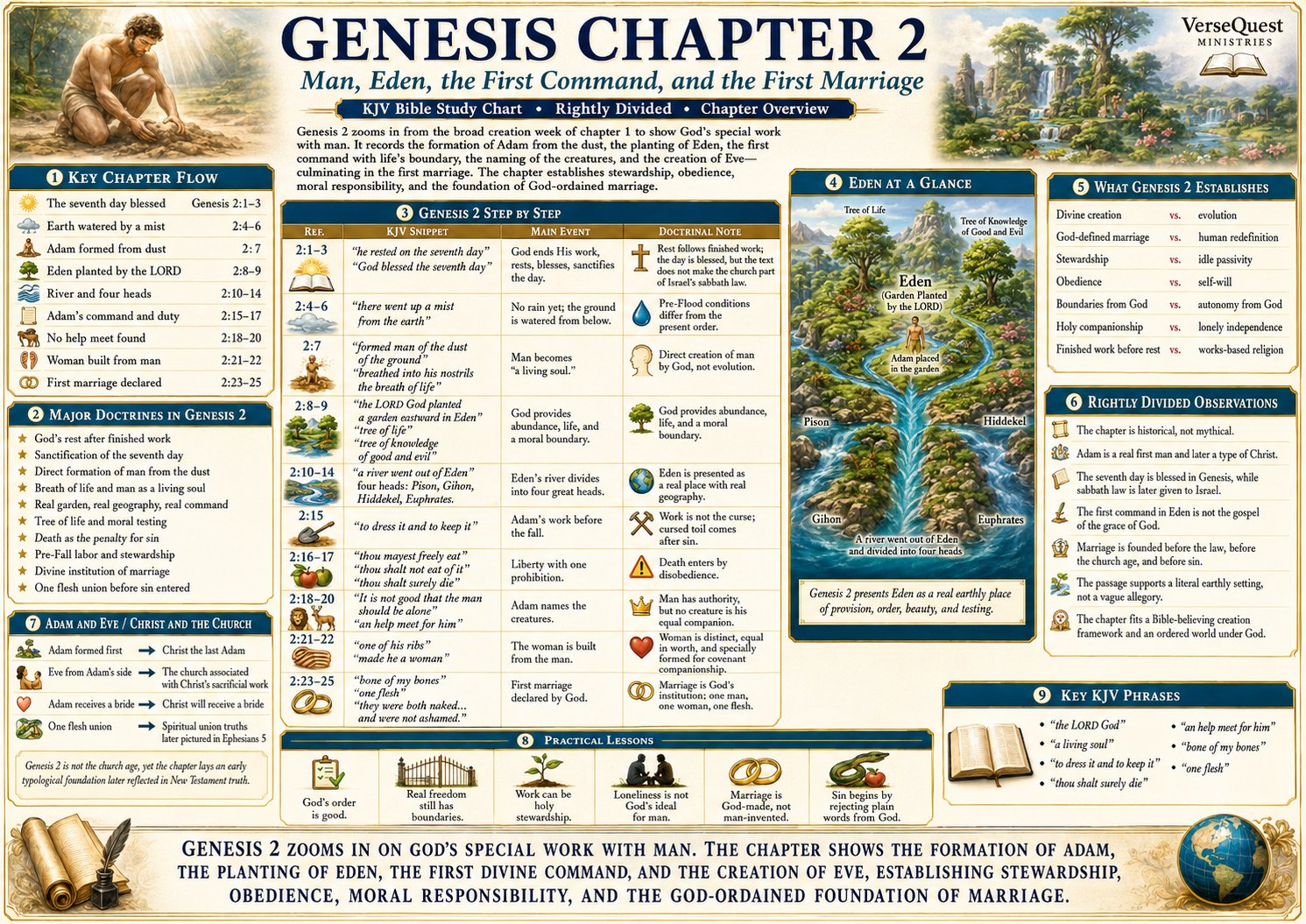
- Genesis Chapter 2 Bible Study Chart – Adam, Eden, the First Command, and the First Marriage (KJV)
- Explore Genesis Chapter 1 with this detailed KJV Bible study chart covering the six days of creation, the firmament, light, fixed kinds, man in God’s image, major doctrines, recurring phrases,…
- $3.99
- Add to cart
-
-
Ages To Come
-
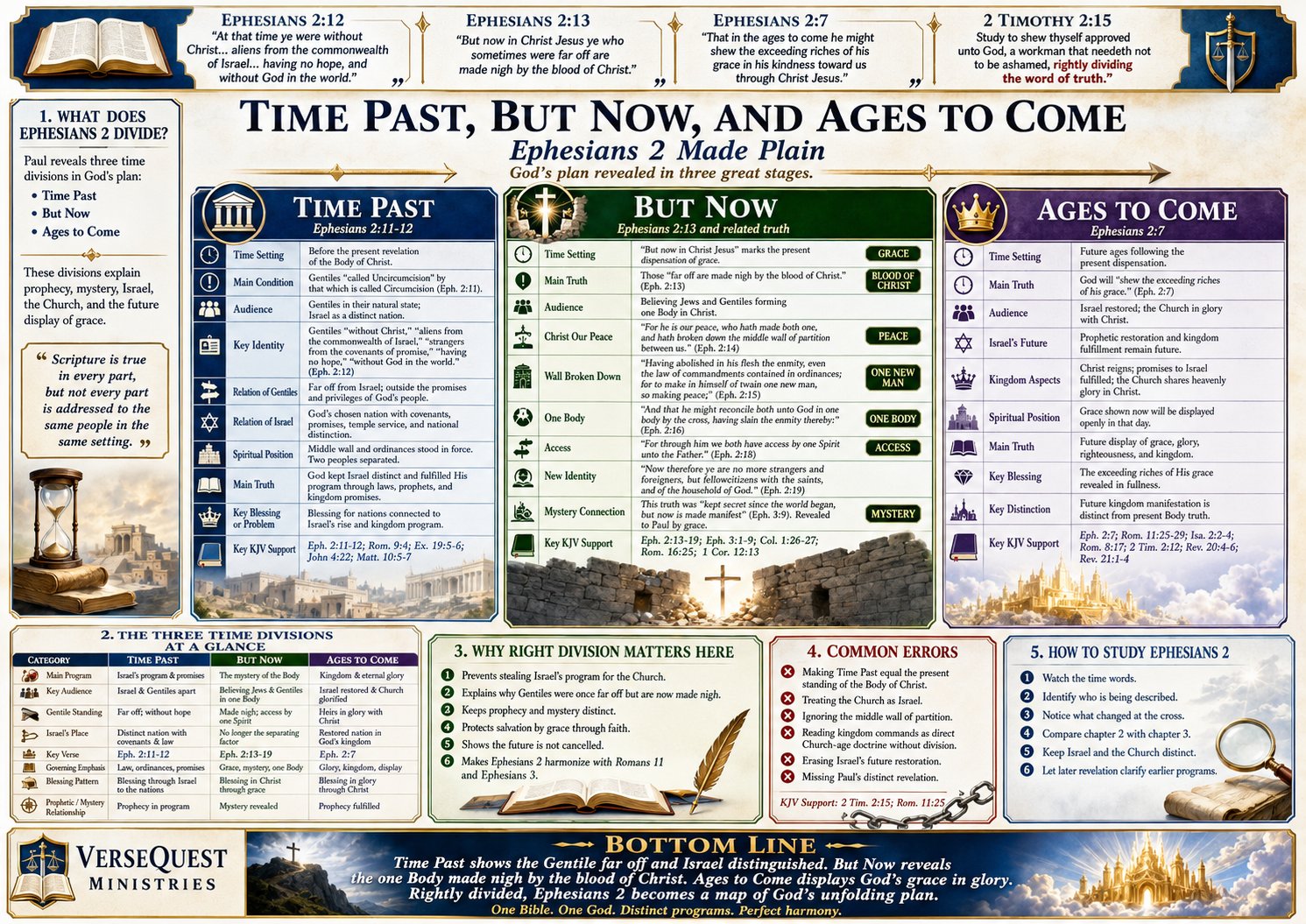
- Time Past, But Now, and Ages to Come – Ephesians 2 Rightly Divided KJV Bible Study Chart
- Understand Ephesians 2 with this detailed KJV chart explaining Time Past, But Now, Ages to Come, Gentile distance, the one Body, Israel’s future, and the importance of right division.
- $3.99
- Add to cart
-