
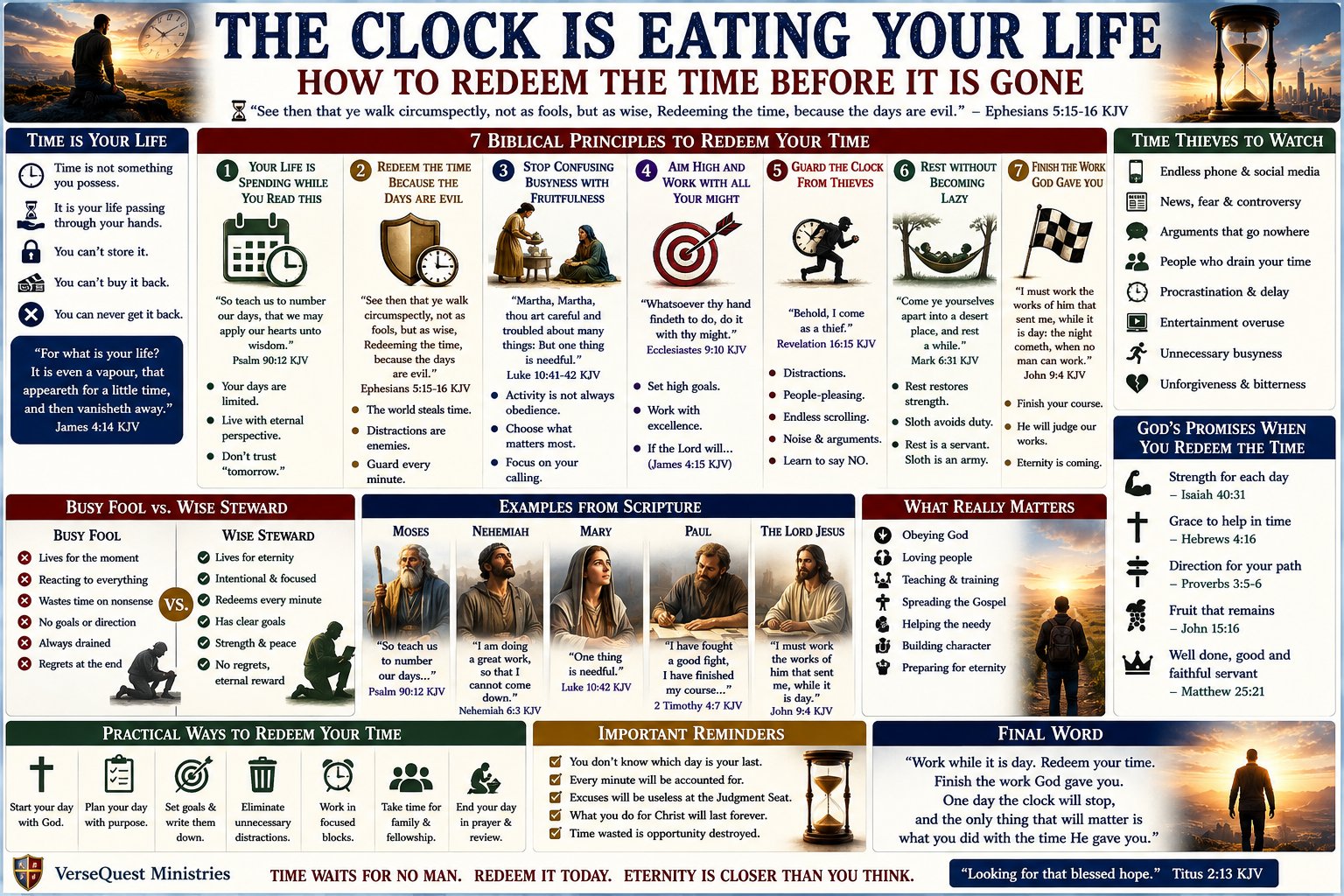
The Clock Is Eating Your Life – How to Redeem the Time Before It Is Gone (KJV Bible Study Chart)
Learn how to redeem the time with this detailed KJV chart covering biblical priorities, busyness versus fruitfulness, time thieves, diligence, proper rest, practical scheduling, eternal purpose, and finishing the work God has given you.
$3.99
Description
The Clock Is Eating Your Life: How to Redeem the Time Before It Is Gone is a detailed KJV Christian-living chart about the biblical stewardship of time, the danger of distraction, the difference between activity and fruitfulness, and the urgency of completing the work God has placed before us.
Built around Ephesians 5:15–16, this chart confronts a truth every person eventually discovers: time is not merely something we possess—it is our life passing through our hands. Money may be regained, possessions may be replaced, and missed opportunities may occasionally return, but a spent hour can never be purchased back.
James 4:14 compares human life to a vapour that appears briefly and then vanishes. The chart therefore calls believers to live with eternal perspective, number their days, guard their attention, and stop treating tomorrow as though it were guaranteed.
The first section explains that time is your life. Every hour given to worry, bitterness, entertainment, argument, distraction, service, prayer, family, study, or obedience becomes part of the life you have lived. The clock does not merely measure life—it steadily consumes it.
The chart develops seven major biblical principles for redeeming time. The first is to recognize that life is being spent while we live it. Psalm 90:12 prays, “So teach us to number our days, that we may apply our hearts unto wisdom.”
Numbering our days does not mean living in panic. It means recognizing that our earthly opportunity is limited and choosing to invest it in what possesses eternal value.
The second principle is to redeem the time because the days are evil. Ephesians 5 commands believers to walk circumspectly—not carelessly or foolishly, but wisely.
To redeem time is to rescue it from waste and devote it to God’s purposes. The world continually attempts to purchase our attention through noise, fear, controversy, entertainment, temptation, endless information, and unnecessary urgency.
Every minute requires stewardship. Time left unguarded will usually be claimed by something that does not deserve it.
The third principle is to stop confusing busyness with fruitfulness. Martha was occupied with many legitimate tasks, but Mary chose the one thing needful by sitting at the feet of Jesus and hearing His Word.
Activity is not automatically obedience. A person may remain exhausted while accomplishing little that God actually required.
Some people are busy because they lack priorities. Others remain busy to avoid the harder work of prayer, study, decision-making, discipline, family responsibility, or obedience.
Biblical fruitfulness means doing the right work rather than merely doing more work. The believer should ask whether his schedule reflects God’s calling or merely the demands of whoever speaks loudest.
The fourth principle is to aim high and work with all your might. Ecclesiastes 9:10 commands, “Whatsoever thy hand findeth to do, do it with thy might.”
Redeeming time does not produce laziness, mediocrity, or vague intentions. It should produce deliberate effort, clear goals, excellence, persistence, and faithful labour.
The Christian should work diligently while remembering that results ultimately remain in God’s hands. James warns believers not to boast confidently about tomorrow but to say, “If the Lord will.”
The fifth principle is to guard the clock from thieves. Revelation warns, “Behold, I come as a thief.” The coming of Christ and the uncertainty of life make spiritual watchfulness essential.
Time thieves often appear harmless. A few minutes of scrolling becomes an hour. A small argument occupies the mind all day. Constant news consumption creates fear without producing useful action.
The chart identifies major time thieves: endless phone use and social media, news and manufactured controversy, arguments that lead nowhere, draining relationships, procrastination, entertainment overuse, unnecessary busyness, unforgiveness, and bitterness.
Not every distraction is sinful by itself, but anything that repeatedly steals attention from duty, fellowship, family, Scripture, prayer, rest, and calling becomes spiritually expensive.
The believer must learn to say no. Every yes given to one activity becomes a no to something else. Wise stewardship requires choosing what deserves access to limited time.
The sixth principle is to rest without becoming lazy. Jesus told His disciples, “Come ye yourselves apart into a desert place, and rest a while.”
Biblical rest restores strength for faithful service. It is not the same as sloth, avoidance, procrastination, or constant escape.
Rest is a servant; laziness is a master. Proper rest prepares the believer to work with renewed focus, while sloth leaves responsibility unfinished and creates greater pressure later.
The seventh principle is to finish the work God gave you. Jesus declared, “I must work the works of him that sent me, while it is day: the night cometh, when no man can work.”
Every believer has responsibilities, relationships, gifts, duties, opportunities, and a course to finish. The Christian should not drift through life beginning everything and completing nothing.
Paul could say near the end of his life, “I have fought a good fight, I have finished my course, I have kept the faith.” That testimony did not come from accidental living. It came from sustained obedience.
A major comparison contrasts the busy fool with the wise steward. The busy fool lives only for the present, reacts to everything, wastes time on nonsense, lacks direction, remains perpetually drained, and reaches the end with regret.
The wise steward lives with eternity in view, acts intentionally, redeems each day, establishes clear priorities, maintains strength through proper rest, and seeks eternal rather than temporary reward.
The chart presents several biblical examples. Moses prayed that God would teach His people to number their days. Nehemiah refused distraction by declaring, “I am doing a great work, so that I cannot come down.”
Mary chose the one thing needful. Paul finished his course. The Lord Jesus Christ remained devoted to the work the Father sent Him to accomplish.
These examples demonstrate that faithful people do not possess more hours than everyone else. They use the hours they receive according to clearer priorities.
Nehemiah’s example is especially important. His enemies repeatedly attempted to draw him away from Jerusalem’s wall. Their invitation sounded like a meeting, but its purpose was delay, distraction, and harm.
Every interruption does not deserve a response. Some requests must be declined because coming down from the work would mean abandoning a greater responsibility.
The chart also identifies what truly matters: obeying God, loving people, teaching and training others, spreading the gospel, helping the needy, building godly character, strengthening family and fellowship, and preparing for eternity.
Many things that consume enormous amounts of modern attention will mean nothing at the judgment seat of Christ. Trends pass, controversies disappear, platforms change, and popular personalities are forgotten.
What is done for Jesus Christ possesses lasting value. A life invested in Scripture, prayer, faithful work, family, ministry, truth, service, and the gospel is never wasted.
The chart offers practical ways to redeem time. Begin the day with God rather than immediately surrendering the mind to a phone, inbox, news cycle, or social-media feed.
Plan the day with purpose. Write down necessary responsibilities. Establish priorities rather than allowing circumstances to decide everything.
Set meaningful goals and record them. A goal left undefined often remains an intention that never becomes action.
Remove unnecessary distractions. Silence notifications, limit unproductive media, withdraw from pointless arguments, and protect focused periods of work.
Use concentrated blocks of time for demanding responsibilities. Constant interruption weakens thought, creativity, study, writing, prayer, and meaningful service.
Make time for family and Christian fellowship. Productivity that destroys relationships is not biblical success.
End the day with prayer and review. Thank God for what was accomplished, confess wasted time or wrong priorities, and prepare wisely for the next day.
The chart includes several important reminders. No one knows which earthly day will be his last. Every person will give account for the life and opportunities God provided.
Excuses that appear persuasive now will become useless before the judgment seat. Wasted time represents opportunities that cannot be recovered.
What is done for Christ will last forever. The believer should therefore invest his strongest attention rather than merely his leftover minutes in eternal priorities.
God also provides promises for those seeking to redeem their time. Isaiah 40:31 promises renewed strength to those who wait upon the LORD.
Hebrews 4:16 invites believers to obtain mercy and find grace for timely help. Proverbs 3:5–6 promises direction to those who trust and acknowledge God.
John 15:16 speaks of fruit that remains. Matthew 25 presents the joyful commendation, “Well done, thou good and faithful servant.”
These promises do not teach that careful scheduling removes every difficulty. They assure believers that God supplies strength, wisdom, direction, grace, and lasting fruit as they walk faithfully.
The chart’s final word is direct: work while it is day. Redeem the time. Finish the work God gave you.
One day the clock will stop, and the question will not be how busy you were, how entertained you remained, how many arguments you won, or how much information you consumed.
The question will be what you did with the life, abilities, truth, relationships, and opportunities God placed in your hands.
Time waits for no man. Eternity is closer than we think. The wise believer begins redeeming the time today.
This resource is ideal for personal Bible study, Christian productivity, time-management teaching, discipleship, pastoral counseling, youth ministry, family devotions, ministry leadership, goal setting, spiritual-growth classes, Sunday school, homeschool Bible curriculum, Christian schools, Bible institutes, sermon preparation, and believers seeking to overcome distraction and live intentionally for Jesus Christ.
Redeeming the time, biblical time management, Christian stewardship, numbering our days, life is a vapour, wise use of time, busyness versus fruitfulness, spiritual priorities, finishing your course, focused Christian living, distractions and time thieves, social-media overuse, procrastination, proper rest, diligent work, eternal perspective, judgment seat of Christ, lasting fruit, Christian productivity, preparing for eternity
Time is not merely something a person possesses. It is his earthly life steadily passing away.
James compares life to a vapour that appears briefly and then vanishes.
Money and possessions may sometimes be replaced. Spent time can never be recovered.
Psalm 90 teaches believers to number their days so they may apply their hearts unto wisdom.
Numbering days should produce wisdom and urgency rather than fear or panic.
Ephesians 5 commands believers to redeem the time because the days are evil.
Redeeming time means rescuing opportunities from waste and investing them in God’s purposes.
A schedule will be filled by something. Unprotected time is easily consumed by distractions and other people’s priorities.
Busyness is not the same as fruitfulness. Activity may create exhaustion without accomplishing God’s will.
Martha was troubled about many things, but Mary chose the one thing needful.
The believer should identify what God has actually called him to do rather than reacting continually to every demand.
Ecclesiastes commands faithful work with all one’s might.
Christian diligence should be joined with submission to the Lord’s will.
Digital media, news, arguments, entertainment, procrastination, bitterness, and unnecessary busyness can become major time thieves.
Not every interruption deserves a response. Nehemiah refused to leave a great work for an enemy’s distracting meeting.
Learning to say no is an important part of time stewardship.
Rest is biblical and necessary. Jesus instructed His disciples to come apart and rest.
Rest restores strength for service. Laziness avoids responsibility and increases future pressure.
The believer should not confuse exhaustion with faithfulness. Wise service includes renewal.
Jesus worked while it was day and completed the work the Father gave Him.
Paul’s goal was not merely to begin the Christian race but to finish his course faithfully.
The busy fool reacts to everything and lives only for the present.
The wise steward lives intentionally, establishes priorities, and remembers eternity.
What matters eternally includes obeying God, loving people, teaching truth, spreading the gospel, helping others, building character, and finishing one’s calling.
Begin the day with God before allowing news, messages, or social media to control the mind.
Planning does not oppose faith. Wise planning operates beneath the will and providence of God.
Written goals turn vague intentions into measurable responsibilities.
Focused blocks of uninterrupted work improve study, writing, prayer, creativity, and ministry.
Family and Christian fellowship should not be sacrificed upon the altar of productivity.
The believer should review his day prayerfully, giving thanks, confessing failure, and adjusting priorities.
Every minute will be accounted for before God.
What is done for Christ possesses eternal value even when earthly recognition is absent.
God promises strength, grace, wisdom, direction, and fruit to believers who depend upon Him.
Good stewardship does not mean controlling every circumstance. It means responding faithfully to the time God provides.
The clock will eventually stop for every person. The wise believer redeems the time before it is gone.
Biblical time-management studies, Christian productivity, overcoming procrastination, reducing digital distraction, setting godly priorities, ministry leadership, personal discipline, spiritual-growth classes, family scheduling, youth discipleship, balancing work and rest, finishing long-term projects, eternal-reward teaching, judgment-seat studies, pastoral counseling, Sunday school lessons, homeschool Bible curriculum, Christian school teaching, Bible institute classes, sermon preparation
King James Bible, Strong’s Concordance, Thompson Chain-Reference Bible, Treasury of Scripture Knowledge, Nave’s Topical Bible, daily Christian planner, Scripture memory cards, prayer journal, goal-setting worksheets, weekly time audit, digital-distraction checklist, Ephesians study notes, Proverbs on diligence, Christian stewardship resources, judgment-seat and reward charts, Pauline epistle outlines, VerseQuest Christian Living charts
Related products
-
October 2026 Devotional
-

- VerseQuest Daily — October 2026: Identity in Christ and the Daily Walk
- VerseQuest Daily — October 2026 is a 67-page downloadable PDF containing thirty-one KJV devotionals on identity in Christ and the daily Christian walk. Each reading includes an assigned Scripture passage,…
- $6.99
- Add to cart
-
-
Finding The Will of God
-
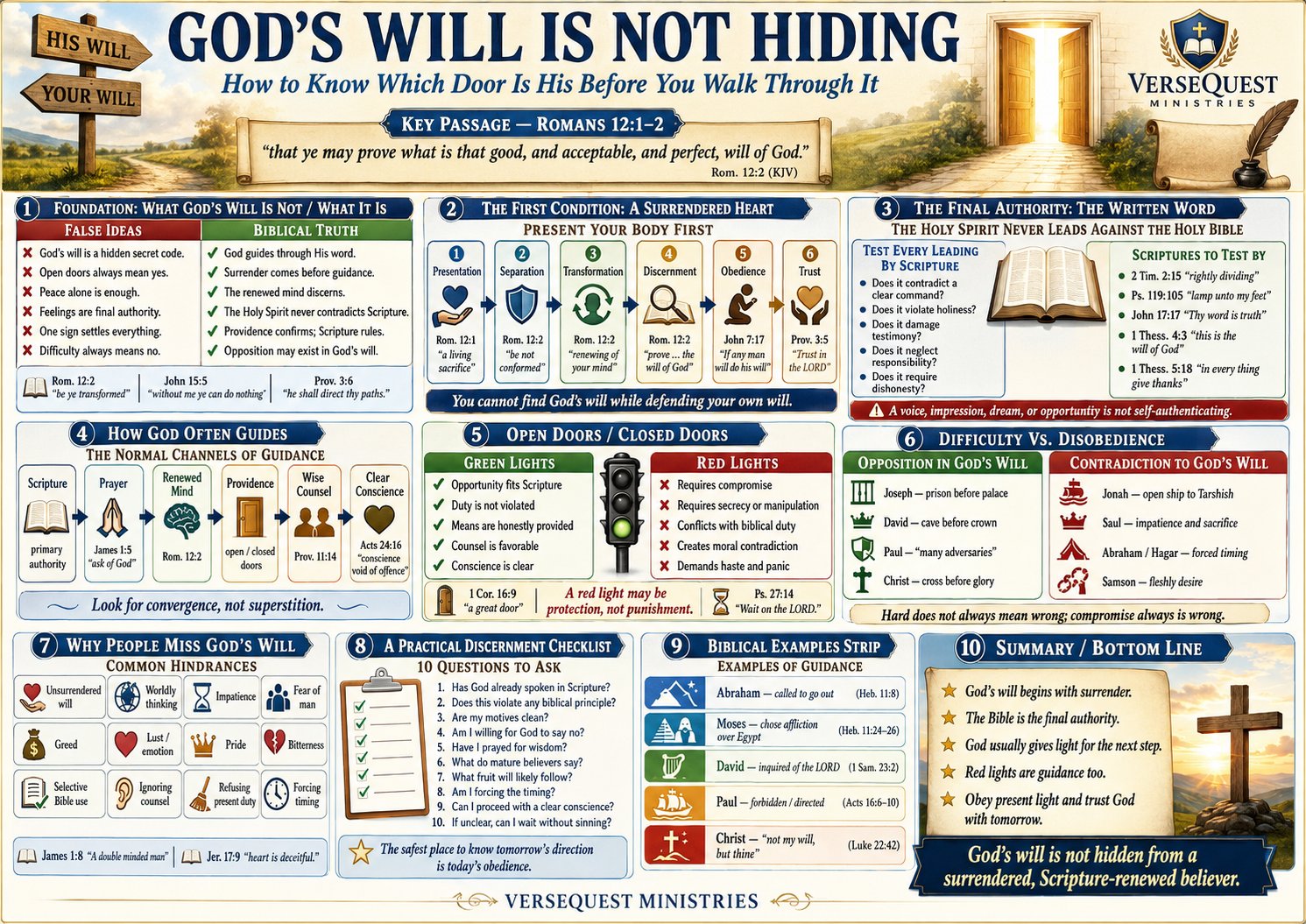
- God’s Will Is Not Hiding – How to Discern Biblical Guidance and Know Which Door Is His (KJV Bible Study Chart)
- Learn how to discern God’s will with this detailed KJV Bible study chart covering surrender, Scripture, prayer, wise counsel, open doors, closed doors, and practical decision-making.
- $3.99
- Add to cart
-
-
Call For Revival
-

- Sleeping Through the Last Watch – 681-Page KJV Bible Study Series (PDF eBook)
- 681 Pages • 100 Essays • KJV Bible Study • Full-Color Bible Chart What does it really mean to be spiritually awake while waiting for Christ's return? Sleeping Through the…
- $29.99
- Add to cart
-
-
Biblical Humility
-
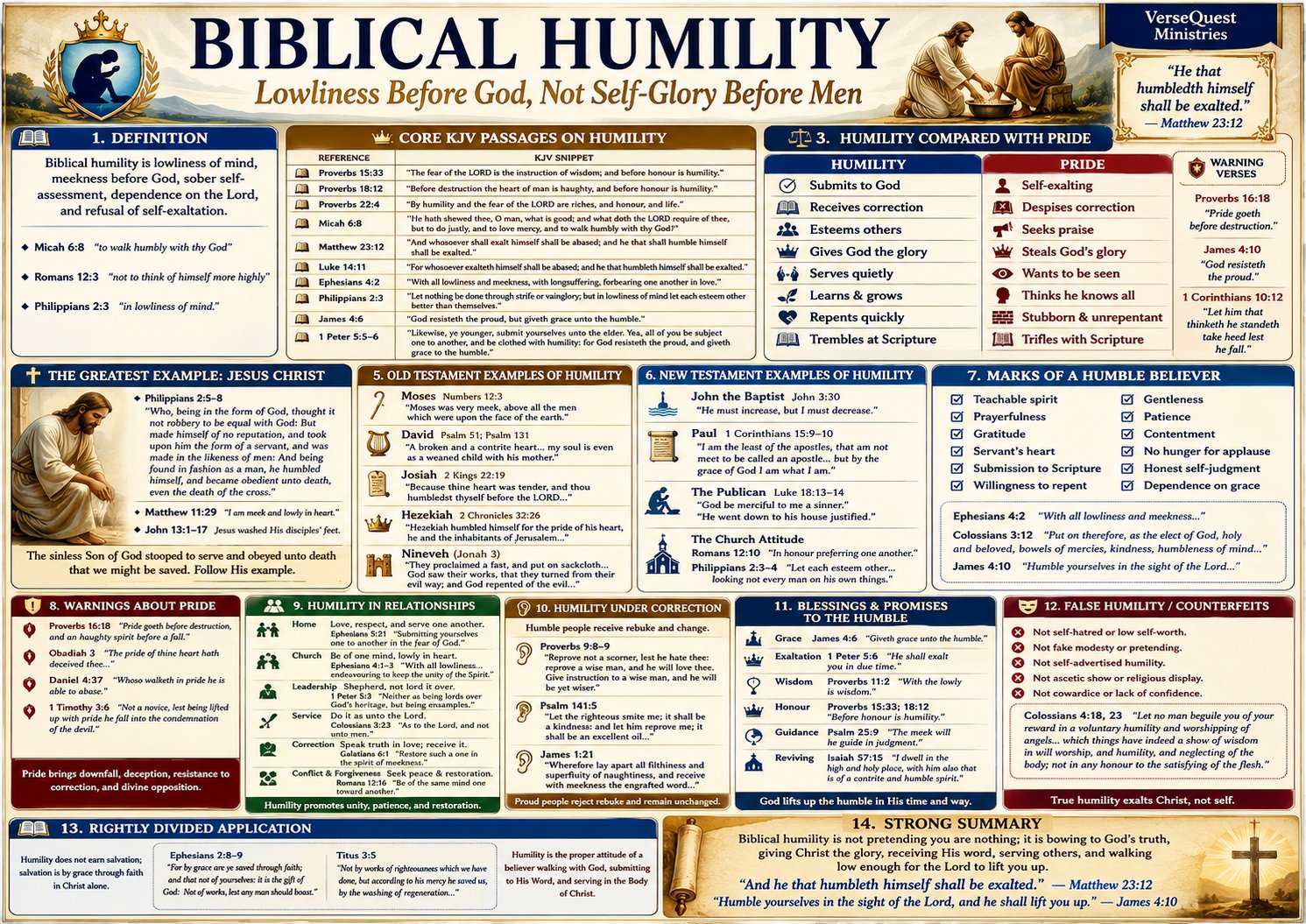
- Biblical Humility Bible Study Chart – Lowliness Before God, Not Self-Glory Before Men (KJV)
- Study biblical humility with this detailed KJV chart comparing humility and pride, Christ’s example, receiving correction, servant leadership, grace, and practical Christian living.
- $3.99
- Add to cart
-
-
Christian Family Counseling
-

- When Families Become Strangers – Biblical Family Estrangement PDF Book
- When Families Become Strangers is a comprehensive 249-page downloadable PDF book examining family estrangement through the King James Bible. Its 35 substantial essays address parent–adult child cutoffs, grandparent alienation, sibling…
- $12.99
- Add to cart
-