
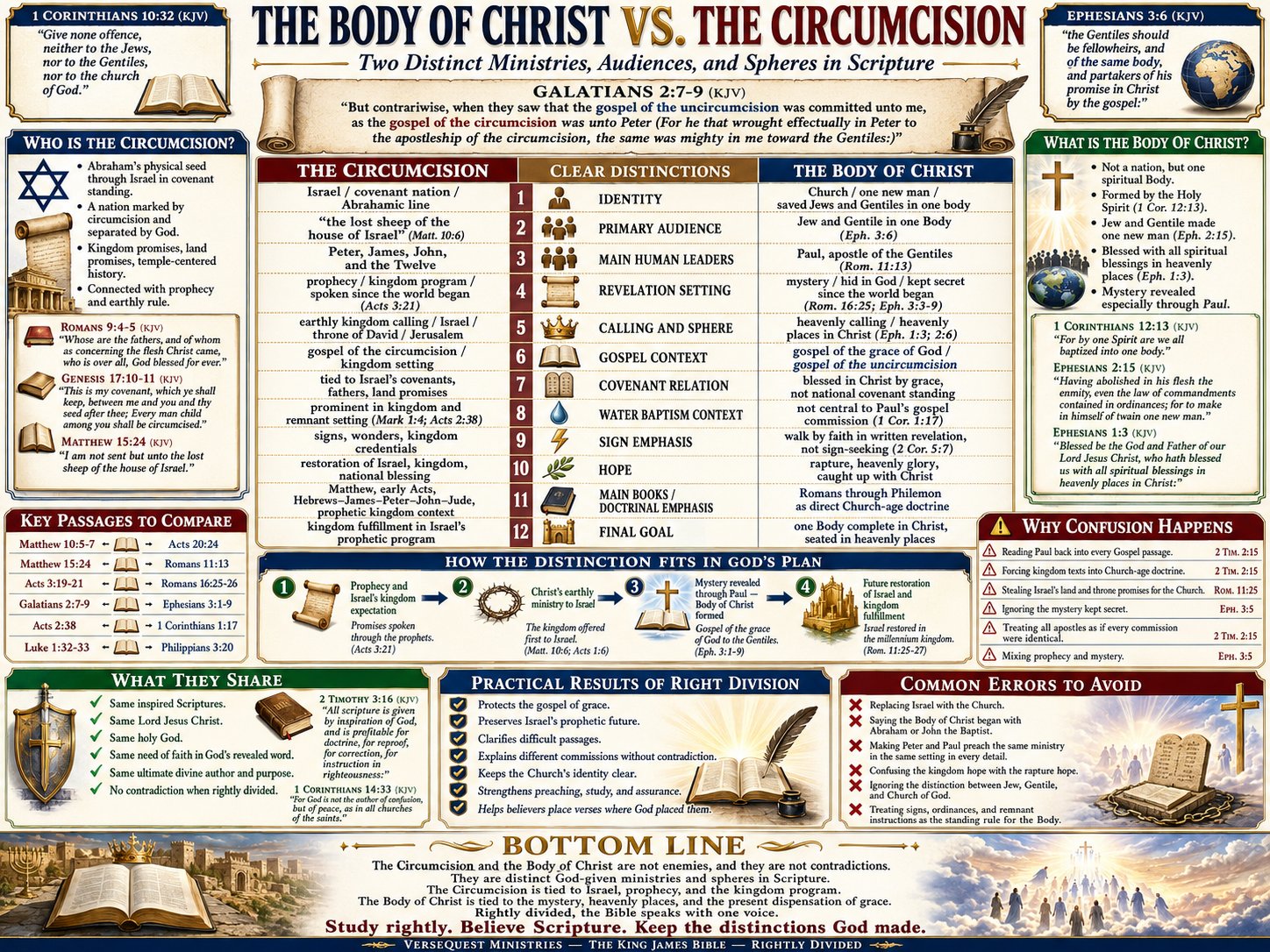
The Body of Christ vs. the Circumcision – Two Distinct Ministries, Audiences, and Spheres in Scripture (KJV Bible Study Chart)
Compare the Body of Christ and the circumcision with this detailed KJV chart covering Israel, Peter, Paul, prophecy, mystery, covenant promises, baptism, signs, and the Church’s heavenly hope.
$3.99
Description
The Body of Christ vs. the Circumcision is a detailed KJV Bible study chart explaining the biblical distinction between Israel’s covenant and Kingdom program and the Church, the one spiritual Body revealed especially through the apostle Paul.
Built around 1 Corinthians 10:32, Galatians 2:7–9, and Ephesians 3:6, this chart demonstrates that Scripture identifies Jews, Gentiles, and the Church of God as meaningful categories within God’s unfolding plan. Recognizing these distinctions protects the gospel of grace, preserves Israel’s prophetic promises, and prevents passages addressed to different audiences from being forced into one undivided program.
The biblical term “the circumcision” is closely connected with Abraham’s physical seed, the nation of Israel, the covenant sign given in Genesis 17, and the prophetic Kingdom program. Israel received promises concerning the land, David’s throne, national restoration, Jerusalem, and the visible earthly reign of the Messiah.
The circumcision program developed through the Abrahamic line and Israel’s national history. Its major human representatives include Peter, James, John, and the Twelve, whose early ministry was directed primarily toward “the lost sheep of the house of Israel.” Their commission stood within the expectation of Israel’s King and promised Kingdom.
Prophecy forms the primary revelation setting of the circumcision program. Acts 3:21 speaks of truths announced through the prophets since the world began. These include Israel’s covenants, national judgment, restoration, Messianic hope, earthly Kingdom, and future blessing among the nations.
The Body of Christ, by contrast, is not a physical nation or a replacement version of Israel. It is one spiritual Body composed of saved Jews and Gentiles who have been baptized by the Holy Spirit into Christ. First Corinthians 12:13 declares that believers are placed into one Body by one Spirit.
Ephesians 2 describes this Body as “one new man.” The middle wall of partition has been broken down, and believing Jews and Gentiles now possess equal spiritual standing through the blood of Christ. Gentiles do not become physical Israelites, and Israel does not simply become another name for the Church.
The Body of Christ is associated with the revelation of the mystery—truth that was kept secret in previous ages and later revealed especially through Paul. Romans 16:25 and Ephesians 3 distinguish this mystery revelation from the prophetic program spoken openly through Israel’s prophets.
Paul identifies himself as “the apostle of the Gentiles.” His epistles explain the present dispensation of grace, the one Body, the believer’s complete standing in Christ, spiritual blessings in heavenly places, salvation by grace through faith, and the Church’s heavenly calling.
The chart compares the circumcision and the Body of Christ across twelve major categories: identity, primary audience, human leaders, revelation setting, calling and sphere, gospel context, covenant relationship, water-baptism context, sign emphasis, hope, principal doctrinal books, and final goal.
The circumcision is identified with Israel’s covenant nation and Abrahamic line. The Body of Christ is identified with the Church, the one new man, and saved Jews and Gentiles united in Christ.
The circumcision ministry initially emphasized Israel as its principal audience. The present grace message goes to Jew and Gentile alike, offering salvation freely to all who believe the gospel of Jesus Christ.
Peter and the Twelve are prominently connected with Israel’s Kingdom ministry, while Paul is identified as the apostle of the Gentiles and steward of the mystery. These ministries serve the same Lord without requiring their commissions to be identical in every detail.
The circumcision stands within prophecy and the Kingdom program spoken since the world began. The Body of Christ stands within mystery truth that was hidden in God and later revealed. Prophecy concerns Israel’s earthly program; mystery reveals the Church’s heavenly identity.
Their callings and spheres also differ. Israel’s hope concerns its promised land, Davidic throne, national restoration, and the reign of Christ from Jerusalem. The Church possesses a heavenly calling, spiritual blessings in Christ, and the expectation of being caught up to meet the Lord.
Galatians 2 distinguishes the gospel of the circumcision committed to Peter from the gospel of the uncircumcision committed to Paul. This does not mean that two rival Saviours exist. It recognizes different apostolic stewardships, audiences, and stages within God’s revelation.
The present gospel of grace centres upon the finished work of Jesus Christ: He died for our sins, was buried, and rose again. Salvation is received through faith rather than national lineage, circumcision, Mosaic ordinances, water baptism, temple participation, or religious performance.
Israel’s covenant relationship includes the Abrahamic, Mosaic, Davidic, and New Covenant promises. Members of the Body of Christ are blessed in Christ by grace but do not become Israel’s national covenant people or inherit Israel’s earthly identity.
Water baptism held a prominent place in Israel’s repentance and Kingdom setting. Paul baptized during the transitional period recorded in Acts, yet declared that Christ sent him not to baptize but to preach the gospel. Water baptism is therefore not the centre or saving condition of Paul’s gospel commission.
Signs, wonders, healings, and miraculous credentials accompanied Israel’s Kingdom offer and authenticated the apostolic messengers. Although signs also occurred during Paul’s transitional ministry, the mature Church is directed to walk by faith in the completed written revelation rather than seek Israel’s sign-based program.
The circumcision’s prophetic hope includes Israel’s restoration and Kingdom blessing. The Church’s hope includes the Rapture, heavenly glory, and eternal union with Christ. Confusing these hopes can place the Body of Christ into Israel’s Tribulation passages or transfer Israel’s land and throne promises to the Church.
The chart also explains how the distinction fits within God’s overall plan. Prophecy announced Israel’s coming Kingdom. Christ’s earthly ministry offered the Kingdom first to Israel. The mystery concerning the Body of Christ was later revealed through Paul. Israel’s prophetic program will ultimately resume and reach its promised fulfillment under Jesus Christ.
The circumcision and the Body of Christ are not enemies, contradictions, or competing religions. They share the same inspired Scriptures, the same Lord Jesus Christ, the same holy God, and the same need for faith in God’s revealed truth. Their distinctions reveal divine order rather than doctrinal conflict.
Confusion arises when readers force Paul’s revelation backward into every Gospel passage, place Kingdom texts directly into Church doctrine, steal Israel’s land and throne promises, ignore the hidden character of the mystery, or treat all apostolic commissions as identical.
Common errors include replacing Israel with the Church, claiming that the Body began with Abraham or John the Baptist, confusing the Kingdom hope with the Rapture hope, and imposing Israel’s signs, ordinances, covenants, or remnant instructions upon the Church as its standing rule.
Right division protects the gospel of grace, preserves Israel’s prophetic future, explains different apostolic commissions, clarifies difficult passages, strengthens assurance, and allows every verse to remain in the audience and setting where God placed it.
This chart is ideal for personal Bible study, dispensational teaching, Pauline doctrine, Israel-and-Church comparisons, prophecy-and-mystery classes, pastoral training, Sunday school, homeschool Bible curriculum, Bible institutes, sermon preparation, and believers seeking a clear KJV explanation of the Body of Christ and the circumcision.
Body of Christ, the circumcision, Israel and the Church, one new man, apostle of the Gentiles, Peter and the Twelve, gospel of the circumcision, gospel of the uncircumcision, prophecy and mystery, Kingdom program, present dispensation of grace, Abrahamic Covenant, land and throne promises, water baptism, signs and wonders, heavenly calling, Rapture of the Church, Israel’s restoration, Pauline doctrine, rightly dividing Scripture
The term “circumcision” may describe the physical covenant sign given to Abraham, the Jewish people identified by that sign, or the apostolic ministry associated primarily with Israel.
Israel’s circumcision identity is physical, national, covenantal, and prophetic. It concerns Abraham’s seed, the promised land, David’s throne, Jerusalem, and the future earthly Kingdom.
The Body of Christ is spiritual rather than national. It is formed when the Holy Spirit places saved Jews and Gentiles into one Body through faith in Jesus Christ.
The Church is not Israel renamed. Ephesians describes it as one new man rather than a continuation of Israel’s former national standing.
First Corinthians 10:32 preserves the distinctions among Jews, Gentiles, and the Church of God. Bible students should not erase categories retained by the Holy Spirit.
Galatians 2 recognizes distinct gospel stewardships connected with Peter and Paul. The distinction concerns commission, audience, and administration rather than two competing Lords.
Peter and the Twelve ministered prominently within Israel’s prophetic Kingdom setting. Paul received a heavenly commission and was sent especially to the Gentiles.
Prophecy was spoken since the world began. The mystery concerning the Body of Christ was kept secret and later revealed through Paul.
The gospel of grace centres upon Christ’s finished death, burial, and resurrection. The sinner is justified by faith apart from circumcision, ordinances, national identity, or religious works.
Water baptism belonged prominently to Israel’s repentance and Kingdom context. Paul’s statement in 1 Corinthians 1:17 demonstrates that baptism was not the centre of his gospel commission.
Signs authenticated Israel’s Messianic and apostolic program. The mature Body of Christ is instructed to walk by faith and rest upon the completed written Word.
Israel’s hope is earthly and prophetic: restoration, land, Kingdom, and the return of the King. The Church’s hope is heavenly: the Rapture, glorification, and eternal union with Christ.
The Church does not cancel Israel’s future. Romans 11 teaches that Israel’s blindness is partial and temporary and that God’s gifts and calling are without repentance.
Reading Paul backward into every Gospel passage destroys the progressive nature of revelation and obscures the mystery’s previously hidden character.
Right division does not make Peter and Paul enemies. It honours their distinct commissions and allows both ministries to fit harmoniously within God’s plan.
All Scripture is inspired and profitable, but not every command is addressed directly to the same people under the same administration.
The practical rule is simple: identify the audience, recognize the program, compare Scripture with Scripture, and allow every passage to remain where God placed it.
Israel-and-Church comparison studies, Pauline doctrine classes, Galatians 2 teaching, prophecy-and-mystery instruction, dispensational Bible study, apostolic commission comparisons, baptism studies, signs-and-wonders teaching, Kingdom-versus-Body doctrine, Rapture instruction, refuting replacement theology, Sunday school lessons, homeschool Bible curriculum, Christian school teaching, Bible institute classes, pastoral training, sermon preparation, new-believer discipleship
King James Bible, Strong’s Concordance, Thompson Chain-Reference Bible, Treasury of Scripture Knowledge, Nave’s Topical Bible, Galatians study notes, Romans 9–11 resources, Ephesians 2–3 outlines, Pauline epistle charts, Israel-and-Church comparison materials, prophecy-and-mystery worksheets, baptism comparison studies, Rapture and Second Coming charts, dispensational timelines, VerseQuest right-division and doctrine charts
Related products
-
Jesus Christ Studies
-
-67%
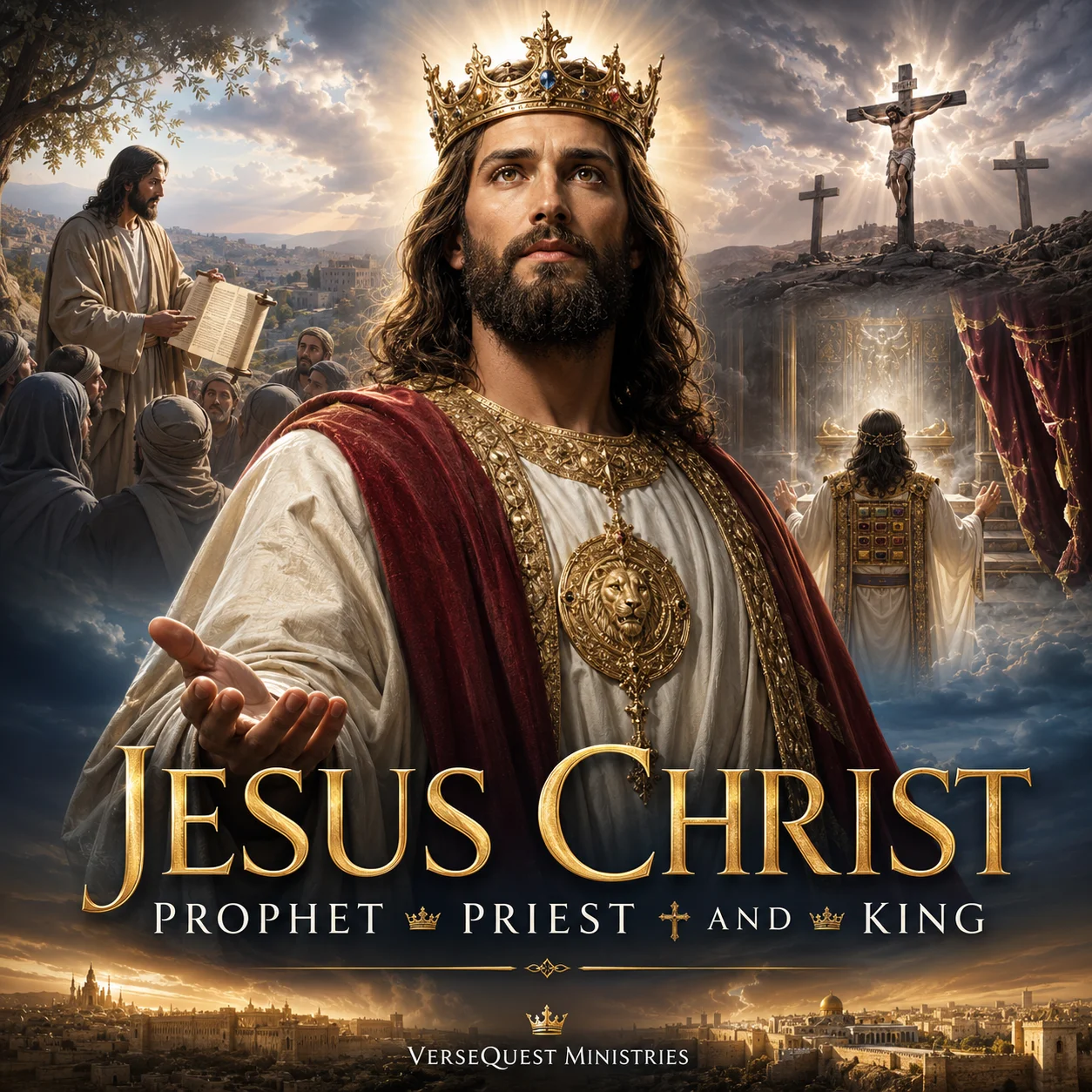
- Jesus Christ Prophet Priest and King – 441-Page PDF Study
- A 441-page premium KJV PDF study on Jesus Christ as Prophet, Priest, and King. This detailed VerseQuest book covers Christ’s prophetic ministry to Israel, His finished sacrifice and present intercession…
- Original price was: $29.99.$9.99Current price is: $9.99.
- Add to cart
-
-67%
-
Not Under Law But Grace
-
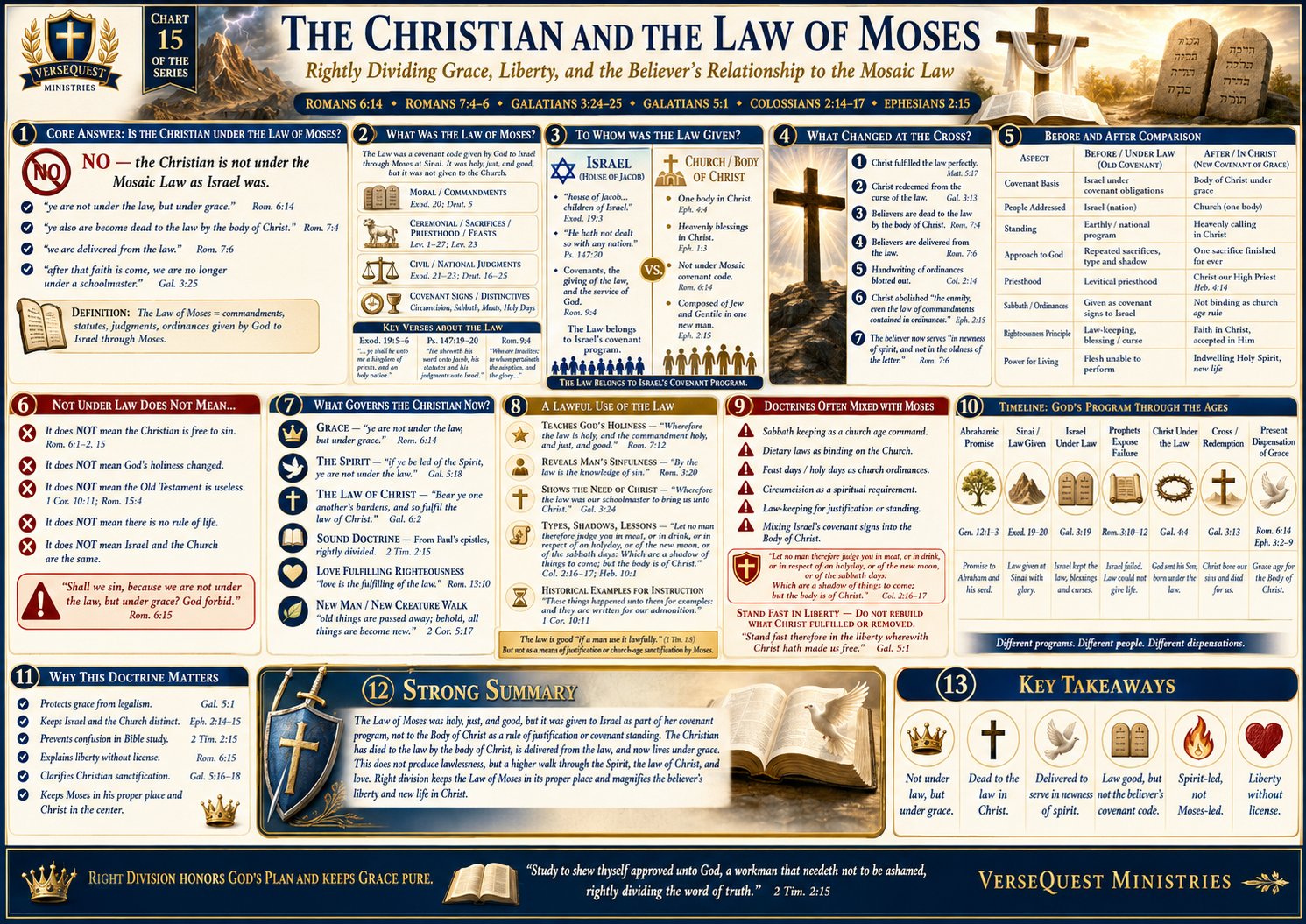
- The Christian and the Law of Moses – Grace, Liberty, and the Believer’s Relationship to the Mosaic Law (KJV Bible Study Chart)
- Understand the Christian’s relationship to the law of Moses with this detailed KJV chart covering Israel’s covenant, grace, liberty, the cross, the law of Christ, and Spirit-led living.
- $3.99
- Add to cart
-
-
Heavenly Program
-
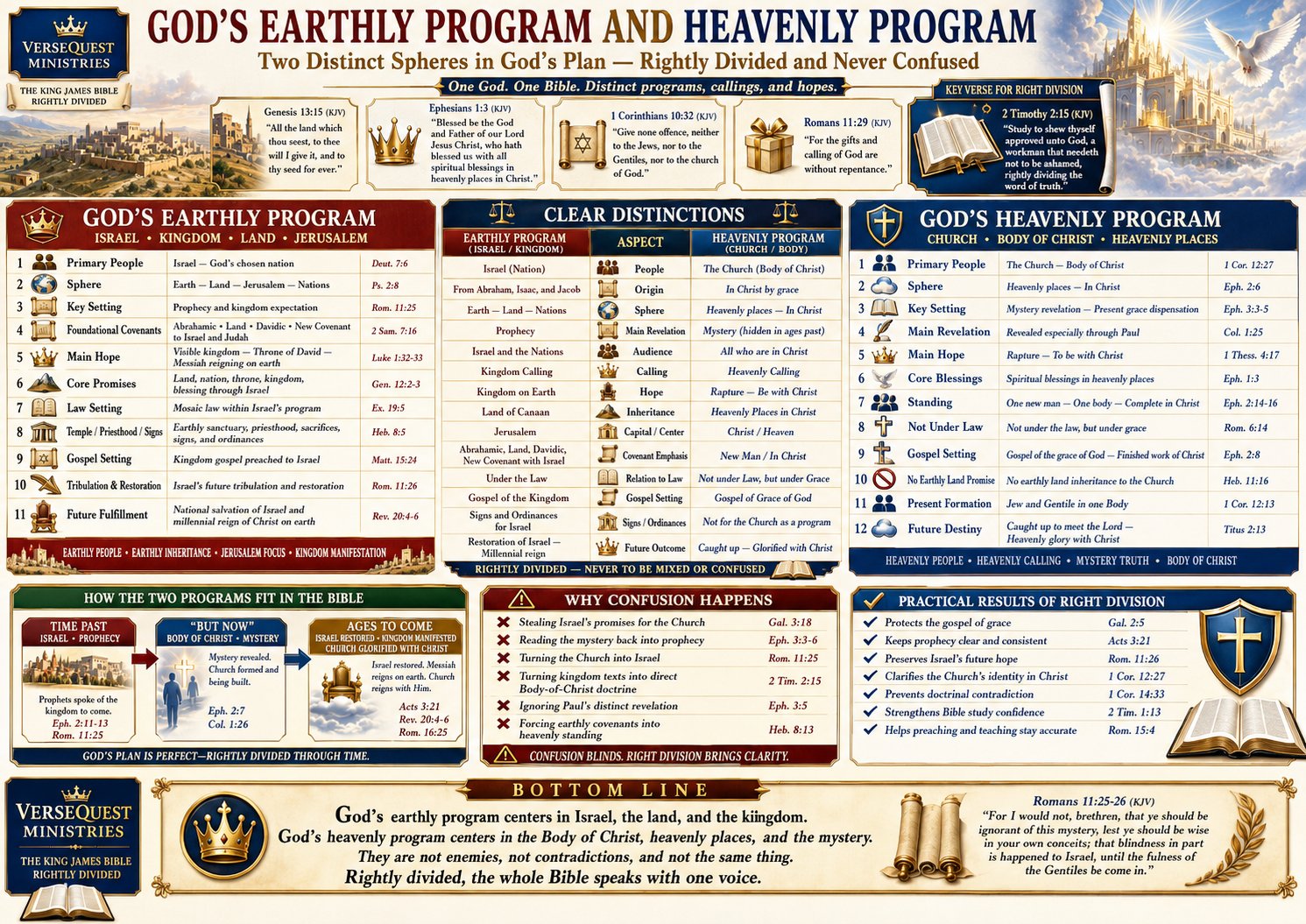
- Israel and the Church: Earthly and Heavenly Callings – KJV Bible Study Chart
- Printable digital KJV Bible study chart comparing Israel’s earthly promises and kingdom hope with the Church’s heavenly calling in Christ. Covers prophecy and mystery, biblical covenants, law and grace, the…
- $3.99
- Add to cart
-
-
Hebrews Rightly Divided
-
-71%
- Hebrews Without Confusion – 833-Page, 120-Study KJV PDF Commentary
- Hebrews Without Confusion is an enormous 833-page digital KJV commentary containing 120 detailed studies through all thirteen chapters of Hebrews. This rightly divided study explains Christ’s supremacy, His eternal priesthood,…
- Original price was: $34.99.$9.99Current price is: $9.99.
- Add to cart
-
-71%
-
Rightly Divided
-
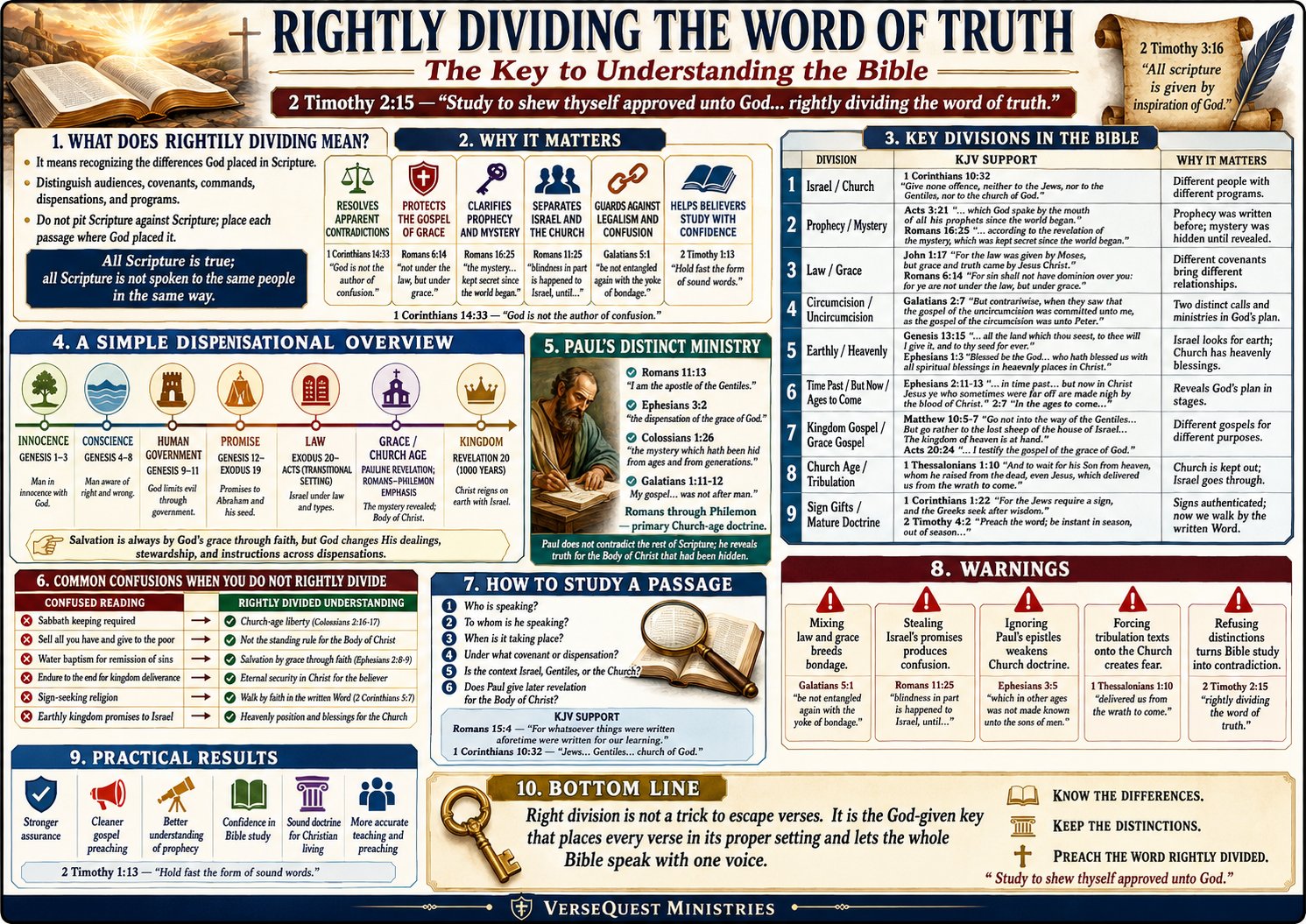
- Rightly Dividing the Word of Truth – KJV Bible Study Chart
- A premium KJV Bible study chart explaining how to rightly divide the word of truth, distinguish key biblical divisions, and study Scripture with clarity and confidence.
- $3.99
- Add to cart
-