
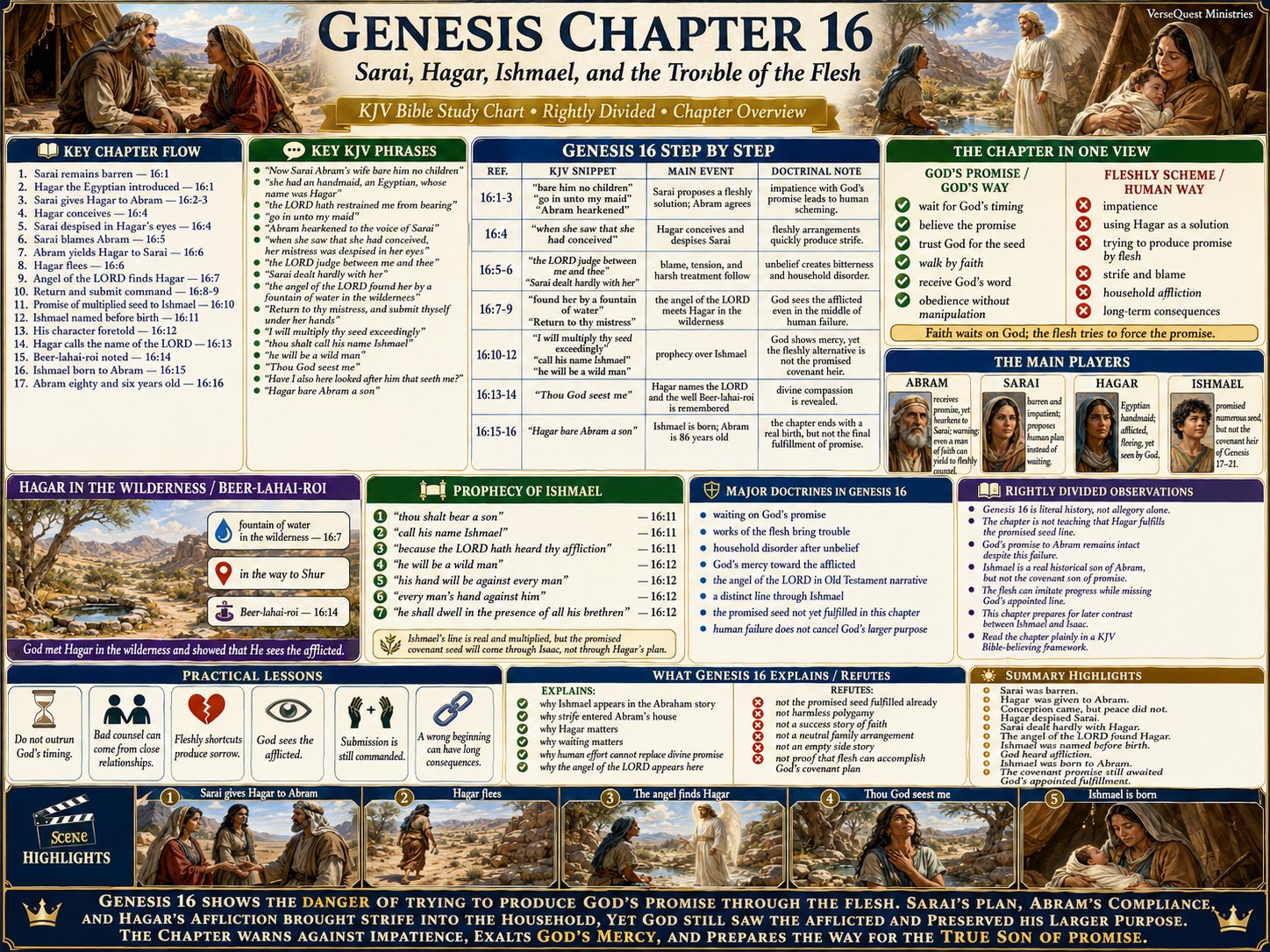
Genesis Chapter 16 Bible Study Chart – Sarai, Hagar, Ishmael, and the Trouble of the Flesh (KJV)
Explore Genesis Chapter 16 with this detailed KJV Bible study chart covering Sarai’s plan, Hagar’s affliction, Ishmael’s birth, the trouble of the flesh, and God’s mercy toward those He sees.
$3.99
Description
Genesis Chapter 16: Sarai, Hagar, Ishmael, and the Trouble of the Flesh is a detailed KJV Bible study chart examining the danger of impatience, the consequences of attempting to fulfill God’s promise through human effort, God’s compassion toward the afflicted, and the birth of Ishmael.
God had promised Abram an heir and an innumerable seed, but the passing years placed pressure upon Abram and Sarai’s faith. Sarai remained barren and began searching for a human solution to a problem only God could solve. She gave her Egyptian handmaid Hagar to Abram in an attempt to produce the promised seed through ordinary human planning.
The chapter provides a sober contrast between God’s promise and God’s way and a fleshly scheme carried out through man’s way. Faith waits for God’s timing, believes His promise, trusts Him for the seed, and obeys without manipulation. The flesh becomes impatient, forces circumstances, uses another person as a solution, and produces strife, blame, affliction, and long-term consequences.
Abram hearkens to Sarai instead of patiently waiting for the LORD. Hagar conceives, but conception does not produce peace. Once she realizes she is with child, her mistress becomes despised in her eyes. Sarai then blames Abram, Abram returns responsibility to Sarai, and Hagar is treated harshly. The household disorder demonstrates that human plans cannot accomplish God’s purposes without producing consequences.
The chart follows Genesis 16 step by step, tracing Sarai’s proposal, Abram’s agreement, Hagar’s conception, the resulting contempt and bitterness, Sarai’s complaint, Hagar’s mistreatment, and her flight into the wilderness. What began as an apparently practical solution quickly became a household crisis involving wounded pride, accusation, mistreatment, and separation.
Hagar’s suffering does not escape God’s attention. The angel of the LORD finds her beside a fountain of water in the wilderness on the way to Shur. This is the first explicit appearance of the angel of the LORD in the Genesis narrative, and the encounter reveals divine knowledge, authority, compassion, and concern for a mistreated servant far from home.
The angel asks Hagar where she came from and where she is going. Hagar can explain the place she fled, but she has no clear destination. She is commanded to return to her mistress and submit herself under Sarai’s hands. The command does not excuse Sarai’s harshness; it directs Hagar according to God’s larger purpose and demonstrates that painful obedience may still be required in a deeply disordered situation.
God promises to multiply Hagar’s seed exceedingly and declares that she will bear a son named Ishmael, meaning that God hears. The name permanently testifies that the LORD heard Hagar’s affliction. Ishmael will become the father of a numerous people, but he is not the covenant son through whom the specific Abrahamic promise will be established. That distinction is explained more fully in Genesis 17 and Genesis 21.
The prophecy concerning Ishmael describes him as a wild man whose hand will be against every man and every man’s hand against him. He will dwell in the presence of his brethren. The chart presents this as a real prophecy concerning Ishmael and his descendants while carefully preserving the distinction between a multiplied natural seed and the covenant line that will later continue through Isaac.
Hagar responds to God’s intervention by calling the LORD, “Thou God seest me.” She recognizes that the God of Abram has seen her suffering in the wilderness. The well is named Beer-lahai-roi, connecting the location with the living God who sees. The chapter therefore contains not only human failure but also a powerful revelation of divine compassion.
Genesis 16 ends with Hagar bearing Ishmael to Abram when Abram is eighty-six years old. The child is real, the family consequences are real, and God’s mercy toward Hagar is real. Yet Ishmael’s birth is not the fulfillment of the specific covenant promise. Human effort has produced a son, but it has not produced the promised son.
The chart includes a clear comparison of the main participants. Abram has received God’s promise but yields to fleshly counsel. Sarai believes the promise yet becomes impatient with God’s timing. Hagar is drawn into the arrangement, becomes proud after conceiving, suffers harshly, and is found by God. Ishmael becomes a numerous historical seed but not the covenant heir of Genesis 17.
Major doctrines include waiting upon God’s promise, the trouble produced by the flesh, household disorder after unbelief, God’s mercy toward the afflicted, the angel of the LORD, the historical line of Ishmael, the continued preservation of the promised seed, and the inability of human effort to replace divine fulfillment.
This chart is ideal for personal Bible study, Genesis teaching, studies on Abram and Sarai, Hagar and Ishmael, faith and patience, flesh versus promise, family conflict, divine compassion, Sunday school, homeschool Bible curriculum, Bible institute instruction, sermon preparation, discipleship, and rightly divided study of the covenant line.
Sarai and Hagar, Abram and Ishmael, waiting for God’s promise, impatience, flesh versus faith, human effort, forced timing, household conflict, pride, blame, harsh treatment, Hagar in the wilderness, angel of the LORD, divine compassion, Thou God seest me, Beer-lahai-roi, prophecy of Ishmael, promised seed, covenant line, long-term consequences
Genesis 16 demonstrates that believing God’s promise does not automatically guarantee patient obedience. Sarai and Abram knew what God had promised, but delay created pressure to devise their own method of fulfillment.
Sarai’s proposal appeared practical within the customs of the ancient world, but cultural acceptance did not make it God’s will. Human customs must never be allowed to replace divine revelation.
Abram’s failure begins when he hearkens to Sarai without any recorded word from God authorizing the plan. Good intentions and close relationships cannot make fleshly counsel spiritually sound.
Hagar’s conception immediately changes the household. Pride enters, Sarai feels dishonoured, Abram avoids responsibility, and harsh treatment follows. The flesh may produce visible results quickly, but it cannot produce the peace associated with God’s perfect will.
Sarai blames Abram even though she initiated the arrangement, while Abram returns the matter to her hands. Sin often creates a circle of accusation in which every participant recognizes another person’s failure more readily than his own.
Hagar flees into the wilderness, but God sees her. The angel of the LORD finds her by the fountain and demonstrates that divine attention reaches the afflicted, displaced, and forgotten.
The command for Hagar to return is difficult, but it places her back within the setting where God’s declared purpose will unfold. Submission does not mean that Sarai’s harshness was righteous; it means Hagar must obey the direction God gives her.
Ishmael’s name testifies that the LORD heard Hagar’s affliction. He will become a numerous people, yet multiplication is not identical to covenant status. God blesses Ishmael while reserving the specific covenant line for Isaac.
Hagar’s declaration, “Thou God seest me,” is one of the chapter’s great spiritual truths. People may overlook suffering, but the LORD sees both the afflicted person and the circumstances surrounding the affliction.
Genesis 16 warns believers not to force God’s timing. A shortcut may appear to move the promise forward while actually introducing years of sorrow. Faith waits upon God because only God can fulfill God’s promises in God’s appointed way.
Genesis chapter study, trusting God’s timing, patience during delayed promises, dangers of fleshly shortcuts, family conflict counseling, consequences of poor counsel, personal responsibility, God’s care for the afflicted, Hagar and Ishmael studies, Abrahamic covenant instruction, Sunday school lessons, homeschool Bible curriculum, Christian school teaching, Bible institute classes, sermon preparation, discipleship training, pastoral counseling, biblical decision-making
King James Bible, Strong’s Concordance, Thompson Chain-Reference Bible, Treasury of Scripture Knowledge, Nave’s Topical Bible, Bible atlas, maps of Canaan and the way to Shur, Genesis commentary notes, Abrahamic covenant studies, Hagar and Ishmael cross-reference notes, Galatians 4 study materials, Scripture memory cards, biblical family counseling resources, VerseQuest Genesis chapter charts
Related products
-
Names of Christ
-
- The Names and Titles of Jesus Christ Made Plain
- A complete 100-essay KJV Bible study on the names and titles of the Lord Jesus Christ, showing His deity, humanity, blood atonement, resurrection, priesthood, headship over the Church, shepherd care,…
- $29.99
- Add to cart
-
-
Revelation
-
-71%
- Moses and Elijah: The Two Witnesses Made Plain
- Moses and Elijah: The Two Witnesses Made Plain is a 636-page premium VerseQuest PDF study proving from Scripture that the Two Witnesses of Revelation 11 are Moses and Elijah. This…
- Original price was: $34.99.$9.99Current price is: $9.99.
- Add to cart
-
-71%
-
Angels
-
-67%
- The Doctrine of Angels Made Plain – 620-Page KJV Bible Study PDF
- The Doctrine of Angels Made Plain is a 620-page KJV Bible study that traces angels from Genesis to Revelation. This premium VerseQuest PDF explains holy angels, Christ’s supremacy over angels,…
- Original price was: $29.99.$9.99Current price is: $9.99.
- Add to cart
-
-67%
-
Jesus Christ / Christology
-
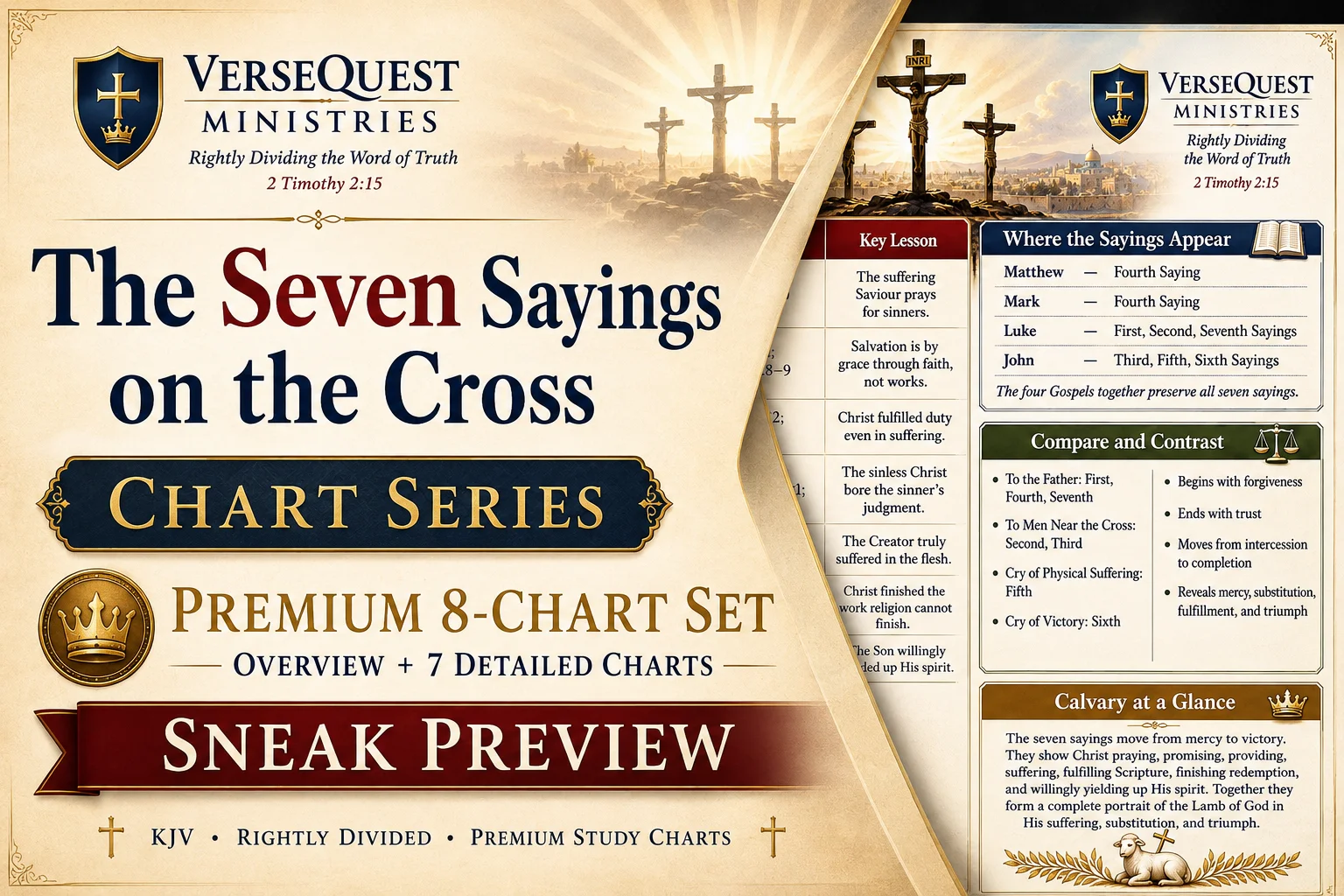
- The Seven Sayings on the Cross – Premium 8-Chart KJV Study Set
- A premium VerseQuest Ministries digital PDF study set on The Seven Sayings on the Cross, featuring an overview chart plus seven detailed KJV Bible study charts. This resource examines Calvary,…
- $12.99
- Add to cart
-
-
Jesus Christ
-
-10%

- The Lord Jesus Christ Made Plain – 637-Page KJV Bible Study
- A massive 637-page, 100-part KJV Bible study on the Person and work of the Lord Jesus Christ. This premium VerseQuest resource covers His deity, incarnation, blood, cross, resurrection, present ministry,…
- Original price was: $39.00.$34.99Current price is: $34.99.
- Add to cart
-
-10%