
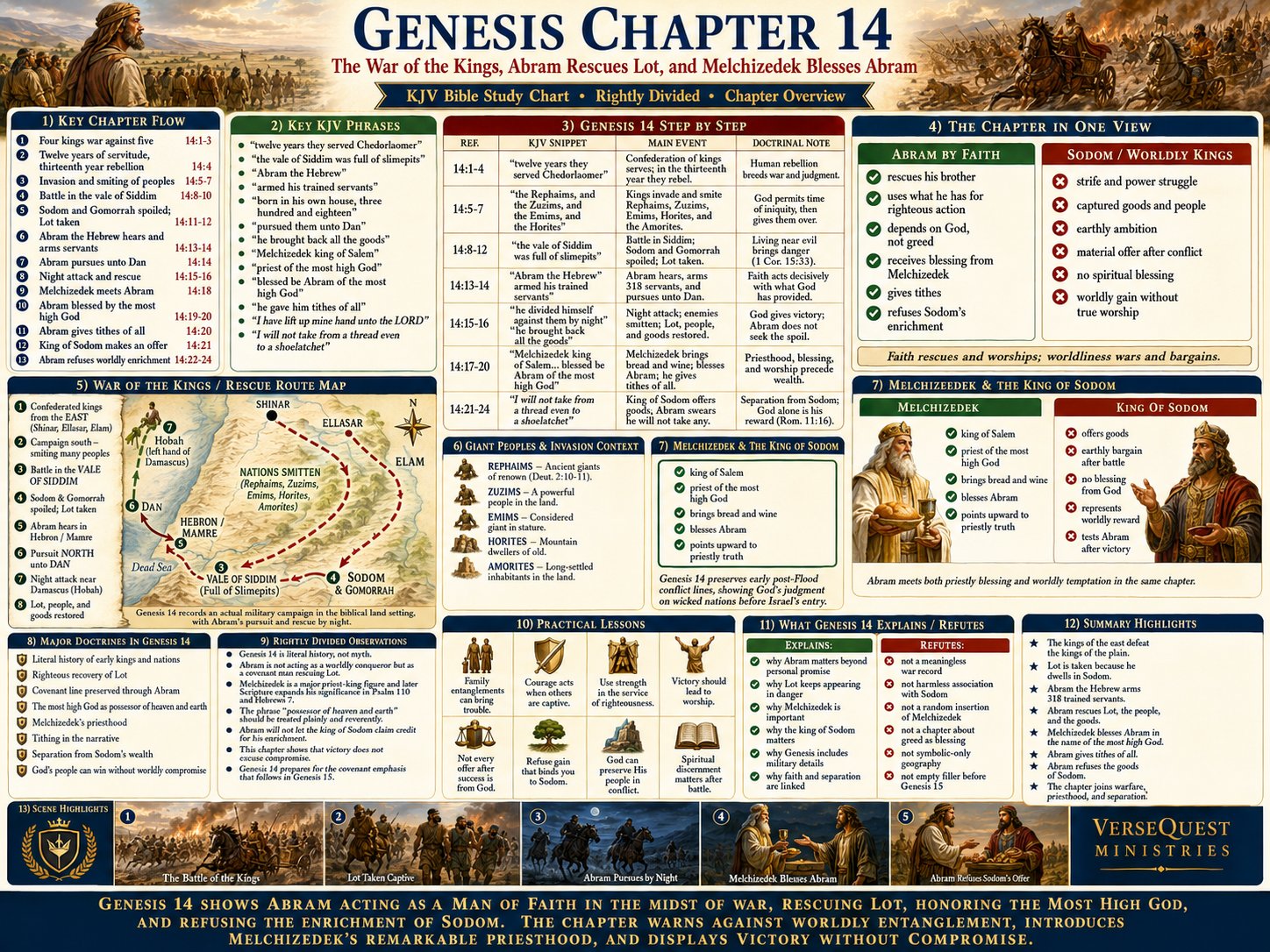
Genesis Chapter 14 Bible Study Chart – The War of the Kings, Abram Rescues Lot, and Melchizedek Blesses Abram (KJV)
Explore Genesis Chapter 14 with this detailed KJV Bible study chart covering the war of the kings, Abram’s rescue of Lot, Melchizedek’s blessing, tithes, divine victory, and Abram’s refusal of Sodom’s wealth.
$3.99
Description
Genesis Chapter 14: The War of the Kings, Abram Rescues Lot, and Melchizedek Blesses Abram is a detailed KJV Bible study chart examining the first recorded military conflict in Scripture, Abram’s courageous rescue of Lot, the mysterious appearance of Melchizedek, and Abram’s refusal to become indebted to the king of Sodom.
The chapter begins with a confederation of four eastern kings going to war against five kings associated with the cities of the plain. After twelve years of servitude, the western kings rebel against Chedorlaomer, producing a campaign that moves through the land and culminates in battle at the vale of Siddim. Genesis presents this conflict as literal history involving identifiable rulers, peoples, places, alliances, and military movements.
The invading kings defeat several ancient peoples, including the Rephaims, Zuzims, Emims, Horites, Amalekites, and Amorites. These references connect Genesis 14 with the wider biblical record of ancient populations and giant peoples encountered in the land. The chapter is not a detached legend but an early historical account rooted in real geography and conflict.
Sodom and Gomorrah are defeated, their possessions are taken, and Lot is carried away with the captives. Lot’s danger is directly connected with the choice he made in Genesis 13. He first looked toward Sodom, then pitched his tent toward Sodom, and eventually lived within Sodom. Genesis 14 demonstrates that proximity to worldly wickedness can bring consequences even when the believer does not share every sin of the surrounding culture.
When Abram hears that his brother has been taken captive, he immediately arms 318 trained servants born in his own household. He pursues the enemy northward, divides his forces by night, defeats the invading coalition, and recovers Lot, the captives, and the stolen goods. Abram is not acting as a worldly conqueror seeking territory or fame. He uses the strength God has given him to rescue others and restore what was taken.
The chart includes a visual route map tracing the eastern kings’ invasion, the battle in the vale of Siddim, Lot’s capture, Abram’s pursuit toward Dan, the night attack near Hobah, and the recovery of the captives and possessions. This geographical overview helps readers follow the chapter’s military movements and understand the scale of Abram’s rescue operation.
Following the victory, Abram encounters two dramatically different kings. Melchizedek, king of Salem and priest of the most high God, brings bread and wine, blesses Abram, and gives glory to God as the One who delivered Abram’s enemies into his hand. The king of Sodom, by contrast, offers Abram the recovered goods and attempts to establish a worldly bargain after the battle.
Melchizedek occupies an important place in biblical doctrine. Genesis identifies him as both king and priest, while Psalm 110 and Hebrews 5–7 later develop the significance of the priesthood connected with his name. He blesses Abram in the name of the most high God, possessor of heaven and earth, and directs attention away from human military skill toward divine victory.
Abram responds by giving Melchizedek tithes of all. This offering occurs centuries before the law of Moses and demonstrates honour, gratitude, and recognition of priestly blessing. Rightly divided study should note that Genesis 14 records Abram’s voluntary act without automatically converting every detail of the narrative into a direct command governing the New Testament church.
The king of Sodom then offers Abram the goods, but Abram refuses everything from a thread to a shoelatchet. He will not allow the ruler of Sodom to claim credit for making him rich. Abram had already accepted bread, blessing, and spiritual recognition from Melchizedek; he would not trade that testimony for Sodom’s wealth.
This refusal reveals Abram’s growth in faith. In Genesis 12, fear drove him into Egypt, where he accepted worldly substance under compromised circumstances. In Genesis 14, he stands before the king of Sodom after a great victory and rejects enrichment that could compromise his testimony. He has learned that God alone must receive the glory for his provision and success.
The chapter also contrasts faith with worldliness. Abram rescues, worships, gives, honours God, and refuses corrupt gain. The worldly kings fight for power, possessions, tribute, and political control. Melchizedek offers priestly blessing, while the king of Sodom offers material reward without spiritual fellowship.
Practical lessons throughout the chart emphasize courage, family responsibility, righteous use of strength, spiritual discernment after victory, separation from worldly enrichment, and worship following deliverance. Victory can become a spiritual danger when success produces pride, greed, or dependence upon worldly approval. Abram’s greatest triumph is not merely defeating the kings but refusing Sodom’s reward.
This chart is ideal for personal Bible study, Genesis teaching, studies of Abram and Lot, biblical warfare, Melchizedek, priesthood, tithing, spiritual separation, Sunday school, homeschool curriculum, Bible institutes, sermon preparation, discipleship, and doctrinal studies connecting Genesis 14 with Psalm 110 and Hebrews.
Genesis 14, war of the kings, Abram rescues Lot, Melchizedek, king of Salem, priest of the most high God, bread and wine, tithes, king of Sodom, spiritual separation, righteous courage, divine victory, recovery of the captives, giant peoples, biblical warfare, faith in action, refusal of worldly gain, priesthood, worship after victory, God as possessor of heaven and earth
Genesis 14 records the first major military campaign described in Scripture. The chapter names kings, territories, alliances, battles, and travel routes, presenting the account as genuine history rather than symbolic mythology.
Lot’s capture is connected with his earlier decision to live near Sodom. The chapter warns that worldly associations can create consequences that extend beyond personal comfort. Lot did not begin by seeking captivity, but his chosen environment placed him in the path of judgment and conflict.
Abram responds to Lot’s danger with courage and responsibility. Although Lot had chosen the better-looking land and separated from him, Abram does not abandon him. Faith does not use another person’s poor decision as an excuse to withhold necessary help.
The 318 trained servants reveal that Abram’s household was organized and prepared. He uses his strength in the service of righteousness rather than conquest. Biblical courage is neither reckless aggression nor passive indifference.
Abram’s victory ultimately comes from God. Melchizedek declares that the most high God delivered Abram’s enemies into his hand. Human preparation has a place, but the glory belongs to the Lord who gives the victory.
Melchizedek appears as king of Salem and priest of the most high God. Later Scripture uses his priesthood to illuminate the superior and eternal priesthood of Jesus Christ. Genesis 14 introduces the historical figure; Psalm 110 and Hebrews unfold the doctrinal significance.
Abram gives Melchizedek tithes of all as an act of honour and gratitude. This occurs before the Mosaic law. The event is doctrinally important, but it should be interpreted carefully rather than used without distinction as a complete New Testament church command.
The king of Sodom presents a different test from the eastern kings. Abram had defeated armed enemies, but he must now resist an attractive financial offer. Some temptations arrive with swords; others arrive carrying rewards.
Abram refuses Sodom’s wealth so that no worldly ruler can claim responsibility for his prosperity. Separation protects his testimony and makes clear that his confidence rests in God rather than political alliances or corrupt enrichment.
Genesis 14 teaches that believers need discernment after victory as much as courage during conflict. Success can expose a person to pride, greed, compromise, and misplaced loyalty. Abram completes his victory by honouring God, blessing others, and refusing Sodom’s bargain.
Genesis chapter study, Abram and Lot lessons, Melchizedek studies, biblical priesthood, faith expressed through action, family responsibility, courage in conflict, righteous use of strength, spiritual discernment after success, separation from worldly compromise, tithing studies, Sunday school lessons, homeschool Bible curriculum, Christian school instruction, Bible institute classes, sermon preparation, discipleship training, biblical history, studies in Hebrews
King James Bible, Strong’s Concordance, Thompson Chain-Reference Bible, Treasury of Scripture Knowledge, Nave’s Topical Bible, Bible atlas, maps of ancient Canaan and Mesopotamia, Genesis commentary notes, Scripture cross-reference guide, studies on Melchizedek and Hebrews 7, biblical priesthood resources, studies on Abram and Lot, tithing study materials, VerseQuest Genesis chapter charts
Related products
-
Christology Studies
-
- The Deity of Christ Defended — 66 KJV Studies Proving Jesus Christ Is God Manifest in the Flesh
- he Deity of Christ Defended is a 444-page premium KJV Bible study defending the full deity of the Lord Jesus Christ. This 66-study book proves from Scripture that Jesus is…
- $29.99
- Add to cart
-
-
KJV Bible Study Resources
-
-60%
- Practical Christianity for Daily Battles – 329-Page KJV Study PDF
- A premium 329-page KJV study PDF with 40 full essays applying sound, rightly divided Bible doctrine to real daily Christian battles. Topics include temptation, anxiety, marriage, parenting, pornography, grief, church…
- Original price was: $24.99.$9.99Current price is: $9.99.
- Add to cart
-
-60%
-
Jesus Christ
-
-67%
- The Millennium Made Plain – 416-Page KJV Study on Christ’s Future Reign
- A premium 416-page KJV, rightly divided Bible study on the literal future Millennial reign of Jesus Christ. The Millennium Made Plain explains Revelation 19–20, Israel’s restoration, Satan’s binding, the Kingdom…
- Original price was: $29.99.$9.99Current price is: $9.99.
- Add to cart
-
-67%
-
VerseQuest Premium Library
-
-67%
- The Book of Psalms Made Plain – 383-Page KJV Psalm Study
- The Book of Psalms Made Plain is a 383-page premium KJV Bible study featuring 54 detailed essays through the major themes, doctrines, prophecies, prayers, laments, and praises of the Psalms.…
- Original price was: $29.99.$9.99Current price is: $9.99.
- Add to cart
-
-67%
-
Heaven
-
- The Doctrine of Heaven Made Plain — 599-Page KJV Bible Study PDF
- A massive 599-page KJV, rightly divided study on heaven, covering the present heaven, resurrection body, Rapture, Millennium, New Jerusalem, eternal state, hard questions, funeral lies, and cult errors.
- $34.99
- Add to cart
-