Sermon Title:
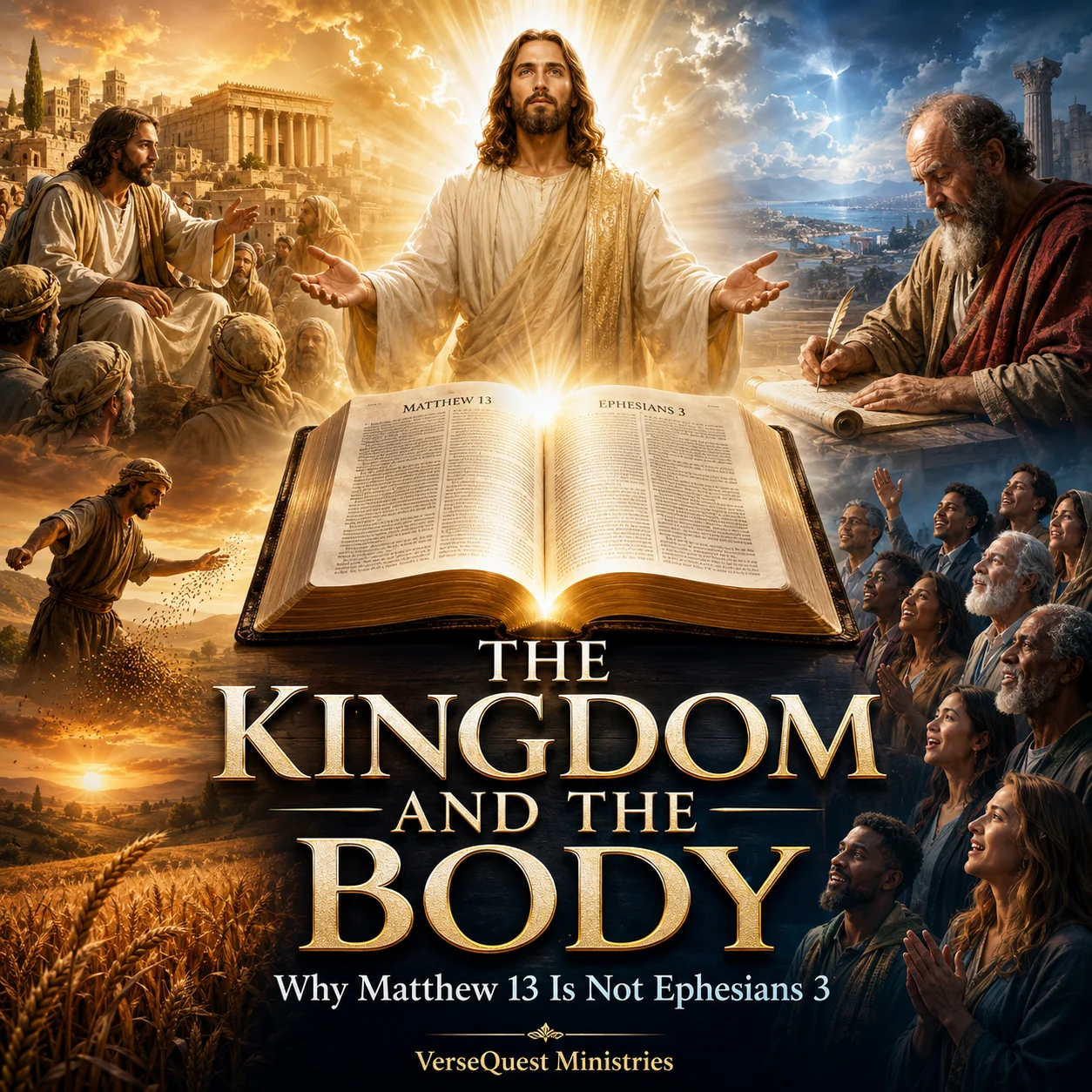
The Kingdom and the Body: Why Matthew 13 Is Not Ephesians 3
Key Passage:
Matthew 13:11 — “He answered and said unto them, Because it is given unto you to know the mysteries of the kingdom of heaven, but to them it is not given.”
Ephesians 3:6 — “That the Gentiles should be fellowheirs, and of the same body, and partakers of his promise in Christ by the gospel.”
Series:
Foundations of Right Division
Topic:
The Difference Between the Kingdom of Heaven and the Body of Christ
Book:
Matthew, Ephesians, Romans, Colossians, 1 Corinthians, Acts, Daniel, 2 Timothy
Speaker:
Paul Tackett
Suggested Sermon Text:
Matthew 13:1–52; Matthew 3:1–2; Matthew 4:17; Matthew 10:5–7; Matthew 24:14; Ephesians 3:1–9; Ephesians 1:22–23; Ephesians 2:14–16; Colossians 1:24–27; Romans 16:25–26; 1 Corinthians 12:13; 2 Timothy 2:15
Short Sermon Description:
This sermon outline explains the biblical difference between the mysteries of the kingdom of heaven in Matthew 13 and the mystery of the Body of Christ revealed through Paul in Ephesians 3. The kingdom of heaven is connected to Israel’s King, kingdom offer, prophetic program, earthly reign, and the hidden form of the kingdom during the King’s rejection. The Body of Christ is connected to the mystery hid in God, revealed through Paul, saved Jews and Gentiles placed into one Body by the Spirit, and the Church’s heavenly calling in the dispensation of grace. This study exposes the confusion caused when men turn Matthew 13 into the Church, turn the Church into the kingdom, or mix Israel’s prophetic program with the Body of Christ. It equips pastors, teachers, Bible students, and believers to rightly divide kingdom truth from Body truth and preach the gospel of grace clearly.
The Kingdom and the Body
Why Matthew 13 Is Not Ephesians 3
Introduction
Matthew 13 and Ephesians 3 are two chapters that many Bible teachers blend together without blinking. Matthew 13 speaks of “the mysteries of the kingdom of heaven.” Ephesians 3 speaks of the mystery revealed through Paul, where Gentiles are “of the same body.” Because both passages use the word “mystery,” many assume they are talking about the same thing. That is how confusion starts. The Bible does not say “mysteries of the kingdom of heaven” and “the Body of Christ” are identical. It does not say the parables of Matthew 13 reveal the Church which is His Body. It does not say the kingdom of heaven is the same as the Church seated in heavenly places in Christ. Those are different words, different contexts, different audiences, different programs, and different doctrinal settings.
The kingdom of heaven in Matthew is connected to the King and His kingdom. John the Baptist preached, “Repent ye: for the kingdom of heaven is at hand.” Jesus preached the same message. The twelve were sent to the lost sheep of the house of Israel preaching, “The kingdom of heaven is at hand.” That kingdom message had to do with Israel’s promised King, the throne of David, the kingdom promised by the prophets, and the earthly reign of Messiah. When Israel’s leadership rejected the King, the Lord Jesus began speaking in parables and revealed mysteries of the kingdom of heaven. These mysteries explain the hidden, mixed, and delayed form of that kingdom program during the King’s rejection. They do not reveal the Body of Christ as later revealed through Paul.
Ephesians 3 is different ground. Paul says the mystery was made known to him by revelation. He says it was not made known in other ages as it is now revealed. He says Gentiles are fellowheirs, of the same Body, and partakers of God’s promise in Christ by the gospel. This is not Israel’s earthly kingdom program in parable form. This is the revelation of the Church, the Body of Christ, connected to the dispensation of grace. If a man mixes Matthew 13 and Ephesians 3, he will confuse the kingdom with the Body, prophecy with mystery, Israel with the Church, and the gospel of the kingdom with the gospel of the grace of God. But when the Book is rightly divided, both passages shine exactly where God placed them.
I. The Kingdom of Heaven Is Announced to Israel
Key Text: Matthew 3:1–2
Supporting Texts: Matthew 4:17; Matthew 10:5–7; Luke 1:32–33
The kingdom of heaven first appears in Matthew with John the Baptist preaching, “Repent ye: for the kingdom of heaven is at hand.” Jesus takes up the same message in Matthew 4:17. Then in Matthew 10:5–7, the twelve are specifically commanded, “Go not into the way of the Gentiles,” but “go rather to the lost sheep of the house of Israel,” preaching, “The kingdom of heaven is at hand.” That settles the original audience of that message. It was directed to Israel, not to the Body of Christ.
The kingdom of heaven is connected with the promised King. Luke 1:32–33 says Jesus Christ will receive “the throne of his father David” and “reign over the house of Jacob for ever.” That is not a vague religious feeling. It is not a Gentile church program. It is not a synonym for the Body of Christ. It is Israel’s King reigning over the house of Jacob. The kingdom preached in Matthew is tied to Israel’s prophetic hope and the Messiah’s earthly reign.
This matters because many read Matthew as though Jesus is preaching Church-age doctrine from the start. But Matthew is not Ephesians. The earthly ministry of Christ was directed primarily to Israel. He came to His own. The kingdom was at hand because the King was present. The question was whether Israel would receive Him. When the King is rejected, the kingdom program does not vanish, but it takes on a hidden form revealed in Matthew 13.
Main Truth:
The kingdom of heaven was announced to Israel in connection with her promised King and earthly kingdom hope.
II. The Kingdom of Heaven Is Not the Same as the Body of Christ
Key Text: Matthew 13:11; Ephesians 3:6
Supporting Texts: Ephesians 1:22–23; 1 Corinthians 12:13; Colossians 1:18
Matthew 13:11 speaks of “the mysteries of the kingdom of heaven.” Ephesians 3:6 speaks of Gentiles being “of the same body.” Those are not the same phrase. The kingdom of heaven is kingdom language. The Body of Christ is Church-age mystery language. A kingdom has a King, subjects, territory, rule, authority, and administration. A body has a Head, members, life, union, and spiritual operation. God chose different language because He is revealing different truth.
Ephesians 1:22–23 says the Church is Christ’s Body. Colossians 1:18 says Christ is “the head of the body, the church.” First Corinthians 12:13 says believers are baptized by one Spirit into one Body. That is not how Matthew 13 describes the kingdom of heaven. Matthew 13 describes sowing, tares, mustard seed, leaven, treasure, a pearl, a net, and separation at the end of the world. These parables are about the kingdom in mystery form, not the Spirit baptizing saved Jews and Gentiles into one Body.
When men make the kingdom and the Body the same thing, they create doctrinal fog. They start calling the Church the kingdom, turning the kingdom into a spiritualized church age, and applying kingdom passages to Body truth. The result is confusion about salvation, prophecy, the tribulation, the rapture, Israel’s restoration, and the believer’s calling. The kingdom of heaven and the Body of Christ must be distinguished if the Bible is to be handled honestly.
Main Truth:
The kingdom of heaven and the Body of Christ are different biblical truths with different language, settings, and doctrinal applications.
III. Matthew 13 Reveals Mysteries of the Kingdom During the King’s Rejection
Key Text: Matthew 13:11
Supporting Texts: Matthew 12:14; Matthew 12:24; Matthew 13:34–35
Matthew 13 does not come out of nowhere. In Matthew 12, the rejection of the King intensifies. The Pharisees hold a council against Him to destroy Him. Then they accuse Him of casting out devils by Beelzebub. That is not a small disagreement. That is the leadership of Israel rejecting the Spirit-anointed King and attributing His works to the devil. After that, Matthew 13 shows Jesus teaching in parables and revealing mysteries of the kingdom of heaven.
When the disciples ask why He speaks in parables, He says, “Because it is given unto you to know the mysteries of the kingdom of heaven, but to them it is not given.” The parables both reveal and conceal. They reveal truth to disciples, but they conceal truth from the hardened nation. This is not the open preaching of the kingdom as at hand in Matthew 3, 4, and 10. This is kingdom truth in a mystery form because of rejection.
Matthew 13:35 says this fulfilled what was spoken by the prophet: “I will open my mouth in parables; I will utter things which have been kept secret from the foundation of the world.” These are secrets concerning the kingdom’s hidden form. But that does not make them identical with the mystery of the Body of Christ in Ephesians 3. The parables reveal the course of the kingdom in mystery form during the King’s absence and rejection, while Paul’s mystery reveals the one Body in Christ during the dispensation of grace.
Main Truth:
Matthew 13 reveals mysteries of the kingdom of heaven in light of Israel’s rejection of the King.
IV. The Kingdom Mysteries Contain a Mixture Until the End
Key Text: Matthew 13:24–30
Supporting Texts: Matthew 13:36–43; Matthew 13:47–50; Matthew 24:13–14
The parables of Matthew 13 show mixture. The wheat and tares grow together until the harvest. The net gathers good and bad. The separation happens at the end of the world. Angels are involved in the separation. The wicked are cast into a furnace of fire. That is kingdom judgment language. It is not a description of the Body of Christ as seated in heavenly places, complete in Christ, and awaiting the blessed hope.
In the parable of the wheat and tares, the servants are told not to uproot the tares prematurely. The harvest comes at the end of the world, and the reapers are the angels. That setting is not the judgment seat of Christ for Church-age believers. It is the end-of-the-age judgment connected with the kingdom. Matthew 13:43 says, “Then shall the righteous shine forth as the sun in the kingdom of their Father.” That fits the kingdom framework.
The Body of Christ is different. The Body is one spiritual organism made up of saved people placed into Christ by the Spirit. It is not a mixed kingdom field of wheat and tares. It is not a dragnet of good and bad gathered for separation by angels. There are lost people in local assemblies, and there are false professors around Christianity, but doctrinally the Body of Christ consists of saved members in Christ. Matthew 13’s kingdom mixture must not be forced into Ephesians’ Body doctrine.
Main Truth:
The kingdom mysteries in Matthew 13 show a mixed kingdom form until end-time separation, not the pure spiritual Body of Christ.
V. The Body of Christ Was a Mystery Hid in God
Key Text: Ephesians 3:5–6
Supporting Texts: Ephesians 3:9; Colossians 1:26; Romans 16:25
Ephesians 3 says the mystery revealed through Paul was “not made known unto the sons of men, as it is now revealed.” Ephesians 3:9 says this mystery was “hid in God.” Colossians 1:26 says it was “hid from ages and from generations, but now is made manifest to his saints.” Romans 16:25 says it was “kept secret since the world began.” Those are strong words. The Body of Christ was not Matthew 13 waiting to be relabeled.
Ephesians 3:6 identifies the mystery as Gentiles being fellowheirs, of the same Body, and partakers of God’s promise in Christ by the gospel. This is not Gentiles coming to Israel’s light in the kingdom. This is saved Jews and Gentiles made members of the same Body on equal standing in Christ. The Body of Christ is not a kingdom with Israel at the head and Gentiles blessed through the nation. It is one new man in Christ.
This truth must be preserved. If the Body of Christ was fully revealed in Matthew 13, then Paul’s language in Ephesians 3 and Colossians 1 loses its force. But the Holy Ghost says the mystery was hid and now revealed. The Church must not erase Paul’s distinct revelation by reading the Body back into every kingdom passage. The Body of Christ is mystery truth revealed in the proper time through the apostle of the Gentiles.
Main Truth:
The Body of Christ was a mystery hid in God and revealed through Paul, not the kingdom of heaven in Matthew 13.
VI. The Kingdom of Heaven Has an Earthly Prophetic Direction
Key Text: Daniel 2:44
Supporting Texts: Isaiah 2:1–4; Zechariah 14:4; Matthew 6:10
Daniel 2:44 says the God of heaven shall set up a kingdom that shall never be destroyed. That kingdom smites and replaces the kingdoms of this world. Isaiah 2 says the law will go forth from Zion and the word of the LORD from Jerusalem. Zechariah 14 says the Lord’s feet shall stand upon the mount of Olives. These are earthly kingdom prophecies. They do not describe the Body of Christ seated in heavenly places in Christ.
In Matthew 6:10, the Lord teaches the disciples to pray, “Thy kingdom come. Thy will be done in earth, as it is in heaven.” That is an earthly kingdom prayer. It is not the same as the Church’s heavenly position revealed in Ephesians. The kingdom comes to earth. The King reigns. Israel is restored. The nations are judged. Jerusalem becomes the center of Messiah’s government. That is the prophetic direction of the kingdom.
The kingdom of heaven in Matthew must be read in light of that prophetic hope. It is not merely “God ruling in your heart.” It is not simply “the Church.” It is not a metaphor for Christian influence in society. It is connected to the King from heaven bringing heaven’s rule to earth. During the King’s rejection, Matthew 13 reveals mysteries concerning the kingdom’s hidden form, but the kingdom still has an earthly prophetic end.
Main Truth:
The kingdom of heaven has an earthly prophetic direction connected to Messiah’s reign and God’s rule on earth.
VII. The Body of Christ Has a Heavenly Mystery Calling
Key Text: Ephesians 2:6
Supporting Texts: Ephesians 1:3; Philippians 3:20; Colossians 3:1–4
The Body of Christ has a heavenly calling. Ephesians 2:6 says believers are seated together in heavenly places in Christ Jesus. Ephesians 1:3 says believers are blessed with all spiritual blessings in heavenly places in Christ. Philippians 3:20 says, “For our conversation is in heaven; from whence also we look for the Saviour.” That is not the same as the kingdom coming to earth in Matthew’s prophetic framework.
The Church is joined to a risen Head in heaven. Colossians 3:1–4 tells believers to seek those things which are above, where Christ sitteth on the right hand of God. The believer’s life is hid with Christ in God. When Christ appears, believers will appear with Him in glory. This is not Israel’s national kingdom calling. It is the Body’s heavenly identity in Christ.
Right division protects both truths. The kingdom is not denied because the Church has a heavenly calling. The Church is not diminished because Israel has an earthly kingdom hope. God has purposes in heaven and earth, and both are gathered in Christ. The problem comes when men try to make every passage about one group, one calling, and one program. Ephesians gives the Body its heavenly place, and Matthew gives the kingdom its proper prophetic setting.
Main Truth:
The Body of Christ has a heavenly mystery calling, seated in Christ and looking for the Saviour from heaven.
VIII. Confusing the Kingdom and the Body Corrupts Doctrine
Key Text: 2 Timothy 2:15
Supporting Texts: Galatians 1:6–9; Matthew 24:13–14; Acts 20:24
Second Timothy 2:15 commands the workman to rightly divide the word of truth. One of the divisions that must be maintained is the difference between kingdom truth and Body truth. When those are mixed, doctrine suffers. The gospel of the kingdom gets confused with the gospel of grace. Matthew 24 endurance gets preached as Church-age salvation. Israel’s tribulation passages get applied to the Body of Christ. The rapture gets blurred with the Second Advent.
Matthew 24:13–14 speaks of enduring unto the end and the gospel of the kingdom being preached before the end comes. Acts 20:24 speaks of Paul’s ministry testifying the gospel of the grace of God. Those are not the same context. If a preacher takes tribulation kingdom passages and preaches them as Paul’s gospel, he will rob believers of assurance and corrupt the clarity of salvation by grace through faith.
Galatians 1 warns against another gospel. The danger is not always open denial of Christ. Sometimes it is mixing messages God placed in different contexts. A little law, a little kingdom endurance, a little water, a little works, a little tribulation warning, a little Paul, a little Moses, a little Matthew, and soon the gospel of grace is buried under religious confusion. Right division keeps kingdom truth and Body truth where God placed them.
Main Truth:
Confusing the kingdom of heaven with the Body of Christ corrupts salvation, prophecy, assurance, and sound doctrine.
IX. Christ Is King of the Kingdom and Head of the Body
Key Text: Colossians 1:18
Supporting Texts: Luke 1:32–33; Ephesians 1:22–23; Ephesians 1:10
Right division does not divide Christ into competing Lords. The same Jesus Christ is King of Israel and Head of the Body. Luke 1:32–33 says He will sit on David’s throne and reign over the house of Jacob. Ephesians 1:22–23 says God gave Him to be Head over all things to the Church, which is His Body. Both are true. The error is not in believing both. The error is in making both the same.
As King, Christ fulfills the promises made to the fathers and reigns over Israel and the nations. As Head, Christ gives life and direction to the Body joined to Him in heaven. The kingdom displays His earthly rule. The Body displays His heavenly headship and the riches of the mystery. Both magnify Him. Neither needs to be stolen from the other.
Ephesians 1:10 says that in the dispensation of the fulness of times, God will gather together in one all things in Christ, both which are in heaven and which are on earth. That verse gives the large view. God has an earthly purpose and a heavenly purpose. The kingdom and the Body are not enemies. They are distinct parts of God’s full purpose in Christ. The wise workman lets Christ have every glory God revealed.
Main Truth:
Jesus Christ is King of the kingdom and Head of the Body, and right division lets Him have the glory of both.
Conclusion
The kingdom of heaven and the Body of Christ must not be mixed. Matthew 13 reveals mysteries of the kingdom of heaven in light of Israel’s rejection of the King. Ephesians 3 reveals the mystery of the Body of Christ, where saved Jews and Gentiles are made fellowheirs and of the same Body by the gospel. Matthew 13 belongs to kingdom truth. Ephesians 3 belongs to Body truth. Both are inspired. Both are profitable. Both reveal God’s wisdom. But they are not the same doctrine.
When men confuse the two, they create a chain reaction of doctrinal errors. The Church becomes a kingdom. Israel’s promises are stolen. Matthew 24 becomes Church-age salvation. The tribulation becomes the Church’s appointment. The gospel of grace becomes mixed with endurance, law, and works. The rapture becomes blurred with the Second Advent. The Body’s heavenly calling gets dragged down into earthly kingdom passages. All of this confusion comes from refusing to rightly divide what God wrote.
The Bible believer does not need to choose between Matthew and Ephesians. He needs to believe both in their proper places. Let the kingdom of heaven remain connected to Israel, prophecy, and the King’s earthly reign. Let the Body of Christ remain connected to Paul’s mystery, grace, one new man, and heavenly calling. Let Christ be King of the kingdom and Head of the Body. Let the gospel of grace be preached plainly. Let every passage stand where God put it. That is how the Book opens.
Final Call
The sinner today is not saved by entering a kingdom program, enduring to the end of the tribulation, keeping Moses, or trying to qualify through religious effort. The sinner is saved by the gospel of the grace of God. Christ died for our sins according to the scriptures. He was buried. He rose again the third day according to the scriptures.
Believe on the Lord Jesus Christ, and thou shalt be saved. Trust the finished work. Trust the blood. Trust the risen Saviour. Do not trust your works, church, baptism, sacraments, or feelings. Trust Christ alone.
Believer, rightly divide the Book. Do not make Matthew 13 into Ephesians 3. Do not turn the Body into the kingdom or the kingdom into the Body. Study the words. Believe the words. Let Israel keep her kingdom promises. Let the Church keep her heavenly calling. Let Jesus Christ be magnified in both.
Closing Verse:
Ephesians 3:6 — “That the Gentiles should be fellowheirs, and of the same body, and partakers of his promise in Christ by the gospel.”
Closing Statement:
The kingdom reveals Christ as Israel’s coming King, the Body reveals Christ as the Church’s heavenly Head, and right division keeps both glories clear.