Sermon Title:
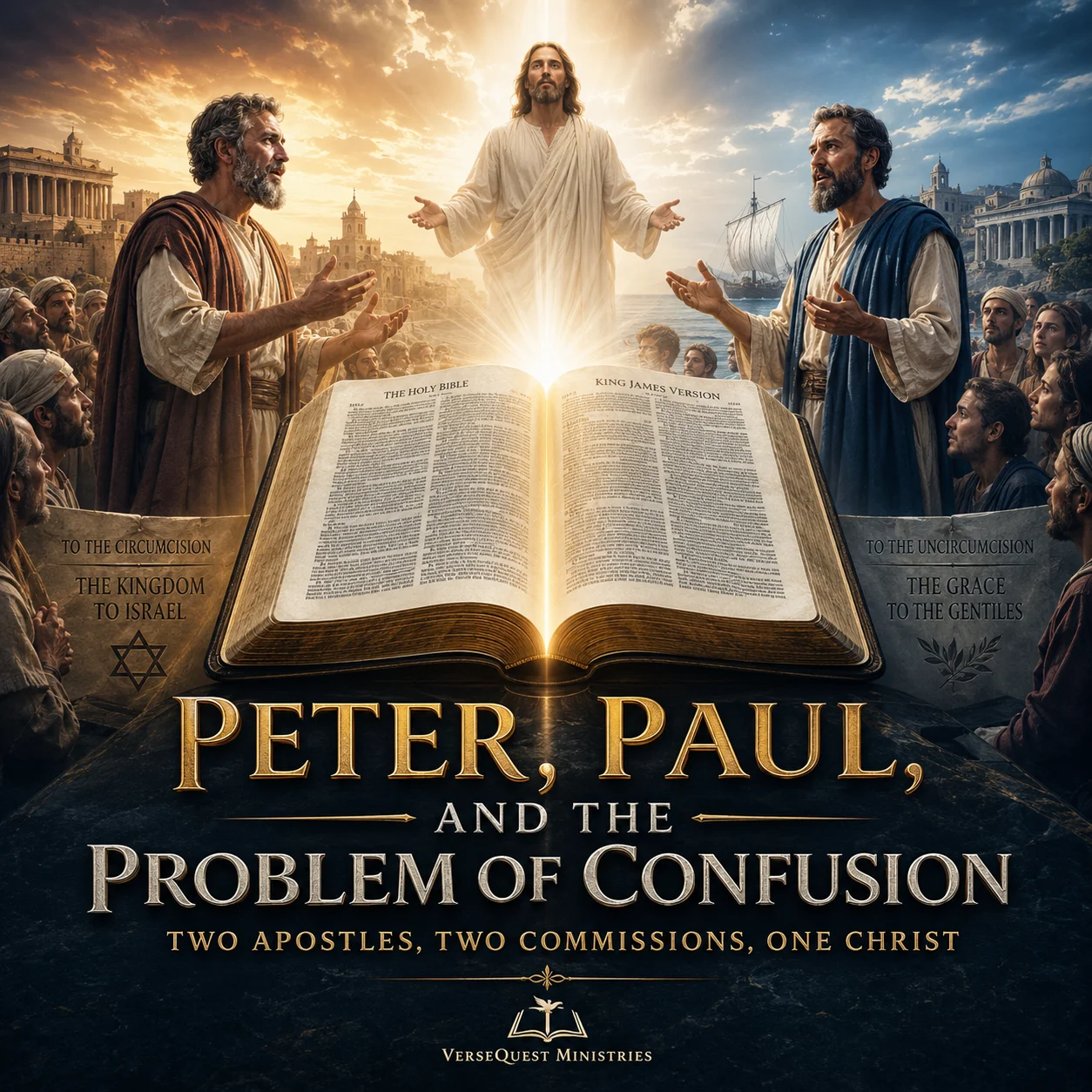
Peter, Paul, and the Problem of Confusion: Two Apostles, Two Commissions, One Christ
Key Passage:
Galatians 2:7–9 — “But contrariwise, when they saw that the gospel of the uncircumcision was committed unto me, as the gospel of the circumcision was unto Peter; (For he that wrought effectually in Peter to the apostleship of the circumcision, the same was mighty in me toward the Gentiles🙂 And when James, Cephas, and John, who seemed to be pillars, perceived the grace that was given unto me, they gave to me and Barnabas the right hands of fellowship; that we should go unto the heathen, and they unto the circumcision.”
Series:
Foundations of Right Division
Topic:
Peter, Paul, and the Difference Between the Apostleship of the Circumcision and the Apostleship of the Gentiles
Book:
Galatians, Acts, Romans, Ephesians, 1 Corinthians, 2 Timothy, Matthew
Speaker:
Paul Tackett
Suggested Sermon Text:
Galatians 2:1–9; Romans 11:13; Acts 2:14–38; Acts 3:19–21; Acts 9:1–16; Acts 13:46–48; Acts 15:1–21; 1 Corinthians 15:1–4; Ephesians 3:1–9; 2 Timothy 2:7; 2 Timothy 2:15
Short Sermon Description:
This sermon outline explains why confusion over Peter and Paul has produced some of the greatest doctrinal errors in modern Christianity. Galatians 2:7–9 clearly distinguishes Peter’s apostleship to the circumcision from Paul’s apostleship to the Gentiles, and it identifies the gospel of the circumcision committed to Peter and the gospel of the uncircumcision committed to Paul. This does not mean there are two Saviours or two ways of salvation today; it means God gave distinct commissions in different dispensational settings. Peter’s early Acts ministry is connected to Israel, prophecy, repentance, the kingdom, and the circumcision, while Paul’s ministry is connected to the Gentiles, the gospel of grace, the revelation of the mystery, and the Body of Christ. This outline equips pastors, teachers, Bible students, and believers to rightly divide Peter and Paul, protect the gospel of grace, understand Acts as a transition book, and avoid the doctrinal blender that mixes Israel’s kingdom program with the Church’s grace doctrine.
Peter, Paul, and the Problem of Confusion
Two Apostles, Two Commissions, One Christ
Introduction
Few areas of Bible study create more confusion than the failure to distinguish Peter’s ministry from Paul’s ministry. The average church member has heard Peter and Paul mentioned together so often that he assumes they preached the same message under the same commission to the same people with the same doctrinal emphasis. But Galatians 2:7–9 says otherwise. Paul says “the gospel of the uncircumcision” was committed unto him, while “the gospel of the circumcision” was unto Peter. He says God wrought effectually in Peter “to the apostleship of the circumcision,” and the same God was mighty in Paul “toward the Gentiles.” That is not theological speculation. That is Scripture.
The confusion does not come from believing Galatians 2. The confusion comes from ignoring it. When men refuse to distinguish Peter and Paul, they end up mixing Acts 2 with Romans, Matthew 24 with 1 Thessalonians, water baptism with the gospel of grace, kingdom repentance with Pauline justification, Israel’s prophetic promises with the Church’s mystery calling, and circumcision truth with uncircumcision truth. The result is a gospel that sounds like grace one minute and works the next. It tells sinners to believe on Christ, but then adds baptism, law, endurance, sacraments, confession systems, signs, or church membership. That is not Bible clarity. That is religious soup.
Right division does not make Peter wrong. It does not make Paul better than Christ. It does not create two Saviours. It simply honors the way God revealed His word. Peter was an apostle of Jesus Christ, and God used him mightily. Paul was also an apostle of Jesus Christ, but his apostleship was distinct. Peter’s early ministry is aimed at the circumcision, Israel, the kingdom, and things spoken by the prophets. Paul’s ministry is aimed at the Gentiles, the gospel of the grace of God, the Body of Christ, and the revelation of the mystery kept secret since the world began. Keep those men in their God-given lanes, and the Bible opens. Mix them carelessly, and confusion follows.
I. Peter and Paul Had the Same Lord, but Different Apostleships
Key Text: Galatians 2:7–8
Supporting Texts: Romans 11:13; Matthew 10:5–7; Acts 9:15
Galatians 2:8 says the same God who wrought effectually in Peter also was mighty in Paul. That means this is not a competition between apostles. Peter and Paul had the same Lord Jesus Christ. They preached the same risen Christ. They were both saved by the grace of God. They were both used by the Holy Ghost. The difference is not in the worth of Christ, but in the commission and audience God assigned to each man.
Peter’s apostleship is identified as “the apostleship of the circumcision.” That fits Matthew 10:5–7, where the twelve were told not to go into the way of the Gentiles, but to go rather to the lost sheep of the house of Israel, preaching, “The kingdom of heaven is at hand.” Peter was one of the twelve apostles connected to Israel’s kingdom program. He walked with Christ in His earthly ministry, saw the miracles, heard the kingdom preaching, and later stood up in Acts 2 addressing “ye men of Judaea” and “ye men of Israel.”
Paul’s apostleship is different. Romans 11:13 says, “For I speak to you Gentiles, inasmuch as I am the apostle of the Gentiles.” Acts 9:15 says Paul was a chosen vessel to bear Christ’s name before Gentiles, kings, and the children of Israel. Paul was not one of the twelve. He was saved after the resurrection and ascension of Christ. His commission came from the risen Lord in heavenly glory. That matters because God gave Paul a distinct ministry for the present dispensation of grace.
Main Truth:
Peter and Paul served the same Lord Jesus Christ, but God assigned them distinct apostleships with different primary audiences.
II. Peter Was Connected to the Circumcision and Israel’s Kingdom Program
Key Text: Galatians 2:8
Supporting Texts: Acts 2:14; Acts 2:36; Acts 3:19–21
Peter’s early preaching in Acts is clearly connected to Israel. In Acts 2, Peter stands up with the eleven and says, “Ye men of Judaea,” then later says, “Ye men of Israel,” and finally declares, “Therefore let all the house of Israel know assuredly.” That is not Paul preaching the gospel of the grace of God to Gentiles in a synagogue in Asia Minor. That is Peter addressing Israel in Jerusalem concerning the crucified and risen Messiah.
In Acts 3, Peter continues in that same prophetic framework. He calls Israel to repent so that the times of refreshing may come from the presence of the Lord, and says God will send Jesus Christ, whom the heaven must receive until the times of restitution of all things spoken by the prophets since the world began. That is prophecy. That is Israel. That is kingdom restoration language. Peter is not expounding the mystery of the Body of Christ as Paul later does in Ephesians 3.
This does not make Peter false. It makes Peter consistent with his commission. Peter had keys connected to Israel’s kingdom program. He preached to the circumcision in the early chapters of Acts. He spoke of David, Joel, the prophets, Israel’s repentance, and the promised return of Christ. If a man takes Peter’s early Acts preaching and makes it the final doctrinal formula for salvation in the Body of Christ, he will create confusion.
Main Truth:
Peter’s early ministry was tied to the circumcision, Israel’s repentance, and the prophetic kingdom program.
III. Paul Was Connected to the Gentiles and the Dispensation of Grace
Key Text: Romans 11:13
Supporting Texts: Ephesians 3:2; Acts 20:24; Galatians 1:11–12
Paul plainly identifies himself as “the apostle of the Gentiles.” That does not mean Paul never preached to Jews. He often went to the Jew first in Acts. But his apostleship, doctrine, and commission were distinctly given for the Gentiles and the Body of Christ. Ephesians 3:2 says Paul was given “the dispensation of the grace of God” to “you-ward.” That dispensation is connected to Gentiles being fellowheirs and of the same Body.
Acts 20:24 identifies Paul’s ministry as testifying “the gospel of the grace of God.” That phrase is essential. Paul’s gospel is not the kingdom message preached to Israel that the kingdom of heaven is at hand. Paul’s gospel centers on Christ’s death for our sins, burial, and resurrection, and salvation by grace through faith apart from works. Paul’s message is not Israel under law with Gentiles added at the edge. It is grace revealed for the present dispensation.
Galatians 1:11–12 says Paul’s gospel was not after man and was not received from man, but by revelation of Jesus Christ. Paul did not receive his commission from Peter. He did not get his message from a Jerusalem council. The risen Christ revealed truth to Paul. A preacher who ignores that fact will not understand Paul’s gospel, Paul’s mystery, or Paul’s instructions to the Church.
Main Truth:
Paul was the apostle of the Gentiles, given the gospel of grace and the dispensation of grace for the Body of Christ.
IV. Peter Preached Things Spoken by the Prophets
Key Text: Acts 3:21
Supporting Texts: Luke 1:70; Acts 2:16–21; 2 Peter 1:19–21
Acts 3:21 says the things Peter preached concerning restitution were “spoken by the mouth of all his holy prophets since the world began.” That phrase is the key to Peter’s prophetic framework. Peter’s message in early Acts is anchored in what God had already spoken through the prophets. He quotes Joel. He quotes David. He speaks to Israel about their Messiah, their sin, their repentance, and the promised restoration.
Luke 1:70 uses similar language, saying God spoke by the mouth of His holy prophets “which have been since the world began.” The context there concerns Israel, the house of David, the covenant, the fathers, deliverance from enemies, and service before God. That is prophecy. It is not the mystery of the Body of Christ. It concerns promises and expectations that were already revealed in the prophetic Scriptures.
Peter’s ministry is therefore not hard to understand when left in its place. Peter preached Christ according to prophecy. He preached the resurrection of Christ as the vindication of Israel’s Messiah. He preached repentance to Israel in light of kingdom hope. This was a true message from God. But it must not be confused with the mystery truth Paul later reveals concerning the Body of Christ and the gospel of grace.
Main Truth:
Peter’s early Acts preaching emphasized things spoken by the prophets concerning Israel, Messiah, and the kingdom.
V. Paul Preached the Mystery Kept Secret Since the World Began
Key Text: Romans 16:25
Supporting Texts: Ephesians 3:3–9; Colossians 1:25–27; 1 Corinthians 2:7–8
Romans 16:25 says God is able to stablish believers according to Paul’s gospel and “the preaching of Jesus Christ, according to the revelation of the mystery, which was kept secret since the world began.” That phrase stands in direct contrast to Acts 3:21. Peter preached things spoken since the world began. Paul preached a mystery kept secret since the world began. Spoken and kept secret are not the same. If words mean anything, prophecy and mystery must be distinguished.
Ephesians 3:3 says the mystery was made known to Paul by revelation. Ephesians 3:5 says it was not made known in other ages as it is now revealed. Colossians 1:26 says it was hid from ages and from generations but now made manifest to the saints. This mystery concerns Christ in the believer, the Body of Christ, Jew and Gentile in one Body, the one new man, and the dispensation of grace.
A man who rejects Paul’s mystery truth will inevitably try to read the Body of Christ back into prophetic passages. He will turn Israel into the Church, the kingdom into the Body, Matthew 24 into Church-age doctrine, and Peter’s kingdom preaching into Paul’s gospel of grace. Paul’s message must be allowed to stand where God put it. It is not a contradiction of prophecy. It is a new revelation that had been hid in God.
Main Truth:
Paul preached the revelation of the mystery kept secret since the world began and now revealed for the Body of Christ.
VI. Galatians 2 Shows Recognition, Not Rebellion
Key Text: Galatians 2:9
Supporting Texts: Galatians 2:1–2; Acts 15:7–11; 2 Peter 3:15–16
Galatians 2:9 says James, Cephas, and John perceived the grace given to Paul and gave him and Barnabas the right hands of fellowship. That is a crucial detail. Paul was not rebelling against the Jerusalem apostles. He was not inventing a private religion. He was not running rogue. The pillars recognized that God had given Paul a distinct ministry. They agreed that Paul and Barnabas should go to the heathen, while they went to the circumcision.
This recognition matters because some people act as though honoring Paul’s distinct apostleship is disrespectful to Peter. It is not. Peter, James, and John themselves recognized the grace given to Paul. The problem is not with Peter or Paul. The problem is with modern teachers who refuse to believe the agreement recorded in Galatians 2. If Peter could recognize Paul’s distinct ministry, Bible teachers today have no excuse for denying it.
Second Peter 3:15–16 later speaks of Paul’s wisdom and his epistles, while also warning that unstable men wrest them to their own destruction. Peter knew Paul had special wisdom given to him. He did not deny it. He warned men not to twist it. The safest thing a Bible believer can do is receive Peter where Peter belongs and Paul where Paul belongs, without turning either man into the other.
Main Truth:
Galatians 2 records the Jerusalem apostles recognizing Paul’s distinct grace and commission, not resisting it.
VII. Peter and Paul Must Be Distinguished to Protect the Gospel of Grace
Key Text: 1 Corinthians 15:1–4
Supporting Texts: Acts 2:38; Acts 20:24; Ephesians 2:8–9
Paul defines the gospel by which men are saved today in 1 Corinthians 15:1–4: Christ died for our sins according to the Scriptures, He was buried, and He rose again the third day according to the Scriptures. That is the gospel of grace. Acts 20:24 calls Paul’s ministry “the gospel of the grace of God.” Ephesians 2:8–9 says salvation is by grace through faith, not of works. That is the message the sinner must hear today.
Acts 2:38 is often mishandled because men lift Peter’s words out of their Jewish kingdom context and use them as a Church-age salvation formula. Peter is speaking to Israel in Jerusalem after they have crucified their Messiah. He calls them to repent and be baptized in the name of Jesus Christ for the remission of sins, in a setting filled with signs, prophecy, and Israel’s kingdom expectation. If a man makes Acts 2:38 the same as Paul’s gospel in 1 Corinthians 15, he will confuse water baptism with salvation.
The gospel of grace must be protected from mixture. If men add Peter’s kingdom setting, water formulas, law, endurance, signs, or tribulation warnings to Paul’s gospel, they blur the message that saves today. The sinner is not saved by correctly navigating Acts transitions. He is saved by trusting the finished work of Jesus Christ. Christ died for our sins, was buried, and rose again. Believe that gospel, and be saved.
Main Truth:
Peter and Paul must be distinguished so the gospel of grace remains clear, unmixed, and free from religious confusion.
VIII. Acts Is a Transition Book, Not a Doctrinal Blender
Key Text: Acts 13:46
Supporting Texts: Acts 1:6–8; Acts 9:15; Acts 15:7–21; Acts 28:28
The book of Acts records a transition. It begins in Jerusalem with Peter and the eleven addressing Israel, and it ends with Paul preaching among the Gentiles. Acts 1 opens with the apostles asking about the restoration of the kingdom to Israel. Acts 2 features Peter preaching to the Jews at Jerusalem. Acts 7 shows Israel’s leaders resisting the Holy Ghost and Stephen being stoned. Acts 9 records the salvation and calling of Saul. Acts 13 marks a turning point as Paul says, “lo, we turn to the Gentiles.” Acts 28 ends with salvation sent to the Gentiles.
If Acts is treated as a flat doctrinal manual where every chapter gives the same instructions for the same dispensation, confusion is guaranteed. There are signs, wonders, Jewish feasts, synagogue preaching, apostolic miracles, water baptisms, laying on of hands, tongues, and transitional events. The book records God moving from Jerusalem-centered kingdom dealings toward the full revelation of the Church-age ministry through Paul.
Acts 15 shows the transition clearly. The question of Gentiles and the law had to be addressed. Peter testifies. James gives judgment. Paul and Barnabas testify of what God is doing among the Gentiles. The apostles do not put Gentiles under the law of Moses for salvation. Acts must be read as a historical and dispensational transition, not as a blender for building confused doctrine.
Main Truth:
Acts records a transition from Israel’s kingdom setting to Paul’s Gentile ministry and must not be flattened into one doctrinal formula.
IX. Considering What Paul Says Brings Understanding for the Church Age
Key Text: 2 Timothy 2:7
Supporting Texts: 2 Timothy 2:15; Romans 16:25; Ephesians 3:1–9
Second Timothy 2:7 says, “Consider what I say; and the Lord give thee understanding in all things.” That is a powerful verse. Paul does not say understanding comes by ignoring his doctrine. He says the Lord gives understanding when a man considers what Paul says. This is especially important in the Church age because Paul is the apostle through whom Christ revealed the doctrine of the Body of Christ.
Second Timothy 2:15 then commands the workman to rightly divide the word of truth. Right division and Pauline understanding belong together. If a man refuses to consider Paul’s distinct ministry, he will misread Peter, Acts, Matthew, Hebrews, James, and Revelation. He will not know where to place Israel, the Church, prophecy, mystery, law, grace, kingdom truth, or Body truth. He may be sincere, but sincerity will not fix bad Bible handling.
Romans 16:25 says believers are stablished according to Paul’s gospel and the preaching of Jesus Christ according to the revelation of the mystery. That is God’s establishment program for the Church age. The Church needs all Scripture, but it must be rightly divided. Paul’s doctrine does not shrink the Bible. It gives the believer the key to handle the Bible in order.
Main Truth:
Church-age understanding comes by considering Paul’s doctrine and rightly dividing the word of truth.
Conclusion
Peter, Paul, and the problem of confusion is not a small subject. It touches the gospel, the Church, Israel, prophecy, mystery, Acts, baptism, salvation, assurance, and Christian doctrine. Peter was an apostle of Jesus Christ, connected especially with the circumcision and Israel’s kingdom program. Paul was an apostle of Jesus Christ, connected especially with the Gentiles, the gospel of grace, and the revelation of the mystery. Both men served the same Lord. Both were used by God. But they were not given identical commissions.
When Peter and Paul are mixed without right division, the gospel becomes muddy. Men take Peter’s early Acts message to Israel and make it the formula for salvation today. They take kingdom passages and apply them to the Body of Christ. They drag the Church into the tribulation. They confuse water baptism with the gospel. They make Paul a footnote instead of the apostle of the Gentiles. Then they accuse right division of causing confusion, when right division is the cure for confusion.
The answer is to believe Galatians 2:7–9. Let Peter be Peter. Let Paul be Paul. Let Israel keep her prophetic program. Let the Church keep her mystery calling. Let the gospel of the circumcision stand in its context, and let the gospel of the uncircumcision stand where God placed it. Let Acts be a transition book. Let Paul’s gospel of grace be preached clearly. Let Jesus Christ be exalted as Israel’s Messiah, the Saviour of sinners, the Head of the Body, and the Lord over all.
Final Call
The sinner today is not saved by sorting out every detail of Acts. He is saved by believing the gospel of the grace of God. Christ died for our sins according to the Scriptures. He was buried. He rose again the third day according to the Scriptures. That is Paul’s gospel. That is the message committed for salvation in this present dispensation.
Do not trust water, works, law, sacraments, church membership, endurance, feelings, or religion. Trust Jesus Christ. Believe on the Lord Jesus Christ, and thou shalt be saved.
Believer, stop letting religious confusion rob you of clarity. Study the Book. Consider what Paul says. Rightly divide the word of truth. Do not make Peter and Paul enemies. Keep them in their God-given places, and the Bible will open with order, grace, and glory.
Closing Verse:
2 Timothy 2:7 — “Consider what I say; and the Lord give thee understanding in all things.”
Closing Statement:
When Peter and Paul are rightly divided, the gospel is protected, Israel is preserved, the Church is clarified, and Jesus Christ is magnified in every part of God’s plan.