Two Gospels, One Christ
The Kingdom Message and the Gospel of Grace Rightly Divided
Introduction
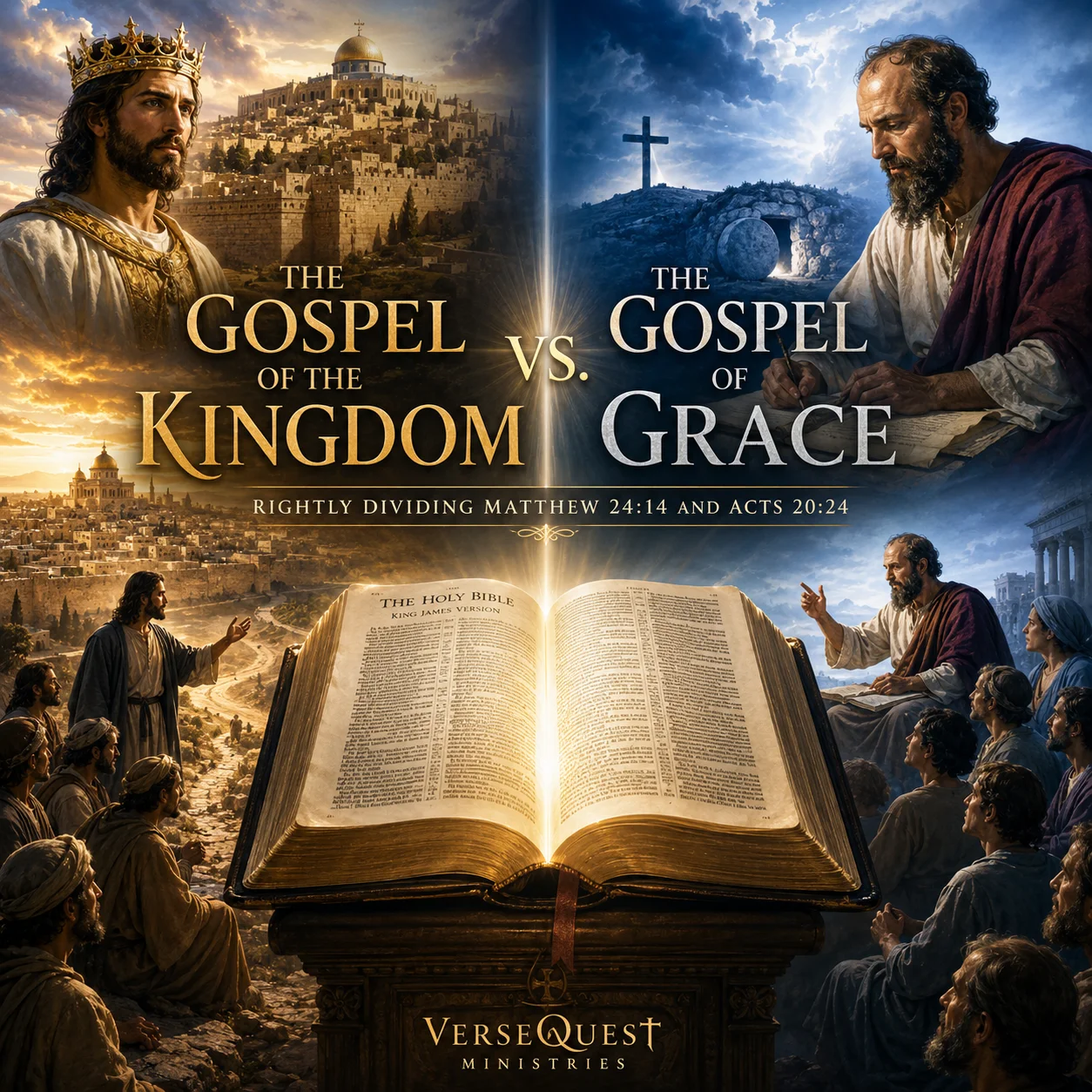
The word “gospel” means good news, but every use of the word “gospel” in the Bible must be handled according to context. A man can create terrible doctrinal confusion by assuming that every gospel mentioned in Scripture has the same audience, same content, same timing, same commission, and same doctrinal application. Matthew 24:14 speaks of “this gospel of the kingdom” being preached in all the world before the end comes. Acts 20:24 speaks of “the gospel of the grace of God” connected to Paul’s ministry. Those two phrases are not accidental. God did not waste words. The gospel of the kingdom and the gospel of the grace of God both concern good news from God, both are connected to Jesus Christ, and both are true in their proper place, but they are not the same message under the same conditions.
The trouble starts when preachers throw Matthew, Acts, Paul, Hebrews, James, and Revelation into a religious blender and call the mixture “the gospel.” That is how sinners are told to believe on Christ, endure to the end, keep commandments, be baptized in water, follow the Sermon on the Mount, confess to a priest, keep the Sabbath, prove themselves by works, avoid the mark of the beast, and hope they make it. That is not the gospel of the grace of God. That is confusion. The sinner in this dispensation is not saved by enduring Daniel’s seventieth week, preaching the kingdom to Israel, keeping Moses, or surviving the tribulation. He is saved by believing that Christ died for his sins, was buried, and rose again the third day according to the Scriptures.
Right division does not create two Saviours. There is one Lord Jesus Christ. Right division does not deny that all salvation is ultimately based upon the blood and righteousness of Christ. It simply recognizes that God has revealed different messages, commissions, hopes, responsibilities, and programs in different dispensational settings. The gospel of the kingdom is tied to Israel’s King and kingdom. The gospel of grace is tied to Paul’s revelation, the finished cross, the Body of Christ, and salvation by grace through faith apart from works. When those are kept in order, the Bible becomes clear, the gospel remains pure, Israel’s prophetic program stands, and the Church’s grace message shines without religious fog.
I. The Word “Gospel” Must Be Defined by Context
Key Text: Galatians 2:7
Supporting Texts: Matthew 4:23; Acts 20:24; Revelation 14:6
The word “gospel” means good news, but the good news being announced must be identified by the passage. The Bible speaks of “the gospel of the kingdom,” “the gospel of the grace of God,” “the gospel of Christ,” “the gospel of the uncircumcision,” “the gospel of the circumcision,” and even “the everlasting gospel” in Revelation 14:6. A Bible believer cannot simply grab the word “gospel” and assume the same doctrinal content every time. The question must be: Who is preaching? To whom? At what time? Under what commission? What is the content? What is the response required? What is the dispensational setting?
Matthew 4:23 says Jesus went about “preaching the gospel of the kingdom.” That was before the cross, before the burial, before the resurrection, before Paul’s conversion, before the revelation of the mystery, and before the Body of Christ was doctrinally revealed. Whatever the gospel of the kingdom was in Matthew 4, it was not a message saying, “Christ died for our sins, was buried, and rose again the third day,” because those events had not yet happened historically. That alone should make a man slow down and read carefully.
Galatians 2:7 says “the gospel of the uncircumcision” was committed unto Paul, as “the gospel of the circumcision” was unto Peter. That verse does not teach two competing Christs. It teaches different commissions and dispensational distinctions. The same God may announce different good news to different people at different times according to His revealed program. Context must govern gospel terminology, or confusion will rule the pulpit.
Main Truth:
The word “gospel” must be understood by its biblical context, not forced into one meaning every time it appears.
II. The Gospel of the Kingdom Was Preached to Israel Concerning Her King
Key Text: Matthew 4:17
Supporting Texts: Matthew 4:23; Matthew 10:5–7; Mark 1:14–15
Matthew 4:17 says, “From that time Jesus began to preach, and to say, Repent: for the kingdom of heaven is at hand.” That is kingdom preaching. It is connected to Israel’s promised King and the nearness of the kingdom. Matthew 4:23 calls it “the gospel of the kingdom.” The King was present. The kingdom was being offered. Israel was being called to repent in light of Messiah’s arrival. This was not Gentile Church-age evangelism. It was the King preaching to the covenant nation.
Matthew 10:5–7 makes the audience unmistakable. Jesus commanded the twelve, saying, “Go not into the way of the Gentiles, and into any city of the Samaritans enter ye not.” He told them, “But go rather to the lost sheep of the house of Israel.” Their message was, “The kingdom of heaven is at hand.” A man has to ignore the words to make that the same as Paul going to the Gentiles with the gospel of the grace of God. The twelve were not sent to the Gentiles in Matthew 10. Paul later was sent as the apostle of the Gentiles.
Mark 1:14–15 says Jesus came into Galilee “preaching the gospel of the kingdom of God,” saying, “The time is fulfilled, and the kingdom of God is at hand: repent ye, and believe the gospel.” The time being fulfilled points to prophecy. The kingdom being at hand points to Israel’s Messianic hope. The gospel of the kingdom was good news that the promised King had come and the kingdom was near. It must be believed where God placed it.
Main Truth:
The gospel of the kingdom was preached to Israel concerning the promised King and the nearness of the kingdom.
III. The Gospel of the Kingdom Is Connected to Prophecy and Israel’s Earthly Hope
Key Text: Luke 1:32–33
Supporting Texts: Daniel 2:44; Isaiah 9:6–7; Acts 3:19–21
The gospel of the kingdom is rooted in prophecy. Luke 1:32–33 says Jesus Christ shall receive “the throne of his father David” and “reign over the house of Jacob for ever.” That is not the Body of Christ seated in heavenly places. That is Israel’s King reigning over Jacob’s house. Isaiah 9:7 speaks of the increase of His government and peace “upon the throne of David, and upon his kingdom.” The prophets spoke of a real King, a real throne, a real kingdom, and a real reign.
Daniel 2:44 says the God of heaven shall set up a kingdom that shall never be destroyed. That kingdom is not a denomination, not Roman Catholicism, not Protestant influence, not social reform, and not a spiritual metaphor for vague religious improvement. It is God’s kingdom overthrowing the kingdoms of men. The kingdom message is tied to the prophetic hope of Messiah’s rule on the earth.
Acts 3:19–21 shows Peter still preaching in connection with Israel’s prophetic program after the resurrection. He calls Israel to repent, speaks of the times of refreshing, and says heaven must receive Christ until the times of restitution of all things, “which God hath spoken by the mouth of all his holy prophets since the world began.” That is prophecy, not mystery. The gospel of the kingdom fits with things spoken by the prophets concerning Israel’s restoration and Messiah’s reign.
Main Truth:
The gospel of the kingdom is connected to Israel’s prophetic, earthly, Messianic kingdom hope.
IV. Matthew 24 Places the Gospel of the Kingdom in a Tribulation Context
Key Text: Matthew 24:14
Supporting Texts: Matthew 24:13; Matthew 24:15–22; Jeremiah 30:7
Matthew 24:14 says, “And this gospel of the kingdom shall be preached in all the world for a witness unto all nations; and then shall the end come.” The context is everything. Matthew 24 is not a Church-age gospel tract. It deals with the end of the age, false Christs, wars, famines, pestilences, persecution, the abomination of desolation, Judea, the Sabbath day, great tribulation, and the coming of the Son of man. The gospel of the kingdom in Matthew 24 is connected with the end-time prophetic setting.
Matthew 24:13 says, “But he that shall endure unto the end, the same shall be saved.” That verse is constantly mishandled by men who drag it into Church-age salvation and destroy assurance. In context, it is connected to the tribulation and the coming end. The next verse speaks of the gospel of the kingdom being preached, and then the end comes. That is not Paul’s gospel of grace being preached to establish the Body of Christ. It is kingdom witness in an end-time setting.
Jeremiah 30:7 calls the future trouble “the time of Jacob’s trouble.” Jacob is Israel. Matthew 24 contains Jewish signs and geography for a Jewish prophetic context. The Church, the Body of Christ, is not appointed to wrath and is not looking for the abomination of desolation. The Church is looking for the Saviour from heaven. Putting the Body of Christ into Matthew 24 as its doctrinal home confuses the blessed hope with Israel’s tribulation trouble.
Main Truth:
Matthew 24 places the gospel of the kingdom in a Jewish, prophetic, tribulation context before the end comes.
V. The Gospel of Grace Was Committed to Paul for This Dispensation
Key Text: Acts 20:24
Supporting Texts: Galatians 1:11–12; Ephesians 3:2; Romans 11:13
Acts 20:24 identifies Paul’s ministry as testifying “the gospel of the grace of God.” That is the great message for the present dispensation. Paul did not receive this ministry from men. Galatians 1:11–12 says the gospel preached by Paul was “not after man” and that he received it “by the revelation of Jesus Christ.” The risen Christ revealed truth to Paul for the Body of Christ.
Ephesians 3:2 says Paul was given “the dispensation of the grace of God.” That dispensation is connected to Gentiles and the revelation of the mystery. Romans 11:13 says Paul is “the apostle of the Gentiles.” Those verses are not Paul bragging. They are the Holy Ghost identifying Paul’s distinctive ministry. If a man ignores Paul’s apostleship, he will likely mishandle the gospel of grace.
The gospel of grace is not kingdom proclamation to Israel that the King is at hand. It is the good news that Christ died for our sins, was buried, and rose again, and that sinners are saved by grace through faith apart from works. It is not tied to the law of Moses, temple service, tribulation endurance, or Israel’s national repentance. It is the message by which sinners are saved today and by which saints are established in this dispensation.
Main Truth:
The gospel of grace was committed to Paul by the risen Christ for the present dispensation of grace.
VI. Paul’s Gospel Centers on Christ’s Death, Burial, and Resurrection
Key Text: 1 Corinthians 15:1–4
Supporting Texts: Romans 4:25; Romans 5:8–9; Ephesians 1:7
First Corinthians 15:1–4 defines the gospel by which men are saved today. Paul writes, “Moreover, brethren, I declare unto you the gospel which I preached unto you,” then says, “by which also ye are saved.” The content is clear: “Christ died for our sins according to the scriptures; and that he was buried, and that he rose again the third day according to the scriptures.” That is Paul’s saving gospel in its plainest form.
This message depends on a completed historical work. Christ died for our sins. He was buried. He rose again. Romans 4:25 says He “was delivered for our offences, and was raised again for our justification.” Romans 5:9 says we are “justified by his blood.” Ephesians 1:7 says we have redemption through His blood. The gospel of grace is not an announcement that the kingdom is at hand. It is an announcement that redemption has been accomplished.
That difference matters. A man cannot preach 1 Corinthians 15:1–4 before the cross in the same doctrinal way Paul preached it after the cross. The twelve in Matthew 10 were not going to Gentiles preaching Christ’s death, burial, and resurrection as a finished gospel of grace. The death, burial, and resurrection were not yet finished events. Paul’s gospel rests on the completed work of Christ and reveals salvation by faith in that finished work.
Main Truth:
Paul’s gospel centers on the finished work of Christ: His death for our sins, burial, and resurrection.
VII. The Gospel of Grace Saves Apart From Works, Law, and Ordinances
Key Text: Ephesians 2:8–9
Supporting Texts: Romans 3:24–28; Titus 3:5; Colossians 2:14–17
Ephesians 2:8–9 says, “For by grace are ye saved through faith… not of works, lest any man should boast.” That is the gospel of grace. It leaves no room for religious boasting. The sinner is not saved by law-keeping, water baptism, sacraments, Sabbath observance, endurance, church membership, confession to a priest, or moral reform. He is saved by grace through faith in Christ’s finished work.
Romans 3:24 says believers are “justified freely by his grace through the redemption that is in Christ Jesus.” Romans 3:28 says a man is justified by faith “without the deeds of the law.” Titus 3:5 says, “Not by works of righteousness which we have done, but according to his mercy he saved us.” That is not hard to understand. It is hard for religion to accept because religion wants to add something man can control.
Colossians 2:14–17 says Christ blotted out the handwriting of ordinances that was against us and nailed it to His cross. Then Paul says no man is to judge believers in meat, drink, holy day, new moon, or sabbath days. The gospel of grace frees the believer from the ordinances that religion keeps trying to revive. Grace does not need Moses to finish what Christ completed. The cross is enough.
Main Truth:
The gospel of grace saves sinners apart from works, law, ordinances, and human merit.
VIII. Mixing the Two Messages Produces Doctrinal Confusion
Key Text: Galatians 1:6–9
Supporting Texts: Galatians 3:1–3; 2 Corinthians 11:3–4; 2 Timothy 2:15
Galatians 1:6–9 shows how serious gospel corruption is. Paul pronounces a curse on any man or angel who preaches another gospel. The Galatians were not being tempted by atheism. They were being tempted by a religious mixture that added law to grace. That is exactly what happens when kingdom passages, law passages, tribulation passages, and grace passages are blended without right division.
Mixing the gospel of the kingdom with the gospel of grace creates confusion about salvation and assurance. It makes sinners think they must endure to the end to be saved in the Church age. It makes believers fear the tribulation as though it were their appointment. It makes water baptism, signs, commandments, ordinances, and kingdom demands part of a gospel where Paul says salvation is not of works. It turns the clear gospel of grace into a religious obstacle course.
Second Timothy 2:15 gives the answer: “rightly dividing the word of truth.” The Bible does not need to be corrected; it needs to be rightly divided. The gospel of the kingdom belongs in its prophetic kingdom setting. The gospel of grace belongs in Paul’s Church-age doctrine. When those messages are kept where God placed them, both are honored. When they are mixed, both are corrupted in practice.
Main Truth:
Mixing kingdom truth with the gospel of grace produces confusion about salvation, assurance, prophecy, and the Church.
IX. One Christ Is Glorified in Both Programs
Key Text: Colossians 1:18
Supporting Texts: Luke 24:44; Romans 16:25–26; Ephesians 1:10
Right division does not divide Christ into competing Saviours. There is one Lord Jesus Christ. In prophecy, He is Israel’s promised Messiah, Son of David, King of kings, and the One who will reign from Jerusalem. In mystery, He is the Head of the Body, the Saviour of the Church, the believer’s life, and the One in whom Jew and Gentile are made one new man. The distinction is not in the worth of Christ, but in the programs God revealed concerning Him.
Luke 24:44 says the law of Moses, the prophets, and the Psalms speak concerning Christ. Romans 16:25–26 speaks of Jesus Christ according to the revelation of the mystery. Both prophecy and mystery glorify Christ, but they reveal different aspects of God’s purpose in Him. Prophecy shows Christ’s earthly kingdom glory. Mystery reveals His heavenly headship over the Body of Christ.
Ephesians 1:10 says God will gather together in one all things in Christ, both which are in heaven and which are on earth. That verse is a key to the whole plan. God has a purpose for the earth connected with Israel and the kingdom, and He has a purpose for heavenly places connected with the Body of Christ. Both are gathered in Christ. Right division does not make less of Jesus Christ; it lets Him have every glory God gave Him.
Main Truth:
The gospel of the kingdom and the gospel of grace must be distinguished, but the same Lord Jesus Christ is glorified in both God’s earthly and heavenly purposes.
Conclusion
The gospel of the kingdom and the gospel of the grace of God are not the same message in the same setting to the same audience. The gospel of the kingdom is tied to Israel, prophecy, the King, the kingdom, and the end-time witness before the end comes. The gospel of grace is tied to Paul’s ministry, the finished cross, the revelation of the mystery, the Body of Christ, and salvation by grace through faith apart from works. Both phrases are Bible phrases. Both must be believed. Both must be placed where God put them.
The confusion in modern Christianity comes from refusing to rightly divide. Men take Matthew 24 and preach it as though it is the Church’s gospel invitation. They take Acts 2 and turn it into a formula for salvation today. They take Hebrews warnings and use them to rob saints of assurance. They take kingdom demands and add them to Paul’s gospel. Then they wonder why people cannot tell the difference between salvation and discipleship, the rapture and the Second Advent, Israel and the Church, law and grace, prophecy and mystery. God is not the author of that confusion. The confusion comes from mishandling the Book.
The answer is to preach the gospel of grace plainly. Christ died for our sins. He was buried. He rose again the third day. Salvation is by grace through faith, not of works. The believer is complete in Christ, sealed by the Spirit, and placed into the Body of Christ. Israel’s kingdom gospel will have its place in God’s prophetic program, and God will fulfill every promise He made. But in this present dispensation, the message committed to the Church is the gospel of the grace of God, and it must be preached without apology and without mixture.
Final Call
The sinner does not need to endure a tribulation program to be saved today. He does not need Moses, sacraments, water ordinances, Sabbath keeping, religious works, or denominational membership to complete what Christ has finished. He needs the Lord Jesus Christ. The gospel of grace is clear: Christ died for your sins according to the scriptures, He was buried, and He rose again the third day according to the scriptures.
Believe on the Lord Jesus Christ, and thou shalt be saved. Trust the finished work. Trust the blood. Trust the risen Saviour. Do not trust religion. Do not trust your works. Do not trust your feelings. Trust Christ alone.
Believer, learn to rightly divide the gospel terms in your Bible. Do not mix kingdom truth with grace truth. Do not let religious confusion corrupt the message that saved you. Preach Paul’s gospel clearly. Defend the gospel of grace boldly. Let Israel keep her kingdom promises, let the Church keep her heavenly calling, and let Jesus Christ receive the glory in both.
Closing Verse:
1 Corinthians 15:3–4 — “For I delivered unto you first of all that which I also received, how that Christ died for our sins according to the scriptures; And that he was buried, and that he rose again the third day according to the scriptures.”
Closing Statement:
The gospel of the kingdom announces the coming King to Israel, but the gospel of grace announces the finished cross to sinners today; mix them, and the message blurs—rightly divide them, and Christ is magnified.