Sermon Title:
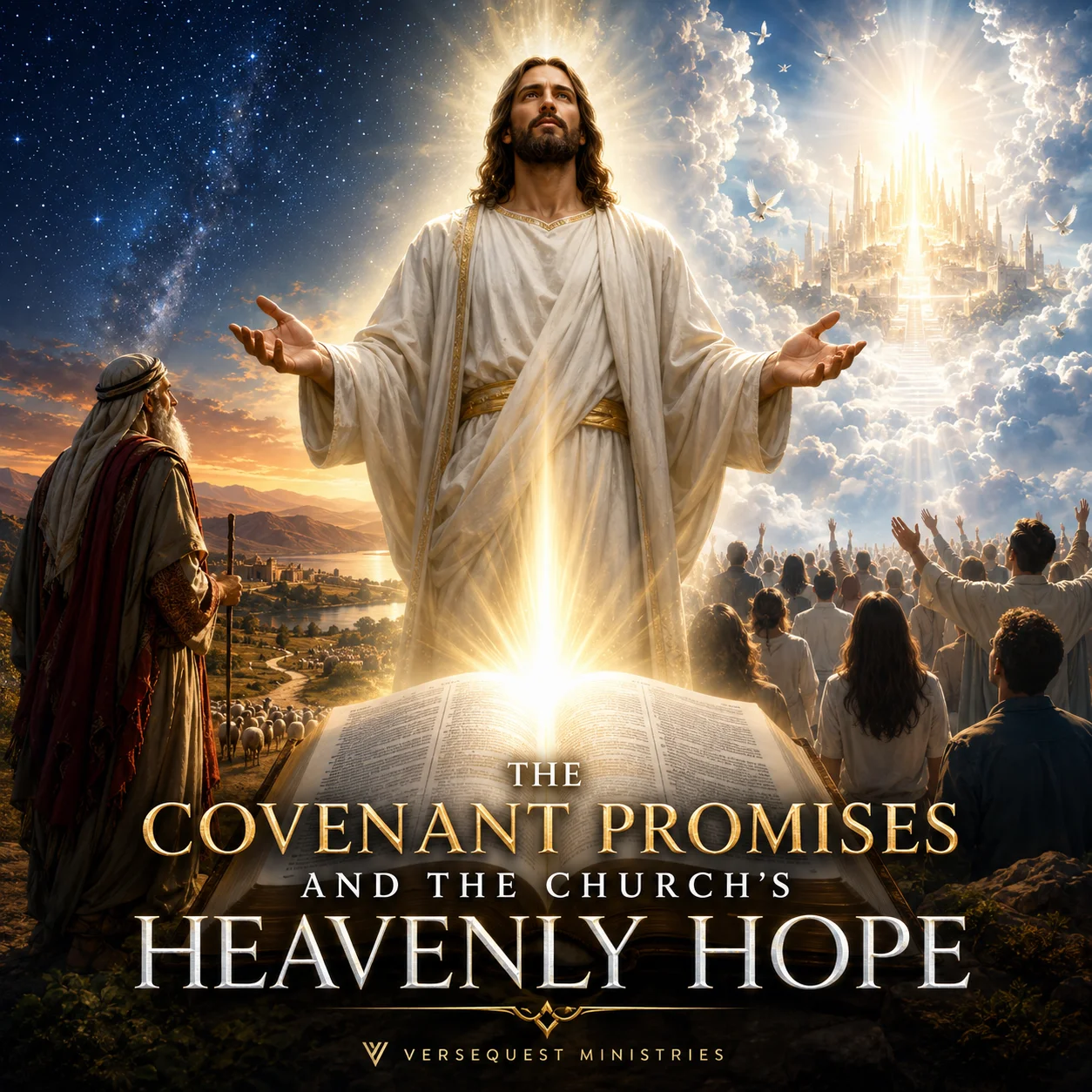
Two Hopes Under One Faithful God: Israel’s Covenant Promises and the Church’s Heavenly Calling
Key Passage:
Genesis 12:1–3 — “Now the LORD had said unto Abram, Get thee out of thy country, and from thy kindred, and from thy father’s house, unto a land that I will shew thee: And I will make of thee a great nation, and I will bless thee, and make thy name great; and thou shalt be a blessing: And I will bless them that bless thee, and curse him that curseth thee: and in thee shall all families of the earth be blessed.”
Philippians 3:20 — “For our conversation is in heaven; from whence also we look for the Saviour, the Lord Jesus Christ.”
Series:
Foundations of Right Division
Topic:
Israel’s Earthly Covenant Promises and the Church’s Heavenly Hope
Book:
Genesis, Romans, Galatians, Ephesians, Philippians, Colossians, 1 Thessalonians, Hebrews
Speaker:
Paul Tackett
Suggested Sermon Text:
Genesis 12:1–3; Genesis 13:14–17; Genesis 15:18; Genesis 17:7–8; Genesis 26:2–5; Genesis 28:13–15; Romans 9:4–5; Romans 11:25–29; Galatians 3:8–16; Ephesians 1:3; Ephesians 2:11–18; Ephesians 3:1–9; Philippians 3:20–21; Colossians 3:1–4; 1 Thessalonians 4:13–18; 2 Timothy 2:15
Short Sermon Description:
This sermon outline explains the biblical distinction between Israel’s earthly covenant promises and the Church’s heavenly calling in Christ. Genesis 12 records God’s unconditional promises to Abraham concerning a land, a seed, a great nation, worldwide blessing, and divine protection. Those national and territorial promises were confirmed through Isaac and Jacob and will ultimately be fulfilled in Israel under the reign of Jesus Christ. Philippians 3:20, however, declares that the Church’s conversation is in heaven, from whence believers look for the Saviour. This study shows how Gentiles receive spiritual blessing through Abraham’s promised Seed, Jesus Christ, without becoming national Israel or inheriting Israel’s land and kingdom identity. It exposes replacement theology, preserves the literal promises of God, distinguishes the earthly kingdom from the heavenly Body, and demonstrates how both Israel’s future and the Church’s blessed hope magnify the faithfulness and glory of the Lord Jesus Christ.
Two Hopes Under One Faithful God
Israel’s Covenant Promises and the Church’s Heavenly Calling
Introduction
Genesis 12 and Philippians 3 open two great windows in the word of God. Genesis 12 looks toward a land, a nation, a seed, and worldwide blessing through Abraham. Philippians 3 looks upward toward heaven, from whence the Church awaits the Saviour. One passage concerns God’s covenant program through Abraham, Isaac, Jacob, and national Israel. The other concerns the heavenly position and hope of the Body of Christ. Both passages are inspired. Both are true. Both center ultimately upon Jesus Christ. But they are not describing the same calling, the same inheritance, or the same prophetic program.
The religious blender has done terrible damage here. Replacement theology takes Israel’s land, throne, covenants, kingdom, and restoration, spiritualizes the words, and hands the promises to the Church. Then, having taken Israel’s blessings, it often leaves Israel with the curses. Other systems move in the opposite direction and drag the Church back under Israel’s covenants, Sabbaths, feasts, ordinances, signs, priesthood, and earthly kingdom expectations. One crowd steals Israel’s mail; the other crowd tries to move the Church into Israel’s house. Both errors come from refusing the divisions God placed in His Book.
Right division allows every promise to stand. Israel does not have to disappear for the Church to be blessed. The Church does not have to become Israel to receive spiritual riches in Christ. God can fulfill His covenant promises upon the earth while completing His heavenly purpose in the Body of Christ. The same Lord Jesus Christ is Abraham’s promised Seed, Israel’s coming King, and the risen Head of the Church. The distinction does not divide Christ; it displays the fullness of His glory in heaven and earth.
I. God Called Abraham and Gave Him Covenant Promises
Key Text: Genesis 12:1–3
Supporting Texts: Genesis 15:1–6; Genesis 17:1–8; Romans 4:1–5
Genesis 12 marks a decisive point in the Bible. After the nations are divided and scattered at Babel, God calls one man out from his country, kindred, and father’s house. God promises Abram a land, a great nation, blessing, a great name, divine protection, and worldwide blessing through him. Abram did not design the covenant. He did not negotiate its conditions. God spoke, God promised, and God bound His own faithfulness to the words He gave.
Genesis 15 strengthens the promise. God brings Abram outside and tells him to look toward heaven and number the stars, declaring, “So shall thy seed be.” Abram believes God, and it is counted to him for righteousness. Salvation and justification are always rooted in believing what God has revealed. But the personal justification of Abraham does not erase the national, territorial, and prophetic elements of the covenant. God promised righteousness by faith, but He also promised a real seed and a real land.
Genesis 17 calls the covenant everlasting and names “all the land of Canaan” as an everlasting possession. Men may turn words into fog, but God knew how to speak plainly. “Land” means land. “Canaan” means Canaan. “Seed” means the line God identifies. “Everlasting” does not mean cancelled when Gentile theologians become uncomfortable with literal fulfillment. God’s covenant rests upon God’s faithfulness, not upon man’s ability to revise it.
Main Truth:
God sovereignly gave Abraham covenant promises involving land, seed, nation, blessing, and worldwide purpose.
II. The Covenant Line Runs Through Isaac and Jacob
Key Text: Genesis 26:3–4
Supporting Texts: Genesis 17:19–21; Genesis 28:13–15; Romans 9:6–13
God did not leave the identity of the covenant seed uncertain. In Genesis 17, He declares that the covenant will be established with Isaac. Ishmael receives blessing and multiplication, but the covenant line runs through Isaac. Genesis 26 confirms the promises to Isaac concerning land, multiplied seed, and blessing to the nations. The covenant is not a vague promise to every physical descendant of Abraham without distinction. God Himself identifies the line.
Genesis 28 continues the line through Jacob. God stands above the ladder and declares, “I am the LORD God of Abraham thy father, and the God of Isaac.” He then promises Jacob the land upon which he lies, multiplied seed, worldwide blessing, divine presence, preservation, and eventual return to the land. Jacob’s name is later changed to Israel. The covenant nation therefore comes through Abraham, Isaac, and Jacob, not through theological imagination.
Romans 9 confirms that God’s purpose moved through the chosen line. This does not teach that every physical Israelite is automatically saved. Salvation has never been secured by fleshly descent alone. But it does teach that God made real covenant distinctions in history. The Church has no authority to erase Isaac, Jacob, Israel, or the national line simply because salvation today is offered freely to Jew and Gentile in Christ.
Main Truth:
God confirmed the covenant through Isaac and Jacob, establishing the national line that became Israel.
III. Israel’s Covenant Promises Are Earthly, National, and Literal
Key Text: Genesis 13:14–17
Supporting Texts: Genesis 15:18; 2 Samuel 7:12–16; Luke 1:32–33
God told Abram to lift up his eyes and look northward, southward, eastward, and westward. The land he saw was promised to him and his seed. He was told to arise and walk through it. Genesis 15 even provides geographical boundaries. This is not a promise that Abraham’s descendants would someday become a Gentile denomination. It is a territorial promise attached to a covenant nation.
The Davidic covenant adds a throne, kingdom, and royal line. God promised David that his seed would sit upon his throne and that his kingdom would be established. Luke 1 identifies Jesus Christ as the ultimate fulfillment: “the Lord God shall give unto him the throne of his father David,” and He shall reign over “the house of Jacob.” David’s throne is not a pulpit. The house of Jacob is not the Body of Christ. Christ will fulfill the words exactly as spoken.
Israel’s future includes national restoration, possession of the promised land, cleansing, covenant fulfillment, and Messiah’s reign from Jerusalem. These promises are earthly, but earthly does not mean carnal or inferior. The earth belongs to God. Christ will reign upon it. Righteousness will fill it. Israel’s restoration will vindicate God’s truth before the nations. Literal fulfillment magnifies the faithfulness of the One who cannot lie.
Main Truth:
Israel’s covenant inheritance involves a literal land, nation, throne, kingdom, restoration, and earthly reign under Messiah.
IV. The Church Is the Body of Christ, Not Israel Renamed
Key Text: Ephesians 1:22–23
Supporting Texts: Ephesians 2:14–16; Ephesians 3:6; 1 Corinthians 12:13
The Church is not Israel with a Christian label attached. Ephesians 1 says the Church is Christ’s Body. First Corinthians 12 says believers are baptized by one Spirit into one Body. Ephesians 2 says Christ made believing Jews and Gentiles “one new man.” The wording matters. Christ did not make Gentiles into Israel. He did not convert Israel into Gentiles. He made something new in Himself.
Ephesians 3 identifies this truth as part of the mystery revealed through Paul. Gentiles are fellowheirs, “and of the same body,” and partakers of God’s promise in Christ by the gospel. The Body of Christ was not Israel’s earthly kingdom program under a new administration. It is a spiritual organism joined to a risen Head in heaven, composed of saved Jews and Gentiles standing equally in Christ.
First Corinthians 10:32 still distinguishes the Jews, the Gentiles, and the Church of God. A Jew who believes Paul’s gospel becomes a member of the Body. A Gentile who believes becomes a member of the same Body. Yet Israel’s national identity and future remain intact outside the present positional unity of believers in Christ. The Church does not need to steal Israel’s name to possess glory. It is already accepted in the Beloved and complete in Christ.
Main Truth:
The Church is the one new Body of Christ, not national Israel renamed, replaced, or spiritually repackaged.
V. The Church’s Blessings Are in Heavenly Places
Key Text: Ephesians 1:3
Supporting Texts: Ephesians 2:6; Colossians 3:1–4; Philippians 3:20
Ephesians 1:3 says God has blessed believers “with all spiritual blessings in heavenly places in Christ.” That is the doctrinal location of the Church’s blessings. The Body of Christ is not promised tribal allotments in Canaan. It is not waiting for Levitical property, an earthly temple position, or a throne in Jerusalem. Its blessings are spiritual, heavenly, and found in union with the risen Christ.
Ephesians 2:6 says believers have been raised up together and made to sit together in heavenly places in Christ Jesus. That is present positional truth. The Christian may still live bodily upon the earth, face hardship, battle the flesh, and endure opposition, but his standing before God is already settled in Christ. His citizenship, identity, life, and inheritance are connected to heaven.
Colossians 3 commands believers to seek those things which are above, where Christ sits at the right hand of God. The Church does not ignore earthly responsibility, but it does not build its identity upon an earthly covenant nation. Its life is hid with Christ in God. When Christ appears, believers will appear with Him in glory. The Body’s hope rises above the systems of this present world.
Main Truth:
The Church possesses spiritual blessings, a heavenly position, and an inheritance found entirely in the risen Lord Jesus Christ.
VI. The Church Looks for the Saviour From Heaven
Key Text: Philippians 3:20–21
Supporting Texts: 1 Thessalonians 4:13–18; Titus 2:13; 1 Corinthians 15:51–53
Philippians 3:20 says, “For our conversation is in heaven; from whence also we look for the Saviour.” The Church’s expectation is personal. We are looking for Christ. We are not looking first for the Antichrist, the mark of the beast, the abomination of desolation, armies surrounding Jerusalem, or Jacob’s trouble. We look for the Lord Jesus Christ to come from heaven and change our vile bodies.
First Thessalonians 4 explains this blessed event. The Lord descends from heaven with a shout, the dead in Christ rise first, and living believers are caught up together with them to meet the Lord in the air. Paul concludes with comfort. The Church is gathered to Christ before the prophetic wrath that belongs to Israel’s future trouble and the day of the Lord.
Titus calls this “that blessed hope.” The Church’s hope is heavenly because the Church’s Head is heavenly, its position is heavenly, its citizenship is heavenly, and its destination is heavenly. Israel awaits national restoration under Messiah upon the earth. The Church awaits union with Christ in the air and glory with Him. These are not competing hopes. They are distinct parts of God’s ordered plan.
Main Truth:
The Church’s blessed hope is the personal coming of Jesus Christ from heaven to gather and glorify His Body.
VII. Gentiles Are Blessed Through Abraham Without Becoming Israel
Key Text: Galatians 3:8
Supporting Texts: Galatians 3:13–16; Romans 4:9–12; Ephesians 2:11–13
Galatians 3 says the Scripture preached the gospel beforehand unto Abraham: “In thee shall all nations be blessed.” The blessing of the nations was part of the Abrahamic promise from the beginning. God’s purpose was never limited to one nation as though the Gentiles were permanently beyond mercy. Through Abraham’s line would come the promised Seed, Jesus Christ, through whom salvation would reach the nations.
Galatians 3:16 identifies the ultimate Seed as Christ. The blessing of Abraham comes upon the Gentiles through Jesus Christ so that believers receive the promise of the Spirit through faith. Gentiles do not receive blessing by becoming Jewish proselytes, keeping Moses, claiming Canaan, or replacing Jacob. They receive blessing by faith in the crucified and risen Seed.
Ephesians 2 says Gentiles were once aliens from Israel’s commonwealth and strangers from the covenants of promise, but are now made nigh by the blood of Christ. Notice that Gentiles are brought nigh in Christ, not rewritten backward into Israel’s national history. The cross brings salvation, reconciliation, and spiritual unity without cancelling the distinctions God made in prophecy. The blessing reaches Gentiles while the covenant promises to Israel still stand.
Main Truth:
Gentiles receive spiritual blessing through Abraham’s promised Seed, Jesus Christ, without becoming national Israel or inheriting Israel’s covenant identity.
VIII. Replacement Theology Attacks God’s Faithfulness
Key Text: Romans 11:25–29
Supporting Texts: Jeremiah 31:35–37; Psalm 89:34; Numbers 23:19
Romans 11 warns Gentile believers not to be wise in their own conceits. Israel’s blindness is “in part,” and it lasts “until the fulness of the Gentiles be come in.” Paul then says, “And so all Israel shall be saved.” He speaks of Jacob, covenant, the fathers, election, and concludes that the gifts and calling of God are without repentance. That chapter leaves no room for the claim that God permanently discarded Israel and transferred her national identity to the Church.
Jeremiah 31 ties Israel’s national continuance to the fixed ordinances of the sun, moon, and stars. God says that if those ordinances depart, then Israel may cease from being a nation before Him. The sun still rises. The moon still shines. The stars still stand. Israel’s covenant future therefore rests not in present worthiness but in God’s unchanging word.
Replacement theology does not merely mishandle prophecy. It strikes at the character of God. If God can redefine Israel after naming Israel, turn land into heaven after naming Canaan, or transfer David’s throne after promising it to David’s Seed, then words lose stability. But God is not a man that He should lie. His covenant He will not break, nor alter the thing gone out of His lips. The Church should defend Israel’s future because God’s faithfulness is at stake.
Main Truth:
Replacement theology undermines the plain words and unchanging faithfulness of the God who covenanted with Israel.
IX. Christ Unites God’s Heavenly and Earthly Purposes Without Confusing Them
Key Text: Ephesians 1:10
Supporting Texts: Colossians 1:16–20; Revelation 19:11–16; Revelation 21:1–3
Ephesians 1:10 says that in the dispensation of the fulness of times, God will gather together in one all things in Christ, “both which are in heaven, and which are on earth.” Christ is the center of both spheres. Israel’s covenant promises are fulfilled in Him as Abraham’s Seed, David’s Son, Israel’s Messiah, and King of kings. The Church’s heavenly blessings are secured in Him as the risen Head of the Body.
Distinction does not mean separation from Christ. Israel and the Church are distinct, but both depend upon Jesus Christ. The land covenant finds its security in Him. The Davidic throne finds its rightful King in Him. The salvation of the remnant rests upon His blood. The Body of Christ receives life, position, inheritance, and hope in Him. He is not divided; His glories are manifold.
Revelation shows Christ returning to rule the earth, defeat His enemies, vindicate Israel, judge the nations, and establish His kingdom. The epistles reveal the Church glorified with Him in heavenly purpose. Ultimately, heaven and earth come beneath the acknowledged supremacy of Jesus Christ. Right division protects the distinctions until God gathers every purpose under the One who fills all in all.
Main Truth:
Jesus Christ fulfills Israel’s earthly covenant hope and the Church’s heavenly calling while preserving the distinctions God revealed.
Conclusion
God gave Abraham covenant promises concerning land, seed, nation, blessing, and worldwide purpose. He confirmed those promises through Isaac and Jacob. Israel’s future remains earthly, national, literal, and centered upon Messiah’s reign. The Church, however, is the Body of Christ, made up of saved Jews and Gentiles united in one new man. Its position is in heavenly places, its blessings are spiritual, its conversation is in heaven, and its hope is the return of the Saviour from heaven.
The Church does not need to become Israel in order to be blessed. It possesses riches Israel was never promised in the same form: union with Christ as His Body, one Spirit baptism, heavenly position, completeness in the Head, and the blessed hope. Israel does not need to become the Church in order for God to save and restore the nation. God will take away Jacob’s sins, fulfill the covenants, restore the kingdom, and seat Jesus Christ upon David’s throne. Both programs display grace, wisdom, and faithfulness.
The Bible believer must resist every system that mixes the two hopes. Do not steal Israel’s land. Do not place the Church under Israel’s law. Do not turn David’s throne into church government. Do not drag the Body into Jacob’s trouble. Let the covenant promises stand upon the earth. Let the Church’s hope remain in heaven. Let Jesus Christ possess every glory—as Abraham’s Seed, David’s Son, Israel’s King, the Saviour of sinners, and the Head of the Body.
Final Call
The sinner today is not saved by claiming Abraham’s land, keeping Moses’ law, joining Israel’s covenant identity, entering a religious institution, or working toward heaven. Salvation is found in Jesus Christ. He died for our sins according to the Scriptures. He was buried. He rose again the third day according to the Scriptures.
Believe on the Lord Jesus Christ, and thou shalt be saved. The blessing promised through Abraham reaches guilty sinners through the promised Seed. Trust Christ’s blood, burial, and resurrection. Do not trust religion, heritage, baptism, law, works, morality, or feelings.
Believer, remember where your conversation is. Seek those things which are above. Do not build your hope upon earthly systems that are passing away. Stand in grace. Preserve Israel’s promises. Rejoice in your heavenly calling. Look for the Saviour, the Lord Jesus Christ, who shall change our vile body and fashion it like unto His glorious body.
Closing Verse:
Philippians 3:20 — “For our conversation is in heaven; from whence also we look for the Saviour, the Lord Jesus Christ.”
Closing Statement:
Israel’s covenant hope stands upon God’s promises to the fathers, while the Church’s heavenly hope rests in the returning Saviour—and the faithful Christ will fulfill them both.