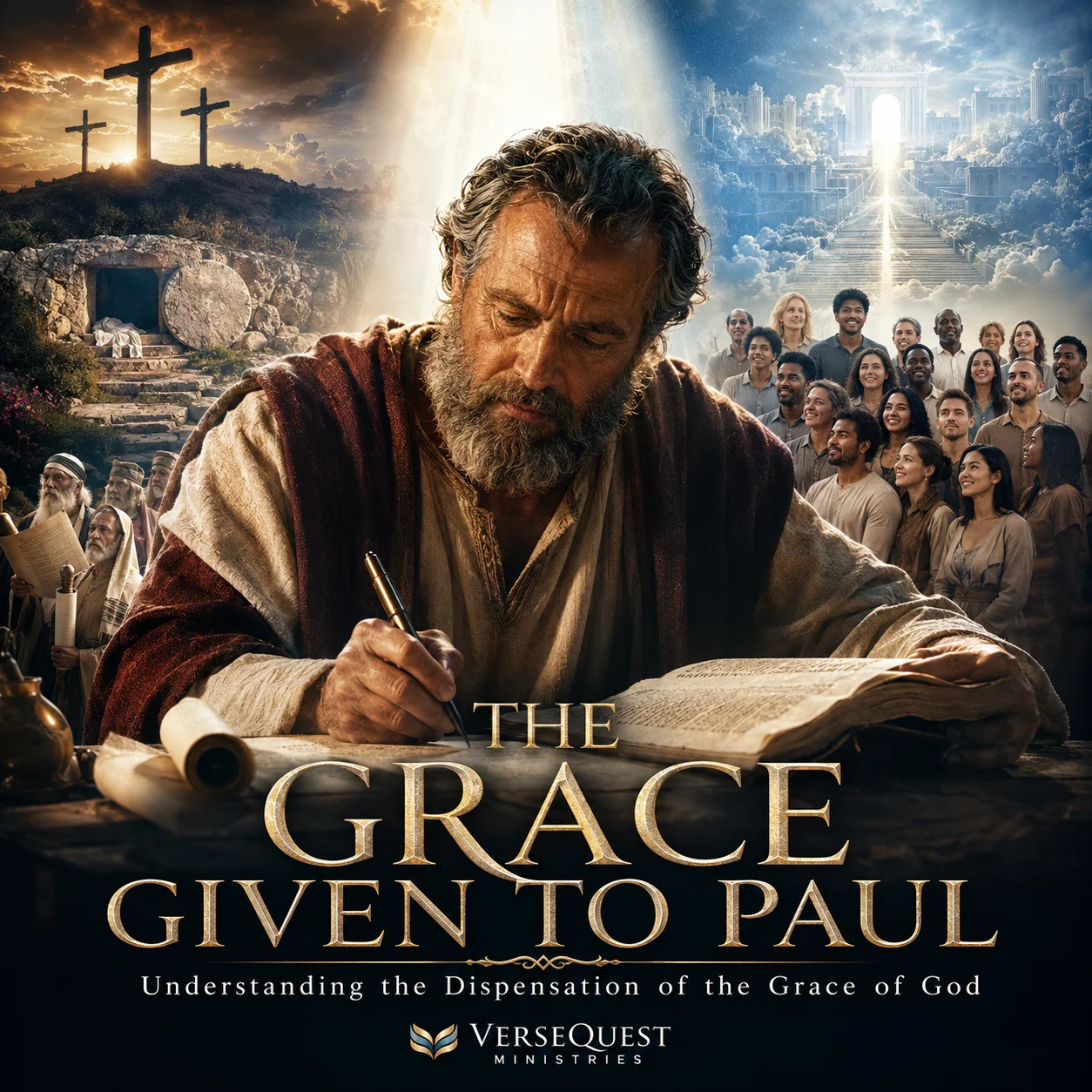
The Grace Given to Paul
Understanding the Dispensation of the Grace of God
Introduction
Ephesians 3:2 is one of those verses that can clear up years of religious confusion if a man will simply believe the words on the page. Paul writes, “If ye have heard of the dispensation of the grace of God which is given me to you-ward.” That sentence contains more Bible doctrine than many churches hear in a year. There is a dispensation. It is connected with grace. It was given to Paul. It was given “to you-ward,” meaning it concerns those to whom Paul was sent, especially Gentiles in the present age. This is not a private theory. It is not a denominational slogan. It is not a chart-maker’s hobby. It is a Bible verse, and the Holy Ghost put it in the middle of Paul’s explanation of the mystery.
The word “dispensation” refers to a stewardship, an administration, a responsibility committed to someone by God. God does not change in His character. He is always holy, righteous, merciful, just, and true. But God has not dealt with every man in every age under the same revealed commands, ordinances, promises, signs, hopes, covenants, and responsibilities. Adam was not under Moses. Noah was not under Sinai. Abraham was not under the law. Israel under Moses was not the Body of Christ. Tribulation saints are not the same as the Church caught up before wrath. The millennial nations will not be living under the same arrangement as the Church seated in heavenly places in Christ. The Bible makes sense when a man lets God’s dispensations stand where God placed them.
The dispensation of the grace of God is the present stewardship revealed through Paul after Israel’s continued rejection and Christ’s heavenly revelation to the apostle of the Gentiles. It is marked by the gospel of grace, justification by faith apart from works, the formation of the Body of Christ, the revelation of the mystery, the one new man, the sealing of the Spirit, and the believer’s heavenly calling. The tragedy of modern religion is that it takes this glorious dispensation and mixes it with Moses, Matthew 24, Acts 2, Hebrews warnings, James’ tribulation emphasis, and Revelation judgment passages, then wonders why people are confused about salvation, assurance, prophecy, and the Christian life. God gave Paul a dispensation of grace, and the Church must understand it if it wants to preach clearly, stand firmly, and rightly divide the word of truth.
I. The Dispensation of Grace Is Bible Language
Key Text: Ephesians 3:2
Supporting Texts: 1 Corinthians 9:17; Ephesians 1:10; Colossians 1:25
The first thing to settle is that the word “dispensation” is not a dirty word. It is not an invention of theologians trying to force a system onto the Bible. It is Bible language. Paul uses the word in 1 Corinthians 9:17 when he says, “a dispensation of the gospel is committed unto me.” He uses it in Ephesians 1:10 when he speaks of “the dispensation of the fulness of times.” He uses it in Ephesians 3:2 when he speaks of “the dispensation of the grace of God.” He uses it in Colossians 1:25 when he says a dispensation was given to him “to fulfil the word of God.”
A dispensation is a stewardship or administration. It does not mean God changes His nature. It means God commits certain truth, responsibility, and order for a particular purpose in His unfolding revelation. A man who rejects dispensational truth still lives by it every day whether he admits it or not. He does not bring animal sacrifices to a Levitical priest. He does not travel to Jerusalem three times a year. He does not stone Sabbath breakers. He does not build an ark. He does not wait for tongues of fire in an upper room to begin the Church. He already makes distinctions. The question is whether he makes them according to Scripture or according to tradition.
Ephesians 3:2 is especially important because Paul identifies the present dispensation as “the dispensation of the grace of God.” That phrase should govern how we understand God’s present dealings with sinners and saints. The Church age is not Israel under a new label. It is not the Mosaic law with Christian vocabulary. It is not the kingdom offered to Israel repackaged for Gentile religion. It is a dispensation of grace committed to Paul for the Body of Christ.
Main Truth:
The dispensation of grace is not man-made terminology but Bible language describing a stewardship God committed to Paul.
II. The Dispensation of Grace Was Given to Paul
Key Text: Ephesians 3:2
Supporting Texts: Galatians 1:11–12; Romans 11:13; 1 Timothy 1:16
Paul says the dispensation of the grace of God “is given me to you-ward.” That statement must be believed. The dispensation was given to Paul, not because Paul is the Saviour, not because Paul replaces Christ, and not because Paul is above the twelve, but because the risen Christ chose Paul as the apostle through whom this Church-age revelation would be made known. Romans 11:13 says, “For I speak to you Gentiles, inasmuch as I am the apostle of the Gentiles.” That is not Paul bragging. That is the Holy Ghost identifying Paul’s office.
Galatians 1:11–12 says the gospel Paul preached was “not after man,” and that he “neither received it of man, neither was I taught it, but by the revelation of Jesus Christ.” Paul did not learn the dispensation of grace from a rabbinical school, a Jerusalem council, Peter’s notebook, or denominational tradition. He received truth by revelation from the risen Lord. That is why rejecting Paul’s distinct ministry is not humility. It is rebellion against the order Christ established.
First Timothy 1:16 says Paul obtained mercy so that in him first Jesus Christ might shew forth all longsuffering “for a pattern to them which should hereafter believe on him to life everlasting.” Paul is the pattern sinner saved by grace in this dispensation. The persecutor becomes the preacher. The blasphemer becomes the apostle. The enemy of the Church becomes the minister of grace. If God can save Saul of Tarsus, He can save any sinner by grace.
Main Truth:
The dispensation of grace was given to Paul by the risen Christ for the benefit of the Gentiles and the Body of Christ.
III. The Dispensation of Grace Reveals Salvation by Grace Through Faith
Key Text: Ephesians 2:8–9
Supporting Texts: Romans 3:24–28; Titus 3:5; Acts 20:24
Ephesians 2:8–9 is the great banner verse of this dispensation: “For by grace are ye saved through faith; and that not of yourselves: it is the gift of God: not of works, lest any man should boast.” That does not mean God had no grace before Paul. Noah found grace in the eyes of the Lord. Abraham was justified by faith. David knew blessed forgiveness. But in the present dispensation, salvation by grace apart from works is revealed with unmatched clarity through Paul’s gospel.
Romans 3:24 says believers are “justified freely by his grace through the redemption that is in Christ Jesus.” Romans 3:28 says, “Therefore we conclude that a man is justified by faith without the deeds of the law.” That conclusion is not optional. It is apostolic doctrine. The sinner is not saved by keeping commandments, joining a church, taking sacraments, being baptized in water, enduring tribulation, keeping the Sabbath, confessing to a priest, or promising to do better. He is saved by grace through faith in the finished work of Jesus Christ.
Acts 20:24 calls Paul’s ministry “the gospel of the grace of God.” That is the message this dispensation is to proclaim. Christ died for our sins, was buried, and rose again the third day. The gospel of grace is not “do your part and God will do His.” It is not “start by grace and finish by works.” It is not “trust Christ but maintain your status by religious performance.” Grace saves the guilty sinner freely because Christ paid the full price.
Main Truth:
The dispensation of grace reveals salvation by grace through faith in Christ apart from works, law, ordinances, or human merit.
IV. The Dispensation of Grace Means the Believer Is Not Under the Law
Key Text: Romans 6:14
Supporting Texts: John 1:17; Galatians 3:24–25; Colossians 2:14–17
Romans 6:14 says, “For sin shall not have dominion over you: for ye are not under the law, but under grace.” That verse is simple until religion starts explaining it away. The believer in the Body of Christ is not under the Mosaic law as his covenant system. He is under grace. That does not make him lawless. It makes him free from the law’s condemnation and free to serve God in the newness of life.
John 1:17 says, “For the law was given by Moses, but grace and truth came by Jesus Christ.” The law had a purpose. It exposed sin. It revealed guilt. It showed man his inability. Galatians 3:24 says the law was “our schoolmaster to bring us unto Christ.” But Galatians 3:25 says, “after that faith is come, we are no longer under a schoolmaster.” Religion keeps dragging believers back into the classroom after God has declared the schoolmaster’s purpose fulfilled.
Colossians 2:14 says Christ blotted out “the handwriting of ordinances that was against us.” Colossians 2:16 then says, “Let no man therefore judge you in meat, or in drink, or in respect of an holyday, or of the new moon, or of the sabbath days.” That is Church-age liberty. The believer’s standing is not measured by Israel’s ordinances. He is complete in Christ. The man who puts the Church back under Moses has not improved Christianity; he has denied the force of Romans 6:14.
Main Truth:
Under the dispensation of grace, the believer is not under the Mosaic law but stands in Christ under grace.
V. The Dispensation of Grace Reveals the Mystery Hid in God
Key Text: Ephesians 3:3–5
Supporting Texts: Romans 16:25; Colossians 1:25–27; 1 Corinthians 2:7
Ephesians 3:3 says, “How that by revelation he made known unto me the mystery.” Ephesians 3:5 says this mystery “in other ages was not made known unto the sons of men, as it is now revealed.” That must be believed as written. The mystery was not hidden in the Old Testament as a plain doctrine waiting for someone to notice it. It was hid in God until revealed in due time through Paul.
Romans 16:25 speaks of “the revelation of the mystery, which was kept secret since the world began.” Colossians 1:26 calls it “the mystery which hath been hid from ages and from generations, but now is made manifest to his saints.” Those verses make a clear contrast with prophecy. Prophecy concerns what God spoke by the prophets since the world began. Mystery concerns what God kept secret since the world began. The dispensation of grace is bound up with the revelation of that mystery.
The mystery includes the truth of the Body of Christ, Jew and Gentile made fellowheirs, the one new man, Christ in the believer, the Church’s heavenly calling, and the present administration of grace. When this truth is ignored, men try to read the Church back into every Old Testament promise and every kingdom passage. When the mystery is recognized, the Bible comes into focus. Israel keeps her prophetic promises, and the Church keeps her heavenly identity.
Main Truth:
The dispensation of grace reveals the mystery once hid in God but now made known through Paul for the Body of Christ.
VI. The Dispensation of Grace Forms One Body From Jews and Gentiles
Key Text: Ephesians 3:6
Supporting Texts: Ephesians 2:14–16; 1 Corinthians 12:13; Galatians 3:28
Ephesians 3:6 says Gentiles are “fellowheirs, and of the same body, and partakers of his promise in Christ by the gospel.” This is one of the great truths of the dispensation of grace. In time past, Gentiles were strangers from the covenants of promise and without God in the world. But now, in Christ, believing Jews and believing Gentiles are made members of the same Body.
Ephesians 2:15 says Christ made “in himself of twain one new man.” The one new man is not Israel improved. It is not Gentiles becoming spiritual Jews. It is not a religious denomination. It is the Body of Christ. First Corinthians 12:13 says, “For by one Spirit are we all baptized into one body.” That baptism is the Spirit’s operation placing believers into Christ, not a water ceremony performed by man.
Inside the Body of Christ, Jew and Gentile distinctions do not determine spiritual standing. Galatians 3:28 says, “there is neither Jew nor Greek… for ye are all one in Christ Jesus.” That does not erase Israel’s future national restoration, but it does define the believer’s present position in Christ. During this dispensation, God is forming a heavenly Body made up of saved sinners from both Jews and Gentiles, joined to Christ as Head.
Main Truth:
The dispensation of grace forms the one Body of Christ, where saved Jews and Gentiles are made one new man in Him.
VII. The Dispensation of Grace Gives the Church a Heavenly Calling
Key Text: Ephesians 2:6
Supporting Texts: Philippians 3:20; Colossians 3:1–4; Ephesians 1:3
Ephesians 2:6 says God “hath raised us up together, and made us sit together in heavenly places in Christ Jesus.” That is not Israel’s earthly kingdom hope. That is the Church’s heavenly position. The Body of Christ is blessed “with all spiritual blessings in heavenly places in Christ” according to Ephesians 1:3. The Church’s life, calling, Head, hope, and inheritance are heavenly.
Philippians 3:20 says, “For our conversation is in heaven; from whence also we look for the Saviour, the Lord Jesus Christ.” The Church is not looking for the Antichrist, the mark of the beast, the abomination of desolation, or the time of Jacob’s trouble. The Church is looking for the Saviour from heaven. Her blessed hope is not wrath. It is Christ.
Colossians 3:1–4 tells believers to seek “those things which are above, where Christ sitteth on the right hand of God.” That does not mean the believer ignores earthly responsibility. It means his identity is not earthly, national, or covenantal like Israel’s kingdom program. His life is hid with Christ in God. The dispensation of grace lifts the believer’s eyes above the world, above religion, above earthly systems, and fixes them on Christ.
Main Truth:
The dispensation of grace gives the Church a heavenly calling, heavenly position, and heavenly hope in Christ.
VIII. The Dispensation of Grace Must Not Be Mixed With Israel’s Kingdom Program
Key Text: 2 Timothy 2:15
Supporting Texts: Matthew 24:13–14; Jeremiah 30:7; Romans 11:25–29; Acts 3:19–21
Second Timothy 2:15 commands the workman to rightly divide the word of truth. One of the greatest failures in modern theology is mixing the dispensation of grace with Israel’s kingdom program. Israel has covenants, land promises, a throne, a kingdom, tribulation passages, national restoration, and prophetic promises connected to the earth. The Church has a heavenly calling in Christ. When those are mixed, confusion follows.
Matthew 24 speaks of a tribulation setting, the abomination of desolation, Judea, the Sabbath day, endurance to the end, and the gospel of the kingdom preached before the end comes. Jeremiah 30:7 calls that period “the time of Jacob’s trouble.” It is not called the time of the Body of Christ’s trouble. Dragging the Church into Israel’s tribulation passages robs the believer of comfort and confuses the blessed hope.
Romans 11:25–29 shows that God is not finished with Israel. Blindness in part has happened to Israel “until the fulness of the Gentiles be come in,” and “all Israel shall be saved.” The dispensation of grace does not cancel Israel’s future. It temporarily interrupts the direct prophetic dealings with the nation while God forms the Body of Christ. Right division protects Israel’s future and the Church’s hope.
Main Truth:
The dispensation of grace must not be mixed with Israel’s kingdom program, tribulation passages, or earthly covenant promises.
IX. The Dispensation of Grace Establishes the Believer in Sound Doctrine
Key Text: Romans 16:25
Supporting Texts: Colossians 2:10; 2 Timothy 2:7; Titus 2:11–14
Romans 16:25 says God is able to stablish believers “according to my gospel, and the preaching of Jesus Christ, according to the revelation of the mystery.” That is how a believer becomes doctrinally stable in this age. He must understand Paul’s gospel, the preaching of Jesus Christ according to the mystery, and the truth revealed for the Body of Christ. Without that foundation, he may be saved, but he will be tossed around by every doctrinal wind.
Colossians 2:10 says, “And ye are complete in him.” That is grace-age standing. The believer is not complete in Moses, rituals, a denomination, a priesthood, a sacramental system, or personal performance. He is complete in Christ. Second Timothy 2:7 says, “Consider what I say; and the Lord give thee understanding in all things.” The Lord gives understanding when a man considers Paul’s doctrine, not when he ignores it.
Titus 2:11–14 shows that grace does not produce careless living. “The grace of God that bringeth salvation” teaches believers to deny ungodliness and worldly lusts and to live soberly, righteously, and godly. Grace saves, establishes, and teaches. It does not put the believer back under law; it trains him from a higher position in Christ. The dispensation of grace produces sound doctrine, godly living, gospel clarity, and hope in the appearing of the Lord.
Main Truth:
The dispensation of grace establishes believers through Paul’s gospel, the revelation of the mystery, completeness in Christ, and grace-taught living.
Conclusion
The dispensation of the grace of God is not a side issue. It is central to understanding what God is doing in the present age. Paul said it was given to him “to you-ward.” That means the Church cannot afford to ignore it. It explains why salvation is by grace through faith apart from works. It explains why believers are not under the law. It explains why Jew and Gentile are made one Body in Christ. It explains why the mystery was hidden in God and revealed through Paul. It explains the Church’s heavenly calling and keeps the believer from being dragged into Israel’s prophetic program.
Modern religion has done terrible damage by refusing this truth. It has mixed Moses with Paul, law with grace, Israel with the Church, prophecy with mystery, the kingdom with the Body of Christ, and tribulation endurance with salvation by grace. The result is confusion. Some believers have no assurance. Some think the Church is spiritual Israel. Some think they must endure Daniel’s seventieth week. Some think ordinances help save them. Some think grace is dangerous unless Moses is brought back to control it. But God’s answer is not confusion. God’s answer is right division.
The Church must recover the dispensation of grace. It must preach Paul’s gospel clearly. It must stand in the liberty wherewith Christ hath made us free. It must exalt the finished work of Jesus Christ. It must teach believers who they are in Christ. It must let Israel keep her promises and let the Church keep her heavenly calling. The dispensation of grace is not an excuse for shallow Christianity. It is the divine administration in which God is displaying the riches of His grace through sinners saved, sealed, seated, and made complete in Christ.
Final Call
The sinner does not need law. The law can condemn him, but it cannot save him. He does not need religion. Religion can occupy him, but it cannot redeem him. He does not need ordinances, sacraments, ceremonies, priestcraft, or moral renovation. He needs grace. He needs the Lord Jesus Christ, who died for his sins, was buried, and rose again the third day.
The gospel of the grace of God is clear. Christ finished the work. The blood has been shed. The tomb is empty. Salvation is offered freely to the guilty sinner by faith in Jesus Christ. Believe on the Lord Jesus Christ, and thou shalt be saved.
Believer, do not let religion put you back under a yoke God removed. Stand in grace. Study Paul’s doctrine. Learn the mystery. Rightly divide the word of truth. Rejoice that in this dispensation, God has made you accepted in the Beloved, complete in Christ, sealed by the Spirit, and seated in heavenly places in Him.
Closing Verse:
Romans 6:14 — “For sin shall not have dominion over you: for ye are not under the law, but under grace.”
Closing Statement:
The dispensation of grace is God’s present display of sinners saved freely, saints established firmly, and Christ exalted completely through the finished gospel revealed for the Church age.