

When the Heart Is Overwhelmed: A Biblical Series on Suicide, Despair, Intervention, and Hope
When the Heart Is Overwhelmed is a 145-page downloadable KJV Bible study examining suicide, despair, eternal security, crisis intervention, pastoral responsibility, grief, and enduring hope. Through twenty thorough studies, the book examines overwhelmed believers such as Job, Elijah, Jonah, David, and Paul alongside the difficult accounts of Saul, Ahithophel, Zimri, Judas, and Samson.
Readers will learn how to distinguish salvation from fellowship, recognize warning signs, ask direct questions, respond when danger becomes immediate, break life-threatening secrecy, involve responsible help, and minister to survivors and grieving families. The PDF includes a complete introduction, twenty studies, a substantial conclusion, and an extremely detailed VerseQuest Bible study chart. Digital PDF: 145 pages. Price: $9.99.
$9.99
Description
When the Heart Is Overwhelmed is a substantial 145-page downloadable PDF book addressing suicide, despair, crisis intervention, eternal security, grief, and Christian hope from a King James Bible-centered perspective. This twenty-part study refuses the two common errors surrounding this difficult subject: treating suicide lightly as an understandable escape from suffering or treating every person who dies by suicide as automatically condemned beyond the reach of Christ’s finished work. The book speaks plainly about the sinfulness and terrible consequences of suicide while carefully distinguishing salvation from fellowship, justification from daily obedience, and a believer’s eternal standing from his changing earthly state.
The study begins with the overwhelmed heart itself. Psalm 61:2 declares, “when my heart is overwhelmed: lead me to the rock that is higher than I.” Scripture does not pretend that saved people are immune to exhaustion, anguish, isolation, fear, disappointment, or despair. Paul was “pressed out of measure, above strength,” Elijah asked God to let him die, Jonah repeatedly declared that death was better than life, Job spoke from the depths of unbearable grief, and David repeatedly cried unto God from places of fear and affliction. These accounts demonstrate that severe despair does not automatically prove that a person is unsaved, abandoned by God, or devoid of faith.
Several chapters examine the difficult biblical accounts of Saul, Ahithophel, Zimri, Judas, and Samson. Rather than forcing every case into the same doctrinal box, the book considers the different roads, motives, spiritual conditions, consequences, and circumstances surrounding each death. Saul’s final act followed a long descent through rebellion, jealousy, isolation, persecution, and forbidden counsel. Ahithophel deliberately put his house in order after his influence collapsed. Judas experienced remorse but never ran to the risen Saviour for mercy. Samson knowingly participated in his own death during a divinely answered act of judgment against Israel’s enemies, yet the Holy Ghost still placed his name among the men of faith in Hebrews 11. These distinctions prevent careless conclusions and keep the reader anchored to what Scripture actually says.
The book gives particular attention to the question grieving Christians frequently ask: Is suicide the one sin that Christ cannot forgive? The answer is developed through the Bible’s teaching on the finished work of Christ, the new birth, eternal life, the believer’s position in Christ, the sealing of the Holy Ghost, and the keeping power of the Father and the Son. Romans 8:35–39 specifically names death among the things that cannot separate the child of God from the love of God in Christ Jesus. Suicide is never excused, approved, or romanticized, but neither is it given a power over Calvary that the Bible never assigns to it.
The second half of the book moves from doctrinal understanding to practical intervention. Readers are taught to recognize verbal and behavioral warning signs, take statements of despair seriously, ask directly whether someone is thinking about suicide, and determine whether the danger has become immediate. The book explains the importance of remaining with an endangered person, creating safe distance from lethal means when this can be done safely, involving responsible adults and family members, contacting crisis or emergency assistance, and refusing promises of secrecy that could cost a life. Prayer and Scripture accompany responsible action; they are never used as excuses for neglecting necessary protection.
Special attention is given to teenagers, private messages, social-media disclosures, farewell statements, unusual goodbyes, sudden calm following intense anguish, and disclosures made during relationship conflicts. The book teaches parents, pastors, teachers, friends, spouses, youth workers, and church members how to respond without panicking, interrogating, shaming, dismissing, or attempting to manage a life-threatening emergency alone. It also explains why a pastor is a shepherd rather than a one-man emergency room and why responsible ministry may require the combined help of family, church leadership, crisis workers, medical personnel, and emergency responders.
The final chapters minister to those who survive an attempt and to the families, friends, pastors, teachers, and churches left grieving after a suicide. They address guilt, anger, shame, unanswered questions, funeral preaching, false personal responsibility, continued care, and the danger of allowing one terrible act to erase the entire life that came before it. The book does not offer shallow slogans for deep wounds. It offers biblical distinctions, practical safeguards, sober warnings, compassionate instruction, and the enduring declaration that despair does not own tomorrow.
The PDF includes a thorough series introduction, twenty complete studies, a comprehensive conclusion, and an extremely detailed KJV Bible study chart summarizing the book’s central doctrines, biblical examples, warning signs, intervention principles, pastoral responsibilities, and continuing care. The complete 145-page downloadable PDF book is available for $9.99.
The sanctity and divine ownership of human life — Life comes from God, remains under His authority, and is not personal property to be discarded when suffering becomes severe. The overwhelmed heart in Scripture — Job, David, Elijah, Jonah, and Paul demonstrate that believers can experience profound anguish without being abandoned by God. Despair as a false interpreter — Despair takes a present wound, declares it permanent, and demands an irreversible answer before help can arrive. Suicide as sin without making it the unpardonable sin — The book condemns self-destruction without assigning it a unique power to cancel the finished work of Christ. Salvation and fellowship — Eternal justification is distinguished from daily communion, confession, obedience, chastisement, service, and reward. Standing and state — The believer’s settled position in Christ is distinguished from his changing emotional, spiritual, and practical condition. Eternal security — The book examines eternal life, the new birth, the believer’s position in Christ, the sealing of the Holy Ghost, and the keeping hands of the Son and the Father. The biblical accounts of suicide and suicidal despair — Saul, Ahithophel, Zimri, Judas, Samson, Elijah, Jonah, Job, Paul, and the Philippian jailer are studied according to their distinct circumstances. Remorse and repentance — Judas and Peter provide a sobering contrast between sorrow that runs back to empty religion and failure brought to the restoring Saviour. Exhaustion, isolation, and distorted perception — Elijah’s experience demonstrates how prolonged conflict, fear, fatigue, disappointment, and loneliness can narrow judgment. Anger, shame, pride, and loss of control — Jonah, Saul, Ahithophel, and Zimri reveal that suicidal language and behavior may arise from several competing pressures. Recognizing warning signs — Statements about being a burden, hopelessness, unusual farewells, giving away possessions, settling affairs, withdrawal, and abrupt calm are treated as reasons to draw near. Asking directly about suicide — The book teaches readers to ask plainly, calmly, and compassionately rather than hiding behind vague religious language. Determining immediate danger — Suicidal thoughts are distinguished from an immediate crisis involving intention, preparation, access, opportunity, or actions already underway. Life-preserving intervention — Remaining with the person, creating safe distance from danger, involving others, and contacting emergency help are presented as acts of responsible love. Breaking dangerous secrecy — No private promise outranks the preservation of life, particularly when children or teenagers disclose suicidal intentions. Responsible pastoral care — Pastors are taught to shepherd faithfully without attempting to become an unassisted emergency response system. Continuing care after the crisis — Survival begins a longer work of rebuilding safeguards, fellowship, trust, purpose, and daily faithfulness. Grief after suicide — The book addresses the empty chair, unanswered questions, survivor guilt, anger, shame, funeral preaching, and false personal omnipotence. Biblical hope beyond the night — The concluding message directs the reader to the Rock who is higher than the overwhelmed heart and declares that the grave is not the healer.
Central Argument
Suicide is a grievous sin and a catastrophic rejection of God’s authority over life, but Scripture never identifies it as a special transgression capable of reversing the new birth, breaking the Holy Ghost’s seal, removing a believer from the body of Christ, or overpowering the finished work of Calvary. Pain can explain the temptation without making self-destruction righteous. The biblical answer is neither condemnation without compassion nor compassion without truth.
Major Biblical Observations
- Scripture records despair honestly. Job, Elijah, Jonah, David, and Paul spoke from places of severe anguish.
- Being overwhelmed is not the same as being abandoned. Psalm 61 directs the overwhelmed heart toward a refuge higher than itself.
- Different biblical deaths arose from different motives and circumstances. Saul, Ahithophel, Zimri, Judas, and Samson must not be treated as interchangeable cases.
- Samson’s death was connected with a final prayer and an answered act of judgment against Israel’s enemies. Hebrews 11 still records him among the men of faith.
- Judas experienced remorse and acknowledged innocent blood, but he returned to religious leaders rather than coming to Christ for salvation.
- Paul’s admission that he “despaired even of life” proves that spiritual maturity does not make a person immune to extreme pressure.
- Elijah’s restoration included sleep, food, water, divine presence, correction, renewed purpose, and the knowledge that he was not alone.
Essential Doctrinal Distinctions
- Salvation is not fellowship. Salvation is received through faith in Christ; fellowship concerns the believer’s daily walk and communion with God.
- Standing is not state. The believer’s standing in Christ is settled, while his earthly state may fluctuate through fear, failure, exhaustion, confusion, or disobedience.
- Sonship is not service. A child of God may fail terribly in service without becoming spiritually unborn.
- Eternal life is not probationary life. If eternal life can expire because of one final sin, it was never eternal.
- Reward is not redemption. First Corinthians 3 allows for loss at the Judgment Seat of Christ while plainly stating that the believer himself shall be saved.
- Remorse is not regeneration. Feeling guilty, returning money, confessing wrongdoing, or belonging to a religious group cannot replace faith in Jesus Christ.
- Temptation is not permission. The severity of pain may explain why death appears attractive, but suffering never transfers God’s authority over life to the sufferer.
Crisis-Recognition Notes
- Warning signs are not absolute proof, but they are invitations to draw near and ask direct questions.
- Statements about being a burden, having no reason to live, wanting pain to end, or believing others would be better without the person should not be dismissed as mere drama.
- Withdrawal, unusual farewells, settled affairs, giving away meaningful possessions, seeking access to lethal means, and sudden calm after visible anguish require careful attention.
- A direct question about suicide does not create the idea. It gives the suffering person permission to reveal a danger that may already exist.
- The helper should determine whether there is present intention, a specific plan, access to the intended means, a chosen time, completed preparations, intoxication, or harm already underway.
- When intention, preparation, access, and opportunity come together, ordinary conversation must give way to immediate protection.
Intervention Principles
- Do not leave a person alone when immediate danger exists.
- Reduce access to lethal means when this can be accomplished safely.
- Bring responsible family members, guardians, trusted adults, crisis workers, medical personnel, or emergency responders into the situation.
- Do not promise secrecy when a life may be in danger.
- Prayer should accompany action rather than replace it.
- A pastor should remain involved without trying to manage a life-threatening emergency alone.
- Children and teenagers who report a friend’s suicidal statement are not betraying that friend. Telling a responsible adult may preserve the friend’s life.
- Digital messages, disappearing posts, threats during arguments, and farewell statements should be taken seriously even when manipulation may also be present.
Continuing-Care Notes
- Surviving an immediate crisis does not end the need for care.
- Continued calls, visits, prayer, listening, fellowship, practical safeguards, and dependable support help prevent the person from returning to isolation.
- A survivor should not be forced to wear a permanent label of shame.
- Families grieving after suicide should be allowed to mourn without being crushed by unsupported declarations about the deceased person’s eternal destination.
- Reasonable reflection asks what can be learned. False personal omnipotence assumes that one survivor could have known and controlled every hidden thought, pressure, opportunity, and decision.
- The final act should not be glorified, but neither should it erase every relationship, testimony, kindness, struggle, and year that came before it.
Memorable Teaching Statements
- Despair is a liar with a stopwatch in its hand.
- Pain reports suffering; it cannot prophesy every tomorrow.
- The grave is not a counsellor, death is not a healer, and despair is not a prophet.
- Love does not help someone hide in a locked room with death.
- Faith does not quote verses across the street while the house burns; it sounds the alarm and helps carry the endangered person out.
- An overwhelmed heart needs truth without cruelty, compassion without falsehood, and help without delay.
- The night may be long, but it has never been given ownership of the morning.
Questions for Further Study
- How do Romans 8:35–39 and John 10:27–30 establish the believer’s eternal security?
- What differences appear among the accounts of Saul, Ahithophel, Zimri, Judas, and Samson?
- What did God provide Elijah before correcting his distorted conclusions?
- How does Paul’s experience in 2 Corinthians 1 challenge shallow ideas about Christian suffering?
- Why must confession for fellowship in 1 John 1:9 be distinguished from the possession of eternal life in 1 John 5:11–13?
- What responsibilities arise when a friend, child, church member, or online contact expresses suicidal thoughts?
- How can a church prepare a responsible crisis plan before an emergency occurs?
- How should a preacher address suicide at a funeral without glorifying the death or pronouncing judgment beyond what Scripture permits?
Personal Bible study: Readers can work through the book as a structured topical study, examining each biblical passage in context and recording the doctrinal distinctions, warnings, promises, and practical responsibilities connected with despair and suicide.
Sermon and preaching preparation: Pastors and preachers can use individual chapters as foundations for sermons on the sanctity of life, eternal security, overwhelmed believers, compassionate intervention, bearing burdens, pastoral responsibility, and hope in Christ.
Sunday school and adult Bible classes: The twenty-part structure allows teachers to develop an extended class series without attempting to cover the entire subject in one hurried lesson. The chapters can be grouped into doctrine, biblical case studies, crisis recognition, intervention, and continuing care.
Small groups and discipleship: Mature groups can study the material to learn how Christians should respond when someone expresses hopelessness or suicidal thinking. Leaders should handle the subject carefully and establish an appropriate response plan before discussion begins.
Family and parental instruction: Parents can use the intervention chapters to recognize changes in a child or teenager, respond to private disclosures, understand why secrecy must sometimes be broken, and know when responsible adults or emergency assistance must be involved.
Pastoral and ministry training: Churches can use the book to train pastors, youth workers, teachers, ushers, ministry volunteers, and trusted members before a crisis occurs. The material can help a church establish clear responsibilities for receiving disclosures, involving families, documenting serious concerns, and summoning qualified assistance.
Christian school and homeschool instruction: Selected portions can support age-appropriate teaching concerning the value of life, the danger of isolation, how to report a friend’s suicidal statement, and why seeking adult help is an act of love rather than betrayal.
Grief and bereavement ministry: The later chapters can help churches minister to families after a suicide without romanticizing the death, pronouncing unsupported judgment, or reducing an entire life to its final act.
Topical Bible teaching: The included study chart supplies a compact reference for reviewing biblical cases, doctrinal distinctions, warning signs, crisis questions, emergency action, pastoral responsibilities, and aftercare.
This book is a biblical teaching and ministry resource. It is not a substitute for emergency intervention, qualified medical care, or appropriate crisis assistance when someone is in immediate danger.
The King James Bible — The primary authority for every doctrine, distinction, warning, promise, and biblical case examined in the book.
A complete KJV concordance — Useful for tracing words and subjects such as life, death, sorrow, despair, hope, comfort, refuge, burden, salvation, eternal life, sealed, and redemption.
The Treasury of Scripture Knowledge — Helpful for following cross-references related to God’s ownership of life, the believer’s security, suffering saints, Christian fellowship, grief, and resurrection hope.
Nave’s Topical Bible — Useful for collecting passages concerning affliction, comfort, sorrow, temptation, death, hope, prayer, fellowship, and divine preservation.
Webster’s 1828 Dictionary — Valuable for examining older English words and doctrinal terminology appearing in the King James Bible.
A KJV Bible dictionary — Helpful for studying the historical settings and people connected with Samson, Saul, Ahithophel, Zimri, Elijah, Job, Jonah, Judas, Peter, Paul, and the Philippian jailer.
Bible maps and timelines — Maps of Israel during the judges, the united and divided kingdoms, the ministry of Elijah, the life of Christ, and Paul’s missionary journeys can clarify the historical settings of the biblical accounts.
A dispensational Bible study guide — Useful for maintaining proper distinctions between Israel and the Church, Old Testament covenant relationships and New Testament salvation, and exceptional acts of divine judgment and ordinary Christian conduct.
Studies on eternal security — Further examination of John 6, John 10, Romans 8, Ephesians 1, Ephesians 4, Colossians 2, and 1 John 5 will strengthen the doctrinal foundation presented in this book.
Studies on grief, resurrection, and the believer’s hope — Job, selected Psalms, John 11, 1 Corinthians 15, 1 Thessalonians 4, and Revelation 21 provide essential biblical instruction for sorrow and bereavement.
The included VerseQuest Bible study chart — The chart at the conclusion of the PDF provides a detailed visual summary for review, teaching, classroom presentation, and ministry preparation.
A written church crisis-response plan — Churches should prepare contact procedures, child-safeguarding responsibilities, family-notification steps, emergency protocols, and continuing-care assignments before an emergency occurs.
Related products
-
The Rapture
-
-67%
- Caught Up Before the Wrath – 66-Essay KJV Rapture Study
- Caught Up Before the Wrath is a 430-page premium KJV Bible study defending the pre-tribulation Rapture of the Church from a rightly divided, dispensational perspective. This 66-essay VerseQuest Ministries book…
- Original price was: $29.99.$9.99Current price is: $9.99.
- Add to cart
-
-67%
-
Chart Collections
-
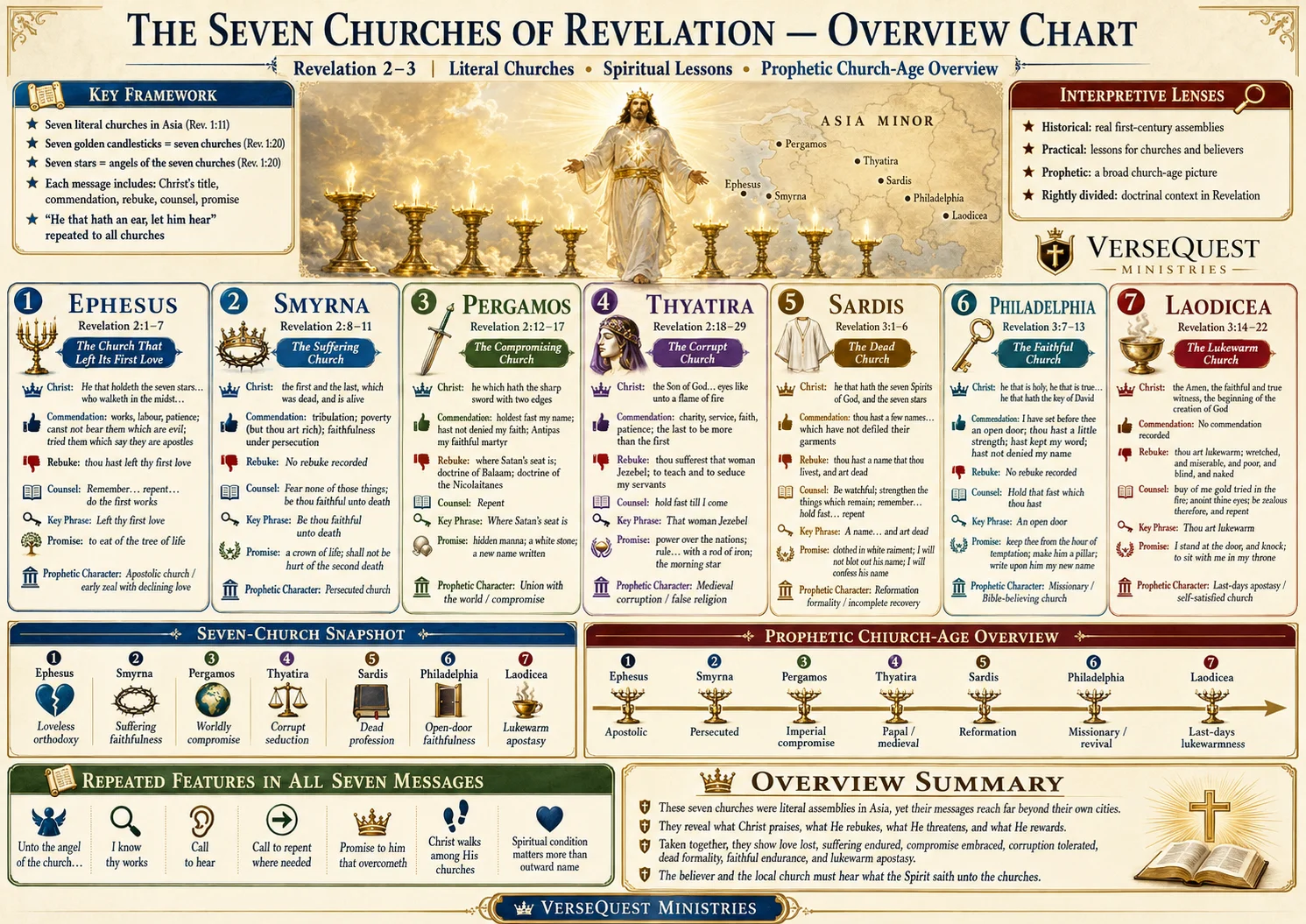
- The Seven Churches of Revelation Chart Collection – Christ Walking Among the Candlesticks
- A premium VerseQuest Ministries™ PDF chart collection covering the Seven Churches of Revelation in Revelation 2–3. Includes one overview chart plus individual KJV Bible study charts for Ephesus, Smyrna, Pergamos,…
- $12.99
- Add to cart
-
-
VerseQuest Premium Library
-
-67%

- The Book of Psalms Made Plain – 383-Page KJV Psalm Study
- The Book of Psalms Made Plain is a 383-page premium KJV Bible study featuring 54 detailed essays through the major themes, doctrines, prophecies, prayers, laments, and praises of the Psalms.…
- Original price was: $29.99.$9.99Current price is: $9.99.
- Add to cart
-
-67%
-
Jesus Christ Studies
-
-67%

- Jesus Christ Prophet Priest and King – 441-Page PDF Study
- A 441-page premium KJV PDF study on Jesus Christ as Prophet, Priest, and King. This detailed VerseQuest book covers Christ’s prophetic ministry to Israel, His finished sacrifice and present intercession…
- Original price was: $29.99.$9.99Current price is: $9.99.
- Add to cart
-
-67%
-
Kingdom Hall
-
-71%

- Jehovah’s Witnesses Made Plain – 574-Page KJV Watchtower Study
- A massive 574-page VerseQuest study exposing the Watchtower system from the King James Bible. This detailed 100-essay book covers the false Christ, false gospel, New World Translation, failed prophecy, 144,000,…
- Original price was: $34.99.$9.99Current price is: $9.99.
- Add to cart
-
-71%